Corporate  WELLNESS P.O. Box 787 Norwell, MA 02061 888-794-7447 www.mertech.org
KEY Questions Could the  stress-related medical costs  for your employees be a problem for your company’s budget and a source of stress for you? Look at what employee health care costs are doing to GM! Would you be interested in a program that will reduce your employee health care costs and absenteeism while improving morale, teamwork and productivity?
Managing  Corporate  HEALTH
The  CASE  for  CHANGE More than 9 of 10 members of senior management see  increasing healthcare costs as a serious business issue   (Sauter, Steven et al. National Institute for Occupational Safety and Health. “Stress…At Work.” Publication No. 99-101).   In this environment  businesses need to find innovative strategies  that sustainably stem the cost of rising healthcare coverage.
Employee   WELL-BEING Is a  Strategic ADVANTAGE  and a  Cornerstone  for  Business SUCCESS .
Job   STRESS Job stress is defined as the  negative physical and emotional responses  that occur when there is a  gap between requirements and expectations of the job and the current capabilities, resources or needs  of the worker .  Job stress has been  demonstrated to lead to poor health, injury and job failure .  Job stress needs to be distinguished from  job-related challenges which energize us psychologically and physically and motivate us to learn new skills and improve our present capabilities.
UNHEALTHY  Job Conditions The Design of Tasks : heavy work loads, infrequent rest breaks, long work hours and shift work; hectic and routine tasks that have little inherent meaning, do no utilize workers’ skills, and provide little sense of control. Management Style : lack of participation by workers in decision-making, poor communication in the organization, lack of family-friendly policies. Interpersonal Relationships : poor social environment and lack of support or help from coworkers and supervisors. Work Roles : conflicting or uncertain job expectations, too much responsibility and too many “hats to wear.” Career Concerns : job insecurity and lack of opportunity for growth, advancement or promotion; rapid changes for which workers are unprepared. Environmental Conditions : unpleasant or dangerous physical conditions such as crowding, noise, air pollution or ergonomic problems.
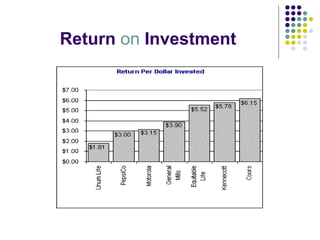
The   ROI  of  Worksite WELLNESS  Programs A review of 32 studies of corporate wellness programs found claims costs were reduced by 27.8%, physician visits declined by 16.5%, hospital admissions declined by 62.5%, disability costs reduced by 34.4%, incidence of injury declined by 24.8%. .  A study reported average annual savings of $8.5 million during 4 years when 18,331 Johnson & Johnson employees participated in a health and wellness program at work. .  A separate study of the same group showed reductions in tobacco use, sedentary lifestyle, high blood pressure, high cholesterol, low dietary fiber intake and poor motor vehicle safety practices. .  Another study showed that employees who utilized an employee fitness center gained both physical and psychological benefits: improved morale (64%), job satisfaction (70%), work productivity (66%), energy level (83%), physical fitness (86%), general health (80%), work/life balance (63%), stress management (76%), stamina/endurance (84%), attentiveness at work (70%), healthy back (74%), keeping high blood pressure in check (62%), managing cholesterol levels (68%), and controlling weight (76%). .  Citibank’s health management program reported an estimated return on investment of $4.56 to $4.73 saved per $1 spent on the program (AJHP, Ozminkowski, Goetzel et al., 1999). .  Over 5 years, Blue Cross Blue Shield of Indiana realized a 250% return on its corporate fitness program investment, yielding a ROI of $2.51 for every $1.00 invested (AJHP, Kenneth R. Pelletier, March/April 1991).
Return  on  Investment
Focus on  WELLNESS
HEALTHY ORGANIZATION Employees  are able to  CREATE   NEW REALITIES for themselves and for the organization
HEALTHY ORGANIZATION Organizational Characteristics  associated with both  healthy, low-stress work and high levels of productivity  include the following: RECOGNITION  of employees for GOOD work PERFORMANCE OPPORTUNITIES  for career development An organizational  CULTURE  that   VALUES the individual worker Management ACTIONS that are CONSISTENT with Organizational  MISSION  and  VALUES
CAPABILITY  is the KEY   In today’s complex world we need to Increase Capability =Ability   To Adapt to change Generate new knowledge Continuously   improve performance
Our  Primary  Wellness Goals  are AWARENESS : Improve Motivation and Passion LEARNING : Improve Creativity and Insight INTER-RELATIONSHIPS : Build  Trust and Effective Teams
ALIGNMENT  is  Critical
Key Objectives  for  Work-site  WELLNESS BUILD   general awareness about job stress  (causes, costs and prevention) SECURE  top management commitment and support  for the program INCORPORATE  employee input and involvement  in all phases of the program ESTABLISH  the technical capabilities  to effectively and efficiently conduct the program (e.g. specialized training for in-house staff or use of consultants)
Creating Opportunities  for   IMPROVEMENT Health Assessment Questionnaires and Programs   aimed at identifying  key factors influencing employee’s stress and/or health issues . Self enrollment by   Means of Learning about these programs  including wellness articles in staff newsletters, word of mouth, organizational training outreach with groups and at meetings ,  and many others . Professional Recommendation by Clinicians to Employees   to consider learning about these resources for more effective living .
Key Components  for  Work-site  WELLNESS Intervention :   specific   Wellness modules   designed to improve individual wellness through facilitated authentic, lasting life improvement . Database system :  tracks  Member-specific information  both qualitative and quantitative  regarding health status  with personalized recommendations based on population segment and utilization. Communication:   provides frequent, ongoing  engagement  with members specifically related to their   Wellness activity .
The  MERTECH WELLNESS  Program Demonstrated a 300%+ return on investment (ROI)   when an  innovative combination  of these components was used to  treat patients that were high consumers of medical resources .   Evidence-based :  Locke SE, Chan PP, et al. Behavioral medicine group intervention for high-utilizing somatisizing patients – Evaluation across 7 unrelated healthcare organizations. Dis Manage Health Outcomes 1999; 6: 387-404.
Innovating Ways to Wellness P.O. Box 787 Norwell, MA 02061 888-794-7447 www.mertech.org

Corporate Wellness 12 12 08

  • 1.
    Corporate WELLNESSP.O. Box 787 Norwell, MA 02061 888-794-7447 www.mertech.org
  • 2.
    KEY Questions Could the stress-related medical costs for your employees be a problem for your company’s budget and a source of stress for you? Look at what employee health care costs are doing to GM! Would you be interested in a program that will reduce your employee health care costs and absenteeism while improving morale, teamwork and productivity?
  • 3.
  • 4.
    The CASE for CHANGE More than 9 of 10 members of senior management see increasing healthcare costs as a serious business issue (Sauter, Steven et al. National Institute for Occupational Safety and Health. “Stress…At Work.” Publication No. 99-101). In this environment businesses need to find innovative strategies that sustainably stem the cost of rising healthcare coverage.
  • 5.
    Employee WELL-BEING Is a Strategic ADVANTAGE and a Cornerstone for Business SUCCESS .
  • 6.
    Job STRESS Job stress is defined as the negative physical and emotional responses that occur when there is a gap between requirements and expectations of the job and the current capabilities, resources or needs of the worker . Job stress has been demonstrated to lead to poor health, injury and job failure . Job stress needs to be distinguished from job-related challenges which energize us psychologically and physically and motivate us to learn new skills and improve our present capabilities.
  • 7.
    UNHEALTHY JobConditions The Design of Tasks : heavy work loads, infrequent rest breaks, long work hours and shift work; hectic and routine tasks that have little inherent meaning, do no utilize workers’ skills, and provide little sense of control. Management Style : lack of participation by workers in decision-making, poor communication in the organization, lack of family-friendly policies. Interpersonal Relationships : poor social environment and lack of support or help from coworkers and supervisors. Work Roles : conflicting or uncertain job expectations, too much responsibility and too many “hats to wear.” Career Concerns : job insecurity and lack of opportunity for growth, advancement or promotion; rapid changes for which workers are unprepared. Environmental Conditions : unpleasant or dangerous physical conditions such as crowding, noise, air pollution or ergonomic problems.
  • 8.
    The ROI of Worksite WELLNESS Programs A review of 32 studies of corporate wellness programs found claims costs were reduced by 27.8%, physician visits declined by 16.5%, hospital admissions declined by 62.5%, disability costs reduced by 34.4%, incidence of injury declined by 24.8%. . A study reported average annual savings of $8.5 million during 4 years when 18,331 Johnson & Johnson employees participated in a health and wellness program at work. . A separate study of the same group showed reductions in tobacco use, sedentary lifestyle, high blood pressure, high cholesterol, low dietary fiber intake and poor motor vehicle safety practices. . Another study showed that employees who utilized an employee fitness center gained both physical and psychological benefits: improved morale (64%), job satisfaction (70%), work productivity (66%), energy level (83%), physical fitness (86%), general health (80%), work/life balance (63%), stress management (76%), stamina/endurance (84%), attentiveness at work (70%), healthy back (74%), keeping high blood pressure in check (62%), managing cholesterol levels (68%), and controlling weight (76%). . Citibank’s health management program reported an estimated return on investment of $4.56 to $4.73 saved per $1 spent on the program (AJHP, Ozminkowski, Goetzel et al., 1999). . Over 5 years, Blue Cross Blue Shield of Indiana realized a 250% return on its corporate fitness program investment, yielding a ROI of $2.51 for every $1.00 invested (AJHP, Kenneth R. Pelletier, March/April 1991).
  • 9.
    Return on Investment
  • 10.
    Focus on WELLNESS
  • 11.
    HEALTHY ORGANIZATION Employees are able to CREATE NEW REALITIES for themselves and for the organization
  • 12.
    HEALTHY ORGANIZATION OrganizationalCharacteristics associated with both healthy, low-stress work and high levels of productivity include the following: RECOGNITION of employees for GOOD work PERFORMANCE OPPORTUNITIES for career development An organizational CULTURE that VALUES the individual worker Management ACTIONS that are CONSISTENT with Organizational MISSION and VALUES
  • 13.
    CAPABILITY isthe KEY In today’s complex world we need to Increase Capability =Ability To Adapt to change Generate new knowledge Continuously improve performance
  • 14.
    Our Primary Wellness Goals are AWARENESS : Improve Motivation and Passion LEARNING : Improve Creativity and Insight INTER-RELATIONSHIPS : Build Trust and Effective Teams
  • 15.
    ALIGNMENT is Critical
  • 16.
    Key Objectives for Work-site WELLNESS BUILD general awareness about job stress (causes, costs and prevention) SECURE top management commitment and support for the program INCORPORATE employee input and involvement in all phases of the program ESTABLISH the technical capabilities to effectively and efficiently conduct the program (e.g. specialized training for in-house staff or use of consultants)
  • 17.
    Creating Opportunities for IMPROVEMENT Health Assessment Questionnaires and Programs aimed at identifying key factors influencing employee’s stress and/or health issues . Self enrollment by Means of Learning about these programs including wellness articles in staff newsletters, word of mouth, organizational training outreach with groups and at meetings , and many others . Professional Recommendation by Clinicians to Employees to consider learning about these resources for more effective living .
  • 18.
    Key Components for Work-site WELLNESS Intervention : specific Wellness modules designed to improve individual wellness through facilitated authentic, lasting life improvement . Database system : tracks Member-specific information both qualitative and quantitative regarding health status with personalized recommendations based on population segment and utilization. Communication: provides frequent, ongoing engagement with members specifically related to their Wellness activity .
  • 19.
    The MERTECHWELLNESS Program Demonstrated a 300%+ return on investment (ROI) when an innovative combination of these components was used to treat patients that were high consumers of medical resources . Evidence-based : Locke SE, Chan PP, et al. Behavioral medicine group intervention for high-utilizing somatisizing patients – Evaluation across 7 unrelated healthcare organizations. Dis Manage Health Outcomes 1999; 6: 387-404.
  • 20.
    Innovating Ways toWellness P.O. Box 787 Norwell, MA 02061 888-794-7447 www.mertech.org