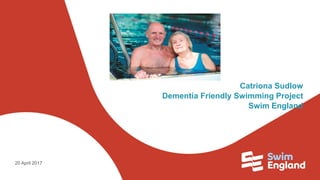
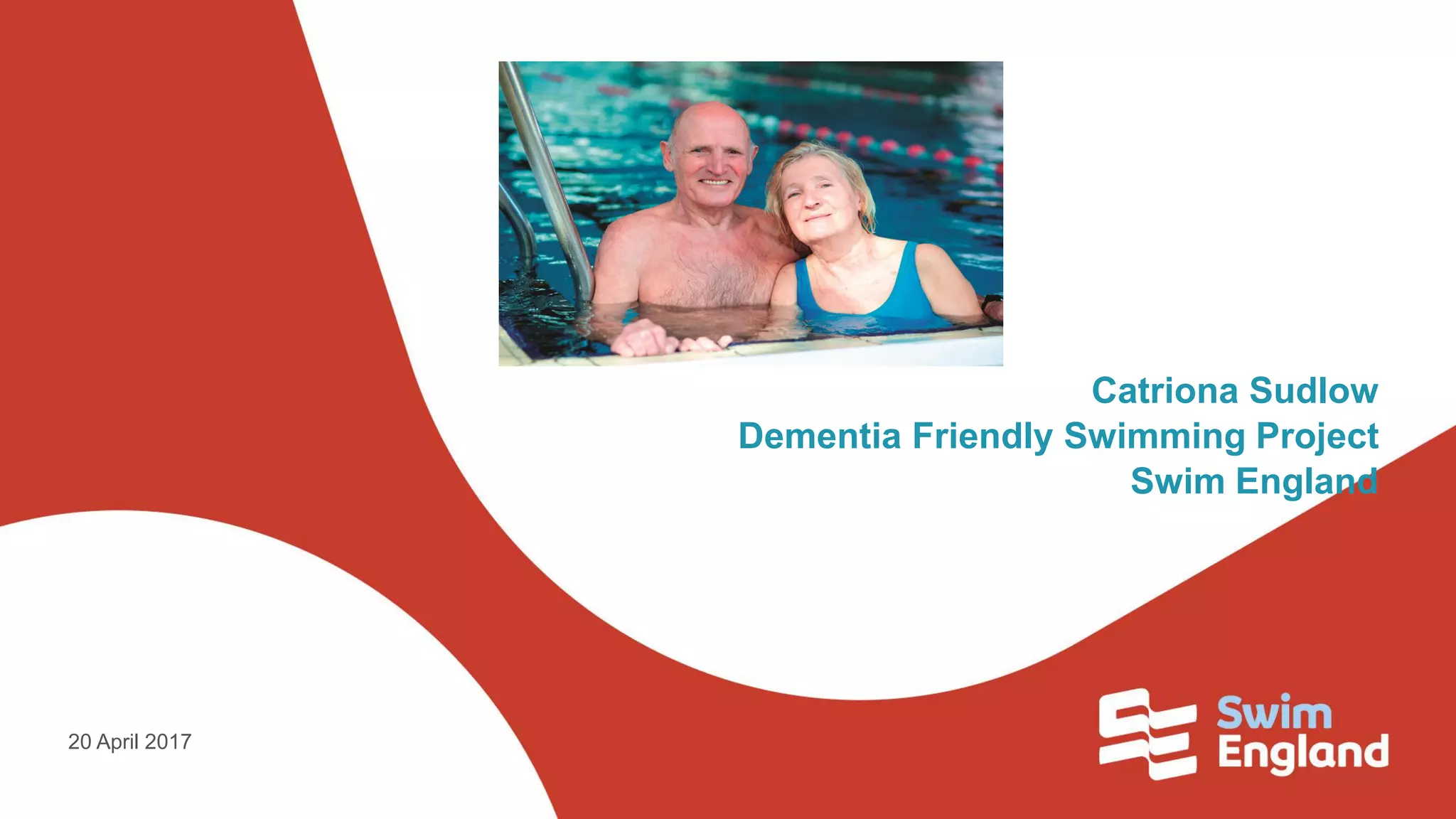
Catriona Sudlow
Dementia Friendly Swimming Project
Swim England
20 April 2017
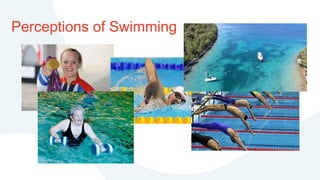
Perceptions of Swimming
Challenging perceptions and having an
impact
• Value of swimming
• Is swimming seen as an activity of choice by people living with dementia?
• Improved insight into motivations, barriers and perceptions
• Building partnerships between leisure, health and social care sectors
• Promoting a culture change
• Working together to enhance community support for people affected by
dementia
• Creating a network of dementia friendly pools
• Enhancing the swimming experience for people affected by dementia
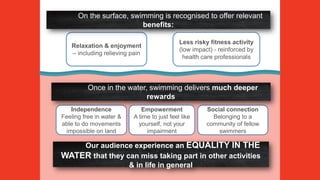
Independence
Feeling free in water &
able to do movements
impossible on land
Social connection
Belonging to a
community of fellow
swimmers
Once in the water, swimming delivers much deeper
rewards
Our audience experience an EQUALITY IN THE
WATER that they can miss taking part in other activities
& in life in general
Empowerment
A time to just feel like
yourself, not your
impairment
Relaxation & enjoyment
– including relieving pain
On the surface, swimming is recognised to offer relevant
benefits:
Less risky fitness activity
(low impact) - reinforced by
health care professionals
Collaborative approach
• Promoted a culture change
• New work area – increased awareness and appetite to deliver more specific
activities
• Catalyst to building new partnerships between previously non-
traditional partners
• Health, social care, leisure, housing, transport….
• Helped raise profile of role swimming/physical activity can play in the lives of
people living with dementia
• Customer led
• Its exploratory and evolutionary rather than prescribed
Risk v Choice
• Swimming not a natural choice of activity for people with dementia
• Linked to perception and a tendency to look at the risks involved
• Use insight collected through customer led approach to:
• Help reduce the risk associated with swimming/pool environment
• Enable swimming to remain a choice of activity for people living with dementia
• Potential risks/barriers to participation
• Lack of support in centre/staff awareness of dementia
• Water
• Inability to swim/ uncertainty of swimming ability
• Changing environment
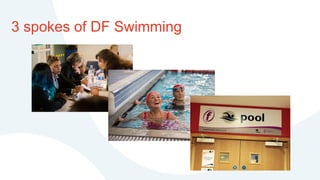
3 spokes of DF Swimming
Increasing dementia awareness
• First step – upskill the workforce in dementia awareness across
leisure facilities
• Understanding Dementia in the Leisure Environment
• 557 leisure staff trained
• Contributing towards Prime Minister Challenge
• 185 Dementia Friends created
• Currently 45 pools delivering DFS sessions across England and
working with a further 104 pools
Accessible, safe and supported provision
• Traditional vs non-traditional
• Customer led
• Market research with services supporting people living with dementia
• Feedback from participants
• Barriers
• Transport
• Availability of support to attend
• Water and swimming confidence – perception
• Motivations
• Relaxation
• Family time/Social time
Creating a Dementia Friendly Environment
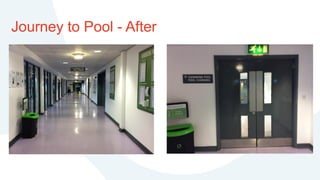
• Innovation – Small changes = big impact
• Common issues
• Navigation – signage
• Noise
• Unhelpful lighting – glare on pools and wet surfaces
• Fear of slipping
• Number of accessible changing areas
• Poor use of colour and contrast
• Lack of personalisation
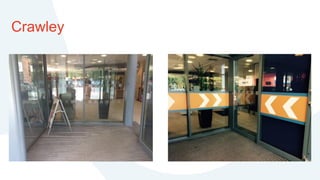
Crawley
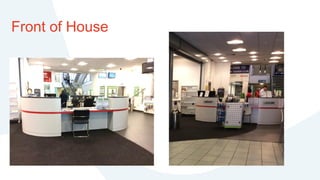
Front of House
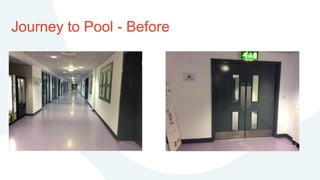
Journey to Pool - Before
Journey to Pool - After
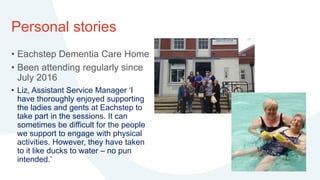
Personal stories
• Eachstep Dementia Care Home
• Been attending regularly since
July 2016
• Liz, Assistant Service Manager ‘I
have thoroughly enjoyed supporting
the ladies and gents at Eachstep to
take part in the sessions. It can
sometimes be difficult for the people
we support to engage with physical
activities. However, they have taken
to it like ducks to water – no pun
intended.’
‘You see such a change in people when they get into the pool. It’s lovely.
Everyone benefits, some swimmers have very stiff joints but they relax
straight away in the water. Others have difficulty sleeping, but after a
session in the pool have no trouble. And, some people we work with have
high levels of anxiety, but once in the water completely change.’
‘When we first heard of the project we didn’t think it would be
possible to bring a small group, we’re regular swimmers
ourselves and when we were at the pool saw someone using
the hoist and how accessible it was. The pool staff are excellent
and will always help. From car to pool can be done without any
walking and there’s a hoist, komode and plinth bed in the
changing room.’
Carer
Story from
Bristol
Feedback
‘The best thing about the
dementia programme is it
makes me fitter and
happier. It boosts my self
esteem.’
• ‘I’ve seen an improvement in my general health
and control of other health issues.’
‘It gets me out and I meet people. I also
used to swim every Wednesday at school
so it brings back fond memories.’
Swimming is a very positive activity from my
perspective. I see the improvement in mood and
mobility it provides to my supported men. I would like
to acknowledge and commend the staff at East
Manchester LC. We have always found them to be
supportive, kind and welcoming. Their attitude and
help has made the sessions all the more enjoyable
and relaxing.
‘Swimming was a new outlet for my
illnesses. I sometimes got fed up with
life but my new interests got me out of
the doldrums. My self worth has
improved and my confidence has
improved. It’s just a simple swim but it
has changed my life. So give it a go –
it’s great fun! Thank you and go for it!
Catriona Sudlow

Catriona Sudlow

  • 1.
    Catriona Sudlow Dementia FriendlySwimming Project Swim England 20 April 2017
  • 2.
  • 3.
    Challenging perceptions andhaving an impact • Value of swimming • Is swimming seen as an activity of choice by people living with dementia? • Improved insight into motivations, barriers and perceptions • Building partnerships between leisure, health and social care sectors • Promoting a culture change • Working together to enhance community support for people affected by dementia • Creating a network of dementia friendly pools • Enhancing the swimming experience for people affected by dementia
  • 4.
    Independence Feeling free inwater & able to do movements impossible on land Social connection Belonging to a community of fellow swimmers Once in the water, swimming delivers much deeper rewards Our audience experience an EQUALITY IN THE WATER that they can miss taking part in other activities & in life in general Empowerment A time to just feel like yourself, not your impairment Relaxation & enjoyment – including relieving pain On the surface, swimming is recognised to offer relevant benefits: Less risky fitness activity (low impact) - reinforced by health care professionals
  • 5.
    Collaborative approach • Promoteda culture change • New work area – increased awareness and appetite to deliver more specific activities • Catalyst to building new partnerships between previously non- traditional partners • Health, social care, leisure, housing, transport…. • Helped raise profile of role swimming/physical activity can play in the lives of people living with dementia • Customer led • Its exploratory and evolutionary rather than prescribed
  • 6.
    Risk v Choice •Swimming not a natural choice of activity for people with dementia • Linked to perception and a tendency to look at the risks involved • Use insight collected through customer led approach to: • Help reduce the risk associated with swimming/pool environment • Enable swimming to remain a choice of activity for people living with dementia • Potential risks/barriers to participation • Lack of support in centre/staff awareness of dementia • Water • Inability to swim/ uncertainty of swimming ability • Changing environment
  • 7.
    3 spokes ofDF Swimming
  • 8.
    Increasing dementia awareness •First step – upskill the workforce in dementia awareness across leisure facilities • Understanding Dementia in the Leisure Environment • 557 leisure staff trained • Contributing towards Prime Minister Challenge • 185 Dementia Friends created • Currently 45 pools delivering DFS sessions across England and working with a further 104 pools
  • 9.
    Accessible, safe andsupported provision • Traditional vs non-traditional • Customer led • Market research with services supporting people living with dementia • Feedback from participants • Barriers • Transport • Availability of support to attend • Water and swimming confidence – perception • Motivations • Relaxation • Family time/Social time
  • 10.
    Creating a DementiaFriendly Environment • Innovation – Small changes = big impact • Common issues • Navigation – signage • Noise • Unhelpful lighting – glare on pools and wet surfaces • Fear of slipping • Number of accessible changing areas • Poor use of colour and contrast • Lack of personalisation
  • 11.
  • 12.
  • 13.
  • 14.
  • 15.
    Personal stories • EachstepDementia Care Home • Been attending regularly since July 2016 • Liz, Assistant Service Manager ‘I have thoroughly enjoyed supporting the ladies and gents at Eachstep to take part in the sessions. It can sometimes be difficult for the people we support to engage with physical activities. However, they have taken to it like ducks to water – no pun intended.’
  • 16.
    ‘You see sucha change in people when they get into the pool. It’s lovely. Everyone benefits, some swimmers have very stiff joints but they relax straight away in the water. Others have difficulty sleeping, but after a session in the pool have no trouble. And, some people we work with have high levels of anxiety, but once in the water completely change.’ ‘When we first heard of the project we didn’t think it would be possible to bring a small group, we’re regular swimmers ourselves and when we were at the pool saw someone using the hoist and how accessible it was. The pool staff are excellent and will always help. From car to pool can be done without any walking and there’s a hoist, komode and plinth bed in the changing room.’ Carer Story from Bristol
  • 17.
    Feedback ‘The best thingabout the dementia programme is it makes me fitter and happier. It boosts my self esteem.’ • ‘I’ve seen an improvement in my general health and control of other health issues.’ ‘It gets me out and I meet people. I also used to swim every Wednesday at school so it brings back fond memories.’ Swimming is a very positive activity from my perspective. I see the improvement in mood and mobility it provides to my supported men. I would like to acknowledge and commend the staff at East Manchester LC. We have always found them to be supportive, kind and welcoming. Their attitude and help has made the sessions all the more enjoyable and relaxing. ‘Swimming was a new outlet for my illnesses. I sometimes got fed up with life but my new interests got me out of the doldrums. My self worth has improved and my confidence has improved. It’s just a simple swim but it has changed my life. So give it a go – it’s great fun! Thank you and go for it!