Rod Clark PET Chief Executive
Open Forum Prison Reform Conference
Bridgewater Hall Manchester 27 June 2017
www.prisonerseducation.org.uk
http://twitter.com/PrisonersEd
E-mail: info@prisonerseducation.org.uk
25+ years of experience
Prisoners supported on over 35,000
occasions: distance learning courses
NVQ to degree
& advice
Arts and hobby materials
Policy
Influence
Research
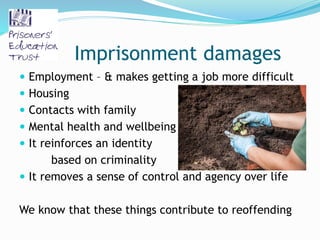
Imprisonment damages
 Employment – & makes getting a job more difficult
 Housing
 Contacts with family
 Mental health and wellbeing
 It reinforces an identity
based on criminality
 It removes a sense of control and agency over life
We know that these things contribute to reoffending
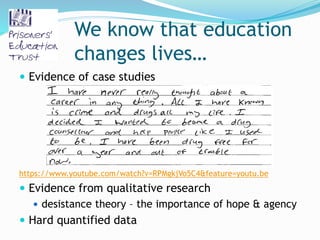
We know that education
changes lives…
 Evidence of case studies
https://www.youtube.com/watch?v=RPMgkjVo5C4&feature=youtu.be
 Evidence from qualitative research
 desistance theory – the importance of hope & agency
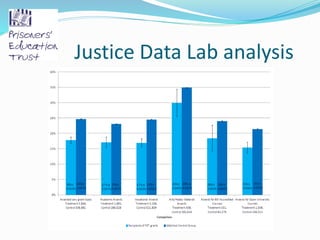
 Hard quantified data
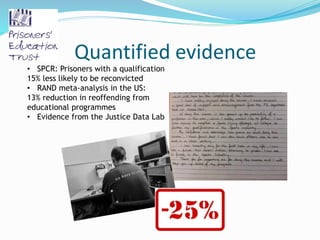
Quantified evidence
• SPCR: Prisoners with a qualification
15% less likely to be reconvicted
• RAND meta-analysis in the US:
13% reduction in reoffending from
educational programmes
• Evidence from the Justice Data Lab
Justice Data Lab analysis
We have good ideas why
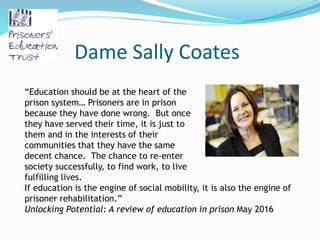
Dame Sally Coates
“Education should be at the heart of the
prison system… Prisoners are in prison
because they have done wrong. But once
they have served their time, it is just to
them and in the interests of their
communities that they have the same
decent chance. The chance to re-enter
society successfully, to find work, to live
fulfilling lives.
If education is the engine of social mobility, it is also the engine of
prisoner rehabilitation.”
Unlocking Potential: A review of education in prison May 2016
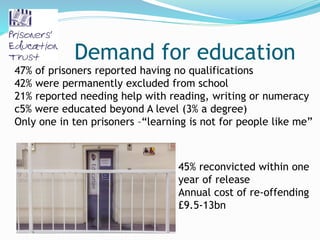
Demand for education
45% reconvicted within one
year of release
Annual cost of re-offending
£9.5-13bn
47% of prisoners reported having no qualifications
42% were permanently excluded from school
21% reported needing help with reading, writing or numeracy
c5% were educated beyond A level (3% a degree)
Only one in ten prisoners –“learning is not for people like me”
How?
 Aspiration – Government, prisons, individuals
 Learning that engages:
 Learning that meets prisoner aspirations
 Learning in contexts and ways that prisoners want
 ‘Nudge’ thinking – trusted messengers, socialising
 Learner voice and agency
Risks and opportunities
 Progress on implementing Coates recommendations:
 Greater clarity of rehabilitative purpose
 Governor and whole prison
 New flexibility: engagement, progression, enablers
 Moves towards greater use of ICT
BUT
 Fragility of regimes in
many prisons
 Political leadership?

Rod Clark

  • 1.
    Rod Clark PETChief Executive Open Forum Prison Reform Conference Bridgewater Hall Manchester 27 June 2017 www.prisonerseducation.org.uk http://twitter.com/PrisonersEd E-mail: info@prisonerseducation.org.uk
  • 2.
    25+ years ofexperience Prisoners supported on over 35,000 occasions: distance learning courses NVQ to degree & advice Arts and hobby materials Policy Influence Research
  • 3.
    Imprisonment damages  Employment– & makes getting a job more difficult  Housing  Contacts with family  Mental health and wellbeing  It reinforces an identity based on criminality  It removes a sense of control and agency over life We know that these things contribute to reoffending
  • 4.
    We know thateducation changes lives…  Evidence of case studies https://www.youtube.com/watch?v=RPMgkjVo5C4&feature=youtu.be  Evidence from qualitative research  desistance theory – the importance of hope & agency  Hard quantified data
  • 5.
    Quantified evidence • SPCR:Prisoners with a qualification 15% less likely to be reconvicted • RAND meta-analysis in the US: 13% reduction in reoffending from educational programmes • Evidence from the Justice Data Lab
  • 6.
  • 7.
    We have goodideas why
  • 8.
    Dame Sally Coates “Educationshould be at the heart of the prison system… Prisoners are in prison because they have done wrong. But once they have served their time, it is just to them and in the interests of their communities that they have the same decent chance. The chance to re-enter society successfully, to find work, to live fulfilling lives. If education is the engine of social mobility, it is also the engine of prisoner rehabilitation.” Unlocking Potential: A review of education in prison May 2016
  • 9.
    Demand for education 45%reconvicted within one year of release Annual cost of re-offending £9.5-13bn 47% of prisoners reported having no qualifications 42% were permanently excluded from school 21% reported needing help with reading, writing or numeracy c5% were educated beyond A level (3% a degree) Only one in ten prisoners –“learning is not for people like me”
  • 10.
    How?  Aspiration –Government, prisons, individuals  Learning that engages:  Learning that meets prisoner aspirations  Learning in contexts and ways that prisoners want  ‘Nudge’ thinking – trusted messengers, socialising  Learner voice and agency
  • 11.
    Risks and opportunities Progress on implementing Coates recommendations:  Greater clarity of rehabilitative purpose  Governor and whole prison  New flexibility: engagement, progression, enablers  Moves towards greater use of ICT BUT  Fragility of regimes in many prisons  Political leadership?