Innocludence   in Intercultural Dialogue   EFQUEL Innovation Forum 2010 Openning Innovation: Inclusion, Inovation, Excellence OEIRAS, Lisbon, 10th of September, 2010
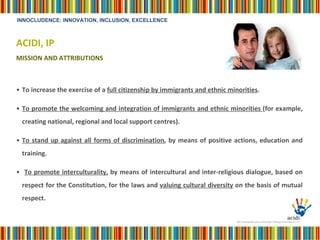
ACIDI, IP MISSION AND ATTRIBUTIONS To increase the exercise of a  full citizenship by immigrants and ethnic minorities .  To promote the welcoming and integration of immigrants and ethnic minorities  (for example, creating national, regional and local support centres). To stand up against all forms of discrimination , by means of positive actions, education and training. To promote interculturality,  by means of intercultural and inter-religious dialogue, based on respect for the Constitution, for the laws and  valuing cultural diversity  on the basis of mutual respect.
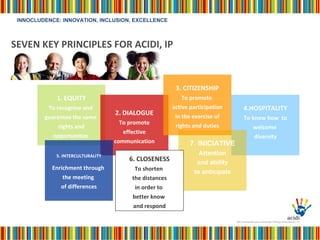
SEVEN KEY PRINCIPLES FOR ACIDI, IP 1. EQUITY To recognise and  guarantee the same  rights and opportunities  2. DIALOGUE To promote effective communication 4.HOSPITALITY To know how  to welcome  diversity 5. INTERCULTURALITY Enrichment through  the meeting  of differences 7. INICIATIVE Attention and ability  to anticipate 6. CLOSENESS To shorten  the distances in order to  better know  and respond 3. CITIZENSHIP To promote  active participation in the exercise of rights and duties
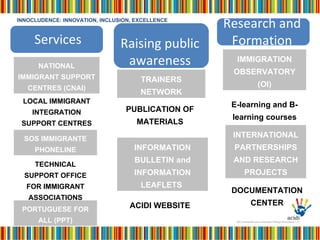
NATIONAL IMMIGRANT SUPPORT CENTRES (CNAI) LOCAL IMMIGRANT INTEGRATION SUPPORT CENTRES SOS IMMIGRANTE PHONELINE TECHNICAL SUPPORT OFFICE FOR IMMIGRANT ASSOCIATIONS PORTUGUESE FOR ALL (PPT) TRAINERS NETWORK PUBLICATION OF MATERIALS ACIDI WEBSITE INFORMATION BULLETIN and INFORMATION LEAFLETS  IMMIGRATION OBSERVATORY (OI) E-learning and B-learning courses INTERNATIONAL PARTNERSHIPS AND RESEARCH PROJECTS DOCUMENTATION CENTER Research and Formation Services Research Raising public awareness Services
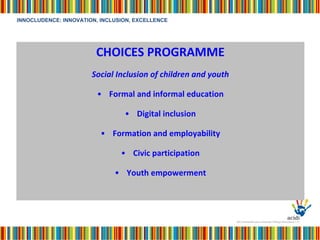
CHOICES PROGRAMME Social Inclusion of children and youth Formal and informal education Digital inclusion Formation and employability Civic participation Youth empowerment
Let’s question ourselves...
The 10 top in-demand jobs did not exist in 2004. Are we preparing our children for the future jobs?
One week of the New York Times contains more information then it could possibly ever be obtained in the XVIII Century during an entire lifetime How can we manage all this information?
The volume of information produced in 2010 will be greater than in the last 5000 years. Who has access to all this information?  Who doesn’t?
90%  of the teenagers in the world have a portable electronic game, a cellular phone or a computer.  What about those that don’t? Who are they? What will their future be like?
200 million migrants. This would represent the 5th largest country in the world.
70% of teachers in Portugal consider it necessary to have new strategies developed specifically for the children of immigrants. How can schools manage diversity and promote inclusion at the same time?
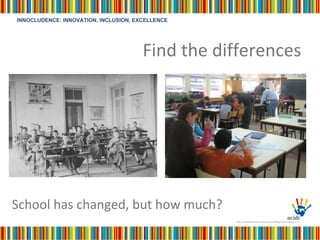
Find the differences School has changed, but how much?
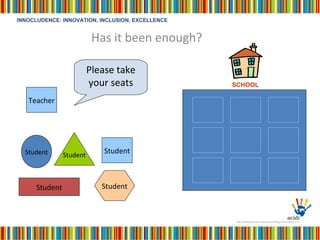
Has it been enough? Student Student Student Student Student SCHOOL Teacher Please take your seats
A NEW EDUCATIONAL PARADIGM IS NECESSARY «The school’s current role is to be able to  recognise the differences in the students  (…) and to find  strategies  for adjustment and development that  respect  and  include all . This is true  democracy .»  Cunha, P. D’Orey, 1992
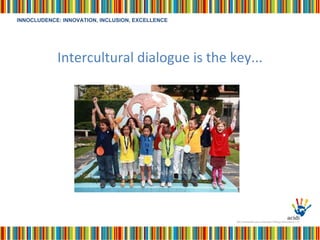
Intercultural dialogue is the key...
The utopia of dialogue “ If the anti-utopias of the 20th century inscribed themselves in the communication area, it is also in the domain of communication that the great utopian projects, capable of triggering transformation in the relationships among people, must be rooted. That is why the utopian space can be, one the one hand, the interior space of the individual, and on the other hand, the space of communication among people…   Therefore, we must search for the new utopias not in places, but in the  relations  and  communications among people .” (J.M. André, 2005)
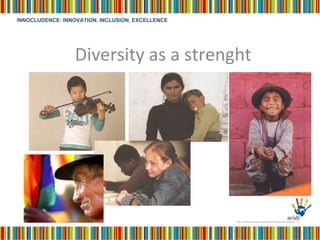
Diversity as a strenght
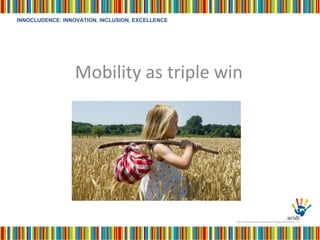
Mobility as triple win
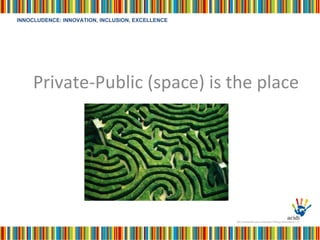
Private-Public (space) is the place
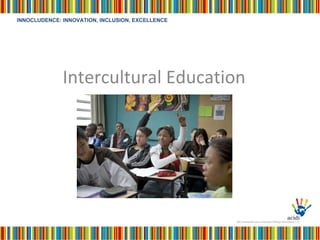
Intercultural Education
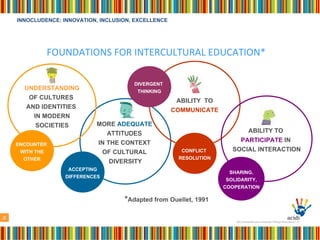
FOUNDATIONS FOR INTERCULTURAL EDUCATION*  * Adapted from Ouellet, 1991 MORE  ADEQUATE  ATTITUDES  IN THE CONTEXT  OF CULTURAL  DIVERSITY ABILITY  TO COMMUNICATE ABILITY TO  PARTICIPATE  IN  SOCIAL INTERACTION ACCEPTING DIFFERENCES CONFLICT  RESOLUTION SHARING, SOLIDARITY, COOPERATION UNDERSTANDING OF CULTURES  AND IDENTITIES  IN MODERN SOCIETIES DIVERGENT  THINKING ENCOUNTER  WITH THE OTHER
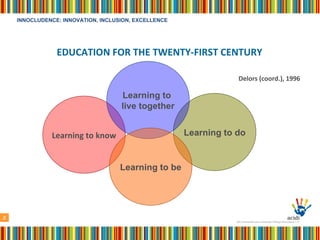
EDUCATION FOR THE TWENTY-FIRST CENTURY Delors (coord.), 1996 Learning to know Learning to do Learning to  live together Learning to be
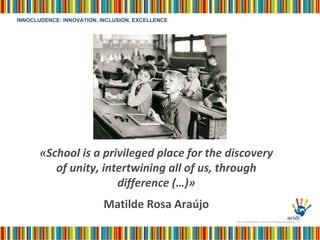
«School is a privileged place for the discovery of unity, intertwining all of us, through difference (…)» Matilde Rosa Araújo
To learn is to make meaning of one’s own experience... Before helping someone to read the  word , help him to read the  world. Nobody teaches anything to anyone; people  learn and  build their own knowledge from each other . Paulo Freire, 1972
Thank you!

Innocludence in Intercultural Dialogue

  • 1.
    Innocludence in Intercultural Dialogue EFQUEL Innovation Forum 2010 Openning Innovation: Inclusion, Inovation, Excellence OEIRAS, Lisbon, 10th of September, 2010
  • 2.
    ACIDI, IP MISSIONAND ATTRIBUTIONS To increase the exercise of a full citizenship by immigrants and ethnic minorities . To promote the welcoming and integration of immigrants and ethnic minorities (for example, creating national, regional and local support centres). To stand up against all forms of discrimination , by means of positive actions, education and training. To promote interculturality, by means of intercultural and inter-religious dialogue, based on respect for the Constitution, for the laws and valuing cultural diversity on the basis of mutual respect.
  • 3.
    SEVEN KEY PRINCIPLESFOR ACIDI, IP 1. EQUITY To recognise and guarantee the same rights and opportunities 2. DIALOGUE To promote effective communication 4.HOSPITALITY To know how to welcome diversity 5. INTERCULTURALITY Enrichment through the meeting of differences 7. INICIATIVE Attention and ability to anticipate 6. CLOSENESS To shorten the distances in order to better know and respond 3. CITIZENSHIP To promote active participation in the exercise of rights and duties
  • 4.
    NATIONAL IMMIGRANT SUPPORTCENTRES (CNAI) LOCAL IMMIGRANT INTEGRATION SUPPORT CENTRES SOS IMMIGRANTE PHONELINE TECHNICAL SUPPORT OFFICE FOR IMMIGRANT ASSOCIATIONS PORTUGUESE FOR ALL (PPT) TRAINERS NETWORK PUBLICATION OF MATERIALS ACIDI WEBSITE INFORMATION BULLETIN and INFORMATION LEAFLETS IMMIGRATION OBSERVATORY (OI) E-learning and B-learning courses INTERNATIONAL PARTNERSHIPS AND RESEARCH PROJECTS DOCUMENTATION CENTER Research and Formation Services Research Raising public awareness Services
  • 5.
    CHOICES PROGRAMME SocialInclusion of children and youth Formal and informal education Digital inclusion Formation and employability Civic participation Youth empowerment
  • 6.
  • 7.
    The 10 topin-demand jobs did not exist in 2004. Are we preparing our children for the future jobs?
  • 8.
    One week ofthe New York Times contains more information then it could possibly ever be obtained in the XVIII Century during an entire lifetime How can we manage all this information?
  • 9.
    The volume ofinformation produced in 2010 will be greater than in the last 5000 years. Who has access to all this information? Who doesn’t?
  • 10.
    90% ofthe teenagers in the world have a portable electronic game, a cellular phone or a computer. What about those that don’t? Who are they? What will their future be like?
  • 11.
    200 million migrants.This would represent the 5th largest country in the world.
  • 12.
    70% of teachersin Portugal consider it necessary to have new strategies developed specifically for the children of immigrants. How can schools manage diversity and promote inclusion at the same time?
  • 13.
    Find the differencesSchool has changed, but how much?
  • 14.
    Has it beenenough? Student Student Student Student Student SCHOOL Teacher Please take your seats
  • 15.
    A NEW EDUCATIONALPARADIGM IS NECESSARY «The school’s current role is to be able to recognise the differences in the students (…) and to find strategies for adjustment and development that respect and include all . This is true democracy .» Cunha, P. D’Orey, 1992
  • 16.
  • 17.
    The utopia ofdialogue “ If the anti-utopias of the 20th century inscribed themselves in the communication area, it is also in the domain of communication that the great utopian projects, capable of triggering transformation in the relationships among people, must be rooted. That is why the utopian space can be, one the one hand, the interior space of the individual, and on the other hand, the space of communication among people… Therefore, we must search for the new utopias not in places, but in the relations and communications among people .” (J.M. André, 2005)
  • 18.
  • 19.
  • 20.
  • 21.
  • 22.
    FOUNDATIONS FOR INTERCULTURALEDUCATION* * Adapted from Ouellet, 1991 MORE ADEQUATE ATTITUDES IN THE CONTEXT OF CULTURAL DIVERSITY ABILITY TO COMMUNICATE ABILITY TO PARTICIPATE IN SOCIAL INTERACTION ACCEPTING DIFFERENCES CONFLICT RESOLUTION SHARING, SOLIDARITY, COOPERATION UNDERSTANDING OF CULTURES AND IDENTITIES IN MODERN SOCIETIES DIVERGENT THINKING ENCOUNTER WITH THE OTHER
  • 23.
    EDUCATION FOR THETWENTY-FIRST CENTURY Delors (coord.), 1996 Learning to know Learning to do Learning to live together Learning to be
  • 24.
    «School is aprivileged place for the discovery of unity, intertwining all of us, through difference (…)» Matilde Rosa Araújo
  • 25.
    To learn isto make meaning of one’s own experience... Before helping someone to read the word , help him to read the world. Nobody teaches anything to anyone; people learn and build their own knowledge from each other . Paulo Freire, 1972
  • 26.

Editor's Notes

  • #3 Todas as atribuições do ACIDI, conforme constam no Decreto-Lei nº167/2007 de 03 de Maio: a) Promover o acolhimento e a integração dos imigrantes e das minorias étnicas através da participação na concepção, desenvolvimento e coordenação de políticas públicas transversais, integradas e coerentes, b) Incentivar a participação cívica e cultural dos imigrantes e das minorias étnicas nas instituições portuguesas, bem como através das suas associações representativas para um exercício pleno da sua cidadania, c) Garantir o acesso dos cidadãos imigrantes e minorias étnicas a informação relevante sobre direitos e deveres de cidadania, d) Combater todas as formas de discriminação em função da raça, cor, nacionalidade, origem étnica ou religião, através de acções positivas de sensibilização, educação e formação, bem como através do processamento das contra-ordenações previstas na lei, e) Promover a interculturalidade, através do diálogo intercultural e inter-religioso, com base no respeito pela CRP, pelas leis e valorizando a diversidade cultural num quadro de respeito mútuo, f) Dinamizar centros de apoio ao imigrante, de âmbito nacional, regional e local, que proporcionemuma resposta integrada dos vários serviços públicas às suas necessidades de acolhimento e integração, designadamente, através de parcerias com departamentos governamentais com intervenção no sector, serviços da Admin. Pública, autarquias, ONG's, associações de imigrantes ou outras entidades com interesse relevante na matéria, g) Contribuir para a melhoria das condições de vida e de trabalho dos imigrantes, de modo a que lhes seja proporcionada uma integração com dignidade, em igualdade de oportunidades com todos os cidadãos nacionais, O Alto Comissariado para a Imigração e Diálogo Intercultural, I. P., abreviadamente designado por ACIDI, I. P., é um instituto público integrado na administração indirecta do Estado, dotado de autonomia administrativa. O ACIDI, I. P., prossegue atribuições da Presidência do Conselho de Ministros, sob superintendência e tutela do Primeiro-Ministro ou de outro membro do Governo integrado na Presidência do Conselho de Ministros. Tem como missão colaborar na concepção, execução e avaliação das políticas públicas, transversais e sectoriais, relevantes para a integração dos imigrantes e das minorias étnicas, bem como promover o diálogo entre as diversas culturas, etnias e religiões. A missão específica do ACIDI encontra-se consagrada no Decreto-Lei nº 167/2007 de 3 de Maio.
  • #4   Os Sete Princípios-chave do ACIDI : 1 - IGUALDADE - reconhecer e garantir os mesmos direitos e oportunidades; 2 - DIÁLOGO - promover uma comunicação efectiva; 3 -  CIDADANIA - promover a participação activa no exercício dos direitos e dos deveres; 4 - HOSPITALIDADE - saber acolher a diversidade; 5 - INTERCULTURALIDADE - enriquecer no encontro das diferenças; 6 - PROXIMIDADE - encurtar as distâncias para conhecer e responder melhor; 7 - INICIATIVA - atenção e capacidade de antecipação.
  • #13 Joana Lopes Martins - Estudo “Estado, Escola e Diversidade”
  • #14 1ª imagem - sala de aula de escola do início do Século XX; 2ª imagem – sala de aula da Escola da Ponte (em Vila das Aves) - mais informação em: http://www.escoladaponte.com.pt/html2/portug/bemvindo.htm
  • #18 We found very reassuring the words of Touraine and Frederico Mayor in two of the essays of the KEYS TO THE 21st CENTURY Conferences. We have always to bear in mind that the words are not the things…are intellectual constructs which try to make reality more intelligible. The pragmatic dimensions, attention to reality and to people, are essential conditions for success
  • #22 Cartaz do filme “A turma”, de Laurent Cantent
  • #23 Quando falamos de educação intercultural, estamos a referi-nos a uma perspectiva dinâmica e a um conjunto de dimensões, transversais a toda a educação / intervenção. no fundo, trata-se de uma mudança de paradigma.
  • #24 Segundo a UNESCO (Delors (coord.), 1996), a educação actual deve ser sustentada em quatro pilares basilares: Aprender a conhecer – fomentando a aquisição dos instrumentos da compreensão; Aprender a fazer – promovendo o saber agir no contexto em que se insere; Aprender a viver juntos – valorizando a participação e cooperação com os outros face a esse mesmo contexto; Aprender a ser – via essencial que engloba as anteriores, e que fomenta a capacidade de autonomia e de discernimento, reforçando a responsabilidade pessoal no sentido da realização de um destino colectivo.
  • #25 Fotografia de Robert Doisneau (1914-1994)