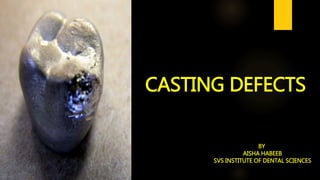
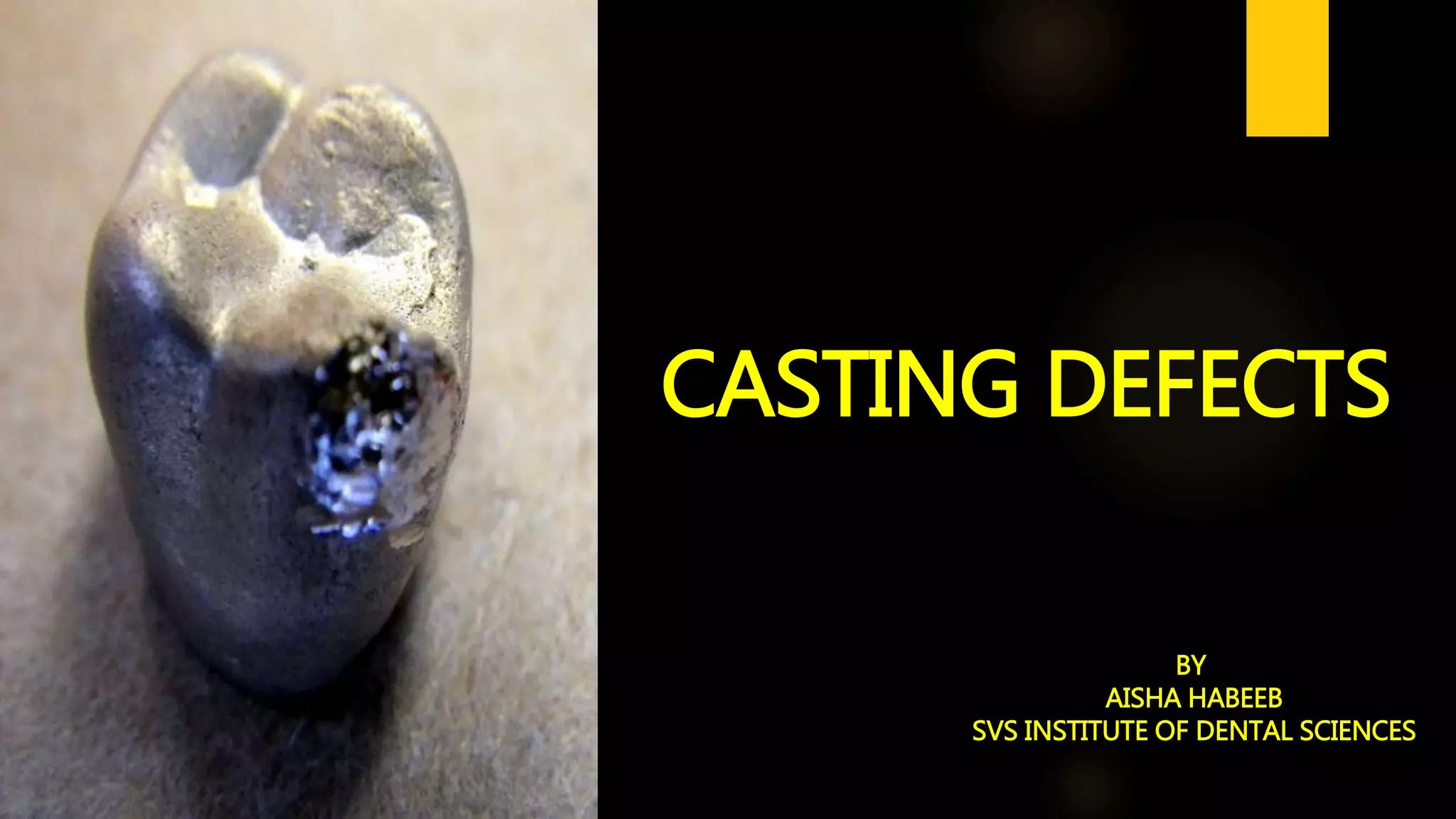
CASTING DEFECTS
BY
AISHA HABEEB
SVS INSTITUTE OF DENTAL SCIENCES
Introduction
Classification of defect in casting/common
causes of casting defects
Dimensional Inaccuracies or Dimensional errors in
casting
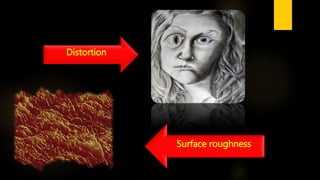
Distortion
Surface roughness
Contents
Surface irregularities
Nodules
Fins
Ridges/Veins on casting surface
Discolored castings
Pits (inclusion porosity)
Incomplete casting
Porosity
Conclusion
unsuccessful castings
defects in castings
Lost wax technique
Classification of defect in casting/common causes of
casting defects.
According to Rosenstiel
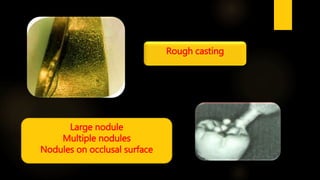
Rough casting
Large nodule
Multiple nodules
Nodules on occlusal surface
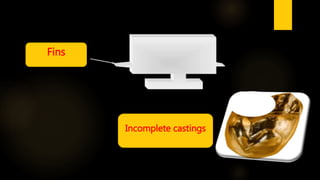
Fins
Incomplete castings
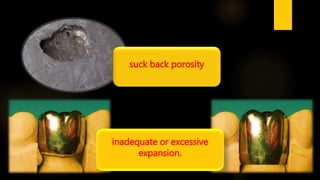
suck back porosity
inadequate or excessive
expansion.
According to O’Brien
General
problems
Problems with
internal porosity
Problems with
external porosity
accuracy
distortion
bubbles
fins
short rounded margins
miscasting's
pits
localize shrinkage porosity
subsurface porosity
micro porosity
back pressure porosity
According to Anusavice
Distortion
Surface roughness
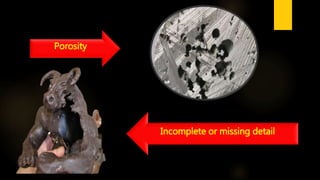
Porosity
Incomplete or missing detail
Dimensional Inaccuracies or
Dimensional errors in casting
The final fit of a casting depends on a balancing out
of contraction and expansion which occurs during
its construction.
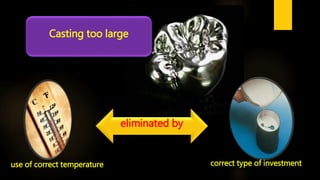
Casting too large
eliminated by
correct type of investmentuse of correct temperature
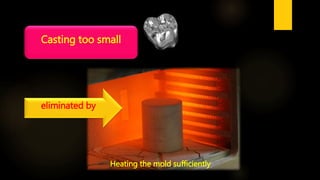
Casting too small
eliminated by
Heating the mold sufficiently
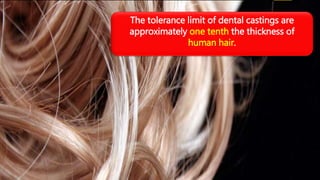
The tolerance limit of dental castings are
approximately one tenth the thickness of
human hair.
Control of Dimensional accuracy
Use mixing water of correct temperature (usually mouth
temperature)
use constant water powder ratio
For hygroscopic expansion immerse the investment
before it reaches initial set
control time and temperature
cast into the heated mould while it is still at the correct
temperature.
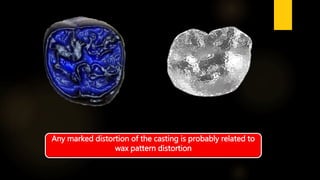
Any marked distortion of the casting is probably related to
wax pattern distortion
Unquestionably some distortion of the wax pattern
occurs as the investment hardens around it
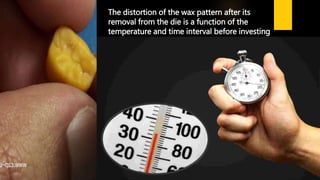
The distortion of the wax pattern after its
removal from the die is a function of the
temperature and time interval before investing
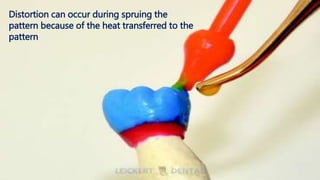
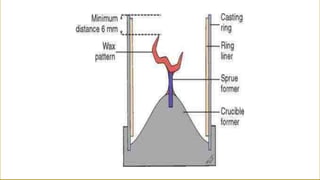
Distortion can occur during spruing the
pattern because of the heat transferred to the
pattern
Pattern should be removed carefully from the die,
and should be invested immediately.
Surface roughness
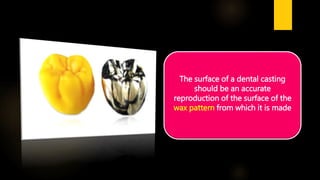
The surface of a dental casting
should be an accurate
reproduction of the surface of the
wax pattern from which it is made
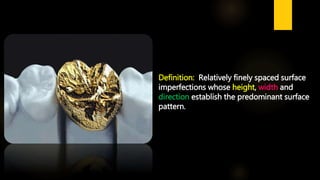
Definition: Relatively finely spaced surface
imperfections whose height, width and
direction establish the predominant surface
pattern.
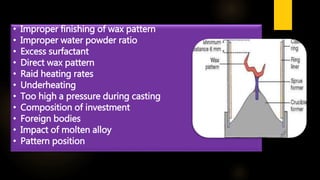
• Improper finishing of wax pattern
• Improper water powder ratio
• Excess surfactant
• Direct wax pattern
• Raid heating rates
• Underheating
• Too high a pressure during casting
• Composition of investment
• Foreign bodies
• Impact of molten alloy
• Pattern position
Control of surface roughness
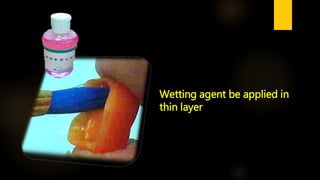
Wetting agent be applied in
thin layer
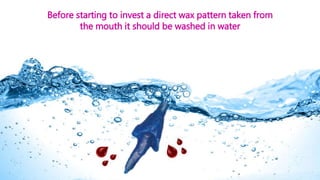
Before starting to invest a direct wax pattern taken from
the mouth it should be washed in water
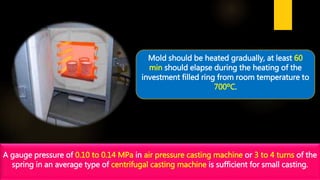
Mold should be heated gradually, at least 60
min should elapse during the heating of the
investment filled ring from room temperature to
700ºC.
A gauge pressure of 0.10 to 0.14 MPa in air pressure casting machine or 3 to 4 turns of the
spring in an average type of centrifugal casting machine is sufficient for small casting.
Surface irregularities
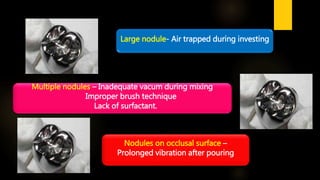
Bubbles of gases trapped between the wax
pattern and the investment produce nodules
on the casting surface.
Large nodule- Air trapped during investing
Multiple nodules – Inadequate vacum during mixing
Improper brush technique
Lack of surfactant.
Nodules on occlusal surface –
Prolonged vibration after pouring
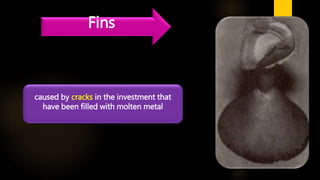
Fins
caused by cracks in the investment that
have been filled with molten metal
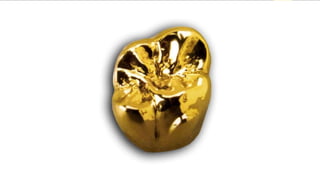
Discolored castings
With calcium sulphate bonded
investments-color of the casting in
black after removal from the
investment
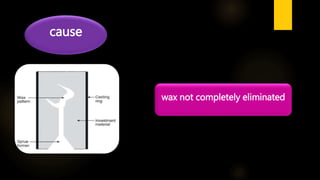
cause
wax not completely eliminated
Mold remains in the oven too
long
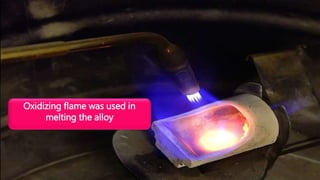
Oxidizing flame was used in
melting the alloy
The investment did not contain deoxidizing
agents.
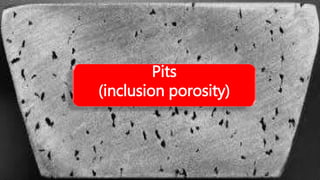
Pits
(inclusion porosity)
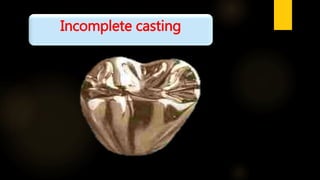
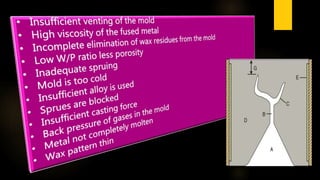
Incomplete casting
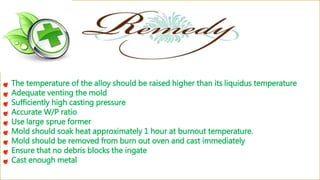
The temperature of the alloy should be raised higher than its liquidus temperature
Adequate venting the mold
Sufficiently high casting pressure
Accurate W/P ratio
Use large sprue former
Mold should soak heat approximately 1 hour at burnout temperature.
Mold should be removed from burn out oven and cast immediately
Ensure that no debris blocks the ingate
Cast enough metal
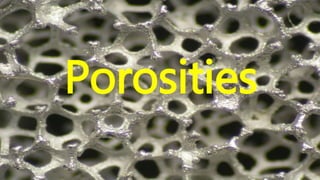
Porosities
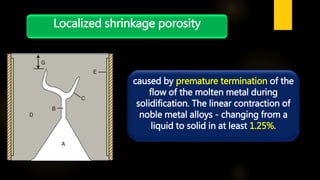
Localized shrinkage porosity
caused by premature termination of the
flow of the molten metal during
solidification. The linear contraction of
noble metal alloys - changing from a
liquid to solid in at least 1.25%.
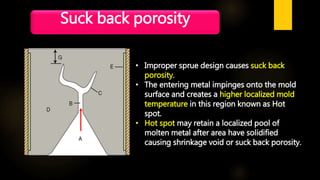
• Improper sprue design causes suck back
porosity.
• The entering metal impinges onto the mold
surface and creates a higher localized mold
temperature in this region known as Hot
spot.
• Hot spot may retain a localized pool of
molten metal after area have solidified
causing shrinkage void or suck back porosity.
Suck back porosity
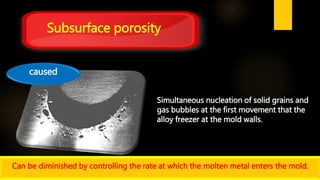
Simultaneous nucleation of solid grains and
gas bubbles at the first movement that the
alloy freezer at the mold walls.
Subsurface porosity
caused
Can be diminished by controlling the rate at which the molten metal enters the mold.
Back pressure porosity
Since back pressure porosity occurs more generally in full crown type
castings, insertion of a wax rod into the core of the investment when
investing the pattern will provide a good means of venting the hot gases
quickly
Use of reservoir
The instance from the top of the
pattern to the outside of the
investment is kept to ¼ inch.
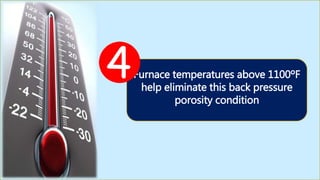
Furnace temperatures above 1100ºF
help eliminate this back pressure
porosity condition
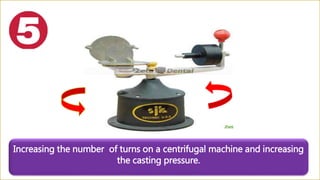
Increasing the number of turns on a centrifugal machine and increasing
the casting pressure.
Performing the casting operation in
a vacuum.
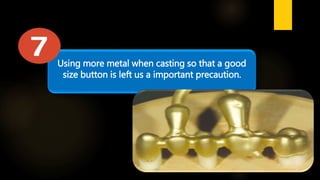
Using more metal when casting so that a good
size button is left us a important precaution.
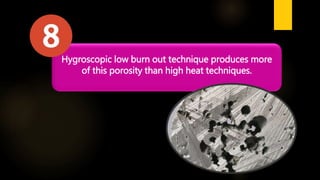
Hygroscopic low burn out technique produces more
of this porosity than high heat techniques.
CONCLUSION
Thus, these are the various causes for the failure of the
castings and methods by which these defects can be
avoided, thereby producing a casting of good quality
for clinical success.
REFERENCES
Operative Dentistry Modern theory and practice-Marzouk
Dental materials – Philiphs – Anusavice
Full mouth rehabilitation – Kornfield
Restorative Dental materials – Craig
Fixed prosthodontics – Rosenstiel
Fundamentals of fixed prosthodontics – Schillinburg.
Australian Dental Journal 1991 36 (5): 391-6
1992 37(1) 93-54
1991 36(4): 302-9
1992 37 (2): 91-7
Notes on Dental Materials – E.C. Coombe
British Dental Journal 1972: 428-435.
CASTING DEFECTS

CASTING DEFECTS