Building awesome applications with Apache 
Cassandra 
Christopher Batey 
@chbatey 
©2013 DataStax Confidential. Do not distribute without consent. 
1
Who am I? 
•Technical Evangelist for Apache Cassandra 
• Founder of Stubbed Cassandra 
• Help out Apache Cassandra users 
• Previous: Cassandra backed apps at BSkyB 
@chbatey
@chbatey 
Overview 
• Topics covered 
• Cassandra overview 
• Customer events example 
• DataStax Java Driver 
• Java Mapping API 
• Other features 
• Light weight transactions 
• Load balancing 
• Reconnection policies
@chbatey 
Overview 
• Topics covered 
• Cassandra overview 
• Customer events example 
• DataStax Java Driver 
• Java Mapping API 
• Other features 
• Light weight transactions 
• Load balancing 
• Reconnection policies 
• Not covered 
• Cassandra read and write paths 
• Cassandra failure nodes
Common use cases 
•Ordered data such as time series 
•Event stores 
•Financial transactions 
•Sensor data e.g IoT 
@chbatey
Common use cases 
•Ordered data such as time series 
•Event stores 
•Financial transactions 
•Sensor data e.g IoT 
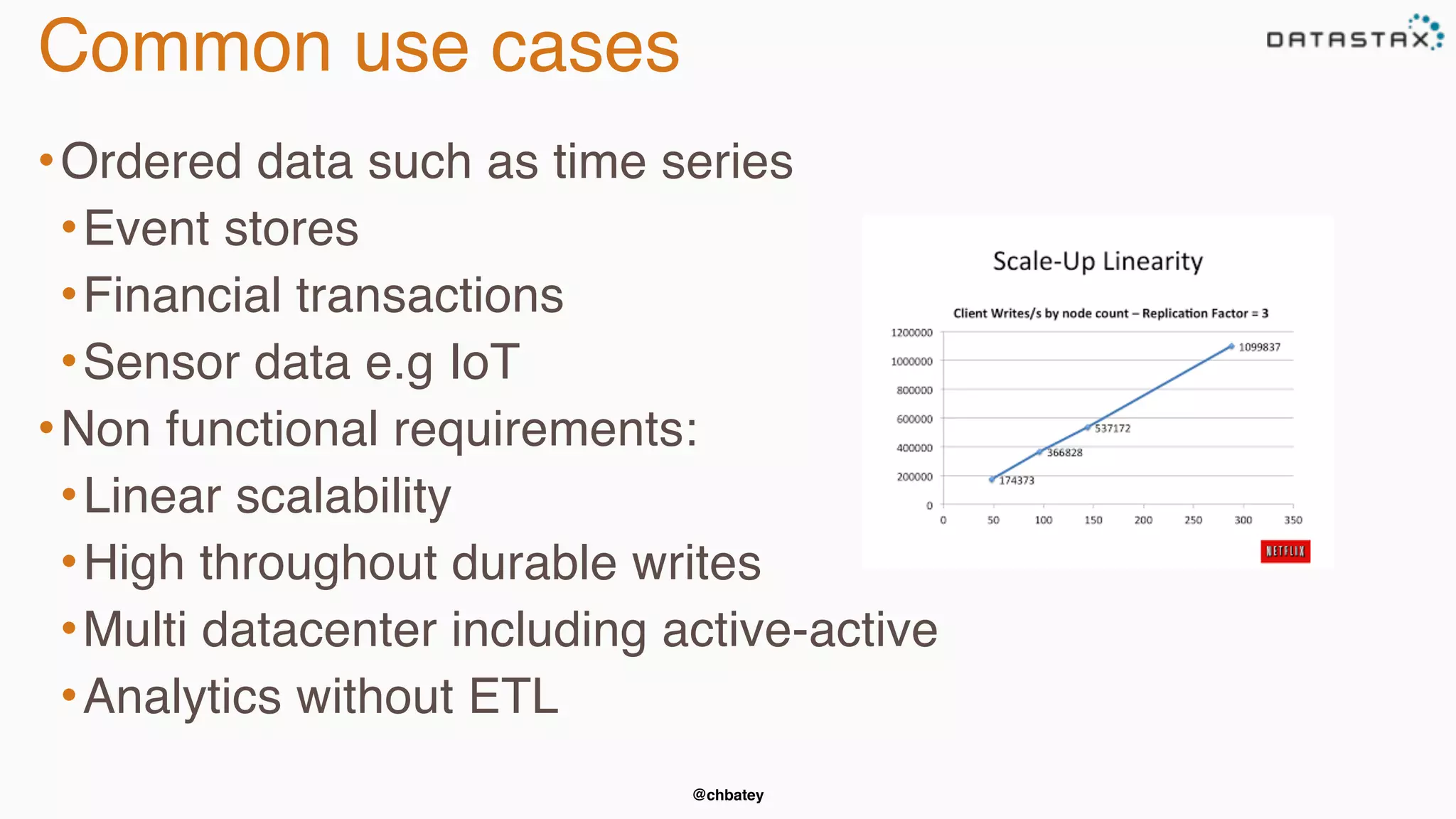
•Non functional requirements: 
• Linear scalability 
• High throughout durable writes 
•Multi datacenter including active-active 
•Analytics without ETL 
@chbatey
Cassandra overview 
@chbatey
Cassandra 
Cassandra 
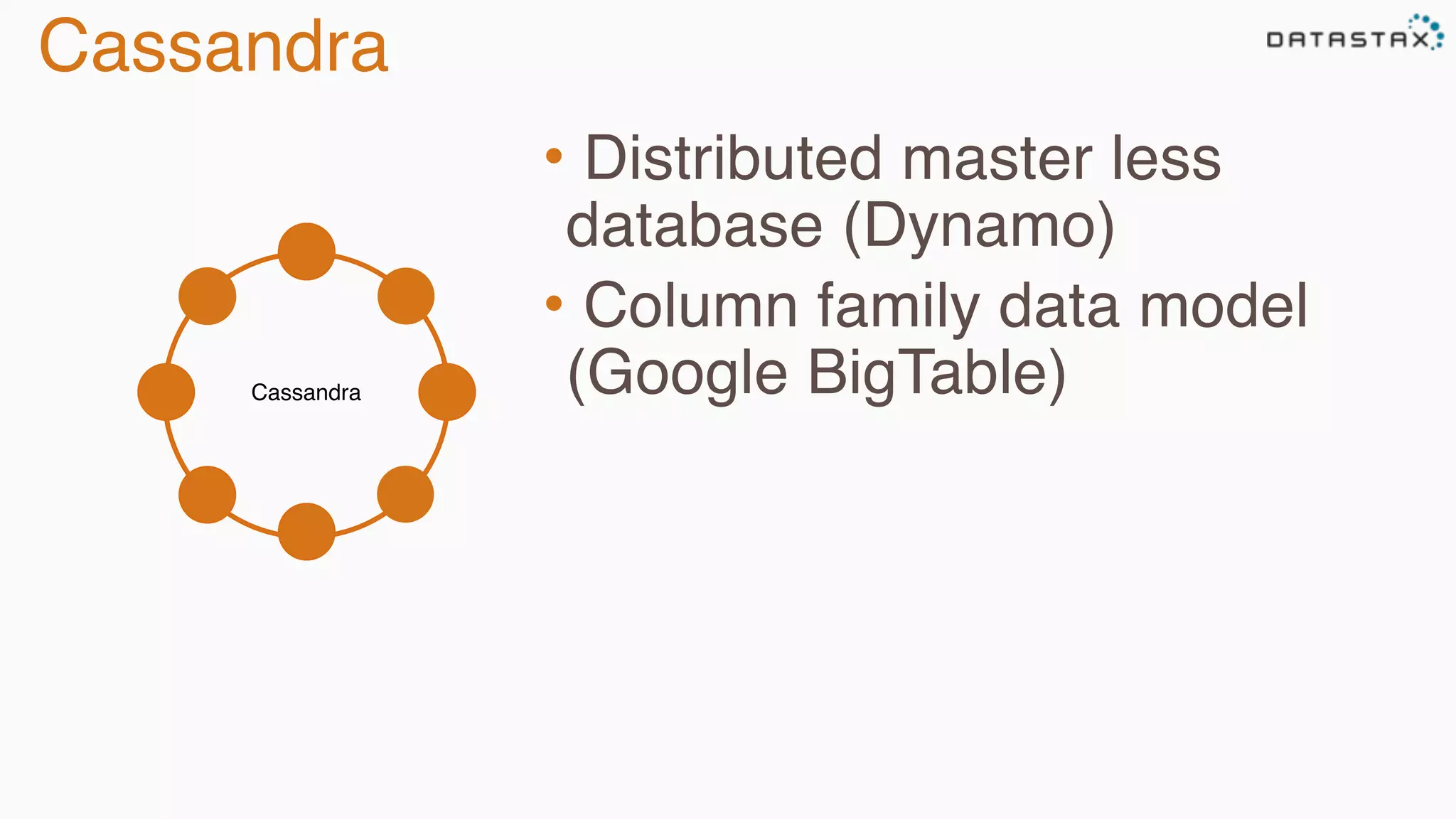
• Distributed master less 
database (Dynamo) 
• Column family data model 
(Google BigTable)
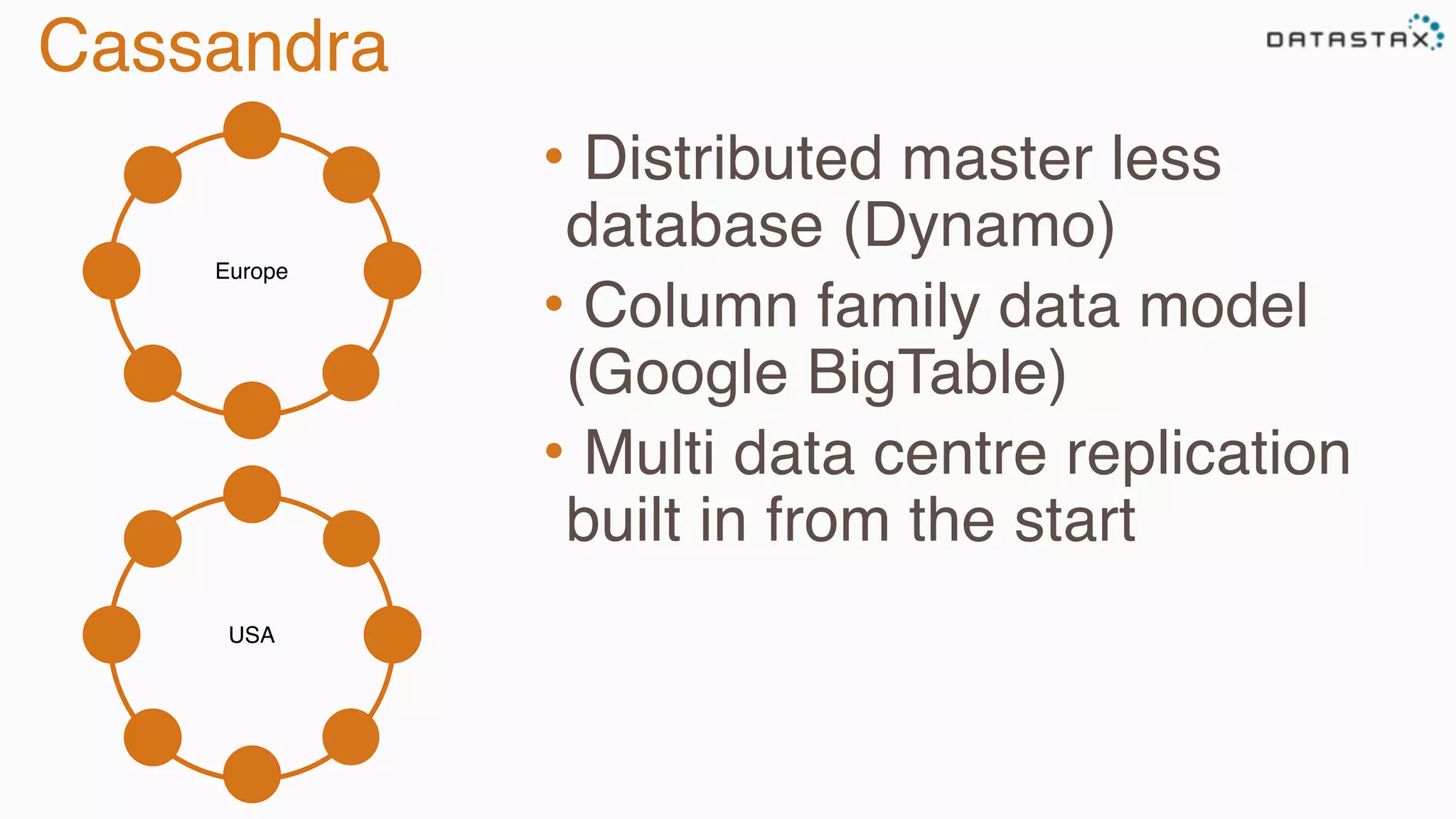
Cassandra 
Europe 
• Distributed master less 
database (Dynamo) 
• Column family data model 
(Google BigTable) 
• Multi data centre replication 
built in from the start 
USA
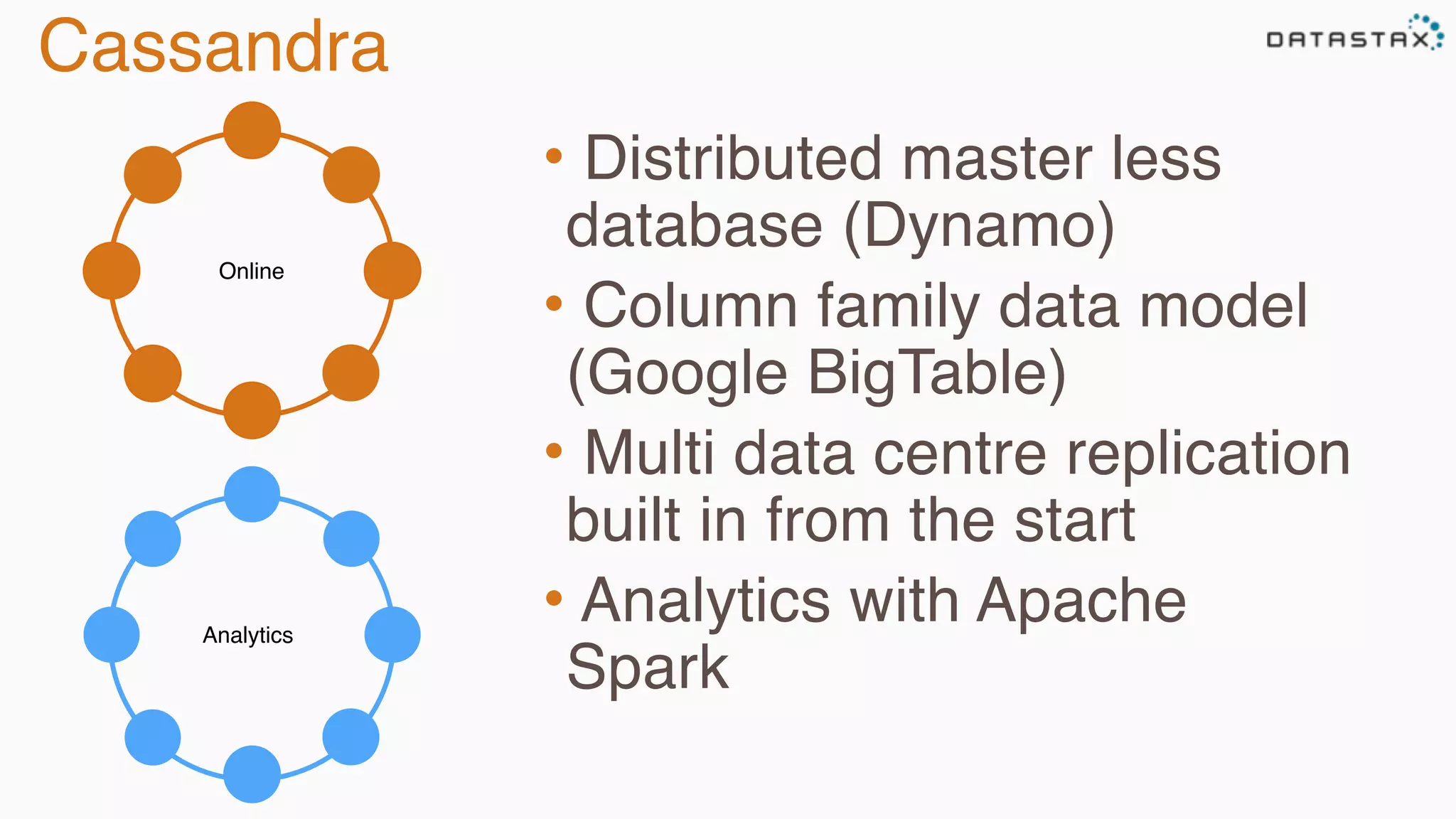
Cassandra 
Online 
• Distributed master less 
database (Dynamo) 
• Column family data model 
(Google BigTable) 
• Multi data centre replication 
built in from the start 
• Analytics with Apache 
Spark 
Analytics
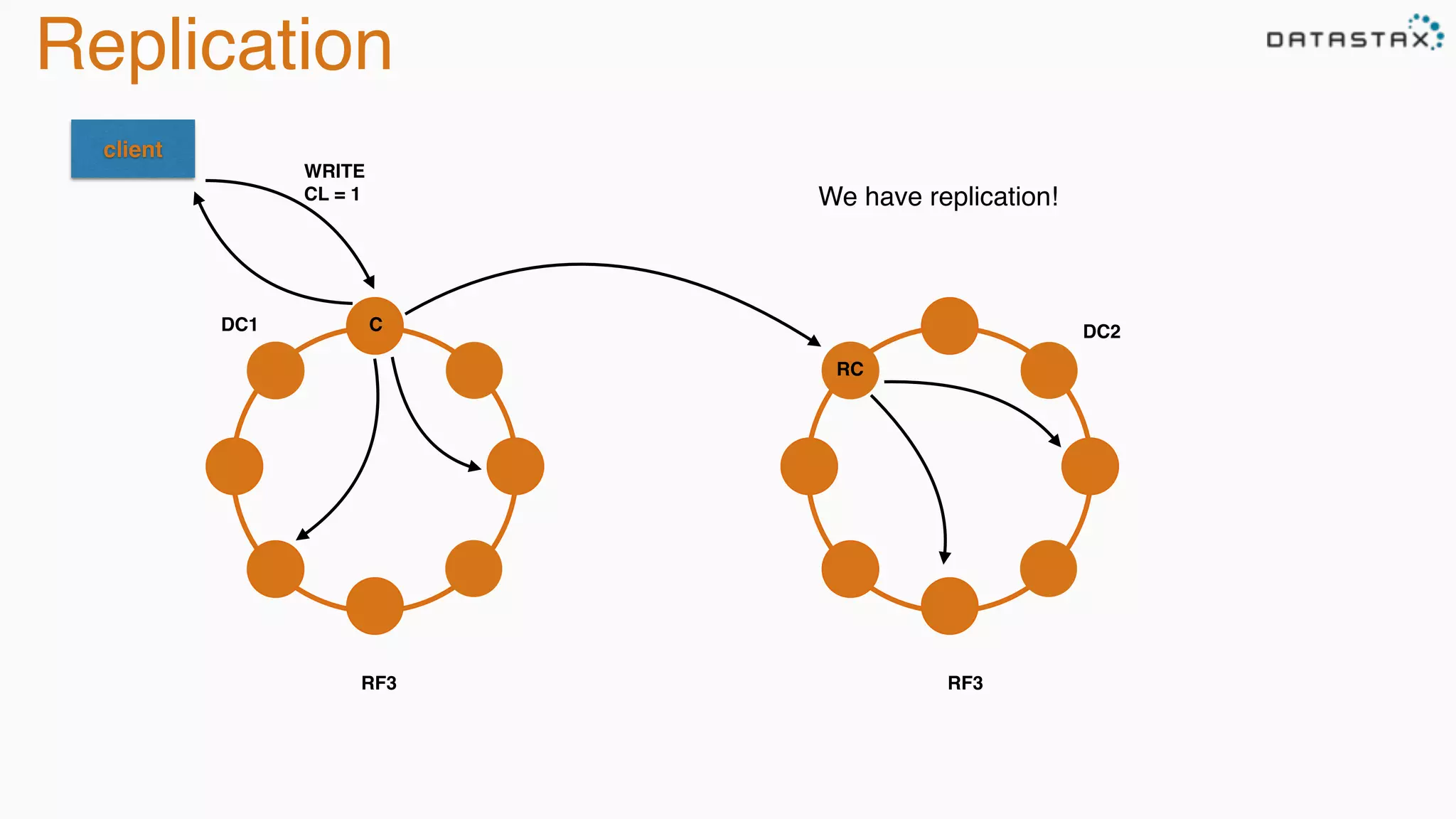
Replication 
WRITE 
CL = 1 We have replication! 
DC1 DC2 
client 
C 
RC 
RF3 RF3
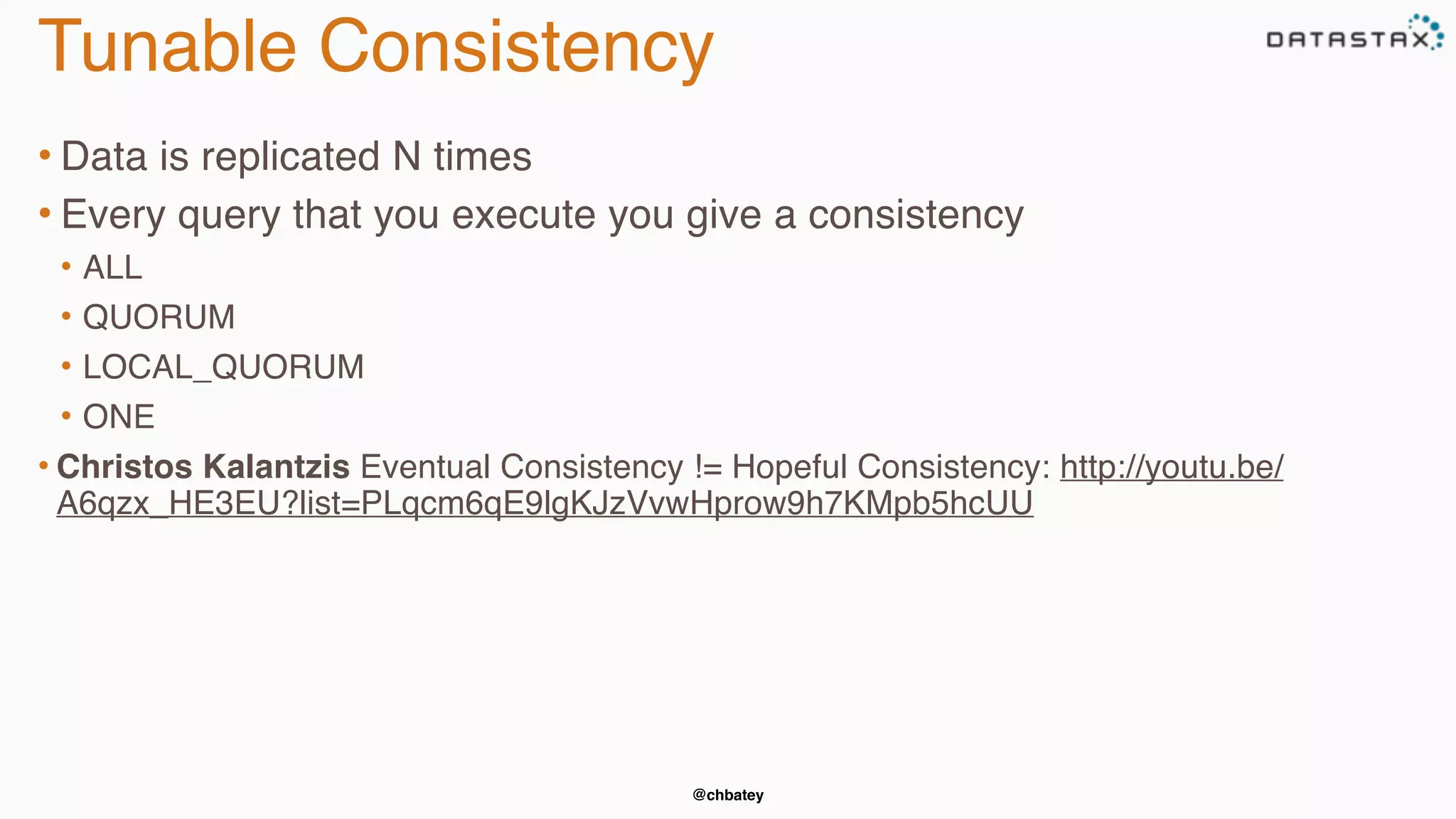
Tunable Consistency 
• Data is replicated N times 
• Every query that you execute you give a consistency 
• ALL 
• QUORUM 
• LOCAL_QUORUM 
• ONE 
• Christos Kalantzis Eventual Consistency != Hopeful Consistency: http://youtu.be/ 
A6qzx_HE3EU?list=PLqcm6qE9lgKJzVvwHprow9h7KMpb5hcUU 
@chbatey
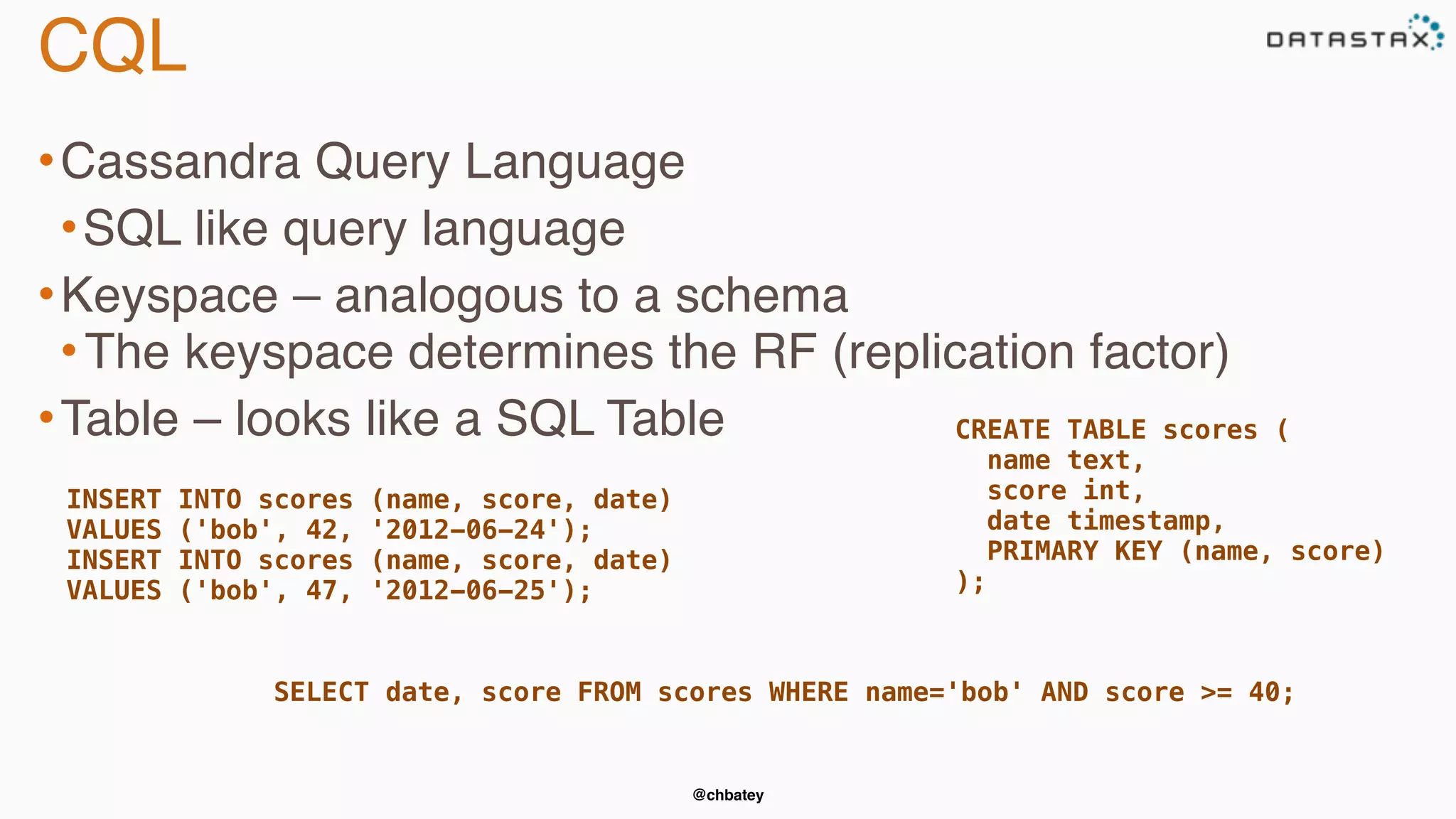
CQL 
•Cassandra Query Language 
•SQL like query language 
•Keyspace – analogous to a schema 
• The keyspace determines the RF (replication factor) 
•Table – looks like a SQL Table CREATE TABLE scores ( 
@chbatey 
name text, 
score int, 
date timestamp, 
PRIMARY KEY (name, score) 
); 
INSERT INTO scores (name, score, date) 
VALUES ('bob', 42, '2012-06-24'); 
INSERT INTO scores (name, score, date) 
VALUES ('bob', 47, '2012-06-25'); 
SELECT date, score FROM scores WHERE name='bob' AND score >= 40;
Example Time: Customer event store 
@chbatey
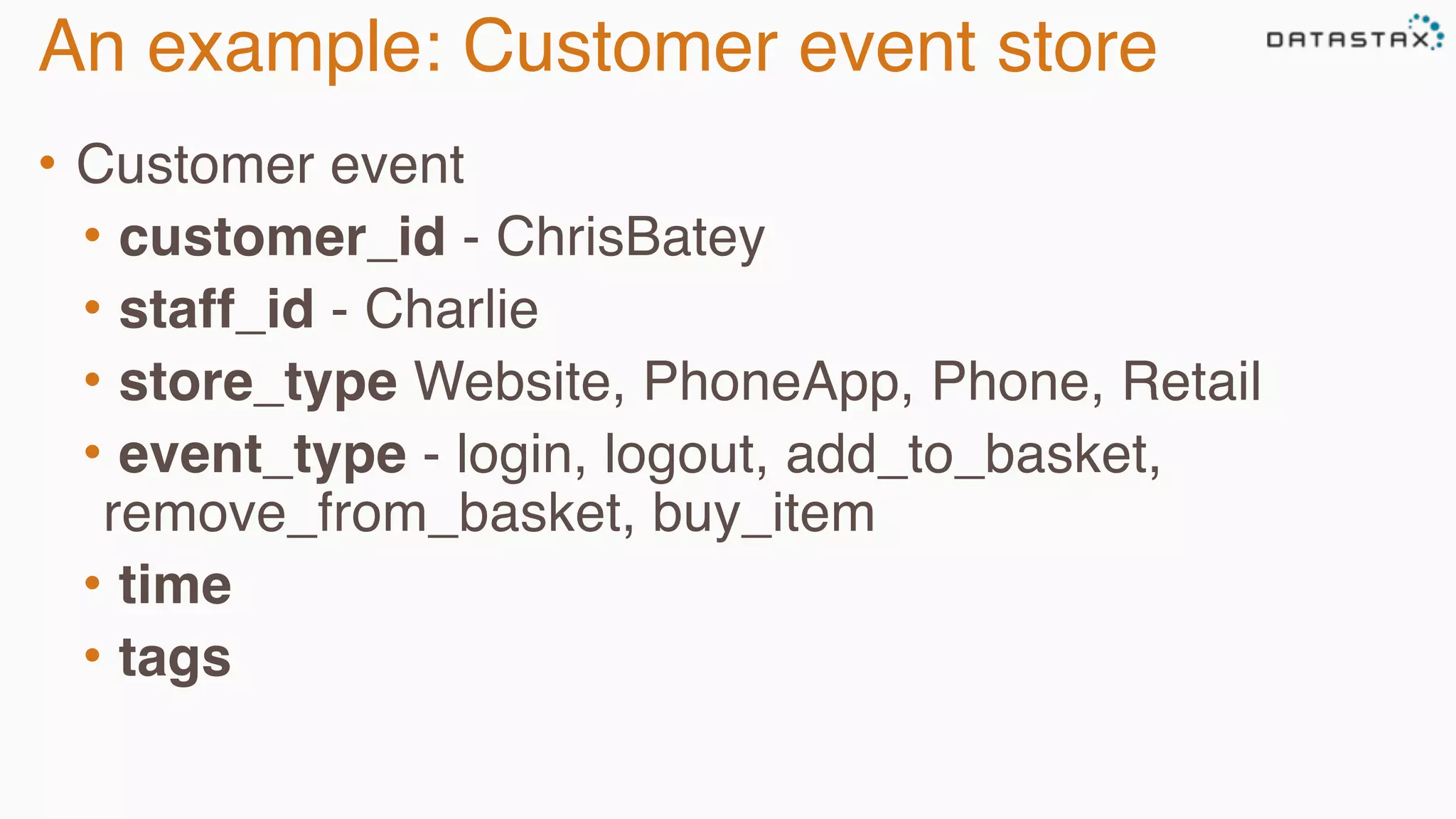
An example: Customer event store 
• Customer event 
• customer_id - ChrisBatey 
• staff_id - Charlie 
• store_type Website, PhoneApp, Phone, Retail 
• event_type - login, logout, add_to_basket, 
remove_from_basket, buy_item 
• time 
• tags
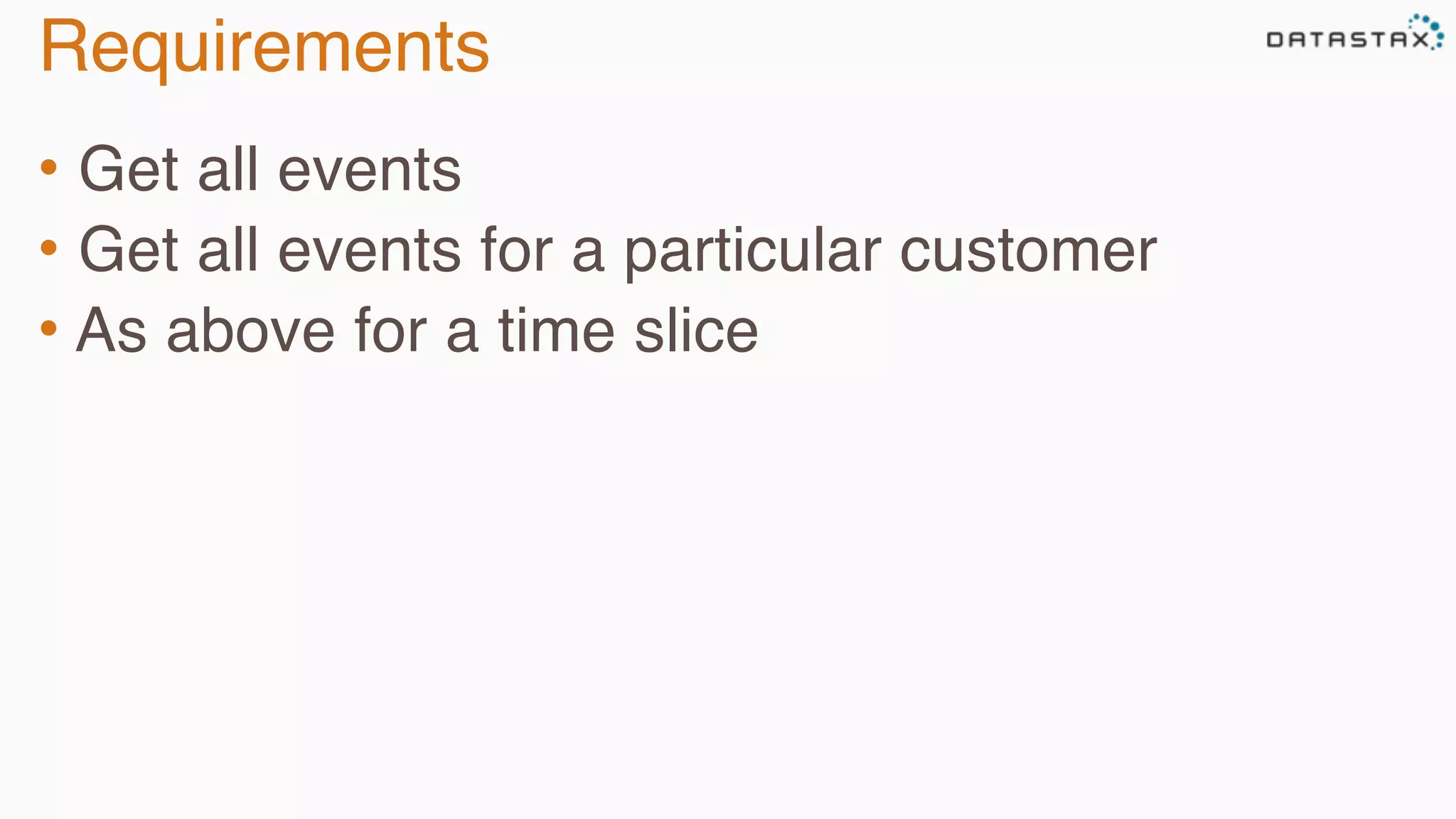
Requirements 
• Get all events 
• Get all events for a particular customer 
• As above for a time slice
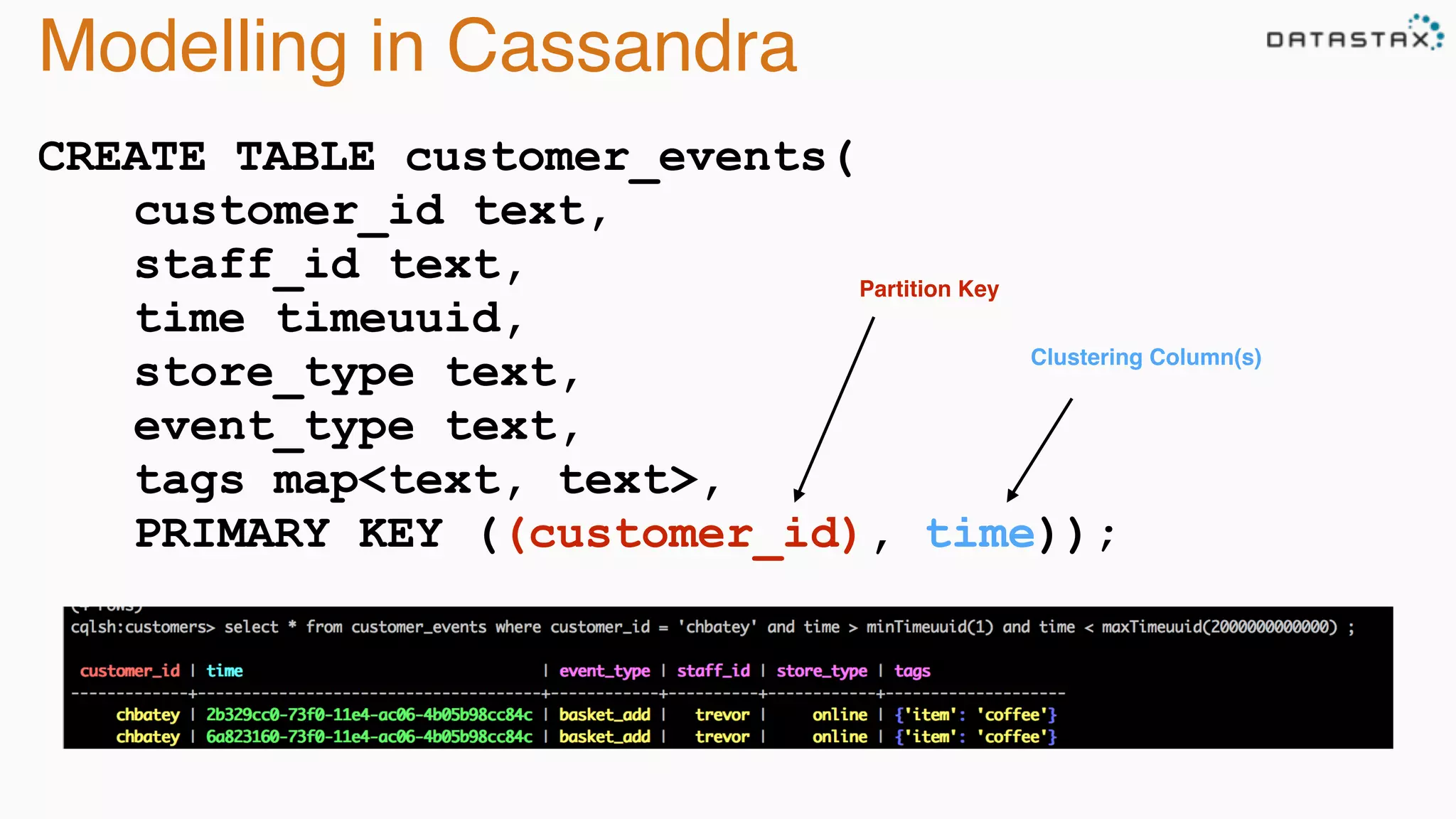
Modelling in Cassandra 
CREATE TABLE customer_events( 
customer_id text, 
staff_id text, 
Partition Key 
time timeuuid, 
store_type text, 
event_type text, 
tags map<text, text>, 
PRIMARY KEY ((customer_id), time)); 
Clustering Column(s)
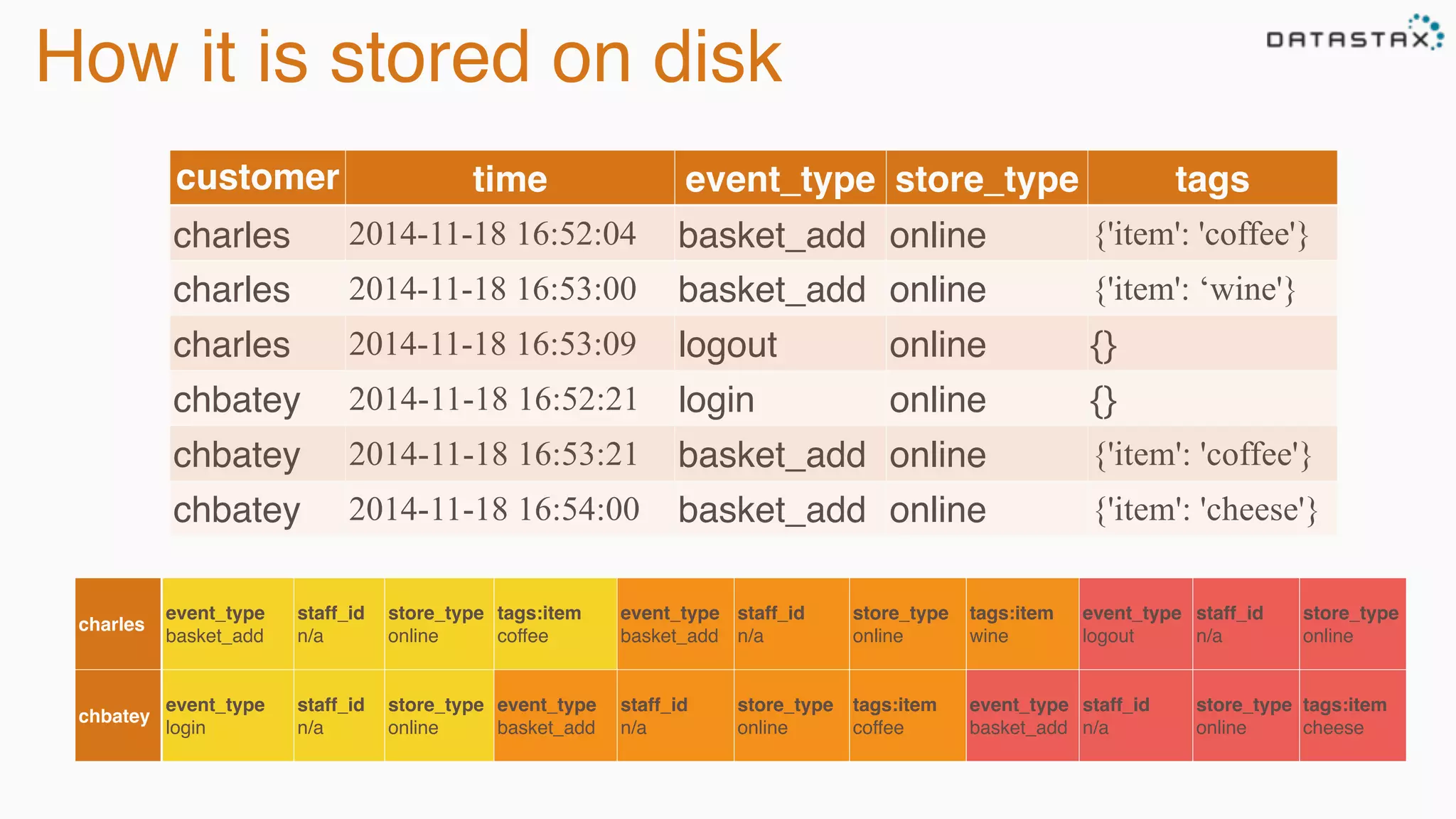
How it is stored on disk 
customer 
_id 
time event_type store_type tags 
charles 2014-11-18 16:52:04 basket_add online {'item': 'coffee'} 
charles 2014-11-18 16:53:00 basket_add online {'item': ‘wine'} 
charles 2014-11-18 16:53:09 logout online {} 
chbatey 2014-11-18 16:52:21 login online {} 
chbatey 2014-11-18 16:53:21 basket_add online {'item': 'coffee'} 
chbatey 2014-11-18 16:54:00 basket_add online {'item': 'cheese'} 
charles 
event_type 
basket_add 
staff_id 
n/a 
store_type 
online 
tags:item 
coffee 
event_type 
basket_add 
staff_id 
n/a 
store_type 
online 
tags:item 
wine 
event_type 
logout 
staff_id 
n/a 
store_type 
online 
chbatey 
event_type 
login 
staff_id 
n/a 
store_type 
online 
event_type 
basket_add 
staff_id 
n/a 
store_type 
online 
tags:item 
coffee 
event_type 
basket_add 
staff_id 
n/a 
store_type 
online 
tags:item 
cheese
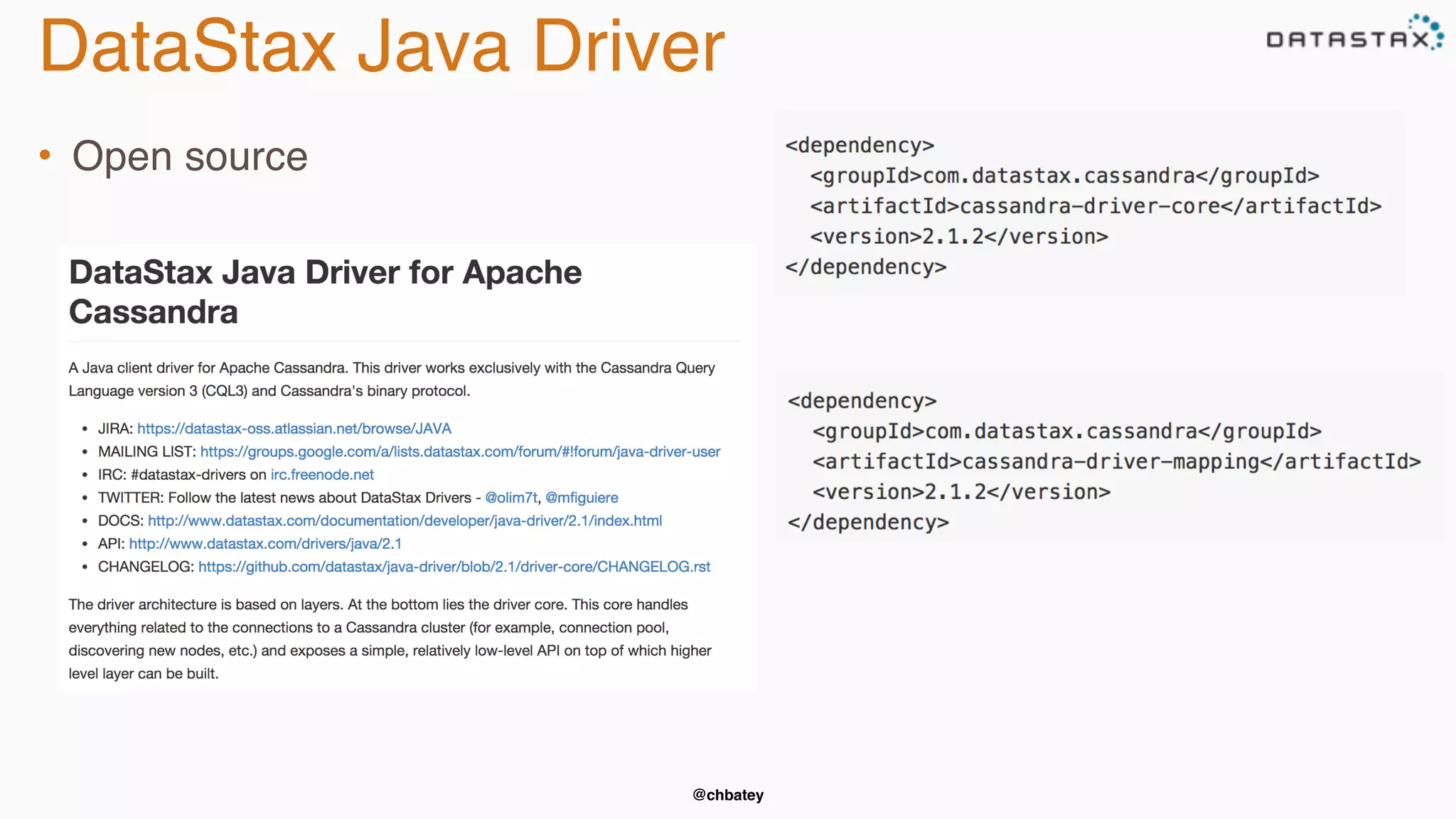
DataStax Java Driver 
• Open source 
@chbatey
@chbatey 
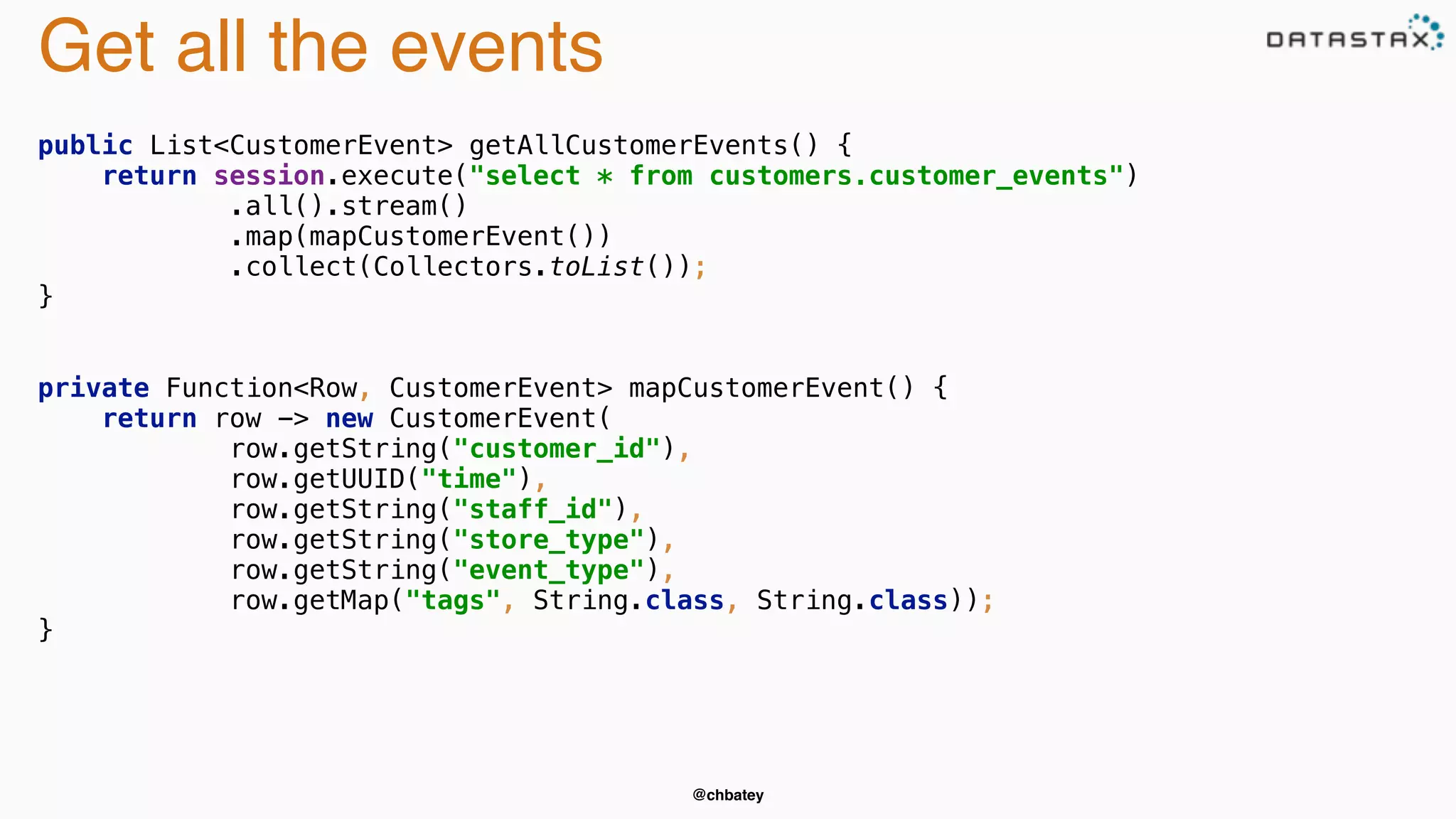
Get all the events 
public List<CustomerEvent> getAllCustomerEvents() { 
return session.execute("select * from customers.customer_events") 
.all().stream() 
.map(mapCustomerEvent()) 
.collect(Collectors.toList()); 
} 
private Function<Row, CustomerEvent> mapCustomerEvent() { 
return row -> new CustomerEvent( 
row.getString("customer_id"), 
row.getUUID("time"), 
row.getString("staff_id"), 
row.getString("store_type"), 
row.getString("event_type"), 
row.getMap("tags", String.class, String.class)); 
}
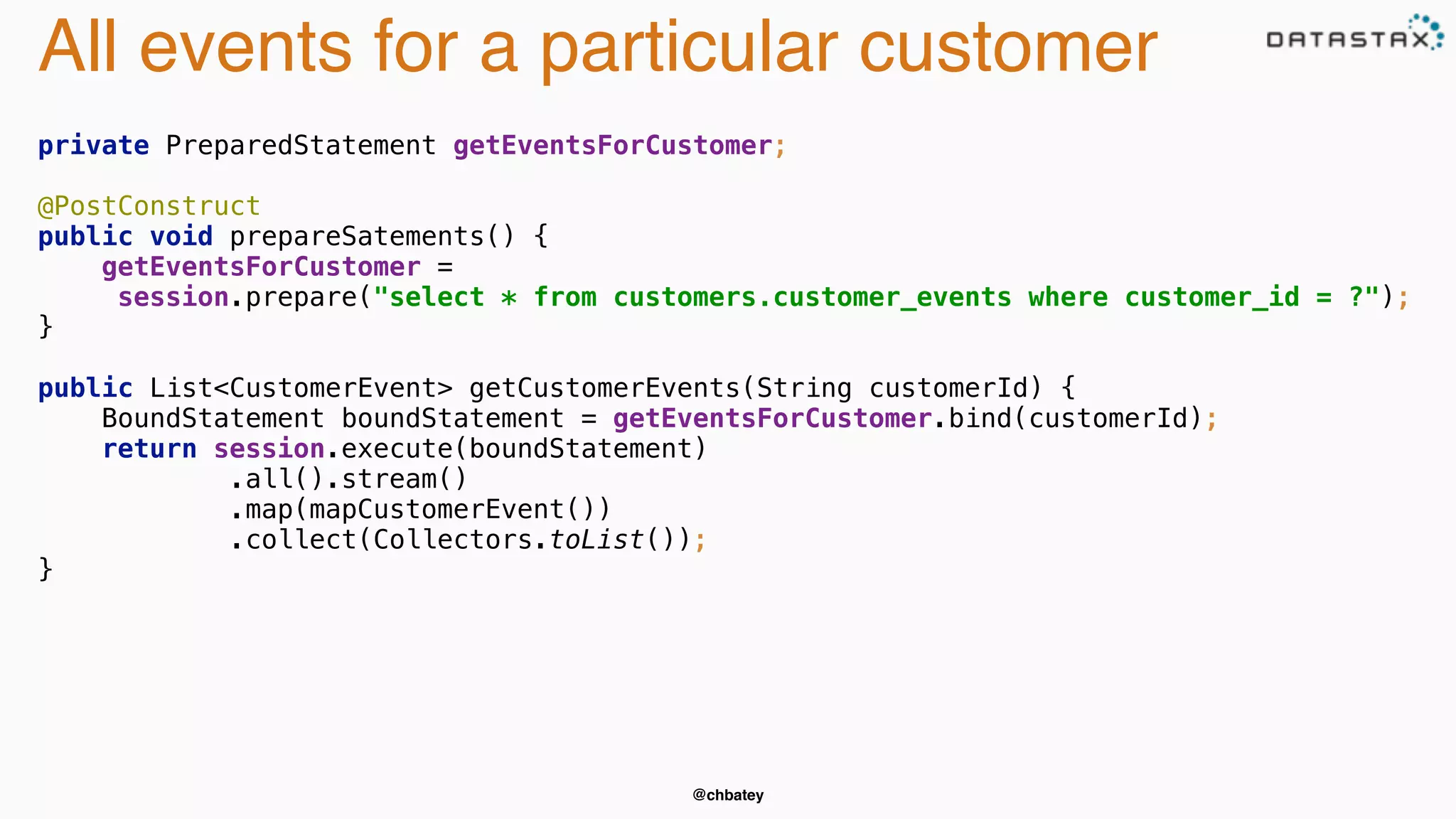
All events for a particular customer 
private PreparedStatement getEventsForCustomer; 
@PostConstruct 
public void prepareSatements() { 
getEventsForCustomer = 
session.prepare("select * from customers.customer_events where customer_id = ?"); 
} 
public List<CustomerEvent> getCustomerEvents(String customerId) { 
BoundStatement boundStatement = getEventsForCustomer.bind(customerId); 
return session.execute(boundStatement) 
.all().stream() 
.map(mapCustomerEvent()) 
.collect(Collectors.toList()); 
@chbatey 
}
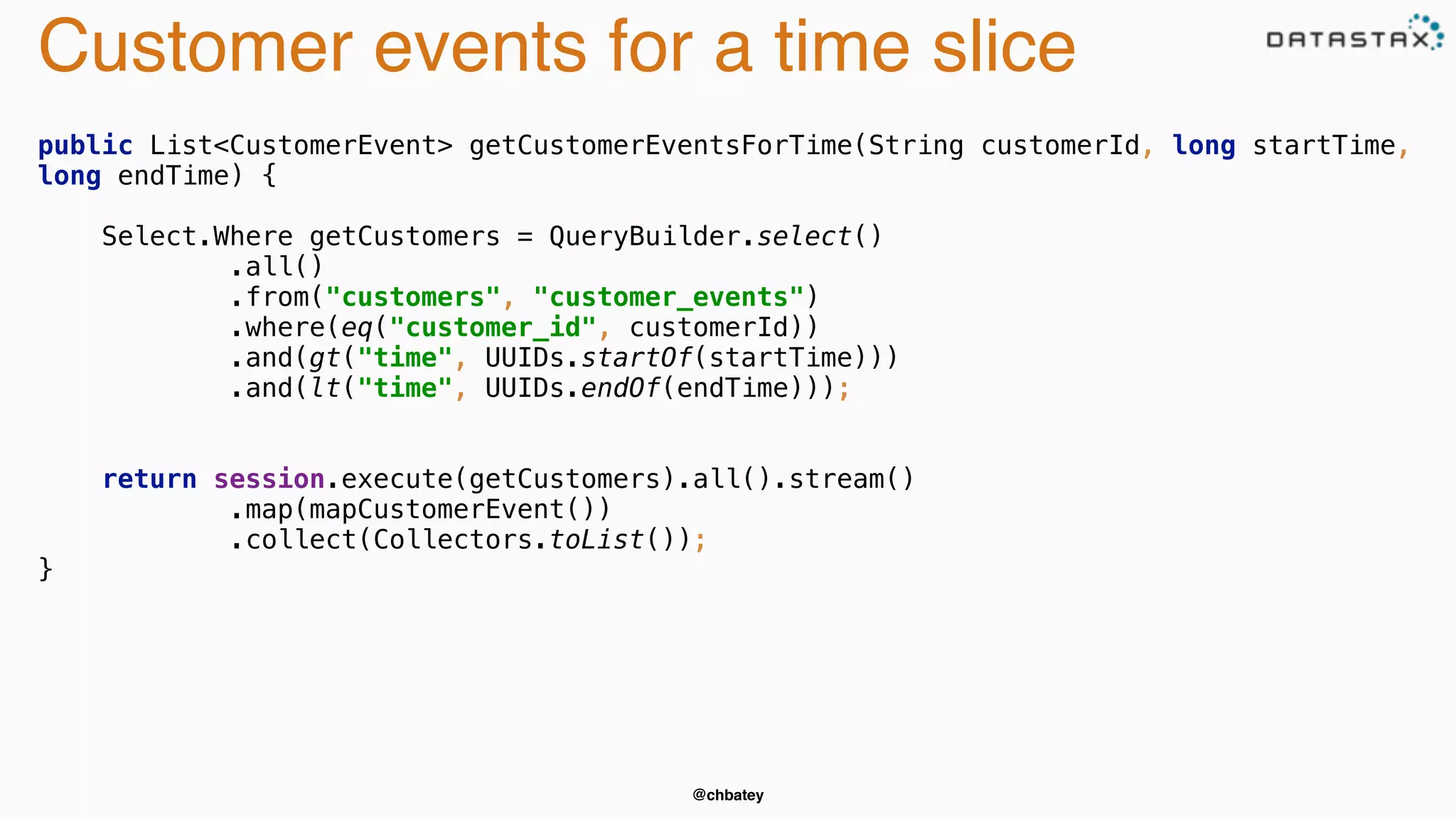
Customer events for a time slice 
public List<CustomerEvent> getCustomerEventsForTime(String customerId, long startTime, 
long endTime) { 
Select.Where getCustomers = QueryBuilder.select() 
.all() 
.from("customers", "customer_events") 
.where(eq("customer_id", customerId)) 
.and(gt("time", UUIDs.startOf(startTime))) 
.and(lt("time", UUIDs.endOf(endTime))); 
return session.execute(getCustomers).all().stream() 
.map(mapCustomerEvent()) 
.collect(Collectors.toList()); 
@chbatey 
}
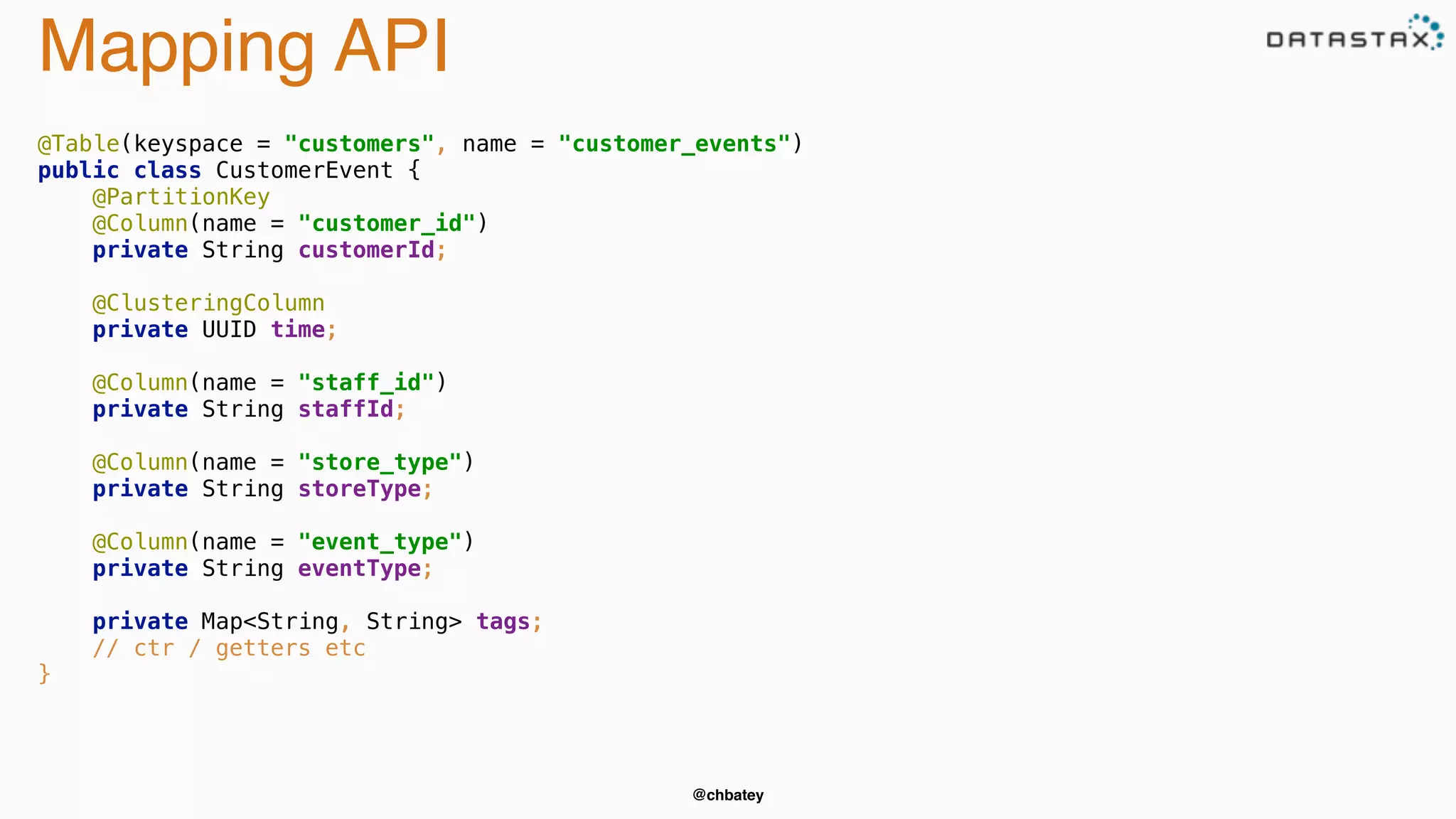
@chbatey 
Mapping API 
@Table(keyspace = "customers", name = "customer_events") 
public class CustomerEvent { 
@PartitionKey 
@Column(name = "customer_id") 
private String customerId; 
@ClusteringColumn 
private UUID time; 
@Column(name = "staff_id") 
private String staffId; 
@Column(name = "store_type") 
private String storeType; 
@Column(name = "event_type") 
private String eventType; 
private Map<String, String> tags; 
// ctr / getters etc 
}
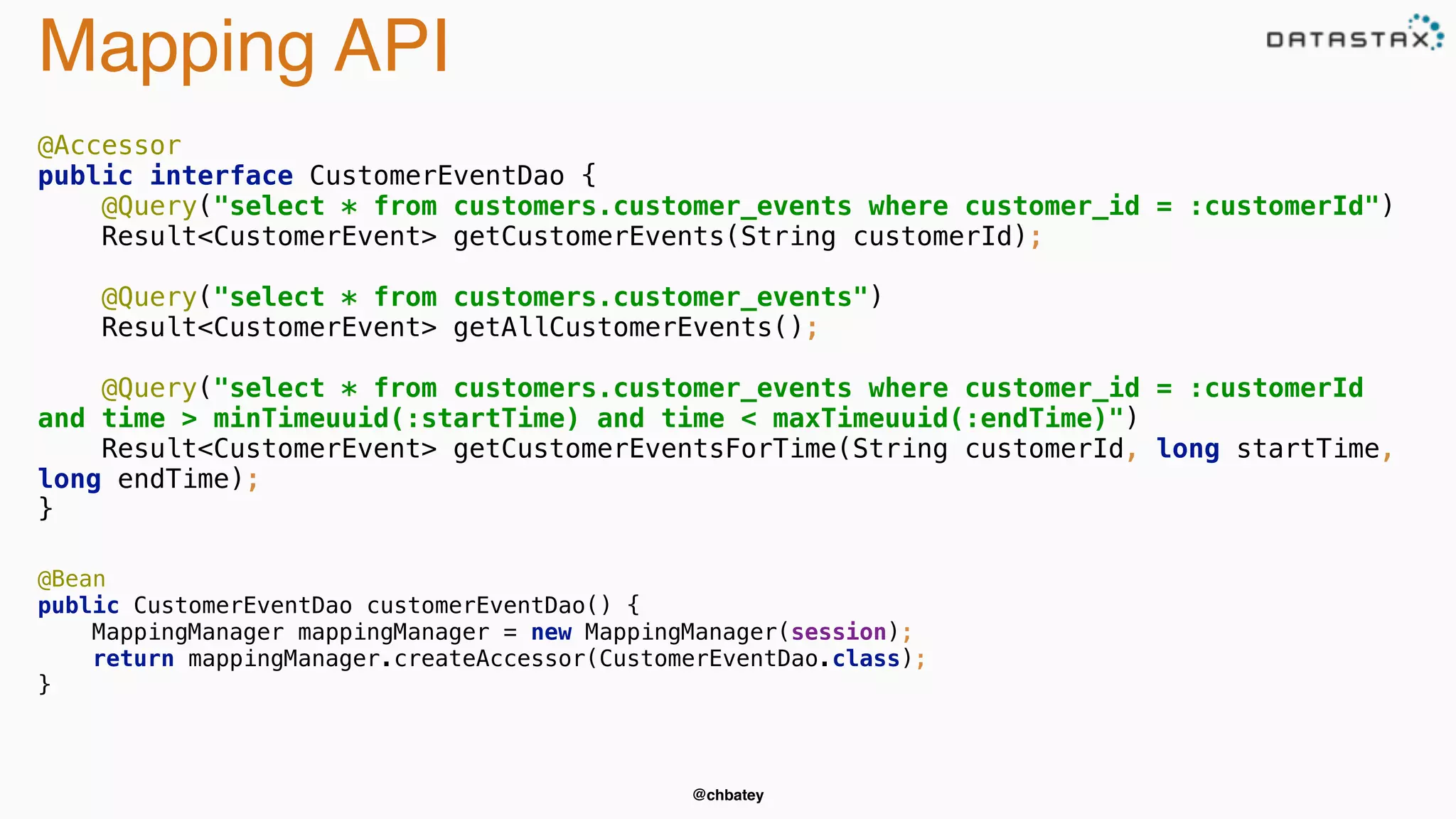
@chbatey 
Mapping API 
@Accessor 
public interface CustomerEventDao { 
@Query("select * from customers.customer_events where customer_id = :customerId") 
Result<CustomerEvent> getCustomerEvents(String customerId); 
@Query("select * from customers.customer_events") 
Result<CustomerEvent> getAllCustomerEvents(); 
@Query("select * from customers.customer_events where customer_id = :customerId 
and time > minTimeuuid(:startTime) and time < maxTimeuuid(:endTime)") 
Result<CustomerEvent> getCustomerEventsForTime(String customerId, long startTime, 
long endTime); 
} 
@Bean 
public CustomerEventDao customerEventDao() { 
MappingManager mappingManager = new MappingManager(session); 
return mappingManager.createAccessor(CustomerEventDao.class); 
}
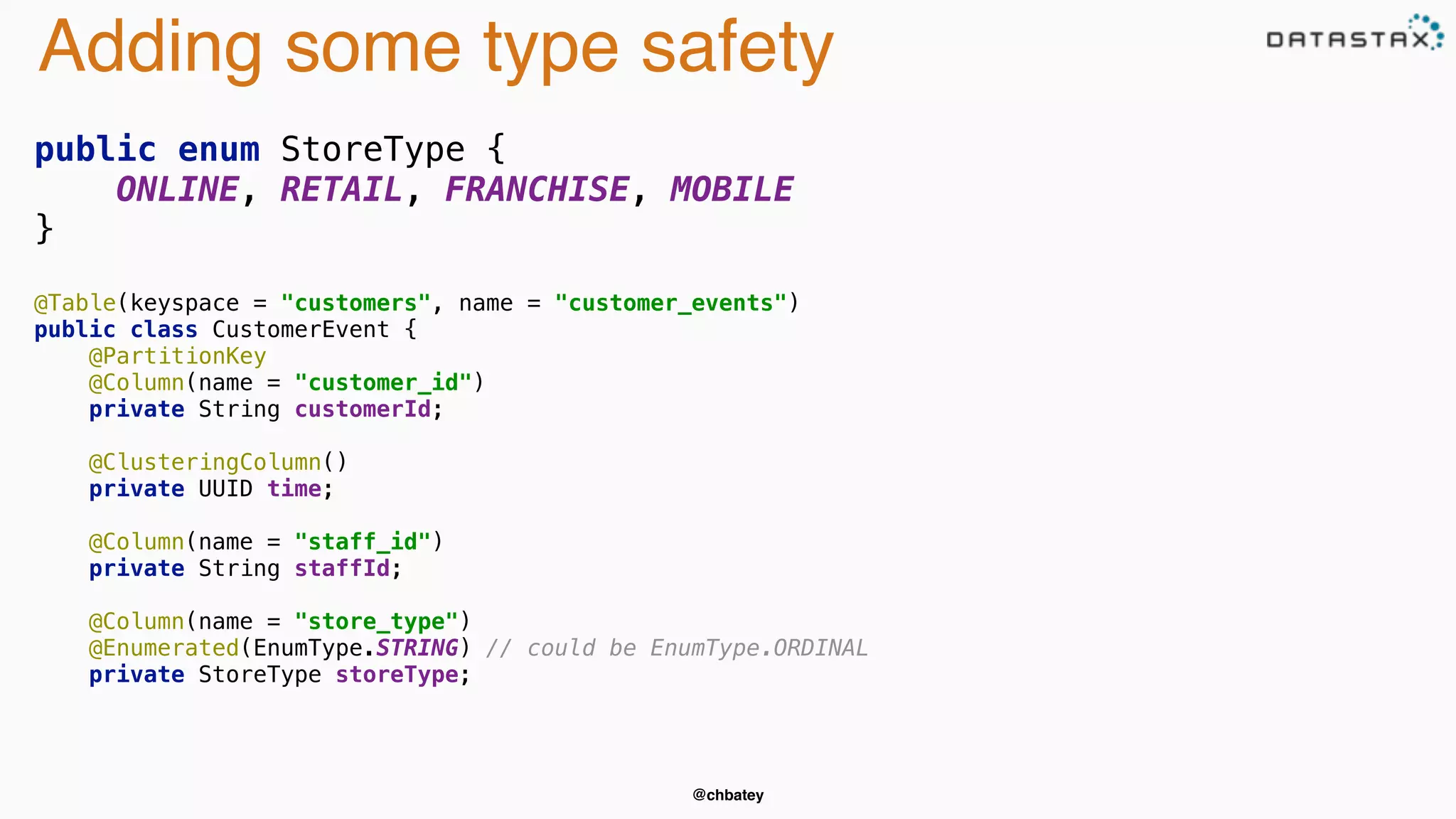
Adding some type safety 
public enum StoreType { 
ONLINE, RETAIL, FRANCHISE, MOBILE 
@chbatey 
} 
@Table(keyspace = "customers", name = "customer_events") 
public class CustomerEvent { 
@PartitionKey 
@Column(name = "customer_id") 
private String customerId; 
@ClusteringColumn() 
private UUID time; 
@Column(name = "staff_id") 
private String staffId; 
@Column(name = "store_type") 
@Enumerated(EnumType.STRING) // could be EnumType.ORDINAL 
private StoreType storeType;
@chbatey 
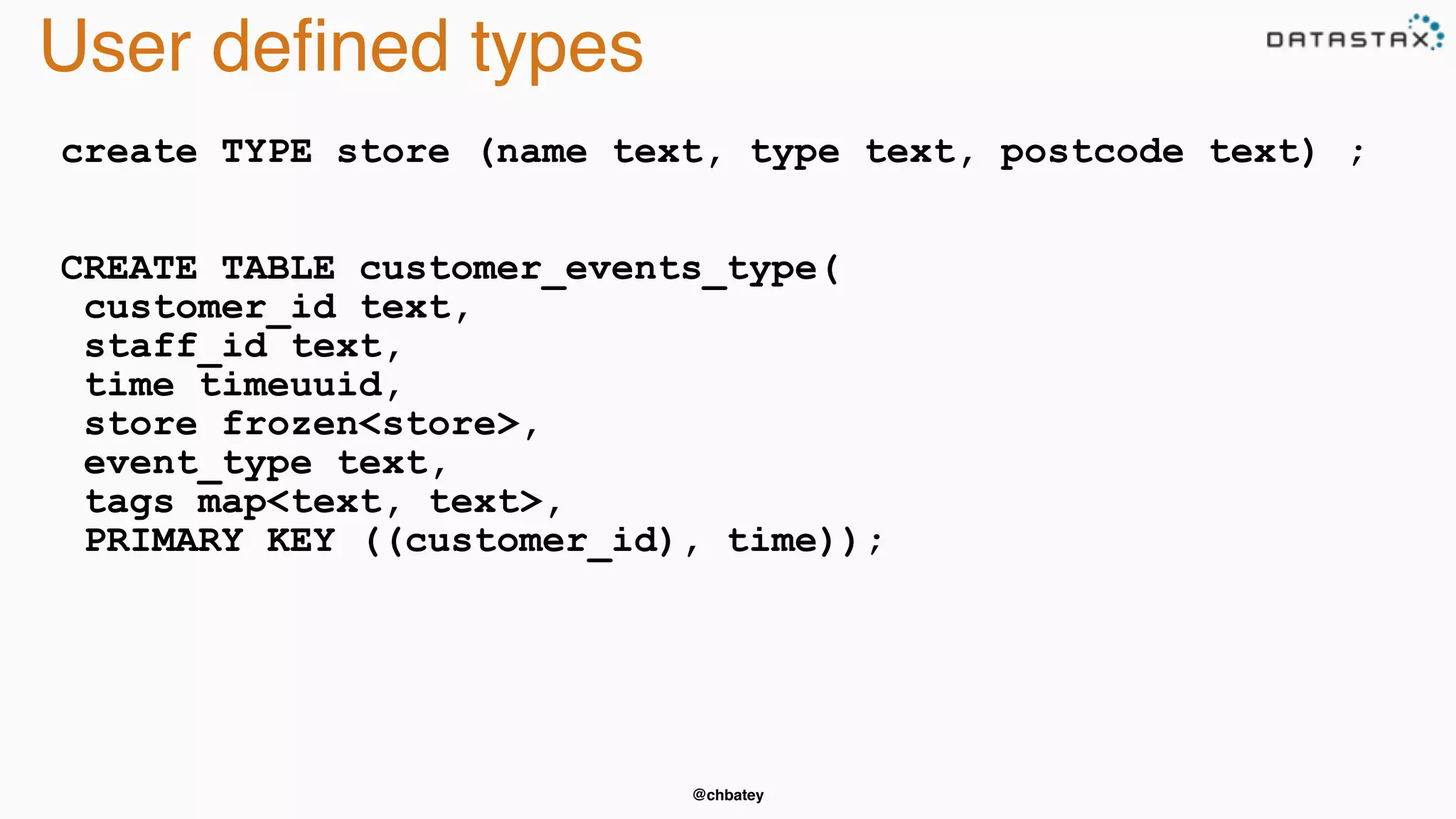
User defined types 
create TYPE store (name text, type text, postcode text) ; 
CREATE TABLE customer_events_type( 
customer_id text, 
staff_id text, 
time timeuuid, 
store frozen<store>, 
event_type text, 
tags map<text, text>, 
PRIMARY KEY ((customer_id), time));
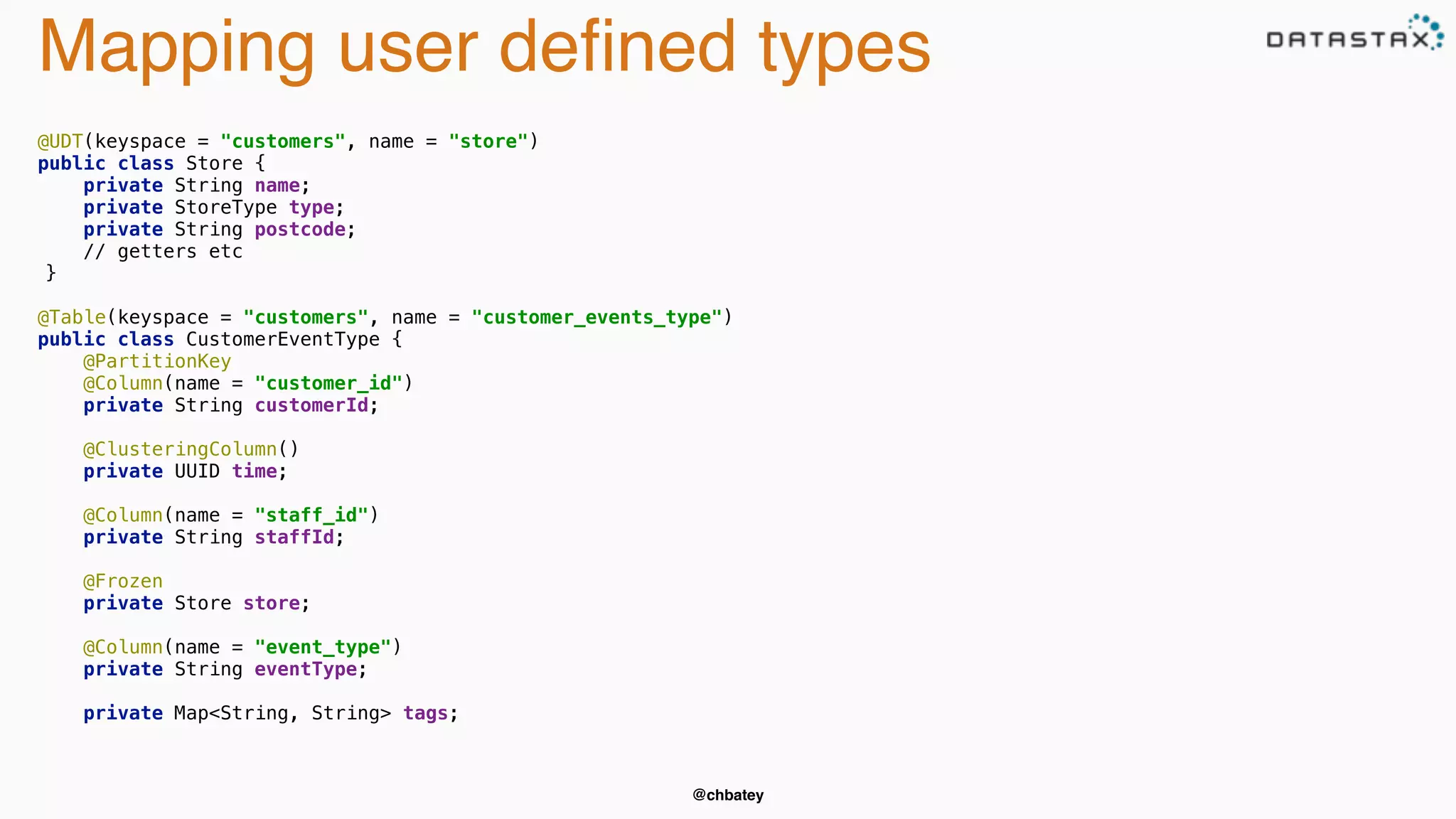
Mapping user defined types 
@chbatey 
@UDT(keyspace = "customers", name = "store") 
public class Store { 
private String name; 
private StoreType type; 
private String postcode; 
// getters etc 
} 
@Table(keyspace = "customers", name = "customer_events_type") 
public class CustomerEventType { 
@PartitionKey 
@Column(name = "customer_id") 
private String customerId; 
@ClusteringColumn() 
private UUID time; 
@Column(name = "staff_id") 
private String staffId; 
@Frozen 
private Store store; 
@Column(name = "event_type") 
private String eventType; 
private Map<String, String> tags;
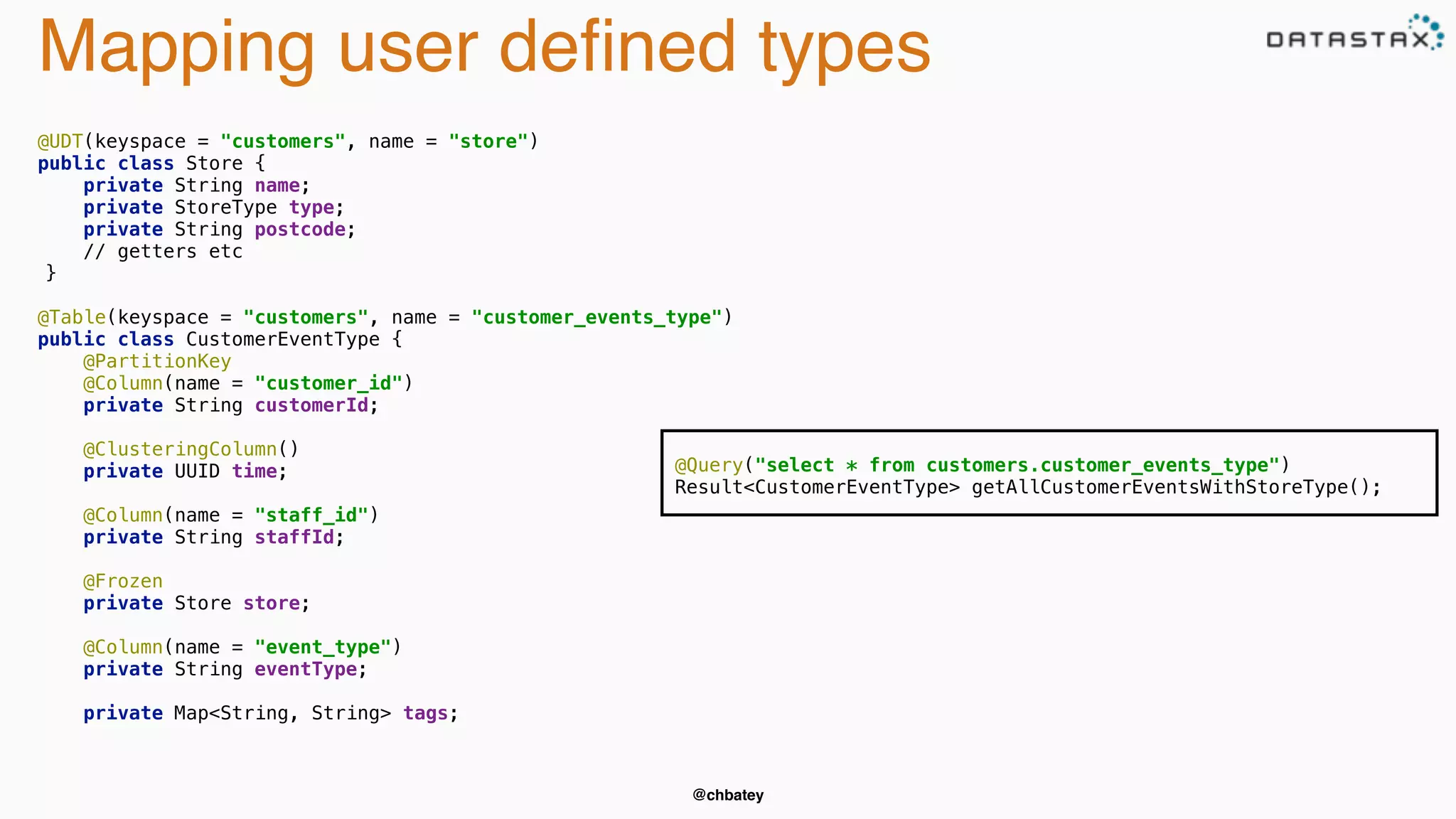
Mapping user defined types 
@chbatey 
@UDT(keyspace = "customers", name = "store") 
public class Store { 
private String name; 
private StoreType type; 
private String postcode; 
// getters etc 
} 
@Table(keyspace = "customers", name = "customer_events_type") 
public class CustomerEventType { 
@PartitionKey 
@Column(name = "customer_id") 
private String customerId; 
@ClusteringColumn() 
private UUID time; 
@Column(name = "staff_id") 
private String staffId; 
@Frozen 
private Store store; 
@Column(name = "event_type") 
private String eventType; 
private Map<String, String> tags; 
@Query("select * from customers.customer_events_type") 
Result<CustomerEventType> getAllCustomerEventsWithStoreType();
What else can I do? 
@chbatey
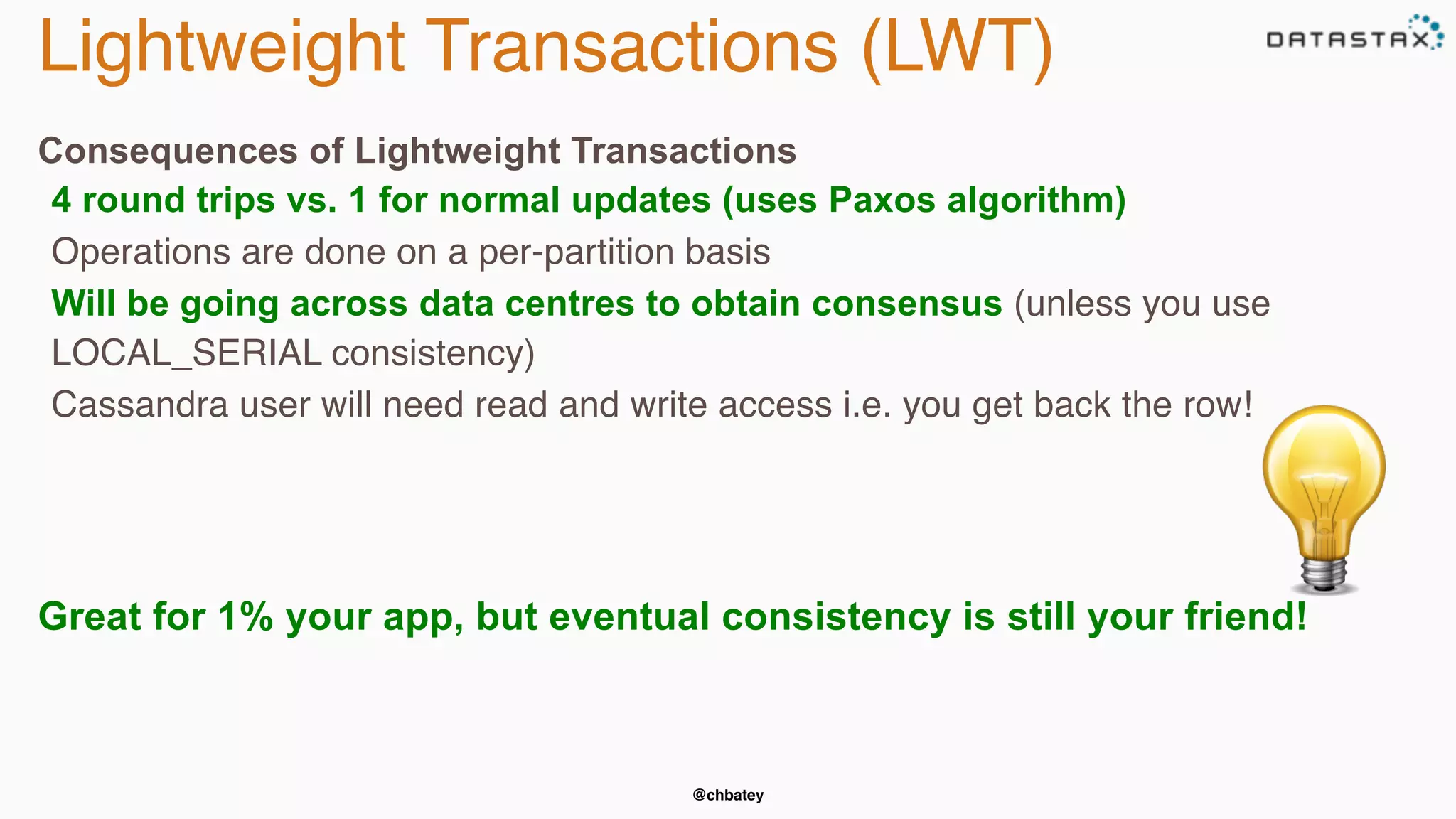
Lightweight Transactions (LWT) 
Consequences of Lightweight Transactions 
4 round trips vs. 1 for normal updates (uses Paxos algorithm) 
Operations are done on a per-partition basis 
Will be going across data centres to obtain consensus (unless you use 
LOCAL_SERIAL consistency) 
Cassandra user will need read and write access i.e. you get back the row! 
Great for 1% your app, but eventual consistency is still your friend! 
@chbatey
Company Confidential 
@chbatey 
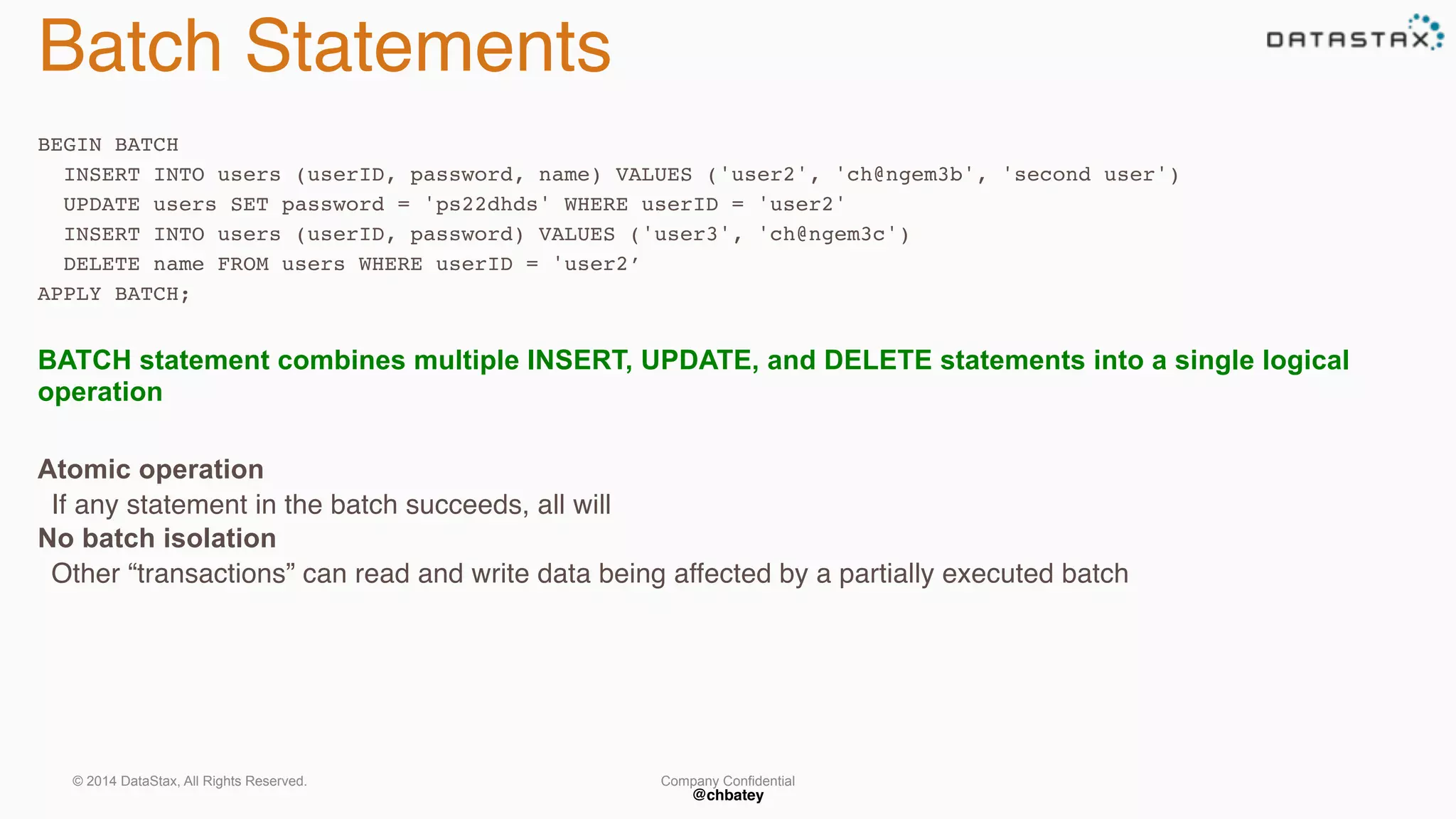
Batch Statements 
BEGIN BATCH 
INSERT INTO users (userID, password, name) VALUES ('user2', 'ch@ngem3b', 'second user') 
UPDATE users SET password = 'ps22dhds' WHERE userID = 'user2' 
INSERT INTO users (userID, password) VALUES ('user3', 'ch@ngem3c') 
DELETE name FROM users WHERE userID = 'user2’ 
APPLY BATCH; 
BATCH statement combines multiple INSERT, UPDATE, and DELETE statements into a single logical 
operation 
Atomic operation 
If any statement in the batch succeeds, all will 
No batch isolation 
Other “transactions” can read and write data being affected by a partially executed batch 
© 2014 DataStax, All Rights Reserved.
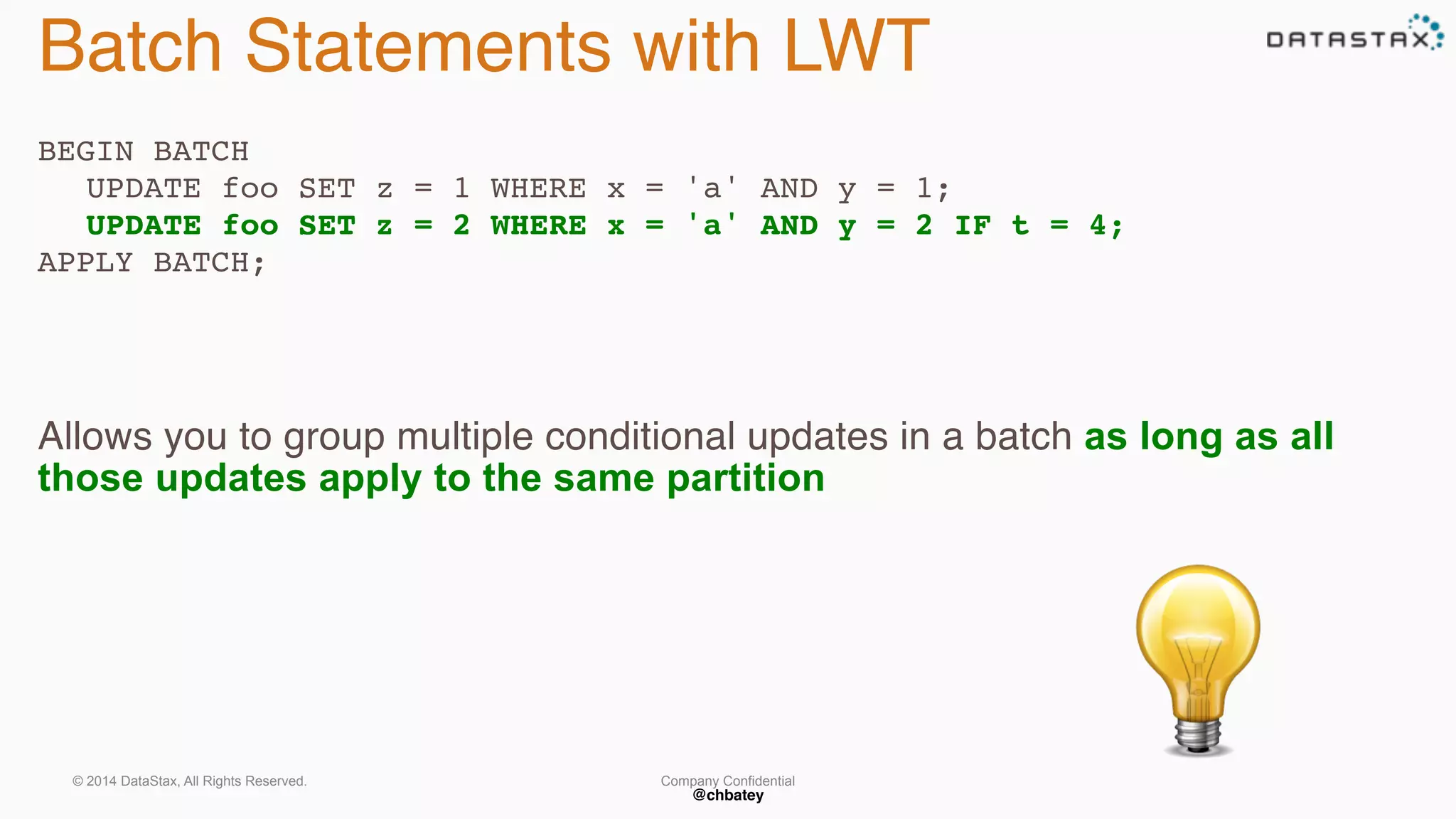
Batch Statements with LWT 
BEGIN BATCH 
UPDATE foo SET z = 1 WHERE x = 'a' AND y = 1; 
UPDATE foo SET z = 2 WHERE x = 'a' AND y = 2 IF t = 4; 
Company Confidential 
@chbatey 
APPLY BATCH; 
Allows you to group multiple conditional updates in a batch as long as all 
those updates apply to the same partition 
© 2014 DataStax, All Rights Reserved.
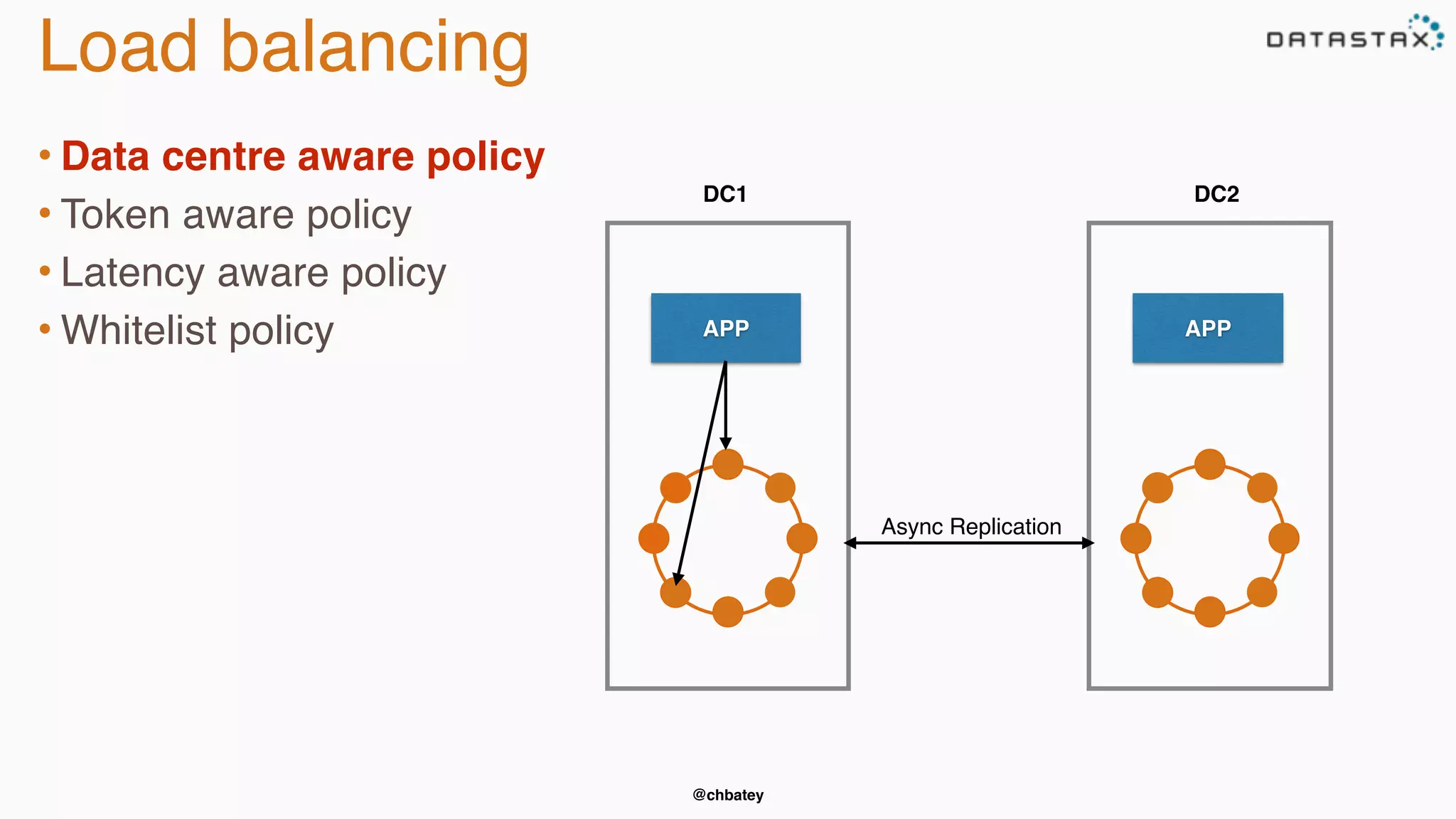
Load balancing 
• Data centre aware policy 
• Token aware policy 
• Latency aware policy 
• Whitelist policy APP APP 
DC1 DC2 
@chbatey 
Async Replication
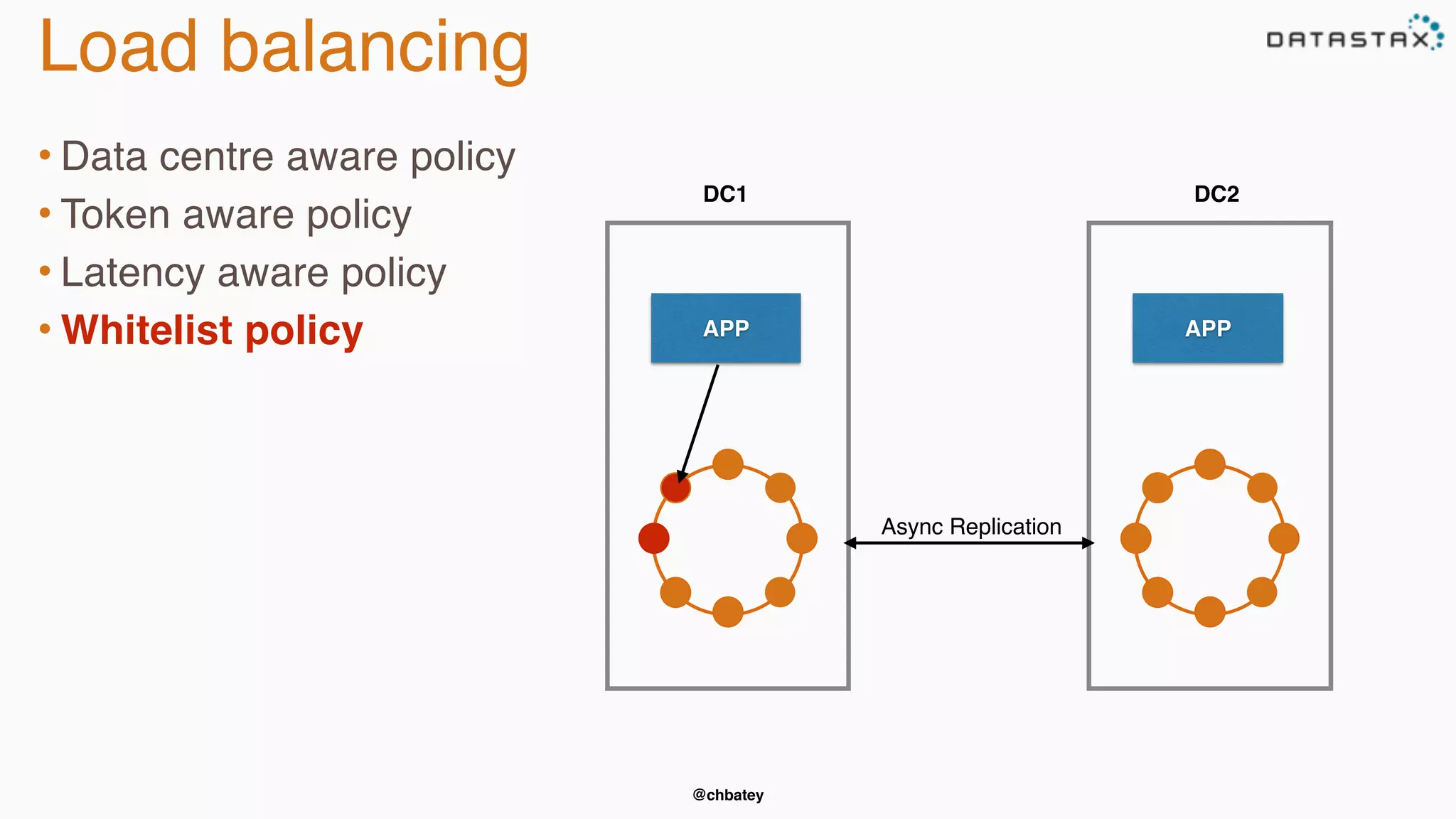
Load balancing 
• Data centre aware policy 
• Token aware policy 
• Latency aware policy 
• Whitelist policy APP APP 
DC1 DC2 
@chbatey 
Async Replication
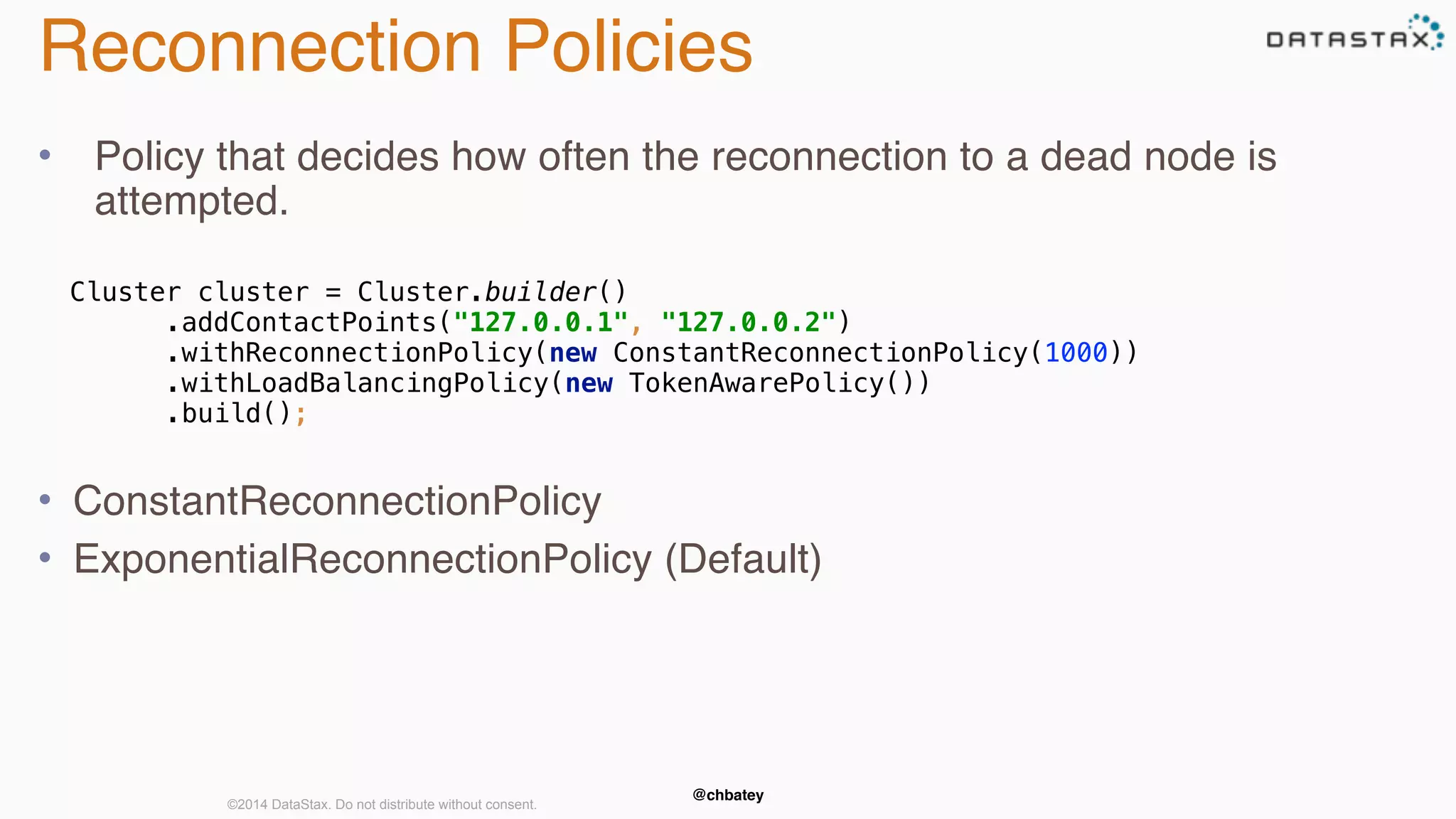
Reconnection Policies 
• Policy that decides how often the reconnection to a dead node is 
attempted. 
Cluster cluster = Cluster.builder() 
.addContactPoints("127.0.0.1", "127.0.0.2") 
.withReconnectionPolicy(new ConstantReconnectionPolicy(1000)) 
.withLoadBalancingPolicy(new TokenAwarePolicy()) 
.build(); 
• ConstantReconnectionPolicy 
• ExponentialReconnectionPolicy (Default) 
@chbatey ©2014 DataStax. Do not distribute without consent.
Reconnection Policies 
• Policy that decides how often the reconnection to a dead node is 
attempted. 
Cluster cluster = Cluster.builder() 
.addContactPoints("127.0.0.1", "127.0.0.2") 
.withReconnectionPolicy(new ConstantReconnectionPolicy(1000)) 
.withLoadBalancingPolicy(new TokenAwarePolicy()) 
.build(); 
• ConstantReconnectionPolicy 
• ExponentialReconnectionPolicy (Default) 
@chbatey ©2014 DataStax. Do not distribute without consent.
@chbatey 
Summary 
• Cassandra overview 
• Customer events example 
• DataStax Java Driver 
• Java Mapping API 
• Other features 
• Light weight transactions 
• Load balancing 
• Reconnection policies
Thanks for listening 
• Badger me on twitter @chbatey 
• https://github.com/chbatey/cassandra-customer-events 
• https://academy.datastax.com/ 
• http://christopher-batey.blogspot.co.uk/ 
@chbatey
© 2014 DataStax, All Rights Reserved. Company Confidential 
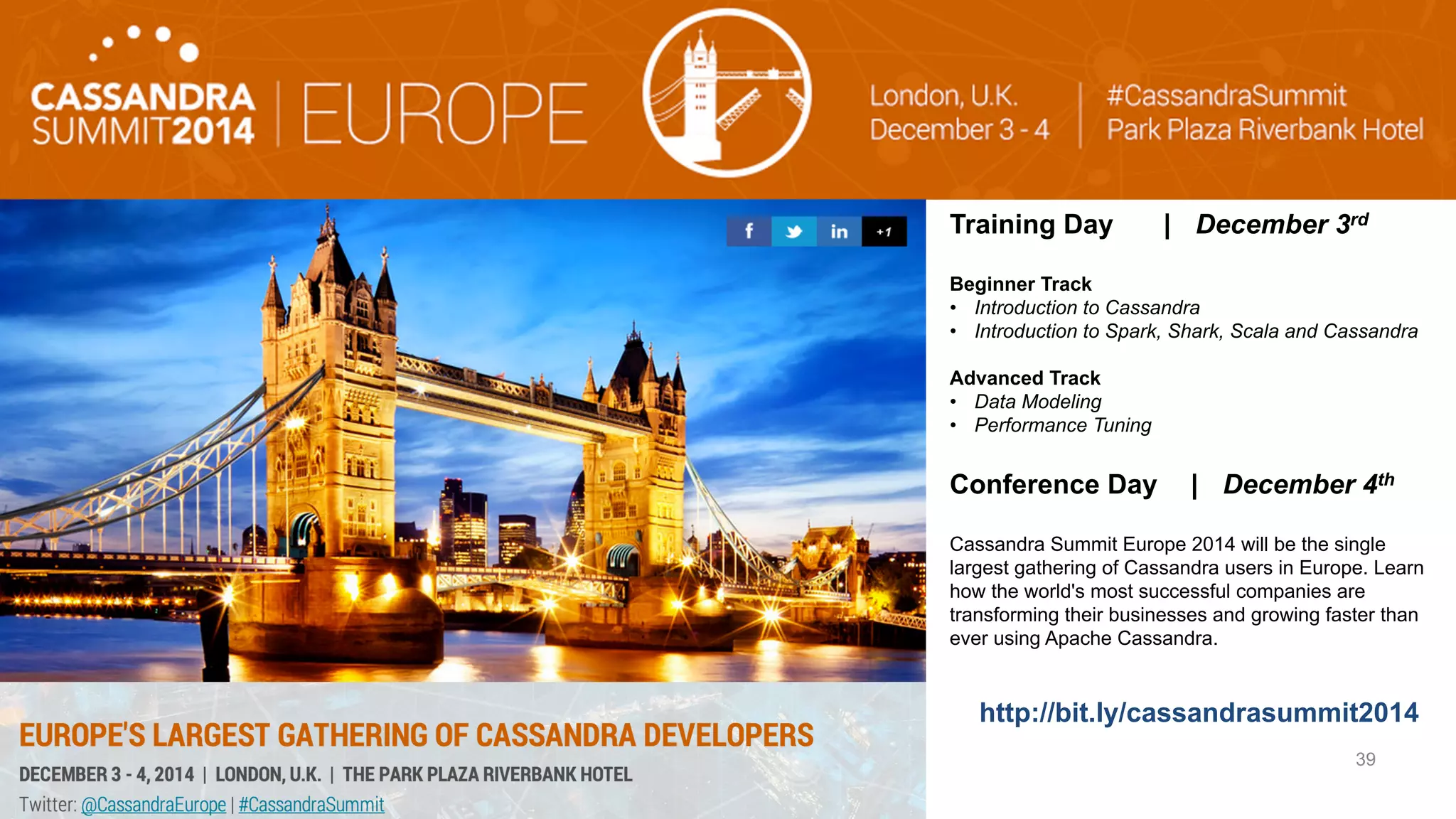
Training Day | December 3rd 
Beginner Track 
• Introduction to Cassandra 
• Introduction to Spark, Shark, Scala and Cassandra 
Advanced Track 
• Data Modeling 
• Performance Tuning 
Conference Day | December 4th 
Cassandra Summit Europe 2014 will be the single 
largest gathering of Cassandra users in Europe. Learn 
how the world's most successful companies are 
transforming their businesses and growing faster than 
ever using Apache Cassandra. 
http://bit.ly/cassandrasummit2014 
39

LJC Conference 2014 Cassandra for Java Developers

  • 1.
    Building awesome applicationswith Apache Cassandra Christopher Batey @chbatey ©2013 DataStax Confidential. Do not distribute without consent. 1
  • 2.
    Who am I? •Technical Evangelist for Apache Cassandra • Founder of Stubbed Cassandra • Help out Apache Cassandra users • Previous: Cassandra backed apps at BSkyB @chbatey
  • 3.
    @chbatey Overview •Topics covered • Cassandra overview • Customer events example • DataStax Java Driver • Java Mapping API • Other features • Light weight transactions • Load balancing • Reconnection policies
  • 4.
    @chbatey Overview •Topics covered • Cassandra overview • Customer events example • DataStax Java Driver • Java Mapping API • Other features • Light weight transactions • Load balancing • Reconnection policies • Not covered • Cassandra read and write paths • Cassandra failure nodes
  • 5.
    Common use cases •Ordered data such as time series •Event stores •Financial transactions •Sensor data e.g IoT @chbatey
  • 6.
    Common use cases •Ordered data such as time series •Event stores •Financial transactions •Sensor data e.g IoT •Non functional requirements: • Linear scalability • High throughout durable writes •Multi datacenter including active-active •Analytics without ETL @chbatey
  • 7.
  • 8.
    Cassandra Cassandra •Distributed master less database (Dynamo) • Column family data model (Google BigTable)
  • 9.
    Cassandra Europe •Distributed master less database (Dynamo) • Column family data model (Google BigTable) • Multi data centre replication built in from the start USA
  • 10.
    Cassandra Online •Distributed master less database (Dynamo) • Column family data model (Google BigTable) • Multi data centre replication built in from the start • Analytics with Apache Spark Analytics
  • 11.
    Replication WRITE CL= 1 We have replication! DC1 DC2 client C RC RF3 RF3
  • 12.
    Tunable Consistency •Data is replicated N times • Every query that you execute you give a consistency • ALL • QUORUM • LOCAL_QUORUM • ONE • Christos Kalantzis Eventual Consistency != Hopeful Consistency: http://youtu.be/ A6qzx_HE3EU?list=PLqcm6qE9lgKJzVvwHprow9h7KMpb5hcUU @chbatey
  • 13.
    CQL •Cassandra QueryLanguage •SQL like query language •Keyspace – analogous to a schema • The keyspace determines the RF (replication factor) •Table – looks like a SQL Table CREATE TABLE scores ( @chbatey name text, score int, date timestamp, PRIMARY KEY (name, score) ); INSERT INTO scores (name, score, date) VALUES ('bob', 42, '2012-06-24'); INSERT INTO scores (name, score, date) VALUES ('bob', 47, '2012-06-25'); SELECT date, score FROM scores WHERE name='bob' AND score >= 40;
  • 14.
    Example Time: Customerevent store @chbatey
  • 15.
    An example: Customerevent store • Customer event • customer_id - ChrisBatey • staff_id - Charlie • store_type Website, PhoneApp, Phone, Retail • event_type - login, logout, add_to_basket, remove_from_basket, buy_item • time • tags
  • 16.
    Requirements • Getall events • Get all events for a particular customer • As above for a time slice
  • 17.
    Modelling in Cassandra CREATE TABLE customer_events( customer_id text, staff_id text, Partition Key time timeuuid, store_type text, event_type text, tags map<text, text>, PRIMARY KEY ((customer_id), time)); Clustering Column(s)
  • 18.
    How it isstored on disk customer _id time event_type store_type tags charles 2014-11-18 16:52:04 basket_add online {'item': 'coffee'} charles 2014-11-18 16:53:00 basket_add online {'item': ‘wine'} charles 2014-11-18 16:53:09 logout online {} chbatey 2014-11-18 16:52:21 login online {} chbatey 2014-11-18 16:53:21 basket_add online {'item': 'coffee'} chbatey 2014-11-18 16:54:00 basket_add online {'item': 'cheese'} charles event_type basket_add staff_id n/a store_type online tags:item coffee event_type basket_add staff_id n/a store_type online tags:item wine event_type logout staff_id n/a store_type online chbatey event_type login staff_id n/a store_type online event_type basket_add staff_id n/a store_type online tags:item coffee event_type basket_add staff_id n/a store_type online tags:item cheese
  • 19.
    DataStax Java Driver • Open source @chbatey
  • 20.
    @chbatey Get allthe events public List<CustomerEvent> getAllCustomerEvents() { return session.execute("select * from customers.customer_events") .all().stream() .map(mapCustomerEvent()) .collect(Collectors.toList()); } private Function<Row, CustomerEvent> mapCustomerEvent() { return row -> new CustomerEvent( row.getString("customer_id"), row.getUUID("time"), row.getString("staff_id"), row.getString("store_type"), row.getString("event_type"), row.getMap("tags", String.class, String.class)); }
  • 21.
    All events fora particular customer private PreparedStatement getEventsForCustomer; @PostConstruct public void prepareSatements() { getEventsForCustomer = session.prepare("select * from customers.customer_events where customer_id = ?"); } public List<CustomerEvent> getCustomerEvents(String customerId) { BoundStatement boundStatement = getEventsForCustomer.bind(customerId); return session.execute(boundStatement) .all().stream() .map(mapCustomerEvent()) .collect(Collectors.toList()); @chbatey }
  • 22.
    Customer events fora time slice public List<CustomerEvent> getCustomerEventsForTime(String customerId, long startTime, long endTime) { Select.Where getCustomers = QueryBuilder.select() .all() .from("customers", "customer_events") .where(eq("customer_id", customerId)) .and(gt("time", UUIDs.startOf(startTime))) .and(lt("time", UUIDs.endOf(endTime))); return session.execute(getCustomers).all().stream() .map(mapCustomerEvent()) .collect(Collectors.toList()); @chbatey }
  • 23.
    @chbatey Mapping API @Table(keyspace = "customers", name = "customer_events") public class CustomerEvent { @PartitionKey @Column(name = "customer_id") private String customerId; @ClusteringColumn private UUID time; @Column(name = "staff_id") private String staffId; @Column(name = "store_type") private String storeType; @Column(name = "event_type") private String eventType; private Map<String, String> tags; // ctr / getters etc }
  • 24.
    @chbatey Mapping API @Accessor public interface CustomerEventDao { @Query("select * from customers.customer_events where customer_id = :customerId") Result<CustomerEvent> getCustomerEvents(String customerId); @Query("select * from customers.customer_events") Result<CustomerEvent> getAllCustomerEvents(); @Query("select * from customers.customer_events where customer_id = :customerId and time > minTimeuuid(:startTime) and time < maxTimeuuid(:endTime)") Result<CustomerEvent> getCustomerEventsForTime(String customerId, long startTime, long endTime); } @Bean public CustomerEventDao customerEventDao() { MappingManager mappingManager = new MappingManager(session); return mappingManager.createAccessor(CustomerEventDao.class); }
  • 25.
    Adding some typesafety public enum StoreType { ONLINE, RETAIL, FRANCHISE, MOBILE @chbatey } @Table(keyspace = "customers", name = "customer_events") public class CustomerEvent { @PartitionKey @Column(name = "customer_id") private String customerId; @ClusteringColumn() private UUID time; @Column(name = "staff_id") private String staffId; @Column(name = "store_type") @Enumerated(EnumType.STRING) // could be EnumType.ORDINAL private StoreType storeType;
  • 26.
    @chbatey User definedtypes create TYPE store (name text, type text, postcode text) ; CREATE TABLE customer_events_type( customer_id text, staff_id text, time timeuuid, store frozen<store>, event_type text, tags map<text, text>, PRIMARY KEY ((customer_id), time));
  • 27.
    Mapping user definedtypes @chbatey @UDT(keyspace = "customers", name = "store") public class Store { private String name; private StoreType type; private String postcode; // getters etc } @Table(keyspace = "customers", name = "customer_events_type") public class CustomerEventType { @PartitionKey @Column(name = "customer_id") private String customerId; @ClusteringColumn() private UUID time; @Column(name = "staff_id") private String staffId; @Frozen private Store store; @Column(name = "event_type") private String eventType; private Map<String, String> tags;
  • 28.
    Mapping user definedtypes @chbatey @UDT(keyspace = "customers", name = "store") public class Store { private String name; private StoreType type; private String postcode; // getters etc } @Table(keyspace = "customers", name = "customer_events_type") public class CustomerEventType { @PartitionKey @Column(name = "customer_id") private String customerId; @ClusteringColumn() private UUID time; @Column(name = "staff_id") private String staffId; @Frozen private Store store; @Column(name = "event_type") private String eventType; private Map<String, String> tags; @Query("select * from customers.customer_events_type") Result<CustomerEventType> getAllCustomerEventsWithStoreType();
  • 29.
    What else canI do? @chbatey
  • 30.
    Lightweight Transactions (LWT) Consequences of Lightweight Transactions 4 round trips vs. 1 for normal updates (uses Paxos algorithm) Operations are done on a per-partition basis Will be going across data centres to obtain consensus (unless you use LOCAL_SERIAL consistency) Cassandra user will need read and write access i.e. you get back the row! Great for 1% your app, but eventual consistency is still your friend! @chbatey
  • 31.
    Company Confidential @chbatey Batch Statements BEGIN BATCH INSERT INTO users (userID, password, name) VALUES ('user2', 'ch@ngem3b', 'second user') UPDATE users SET password = 'ps22dhds' WHERE userID = 'user2' INSERT INTO users (userID, password) VALUES ('user3', 'ch@ngem3c') DELETE name FROM users WHERE userID = 'user2’ APPLY BATCH; BATCH statement combines multiple INSERT, UPDATE, and DELETE statements into a single logical operation Atomic operation If any statement in the batch succeeds, all will No batch isolation Other “transactions” can read and write data being affected by a partially executed batch © 2014 DataStax, All Rights Reserved.
  • 32.
    Batch Statements withLWT BEGIN BATCH UPDATE foo SET z = 1 WHERE x = 'a' AND y = 1; UPDATE foo SET z = 2 WHERE x = 'a' AND y = 2 IF t = 4; Company Confidential @chbatey APPLY BATCH; Allows you to group multiple conditional updates in a batch as long as all those updates apply to the same partition © 2014 DataStax, All Rights Reserved.
  • 33.
    Load balancing •Data centre aware policy • Token aware policy • Latency aware policy • Whitelist policy APP APP DC1 DC2 @chbatey Async Replication
  • 34.
    Load balancing •Data centre aware policy • Token aware policy • Latency aware policy • Whitelist policy APP APP DC1 DC2 @chbatey Async Replication
  • 35.
    Reconnection Policies •Policy that decides how often the reconnection to a dead node is attempted. Cluster cluster = Cluster.builder() .addContactPoints("127.0.0.1", "127.0.0.2") .withReconnectionPolicy(new ConstantReconnectionPolicy(1000)) .withLoadBalancingPolicy(new TokenAwarePolicy()) .build(); • ConstantReconnectionPolicy • ExponentialReconnectionPolicy (Default) @chbatey ©2014 DataStax. Do not distribute without consent.
  • 36.
    Reconnection Policies •Policy that decides how often the reconnection to a dead node is attempted. Cluster cluster = Cluster.builder() .addContactPoints("127.0.0.1", "127.0.0.2") .withReconnectionPolicy(new ConstantReconnectionPolicy(1000)) .withLoadBalancingPolicy(new TokenAwarePolicy()) .build(); • ConstantReconnectionPolicy • ExponentialReconnectionPolicy (Default) @chbatey ©2014 DataStax. Do not distribute without consent.
  • 37.
    @chbatey Summary •Cassandra overview • Customer events example • DataStax Java Driver • Java Mapping API • Other features • Light weight transactions • Load balancing • Reconnection policies
  • 38.
    Thanks for listening • Badger me on twitter @chbatey • https://github.com/chbatey/cassandra-customer-events • https://academy.datastax.com/ • http://christopher-batey.blogspot.co.uk/ @chbatey
  • 39.
    © 2014 DataStax,All Rights Reserved. Company Confidential Training Day | December 3rd Beginner Track • Introduction to Cassandra • Introduction to Spark, Shark, Scala and Cassandra Advanced Track • Data Modeling • Performance Tuning Conference Day | December 4th Cassandra Summit Europe 2014 will be the single largest gathering of Cassandra users in Europe. Learn how the world's most successful companies are transforming their businesses and growing faster than ever using Apache Cassandra. http://bit.ly/cassandrasummit2014 39