CUSTOMER
ATTRACTION
SCORE
–Findings
Customer
Attraction
Score (CAS)
- 02- 02
CUSTOMER
ATTRACTION
SCORE
CUSTOMER
ATTRACTION
SCORE
RESEARCH
WAS CONDUCTED USING AN
ONLINE SURVEY
1600AUSTRALIAN
SHOPPERS AND TRAVELLERS
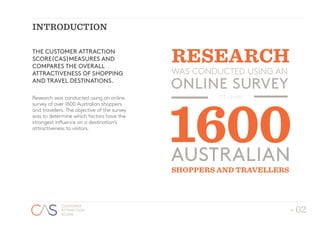
THE CUSTOMER ATTRACTION
SCORE(CAS)MEASURES AND
COMPARES THE OVERALL
ATTRACTIVENESS OF SHOPPING
AND TRAVEL DESTINATIONS.
Research was conducted using an online
survey of over 1600 Australian shoppers
and travellers. The objective of the survey
was to determine which factors have the
strongest influence on a destination’s
attractiveness to visitors.
INTRODUCTION
- 03
CUSTOMER
ATTRACTION
SCORE
RESEARCH
APPROACH
- 04
CUSTOMER
ATTRACTION
SCORE
- 04
CUSTOMER
ATTRACTION
SCORE
RESEARCH
APPROACH
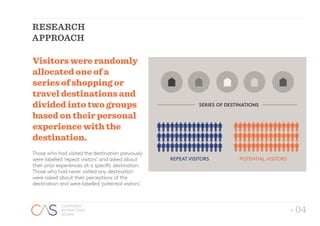
REPEAT VISITORS
SERIES OF DESTINATIONS
POTENTIAL VISITORS
Visitors were randomly
allocated one of a
series of shopping or
travel destinations and
divided into two groups
based on their personal
experience with the
destination.
Those who had visited the destination previously
were labelled ‘repeat visitors’ and asked about
their prior experiences at a specific destination.
Those who had never visited any destination
were asked about their perceptions of the
destination and were labelled ‘potential visitors’.
- 05
CUSTOMER
ATTRACTION
SCORE
TEXT GOES
HERE
“THE CAS IS A DESTINATION-SPECIFIC RESEARCH
TOOL, WHICH MEASURES CUSTOMER PERCEPTIONS
AND EXPERIENCES TO COMPARE THE OVERALL
ABILITY OF YOUR SHOPPING CENTRES IN ATTRACTING
CUSTOMERS RELATIVE TO THE COMPETING MARKET.”
- 05
CUSTOMER
ATTRACTION
SCORE
CUSTOMER
ATTRACTION
MEASUREMENT
- 06
1. DRIVING FACTORS
CUSTOMER
ATTRACTION
SCORE
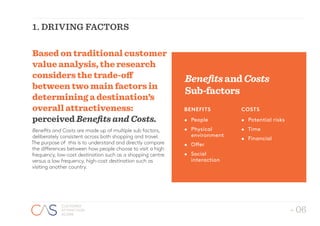
Based on traditional customer
value analysis, the research
considers the trade-off
between two main factors in
determining a destination’s
overall attractiveness:
perceived Benefits and Costs.
Benefits and Costs are made up of multiple sub factors,
deliberately consistent across both shopping and travel.
The purpose of this is to understand and directly compare
the differences between how people choose to visit a high
frequency, low-cost destination such as a shopping centre
versus a low frequency, high-cost destination such as
visiting another country.
COSTS
•	 Potential risks
•	 Time
•	 Financial
BENEFITS
•	 People
•	 Physical
environment
•	 Offer
•	 Social
interaction
BenefitsandCosts
Sub-factors
- 07
CUSTOMER
ATTRACTION
SCORE
- 07
CUSTOMER
ATTRACTION
SCORE
MARKETING
CHANNELS
Potential visitors were asked which
channels impacted their perceptions
of the destination.
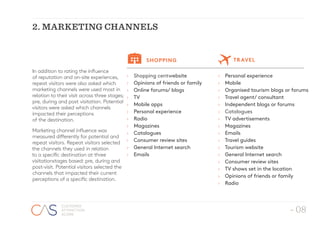
›› Shopping centwebsite
›› Opinions of friends or family
›› Online forums/ blogs
›› TV
›› Mobile apps
›› Personal experience
›› Radio
›› Magazines
›› Catalogues
›› Consumer review sites
›› General Internet search
›› Emails
- 08
2. MARKETING CHANNELS
CUSTOMER
ATTRACTION
SCORE
In addition to rating the influence
of reputation and on-site experiences,
repeat visitors were also asked which
marketing channels were used most in
relation to their visit across three stages;
pre, during and post visitation. Potential
visitors were asked which channels
impacted their perceptions
of the destination.
Marketing channel influence was
measured differently for potential and
repeat visitors. Repeat visitors selected
the channels they used in relation
to a specific destination at three
visitationstages based: pre, during and
post-visit. Potential visitors selected the
channels that impacted their current
perceptions of a specific destination.
›› Personal experience
›› Mobile
›› Organised tourism blogs or forums
›› Travel agent/ consultant
›› Independent blogs or forums
›› Catalogues
›› TV advertisements
›› Magazines
›› Emails
›› Travel guides
›› Tourism website
›› General Internet search
›› Consumer review sites
›› TV shows set in the location
›› Opinions of friends or family
›› Radio
TRAVELSHOPPING
- 09
CUSTOMER
ATTRACTION
SCORE
TEXT GOES
HERE
“THE CAS IS A DESTINATION-SPECIFIC RESEARCH
TOOL, WHICH MEASURES CUSTOMER PERCEPTIONS
AND EXPERIENCES TO COMPARE THE OVERALL
ABILITY OF YOUR SHOPPING CENTRES IN ATTRACTING
CUSTOMERS RELATIVE TO THE COMPETING MARKET.”
- 09
CUSTOMER
ATTRACTION
SCORE
OVERALL
ATTRACTION
- 10
CUSTOMER
ATTRACTION
SCORE
- 10
CUSTOMER
ATTRACTION
SCORE
OVERALL ATTRACTION
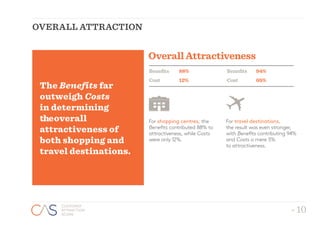
The Benefits far
outweigh Costs
in determining
theoverall
attractiveness of
both shopping and
travel destinations.
For shopping centres, the
Benefits contributed 88% to
attractiveness, while Costs
were only 12%.
For travel destinations,
the result was even stronger,
with Benefits contributing 94%
and Costs a mere 5%
to attractiveness.
88%
12%
94%
05%
Benefits
Cost
Benefits
Cost
OverallAttractiveness
- 11
CUSTOMER
ATTRACTION
SCORE
Benefits
OVER Costs
The Benefits of a destination therefore have a far
greater impact on its overall attractiveness than
the Costs. This means that it is far more effective to
focus on promoting the Benefits of a destination rather
than reduced Costs. This contradicts many marketing
strategies, which promote sales and offers to attract
shoppers, which may lead to a short-term boost in
visitation, but ultimately commoditises the experience.
- 12
CUSTOMER
ATTRACTION
SCORE
KEY
LEARNING
To have the greatest positive impact on destination
attractiveness, shopping destination owners and
managers should focus marketing and onsite
upgrades on increasing perceived Benefits rather than
on promoting assurances to reduce perceived costs
When people travel, they are almost entirely
concerned with the Benefits. When planning a trip,
people appear to prepare for the Costs in lieu of the
travel experience. People may also place a premium
on destinations that are harder to get to, since it
makes the destination scarcer and often increases
the positive impression among others.
- 13
CUSTOMER
ATTRACTION
SCORE
Benefits: Sub-Factors
#1: SOCIAL
INTERACTION
Whether a shopping or travel destination,
the Benefit people are most interested in
is social interaction. For shopping destinations,
this indicates value in building the reputation
of the centre and making it a place that people
want to visit with friends and family.
- 14
CUSTOMER
ATTRACTION
SCORE
- 14
CUSTOMER
ATTRACTION
SCORE
Benefits: Sub-Factors
#1: SOCIAL INTERACTION
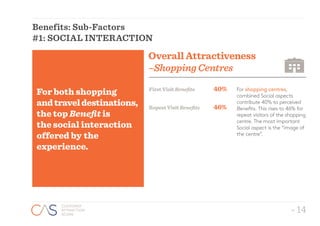
40%
46%
FirstVisitBenefits
RepeatVisitBenefits
For both shopping
andtraveldestinations,
the top Benefit is
the social interaction
offered by the
experience.
For shopping centres,
combined Social aspects
contribute 40% to perceived
Benefits. This rises to 46% for
repeat visitors of the shopping
centre. The most important
Social aspect is the “image of
the centre”.
OverallAttractiveness
–ShoppingCentres
- 15
CUSTOMER
ATTRACTION
SCORE
- 15
CUSTOMER
ATTRACTION
SCORE
Benefits: Sub-Factors
#1: SOCIAL INTERACTION
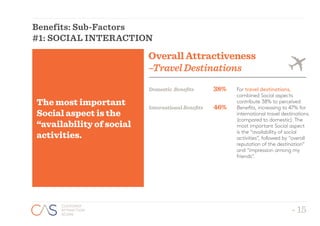
The most important
Social aspect is the
“availability of social
activities.
OverallAttractiveness
–TravelDestinations
For travel destinations,
combined Social aspects
contribute 38% to perceived
Benefits, increasing to 47% for
international travel destinations
(compared to domestic). The
most important Social aspect
is the “availability of social
activities”, followed by “overall
reputation of the destination”
and “impression among my
friends”.
38%
46%
Domestic Benefits
InternationalBenefits
- 16
CUSTOMER
ATTRACTION
SCORE
KEY
LEARNING
The strongest influence on how attractive a shopping
destination is its image/reputation and how well it
facilitates social interaction with friends and family.
The social interactions facilitated by travel destinations
improves overall attractiveness. This suggests that travel
destination marketing should focus on promoting the
destination as a place to meet new people and strengthen
bonds between travellers. Social experiences are even more
important for international travel destinations, which points
to the heightened value that people place on meeting locals.
or relating to people from different cultures.
- 17
CUSTOMER
ATTRACTION
SCORE
Benefits: Sub-Factors
#2 OFFER
(shopping) and
PHYSICAL
PLACE (travel)
- 18
CUSTOMER
ATTRACTION
SCORE
- 18
CUSTOMER
ATTRACTION
SCORE
Benefits: Sub-Factors
#2: OFFER (shopping) AND
PHYSICAL PLACE (travel)
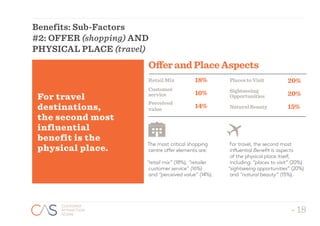
The most critical shopping
centre offer elements are:
“retail mix” (18%), “retailer
customer service” (16%)
and “perceived value” (14%).
For travel, the second most
influential Benefit is aspects
of the physical place itself,
including: “places to visit” (20%)
“sightseeing opportunities” (20%)
and “natural beauty” (15%).
18%
16%
14%
20%
20%
15%
PlacestoVisit
Sightseeing
Opportunities
NaturalBeauty
RetailMix
Customer
service
Perceived
value
OfferandPlaceAspects
For travel
destinations,
the second most
influential
benefit is the
physical place.
- 19
CUSTOMER
ATTRACTION
SCORE
- 19
CUSTOMER
ATTRACTION
SCORE
KEY
LEARNING
The offer is about the functional aspects of shopping:
store selection, food court, customer service.
This result suggests that if a centre is well regarded,
but is not a place that meets utilitarian needs, it will
not be an attractive shopping destination.
In comparison, travel destinations should focus more
on promoting significant places to visit and things to
see, followed by local shops, restaurants and nightlife.
- 20
CUSTOMER
ATTRACTION
SCORE
Benefits: Sub-Factors
#3 OTHER
PEOPLE
 SERVICE
- 21
CUSTOMER
ATTRACTION
SCORE
- 21
CUSTOMER
ATTRACTION
SCORE
Benefits: Sub-Factors
#3 OTHER PEOPLE  SERVICE
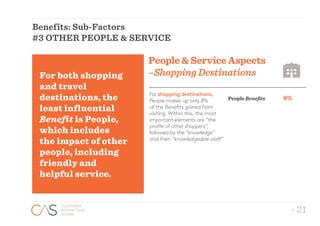
For shopping destinations,
People makes up only 8%
of the Benefits gained from
visiting. Within this, the most
important elements are “the
profile of other shoppers”,
followed by the “knowledge”
and then “knowledgeable staff”.
8%PeopleBenefits
PeopleServiceAspects
–ShoppingDestinationsFor both shopping
and travel
destinations, the
least influential
Benefit is People,
which includes
the impact of other
people, including
friendly and
helpful service.
- 22
CUSTOMER
ATTRACTION
SCORE
- 22
CUSTOMER
ATTRACTION
SCORE
Benefits: Sub-Factors
#3 OTHER PEOPLE  SERVICE
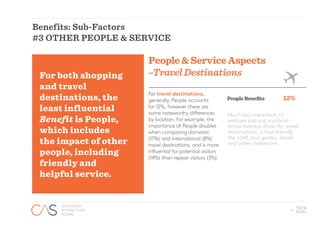
For travel destinations,
generally, People accounts
for 12%, however there are
some noteworthy differences
by location. For example, the
importance of People doubles
when comparing domestic
(17%) and international (8%)
travel destinations, and is more
influential for potential visitors
(14%) than repeat visitors (3%).
12%PeopleBenefits
PeopleServiceAspects
–TravelDestinationsFor both shopping
and travel
destinations, the
least influential
Benefit is People,
which includes
the impact of other
people, including
friendly and
helpful service.
Much less important, or
perhaps just not a critical
attractiveness driver for travel
destinations, is how friendly
the staff, tour guides, locals
and other visitors are.
- 23
CUSTOMER
ATTRACTION
SCORE
KEY
LEARNING
In terms of visitation, potential visitors are concerned
about whether others will be helpful, but this sub
factor does not rate highly for repeat visitors.
This suggests that it is most effective to promote
staff friendliness and service delivery in targeting
potential visitors to a destination.
- 24
CUSTOMER
ATTRACTION
SCORE
Shopping Costs: Sub-Factors
#1 FINANCIAL
The key Cost impacting shopping destination
attractiveness is Financial, and includes the
travel cost to get there and get around, parking,
food court, and the price point of stores.
- 25
CUSTOMER
ATTRACTION
SCORE
- 25
CUSTOMER
ATTRACTION
SCORE
SHOPPING CENTRE COST SUB-FACTORS
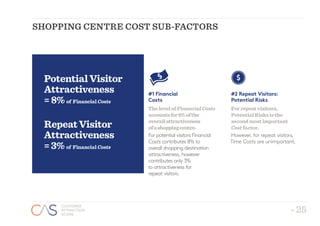
#1 Financial
Costs
ThelevelofFinancialCosts
accountsfor6%ofthe
overallattractiveness
ofashoppingcentre.
For potential visitors Financial
Costs contributes 8% to
overall shopping destination
attractiveness, however
contributes only 3%
to attractiveness for
repeat visitors.
#2 Repeat Visitors:
Potential Risks
Forrepeatvisitors,
PotentialRisksisthe
secondmostimportant
Costfactor.
However, for repeat visitors,
Time Costs are unimportant.
PotentialVisitor
Attractiveness
=8%of FinancialCosts
RepeatVisitor
Attractiveness
=3%of FinancialCosts
- 26
CUSTOMER
ATTRACTION
SCORE
KEY
LEARNING
Invest in making it easy for first time visitors to get to the
centre (e.g. shuttle buses, signage, offsite marketing that
includes transport tips). Onsite, establish clear way finding
a priority and offer it through a variety of channels to suit
personal preferences (e.g. printed maps, smart phone
navigation, signage)meeting locals.
- 27
CUSTOMER
ATTRACTION
SCORE
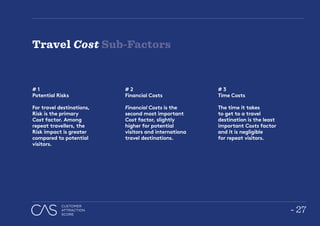
# 1
Potential Risks
For travel destinations,
Risk is the primary
Cost factor. Among
repeat travellers, the
Risk impact is greater
compared to potential
visitors.
# 3
Time Costs
The time it takes
to get to a travel
destination is the least
important Costs factor
and it is negligible
for repeat visitors.
# 2
Financial Costs
Financial Costs is the
second most important
Cost factor, slightly
higher for potential
visitors and internationa
travel destinations.
Travel Cost Sub-Factors
- 28
CUSTOMER
ATTRACTION
SCORE
KEY
LEARNING
Operators should invest in measures to ensure and promote
safety. Even if visitors don’t personally experience any physical
harm, their sense of vulnerability or being unable to gauge
the security of a situation will have a lasting impact on their
impression of the destination.
Despite the fact that travel often requires substantial time,
the Time Costs fades in comparison to the experience for
repeat visitors.
- 29
CUSTOMER
ATTRACTION
SCORE
MARKETING
CHANNEL
INFLUENCE
- 30
CUSTOMER
ATTRACTION
SCORE
- 30
CUSTOMER
ATTRACTION
SCORE
Destination: Pre-Visitation
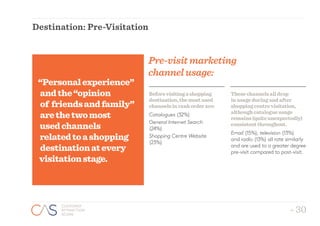
Beforevisitingashopping
destination,themostused
channelsinrankorderare:
Catalogues (32%)
General Internet Search
(24%)
Shopping Centre Website
(23%)
Thesechannelsalldrop
inusageduringandafter
shoppingcentrevisitation,
althoughcatalogueusage
remains(quiteunexpectedly)
consistentthroughout.
Email (15%), television (13%)
and radio (13%) all rate similarly
and are used to a greater degree
pre-visit compared to post-visit.
Pre-visitmarketing
channelusage:
“Personalexperience”
andthe“opinion
of friendsandfamily”
arethetwomost
usedchannels
relatedtoashopping
destinationatevery
visitationstage.
- 31
CUSTOMER
ATTRACTION
SCORE
- 31
CUSTOMER
ATTRACTION
SCORE
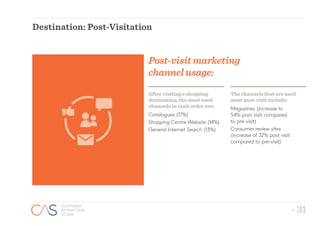
Destination: Post-Visitation
Aftervisitingashopping
destination,themostused
channelsinrankorderare:
Catalogues (17%)
Shopping Centre Website (14%)
General Internet Search (13%)
Thechannelsthatareused
mostpost-visitinclude:
Magazines (increase to
54% post visit compared
to pre-visit)
Consumer review sites
(increase of 32% post visit
compared to pre-visit)
Post-visitmarketing
channelusage:
- 32
CUSTOMER
ATTRACTION
SCORE
- 32
CUSTOMER
ATTRACTION
SCORE
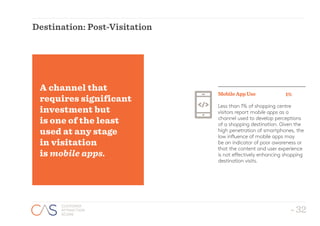
Destination: Post-Visitation
Less than 1% of shopping centre
visitors report mobile apps as a
channel used to develop perceptions
of a shopping destination. Given the
high penetration of smartphones, the
low influence of mobile apps may
be an indicator of poor awareness or
that the content and user experience
is not effectively enhancing shopping
destination visits.
A channel that
requires significant
investment but
is one of the least
used at any stage
in visitation
is mobile apps.
MobileAppUse 1%
- 33
CUSTOMER
ATTRACTION
SCORE
- 33
CUSTOMER
ATTRACTION
SCORE
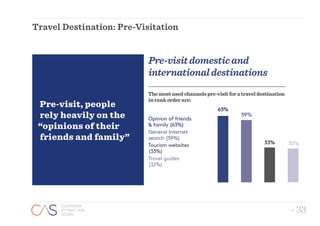
63+59+33+32
Travel Destination: Pre-Visitation
Themostusedchannelspre-visitforatraveldestination
inrankorderare:
Pre-visitdomesticand
internationaldestinations
Pre-visit, people
rely heavily on the
“opinions of their
friends and family”
Opinion of friends
 family (63%)
General Internet
search (59%)
Tourism websites
(33%)
Travel guides
(32%)
63%
59%
33% 32%
- 34
CUSTOMER
ATTRACTION
SCORE
- 34
CUSTOMER
ATTRACTION
SCORE
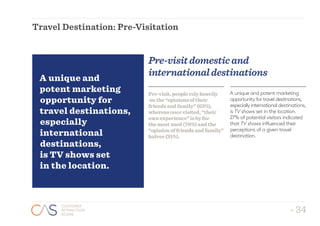
Travel Destination: Pre-Visitation
A unique and potent marketing
opportunity for travel destinations,
especially international destinations,
is TV shows set in the location.
27% of potential visitors indicated
that TV shows influenced their
perceptions of a given travel
destination.
Pre-visitdomesticand
internationaldestinations
A unique and
potent marketing
opportunity for
travel destinations,
especially
international
destinations,
is TV shows set
in the location.
Pre-visit,peoplerelyheavily
onthe“opinionsoftheir
friendsandfamily”(63%),
whereasoncevisited,“their
ownexperience”isbyfar
themostused(70%)andthe
“opinionoffriendsandfamily”
halves(31%).
- 35
CUSTOMER
ATTRACTION
SCORE
- 35
CUSTOMER
ATTRACTION
SCORE
Travel Destination: Post-visitation
Even at 31%, the opinion
of friends and family is highly
used, followed by general
Internet search (28%)
and travel guides (18%)
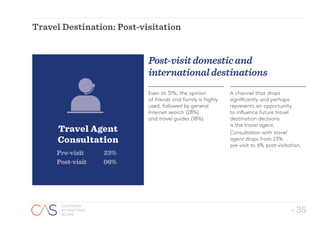
A channel that drops
significantly and perhaps
represents an opportunity
to influence future travel
destination decisions
is the travel agent.
Consultation with travel
agent drops from 23%
pre-visit to 6% post-visitation.
Post-visitdomesticand
internationaldestinations
Travel Agent
Consultation
23%
06%
Pre-visit
Post-visit
- 36
CUSTOMER
ATTRACTION
SCORE
- 36
CUSTOMER
ATTRACTION
SCORE
Travel Destination: Post-visitation
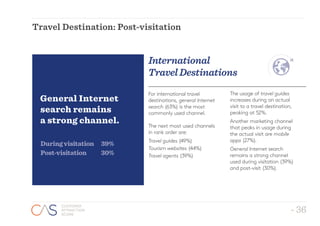
For international travel
destinations, general Internet
search (63%) is the most
commonly used channel.
The next most used channels
in rank order are:
Travel guides (49%)
Tourism websites (44%)
Travel agents (39%)
General Internet
search remains
a strong channel.
39%
30%
Duringvisitation
Post-visitation
The usage of travel guides
increases during an actual
visit to a travel destination,
peaking at 52%.
Another marketing channel
that peaks in usage during
the actual visit are mobile
apps (27%).
General Internet search
remains a strong channel
used during visitation (39%)
and post-visit (30%).
International
TravelDestinations
- 37
CUSTOMER
ATTRACTION
SCORE
- 37
CUSTOMER
ATTRACTION
SCORE
Travel Destination: Post-visitation
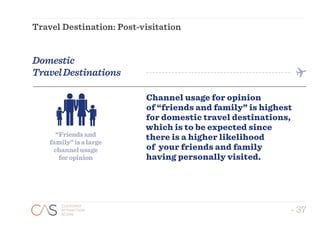
Domestic
TravelDestinations
Channel usage for opinion
of “friends and family” is highest
for domestic travel destinations,
which is to be expected since
there is a higher likelihood
of your friends and family
having personally visited.
“Friendsand
family”isalarge
channelusage
foropinion
- 38
CUSTOMER
ATTRACTION
SCORE
- 38
CUSTOMER
ATTRACTION
SCORE
Travel Destination: Post-visitation
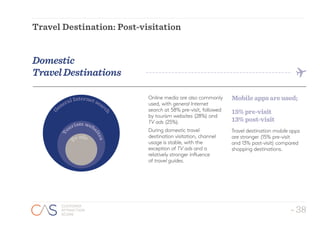
Online media are also commonly
used, with general Internet
search at 58% pre-visit, followed
by tourism websites (28%) and
TV ads (25%).
During domestic travel
destination visitation, channel
usage is stable, with the
exception of TV ads and a
relatively stronger influence
of travel guides.
Domestic
TravelDestinations
Travel destination mobile apps
are stronger (15% pre-visit
and 13% post-visit) compared
shopping destinations.
Mobileappsareused;
15%pre-visit
13%post-visit
G
eneral Internet sear
ch
T
ourism web
sites
Tvads
- 39
CUSTOMER
ATTRACTION
SCORE
- 39
CUSTOMER
ATTRACTION
SCORE
Travel Destination: Post-visitation
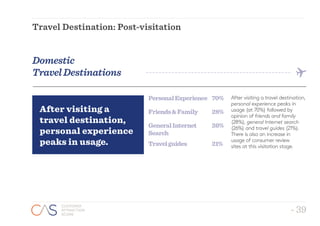
After visiting a
travel destination,
personal experience
peaks in usage.
70%
28%
26%
21%
PersonalExperience
FriendsFamily
GeneralInternet
Search
Travelguides
After visiting a travel destination,
personal experience peaks in
usage (at 70%) followed by
opinion of friends and family
(28%), general Internet search
(26%) and travel guides (21%).
There is also an increase in
usage of consumer review
sites at this visitation stage.
Domestic
TravelDestinations
- 40
CUSTOMER
ATTRACTION
SCORE
APPENDIX:
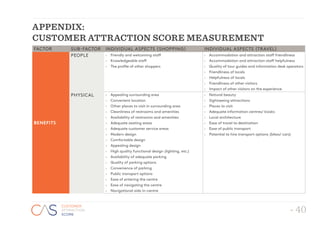
CUSTOMER ATTRACTION SCORE MEASUREMENT
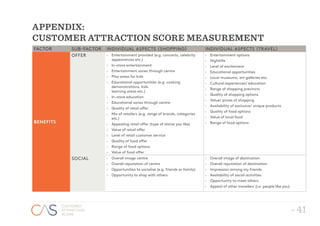
FACTOR SUB-FACTOR INDIVIDUAL ASPECTS (SHOPPING) INDIVIDUAL ASPECTS (TRAVEL)
BENEFITS
PEOPLE ›› Friendly and welcoming staff
›› Knowledgeable staff
›› The profile of other shoppers
›› Accommodation and attraction staff friendliness
›› Accommodation and attraction staff helpfulness
›› Quality of tour guides and information desk operators
›› Friendliness of locals
›› Helpfulness of locals
›› Friendliness of other visitors
›› Impact of other visitors on the experience
PHYSICAL ›› Appealing surrounding area
›› Convenient location
›› Other places to visit in surrounding area
›› Cleanliness of restrooms and amenities
›› Availability of restrooms and amenities
›› Adequate seating areas
›› Adequate customer service areas
›› Modern design
›› Comfortable design
›› Appealing design
›› High quality functional design (lighting, etc.)
›› Availability of adequate parking
›› Quality of parking options
›› Convenience of parking
›› Public transport options
›› Ease of entering the centre
›› Ease of navigating the centre
›› Navigational aids in-centre
›› Natural beauty
›› Sightseeing attractions
›› Places to visit
›› Adequate information centres/ kiosks
›› Local architecture
›› Ease of travel to destination
›› Ease of public transport
›› Potential to hire transport options (bikes/ cars)
- 41
CUSTOMER
ATTRACTION
SCORE
FACTOR SUB-FACTOR INDIVIDUAL ASPECTS (SHOPPING) INDIVIDUAL ASPECTS (TRAVEL)
BENEFITS
OFFER ›› Entertainment provided (e.g. concerts, celebrity
appearances etc.)
›› In-store entertainment
›› Entertainment zones through centre
›› Play areas for kids
›› Educational opportunities (e.g. cooking
demonstrations, kids
learning areas etc.)
›› In-store education
›› Educational zones through centre
›› Quality of retail offer
›› Mix of retailers (e.g. range of brands, categories
etc.)
›› Appealing retail offer (type of stores you like)
›› Value of retail offer
›› Level of retail customer service
›› Quality of food offer
›› Range of food options
›› Value of food offer
›› Entertainment options
›› Nightlife
›› Level of excitement
›› Educational opportunities
›› Local museums, art galleries etc.
›› Cultural experiences/ education
›› Range of shopping precincts
›› Quality of shopping options
›› Value/ prices of shopping
›› Availability of exclusive/ unique products
›› Quality of food options
›› Value of local food
›› Range of food options
SOCIAL ›› Overall image centre
›› Overall reputation of centre
›› Opportunities to socialise (e.g. friends or family)
›› Opportunity to shop with others
›› Overall image of destination
›› Overall reputation of destination
›› Impression among my friends
›› Availability of social activities
›› Opportunity to meet others
›› Appeal of other travellers (i.e. people like you)
APPENDIX:
CUSTOMER ATTRACTION SCORE MEASUREMENT
- 42
CUSTOMER
ATTRACTION
SCORE
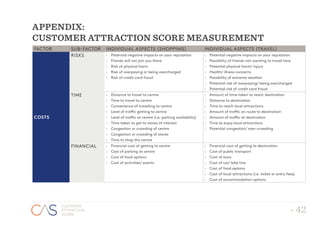
FACTOR SUB-FACTOR INDIVIDUAL ASPECTS (SHOPPING) INDIVIDUAL ASPECTS (TRAVEL)
COSTS
RISKS ›› Potential negative impacts on your reputation
›› Friends will not join you there
›› Risk of physical harm
›› Risk of overpaying or being overcharged
›› Risk of credit card fraud
›› Potential negative impacts on your reputation
›› Possibility of friends not wanting to travel here
›› Potential physical harm/ injury
›› Health/ illness concerns
›› Possibility of extreme weather
›› Potential risk of overpaying/ being overcharged
›› Potential risk of credit card fraud
TIME ›› Distance to travel to centre
›› Time to travel to centre
›› Convenience of travelling to centre
›› Level of traffic getting to centre
›› Level of traffic at centre (i.e. parking availability)
›› Time taken to get to stores of interest
›› Congestion or crowding of centre
›› Congestion or crowding of stores
›› Time to shop the centre
›› Amount of time taken to reach destination
›› Distance to destination
›› Time to reach local attractions
›› Amount of traffic on route to destination
›› Amount of traffic at destination
›› Time to enjoy local attractions
›› Potential congestion/ over-crowding
FINANCIAL ›› Financial cost of getting to centre
›› Cost of parking at centre
›› Cost of food options
›› Cost of activities/ events
›› Financial cost of getting to destination
›› Cost of public transport
›› Cost of taxis
›› Cost of car/ bike hire
›› Cost of food options
›› Cost of local attractions (i.e. ticket or entry fees)
›› Cost of accommodation options
APPENDIX:
CUSTOMER ATTRACTION SCORE MEASUREMENT
- 43
CUSTOMER
ATTRACTION
SCORE
- 43
CUSTOMER
ATTRACTION
SCORE
THANK YOU
CONTACT
SEAN SANDS
Research Director
Australian Centre for Retail Studies
sean.sands@monash.edu
DAVID GRANT
Strategy Director
Place Associates
david.grant@placeassociates.com.au

CAS_Overall_Findings

  • 1.
  • 2.
    - 02- 02 CUSTOMER ATTRACTION SCORE CUSTOMER ATTRACTION SCORE RESEARCH WASCONDUCTED USING AN ONLINE SURVEY 1600AUSTRALIAN SHOPPERS AND TRAVELLERS THE CUSTOMER ATTRACTION SCORE(CAS)MEASURES AND COMPARES THE OVERALL ATTRACTIVENESS OF SHOPPING AND TRAVEL DESTINATIONS. Research was conducted using an online survey of over 1600 Australian shoppers and travellers. The objective of the survey was to determine which factors have the strongest influence on a destination’s attractiveness to visitors. INTRODUCTION
  • 3.
  • 4.
    - 04 CUSTOMER ATTRACTION SCORE - 04 CUSTOMER ATTRACTION SCORE RESEARCH APPROACH REPEATVISITORS SERIES OF DESTINATIONS POTENTIAL VISITORS Visitors were randomly allocated one of a series of shopping or travel destinations and divided into two groups based on their personal experience with the destination. Those who had visited the destination previously were labelled ‘repeat visitors’ and asked about their prior experiences at a specific destination. Those who had never visited any destination were asked about their perceptions of the destination and were labelled ‘potential visitors’.
  • 5.
    - 05 CUSTOMER ATTRACTION SCORE TEXT GOES HERE “THECAS IS A DESTINATION-SPECIFIC RESEARCH TOOL, WHICH MEASURES CUSTOMER PERCEPTIONS AND EXPERIENCES TO COMPARE THE OVERALL ABILITY OF YOUR SHOPPING CENTRES IN ATTRACTING CUSTOMERS RELATIVE TO THE COMPETING MARKET.” - 05 CUSTOMER ATTRACTION SCORE CUSTOMER ATTRACTION MEASUREMENT
  • 6.
    - 06 1. DRIVINGFACTORS CUSTOMER ATTRACTION SCORE Based on traditional customer value analysis, the research considers the trade-off between two main factors in determining a destination’s overall attractiveness: perceived Benefits and Costs. Benefits and Costs are made up of multiple sub factors, deliberately consistent across both shopping and travel. The purpose of this is to understand and directly compare the differences between how people choose to visit a high frequency, low-cost destination such as a shopping centre versus a low frequency, high-cost destination such as visiting another country. COSTS • Potential risks • Time • Financial BENEFITS • People • Physical environment • Offer • Social interaction BenefitsandCosts Sub-factors
  • 7.
    - 07 CUSTOMER ATTRACTION SCORE - 07 CUSTOMER ATTRACTION SCORE MARKETING CHANNELS Potentialvisitors were asked which channels impacted their perceptions of the destination.
  • 8.
    ›› Shopping centwebsite ››Opinions of friends or family ›› Online forums/ blogs ›› TV ›› Mobile apps ›› Personal experience ›› Radio ›› Magazines ›› Catalogues ›› Consumer review sites ›› General Internet search ›› Emails - 08 2. MARKETING CHANNELS CUSTOMER ATTRACTION SCORE In addition to rating the influence of reputation and on-site experiences, repeat visitors were also asked which marketing channels were used most in relation to their visit across three stages; pre, during and post visitation. Potential visitors were asked which channels impacted their perceptions of the destination. Marketing channel influence was measured differently for potential and repeat visitors. Repeat visitors selected the channels they used in relation to a specific destination at three visitationstages based: pre, during and post-visit. Potential visitors selected the channels that impacted their current perceptions of a specific destination. ›› Personal experience ›› Mobile ›› Organised tourism blogs or forums ›› Travel agent/ consultant ›› Independent blogs or forums ›› Catalogues ›› TV advertisements ›› Magazines ›› Emails ›› Travel guides ›› Tourism website ›› General Internet search ›› Consumer review sites ›› TV shows set in the location ›› Opinions of friends or family ›› Radio TRAVELSHOPPING
  • 9.
    - 09 CUSTOMER ATTRACTION SCORE TEXT GOES HERE “THECAS IS A DESTINATION-SPECIFIC RESEARCH TOOL, WHICH MEASURES CUSTOMER PERCEPTIONS AND EXPERIENCES TO COMPARE THE OVERALL ABILITY OF YOUR SHOPPING CENTRES IN ATTRACTING CUSTOMERS RELATIVE TO THE COMPETING MARKET.” - 09 CUSTOMER ATTRACTION SCORE OVERALL ATTRACTION
  • 10.
    - 10 CUSTOMER ATTRACTION SCORE - 10 CUSTOMER ATTRACTION SCORE OVERALLATTRACTION The Benefits far outweigh Costs in determining theoverall attractiveness of both shopping and travel destinations. For shopping centres, the Benefits contributed 88% to attractiveness, while Costs were only 12%. For travel destinations, the result was even stronger, with Benefits contributing 94% and Costs a mere 5% to attractiveness. 88% 12% 94% 05% Benefits Cost Benefits Cost OverallAttractiveness
  • 11.
    - 11 CUSTOMER ATTRACTION SCORE Benefits OVER Costs TheBenefits of a destination therefore have a far greater impact on its overall attractiveness than the Costs. This means that it is far more effective to focus on promoting the Benefits of a destination rather than reduced Costs. This contradicts many marketing strategies, which promote sales and offers to attract shoppers, which may lead to a short-term boost in visitation, but ultimately commoditises the experience.
  • 12.
    - 12 CUSTOMER ATTRACTION SCORE KEY LEARNING To havethe greatest positive impact on destination attractiveness, shopping destination owners and managers should focus marketing and onsite upgrades on increasing perceived Benefits rather than on promoting assurances to reduce perceived costs When people travel, they are almost entirely concerned with the Benefits. When planning a trip, people appear to prepare for the Costs in lieu of the travel experience. People may also place a premium on destinations that are harder to get to, since it makes the destination scarcer and often increases the positive impression among others.
  • 13.
    - 13 CUSTOMER ATTRACTION SCORE Benefits: Sub-Factors #1:SOCIAL INTERACTION Whether a shopping or travel destination, the Benefit people are most interested in is social interaction. For shopping destinations, this indicates value in building the reputation of the centre and making it a place that people want to visit with friends and family.
  • 14.
    - 14 CUSTOMER ATTRACTION SCORE - 14 CUSTOMER ATTRACTION SCORE Benefits:Sub-Factors #1: SOCIAL INTERACTION 40% 46% FirstVisitBenefits RepeatVisitBenefits For both shopping andtraveldestinations, the top Benefit is the social interaction offered by the experience. For shopping centres, combined Social aspects contribute 40% to perceived Benefits. This rises to 46% for repeat visitors of the shopping centre. The most important Social aspect is the “image of the centre”. OverallAttractiveness –ShoppingCentres
  • 15.
    - 15 CUSTOMER ATTRACTION SCORE - 15 CUSTOMER ATTRACTION SCORE Benefits:Sub-Factors #1: SOCIAL INTERACTION The most important Social aspect is the “availability of social activities. OverallAttractiveness –TravelDestinations For travel destinations, combined Social aspects contribute 38% to perceived Benefits, increasing to 47% for international travel destinations (compared to domestic). The most important Social aspect is the “availability of social activities”, followed by “overall reputation of the destination” and “impression among my friends”. 38% 46% Domestic Benefits InternationalBenefits
  • 16.
    - 16 CUSTOMER ATTRACTION SCORE KEY LEARNING The strongestinfluence on how attractive a shopping destination is its image/reputation and how well it facilitates social interaction with friends and family. The social interactions facilitated by travel destinations improves overall attractiveness. This suggests that travel destination marketing should focus on promoting the destination as a place to meet new people and strengthen bonds between travellers. Social experiences are even more important for international travel destinations, which points to the heightened value that people place on meeting locals. or relating to people from different cultures.
  • 17.
    - 17 CUSTOMER ATTRACTION SCORE Benefits: Sub-Factors #2OFFER (shopping) and PHYSICAL PLACE (travel)
  • 18.
    - 18 CUSTOMER ATTRACTION SCORE - 18 CUSTOMER ATTRACTION SCORE Benefits:Sub-Factors #2: OFFER (shopping) AND PHYSICAL PLACE (travel) The most critical shopping centre offer elements are: “retail mix” (18%), “retailer customer service” (16%) and “perceived value” (14%). For travel, the second most influential Benefit is aspects of the physical place itself, including: “places to visit” (20%) “sightseeing opportunities” (20%) and “natural beauty” (15%). 18% 16% 14% 20% 20% 15% PlacestoVisit Sightseeing Opportunities NaturalBeauty RetailMix Customer service Perceived value OfferandPlaceAspects For travel destinations, the second most influential benefit is the physical place.
  • 19.
    - 19 CUSTOMER ATTRACTION SCORE - 19 CUSTOMER ATTRACTION SCORE KEY LEARNING Theoffer is about the functional aspects of shopping: store selection, food court, customer service. This result suggests that if a centre is well regarded, but is not a place that meets utilitarian needs, it will not be an attractive shopping destination. In comparison, travel destinations should focus more on promoting significant places to visit and things to see, followed by local shops, restaurants and nightlife.
  • 20.
  • 21.
    - 21 CUSTOMER ATTRACTION SCORE - 21 CUSTOMER ATTRACTION SCORE Benefits:Sub-Factors #3 OTHER PEOPLE SERVICE For shopping destinations, People makes up only 8% of the Benefits gained from visiting. Within this, the most important elements are “the profile of other shoppers”, followed by the “knowledge” and then “knowledgeable staff”. 8%PeopleBenefits PeopleServiceAspects –ShoppingDestinationsFor both shopping and travel destinations, the least influential Benefit is People, which includes the impact of other people, including friendly and helpful service.
  • 22.
    - 22 CUSTOMER ATTRACTION SCORE - 22 CUSTOMER ATTRACTION SCORE Benefits:Sub-Factors #3 OTHER PEOPLE SERVICE For travel destinations, generally, People accounts for 12%, however there are some noteworthy differences by location. For example, the importance of People doubles when comparing domestic (17%) and international (8%) travel destinations, and is more influential for potential visitors (14%) than repeat visitors (3%). 12%PeopleBenefits PeopleServiceAspects –TravelDestinationsFor both shopping and travel destinations, the least influential Benefit is People, which includes the impact of other people, including friendly and helpful service. Much less important, or perhaps just not a critical attractiveness driver for travel destinations, is how friendly the staff, tour guides, locals and other visitors are.
  • 23.
    - 23 CUSTOMER ATTRACTION SCORE KEY LEARNING In termsof visitation, potential visitors are concerned about whether others will be helpful, but this sub factor does not rate highly for repeat visitors. This suggests that it is most effective to promote staff friendliness and service delivery in targeting potential visitors to a destination.
  • 24.
    - 24 CUSTOMER ATTRACTION SCORE Shopping Costs:Sub-Factors #1 FINANCIAL The key Cost impacting shopping destination attractiveness is Financial, and includes the travel cost to get there and get around, parking, food court, and the price point of stores.
  • 25.
    - 25 CUSTOMER ATTRACTION SCORE - 25 CUSTOMER ATTRACTION SCORE SHOPPINGCENTRE COST SUB-FACTORS #1 Financial Costs ThelevelofFinancialCosts accountsfor6%ofthe overallattractiveness ofashoppingcentre. For potential visitors Financial Costs contributes 8% to overall shopping destination attractiveness, however contributes only 3% to attractiveness for repeat visitors. #2 Repeat Visitors: Potential Risks Forrepeatvisitors, PotentialRisksisthe secondmostimportant Costfactor. However, for repeat visitors, Time Costs are unimportant. PotentialVisitor Attractiveness =8%of FinancialCosts RepeatVisitor Attractiveness =3%of FinancialCosts
  • 26.
    - 26 CUSTOMER ATTRACTION SCORE KEY LEARNING Invest inmaking it easy for first time visitors to get to the centre (e.g. shuttle buses, signage, offsite marketing that includes transport tips). Onsite, establish clear way finding a priority and offer it through a variety of channels to suit personal preferences (e.g. printed maps, smart phone navigation, signage)meeting locals.
  • 27.
    - 27 CUSTOMER ATTRACTION SCORE # 1 PotentialRisks For travel destinations, Risk is the primary Cost factor. Among repeat travellers, the Risk impact is greater compared to potential visitors. # 3 Time Costs The time it takes to get to a travel destination is the least important Costs factor and it is negligible for repeat visitors. # 2 Financial Costs Financial Costs is the second most important Cost factor, slightly higher for potential visitors and internationa travel destinations. Travel Cost Sub-Factors
  • 28.
    - 28 CUSTOMER ATTRACTION SCORE KEY LEARNING Operators shouldinvest in measures to ensure and promote safety. Even if visitors don’t personally experience any physical harm, their sense of vulnerability or being unable to gauge the security of a situation will have a lasting impact on their impression of the destination. Despite the fact that travel often requires substantial time, the Time Costs fades in comparison to the experience for repeat visitors.
  • 29.
  • 30.
    - 30 CUSTOMER ATTRACTION SCORE - 30 CUSTOMER ATTRACTION SCORE Destination:Pre-Visitation Beforevisitingashopping destination,themostused channelsinrankorderare: Catalogues (32%) General Internet Search (24%) Shopping Centre Website (23%) Thesechannelsalldrop inusageduringandafter shoppingcentrevisitation, althoughcatalogueusage remains(quiteunexpectedly) consistentthroughout. Email (15%), television (13%) and radio (13%) all rate similarly and are used to a greater degree pre-visit compared to post-visit. Pre-visitmarketing channelusage: “Personalexperience” andthe“opinion of friendsandfamily” arethetwomost usedchannels relatedtoashopping destinationatevery visitationstage.
  • 31.
    - 31 CUSTOMER ATTRACTION SCORE - 31 CUSTOMER ATTRACTION SCORE Destination:Post-Visitation Aftervisitingashopping destination,themostused channelsinrankorderare: Catalogues (17%) Shopping Centre Website (14%) General Internet Search (13%) Thechannelsthatareused mostpost-visitinclude: Magazines (increase to 54% post visit compared to pre-visit) Consumer review sites (increase of 32% post visit compared to pre-visit) Post-visitmarketing channelusage:
  • 32.
    - 32 CUSTOMER ATTRACTION SCORE - 32 CUSTOMER ATTRACTION SCORE Destination:Post-Visitation Less than 1% of shopping centre visitors report mobile apps as a channel used to develop perceptions of a shopping destination. Given the high penetration of smartphones, the low influence of mobile apps may be an indicator of poor awareness or that the content and user experience is not effectively enhancing shopping destination visits. A channel that requires significant investment but is one of the least used at any stage in visitation is mobile apps. MobileAppUse 1%
  • 33.
    - 33 CUSTOMER ATTRACTION SCORE - 33 CUSTOMER ATTRACTION SCORE 63+59+33+32 TravelDestination: Pre-Visitation Themostusedchannelspre-visitforatraveldestination inrankorderare: Pre-visitdomesticand internationaldestinations Pre-visit, people rely heavily on the “opinions of their friends and family” Opinion of friends family (63%) General Internet search (59%) Tourism websites (33%) Travel guides (32%) 63% 59% 33% 32%
  • 34.
    - 34 CUSTOMER ATTRACTION SCORE - 34 CUSTOMER ATTRACTION SCORE TravelDestination: Pre-Visitation A unique and potent marketing opportunity for travel destinations, especially international destinations, is TV shows set in the location. 27% of potential visitors indicated that TV shows influenced their perceptions of a given travel destination. Pre-visitdomesticand internationaldestinations A unique and potent marketing opportunity for travel destinations, especially international destinations, is TV shows set in the location. Pre-visit,peoplerelyheavily onthe“opinionsoftheir friendsandfamily”(63%), whereasoncevisited,“their ownexperience”isbyfar themostused(70%)andthe “opinionoffriendsandfamily” halves(31%).
  • 35.
    - 35 CUSTOMER ATTRACTION SCORE - 35 CUSTOMER ATTRACTION SCORE TravelDestination: Post-visitation Even at 31%, the opinion of friends and family is highly used, followed by general Internet search (28%) and travel guides (18%) A channel that drops significantly and perhaps represents an opportunity to influence future travel destination decisions is the travel agent. Consultation with travel agent drops from 23% pre-visit to 6% post-visitation. Post-visitdomesticand internationaldestinations Travel Agent Consultation 23% 06% Pre-visit Post-visit
  • 36.
    - 36 CUSTOMER ATTRACTION SCORE - 36 CUSTOMER ATTRACTION SCORE TravelDestination: Post-visitation For international travel destinations, general Internet search (63%) is the most commonly used channel. The next most used channels in rank order are: Travel guides (49%) Tourism websites (44%) Travel agents (39%) General Internet search remains a strong channel. 39% 30% Duringvisitation Post-visitation The usage of travel guides increases during an actual visit to a travel destination, peaking at 52%. Another marketing channel that peaks in usage during the actual visit are mobile apps (27%). General Internet search remains a strong channel used during visitation (39%) and post-visit (30%). International TravelDestinations
  • 37.
    - 37 CUSTOMER ATTRACTION SCORE - 37 CUSTOMER ATTRACTION SCORE TravelDestination: Post-visitation Domestic TravelDestinations Channel usage for opinion of “friends and family” is highest for domestic travel destinations, which is to be expected since there is a higher likelihood of your friends and family having personally visited. “Friendsand family”isalarge channelusage foropinion
  • 38.
    - 38 CUSTOMER ATTRACTION SCORE - 38 CUSTOMER ATTRACTION SCORE TravelDestination: Post-visitation Online media are also commonly used, with general Internet search at 58% pre-visit, followed by tourism websites (28%) and TV ads (25%). During domestic travel destination visitation, channel usage is stable, with the exception of TV ads and a relatively stronger influence of travel guides. Domestic TravelDestinations Travel destination mobile apps are stronger (15% pre-visit and 13% post-visit) compared shopping destinations. Mobileappsareused; 15%pre-visit 13%post-visit G eneral Internet sear ch T ourism web sites Tvads
  • 39.
    - 39 CUSTOMER ATTRACTION SCORE - 39 CUSTOMER ATTRACTION SCORE TravelDestination: Post-visitation After visiting a travel destination, personal experience peaks in usage. 70% 28% 26% 21% PersonalExperience FriendsFamily GeneralInternet Search Travelguides After visiting a travel destination, personal experience peaks in usage (at 70%) followed by opinion of friends and family (28%), general Internet search (26%) and travel guides (21%). There is also an increase in usage of consumer review sites at this visitation stage. Domestic TravelDestinations
  • 40.
    - 40 CUSTOMER ATTRACTION SCORE APPENDIX: CUSTOMER ATTRACTIONSCORE MEASUREMENT FACTOR SUB-FACTOR INDIVIDUAL ASPECTS (SHOPPING) INDIVIDUAL ASPECTS (TRAVEL) BENEFITS PEOPLE ›› Friendly and welcoming staff ›› Knowledgeable staff ›› The profile of other shoppers ›› Accommodation and attraction staff friendliness ›› Accommodation and attraction staff helpfulness ›› Quality of tour guides and information desk operators ›› Friendliness of locals ›› Helpfulness of locals ›› Friendliness of other visitors ›› Impact of other visitors on the experience PHYSICAL ›› Appealing surrounding area ›› Convenient location ›› Other places to visit in surrounding area ›› Cleanliness of restrooms and amenities ›› Availability of restrooms and amenities ›› Adequate seating areas ›› Adequate customer service areas ›› Modern design ›› Comfortable design ›› Appealing design ›› High quality functional design (lighting, etc.) ›› Availability of adequate parking ›› Quality of parking options ›› Convenience of parking ›› Public transport options ›› Ease of entering the centre ›› Ease of navigating the centre ›› Navigational aids in-centre ›› Natural beauty ›› Sightseeing attractions ›› Places to visit ›› Adequate information centres/ kiosks ›› Local architecture ›› Ease of travel to destination ›› Ease of public transport ›› Potential to hire transport options (bikes/ cars)
  • 41.
    - 41 CUSTOMER ATTRACTION SCORE FACTOR SUB-FACTORINDIVIDUAL ASPECTS (SHOPPING) INDIVIDUAL ASPECTS (TRAVEL) BENEFITS OFFER ›› Entertainment provided (e.g. concerts, celebrity appearances etc.) ›› In-store entertainment ›› Entertainment zones through centre ›› Play areas for kids ›› Educational opportunities (e.g. cooking demonstrations, kids learning areas etc.) ›› In-store education ›› Educational zones through centre ›› Quality of retail offer ›› Mix of retailers (e.g. range of brands, categories etc.) ›› Appealing retail offer (type of stores you like) ›› Value of retail offer ›› Level of retail customer service ›› Quality of food offer ›› Range of food options ›› Value of food offer ›› Entertainment options ›› Nightlife ›› Level of excitement ›› Educational opportunities ›› Local museums, art galleries etc. ›› Cultural experiences/ education ›› Range of shopping precincts ›› Quality of shopping options ›› Value/ prices of shopping ›› Availability of exclusive/ unique products ›› Quality of food options ›› Value of local food ›› Range of food options SOCIAL ›› Overall image centre ›› Overall reputation of centre ›› Opportunities to socialise (e.g. friends or family) ›› Opportunity to shop with others ›› Overall image of destination ›› Overall reputation of destination ›› Impression among my friends ›› Availability of social activities ›› Opportunity to meet others ›› Appeal of other travellers (i.e. people like you) APPENDIX: CUSTOMER ATTRACTION SCORE MEASUREMENT
  • 42.
    - 42 CUSTOMER ATTRACTION SCORE FACTOR SUB-FACTORINDIVIDUAL ASPECTS (SHOPPING) INDIVIDUAL ASPECTS (TRAVEL) COSTS RISKS ›› Potential negative impacts on your reputation ›› Friends will not join you there ›› Risk of physical harm ›› Risk of overpaying or being overcharged ›› Risk of credit card fraud ›› Potential negative impacts on your reputation ›› Possibility of friends not wanting to travel here ›› Potential physical harm/ injury ›› Health/ illness concerns ›› Possibility of extreme weather ›› Potential risk of overpaying/ being overcharged ›› Potential risk of credit card fraud TIME ›› Distance to travel to centre ›› Time to travel to centre ›› Convenience of travelling to centre ›› Level of traffic getting to centre ›› Level of traffic at centre (i.e. parking availability) ›› Time taken to get to stores of interest ›› Congestion or crowding of centre ›› Congestion or crowding of stores ›› Time to shop the centre ›› Amount of time taken to reach destination ›› Distance to destination ›› Time to reach local attractions ›› Amount of traffic on route to destination ›› Amount of traffic at destination ›› Time to enjoy local attractions ›› Potential congestion/ over-crowding FINANCIAL ›› Financial cost of getting to centre ›› Cost of parking at centre ›› Cost of food options ›› Cost of activities/ events ›› Financial cost of getting to destination ›› Cost of public transport ›› Cost of taxis ›› Cost of car/ bike hire ›› Cost of food options ›› Cost of local attractions (i.e. ticket or entry fees) ›› Cost of accommodation options APPENDIX: CUSTOMER ATTRACTION SCORE MEASUREMENT
  • 43.
    - 43 CUSTOMER ATTRACTION SCORE - 43 CUSTOMER ATTRACTION SCORE THANKYOU CONTACT SEAN SANDS Research Director Australian Centre for Retail Studies sean.sands@monash.edu DAVID GRANT Strategy Director Place Associates david.grant@placeassociates.com.au