Dr. Jerome H. Baldemoro
Ateneo de Naga University
1. Define tourism marketing.
2. Determine the differences between tourism
marketing and product marketing.
3. Describe a systematic approach to
marketing segmentation, orientation,
strategies and plans.
4. Identify the procedures that should be used
in marketing tourism destinations and
organizations.
 The product and or service itself
 The methods of distribution
 The methods of pricing
 The methods of promotion
 The form of selling
 The form of advertising
In relation to tourism, marketing is the
systematic process by which an
organization tries to maximize the
satisfaction of tourist demand through
research, forecasting and the selection
of tourism products and services to
meet that demand.
 It is a management philosophy which
in the light of tourist demand, makes
it possible through research,
forecasting and selection to place
tourism products on the market in line
with the organization’s purpose for
the greatest benefit.
 Tourism is a service. An intangible experience is
being sold, not a physical good that can be inspected
before is bought. For example, a consumer does not
buy a bed or a beach, but buys a night’s lodging in a
hotel at the seashore.
 The service provided is usually composed of several
components such as transportation, lodging, food
and beverage, attractions, activities etc. the degree of
success of anyone component influences the success
of the other components.
 Travel intermediaries are a necessity. Because most
tourist services are located far from their potential
customers, specialized intermediaries are necessary
to bridge the gap between the producer and the
tourists.
 The organizations that market tourism
destinations usually have a little control over
the quality and quantity of services.
 The guest’s satisfaction is a function of the
staff providing the service.
 Tourism demand is highly elastic, seasonal in
nature and it is influenced by subjected
factors such as price and the physical
attraction at the destination
 The intangible nature of tourism services
means that the visitor’s travel experiences
exist only in memory after the trip is over.
 “Marketing is a continuous, sequential
process through which management in
tourism plans, researches, implements,
controls and evaluates activities
designed to satisfy both customers’
needs and wants and their own
organization’s objective. To be effective,
marketing requires the efforts of
everyone in an organization and can be
made more or less effective by the
actions of complementary
organizations.” –Morrison, A.M (2013)
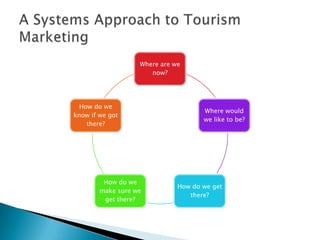
Where are we
now?
Where would
we like to be?
How do we get
there?
How do we
make sure we
get there?
How do we
know if we got
there?
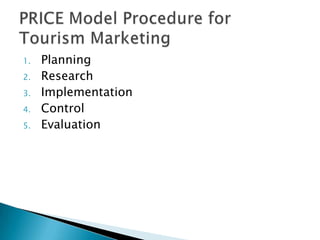
1. Planning
2. Research
3. Implementation
4. Control
5. Evaluation
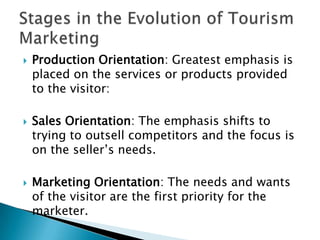
 Production Orientation: Greatest emphasis is
placed on the services or products provided
to the visitor:
 Sales Orientation: The emphasis shifts to
trying to outsell competitors and the focus is
on the seller’s needs.
 Marketing Orientation: The needs and wants
of the visitor are the first priority for the
marketer.
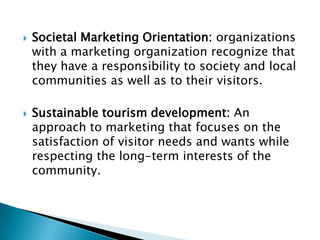
 Societal Marketing Orientation: organizations
with a marketing organization recognize that
they have a responsibility to society and local
communities as well as to their visitors.
 Sustainable tourism development: An
approach to marketing that focuses on the
satisfaction of visitor needs and wants while
respecting the long-term interests of the
community.
Before embarking on a program to market
tourism in general or a specific tourism
product or service in particular, it is necessary
to develop a philosophy or orientation to guide
one’s marketing efforts.
A product orientation emphasizes the products
or services that are available. It may be
successful if there’s a surplus of demand over
supply. Thus, the destination which offers the
best product will get the tourist. The old adage
that reflects this is “Build a better mousetrap,
and the world will beat a path to your door.”
 Is universally accepted way of
analyzing demand. It is the
grouping together of people with
similar needs and wants for the
purpose of serving the market
better.
1. The market for a product or service such as a
vacation, is made up of particular needs and
preferences related to the product or service
being marketed
2. The potential tourists can be grouped into
segments whose members have similar
characteristics.
3. A single product offering such as trip to Boracay
will appeal to some segments of the market
more than others.
4. Some firms and organizations can improve their
marketing effort by developing specific product
offerings to reach specific segments of the
market
 Socioeconomic and demographic
variables
-Age, education, sex, income, family size.
Family size cycle, social class, home
ownership, race or ethnic groups,
occupation.
 Psychographic variables
-Personality traits, life-style, attitudes,
interests, opinions, motivation
 Product-related variables
-Recreation activity, equipment type, volume
usage, brand loyalty, benefit expectations,
length of stay, transportation mode, experience
references, participation patterns
 Geographic Variables
-Region, market area, urban, suburban, rural,
city size and population density
 TEXTBOOK:
 Kotler, Philip et.al. Marketing for Hospitality and Tourism (2010). Fifth Edition. Pearson
Education, Inc.
 COURSE BIBLIOGRAPHY:
 Goeldner ,Charles R. and Ritchie,J.R. Brent. Tourism: Principles, Practices, Philosophies.
Tenth Edition. John Wiley & Sons, Inc.

 Swarbrooke, John. The Development and Management of Visitor Attractions. Second
Edition(2002). Elsevier Science.
 PhD Kandampully, Jay, PhD Mok, Connie and PhD Sparks, Beverly. Service Quality
Management in Hospitality, Tourism and Leisure(2001). The Haworth
 Press, Inc
 Walker, John. Introduction to Hospitality (2009). Fifth Edition.Pearson Education, Inc.

 Lumsdon, Les.Tourism Marketing(1997). First Edition. International Thomson Business
Press.

 Mancini, Marc, Ph. D. Access: Introduction to Travel and Tourism(2006). Thomson Asian
Edition. Delmar Learning.

 Claravall, Bienvenido G. Travel and Tour Operations in the Philippines(2008). Second
Edition. Paul So and Partner.
 Libosada, Carlos Jr and Bosangit, Carmela.Introduction to Tourism:A Comprehensive
Guide to the Travel and Tourism Industry(2007).Anvil Publishing, Inc
 Prepare an advertising campaign that can
help promote tourism of one place
considering all the variables given.
Ex: “it’s more fun in the Philippines”
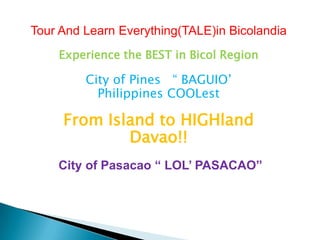
Tour And Learn Everything(TALE)in Bicolandia
Experience the BEST in Bicol Region
City of Pines “ BAGUIO’
Philippines COOLest
From Island to HIGHland
Davao!!
City of Pasacao “ LOL’ PASACAO”
 The concept of product life cycle is useful to
the markets as an additional guide on what
strategies should be used in choosing,
attracting and serving target markets. It
suggests that a product, service or
destination moves through distinct stages.
 A strategic marketing process can be divided
into three elements
1. Market planning
2. Target market selection
3. The marketing mix selection
1. Collection of data- data can be collected into two
ways, from secondary sources and primary sources
2. Analysis of data – data is usually organized and
interpreted. This requires a great amount of skill and
understanding. At present, computers shorten the
process of organizing and interpreting the data.
3. Identification of alternative strategies for reaching
the desired goal – in most cases, there are several
ways to arrive at a desired goal.
4. Cost-benefit analysis – the cost/benefit analysis of
several methods for reaching the goals would
indicate which of the alternatives or combination of
them would be best from a financial standpoint.
5. Selecting alternatives and plan formation –
after the variables and cost/benefit for each are
identified, it is then decided which one should
be carried out by the other organization.
6. Control procedures – these are methods
which analyze the progress made in achieving
the goals of the project.
7. Plan information – putting into effect the plan
of action and supervising it.
1. Estimate the approval of an area’s attractions.
This include the degree of interest of the tourist
of the area and the length of time the tourist will
spend visiting it.
2. Estimate the distance in both travel time and
travel costs. The greater the attraction the
longer the distance potential tourists will travel.
3. Identify the potential target markets
geographically by locating the population
clusters within the maximum distance
determined from the estimated travel time and
lure of the attraction.
4. Identify the actual and potential competition in
the target market
There are six steps in determining a marketing strategy.
These are:
 Identify the market segment
 Determine the preferences of the market segment.
 Determine what influences the segment most – price,
product, image, sales persuasion, customer service,
product availability etc.
 Realize the importance of two clients-the traveler and
the travel intermediary such travel agent and tour
operator.
 Determine the marketing mix that will influence the
segment identified.
 Establish a price policy that will maximize profits by
balancing the number of tourists with the capacity of
the attraction
Marketing mix is the combination of elements
–product, price, promotion and distribution
that interact and complement each other to
attain the objectives of the market plan
A. Product
A vacation consists of several parts or
products such as transportation,
accommodation, food and beverage,
sightseeing, entertainment and souvenirs.
The philosophy of a consumer marketing
orientation suggests that products should
satisfy the needs and wants of the
customer.
B. Price
is the result of supply and demand.
When supply exceeds demand, price tends
to decrease. When demand exceeds supply,
price tends to increase. For example higher
prices are charged during the peak seasons

tourismmarketing-131119180243-phpapp02.pdf

  • 1.
    Dr. Jerome H.Baldemoro Ateneo de Naga University
  • 2.
    1. Define tourismmarketing. 2. Determine the differences between tourism marketing and product marketing. 3. Describe a systematic approach to marketing segmentation, orientation, strategies and plans. 4. Identify the procedures that should be used in marketing tourism destinations and organizations.
  • 3.
     The productand or service itself  The methods of distribution  The methods of pricing  The methods of promotion  The form of selling  The form of advertising
  • 4.
    In relation totourism, marketing is the systematic process by which an organization tries to maximize the satisfaction of tourist demand through research, forecasting and the selection of tourism products and services to meet that demand.
  • 5.
     It isa management philosophy which in the light of tourist demand, makes it possible through research, forecasting and selection to place tourism products on the market in line with the organization’s purpose for the greatest benefit.
  • 6.
     Tourism isa service. An intangible experience is being sold, not a physical good that can be inspected before is bought. For example, a consumer does not buy a bed or a beach, but buys a night’s lodging in a hotel at the seashore.  The service provided is usually composed of several components such as transportation, lodging, food and beverage, attractions, activities etc. the degree of success of anyone component influences the success of the other components.  Travel intermediaries are a necessity. Because most tourist services are located far from their potential customers, specialized intermediaries are necessary to bridge the gap between the producer and the tourists.
  • 7.
     The organizationsthat market tourism destinations usually have a little control over the quality and quantity of services.  The guest’s satisfaction is a function of the staff providing the service.  Tourism demand is highly elastic, seasonal in nature and it is influenced by subjected factors such as price and the physical attraction at the destination  The intangible nature of tourism services means that the visitor’s travel experiences exist only in memory after the trip is over.
  • 8.
     “Marketing isa continuous, sequential process through which management in tourism plans, researches, implements, controls and evaluates activities designed to satisfy both customers’ needs and wants and their own organization’s objective. To be effective, marketing requires the efforts of everyone in an organization and can be made more or less effective by the actions of complementary organizations.” –Morrison, A.M (2013)
  • 9.
    Where are we now? Wherewould we like to be? How do we get there? How do we make sure we get there? How do we know if we got there?
  • 10.
    1. Planning 2. Research 3.Implementation 4. Control 5. Evaluation
  • 11.
     Production Orientation:Greatest emphasis is placed on the services or products provided to the visitor:  Sales Orientation: The emphasis shifts to trying to outsell competitors and the focus is on the seller’s needs.  Marketing Orientation: The needs and wants of the visitor are the first priority for the marketer.
  • 12.
     Societal MarketingOrientation: organizations with a marketing organization recognize that they have a responsibility to society and local communities as well as to their visitors.  Sustainable tourism development: An approach to marketing that focuses on the satisfaction of visitor needs and wants while respecting the long-term interests of the community.
  • 13.
    Before embarking ona program to market tourism in general or a specific tourism product or service in particular, it is necessary to develop a philosophy or orientation to guide one’s marketing efforts. A product orientation emphasizes the products or services that are available. It may be successful if there’s a surplus of demand over supply. Thus, the destination which offers the best product will get the tourist. The old adage that reflects this is “Build a better mousetrap, and the world will beat a path to your door.”
  • 14.
     Is universallyaccepted way of analyzing demand. It is the grouping together of people with similar needs and wants for the purpose of serving the market better.
  • 15.
    1. The marketfor a product or service such as a vacation, is made up of particular needs and preferences related to the product or service being marketed 2. The potential tourists can be grouped into segments whose members have similar characteristics. 3. A single product offering such as trip to Boracay will appeal to some segments of the market more than others. 4. Some firms and organizations can improve their marketing effort by developing specific product offerings to reach specific segments of the market
  • 16.
     Socioeconomic anddemographic variables -Age, education, sex, income, family size. Family size cycle, social class, home ownership, race or ethnic groups, occupation.  Psychographic variables -Personality traits, life-style, attitudes, interests, opinions, motivation
  • 17.
     Product-related variables -Recreationactivity, equipment type, volume usage, brand loyalty, benefit expectations, length of stay, transportation mode, experience references, participation patterns  Geographic Variables -Region, market area, urban, suburban, rural, city size and population density
  • 18.
     TEXTBOOK:  Kotler,Philip et.al. Marketing for Hospitality and Tourism (2010). Fifth Edition. Pearson Education, Inc.  COURSE BIBLIOGRAPHY:  Goeldner ,Charles R. and Ritchie,J.R. Brent. Tourism: Principles, Practices, Philosophies. Tenth Edition. John Wiley & Sons, Inc.   Swarbrooke, John. The Development and Management of Visitor Attractions. Second Edition(2002). Elsevier Science.  PhD Kandampully, Jay, PhD Mok, Connie and PhD Sparks, Beverly. Service Quality Management in Hospitality, Tourism and Leisure(2001). The Haworth  Press, Inc  Walker, John. Introduction to Hospitality (2009). Fifth Edition.Pearson Education, Inc.   Lumsdon, Les.Tourism Marketing(1997). First Edition. International Thomson Business Press.   Mancini, Marc, Ph. D. Access: Introduction to Travel and Tourism(2006). Thomson Asian Edition. Delmar Learning.   Claravall, Bienvenido G. Travel and Tour Operations in the Philippines(2008). Second Edition. Paul So and Partner.  Libosada, Carlos Jr and Bosangit, Carmela.Introduction to Tourism:A Comprehensive Guide to the Travel and Tourism Industry(2007).Anvil Publishing, Inc
  • 19.
     Prepare anadvertising campaign that can help promote tourism of one place considering all the variables given. Ex: “it’s more fun in the Philippines”
  • 20.
    Tour And LearnEverything(TALE)in Bicolandia Experience the BEST in Bicol Region City of Pines “ BAGUIO’ Philippines COOLest From Island to HIGHland Davao!! City of Pasacao “ LOL’ PASACAO”
  • 21.
     The conceptof product life cycle is useful to the markets as an additional guide on what strategies should be used in choosing, attracting and serving target markets. It suggests that a product, service or destination moves through distinct stages.
  • 22.
     A strategicmarketing process can be divided into three elements 1. Market planning 2. Target market selection 3. The marketing mix selection
  • 23.
    1. Collection ofdata- data can be collected into two ways, from secondary sources and primary sources 2. Analysis of data – data is usually organized and interpreted. This requires a great amount of skill and understanding. At present, computers shorten the process of organizing and interpreting the data. 3. Identification of alternative strategies for reaching the desired goal – in most cases, there are several ways to arrive at a desired goal. 4. Cost-benefit analysis – the cost/benefit analysis of several methods for reaching the goals would indicate which of the alternatives or combination of them would be best from a financial standpoint.
  • 24.
    5. Selecting alternativesand plan formation – after the variables and cost/benefit for each are identified, it is then decided which one should be carried out by the other organization. 6. Control procedures – these are methods which analyze the progress made in achieving the goals of the project. 7. Plan information – putting into effect the plan of action and supervising it.
  • 25.
    1. Estimate theapproval of an area’s attractions. This include the degree of interest of the tourist of the area and the length of time the tourist will spend visiting it. 2. Estimate the distance in both travel time and travel costs. The greater the attraction the longer the distance potential tourists will travel. 3. Identify the potential target markets geographically by locating the population clusters within the maximum distance determined from the estimated travel time and lure of the attraction. 4. Identify the actual and potential competition in the target market
  • 26.
    There are sixsteps in determining a marketing strategy. These are:  Identify the market segment  Determine the preferences of the market segment.  Determine what influences the segment most – price, product, image, sales persuasion, customer service, product availability etc.  Realize the importance of two clients-the traveler and the travel intermediary such travel agent and tour operator.  Determine the marketing mix that will influence the segment identified.  Establish a price policy that will maximize profits by balancing the number of tourists with the capacity of the attraction
  • 27.
    Marketing mix isthe combination of elements –product, price, promotion and distribution that interact and complement each other to attain the objectives of the market plan
  • 28.
    A. Product A vacationconsists of several parts or products such as transportation, accommodation, food and beverage, sightseeing, entertainment and souvenirs. The philosophy of a consumer marketing orientation suggests that products should satisfy the needs and wants of the customer. B. Price is the result of supply and demand. When supply exceeds demand, price tends to decrease. When demand exceeds supply, price tends to increase. For example higher prices are charged during the peak seasons