Case Study: Lyme
Disease
BY: AMANDA JOHNSON
History
 A 50 year old man comes into his doctors office for a check-up. He
complains of pain in his joints and muscles that started a couple weeks
ago. His joints are stiff and have swelled. On top of that he has been
fatigued and has had a fever with a headache that isn’t going away and
started a couple weeks ago with the joint pains.
Question 1:
 What is your Diagnosis at this point?
Question 2:
 What tests would you run?
Results
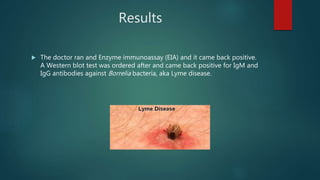
 The doctor ran and Enzyme immunoassay (EIA) and it came back positive.
A Western blot test was ordered after and came back positive for IgM and
IgG antibodies against Borrelia bacteria, aka Lyme disease.
Question 3:
 How many of you have found a tick on yourself?
Impact
• Lyme is the fastest growing disease and it also has the
most cases per year than any other disease.
• The cost of treating Lyme is more expensive than
HIV/AidS.
Lyme
 It is caused by Borrelia burdorferi which is a spirochete parasite.
 Ticks have factors in their saliva that coasts the spirochetes which prevents
the immune system from recognizing it.
 B. burdorferi is a flagellum, when the immune system recognizes the
flagellum it launches a inflammatory response that damages human tissue
and not the infection.
 It changes its cell wall protein to blend in with the host cells.
 The immune system sends neutrophils that release polarizing cytokines
that inflame host cells.
 NK, natural killer, cells are sent to the site of infection and attacks host
cells.
Enzyme Immunoassay
 A blood sample is drawn and sent the laboratory to be tested for an
antibody or antigen for the bacteria Borrelia burgdorferi or Borrelia
mayonii.
 An ELISA can be performed for an EIA.
 Two antibodies are tested for, IgM and IgG. IgM bodies are the first
antibodies the immune system sends out in response to an infection. IgG
antibodies are found in subsequent infections, or, long lasting infections.
Immunoblotting Test
 “Separate the many bacterial antigens spatially on a solid support so that
the specificity and complexity of the antibody responses are revealed”
(CDC).
 With Immunoblotting it’s to see if the antibodies recognize B. burgdorferi
after the EIA tested positive for it.
 IgM results are less specific because they are arranged in a pentagon
shape and are the first wave of an immune breach.
 2/3 bands of IgM are required for the test to be positive and only 5/110
bands of IgG are required for a blotting test to be positive.
Treatment
 There is not a one-size-fit-all treatment for Lyme disease. Because of the
nature of bacterium to imitate host cells.
 Lyme disease can be a chronic issue because the bacterium can stay
hidden in the host body and reoccurring symptoms can happen.
 The most common treatment is a round of antibiotics, doxycycline, but it is
all dependent on the type of symptoms that are present.
Sources
 https://labtestsonline.org/understanding/analytes/lyme/tab/test/
 http://www.bayarealyme.org/about-lyme/lyme-disease-facts-statistics/
 https://www3.epa.gov/climatechange/science/indicatorsEPA-2-24-
2016/health-society/lyme.html
 https://www.lymedisease.org/lyme-basics/lyme-disease/chronic-lyme/
 http://danielcameronmd.com/lyme-disease-treatment/
 http://mytips10.blogspot.com/2015/12/lyme-disease-causes-symptoms-
treatment-and-prevention.html
 https://www.cdc.gov/lyme/resources/halperin_2012_chap4_johnsonb.pdf
 http://www.lymediseaseblog.com/how-lyme-disease-affects-immune-system/

Case Study: Lyme Disease

  • 1.
  • 2.
    History  A 50year old man comes into his doctors office for a check-up. He complains of pain in his joints and muscles that started a couple weeks ago. His joints are stiff and have swelled. On top of that he has been fatigued and has had a fever with a headache that isn’t going away and started a couple weeks ago with the joint pains.
  • 3.
    Question 1:  Whatis your Diagnosis at this point?
  • 4.
    Question 2:  Whattests would you run?
  • 5.
    Results  The doctorran and Enzyme immunoassay (EIA) and it came back positive. A Western blot test was ordered after and came back positive for IgM and IgG antibodies against Borrelia bacteria, aka Lyme disease.
  • 6.
    Question 3:  Howmany of you have found a tick on yourself?
  • 7.
    Impact • Lyme isthe fastest growing disease and it also has the most cases per year than any other disease. • The cost of treating Lyme is more expensive than HIV/AidS.
  • 8.
    Lyme  It iscaused by Borrelia burdorferi which is a spirochete parasite.  Ticks have factors in their saliva that coasts the spirochetes which prevents the immune system from recognizing it.  B. burdorferi is a flagellum, when the immune system recognizes the flagellum it launches a inflammatory response that damages human tissue and not the infection.  It changes its cell wall protein to blend in with the host cells.  The immune system sends neutrophils that release polarizing cytokines that inflame host cells.  NK, natural killer, cells are sent to the site of infection and attacks host cells.
  • 9.
    Enzyme Immunoassay  Ablood sample is drawn and sent the laboratory to be tested for an antibody or antigen for the bacteria Borrelia burgdorferi or Borrelia mayonii.  An ELISA can be performed for an EIA.  Two antibodies are tested for, IgM and IgG. IgM bodies are the first antibodies the immune system sends out in response to an infection. IgG antibodies are found in subsequent infections, or, long lasting infections.
  • 10.
    Immunoblotting Test  “Separatethe many bacterial antigens spatially on a solid support so that the specificity and complexity of the antibody responses are revealed” (CDC).  With Immunoblotting it’s to see if the antibodies recognize B. burgdorferi after the EIA tested positive for it.  IgM results are less specific because they are arranged in a pentagon shape and are the first wave of an immune breach.  2/3 bands of IgM are required for the test to be positive and only 5/110 bands of IgG are required for a blotting test to be positive.
  • 11.
    Treatment  There isnot a one-size-fit-all treatment for Lyme disease. Because of the nature of bacterium to imitate host cells.  Lyme disease can be a chronic issue because the bacterium can stay hidden in the host body and reoccurring symptoms can happen.  The most common treatment is a round of antibiotics, doxycycline, but it is all dependent on the type of symptoms that are present.
  • 12.
    Sources  https://labtestsonline.org/understanding/analytes/lyme/tab/test/  http://www.bayarealyme.org/about-lyme/lyme-disease-facts-statistics/ https://www3.epa.gov/climatechange/science/indicatorsEPA-2-24- 2016/health-society/lyme.html  https://www.lymedisease.org/lyme-basics/lyme-disease/chronic-lyme/  http://danielcameronmd.com/lyme-disease-treatment/  http://mytips10.blogspot.com/2015/12/lyme-disease-causes-symptoms- treatment-and-prevention.html  https://www.cdc.gov/lyme/resources/halperin_2012_chap4_johnsonb.pdf  http://www.lymediseaseblog.com/how-lyme-disease-affects-immune-system/