


Oral Presentation #2
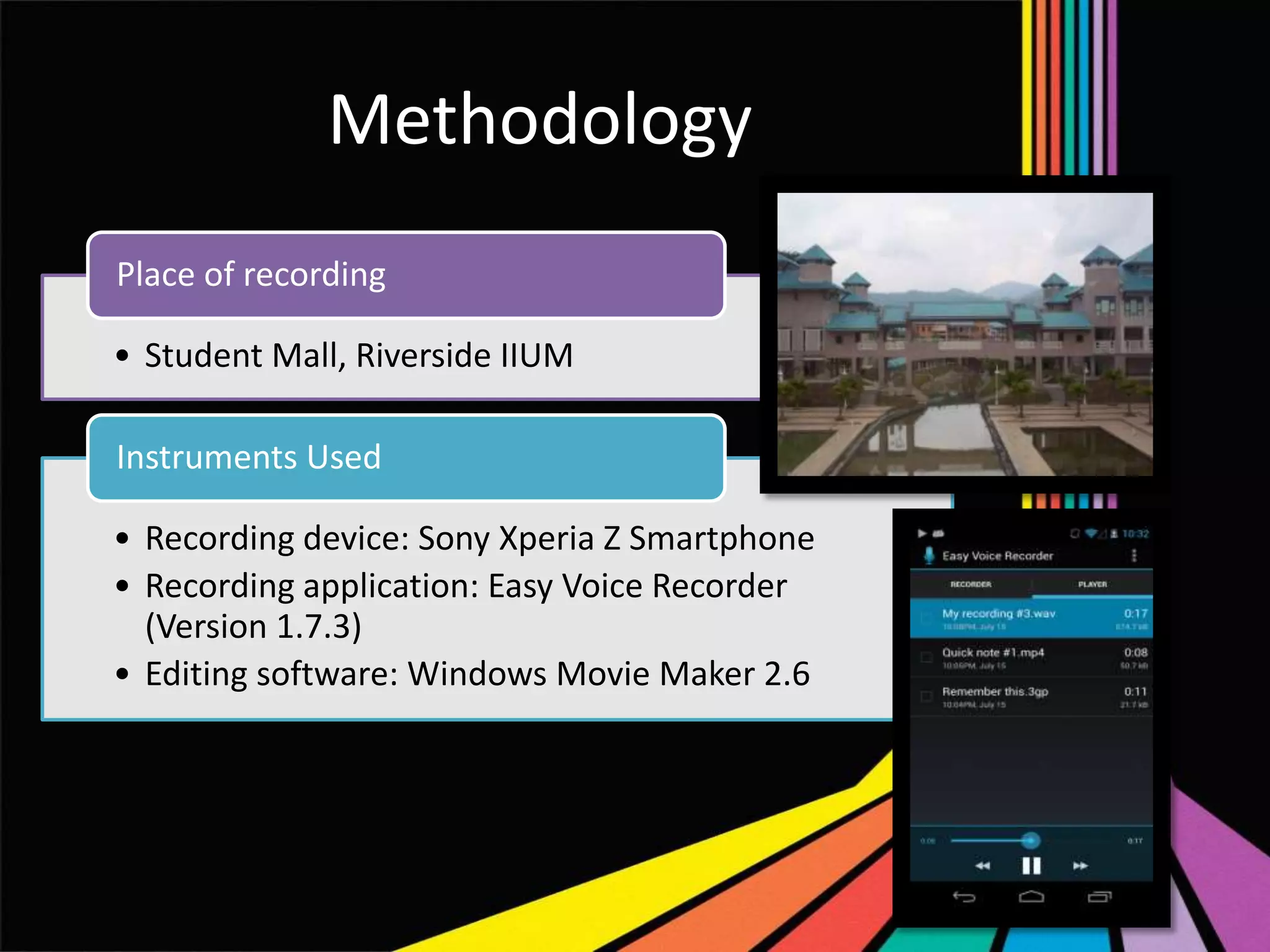
Methodology
Place of recording
• Student Mall, Riverside IIUM
Instruments Used
• Recording device: Sony Xperia Z Smartphone
• Recording application: Easy Voice Recorder
(Version 1.7.3)
• Editing software: Windows Movie Maker 2.6
Literature Review
Literature Review
Malaysian English
• Malaysian English (ME) is a form of English
used and spoken in Malaysia as a second
language. In the spoken variety of ME, there
may be native language influence in the
pronunciation of speakers. This is due to the
distinction of vowel and consonant sounds
between the native language and English (Ivy
Kho Chiann Yiing, 2011).
• It is assumed that Malaysian students will
acquire shared sounds between English,
Mandarin Chinese, Tamil and Malay, since the
education system in Malaysia has been
multilingual. (Ivy Kho Chiann Yiing, 2011).
Literature Review (cont.)
Language Acquisition for ESL Learners
• Second-language learners have an accent since they do
not often achieve native-like grammatical competence in
the second language, especially with respect to
pronunciation. In addition, they usually speak with an
accent as they may transfer the phonemes, phonological
rules, or syllable structures of their first language to their
second language (Fromkin et al., 2011).
• However, based on research, it is believed that the
younger a person exposed to a second language, the
more likely she is to achieve native-like competence
(Fromkin et al., 2011).
Literature Review (cont.)
Language Acquisition for ESL Learners (cont.)
•

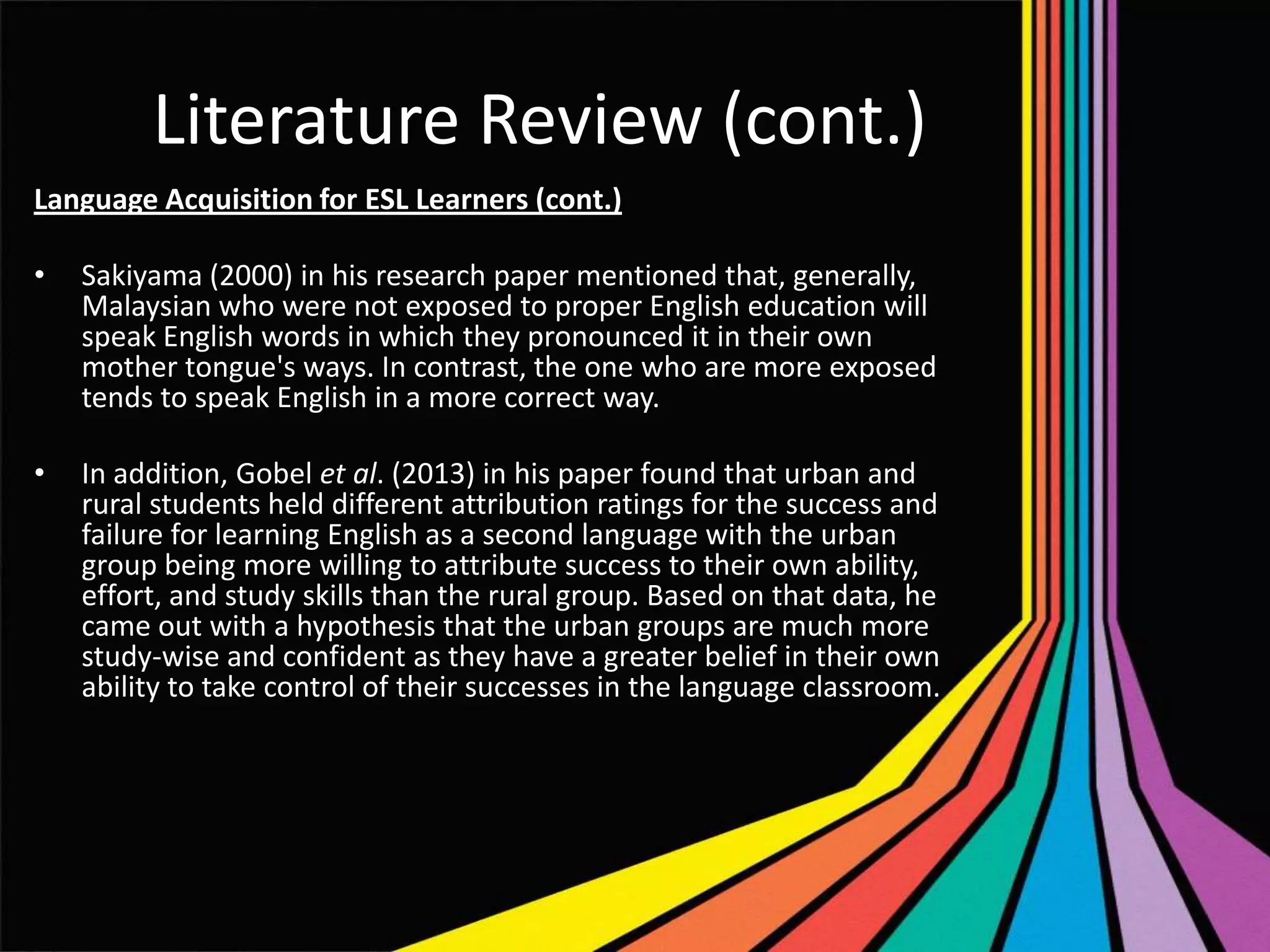
Sakiyama (2000) in his research paper mentioned that, generally,
Malaysian who were not exposed to proper English education will
speak English words in which they pronounced it in their own
mother tongue's ways. In contrast, the one who are more exposed
tends to speak English in a more correct way.

•

In addition, Gobel et al. (2013) in his paper found that urban and
rural students held different attribution ratings for the success and
failure for learning English as a second language with the urban
group being more willing to attribute success to their own ability,
effort, and study skills than the rural group. Based on that data, he
came out with a hypothesis that the urban groups are much more
study-wise and confident as they have a greater belief in their own
ability to take control of their successes in the language classroom.
Literature Review (cont.)
Consonants and Vowels in Malaysian English
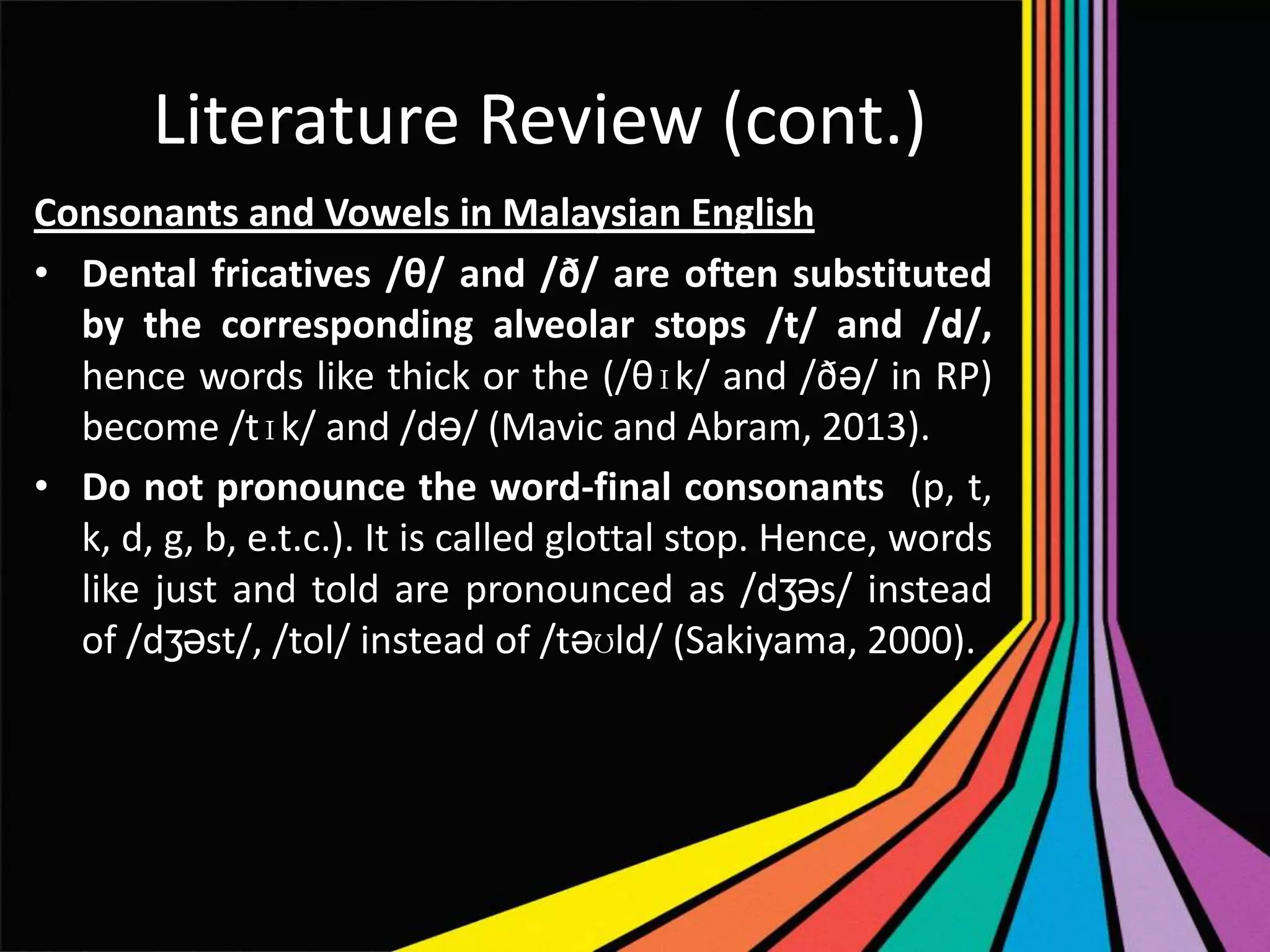
• Dental fricatives /θ/ and /ð/ are often substituted
by the corresponding alveolar stops /t/ and /d/,
hence words like thick or the (/θɪk/ and /ðə/ in RP)
become /tɪk/ and /də/ (Mavic and Abram, 2013).
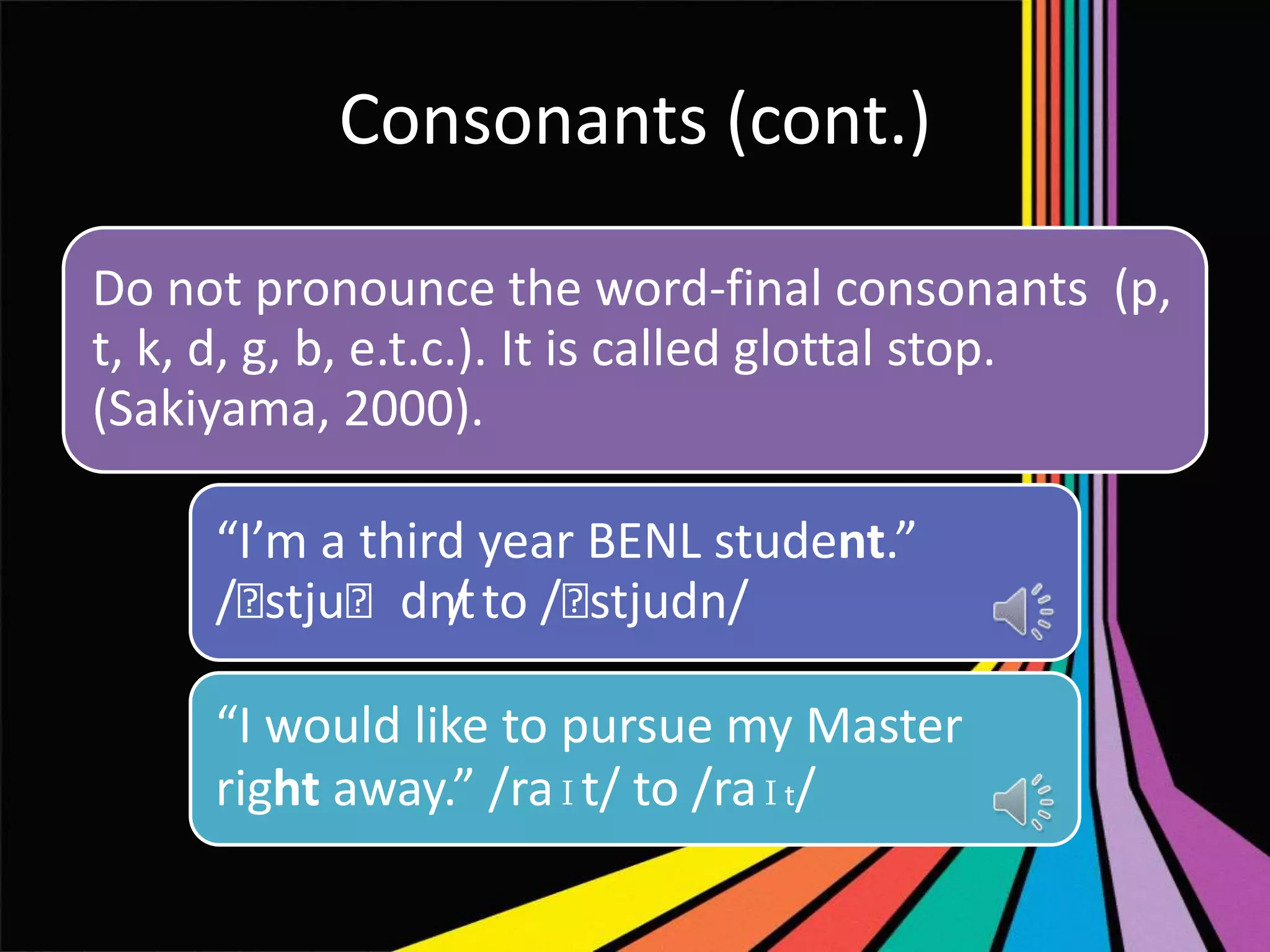
• Do not pronounce the word-final consonants (p, t,
k, d, g, b, e.t.c.). It is called glottal stop. Hence, words
like just and told are pronounced as /dʒəs/ instead
of /dʒəst/, /tol/ instead of /təʊld/ (Sakiyama, 2000).
Literature Review (cont.)
Consonants and Vowels in Malaysian English (cont.)
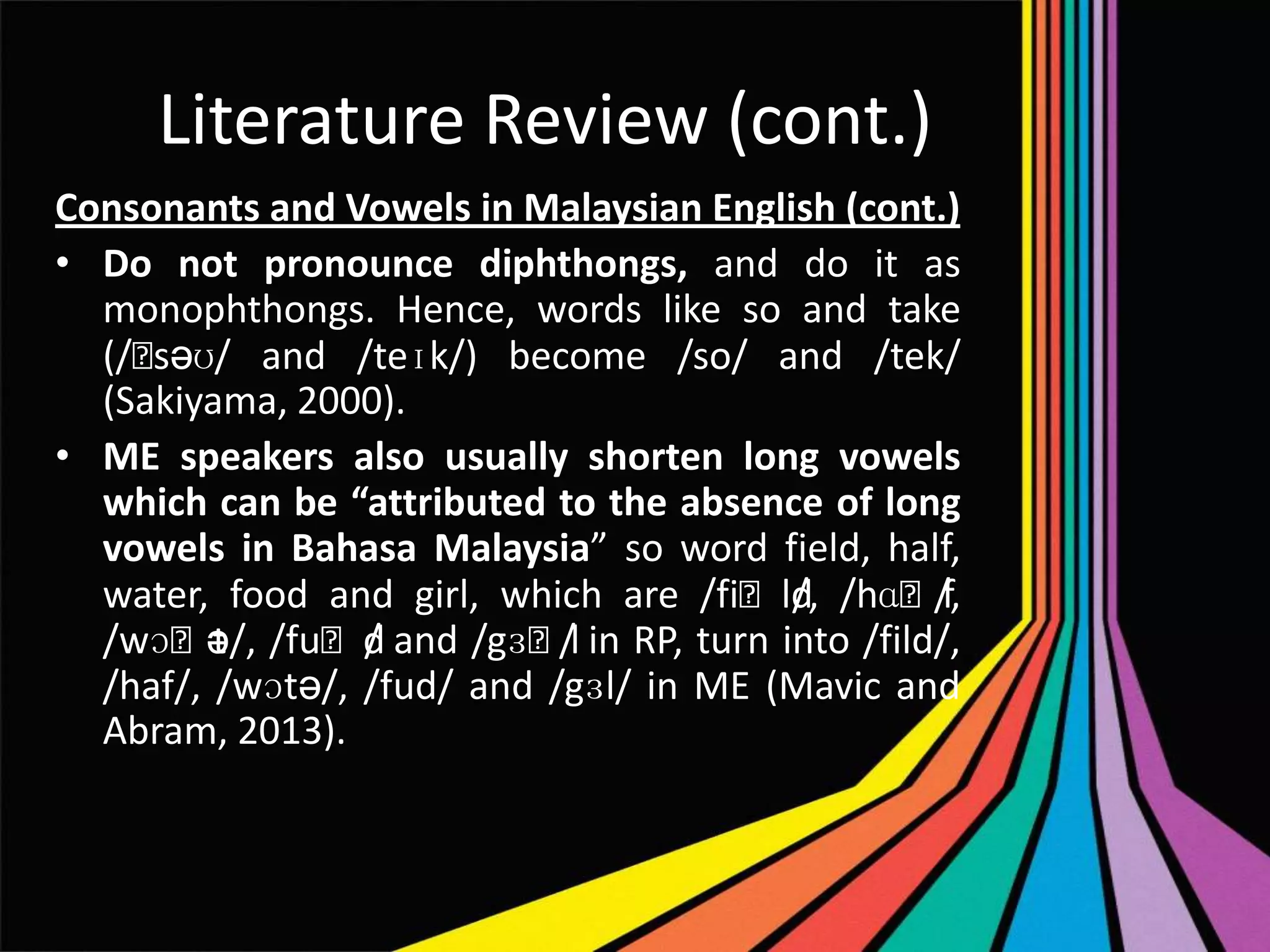
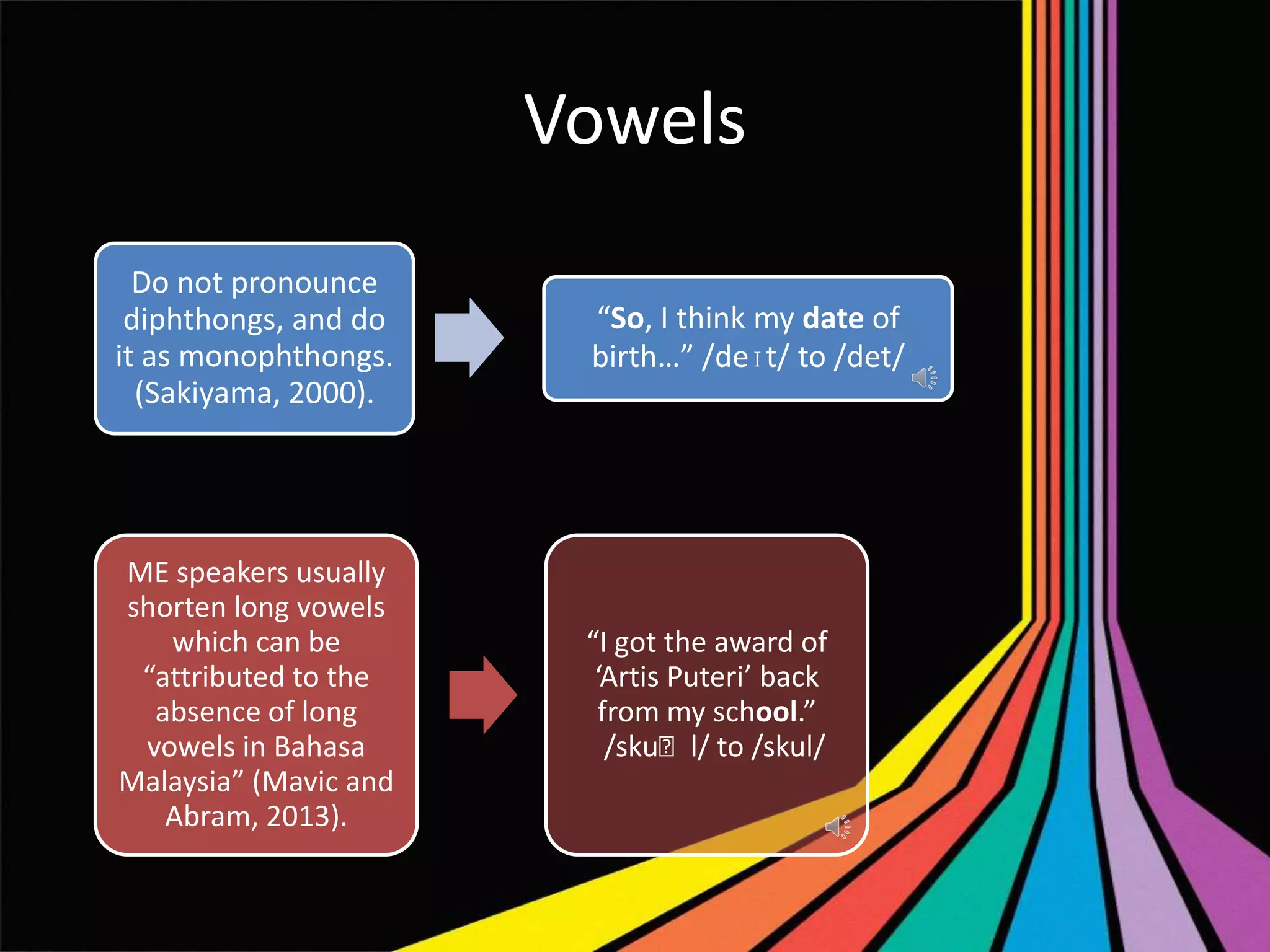
• Do not pronounce diphthongs, and do it as
monophthongs. Hence, words like so and take
(/ˈ
səʊ/ and /teɪk/) become /so/ and /tek/
(Sakiyama, 2000).
• ME speakers also usually shorten long vowels
which can be “attributed to the absence of long
vowels in Bahasa Malaysia” so word field, half,
water, food and girl, which are /fiˈld, /hɑˈf
/
/,
/wɔˈt /fuˈd and /gɜˈl in RP, turn into /fild/,
ə/,
/
/
/haf/, /wɔtə/, /fud/ and /gɜl/ in ME (Mavic and
Abram, 2013).
Analysis
Consonants
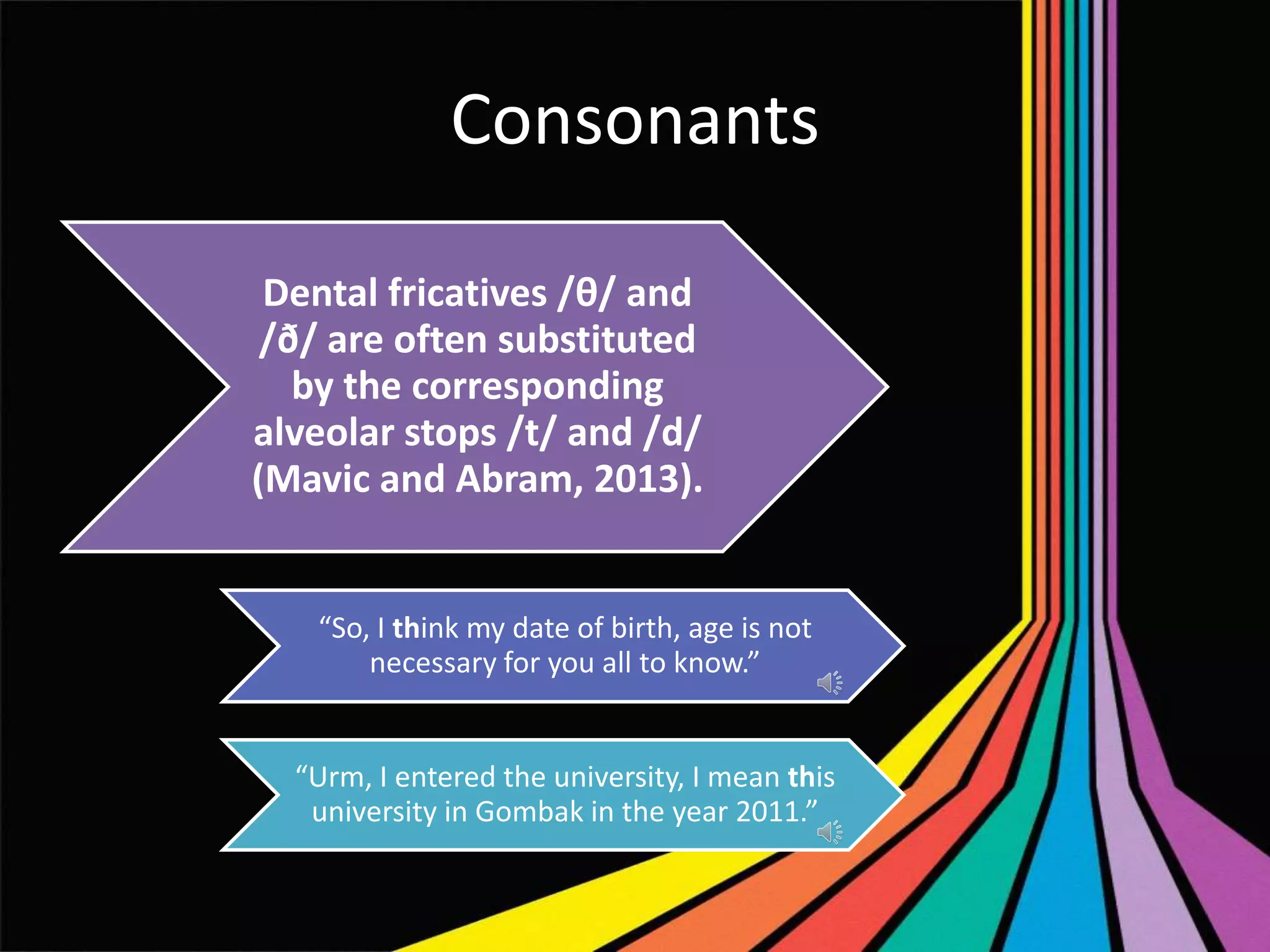
Dental fricatives /θ/ and
/ð/ are often substituted
by the corresponding
alveolar stops /t/ and /d/
(Mavic and Abram, 2013).

“So, I think my date of birth, age is not
necessary for you all to know.”

“Urm, I entered the university, I mean this
university in Gombak in the year 2011.”
Consonants (cont.)
Do not pronounce the word-final consonants (p,
t, k, d, g, b, e.t.c.). It is called glottal stop.
(Sakiyama, 2000).
“I’m a third year BENL student.”
/ˈ
stjuˈdnt to /ˈ
/
stjudn/
“I would like to pursue my Master
right away.” /raɪt/ to /raɪt/
Vowels
Do not pronounce
diphthongs, and do
it as monophthongs.
(Sakiyama, 2000).

“So, I think my date of
birth…” /deɪt/ to /det/

ME speakers usually
shorten long vowels
which can be
“attributed to the
absence of long
vowels in Bahasa
Malaysia” (Mavic and
Abram, 2013).

“I got the award of
‘Artis Puteri’ back
from my school.”
/skuˈl/ to /skul/
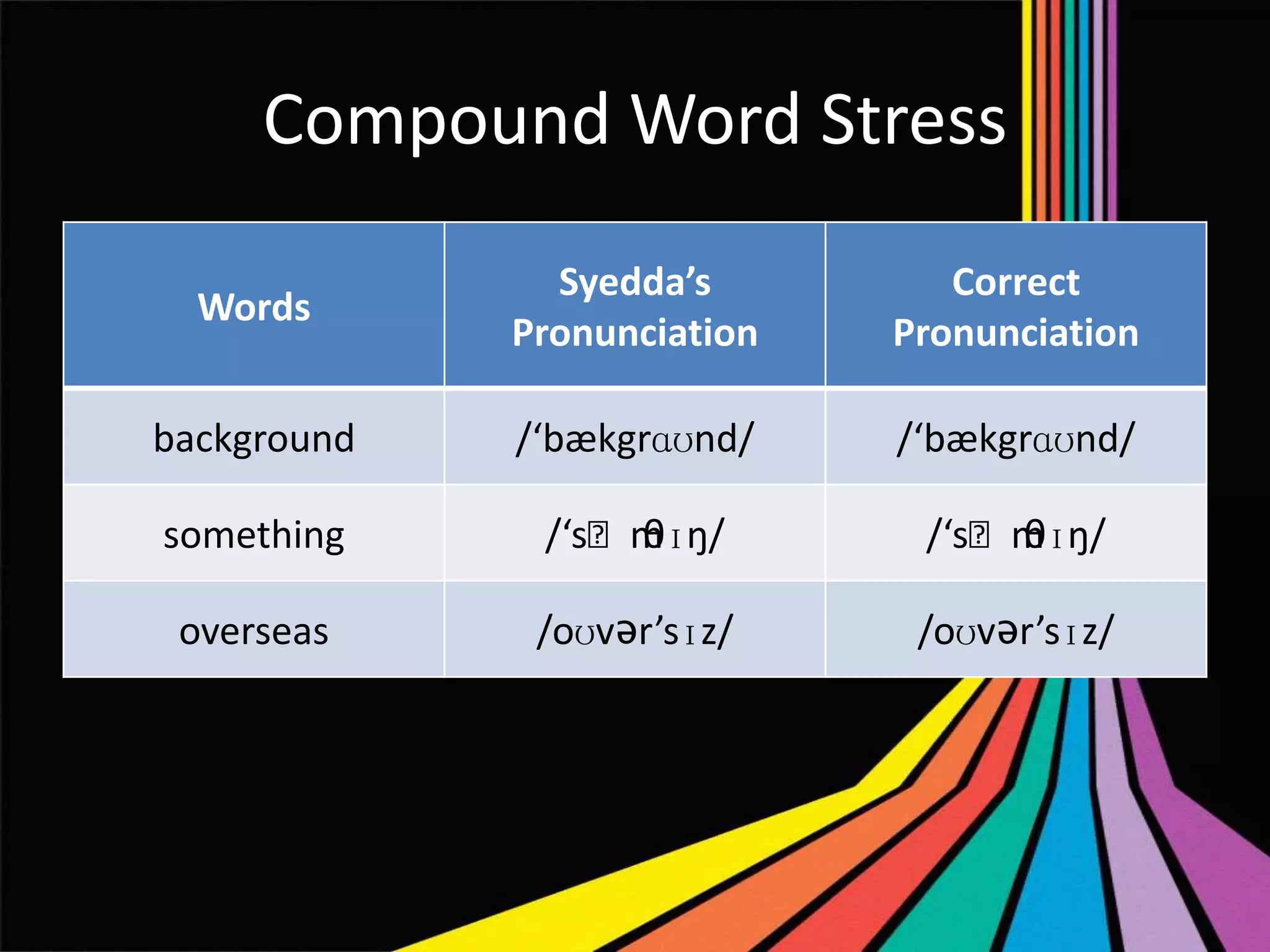
Compound Word Stress
Words

Syedda’s
Pronunciation

Correct
Pronunciation

background

/‘bækgrɑʊnd/

/‘bækgrɑʊnd/

something

/‘sˈm
θɪŋ/

/‘sˈm
θɪŋ/

overseas

/oʊvǝr’sɪz/

/oʊvǝr’sɪz/
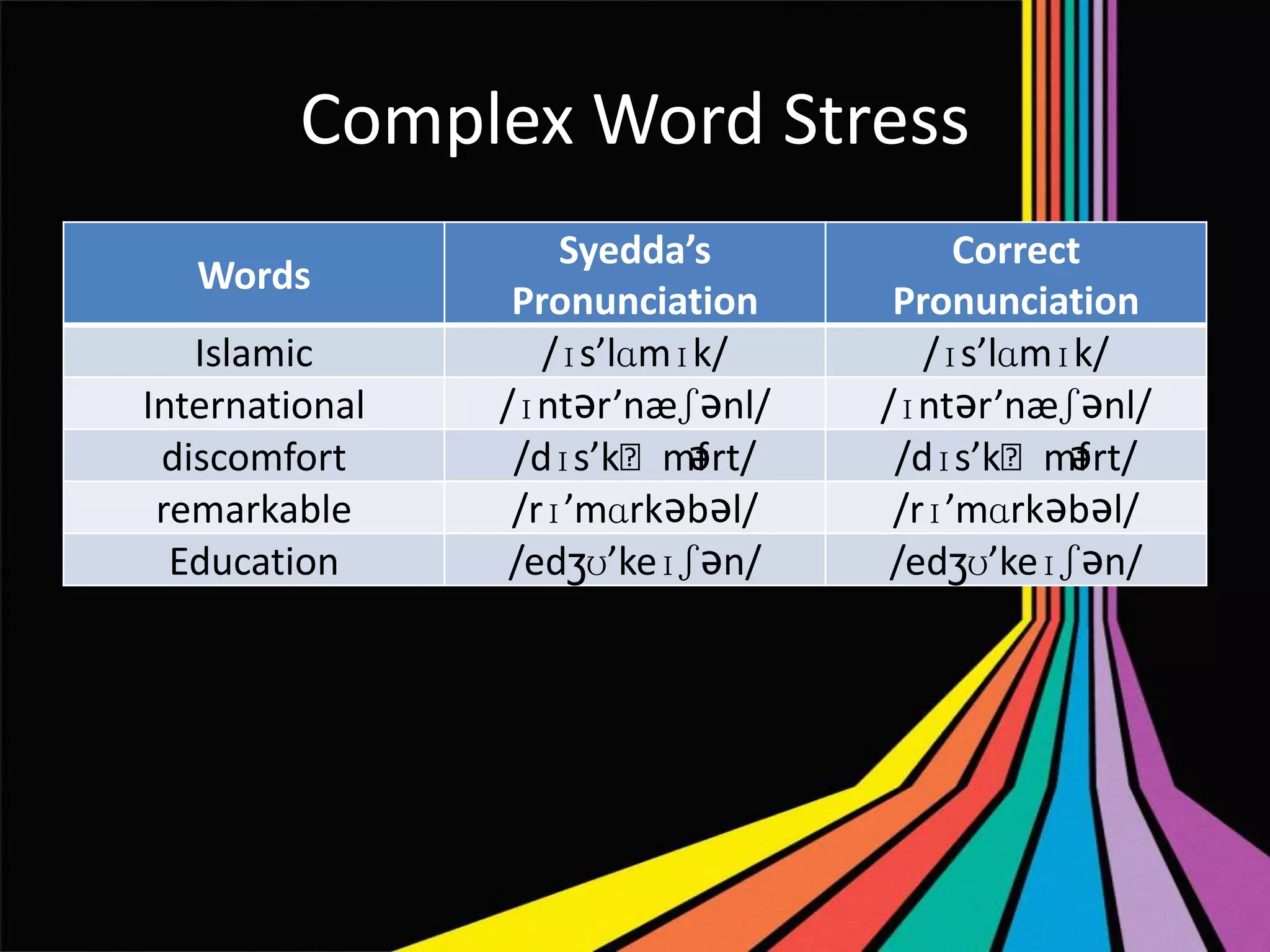
Complex Word Stress
Words
Islamic
International
discomfort
remarkable
Education

Syedda’s
Pronunciation
/ɪs’lɑmɪk/
/ɪntǝr’næʃǝnl/
ǝrt/
/dɪs’kˈmf
/rɪ’mɑrkǝbǝl/
/edʒʊ’keɪʃǝn/

Correct
Pronunciation
/ɪs’lɑmɪk/
/ɪntǝr’næʃǝnl/
ǝrt/
/dɪs’kˈmf
/rɪ’mɑrkǝbǝl/
/edʒʊ’keɪʃǝn/
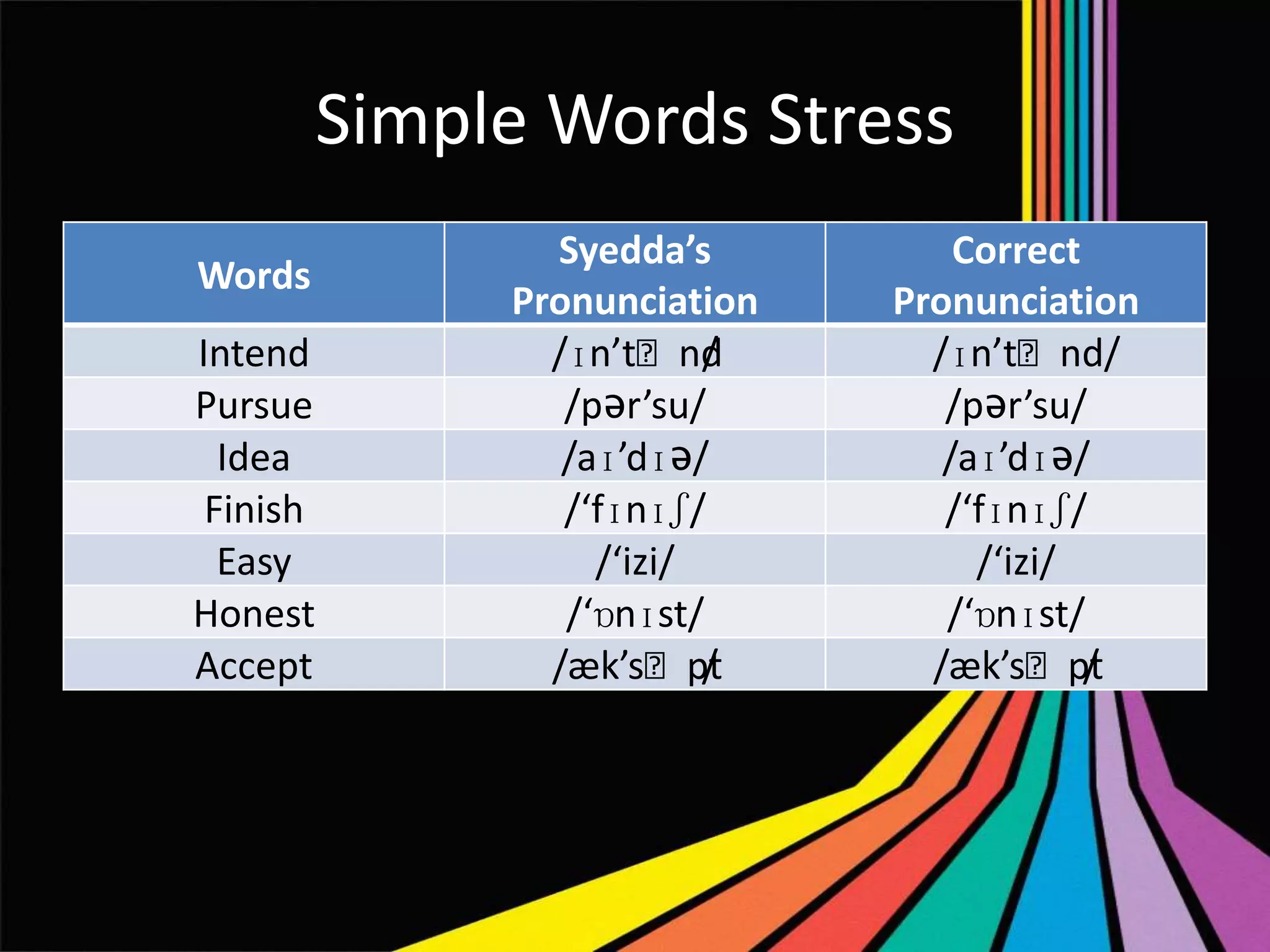
Simple Words Stress
Words
Intend
Pursue
Idea
Finish
Easy
Honest
Accept

Syedda’s
Pronunciation
/ɪn’tˈnd
/
/pǝr’su/
/aɪ’dɪǝ/
/‘fɪnɪʃ/
/‘izi/
/‘ɒnɪst/
/æk’sˈpt
/

Correct
Pronunciation
/ɪn’tˈnd/
/pǝr’su/
/aɪ’dɪǝ/
/‘fɪnɪʃ/
/‘izi/
/‘ɒnɪst/
/æk’sˈpt
/
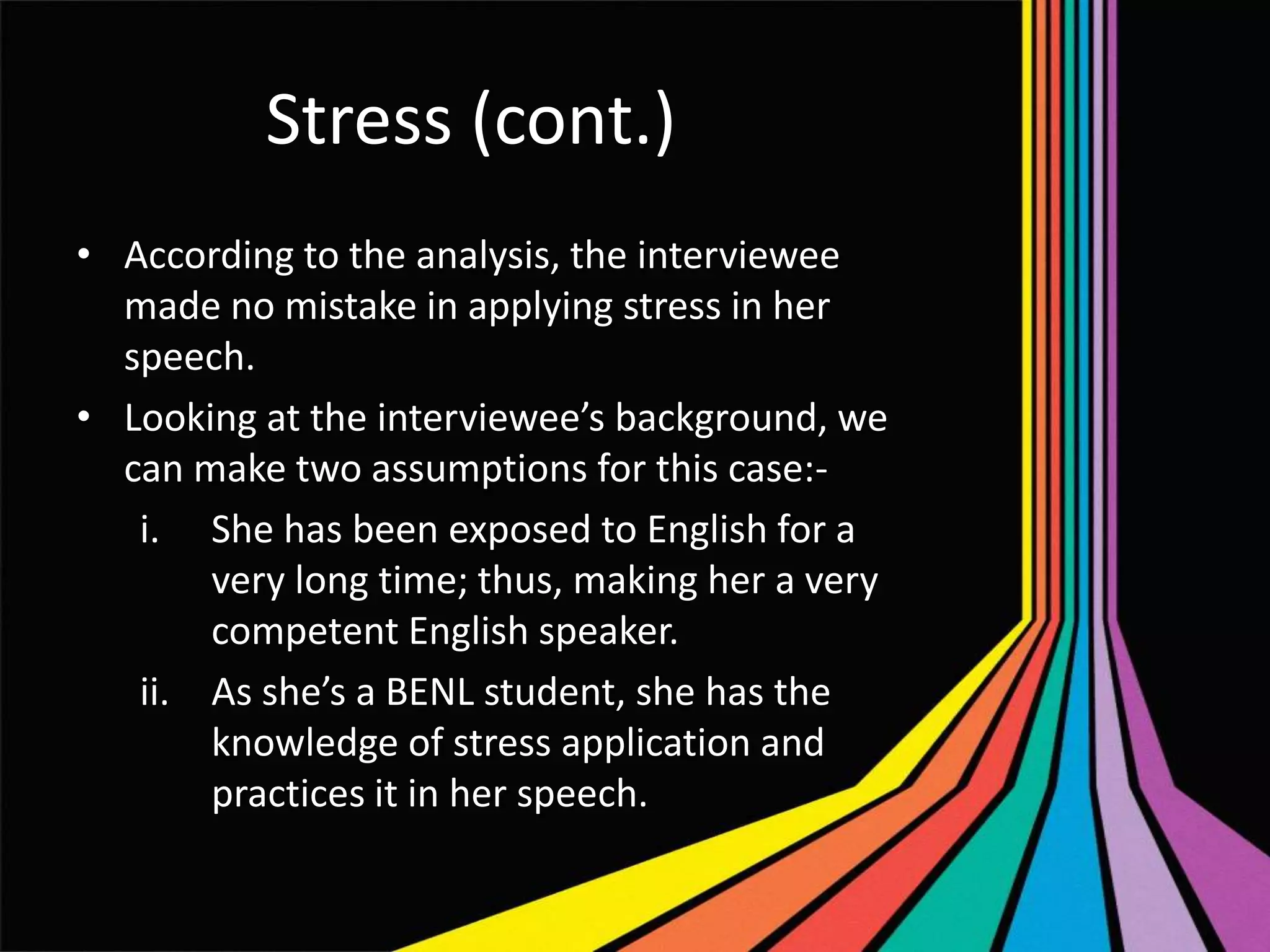
Stress (cont.)
• According to the analysis, the interviewee
made no mistake in applying stress in her
speech.
• Looking at the interviewee’s background, we
can make two assumptions for this case:i. She has been exposed to English for a
very long time; thus, making her a very
competent English speaker.
ii. As she’s a BENL student, she has the
knowledge of stress application and
practices it in her speech.
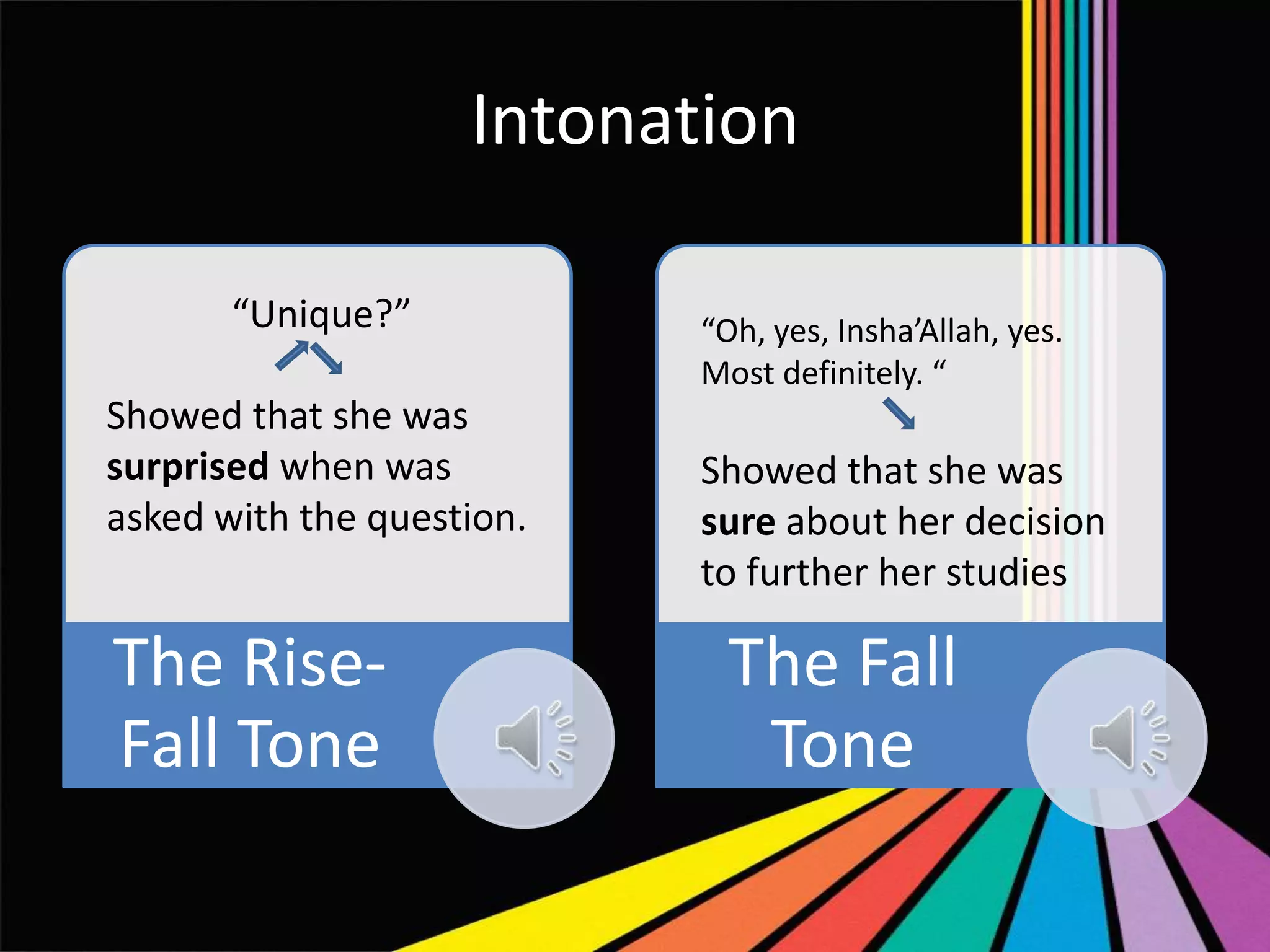
Intonation
“Unique?”
Showed that she was
surprised when was
asked with the question.

The RiseFall Tone

“Oh, yes, Insha’Allah, yes.
Most definitely. “

Showed that she was
sure about her decision
to further her studies

The Fall
Tone
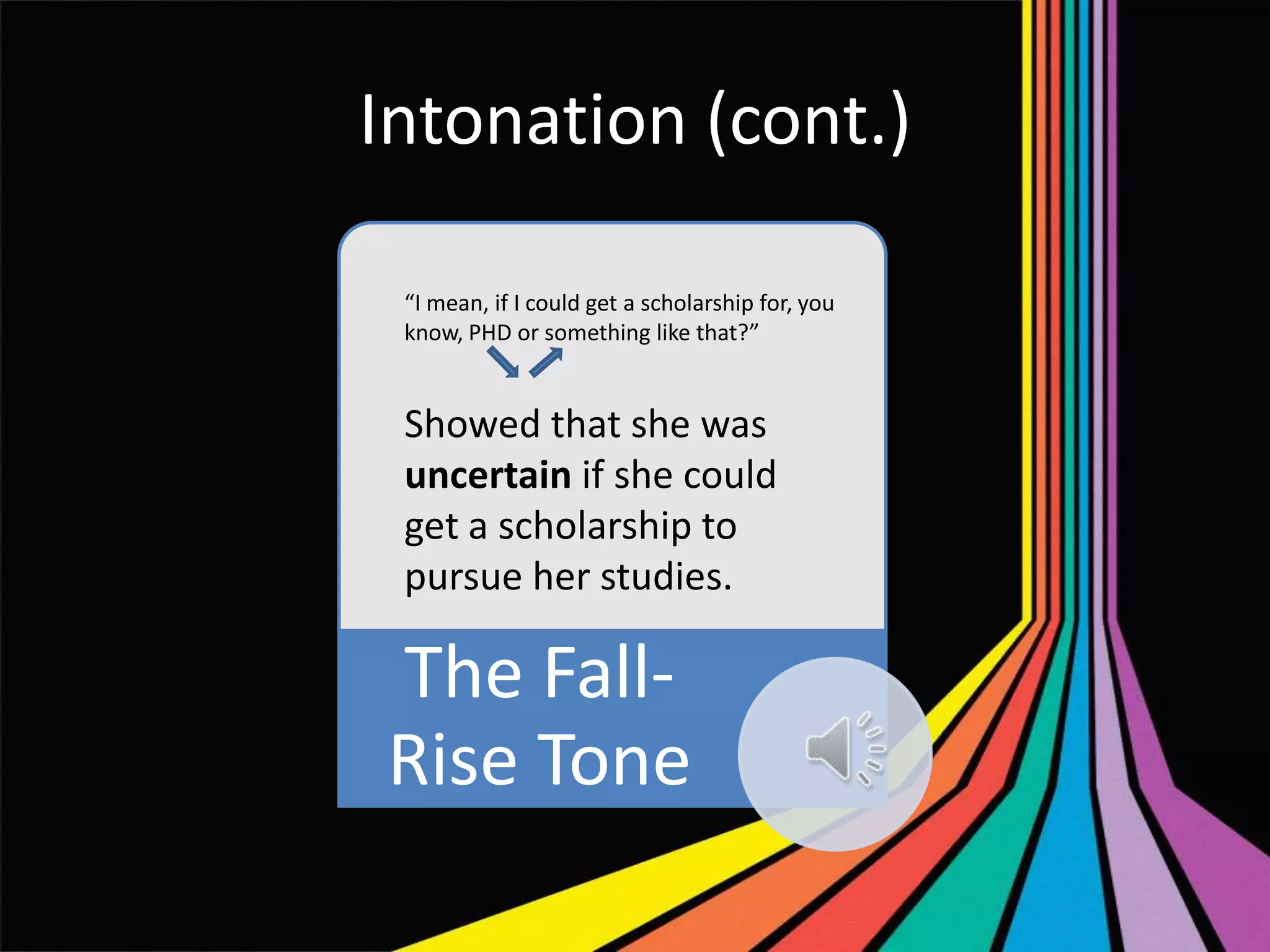
Intonation (cont.)
“I mean, if I could get a scholarship for, you
know, PHD or something like that?”

Showed that she was
uncertain if she could
get a scholarship to
pursue her studies.

The FallRise Tone
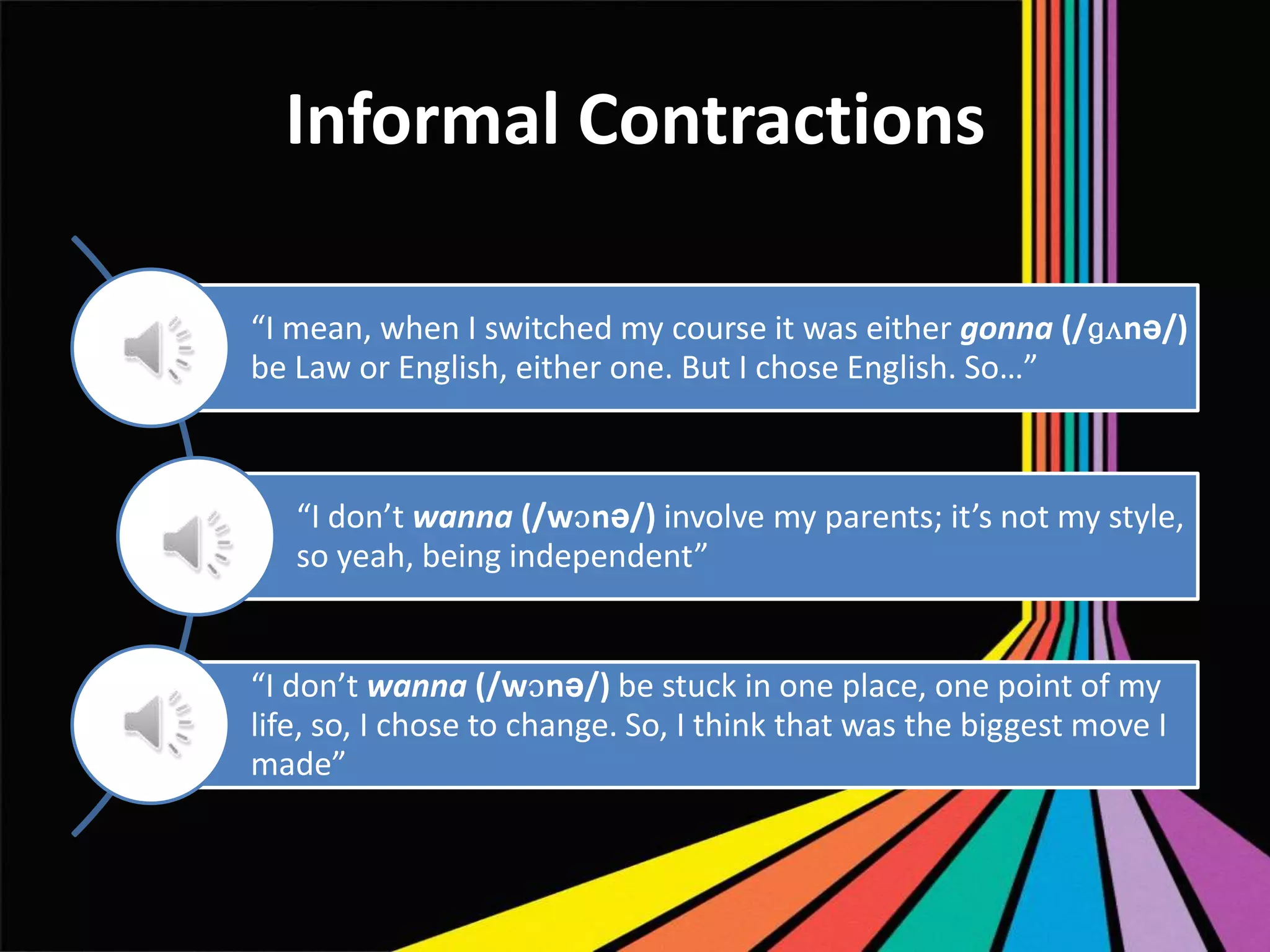
Informal Contractions
“I mean, when I switched my course it was either gonna (/ɡʌnə/)
be Law or English, either one. But I chose English. So…”

“I don’t wanna (/wɔnə/) involve my parents; it’s not my style,
so yeah, being independent”

“I don’t wanna (/wɔnə/) be stuck in one place, one point of my
life, so, I chose to change. So, I think that was the biggest move I
made”
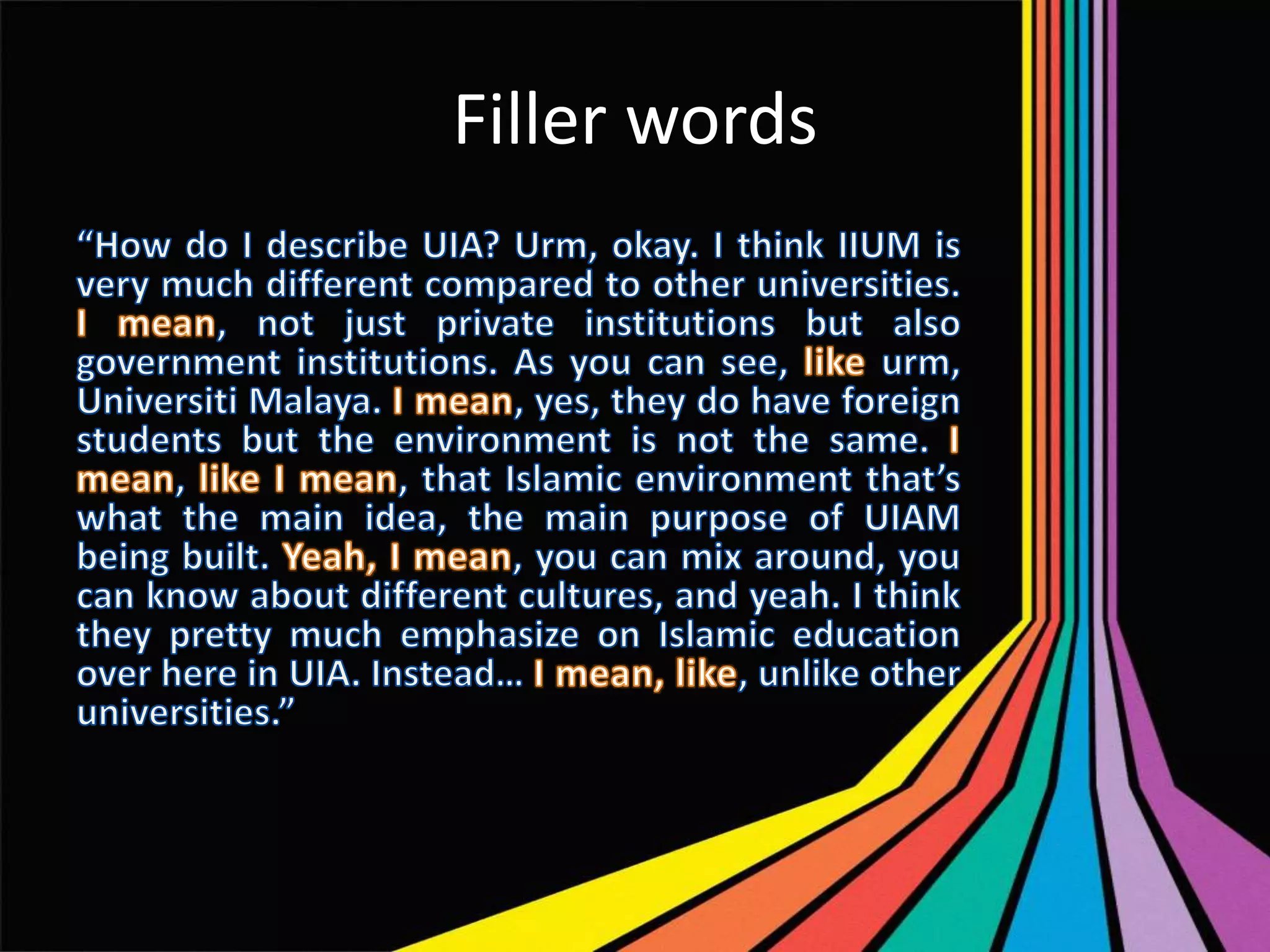
Filler words
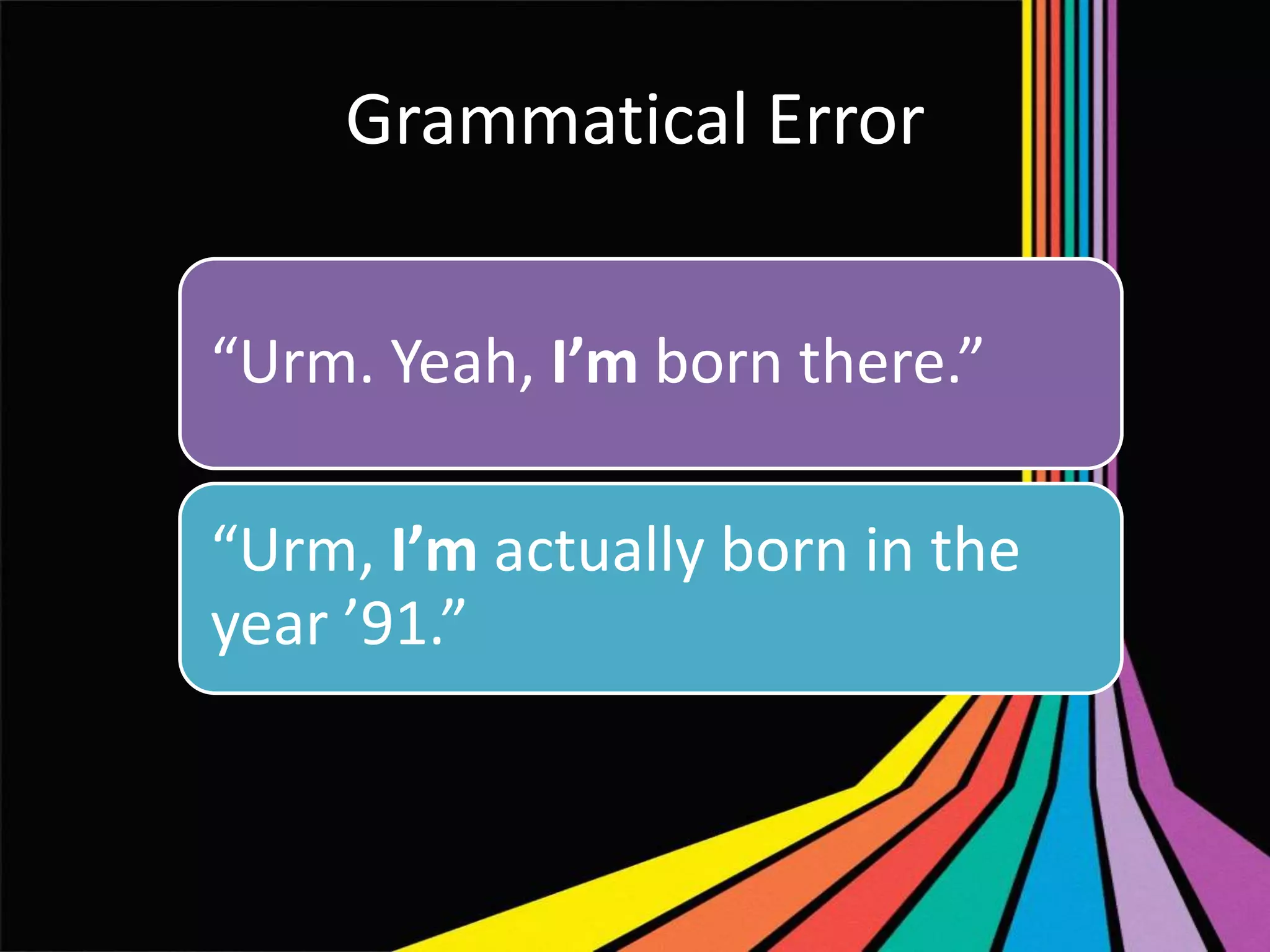
Grammatical Error
“Urm. Yeah, I’m born there.”
“Urm, I’m actually born in the
year ’91.”
Discussion
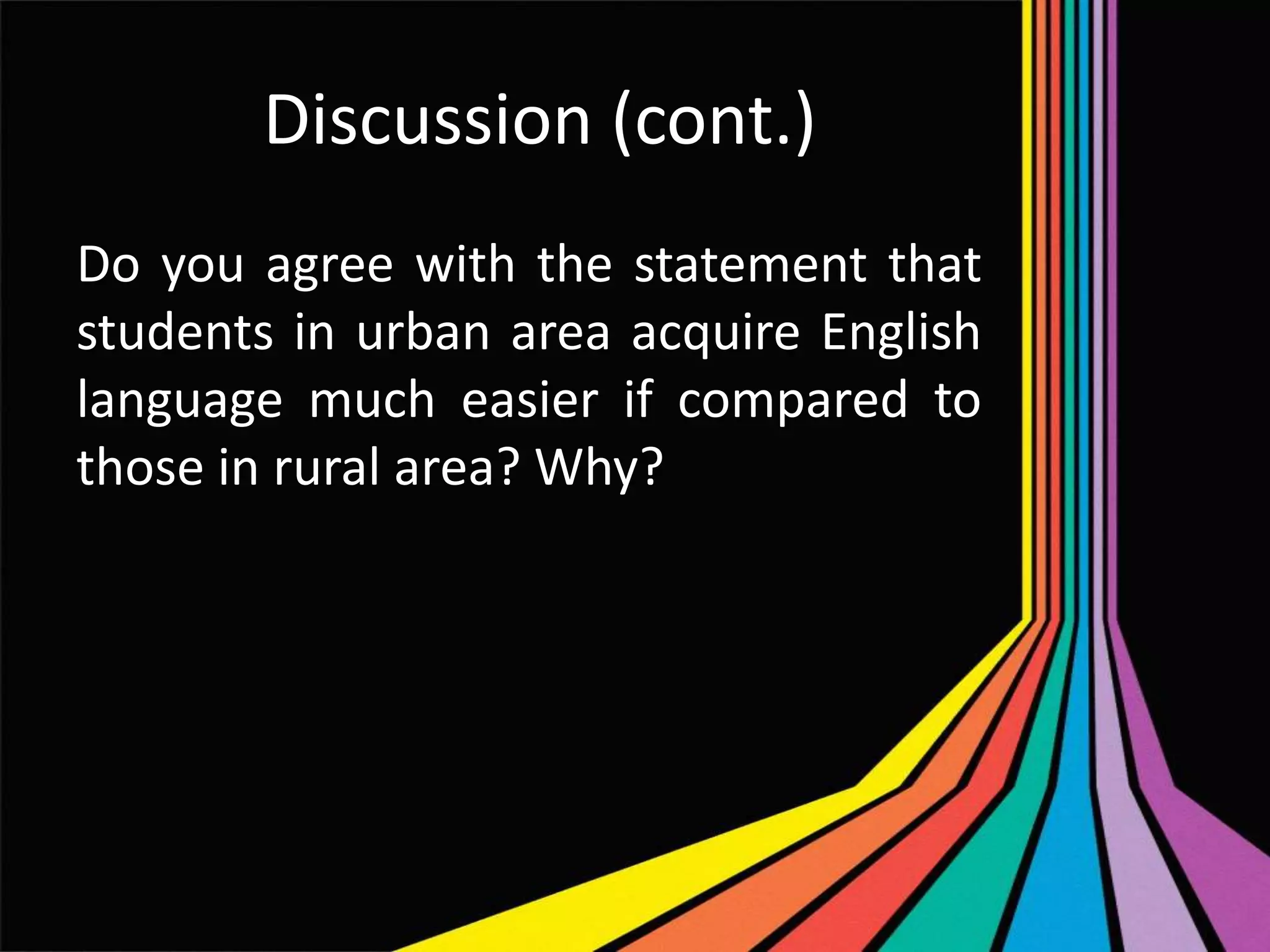
Discussion (cont.)
Do you agree with the statement that
students in urban area acquire English
language much easier if compared to
those in rural area? Why?
Discussion
• From the interview session, it was hardly found
that Syedda’s English pronunciation is affected by
any dialect.
• The tongue-twister activity proved that she could
pronounce most English words very well.
• Here are some of the deductions that we come
out with:– Exposure to English
i.
ii.

Since three years old
Knowledge as BENL student

– The environments, the opportunity to use the
language
i.
ii.

The chance to live in Canada (native speaker country) at
early age
Urban area (Seremban, Negeri Sembilan)
References
Abram, D.and Mavić, M. (2013). Malaysian English: From the old to the new. Retrieved December 10, 2013 from
http://www.academia.edu/2433514/Malaysian_English_From_the_old_to_the_new
Carr, P. (2002) English Phonetics and Phonology: An introduction. Blackwell Publishers: Oxford.
Fromkin, V., Hyams, N., & Rodman, R. (2011). Introduction to language. (9th ed.). Boston: Cengage.
Gobel, P., Siew Ming Thang, Gurnam Kaur Sidhu, Sok Imm Oon, Yuen Fook Cha (2013). Attributions to success and
failure in English language learning: A comparative study of urban and rural undergraduates in Malaysia.
Asian Social Science. Vol 9, No 2.
Ivy Kho Chiann Yiing. (2011). An analysis of pronunciation errors in English of six UTAR Chinese studies
undergraduates. Universiti Tunku Abdul Rahman
Norris, R.W., (1994). Keeping up with native speaker speed: An investigation of reduced forms and deletions in
informal spoken English. Studies in Comparative Culture, No. 25: pp 72-79.

Phoon, H. S. (2010). The phonological development of Malaysian English Speaking Chinese Children: A normative
study. New York: University of Canterbury.
Sakiyama, Y. (2000). Pronunciation and Grammar of English in Malaysia. Kumamoto Gakuen University: BA thesis.

Case Study - English as Second Language (ESL)

  • 1.
  • 2.
    Methodology Place of recording •Student Mall, Riverside IIUM Instruments Used • Recording device: Sony Xperia Z Smartphone • Recording application: Easy Voice Recorder (Version 1.7.3) • Editing software: Windows Movie Maker 2.6
  • 3.
  • 4.
    Literature Review Malaysian English •Malaysian English (ME) is a form of English used and spoken in Malaysia as a second language. In the spoken variety of ME, there may be native language influence in the pronunciation of speakers. This is due to the distinction of vowel and consonant sounds between the native language and English (Ivy Kho Chiann Yiing, 2011). • It is assumed that Malaysian students will acquire shared sounds between English, Mandarin Chinese, Tamil and Malay, since the education system in Malaysia has been multilingual. (Ivy Kho Chiann Yiing, 2011).
  • 5.
    Literature Review (cont.) LanguageAcquisition for ESL Learners • Second-language learners have an accent since they do not often achieve native-like grammatical competence in the second language, especially with respect to pronunciation. In addition, they usually speak with an accent as they may transfer the phonemes, phonological rules, or syllable structures of their first language to their second language (Fromkin et al., 2011). • However, based on research, it is believed that the younger a person exposed to a second language, the more likely she is to achieve native-like competence (Fromkin et al., 2011).
  • 6.
    Literature Review (cont.) LanguageAcquisition for ESL Learners (cont.) • Sakiyama (2000) in his research paper mentioned that, generally, Malaysian who were not exposed to proper English education will speak English words in which they pronounced it in their own mother tongue's ways. In contrast, the one who are more exposed tends to speak English in a more correct way. • In addition, Gobel et al. (2013) in his paper found that urban and rural students held different attribution ratings for the success and failure for learning English as a second language with the urban group being more willing to attribute success to their own ability, effort, and study skills than the rural group. Based on that data, he came out with a hypothesis that the urban groups are much more study-wise and confident as they have a greater belief in their own ability to take control of their successes in the language classroom.
  • 7.
    Literature Review (cont.) Consonantsand Vowels in Malaysian English • Dental fricatives /θ/ and /ð/ are often substituted by the corresponding alveolar stops /t/ and /d/, hence words like thick or the (/θɪk/ and /ðə/ in RP) become /tɪk/ and /də/ (Mavic and Abram, 2013). • Do not pronounce the word-final consonants (p, t, k, d, g, b, e.t.c.). It is called glottal stop. Hence, words like just and told are pronounced as /dʒəs/ instead of /dʒəst/, /tol/ instead of /təʊld/ (Sakiyama, 2000).
  • 8.
    Literature Review (cont.) Consonantsand Vowels in Malaysian English (cont.) • Do not pronounce diphthongs, and do it as monophthongs. Hence, words like so and take (/ˈ səʊ/ and /teɪk/) become /so/ and /tek/ (Sakiyama, 2000). • ME speakers also usually shorten long vowels which can be “attributed to the absence of long vowels in Bahasa Malaysia” so word field, half, water, food and girl, which are /fiˈld, /hɑˈf / /, /wɔˈt /fuˈd and /gɜˈl in RP, turn into /fild/, ə/, / / /haf/, /wɔtə/, /fud/ and /gɜl/ in ME (Mavic and Abram, 2013).
  • 9.
  • 10.
    Consonants Dental fricatives /θ/and /ð/ are often substituted by the corresponding alveolar stops /t/ and /d/ (Mavic and Abram, 2013). “So, I think my date of birth, age is not necessary for you all to know.” “Urm, I entered the university, I mean this university in Gombak in the year 2011.”
  • 11.
    Consonants (cont.) Do notpronounce the word-final consonants (p, t, k, d, g, b, e.t.c.). It is called glottal stop. (Sakiyama, 2000). “I’m a third year BENL student.” /ˈ stjuˈdnt to /ˈ / stjudn/ “I would like to pursue my Master right away.” /raɪt/ to /raɪt/
  • 12.
    Vowels Do not pronounce diphthongs,and do it as monophthongs. (Sakiyama, 2000). “So, I think my date of birth…” /deɪt/ to /det/ ME speakers usually shorten long vowels which can be “attributed to the absence of long vowels in Bahasa Malaysia” (Mavic and Abram, 2013). “I got the award of ‘Artis Puteri’ back from my school.” /skuˈl/ to /skul/
  • 13.
  • 14.
  • 15.
  • 16.
    Stress (cont.) • Accordingto the analysis, the interviewee made no mistake in applying stress in her speech. • Looking at the interviewee’s background, we can make two assumptions for this case:i. She has been exposed to English for a very long time; thus, making her a very competent English speaker. ii. As she’s a BENL student, she has the knowledge of stress application and practices it in her speech.
  • 17.
    Intonation “Unique?” Showed that shewas surprised when was asked with the question. The RiseFall Tone “Oh, yes, Insha’Allah, yes. Most definitely. “ Showed that she was sure about her decision to further her studies The Fall Tone
  • 18.
    Intonation (cont.) “I mean,if I could get a scholarship for, you know, PHD or something like that?” Showed that she was uncertain if she could get a scholarship to pursue her studies. The FallRise Tone
  • 19.
    Informal Contractions “I mean,when I switched my course it was either gonna (/ɡʌnə/) be Law or English, either one. But I chose English. So…” “I don’t wanna (/wɔnə/) involve my parents; it’s not my style, so yeah, being independent” “I don’t wanna (/wɔnə/) be stuck in one place, one point of my life, so, I chose to change. So, I think that was the biggest move I made”
  • 20.
  • 21.
    Grammatical Error “Urm. Yeah,I’m born there.” “Urm, I’m actually born in the year ’91.”
  • 22.
  • 23.
    Discussion (cont.) Do youagree with the statement that students in urban area acquire English language much easier if compared to those in rural area? Why?
  • 24.
    Discussion • From theinterview session, it was hardly found that Syedda’s English pronunciation is affected by any dialect. • The tongue-twister activity proved that she could pronounce most English words very well. • Here are some of the deductions that we come out with:– Exposure to English i. ii. Since three years old Knowledge as BENL student – The environments, the opportunity to use the language i. ii. The chance to live in Canada (native speaker country) at early age Urban area (Seremban, Negeri Sembilan)
  • 25.
    References Abram, D.and Mavić,M. (2013). Malaysian English: From the old to the new. Retrieved December 10, 2013 from http://www.academia.edu/2433514/Malaysian_English_From_the_old_to_the_new Carr, P. (2002) English Phonetics and Phonology: An introduction. Blackwell Publishers: Oxford. Fromkin, V., Hyams, N., & Rodman, R. (2011). Introduction to language. (9th ed.). Boston: Cengage. Gobel, P., Siew Ming Thang, Gurnam Kaur Sidhu, Sok Imm Oon, Yuen Fook Cha (2013). Attributions to success and failure in English language learning: A comparative study of urban and rural undergraduates in Malaysia. Asian Social Science. Vol 9, No 2. Ivy Kho Chiann Yiing. (2011). An analysis of pronunciation errors in English of six UTAR Chinese studies undergraduates. Universiti Tunku Abdul Rahman Norris, R.W., (1994). Keeping up with native speaker speed: An investigation of reduced forms and deletions in informal spoken English. Studies in Comparative Culture, No. 25: pp 72-79. Phoon, H. S. (2010). The phonological development of Malaysian English Speaking Chinese Children: A normative study. New York: University of Canterbury. Sakiyama, Y. (2000). Pronunciation and Grammar of English in Malaysia. Kumamoto Gakuen University: BA thesis.