MOVEMENTS IN
AMERICAN LITERATURE
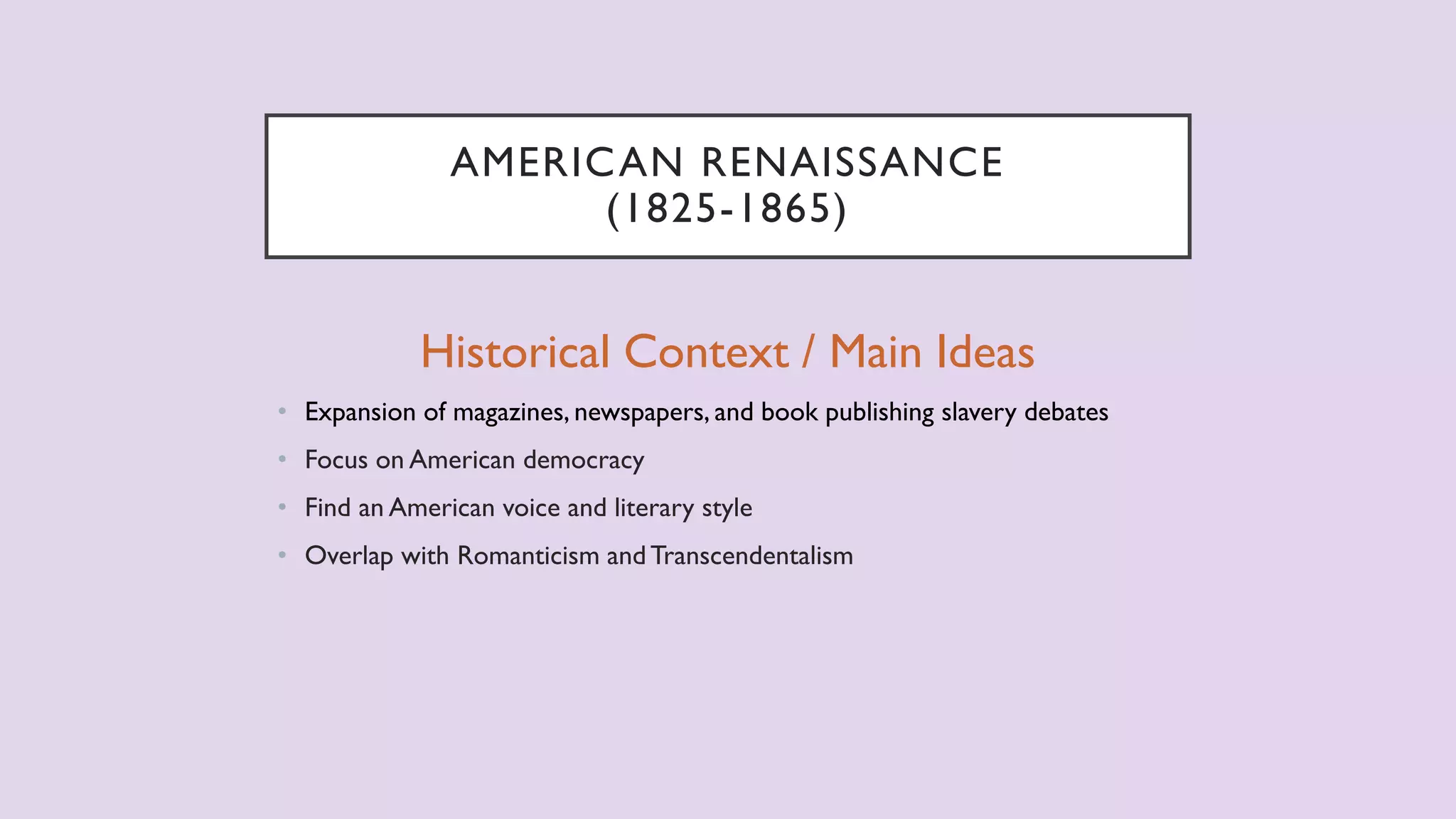
AMERICAN RENAISSANCE
(1825-1865)
Historical Context / Main Ideas
• Expansion of magazines, newspapers, and book publishing slavery debates
• Focus on American democracy
• Find an American voice and literary style
• Overlap with Romanticism andTranscendentalism
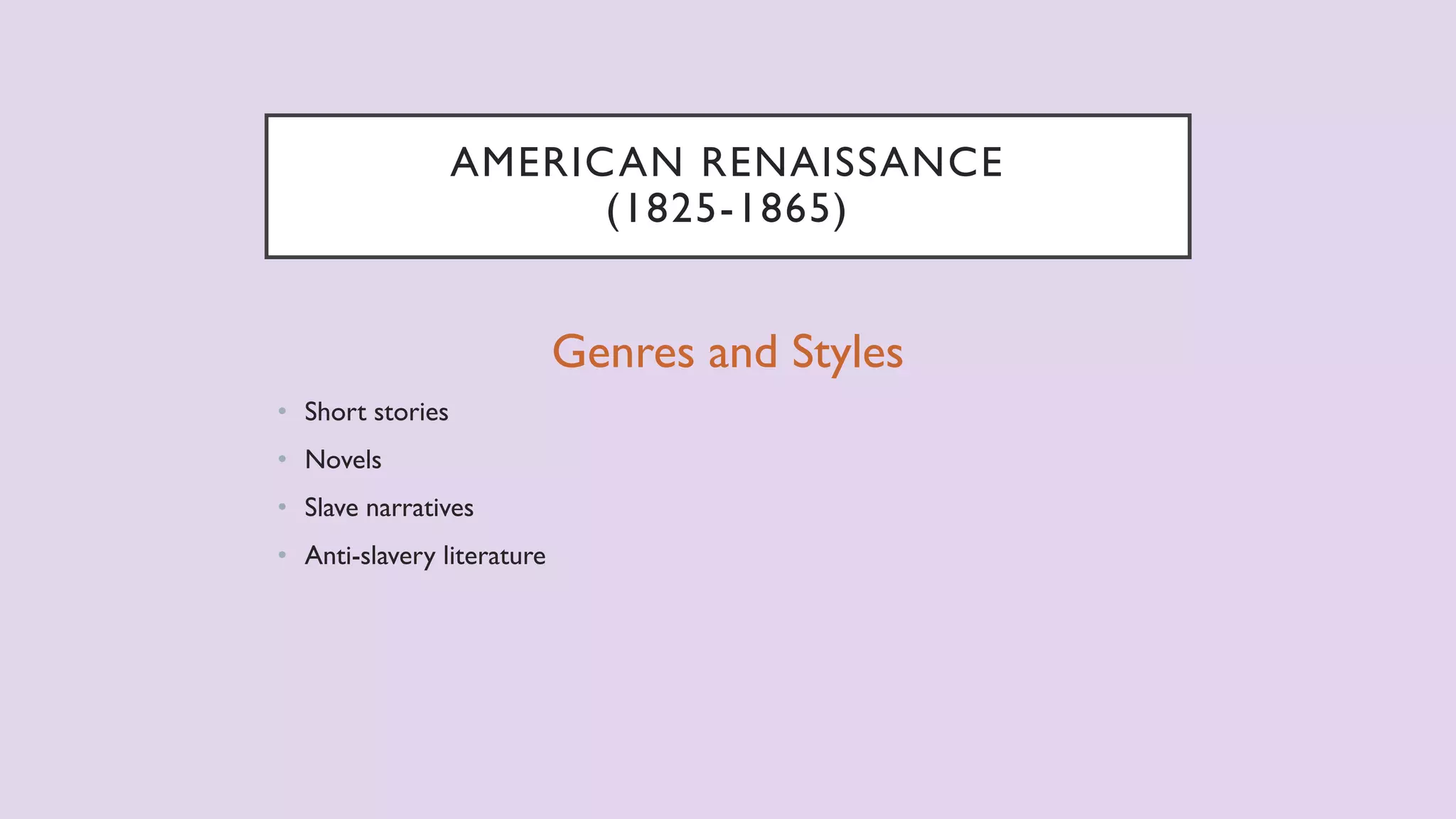
AMERICAN RENAISSANCE
(1825-1865)
Genres and Styles
• Short stories
• Novels
• Slave narratives
• Anti-slavery literature
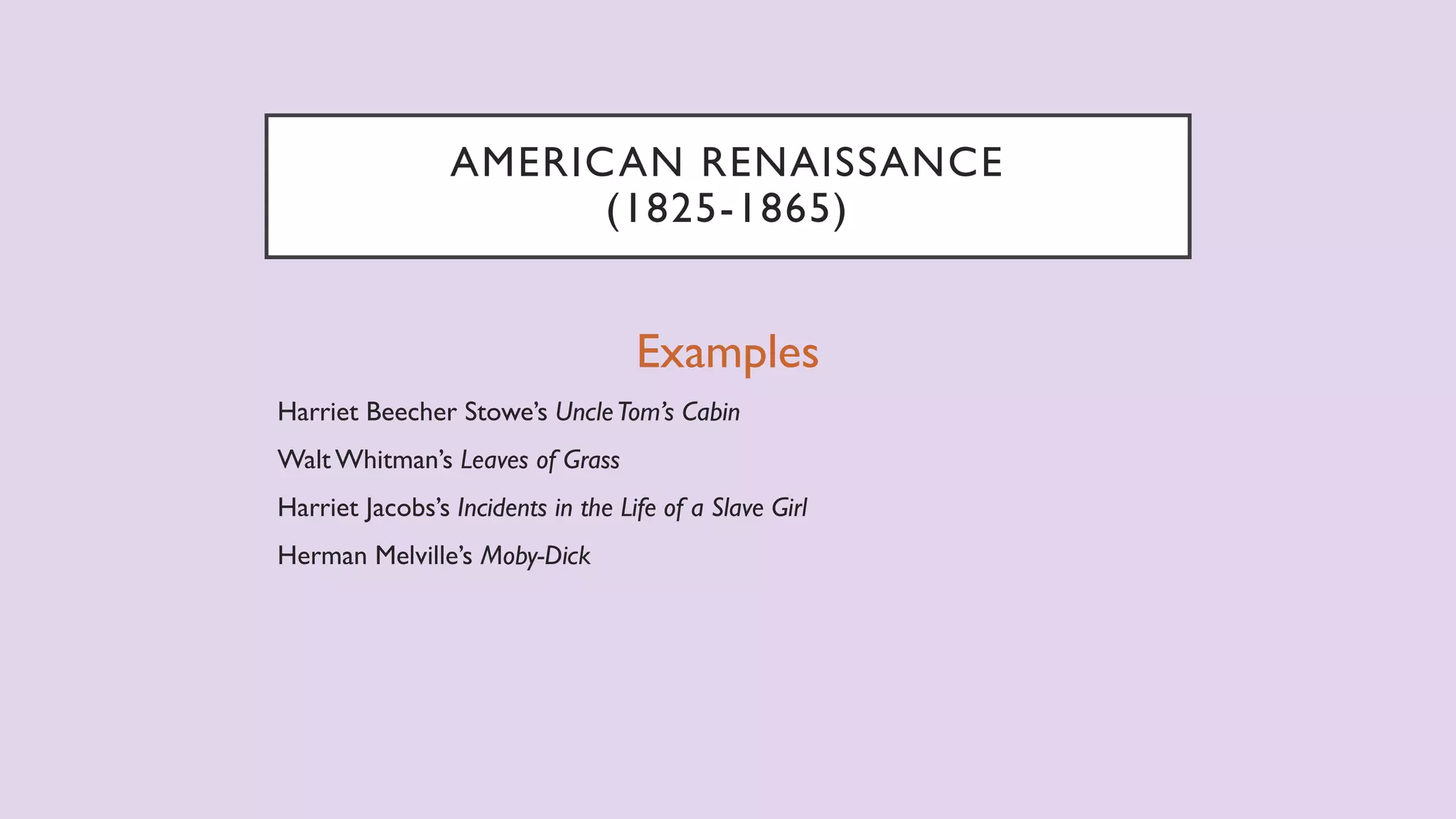
AMERICAN RENAISSANCE
(1825-1865)
Examples
Harriet Beecher Stowe’s UncleTom’s Cabin
Walt Whitman’s Leaves of Grass
Harriet Jacobs’s Incidents in the Life of a Slave Girl
Herman Melville’s Moby-Dick
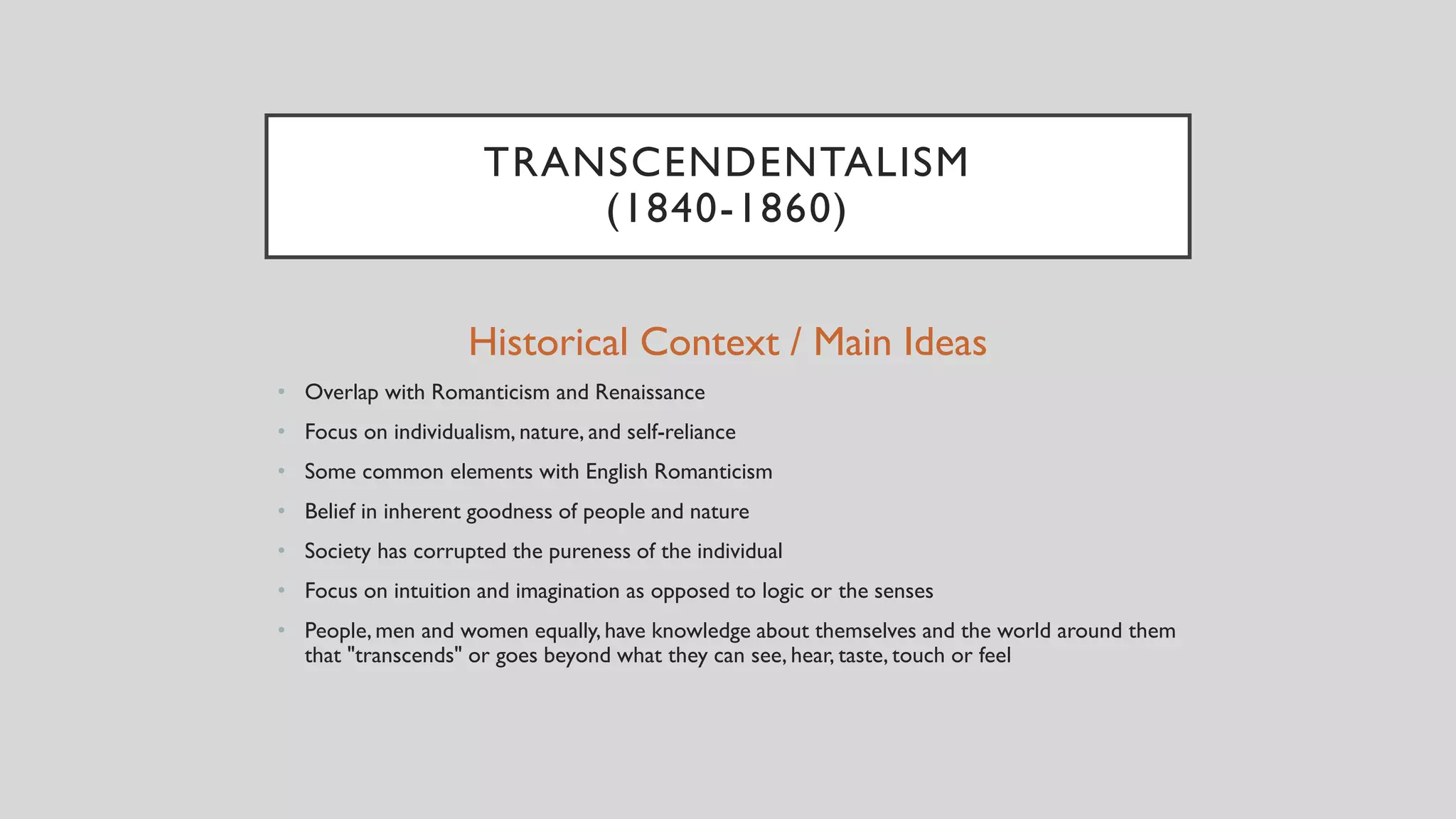
TRANSCENDENTALISM
(1840-1860)
Historical Context / Main Ideas
• Overlap with Romanticism and Renaissance
• Focus on individualism, nature, and self-reliance
• Some common elements with English Romanticism
• Belief in inherent goodness of people and nature
• Society has corrupted the pureness of the individual
• Focus on intuition and imagination as opposed to logic or the senses
• People, men and women equally, have knowledge about themselves and the world around them
that "transcends" or goes beyond what they can see, hear, taste, touch or feel
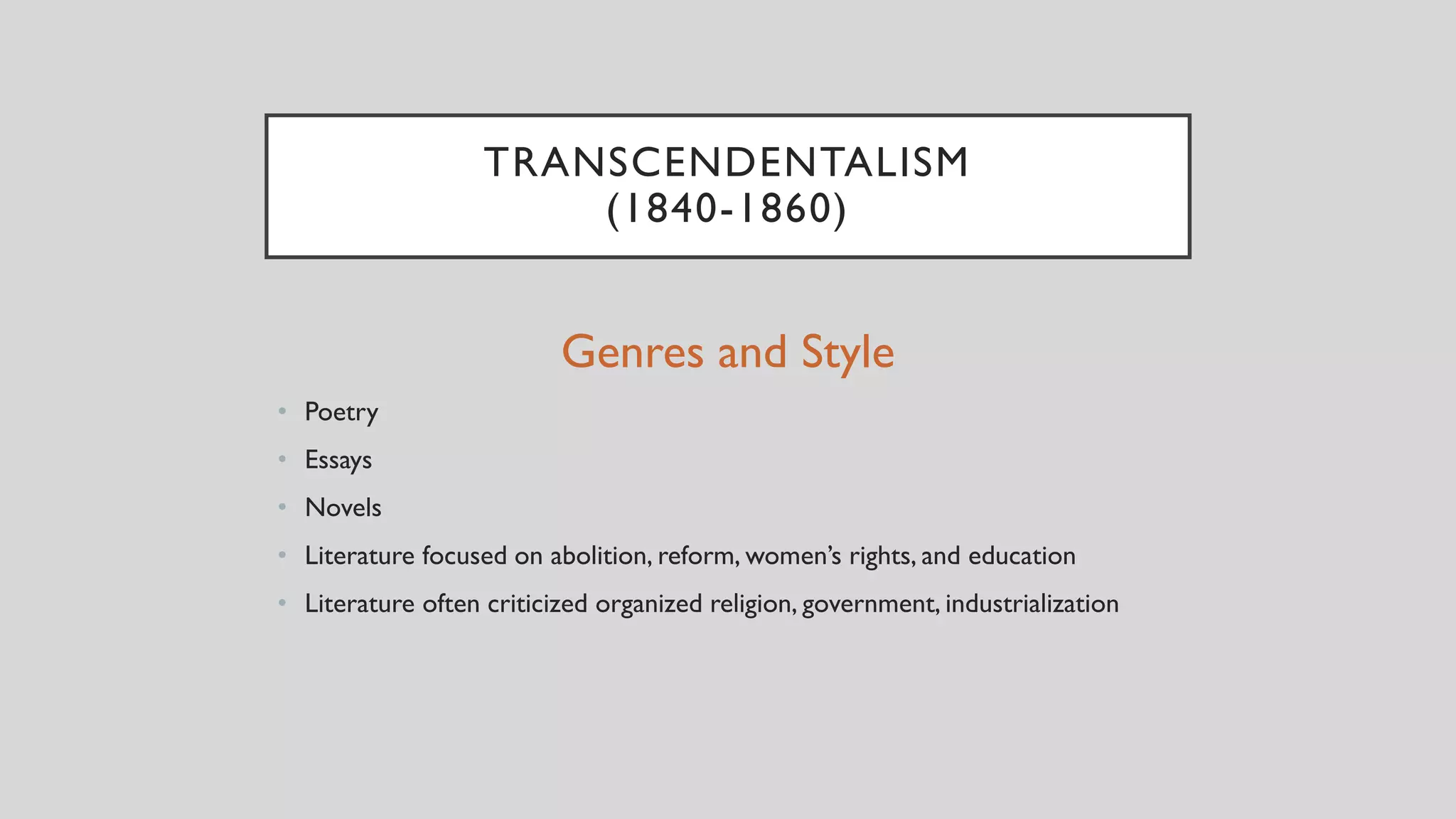
TRANSCENDENTALISM
(1840-1860)
Genres and Style
• Poetry
• Essays
• Novels
• Literature focused on abolition, reform, women’s rights, and education
• Literature often criticized organized religion, government, industrialization
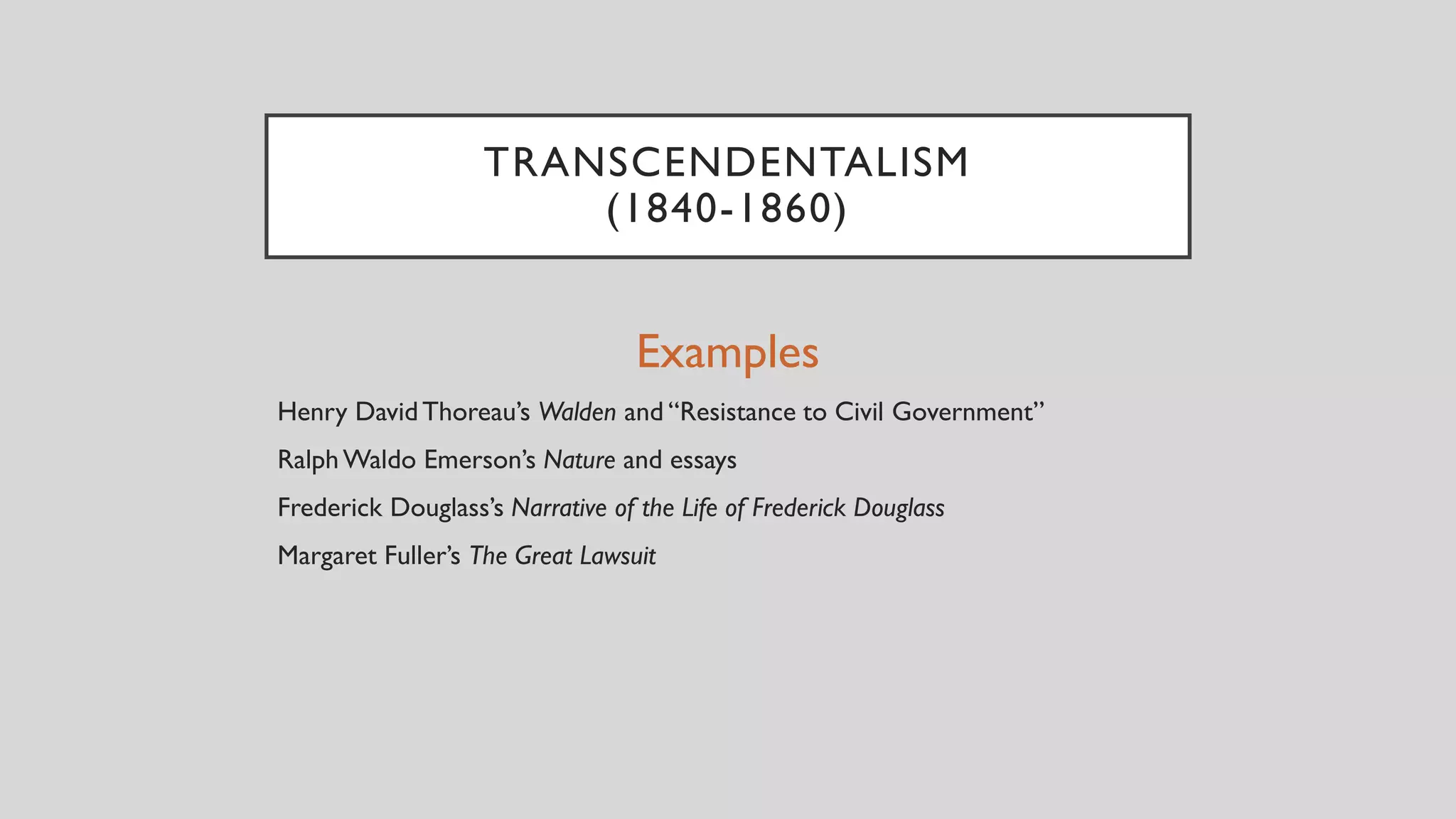
TRANSCENDENTALISM
(1840-1860)
Examples
Henry DavidThoreau’s Walden and “Resistance to Civil Government”
RalphWaldo Emerson’s Nature and essays
Frederick Douglass’s Narrative of the Life of Frederick Douglass
Margaret Fuller’s The Great Lawsuit
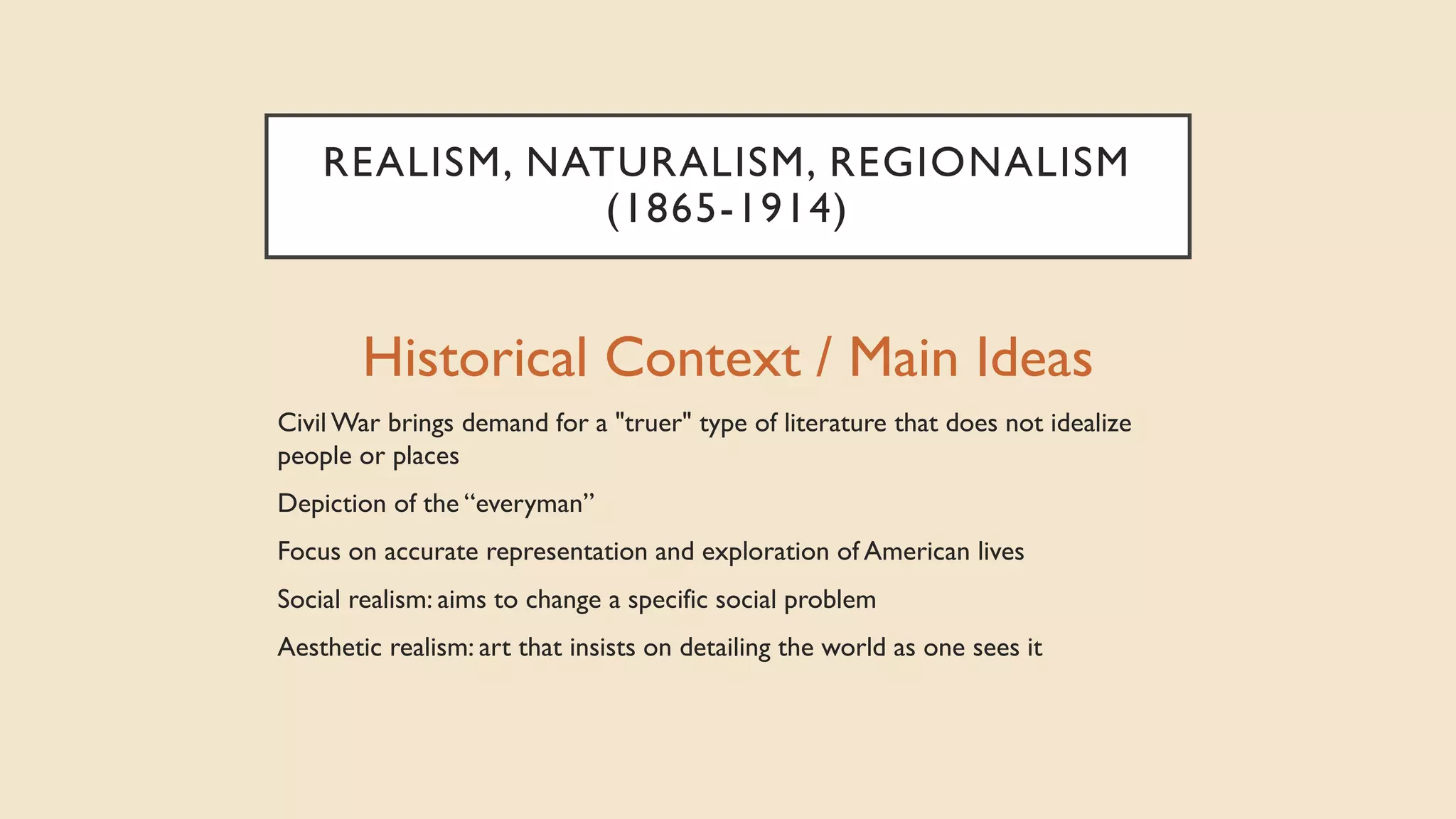
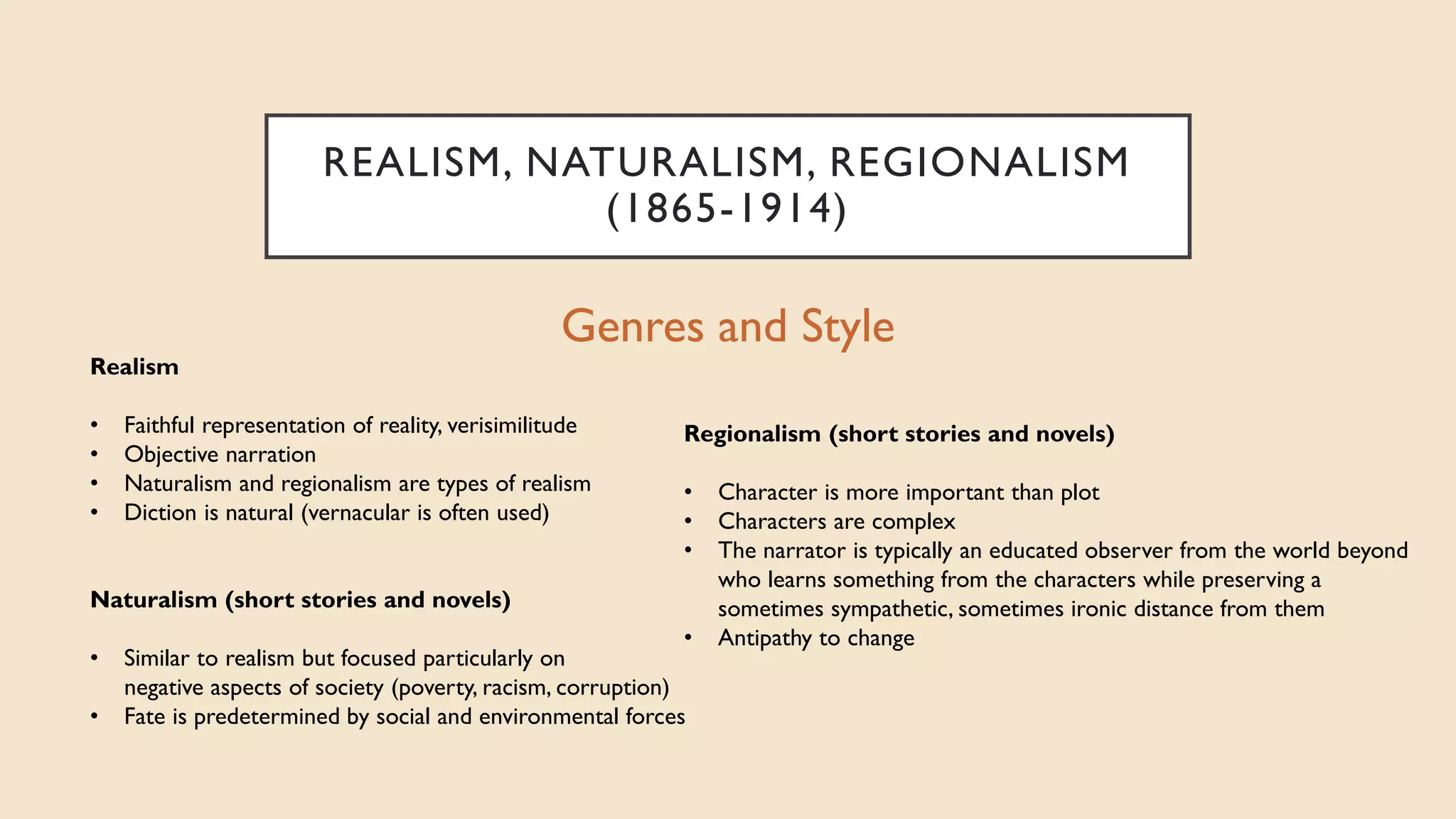
REALISM, NATURALISM, REGIONALISM
(1865-1914)
Historical Context / Main Ideas
Civil War brings demand for a "truer" type of literature that does not idealize
people or places
Depiction of the “everyman”
Focus on accurate representation and exploration of American lives
Social realism: aims to change a specific social problem
Aesthetic realism: art that insists on detailing the world as one sees it
REALISM, NATURALISM, REGIONALISM
(1865-1914)
Genres and Style
Regionalism (short stories and novels)
• Character is more important than plot
• Characters are complex
• The narrator is typically an educated observer from the world beyond
who learns something from the characters while preserving a
sometimes sympathetic, sometimes ironic distance from them
• Antipathy to change
Naturalism (short stories and novels)
• Similar to realism but focused particularly on
negative aspects of society (poverty, racism, corruption)
• Fate is predetermined by social and environmental forces
Realism
• Faithful representation of reality, verisimilitude
• Objective narration
• Naturalism and regionalism are types of realism
• Diction is natural (vernacular is often used)
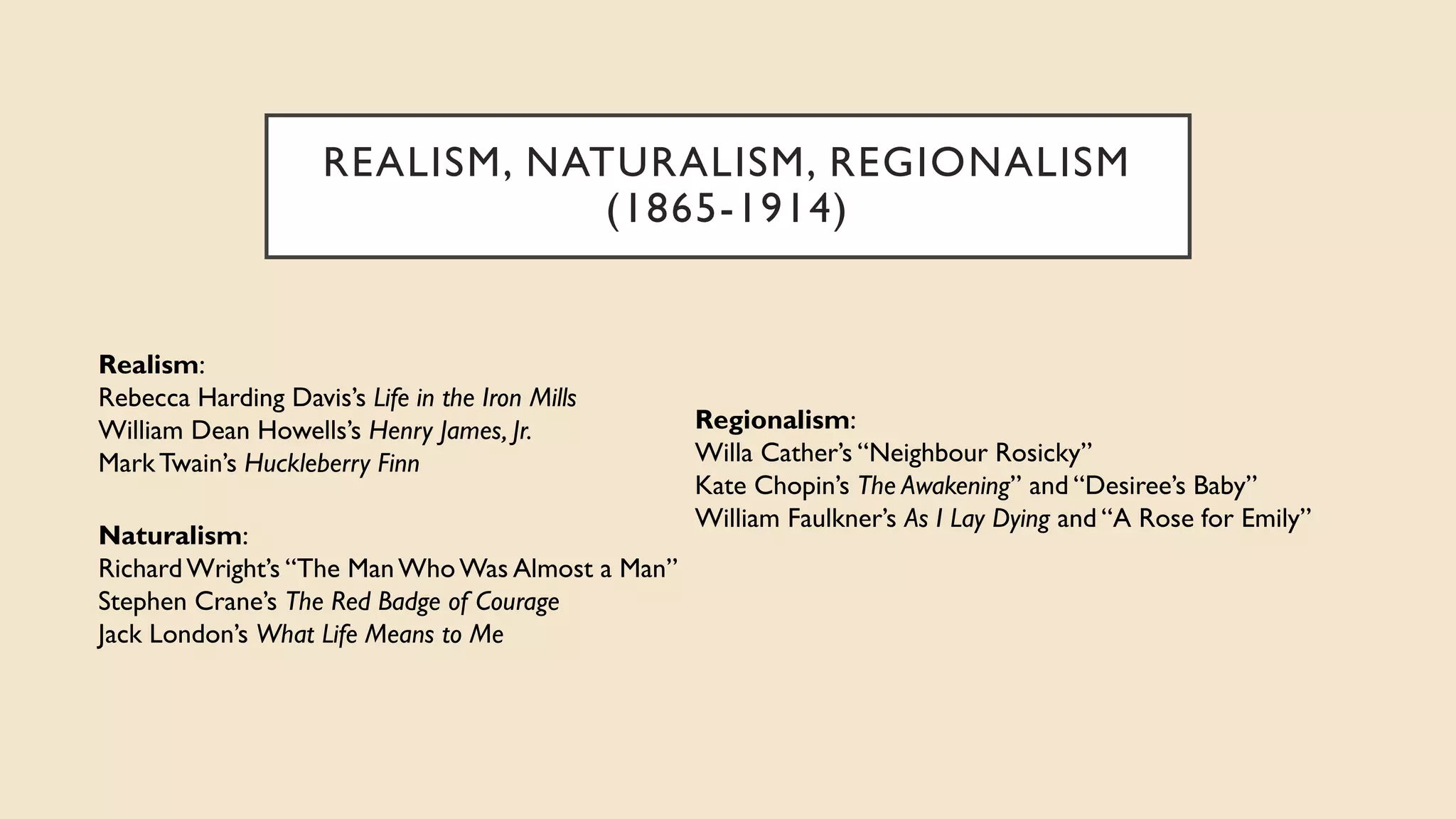
REALISM, NATURALISM, REGIONALISM
(1865-1914)
Regionalism:
Willa Cather’s “Neighbour Rosicky”
Kate Chopin’s The Awakening” and “Desiree’s Baby”
William Faulkner’s As I Lay Dying and “A Rose for Emily”
Naturalism:
RichardWright’s “The ManWhoWas Almost a Man”
Stephen Crane’s The Red Badge of Courage
Jack London’s What Life Means to Me
Realism:
Rebecca Harding Davis’s Life in the Iron Mills
William Dean Howells’s Henry James, Jr.
MarkTwain’s Huckleberry Finn
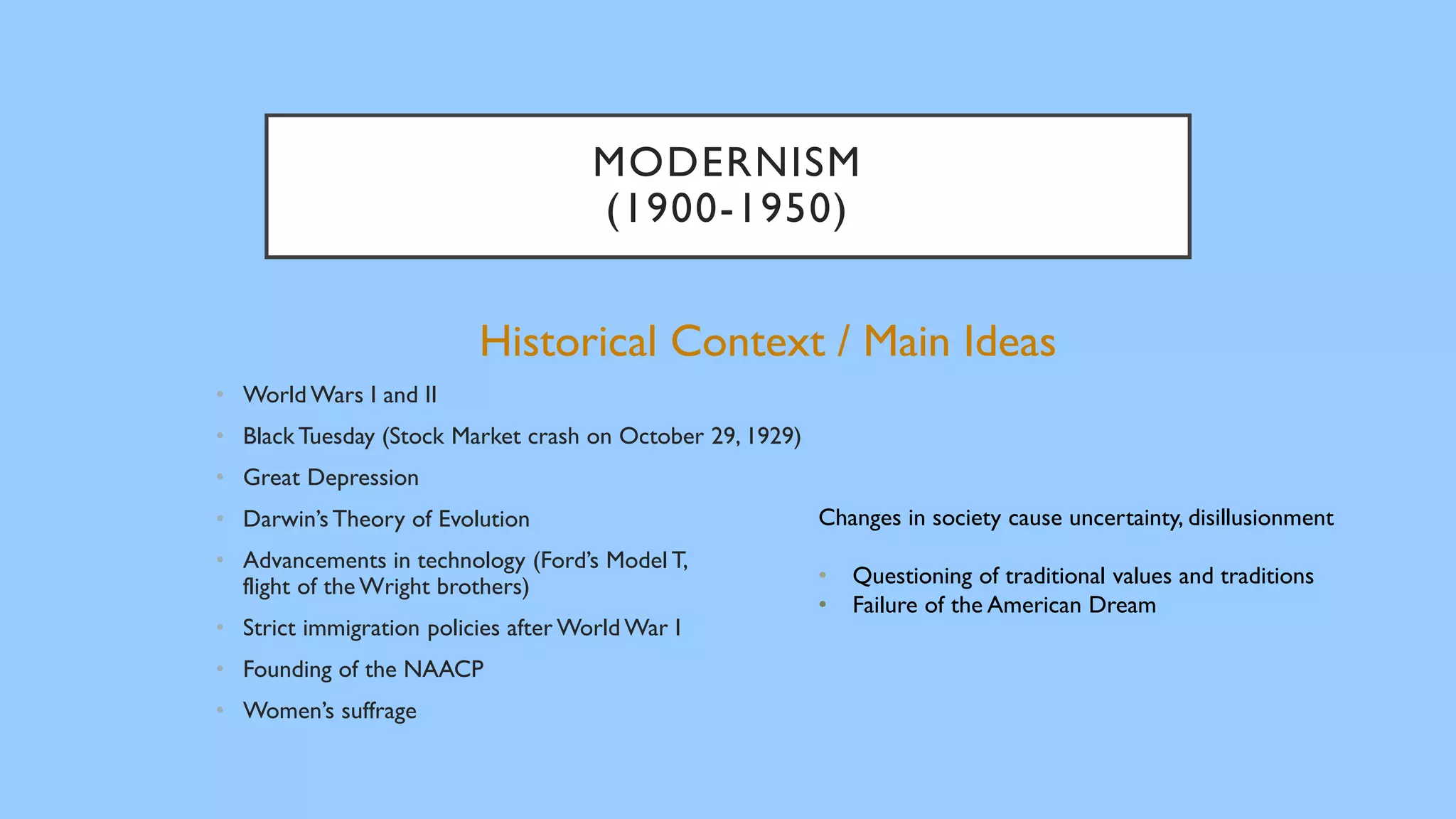
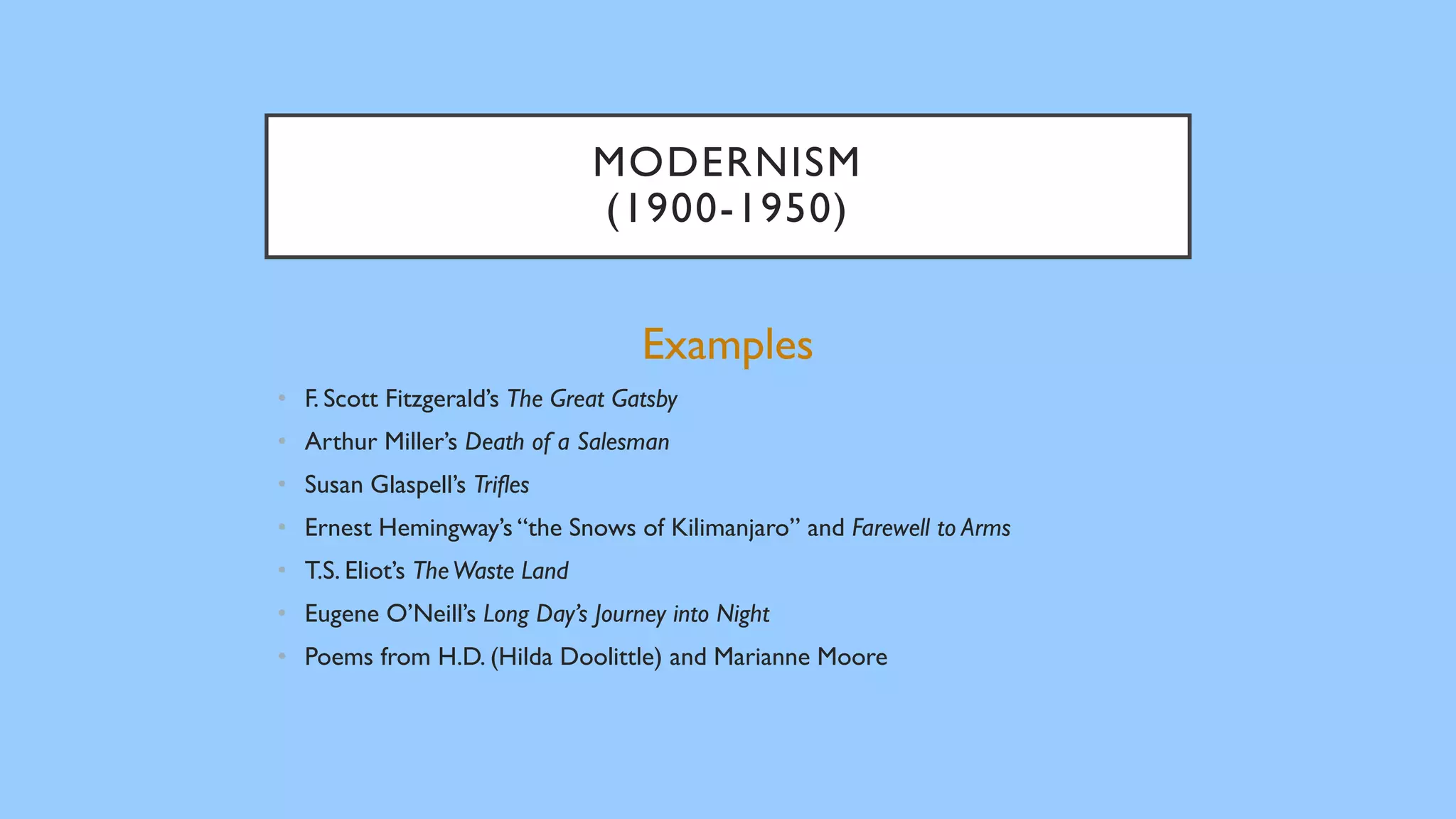
MODERNISM
(1900-1950)
Historical Context / Main Ideas
• World Wars I and II
• Black Tuesday (Stock Market crash on October 29, 1929)
• Great Depression
• Darwin’s Theory of Evolution
• Advancements in technology (Ford’s Model T,
flight of the Wright brothers)
• Strict immigration policies after World War I
• Founding of the NAACP
• Women’s suffrage
Changes in society cause uncertainty, disillusionment
• Questioning of traditional values and traditions
• Failure of the American Dream
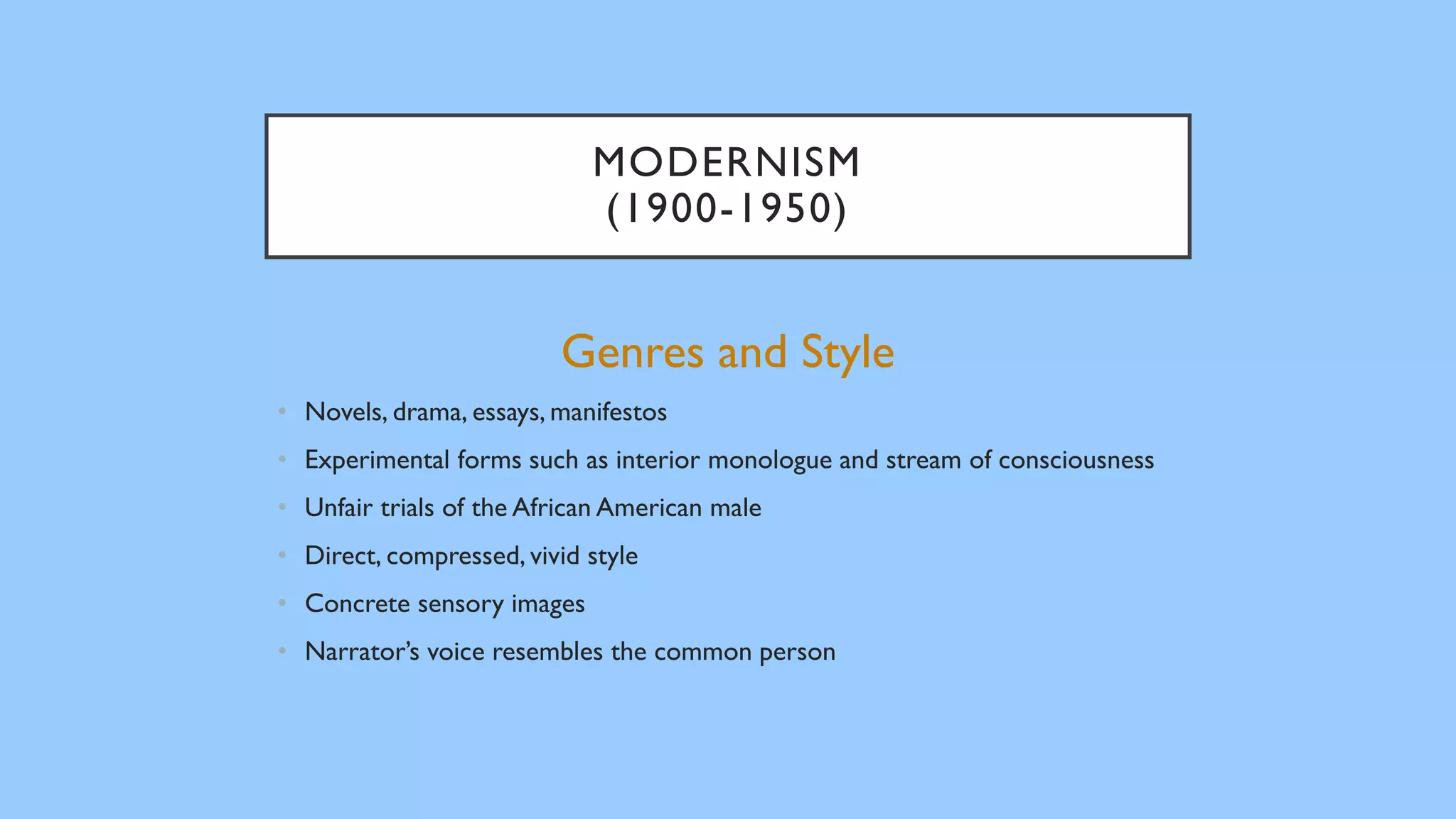
MODERNISM
(1900-1950)
Genres and Style
• Novels, drama, essays, manifestos
• Experimental forms such as interior monologue and stream of consciousness
• Unfair trials of the African American male
• Direct, compressed, vivid style
• Concrete sensory images
• Narrator’s voice resembles the common person
MODERNISM
(1900-1950)
Examples
• F. Scott Fitzgerald’s The Great Gatsby
• Arthur Miller’s Death of a Salesman
• Susan Glaspell’s Trifles
• Ernest Hemingway’s “the Snows of Kilimanjaro” and Farewell to Arms
• T.S. Eliot’s TheWaste Land
• Eugene O’Neill’s Long Day’s Journey into Night
• Poems from H.D. (Hilda Doolittle) and Marianne Moore
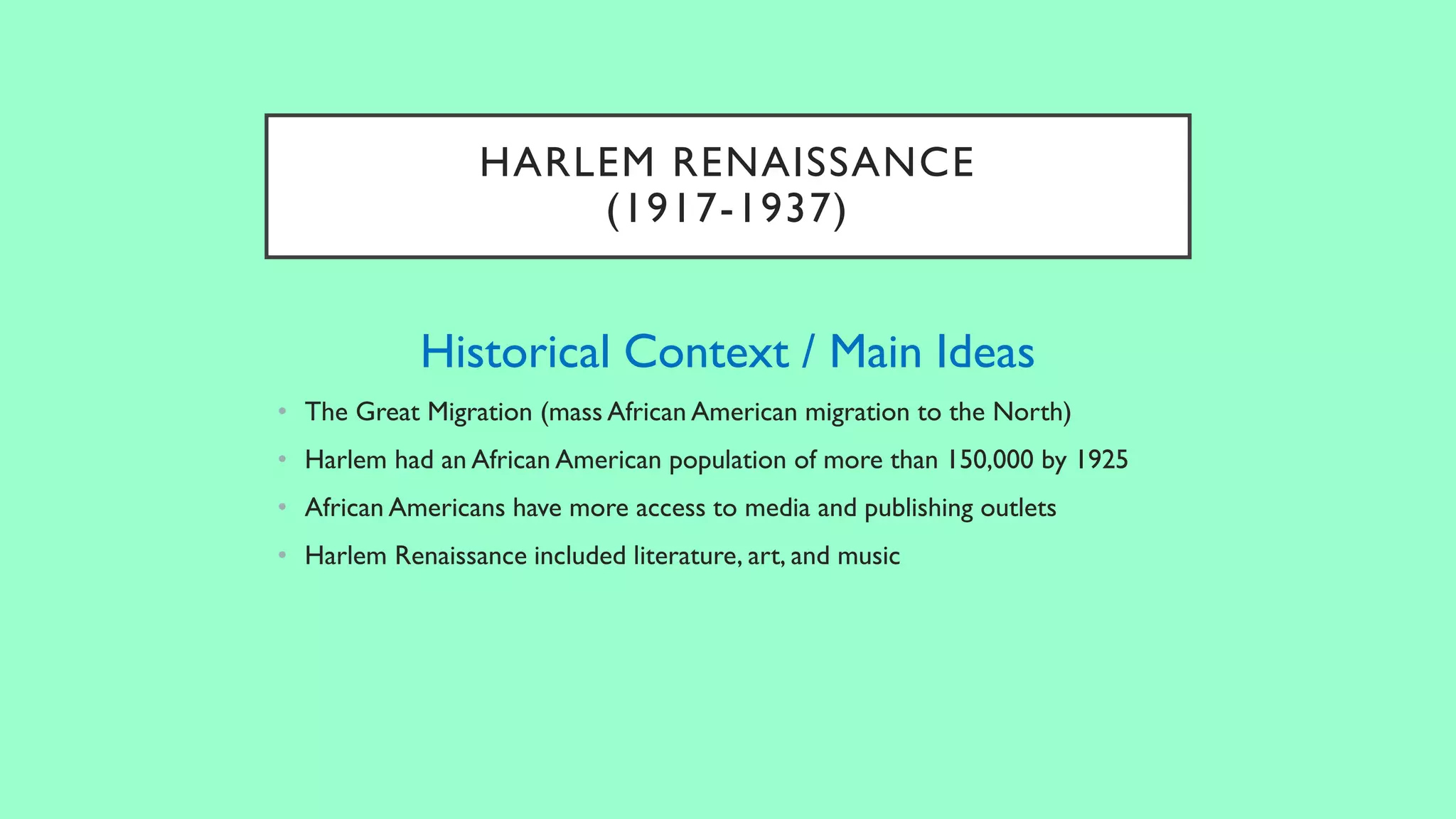
HARLEM RENAISSANCE
(1917-1937)
Historical Context / Main Ideas
• The Great Migration (mass African American migration to the North)
• Harlem had an African American population of more than 150,000 by 1925
• African Americans have more access to media and publishing outlets
• Harlem Renaissance included literature, art, and music
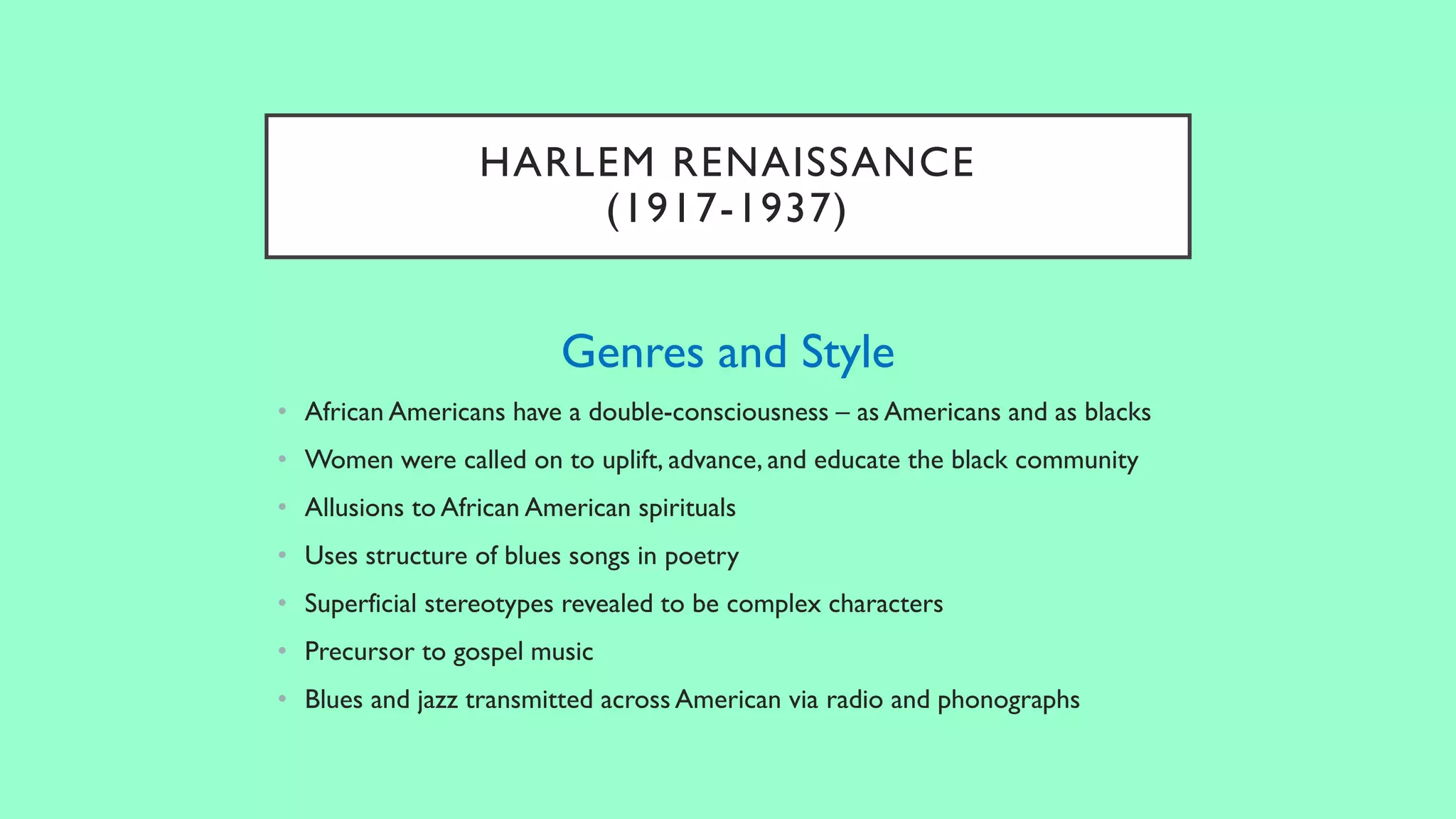
HARLEM RENAISSANCE
(1917-1937)
Genres and Style
• African Americans have a double-consciousness – as Americans and as blacks
• Women were called on to uplift, advance, and educate the black community
• Allusions to African American spirituals
• Uses structure of blues songs in poetry
• Superficial stereotypes revealed to be complex characters
• Precursor to gospel music
• Blues and jazz transmitted across American via radio and phonographs
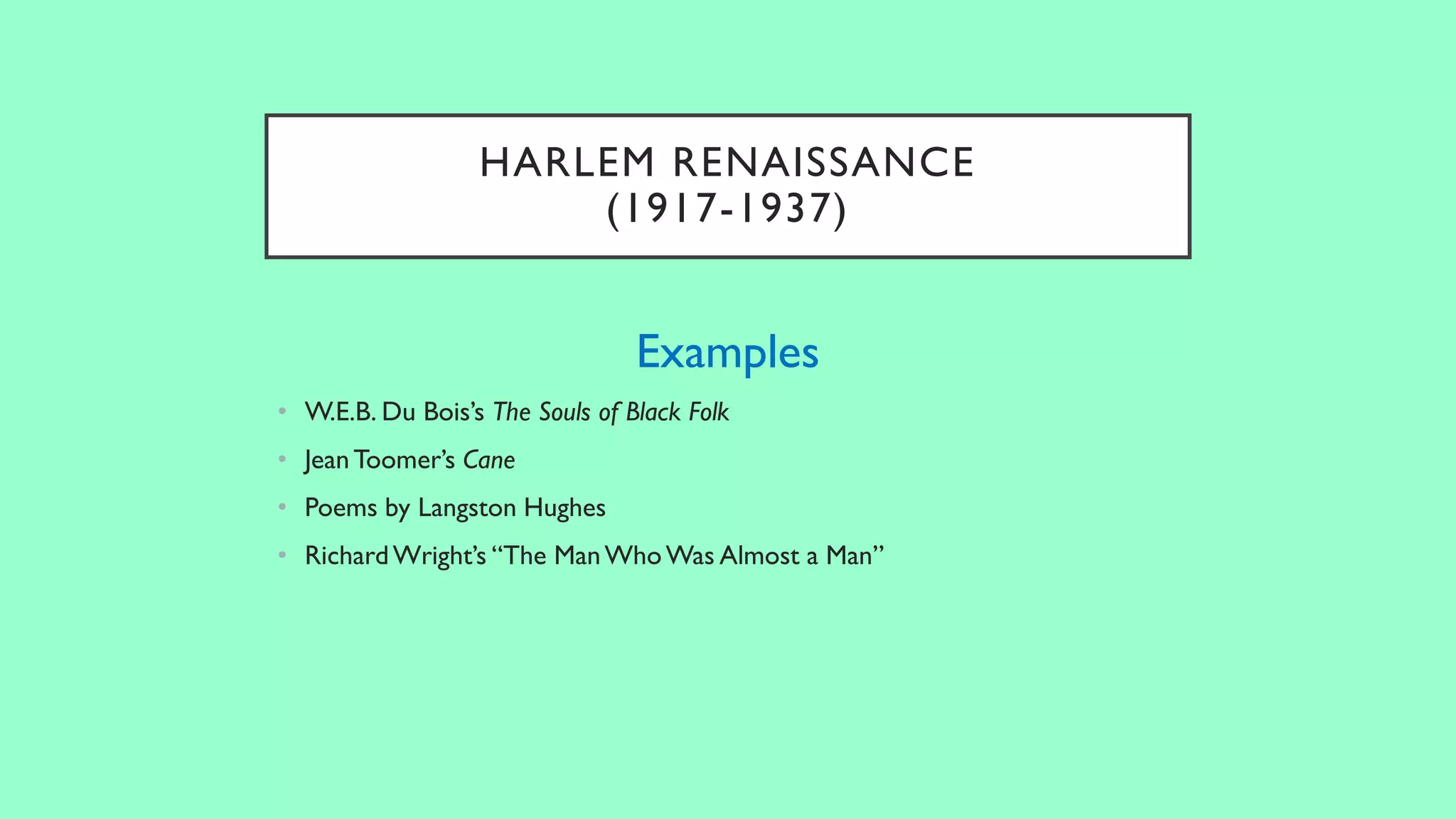
HARLEM RENAISSANCE
(1917-1937)
Examples
• W.E.B. Du Bois’s The Souls of Black Folk
• JeanToomer’s Cane
• Poems by Langston Hughes
• RichardWright’s “The ManWhoWas Almost a Man”
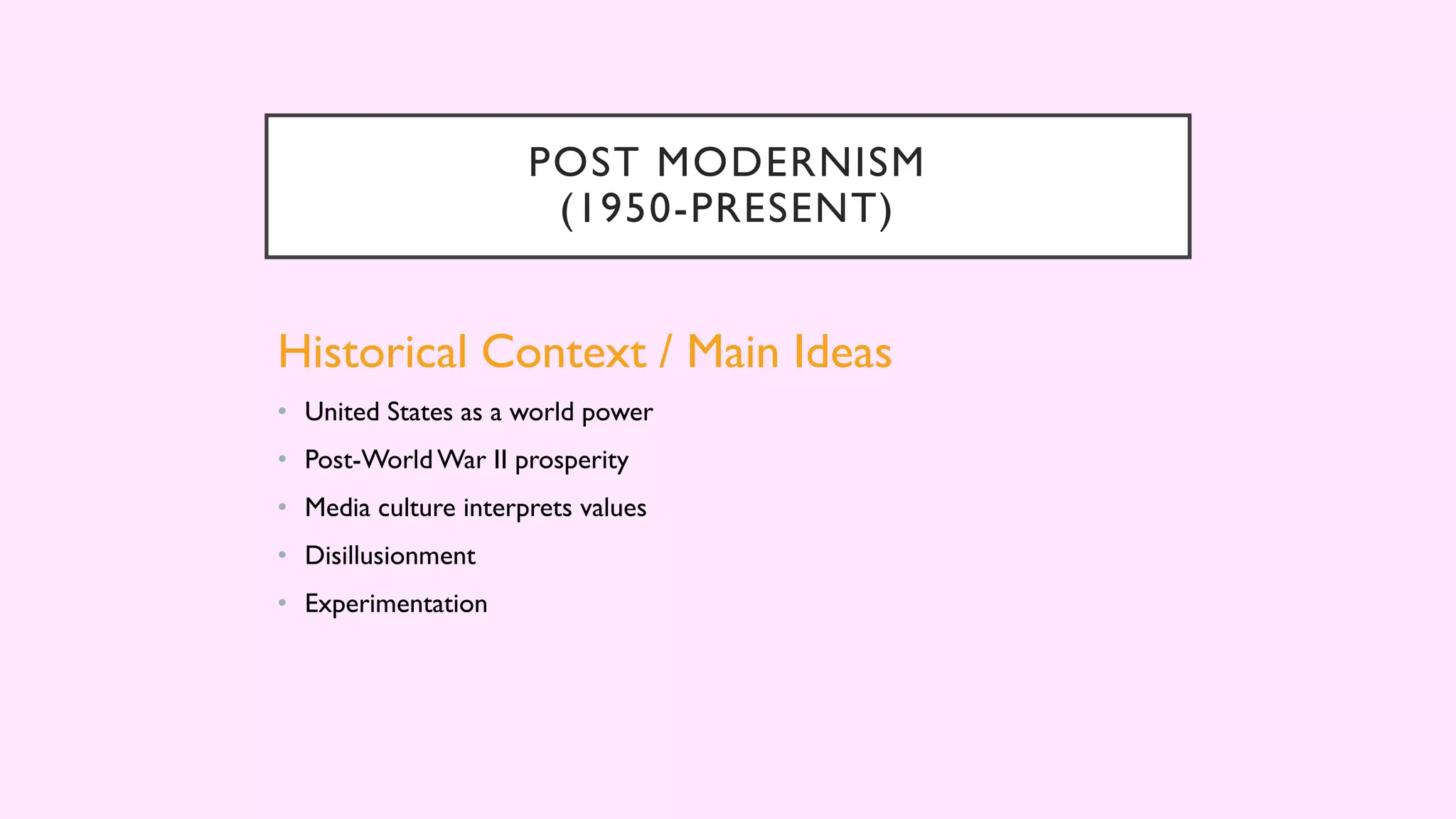
POST MODERNISM
(1950-PRESENT)
Historical Context / Main Ideas
• United States as a world power
• Post-WorldWar II prosperity
• Media culture interprets values
• Disillusionment
• Experimentation
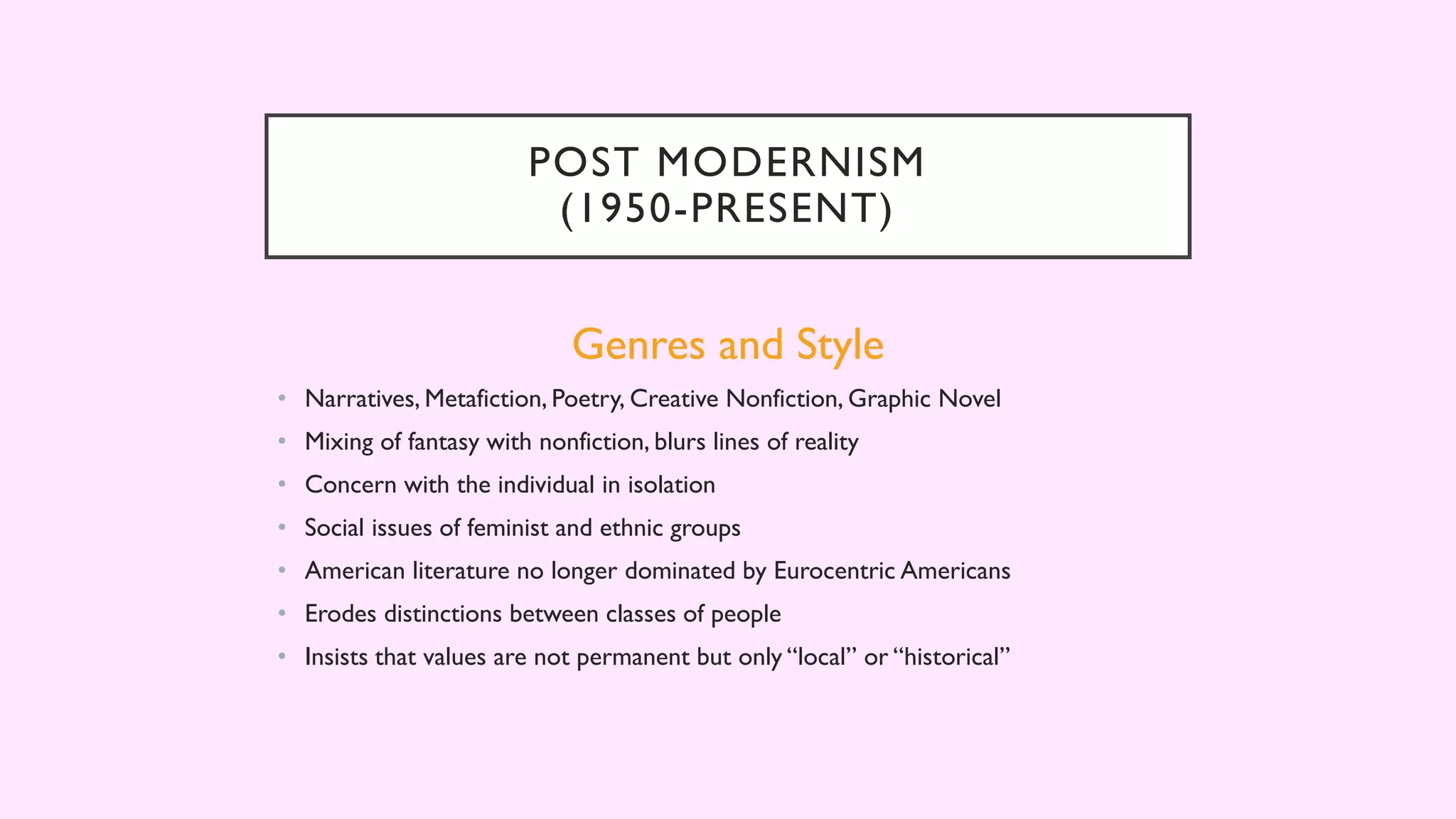
POST MODERNISM
(1950-PRESENT)
Genres and Style
• Narratives, Metafiction, Poetry, Creative Nonfiction, Graphic Novel
• Mixing of fantasy with nonfiction, blurs lines of reality
• Concern with the individual in isolation
• Social issues of feminist and ethnic groups
• American literature no longer dominated by Eurocentric Americans
• Erodes distinctions between classes of people
• Insists that values are not permanent but only “local” or “historical”
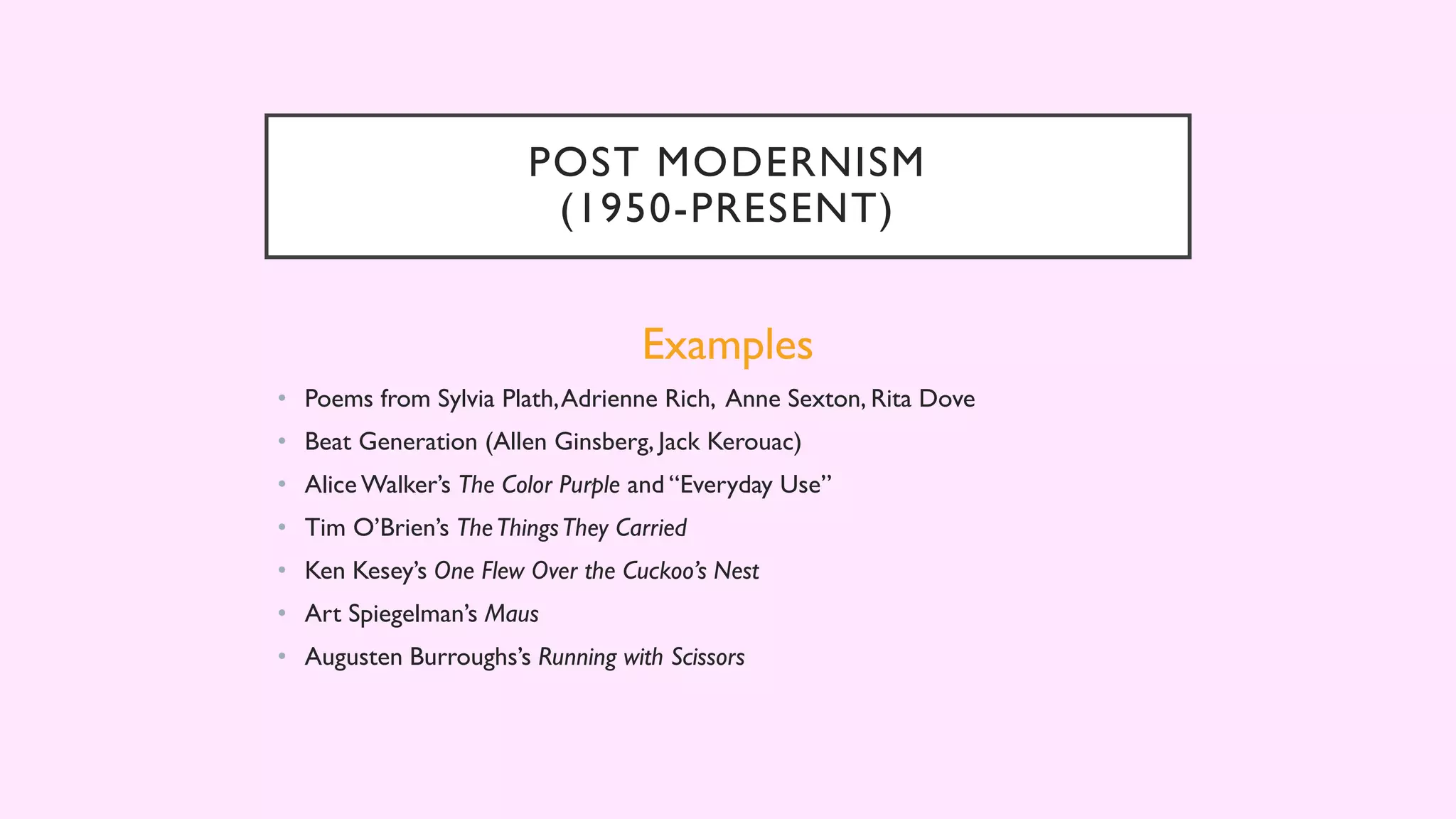
POST MODERNISM
(1950-PRESENT)
Examples
• Poems from Sylvia Plath,Adrienne Rich, Anne Sexton, Rita Dove
• Beat Generation (Allen Ginsberg, Jack Kerouac)
• Alice Walker’s The Color Purple and “Everyday Use”
• Tim O’Brien’s TheThingsThey Carried
• Ken Kesey’s One Flew Over the Cuckoo’s Nest
• Art Spiegelman’s Maus
• Augusten Burroughs’s Running with Scissors

Week 3 American Literature Movements

  • 1.
  • 2.
    AMERICAN RENAISSANCE (1825-1865) Historical Context/ Main Ideas • Expansion of magazines, newspapers, and book publishing slavery debates • Focus on American democracy • Find an American voice and literary style • Overlap with Romanticism andTranscendentalism
  • 3.
    AMERICAN RENAISSANCE (1825-1865) Genres andStyles • Short stories • Novels • Slave narratives • Anti-slavery literature
  • 4.
    AMERICAN RENAISSANCE (1825-1865) Examples Harriet BeecherStowe’s UncleTom’s Cabin Walt Whitman’s Leaves of Grass Harriet Jacobs’s Incidents in the Life of a Slave Girl Herman Melville’s Moby-Dick
  • 5.
    TRANSCENDENTALISM (1840-1860) Historical Context /Main Ideas • Overlap with Romanticism and Renaissance • Focus on individualism, nature, and self-reliance • Some common elements with English Romanticism • Belief in inherent goodness of people and nature • Society has corrupted the pureness of the individual • Focus on intuition and imagination as opposed to logic or the senses • People, men and women equally, have knowledge about themselves and the world around them that "transcends" or goes beyond what they can see, hear, taste, touch or feel
  • 6.
    TRANSCENDENTALISM (1840-1860) Genres and Style •Poetry • Essays • Novels • Literature focused on abolition, reform, women’s rights, and education • Literature often criticized organized religion, government, industrialization
  • 7.
    TRANSCENDENTALISM (1840-1860) Examples Henry DavidThoreau’s Waldenand “Resistance to Civil Government” RalphWaldo Emerson’s Nature and essays Frederick Douglass’s Narrative of the Life of Frederick Douglass Margaret Fuller’s The Great Lawsuit
  • 8.
    REALISM, NATURALISM, REGIONALISM (1865-1914) HistoricalContext / Main Ideas Civil War brings demand for a "truer" type of literature that does not idealize people or places Depiction of the “everyman” Focus on accurate representation and exploration of American lives Social realism: aims to change a specific social problem Aesthetic realism: art that insists on detailing the world as one sees it
  • 9.
    REALISM, NATURALISM, REGIONALISM (1865-1914) Genresand Style Regionalism (short stories and novels) • Character is more important than plot • Characters are complex • The narrator is typically an educated observer from the world beyond who learns something from the characters while preserving a sometimes sympathetic, sometimes ironic distance from them • Antipathy to change Naturalism (short stories and novels) • Similar to realism but focused particularly on negative aspects of society (poverty, racism, corruption) • Fate is predetermined by social and environmental forces Realism • Faithful representation of reality, verisimilitude • Objective narration • Naturalism and regionalism are types of realism • Diction is natural (vernacular is often used)
  • 10.
    REALISM, NATURALISM, REGIONALISM (1865-1914) Regionalism: WillaCather’s “Neighbour Rosicky” Kate Chopin’s The Awakening” and “Desiree’s Baby” William Faulkner’s As I Lay Dying and “A Rose for Emily” Naturalism: RichardWright’s “The ManWhoWas Almost a Man” Stephen Crane’s The Red Badge of Courage Jack London’s What Life Means to Me Realism: Rebecca Harding Davis’s Life in the Iron Mills William Dean Howells’s Henry James, Jr. MarkTwain’s Huckleberry Finn
  • 11.
    MODERNISM (1900-1950) Historical Context /Main Ideas • World Wars I and II • Black Tuesday (Stock Market crash on October 29, 1929) • Great Depression • Darwin’s Theory of Evolution • Advancements in technology (Ford’s Model T, flight of the Wright brothers) • Strict immigration policies after World War I • Founding of the NAACP • Women’s suffrage Changes in society cause uncertainty, disillusionment • Questioning of traditional values and traditions • Failure of the American Dream
  • 12.
    MODERNISM (1900-1950) Genres and Style •Novels, drama, essays, manifestos • Experimental forms such as interior monologue and stream of consciousness • Unfair trials of the African American male • Direct, compressed, vivid style • Concrete sensory images • Narrator’s voice resembles the common person
  • 13.
    MODERNISM (1900-1950) Examples • F. ScottFitzgerald’s The Great Gatsby • Arthur Miller’s Death of a Salesman • Susan Glaspell’s Trifles • Ernest Hemingway’s “the Snows of Kilimanjaro” and Farewell to Arms • T.S. Eliot’s TheWaste Land • Eugene O’Neill’s Long Day’s Journey into Night • Poems from H.D. (Hilda Doolittle) and Marianne Moore
  • 14.
    HARLEM RENAISSANCE (1917-1937) Historical Context/ Main Ideas • The Great Migration (mass African American migration to the North) • Harlem had an African American population of more than 150,000 by 1925 • African Americans have more access to media and publishing outlets • Harlem Renaissance included literature, art, and music
  • 15.
    HARLEM RENAISSANCE (1917-1937) Genres andStyle • African Americans have a double-consciousness – as Americans and as blacks • Women were called on to uplift, advance, and educate the black community • Allusions to African American spirituals • Uses structure of blues songs in poetry • Superficial stereotypes revealed to be complex characters • Precursor to gospel music • Blues and jazz transmitted across American via radio and phonographs
  • 16.
    HARLEM RENAISSANCE (1917-1937) Examples • W.E.B.Du Bois’s The Souls of Black Folk • JeanToomer’s Cane • Poems by Langston Hughes • RichardWright’s “The ManWhoWas Almost a Man”
  • 17.
    POST MODERNISM (1950-PRESENT) Historical Context/ Main Ideas • United States as a world power • Post-WorldWar II prosperity • Media culture interprets values • Disillusionment • Experimentation
  • 18.
    POST MODERNISM (1950-PRESENT) Genres andStyle • Narratives, Metafiction, Poetry, Creative Nonfiction, Graphic Novel • Mixing of fantasy with nonfiction, blurs lines of reality • Concern with the individual in isolation • Social issues of feminist and ethnic groups • American literature no longer dominated by Eurocentric Americans • Erodes distinctions between classes of people • Insists that values are not permanent but only “local” or “historical”
  • 19.
    POST MODERNISM (1950-PRESENT) Examples • Poemsfrom Sylvia Plath,Adrienne Rich, Anne Sexton, Rita Dove • Beat Generation (Allen Ginsberg, Jack Kerouac) • Alice Walker’s The Color Purple and “Everyday Use” • Tim O’Brien’s TheThingsThey Carried • Ken Kesey’s One Flew Over the Cuckoo’s Nest • Art Spiegelman’s Maus • Augusten Burroughs’s Running with Scissors