Case Study #1
The Smith Family
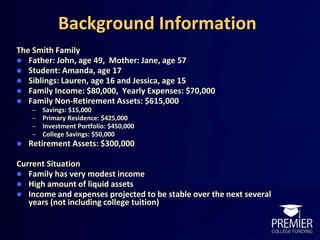
Background Information
The Smith Family
 Father: John, age 49, Mother: Jane, age 57
 Student: Amanda, age 17
 Siblings: Lauren, age 16 and Jessica, age 15
 Family Income: $80,000, Yearly Expenses: $70,000
 Family Non-Retirement Assets: $615,000
– Savings: $15,000
– Primary Residence: $425,000
– Investment Portfolio: $450,000
– College Savings: $50,000
 Retirement Assets: $300,000
Current Situation
 Family has very modest income
 High amount of liquid assets
 Income and expenses projected to be stable over the next several
years (not including college tuition)
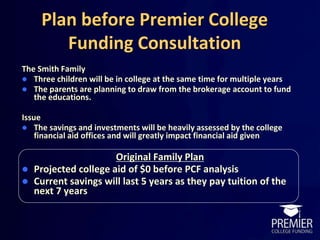
Plan before Premier College
Funding Consultation
The Smith Family
 Three children will be in college at the same time for multiple years
 The parents are planning to draw from the brokerage account to fund
the educations.
Issue
 The savings and investments will be heavily assessed by the college
financial aid offices and will greatly impact financial aid given
Original Family Plan
 Projected college aid of $0 before PCF analysis
 Current savings will last 5 years as they pay tuition of the
next 7 years
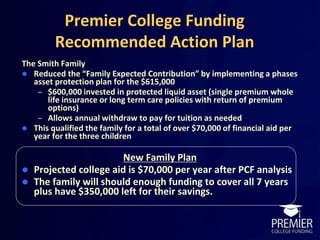
Premier College Funding
Recommended Action Plan
The Smith Family
 Reduced the “Family Expected Contribution” by implementing a
phased asset protection plan for the $615,000
– $600,000 invested in protected liquid asset
– Allows annual withdraw to pay for tuition as needed
 This qualified the family for a total of over $70,000 of financial aid per
year for the three children
New Family Plan
 Projected college aid is $70,000 per year after PCF analysis
 The family will should enough funding to cover all 7 years
plus have $350,000 left for their savings.
Disclosure
The information provided herein is for informational purposes only. Nothing provided herein constitutes tax
advice. Individuals should seek the advice of their own tax advisor for specific information regarding tax
consequences of investments. This is not a recommendation or an offer to sell (or solicitation of an offer to
buy) securities in the United States or in any other jurisdiction. References to indexes and benchmarks are
hypothetical illustrations only. This presentation may contain forward-looking statements relating to
individual objectives and opportunities, and the future cost of higher education. Forward-looking statements
may be identified by the use of such words as; “believe,” “expect,” “anticipate,” “should,” “planned,”
“estimated,” “potential” and other similar terms. Examples of forward-looking statements include, but are
not limited to, estimates with respect to financial condition, and success or lack of success of any particular
strategy. All are subject to various factors, including, but not limited to general and local economic
conditions, changing levels of competition within higher education and markets, and changes in legislation
or regulation that could cause actual results to differ materially from projected results. Such statements are
forward-looking in nature and involve a number of known and unknown risks, uncertainties and other
factors, and accordingly, actual results may differ materially from those reflected or contemplated in such
forward-looking statements. Prospective clients are cautioned not to place undue reliance on any forward-
looking statements or examples. Neither Insight Private Advisers LLC (“IPA”) nor any of its affiliates or
principals nor any other individual or entity assumes any obligation to update any forward-looking
statements as a result of new information, subsequent events or any other circumstances. All statements
made herein speak only as of the date that they were made. IPA and its personnel have relied on certain
third party data to assist in providing analysis and the opinions herein. IPA and its personnel have not
independently varied the accuracy of such data.

Case Study #1 - The Smith Family

  • 1.
    Case Study #1 TheSmith Family
  • 2.
    Background Information The SmithFamily  Father: John, age 49, Mother: Jane, age 57  Student: Amanda, age 17  Siblings: Lauren, age 16 and Jessica, age 15  Family Income: $80,000, Yearly Expenses: $70,000  Family Non-Retirement Assets: $615,000 – Savings: $15,000 – Primary Residence: $425,000 – Investment Portfolio: $450,000 – College Savings: $50,000  Retirement Assets: $300,000 Current Situation  Family has very modest income  High amount of liquid assets  Income and expenses projected to be stable over the next several years (not including college tuition)
  • 3.
    Plan before PremierCollege Funding Consultation The Smith Family  Three children will be in college at the same time for multiple years  The parents are planning to draw from the brokerage account to fund the educations. Issue  The savings and investments will be heavily assessed by the college financial aid offices and will greatly impact financial aid given Original Family Plan  Projected college aid of $0 before PCF analysis  Current savings will last 5 years as they pay tuition of the next 7 years
  • 4.
    Premier College Funding RecommendedAction Plan The Smith Family  Reduced the “Family Expected Contribution” by implementing a phased asset protection plan for the $615,000 – $600,000 invested in protected liquid asset – Allows annual withdraw to pay for tuition as needed  This qualified the family for a total of over $70,000 of financial aid per year for the three children New Family Plan  Projected college aid is $70,000 per year after PCF analysis  The family will should enough funding to cover all 7 years plus have $350,000 left for their savings.
  • 5.
    Disclosure The information providedherein is for informational purposes only. Nothing provided herein constitutes tax advice. Individuals should seek the advice of their own tax advisor for specific information regarding tax consequences of investments. This is not a recommendation or an offer to sell (or solicitation of an offer to buy) securities in the United States or in any other jurisdiction. References to indexes and benchmarks are hypothetical illustrations only. This presentation may contain forward-looking statements relating to individual objectives and opportunities, and the future cost of higher education. Forward-looking statements may be identified by the use of such words as; “believe,” “expect,” “anticipate,” “should,” “planned,” “estimated,” “potential” and other similar terms. Examples of forward-looking statements include, but are not limited to, estimates with respect to financial condition, and success or lack of success of any particular strategy. All are subject to various factors, including, but not limited to general and local economic conditions, changing levels of competition within higher education and markets, and changes in legislation or regulation that could cause actual results to differ materially from projected results. Such statements are forward-looking in nature and involve a number of known and unknown risks, uncertainties and other factors, and accordingly, actual results may differ materially from those reflected or contemplated in such forward-looking statements. Prospective clients are cautioned not to place undue reliance on any forward- looking statements or examples. Neither Insight Private Advisers LLC (“IPA”) nor any of its affiliates or principals nor any other individual or entity assumes any obligation to update any forward-looking statements as a result of new information, subsequent events or any other circumstances. All statements made herein speak only as of the date that they were made. IPA and its personnel have relied on certain third party data to assist in providing analysis and the opinions herein. IPA and its personnel have not independently varied the accuracy of such data.