Well , I’ll Get AroundWell , I’ll Get Around
to it . . .to it . . .
1
Estate Planning 101
Dale B. Cazes, Esq.
Cazes Roberts, P.C.
6301 Waterford Blvd., Ste. 408
Oklahoma City, OK 73118
Phone: (405) 254-5005
Fax: (405) 254-5060
Email: dale@cazesroberts.com
WHO NEEDS AN
ESTATE PLAN?
EVERYONE!
2
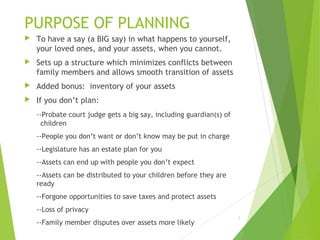
PURPOSE OF PLANNING
 To have a say (a BIG say) in what happens to yourself,
your loved ones, and your assets, when you cannot.
 Sets up a structure which minimizes conflicts between
family members and allows smooth transition of assets
 Added bonus: inventory of your assets
 If you don’t plan:
--Probate court judge gets a big say, including guardian(s) of
children
--People you don’t want or don’t know may be put in charge
--Legislature has an estate plan for you
--Assets can end up with people you don’t expect
--Assets can be distributed to your children before they are
ready
--Forgone opportunities to save taxes and protect assets
--Loss of privacy
--Family member disputes over assets more likely
3
WHAT DOES AN ESTATE PLAN
INCLUDE?
 Will
 Revocable Trust
 Durable General Power of
Attorney
 Durable Health Care Power of
Attorney
 Advance Directive for Health
Care/Organ Donation/HIPAA
 Memorandum of Trust
 Statement of Disposition of
Tangible Personal Property
 Re-titling of Assets
 Beneficiary Designations
 Guardianship Designations
 Life Insurance/ Irrevocable
Trust
4
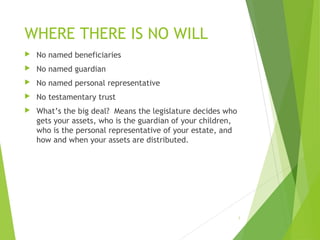
WHERE THERE IS NO WILL
 No named beneficiaries
 No named guardian
 No named personal representative
 No testamentary trust
 What’s the big deal? Means the legislature decides who
gets your assets, who is the guardian of your children,
who is the personal representative of your estate, and
how and when your assets are distributed.
5
THE WILL
 The will is the instrument that directs how your assets
are to be distributed and your debts, taxes and
expenses are paid after your death.
 Personal representatives
 Guardians of minor or incapacitated children
 Beneficiaries
 Testamentary trust (Q-tip trust for spouse, Family trust)
6
GUARDIANS
For people with minor or incapacitated children, this is the most
important reason for establishing an estate plan. Otherwise, a court
looks to state statutes for order of priority meaning that there may
be someone on that list that you may not want to be guardian.
7
REVOCABLE OR “LIVING
TRUST”
 Trust Agreement
--Centralized asset management during life and even long after death
--Provides for succession of management (Trustees)
--Extremely flexible
--Probate avoidance (if funded)
--Protection of vulnerable beneficiaries from themselves
--Provide for charitable intentions
--Estate tax reduction for married couples
 Does NOT
--Provide asset protection for creator
--Protect against costs of long-term care (nursing homes, Medicaid)
--Affect the creator’s income taxes
 Pour-Over Will (for assets not transferred to trust prior to death)
8
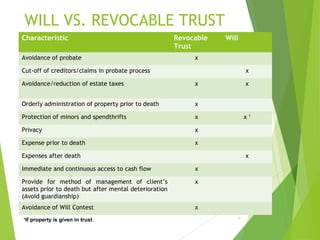
WILL VS. REVOCABLE TRUST
Characteristic Revocable
Trust
Will
Avoidance of probate x
Cut-off of creditors/claims in probate process x
Avoidance/reduction of estate taxes x x
Orderly administration of property prior to death x
Protection of minors and spendthrifts x x 1
Privacy x
Expense prior to death x
Expenses after death x
Immediate and continuous access to cash flow x
Provide for method of management of client’s
assets prior to death but after mental deterioration
(Avoid guardianship)
x
Avoidance of Will Contest x
1
If property is given in trust. 9
Trustees
 Self
 Family members
 Friends
 Professionals
 Institutions
 Beneficiaries as Trustees
 Guardians as Trustees
10
BENEFICIARIES
WHO ARE YOU GOING TO PROVIDE FOR AND HOW MUCH?
Children
Charities
Other family members
11
IF YOU HAVE A REVOCABLE
TRUST . . .
Is it funded?
--If not, then your pour-over will must be utilized to transfer assets to
revocable trust and your pour-over will has to be probated to make such
transfer.
12
GENERAL DURABLE POWER OF
ATTORNEY
This document handles your financial matters.
Financial matters handled by attorney-in-fact.
When does it become effective (immediately, upon
incapacity, or when activated in writing by maker)
Provides for nomination of guardian/conservator (same as
attorney-in-fact generally)
Important for assets not owned by revocable trust
13
GENERAL DURABLE HEALTH
CARE POWER OF ATTORNEY
 You appoint someone to make health care decisions for you when
you are unable
 HIPAA Authorization (Health Insurance Portability and Accountability
Act of 1996 regulations effective April 15, 2003
--Authorizes doctors, hospitals, other medical professionals, and health
insurance companies to speak with and share information with
people you specify.
14
ADVANCE DIRECTIVE FOR
HEALTH CARE
 You appoint someone, called a health care proxy, to carry out
end-of-life decisions you made in such document.
 3 conditions
--Terminal condition (Incurable and irreversible that will
result in death within 6 months
--Persistently unconscious (Irreversible where thought and
awareness of self and environment are absent)
--End-stage condition (Caused by injury, disease or illness,
which results in severe and permanent deterioration
indicated by incompetency and complete physical
dependency)
 HIPAA Authorization
15
ADVANCE DIRECTIVE FOR
HEALTH CARE
 Your end-of-life choices
--No life-sustaining treatment, except artificially administered
nutrition and hydration (if unable to take food and water by mouth)
--No life-sustaining treatment, including artificially administered
nutrition and hydration
--Life-sustaining treatment, and artificially administered nutrition and
hydration (if unable to take food and water by mouth)
16
STATEMENT OF DISPOSITION OF
TANGIBLE PERSONAL PROPERTY
--Specific bequest of personal property in the revocable trust
--Personal property memorandum
●Allows you to gift items such as jewelry, artwork, etc.,
to specific people
17
BENEFICIARY DESIGNATIONS
 Properly designating beneficiaries of Life Insurance and
Retirement Plans (IRAs, 401(k)s, etc.) at death is an important
part of the estate planning process
 For many, your Retirement Plan is the largest asset
 Children as beneficiaries (children generally entitled to receive
distributions directly once they turn 18)
 Trusts work well as beneficiary of Life Insurance
 Be cautious about naming trust as beneficiary of Retirement Plan
--Complicated rules and if not done properly IMMEDIATE income tax
consequences could result
--Typically, I designate trust as beneficiary only if minor children, a
spendthrift, or a spouse of second marriage
18
RE-TITLING OF ASSETS
 Quit claim deeds
 Assignments
19
TYPICAL ENTITY USED IN
ESTATE PLANNING…
 Limited liability companies (real estate, mineral
interests, etc.)
--Series LLCs
• Flow-through
• Fewer formalities/operational flexibility
• Operating agreement
• Managers
• Member(s) (owned by revocable trust(s))
20
OTHER WAYS TO LIMIT
LIABILITY
 Liability insurance (look at your umbrella)
 Pays for the lawyer
21
MINOR CHILDREN
 Appointment of a guardian
 Establishment of a trust – minor children cannot inherit
outright
22
DISABLED CHILD
Supplemental Needs Trust
23
LIFE INSURANCE
 Liquidity – taxes, succession planning
 Creating estates
 Replace income
 Consider an irrevocable trust
24
WHAT IS A PROBATE?
The purpose of probate is to transfer assets and deal with the creditors
of the decedent.
Sometimes, you may want a probate to cut-off creditor claims.
25
PROBATE PROCESS
 Petition to have Will allowed and Personal Representative
appointed
 Inventory and marshall of assets
 Give notice to creditors, heirs-at-law, and beneficiaries
 Pay income and estate taxes (if any)
 Pay debts of decedent
 Make distributions to beneficiaries
 Make final account and close estate
26
What assets go through
probate?
 Whatever assets are held purely individually at death
 Examples: Real property, mineral interests
27
What assets do not go
through probate?
 Non-probate assets
--Jointly held with right of survivorship assets with one or more
surviving joint owners
--Assets with a Death Beneficiary Designation (POD, TOD, ITF, and
Death Beneficiary) with living takers—Life Insurance, IRAs,
Qualified Retirement Plans, annuities, some brokerage accounts
and CDs, some U.S. savings bonds
--Life estates
--Assets owned by trusts
28
THE FIRST RULE IN ESTATE
TAX PLANNING:
Fully utilize the Unified Credit
29
UNIFIED CREDIT
2015 $5,430,000
DON’T FORGET YOUR ANNUAL EXCLUSION GIFTS!
2015 $14,000
30
PORTABILITY OF EXEMPTION
BETWEEN SPOUSES
 Portability of the estate tax exemption between
spouses allows a surviving spouse to transfer their
deceased spouse’s unused estate tax exemption to the
surviving spouse.
 In order to preserve their right to portability, the
surviving spouse must file a Form 706 (United States
Estate Tax Return) tax return even if there is not any
estate tax due.
31
FOR MORE INFORMATION
REGARDING PLANNING, CONTACT:
Dale B. Cazes, Esq.
Cazes Roberts, P.C.
6301 Waterford Blvd., Ste. 408
Oklahoma City, OK 73118
Phone: (405) 254-5005
Fax: (405) 254-5060
Email: dale@cazesroberts.com
32

Estate planning 101 presentation

  • 1.
    Well , I’llGet AroundWell , I’ll Get Around to it . . .to it . . . 1 Estate Planning 101 Dale B. Cazes, Esq. Cazes Roberts, P.C. 6301 Waterford Blvd., Ste. 408 Oklahoma City, OK 73118 Phone: (405) 254-5005 Fax: (405) 254-5060 Email: dale@cazesroberts.com
  • 2.
    WHO NEEDS AN ESTATEPLAN? EVERYONE! 2
  • 3.
    PURPOSE OF PLANNING To have a say (a BIG say) in what happens to yourself, your loved ones, and your assets, when you cannot.  Sets up a structure which minimizes conflicts between family members and allows smooth transition of assets  Added bonus: inventory of your assets  If you don’t plan: --Probate court judge gets a big say, including guardian(s) of children --People you don’t want or don’t know may be put in charge --Legislature has an estate plan for you --Assets can end up with people you don’t expect --Assets can be distributed to your children before they are ready --Forgone opportunities to save taxes and protect assets --Loss of privacy --Family member disputes over assets more likely 3
  • 4.
    WHAT DOES ANESTATE PLAN INCLUDE?  Will  Revocable Trust  Durable General Power of Attorney  Durable Health Care Power of Attorney  Advance Directive for Health Care/Organ Donation/HIPAA  Memorandum of Trust  Statement of Disposition of Tangible Personal Property  Re-titling of Assets  Beneficiary Designations  Guardianship Designations  Life Insurance/ Irrevocable Trust 4
  • 5.
    WHERE THERE ISNO WILL  No named beneficiaries  No named guardian  No named personal representative  No testamentary trust  What’s the big deal? Means the legislature decides who gets your assets, who is the guardian of your children, who is the personal representative of your estate, and how and when your assets are distributed. 5
  • 6.
    THE WILL  Thewill is the instrument that directs how your assets are to be distributed and your debts, taxes and expenses are paid after your death.  Personal representatives  Guardians of minor or incapacitated children  Beneficiaries  Testamentary trust (Q-tip trust for spouse, Family trust) 6
  • 7.
    GUARDIANS For people withminor or incapacitated children, this is the most important reason for establishing an estate plan. Otherwise, a court looks to state statutes for order of priority meaning that there may be someone on that list that you may not want to be guardian. 7
  • 8.
    REVOCABLE OR “LIVING TRUST” Trust Agreement --Centralized asset management during life and even long after death --Provides for succession of management (Trustees) --Extremely flexible --Probate avoidance (if funded) --Protection of vulnerable beneficiaries from themselves --Provide for charitable intentions --Estate tax reduction for married couples  Does NOT --Provide asset protection for creator --Protect against costs of long-term care (nursing homes, Medicaid) --Affect the creator’s income taxes  Pour-Over Will (for assets not transferred to trust prior to death) 8
  • 9.
    WILL VS. REVOCABLETRUST Characteristic Revocable Trust Will Avoidance of probate x Cut-off of creditors/claims in probate process x Avoidance/reduction of estate taxes x x Orderly administration of property prior to death x Protection of minors and spendthrifts x x 1 Privacy x Expense prior to death x Expenses after death x Immediate and continuous access to cash flow x Provide for method of management of client’s assets prior to death but after mental deterioration (Avoid guardianship) x Avoidance of Will Contest x 1 If property is given in trust. 9
  • 10.
    Trustees  Self  Familymembers  Friends  Professionals  Institutions  Beneficiaries as Trustees  Guardians as Trustees 10
  • 11.
    BENEFICIARIES WHO ARE YOUGOING TO PROVIDE FOR AND HOW MUCH? Children Charities Other family members 11
  • 12.
    IF YOU HAVEA REVOCABLE TRUST . . . Is it funded? --If not, then your pour-over will must be utilized to transfer assets to revocable trust and your pour-over will has to be probated to make such transfer. 12
  • 13.
    GENERAL DURABLE POWEROF ATTORNEY This document handles your financial matters. Financial matters handled by attorney-in-fact. When does it become effective (immediately, upon incapacity, or when activated in writing by maker) Provides for nomination of guardian/conservator (same as attorney-in-fact generally) Important for assets not owned by revocable trust 13
  • 14.
    GENERAL DURABLE HEALTH CAREPOWER OF ATTORNEY  You appoint someone to make health care decisions for you when you are unable  HIPAA Authorization (Health Insurance Portability and Accountability Act of 1996 regulations effective April 15, 2003 --Authorizes doctors, hospitals, other medical professionals, and health insurance companies to speak with and share information with people you specify. 14
  • 15.
    ADVANCE DIRECTIVE FOR HEALTHCARE  You appoint someone, called a health care proxy, to carry out end-of-life decisions you made in such document.  3 conditions --Terminal condition (Incurable and irreversible that will result in death within 6 months --Persistently unconscious (Irreversible where thought and awareness of self and environment are absent) --End-stage condition (Caused by injury, disease or illness, which results in severe and permanent deterioration indicated by incompetency and complete physical dependency)  HIPAA Authorization 15
  • 16.
    ADVANCE DIRECTIVE FOR HEALTHCARE  Your end-of-life choices --No life-sustaining treatment, except artificially administered nutrition and hydration (if unable to take food and water by mouth) --No life-sustaining treatment, including artificially administered nutrition and hydration --Life-sustaining treatment, and artificially administered nutrition and hydration (if unable to take food and water by mouth) 16
  • 17.
    STATEMENT OF DISPOSITIONOF TANGIBLE PERSONAL PROPERTY --Specific bequest of personal property in the revocable trust --Personal property memorandum ●Allows you to gift items such as jewelry, artwork, etc., to specific people 17
  • 18.
    BENEFICIARY DESIGNATIONS  Properlydesignating beneficiaries of Life Insurance and Retirement Plans (IRAs, 401(k)s, etc.) at death is an important part of the estate planning process  For many, your Retirement Plan is the largest asset  Children as beneficiaries (children generally entitled to receive distributions directly once they turn 18)  Trusts work well as beneficiary of Life Insurance  Be cautious about naming trust as beneficiary of Retirement Plan --Complicated rules and if not done properly IMMEDIATE income tax consequences could result --Typically, I designate trust as beneficiary only if minor children, a spendthrift, or a spouse of second marriage 18
  • 19.
    RE-TITLING OF ASSETS Quit claim deeds  Assignments 19
  • 20.
    TYPICAL ENTITY USEDIN ESTATE PLANNING…  Limited liability companies (real estate, mineral interests, etc.) --Series LLCs • Flow-through • Fewer formalities/operational flexibility • Operating agreement • Managers • Member(s) (owned by revocable trust(s)) 20
  • 21.
    OTHER WAYS TOLIMIT LIABILITY  Liability insurance (look at your umbrella)  Pays for the lawyer 21
  • 22.
    MINOR CHILDREN  Appointmentof a guardian  Establishment of a trust – minor children cannot inherit outright 22
  • 23.
  • 24.
    LIFE INSURANCE  Liquidity– taxes, succession planning  Creating estates  Replace income  Consider an irrevocable trust 24
  • 25.
    WHAT IS APROBATE? The purpose of probate is to transfer assets and deal with the creditors of the decedent. Sometimes, you may want a probate to cut-off creditor claims. 25
  • 26.
    PROBATE PROCESS  Petitionto have Will allowed and Personal Representative appointed  Inventory and marshall of assets  Give notice to creditors, heirs-at-law, and beneficiaries  Pay income and estate taxes (if any)  Pay debts of decedent  Make distributions to beneficiaries  Make final account and close estate 26
  • 27.
    What assets gothrough probate?  Whatever assets are held purely individually at death  Examples: Real property, mineral interests 27
  • 28.
    What assets donot go through probate?  Non-probate assets --Jointly held with right of survivorship assets with one or more surviving joint owners --Assets with a Death Beneficiary Designation (POD, TOD, ITF, and Death Beneficiary) with living takers—Life Insurance, IRAs, Qualified Retirement Plans, annuities, some brokerage accounts and CDs, some U.S. savings bonds --Life estates --Assets owned by trusts 28
  • 29.
    THE FIRST RULEIN ESTATE TAX PLANNING: Fully utilize the Unified Credit 29
  • 30.
    UNIFIED CREDIT 2015 $5,430,000 DON’TFORGET YOUR ANNUAL EXCLUSION GIFTS! 2015 $14,000 30
  • 31.
    PORTABILITY OF EXEMPTION BETWEENSPOUSES  Portability of the estate tax exemption between spouses allows a surviving spouse to transfer their deceased spouse’s unused estate tax exemption to the surviving spouse.  In order to preserve their right to portability, the surviving spouse must file a Form 706 (United States Estate Tax Return) tax return even if there is not any estate tax due. 31
  • 32.
    FOR MORE INFORMATION REGARDINGPLANNING, CONTACT: Dale B. Cazes, Esq. Cazes Roberts, P.C. 6301 Waterford Blvd., Ste. 408 Oklahoma City, OK 73118 Phone: (405) 254-5005 Fax: (405) 254-5060 Email: dale@cazesroberts.com 32