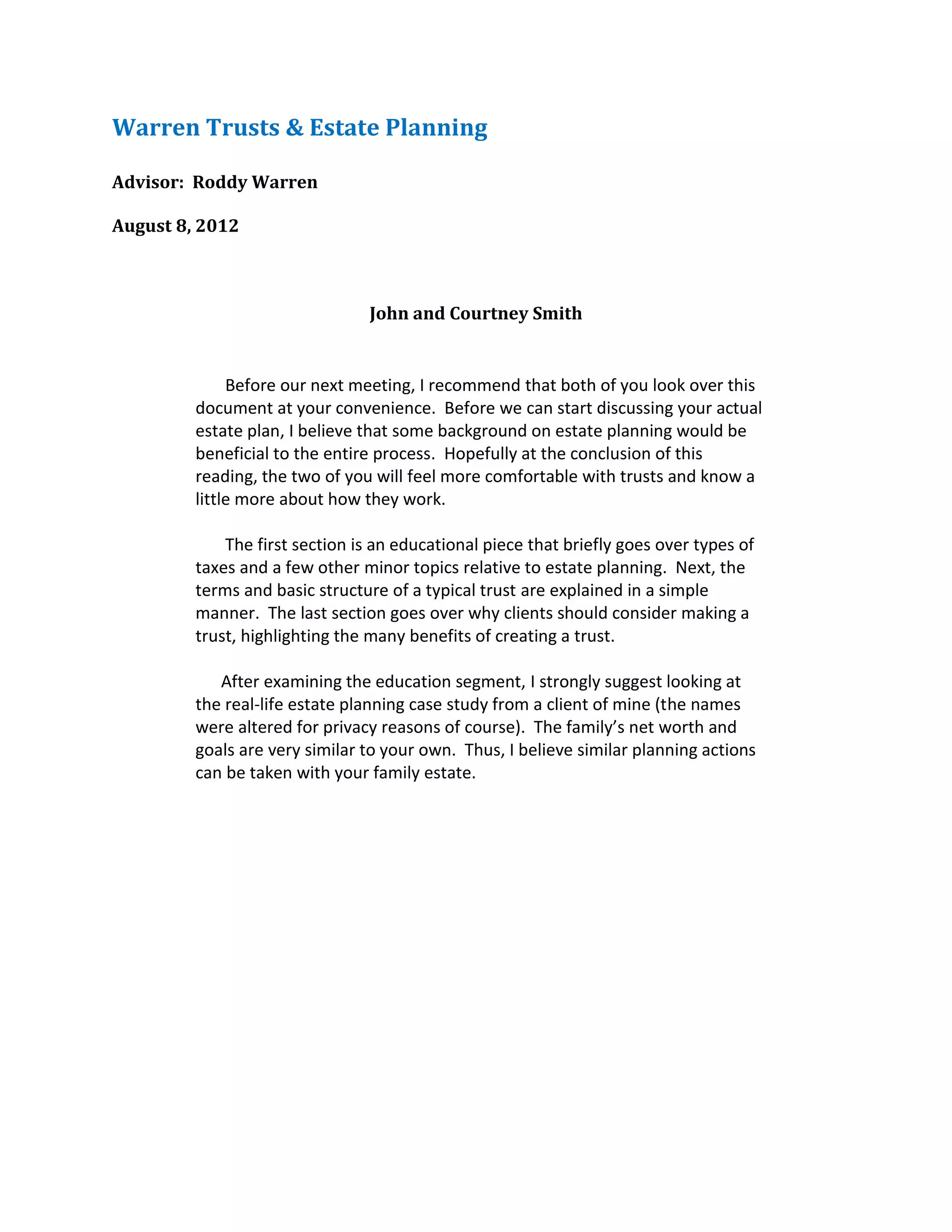
Warren Trusts & Estate Planning

Advisor: Roddy Warren

August 8, 2012


                                John and Courtney Smith


              Before our next meeting, I recommend that both of you look over this
         document at your convenience. Before we can start discussing your actual
         estate plan, I believe that some background on estate planning would be
         beneficial to the entire process. Hopefully at the conclusion of this
         reading, the two of you will feel more comfortable with trusts and know a
         little more about how they work.

             The first section is an educational piece that briefly goes over types of
         taxes and a few other minor topics relative to estate planning. Next, the
         terms and basic structure of a typical trust are explained in a simple
         manner. The last section goes over why clients should consider making a
         trust, highlighting the many benefits of creating a trust.

            After examining the education segment, I strongly suggest looking at
         the real-life estate planning case study from a client of mine (the names
         were altered for privacy reasons of course). The family’s net worth and
         goals are very similar to your own. Thus, I believe similar planning actions
         can be taken with your family estate.
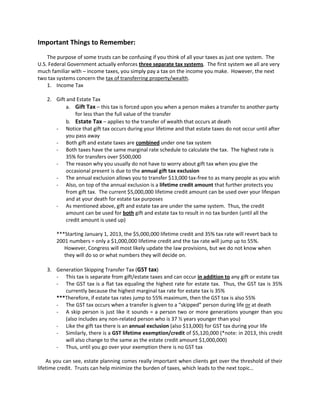
Important Things to Remember:
    The purpose of some trusts can be confusing if you think of all your taxes as just one system. The
U.S. Federal Government actually enforces three separate tax systems. The first system we all are very
much familiar with – income taxes, you simply pay a tax on the income you make. However, the next
two tax systems concern the tax of transferring property/wealth.
    1. Income Tax

   2. Gift and Estate Tax
           a. Gift Tax – this tax is forced upon you when a person makes a transfer to another party
               for less than the full value of the transfer
           b. Estate Tax – applies to the transfer of wealth that occurs at death
      - Notice that gift tax occurs during your lifetime and that estate taxes do not occur until after
           you pass away
      - Both gift and estate taxes are combined under one tax system
      - Both taxes have the same marginal rate schedule to calculate the tax. The highest rate is
           35% for transfers over $500,000
      - The reason why you usually do not have to worry about gift tax when you give the
           occasional present is due to the annual gift tax exclusion
      - The annual exclusion allows you to transfer $13,000 tax-free to as many people as you wish
      - Also, on top of the annual exclusion is a lifetime credit amount that further protects you
           from gift tax. The current $5,000,000 lifetime credit amount can be used over your lifespan
           and at your death for estate tax purposes
      - As mentioned above, gift and estate tax are under the same system. Thus, the credit
           amount can be used for both gift and estate tax to result in no tax burden (until all the
           credit amount is used up)

       ***Starting January 1, 2013, the $5,000,000 lifetime credit and 35% tax rate will revert back to
       2001 numbers = only a $1,000,000 lifetime credit and the tax rate will jump up to 55%.
          However, Congress will most likely update the law provisions, but we do not know when
          they will do so or what numbers they will decide on.

   3. Generation Skipping Transfer Tax (GST tax)
      - This tax is separate from gift/estate taxes and can occur in addition to any gift or estate tax
      - The GST tax is a flat tax equaling the highest rate for estate tax. Thus, the GST tax is 35%
         currently because the highest marginal tax rate for estate tax is 35%
      ***Therefore, if estate tax rates jump to 55% maximum, then the GST tax is also 55%
      - The GST tax occurs when a transfer is given to a “skipped” person during life or at death
      - A skip person is just like it sounds = a person two or more generations younger than you
         (also includes any non-related person who is 37 ½ years younger than you)
      - Like the gift tax there is an annual exclusion (also $13,000) for GST tax during your life
      - Similarly, there is a GST lifetime exemption/credit of $5,120,000 (*note: in 2013, this credit
         will also change to the same as the estate credit amount $1,000,000)
      - Thus, until you go over your exemption there is no GST tax

    As you can see, estate planning comes really important when clients get over the threshold of their
lifetime credit. Trusts can help minimize the burden of taxes, which leads to the next topic…
Trust Basics
Estate Planning Case Study
                                      Warren Trusts & Estate Planning
                                   Jimmy and Sarah Johnson – March 2010

Jimmy Johnson (54) and Sarah Johnson (57) have been happily married for thirty years. They are both in
good health and do not have major problems concerning their family health history. Jimmy has worked
in the oil and gas business for thirty-two years. He earns around $150,000 annually. Sarah does not
currently work, but controls most of the finances for the family. They have one child, Sally Johnson (24),
who is attending college for the next two years.

Five years ago, Jimmy sold his partnership for a great sum of money. After taxes however, the profit
was approximately $9,000,000. The couple has done little planning since selling the business. They
updated their will, but ignored further estate planning. Both spouses are conservative with their money
and have a strong desire to save. They have about one million in their family bank which contains their
savings and checking accounts. The rest of the family’s wealth is located in a portfolio of conservative
investments organized by a financial advisor they like very much.

The husband, Jimmy, is slightly more conservative than his wife. At first, he wanted the safest possible
investments and put a great deal of money into CDs. Over time, their financial advisor has broadened
Jimmy’s perspective and they now hold the portfolio of moderately conservative investments as I
mentioned above. During these five years after the sale, they have recorded a growth of about
$2,000,000.

The financial advisor continually suggested the advice of an estate planner, but the family was hesitant.
The wife has always been interested in trusts and possibly giving a large portion of their wealth to
charity. “I have always wanted to give to charity. It would mean a lot to me if we did.” We don’t need
all of this money; we would be comfortable with only $5,000,000.

They are aware of the annual gift exclusion and have taken advantage of it. They have been giving
$26,000 to Sally for the past four years. They have reported gifts to the IRS each year.

The Issue

Jimmy is wary of trusts in general. He does not like the idea of not owning the assets he worked so hard
to get. Yet, he agrees that taxes are a concerning issue and wants to do the best thing for Sally.

Goals:
   1.    Minimize taxes as much as possible
   2.    Planning for Sally’s future
   3.    Asset protection
   4.    Charitable intent

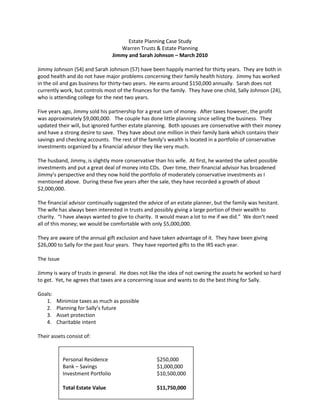
Their assets consist of:


            Personal Residence                     $250,000
            Bank – Savings                         $1,000,000
            Investment Portfolio                   $10,500,000

            Total Estate Value                     $11,750,000

Estate planning case study

  • 1.
    Warren Trusts &Estate Planning Advisor: Roddy Warren August 8, 2012 John and Courtney Smith Before our next meeting, I recommend that both of you look over this document at your convenience. Before we can start discussing your actual estate plan, I believe that some background on estate planning would be beneficial to the entire process. Hopefully at the conclusion of this reading, the two of you will feel more comfortable with trusts and know a little more about how they work. The first section is an educational piece that briefly goes over types of taxes and a few other minor topics relative to estate planning. Next, the terms and basic structure of a typical trust are explained in a simple manner. The last section goes over why clients should consider making a trust, highlighting the many benefits of creating a trust. After examining the education segment, I strongly suggest looking at the real-life estate planning case study from a client of mine (the names were altered for privacy reasons of course). The family’s net worth and goals are very similar to your own. Thus, I believe similar planning actions can be taken with your family estate.
  • 2.
    Important Things toRemember: The purpose of some trusts can be confusing if you think of all your taxes as just one system. The U.S. Federal Government actually enforces three separate tax systems. The first system we all are very much familiar with – income taxes, you simply pay a tax on the income you make. However, the next two tax systems concern the tax of transferring property/wealth. 1. Income Tax 2. Gift and Estate Tax a. Gift Tax – this tax is forced upon you when a person makes a transfer to another party for less than the full value of the transfer b. Estate Tax – applies to the transfer of wealth that occurs at death - Notice that gift tax occurs during your lifetime and that estate taxes do not occur until after you pass away - Both gift and estate taxes are combined under one tax system - Both taxes have the same marginal rate schedule to calculate the tax. The highest rate is 35% for transfers over $500,000 - The reason why you usually do not have to worry about gift tax when you give the occasional present is due to the annual gift tax exclusion - The annual exclusion allows you to transfer $13,000 tax-free to as many people as you wish - Also, on top of the annual exclusion is a lifetime credit amount that further protects you from gift tax. The current $5,000,000 lifetime credit amount can be used over your lifespan and at your death for estate tax purposes - As mentioned above, gift and estate tax are under the same system. Thus, the credit amount can be used for both gift and estate tax to result in no tax burden (until all the credit amount is used up) ***Starting January 1, 2013, the $5,000,000 lifetime credit and 35% tax rate will revert back to 2001 numbers = only a $1,000,000 lifetime credit and the tax rate will jump up to 55%. However, Congress will most likely update the law provisions, but we do not know when they will do so or what numbers they will decide on. 3. Generation Skipping Transfer Tax (GST tax) - This tax is separate from gift/estate taxes and can occur in addition to any gift or estate tax - The GST tax is a flat tax equaling the highest rate for estate tax. Thus, the GST tax is 35% currently because the highest marginal tax rate for estate tax is 35% ***Therefore, if estate tax rates jump to 55% maximum, then the GST tax is also 55% - The GST tax occurs when a transfer is given to a “skipped” person during life or at death - A skip person is just like it sounds = a person two or more generations younger than you (also includes any non-related person who is 37 ½ years younger than you) - Like the gift tax there is an annual exclusion (also $13,000) for GST tax during your life - Similarly, there is a GST lifetime exemption/credit of $5,120,000 (*note: in 2013, this credit will also change to the same as the estate credit amount $1,000,000) - Thus, until you go over your exemption there is no GST tax As you can see, estate planning comes really important when clients get over the threshold of their lifetime credit. Trusts can help minimize the burden of taxes, which leads to the next topic…
  • 3.
  • 4.
    Estate Planning CaseStudy Warren Trusts & Estate Planning Jimmy and Sarah Johnson – March 2010 Jimmy Johnson (54) and Sarah Johnson (57) have been happily married for thirty years. They are both in good health and do not have major problems concerning their family health history. Jimmy has worked in the oil and gas business for thirty-two years. He earns around $150,000 annually. Sarah does not currently work, but controls most of the finances for the family. They have one child, Sally Johnson (24), who is attending college for the next two years. Five years ago, Jimmy sold his partnership for a great sum of money. After taxes however, the profit was approximately $9,000,000. The couple has done little planning since selling the business. They updated their will, but ignored further estate planning. Both spouses are conservative with their money and have a strong desire to save. They have about one million in their family bank which contains their savings and checking accounts. The rest of the family’s wealth is located in a portfolio of conservative investments organized by a financial advisor they like very much. The husband, Jimmy, is slightly more conservative than his wife. At first, he wanted the safest possible investments and put a great deal of money into CDs. Over time, their financial advisor has broadened Jimmy’s perspective and they now hold the portfolio of moderately conservative investments as I mentioned above. During these five years after the sale, they have recorded a growth of about $2,000,000. The financial advisor continually suggested the advice of an estate planner, but the family was hesitant. The wife has always been interested in trusts and possibly giving a large portion of their wealth to charity. “I have always wanted to give to charity. It would mean a lot to me if we did.” We don’t need all of this money; we would be comfortable with only $5,000,000. They are aware of the annual gift exclusion and have taken advantage of it. They have been giving $26,000 to Sally for the past four years. They have reported gifts to the IRS each year. The Issue Jimmy is wary of trusts in general. He does not like the idea of not owning the assets he worked so hard to get. Yet, he agrees that taxes are a concerning issue and wants to do the best thing for Sally. Goals: 1. Minimize taxes as much as possible 2. Planning for Sally’s future 3. Asset protection 4. Charitable intent Their assets consist of: Personal Residence $250,000 Bank – Savings $1,000,000 Investment Portfolio $10,500,000 Total Estate Value $11,750,000