College Financial Planning
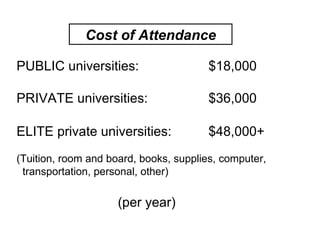
PUBLIC universities:  $18,000  PRIVATE universities:  $36,000 ELITE private universities:  $48,000+ (Tuition, room and board, books, supplies, computer, transportation, personal, other) (per year) Cost of Attendance
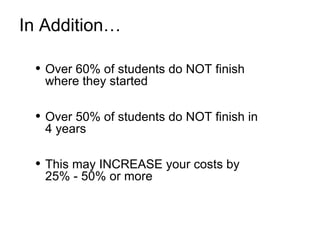
In Addition… Over 60% of students do NOT finish where they started  Over 50% of students do NOT finish in 4 years This may INCREASE your costs by  25% - 50% or more
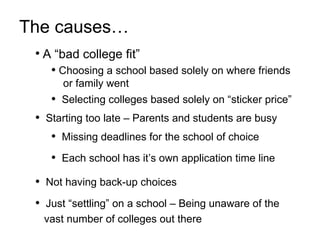
Missing deadlines for the school of choice Each school has it’s own application time line The causes…   A “bad college fit” Choosing a school based solely on where friends  or family went Selecting colleges based solely on “sticker price” Starting too late – Parents and students are busy Just “settling” on a school – Being unaware of the   vast number of colleges out there Not having back-up choices
The results… Some students are so uncomfortable at college that they  just leave. If a student transfers, many credits can be lost.
How To Achieve the “Best Fit”  Have a Purpose –  A career path Take personality assessments Combine with career assessment Do college searches based on results of: personality assessments career assessments
Personality Assessments help determine… Student’s Personality Type -which helps guide them toward a satisfying career  Their real interests and goals Their academic interests The type of learning environment that will help them succeed  - big or small school
  Career  Assessments … Identify careers and majors that match your  student’s Personality Type Help students confirm career they’re  already considering Uncover unknown interests that may help  them decide on -”the right fit” Keeps students focused – results oriented Eases the decision process  Saves money!
Complete the Career profiles Assessment To recognize your student’s strengths and personality preferences To help them identify careers and majors  consistent with their likes and dislikes Things to do:
College Search Programs… It’s critical to find colleges that match the student’s: Personality Interests Budget Career goals/ Major
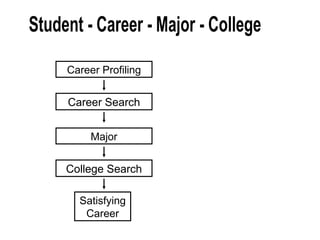
Career Profiling Major Career Search College Search SatisfyingCareer Student - Career - Major - College
Have a Plan B: Apply to more than one college 6 – 8 is recommended  List them on FAFSA Because…….   What if the school the student  has their heart set on doesn’t  accept him or her? Or doesn’t offer a financial award package as good as other schools  And that’s important because…
Paying for College Less than 4% of all families have set aside over $5,000 for their children’s college education
How much will you pay for college? Zero  (Scholarships) A Little A Lot Full “sticker price”  The more you know about the college funding process  the less you pay! And that’s important because….
How are you  going to fund your retirement  after paying for college? How old  will you be  when your last child graduates  from college? Have you saved for college...
Make Funding Education And Retirement A Non-issue!!! Maximize your current cash flow Utilize education tax strategies Qualify for financial aid Without compromising your goals
The Education Problem Funding education Vs. Sacrificing current lifestyle or Robbing retirement
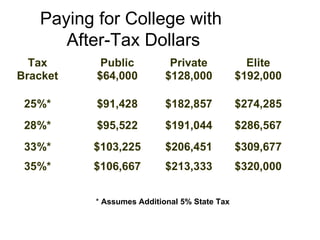
Paying for College with  After-Tax Dollars *  Assumes Additional 5% State Tax
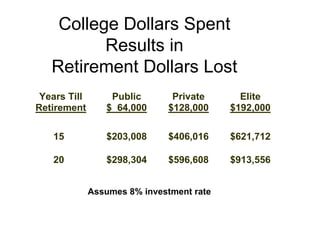
College Dollars Spent Results in Retirement Dollars Lost Assumes 8% investment rate
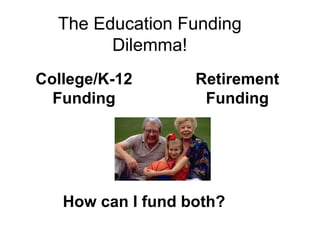
The Education Funding Dilemma! Retirement Funding How can I fund both? College/K-12 Funding
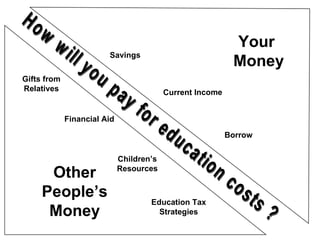
Your  Money Other People’s Money Current Income Borrow Financial Aid Gifts from Relatives Education Tax Strategies How will you pay for education costs ? Savings Children’s Resources
Financial Aid Facts Many of you may qualify for financial aid even though you think you earn too much money! Colleges compete for students Colleges have empty seats to fill Colleges will pay for good students
Financial Aid is Based on: Merit Academic Athletic Other Financial need Family income & assets
Merit Aid Scholarships based on talent Tuition discounts to fill seats Create competition for the child Colleges desire diversity
Need-Based Financial Aid Based on a "needs analysis" formula EXAMPLE: Total College Costs  $ 20,000 Expected Family Contribution   –  8,000 Financial Need  $12,000
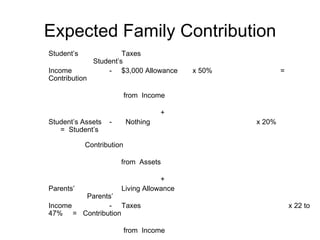
Expected Family Contribution Student’s  Taxes      Student’s  Income  - $3,000 Allowance  x 50%    = Contribution   from  Income   + Student’s Assets  - Nothing   x 20%    = Student’s    Contribution   from  Assets   + Parents’  Living Allowance    Parents’ Income   - Taxes   x 22 to 47%   =  Contribution   from  Income   + Parents’ Assets - Asset Allowance x 5.6%      =   Parents’   Contribution     from  Assets    =  Expected   Family    Contribution
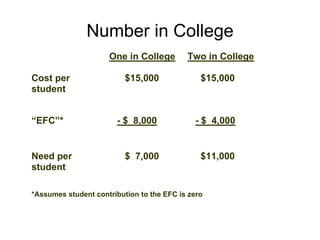
Number in College
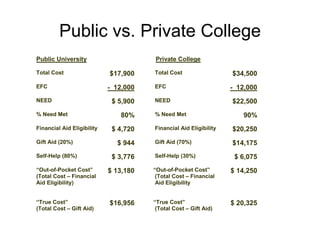
Public vs. Private College
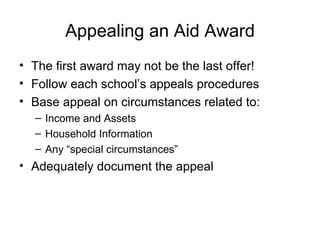
Appealing an Aid Award The first award may not be the last offer! Follow each school’s appeals procedures Base appeal on circumstances related to: Income and Assets Household Information Any “special circumstances” Adequately document the appeal
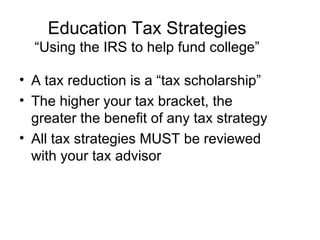
Education Tax Strategies “Using the IRS to help fund college” A tax reduction is a “tax scholarship” The higher your tax bracket, the greater the benefit of any tax strategy All tax strategies MUST be reviewed with your tax advisor
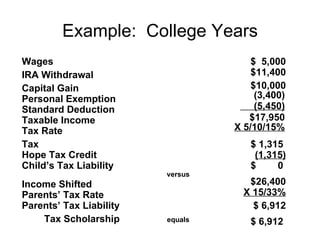
Example:  College Years $ 6,912 Tax Scholarship (1,315) Hope Tax Credit  (5,450) Standard Deduction $10,000 Capital Gain $11,400 IRA Withdrawal $  5,000 Wages equals versus $ 6,912 Parents’ Tax Liability X 15/33% Parents’ Tax Rate $26,400 Income Shifted $  0 Child’s Tax Liability $ 1,315 Tax  X 5/10/15% Tax Rate $17,950 Taxable Income (3,400) Personal Exemption
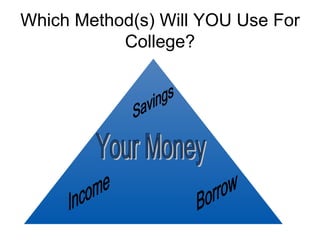
Which Method(s) Will YOU Use For College? Your Money Savings Income Borrow
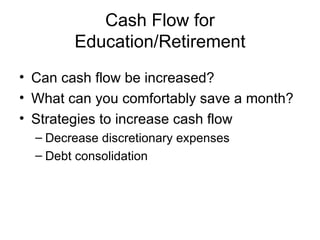
Cash Flow for Education/Retirement Can cash flow be increased? What can you comfortably save a month? Strategies to increase cash flow Decrease discretionary expenses Debt consolidation
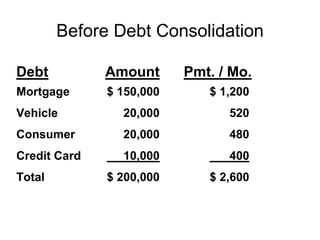
Before Debt Consolidation
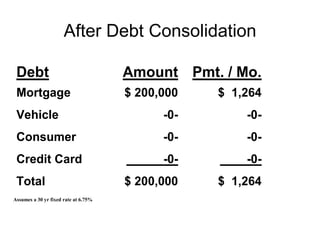
After Debt Consolidation
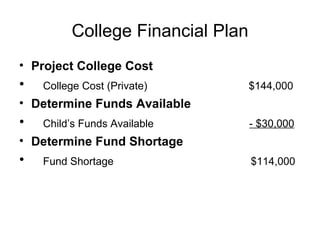
College Financial Plan Project College Cost College Cost (Private)  $144,000 Determine Funds Available Child’s Funds Available  - $30,000 Determine Fund Shortage Fund Shortage  $114,000
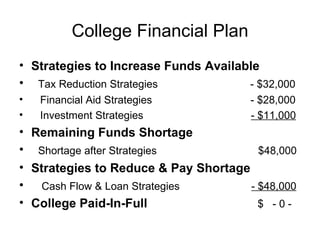
College Financial Plan Strategies to Increase Funds Available Tax Reduction Strategies  - $32,000 Financial Aid Strategies  - $28,000 Investment Strategies  - $11,000 Remaining Funds Shortage Shortage after Strategies  $48,000 Strategies to Reduce & Pay Shortage Cash Flow & Loan Strategies  - $48,000 College Paid-In-Full   $  - 0 -
Remember these important tools to help you reduce the cost of college! Asset/Liability realignment to increase cash flow Summary Career planning & college fit  Positioning the student  Financial aid - need and merit based Grants, scholarships and student loans Education tax incentives - reduce taxes  Debt consolidation to free up cash flow
Do You Have A Game Plan? Have you identified the best strategies to pay for college without jeopardizing your retirement and other financial priorities? Has your student identified and or investigated specific careers in areas that interest them? Will you find the right college “Fit” for your student? Have you developed your student’s merit and marketability?

College Financial Planning

  • 1.
  • 2.
    PUBLIC universities: $18,000 PRIVATE universities: $36,000 ELITE private universities: $48,000+ (Tuition, room and board, books, supplies, computer, transportation, personal, other) (per year) Cost of Attendance
  • 3.
    In Addition… Over60% of students do NOT finish where they started Over 50% of students do NOT finish in 4 years This may INCREASE your costs by 25% - 50% or more
  • 4.
    Missing deadlines forthe school of choice Each school has it’s own application time line The causes… A “bad college fit” Choosing a school based solely on where friends or family went Selecting colleges based solely on “sticker price” Starting too late – Parents and students are busy Just “settling” on a school – Being unaware of the vast number of colleges out there Not having back-up choices
  • 5.
    The results… Somestudents are so uncomfortable at college that they just leave. If a student transfers, many credits can be lost.
  • 6.
    How To Achievethe “Best Fit” Have a Purpose – A career path Take personality assessments Combine with career assessment Do college searches based on results of: personality assessments career assessments
  • 7.
    Personality Assessments helpdetermine… Student’s Personality Type -which helps guide them toward a satisfying career Their real interests and goals Their academic interests The type of learning environment that will help them succeed - big or small school
  • 8.
    Career Assessments … Identify careers and majors that match your student’s Personality Type Help students confirm career they’re already considering Uncover unknown interests that may help them decide on -”the right fit” Keeps students focused – results oriented Eases the decision process Saves money!
  • 9.
    Complete the Careerprofiles Assessment To recognize your student’s strengths and personality preferences To help them identify careers and majors consistent with their likes and dislikes Things to do:
  • 10.
    College Search Programs…It’s critical to find colleges that match the student’s: Personality Interests Budget Career goals/ Major
  • 11.
    Career Profiling MajorCareer Search College Search SatisfyingCareer Student - Career - Major - College
  • 12.
    Have a PlanB: Apply to more than one college 6 – 8 is recommended List them on FAFSA Because……. What if the school the student has their heart set on doesn’t accept him or her? Or doesn’t offer a financial award package as good as other schools And that’s important because…
  • 13.
    Paying for CollegeLess than 4% of all families have set aside over $5,000 for their children’s college education
  • 14.
    How much willyou pay for college? Zero (Scholarships) A Little A Lot Full “sticker price” The more you know about the college funding process the less you pay! And that’s important because….
  • 15.
    How are you going to fund your retirement after paying for college? How old will you be when your last child graduates from college? Have you saved for college...
  • 16.
    Make Funding EducationAnd Retirement A Non-issue!!! Maximize your current cash flow Utilize education tax strategies Qualify for financial aid Without compromising your goals
  • 17.
    The Education ProblemFunding education Vs. Sacrificing current lifestyle or Robbing retirement
  • 18.
    Paying for Collegewith After-Tax Dollars * Assumes Additional 5% State Tax
  • 19.
    College Dollars SpentResults in Retirement Dollars Lost Assumes 8% investment rate
  • 20.
    The Education FundingDilemma! Retirement Funding How can I fund both? College/K-12 Funding
  • 21.
    Your MoneyOther People’s Money Current Income Borrow Financial Aid Gifts from Relatives Education Tax Strategies How will you pay for education costs ? Savings Children’s Resources
  • 22.
    Financial Aid FactsMany of you may qualify for financial aid even though you think you earn too much money! Colleges compete for students Colleges have empty seats to fill Colleges will pay for good students
  • 23.
    Financial Aid isBased on: Merit Academic Athletic Other Financial need Family income & assets
  • 24.
    Merit Aid Scholarshipsbased on talent Tuition discounts to fill seats Create competition for the child Colleges desire diversity
  • 25.
    Need-Based Financial AidBased on a "needs analysis" formula EXAMPLE: Total College Costs $ 20,000 Expected Family Contribution – 8,000 Financial Need $12,000
  • 26.
    Expected Family ContributionStudent’s Taxes Student’s Income - $3,000 Allowance x 50% = Contribution from Income + Student’s Assets - Nothing x 20% = Student’s Contribution from Assets + Parents’ Living Allowance Parents’ Income - Taxes x 22 to 47% = Contribution from Income + Parents’ Assets - Asset Allowance x 5.6% = Parents’ Contribution from Assets = Expected Family Contribution
  • 27.
  • 28.
  • 29.
    Appealing an AidAward The first award may not be the last offer! Follow each school’s appeals procedures Base appeal on circumstances related to: Income and Assets Household Information Any “special circumstances” Adequately document the appeal
  • 30.
    Education Tax Strategies“Using the IRS to help fund college” A tax reduction is a “tax scholarship” The higher your tax bracket, the greater the benefit of any tax strategy All tax strategies MUST be reviewed with your tax advisor
  • 31.
    Example: CollegeYears $ 6,912 Tax Scholarship (1,315) Hope Tax Credit (5,450) Standard Deduction $10,000 Capital Gain $11,400 IRA Withdrawal $ 5,000 Wages equals versus $ 6,912 Parents’ Tax Liability X 15/33% Parents’ Tax Rate $26,400 Income Shifted $ 0 Child’s Tax Liability $ 1,315 Tax X 5/10/15% Tax Rate $17,950 Taxable Income (3,400) Personal Exemption
  • 32.
    Which Method(s) WillYOU Use For College? Your Money Savings Income Borrow
  • 33.
    Cash Flow forEducation/Retirement Can cash flow be increased? What can you comfortably save a month? Strategies to increase cash flow Decrease discretionary expenses Debt consolidation
  • 34.
  • 35.
  • 36.
    College Financial PlanProject College Cost College Cost (Private) $144,000 Determine Funds Available Child’s Funds Available - $30,000 Determine Fund Shortage Fund Shortage $114,000
  • 37.
    College Financial PlanStrategies to Increase Funds Available Tax Reduction Strategies - $32,000 Financial Aid Strategies - $28,000 Investment Strategies - $11,000 Remaining Funds Shortage Shortage after Strategies $48,000 Strategies to Reduce & Pay Shortage Cash Flow & Loan Strategies - $48,000 College Paid-In-Full $ - 0 -
  • 38.
    Remember these importanttools to help you reduce the cost of college! Asset/Liability realignment to increase cash flow Summary Career planning & college fit Positioning the student Financial aid - need and merit based Grants, scholarships and student loans Education tax incentives - reduce taxes Debt consolidation to free up cash flow
  • 39.
    Do You HaveA Game Plan? Have you identified the best strategies to pay for college without jeopardizing your retirement and other financial priorities? Has your student identified and or investigated specific careers in areas that interest them? Will you find the right college “Fit” for your student? Have you developed your student’s merit and marketability?

Editor's Notes

  • #3 One of the most rewarding experiences in a parent's life is sending a child to college. However, college has changed in the last fifteen years. Dramatically!! Today, the cost of a higher education has skyrocketed beyond the ability of most parents to pay. In 2000 the cost of a state public university averaged $12,500 per year and private colleges averaged $25,000 per year, elite colleges like Harvard, Stanford, & Duke, etc., were over $35,000 per year. And look where they are at only a few years later. Other than purchasing a home, paying for a college education may just be a family's single largest expenditure. The cost of college becomes staggering for a family with two, three or more children.
  • #17 To make funding education and retirement a non-issue, you must consider how to: Maximize your cash flow in order to invest funds in education and retirement accounts Utilize the numerous education tax incentives provided by the IRS to reduce taxes and produce “tax scholarships” Qualify for merit and need-based financial aid offered by colleges If you can maximize the benefits produced by the above strategies, you may not have to compromise your education and retirement goals
  • #18 At this point in time, many of you are facing an education problem. You feel a moral obligation to fund your children’s education, but you don’t want to sacrifice your current lifestyle or rob your future retirement in order to fund education costs. The purpose of this presentation is to show you how to fund education costs without sacrificing your current lifestyle or robbing your future retirement.
  • #19 College really costs you more than you think because it is paid with AFTER-TAX dollars! Depending on which tax bracket you are in, the amount you must EARN to pay for college is a good deal more because you must first pay the IRS…before you pay the college. Now, please notice that these numbers represent what you must earn to pay for just one child’s college education at today’s prices.
  • #20 Now consider this: If you are 50 years old and plan to retire in 15 years, the money you give to a public college for four years will cost your retirement fund about $203,008 at an 8% return. If you have 20 years until retirement, it will cost your retirement fund $298,304. An elite private college will cost your retirement fund $913,556, twenty years from now. And remember, these numbers are for just one child’s college education.
  • #21 As you can see, most parents face an education funding dilemma. How can you fund education and retirement at the same time? Is the funding mutually exclusive? If you only have enough cash flow to save for retirement, does that mean that you can’t save for education costs?
  • #22 So, how do you plan to pay for college? Actually, there are only two methods: The first method is by using YOUR MONEY in one, or more of the following forms: (1) paying with withdrawals from your savings account, (2) paying out of your current income, or (3) borrowing. Most people use some combination of all three. The second method is to use OTHER PEOPLE’S MONEY. This comes in the following forms: (1) gifts from relatives, (2) financial aid, (3) your child’s resources (his/her income and assets) or, (4) by using special education tax strategies. Let’s talk about using other people’s money first.
  • #23 Regretfully, many families who would qualify for financial aid do not apply. Why? Because they assume that "they earn too much money to qualify for aid." The result? Many families pay the full cost of college. Many of you will have to rely on financial aid to help pay for the cost of college. One positive aspect is that colleges and universities are more competitive than ever before in their quest for good students. Even the "prestigious" schools will compete for students, from every socio-economic background. In addition, many schools have empty seats to fill and may be willing to discount their cost to fill these empty seats. Therefore, you should never assume a college is too expensive. Colleges do need paying customers; however, they do not expect every student and family to foot the entire bill for their education. This is especially true of private schools. All colleges have money - in the form of financial aid - and they'll pay for good students.
  • #24 Financial aid is awarded based on two factors: (1) the student's talent (merit) and, (2) the family's income and assets (financial need). When you combine the merit-based and need-based systems, you can create a powerful case for your child qualifying for college financial aid.
  • #25 Most colleges will award scholarships based on the student’s talent. These scholarships are awarded regardless of the financial need of the student. Today, many private colleges have empty seats to fill. To fill these empty seats, they may offer a discount on their price. To increase your child’s chances of receiving merit aid, you should try to create competition for your child by having him/her apply to many colleges. You should also take advantage of the colleges’ desire to achieve cultural diversity within their student body. If your child has qualities that would add to the cultural diversity at a college, the college should be informed of these qualities.
  • #26 Now let’s look at need-based financial aid by exploring the concept of FINANCIAL NEED. The process of determining a student’s financial need is called “needs analysis”. The financial aid system assumes that the parents and students are able to contribute some money toward educational expenses. How much financial need the student has is determined by the difference between the Total College Cost and what the family is expected to contribute (EFC). The financial need is the maximum amount of need-based financial aid that a student would be eligible to receive. For Example: $12,000 = FINANCIAL NEED = 8,000 - EXPECTED FAMILY CONTRIBUTION (EFC) - $20,000 TOTAL COLLEGE COST
  • #27 This is a simplistic version of how the Expected Family Contribution, or EFC, is calculated: STUDENT'S CONTRIBUTION – your child’s contribution The student's income, minus taxes and a standard deduction of $2,550, is assessed at a flat rate of 50%. For example, if a student had $3,550 of income, the student would be expected to contribute $500 toward the cost of college. The excess income over $2,550, which would be $1,000, would be assessed at a flat 50% rate to arrive at the $500 contribution. In effect, the $1,000 of extra income would cost the student $500 in financial aid. The student's assets are assessed at a flat rate of 35%. For example, if a student had $10,000 in a college savings account, the student would be expected to contribute $3,500 toward the cost of college.
  • #28 For example, if the Parents' Contribution was computed to be $8,000, this amount would be divided by one if only one person in the household was planning to attend college. As you can see, the EFC would remain at $8,000. However, if two people in the parents' household planned to enroll in college, the Parents' Contribution would be divided in two, resulting in an adjusted EFC of $4,000. This equates to an increase of $4,000 in financial aid eligibility per student. The timing of two or more members of the household enrolled in college at the same time can pay huge financial aid dividends. However, there are specific requirements which must be met by the household members in order to be considered as enrolled in college.
  • #29 When analyzing the student’s financial need, some colleges will meet 100% of the student’s need, and other colleges will meet a lesser percentage of the student’s financial need. Private colleges tend to meet a higher percentage of the student’s financial need than do public colleges. Private colleges also tend to fill the financial need with a higher percentage of gift aid (consisting of grants and scholarships) than do public colleges. Public colleges fill most of the financial need of a student with self-help aid (consisting of loans and work study). For these reasons, the “true cost” of a private college may be comparable to the “true cost” of a public college. This is an example of how this is possible. Note that the "out-of-pocket" costs and the "true" costs are comparable at these two types of colleges.
  • #30 Now let’s look at how to appeal a college’s original financial aid award. Often, the award letter will not be financially acceptable to you. The total amount, or the type (gift versus self-help aid) of financial aid, will not be what you expected or need in order for your child to attend that particular college. If this is the case, you should appeal the financial aid award letter. The appeal is made to the financial aid officer at the college. The appeal could involve the elements of the EFC: income, assets, and household information, such as divorce or death of a parent. The appeal could also involve other special circumstance, such as unemployment of a parent or unusual medical expenses that the family may want to point out to the financial aid officer. You should always adequately document the appeal. Make it easy for the financial aid officer to say "yes" to the appeal!
  • #31 Now let’s look at using Education Tax Strategies to help fund education costs. This funding method involves using special education tax strategies to help pay for college and the theory that – Any new tax reduction is the same as a grant or scholarship. It is money you can use to pay for the cost of college. The higher your income tax bracket, the greater the benefit of any tax strategy. However, all educational tax strategies MUST be reviewed with your tax advisor in order to coordinate the interrelationship between tax and financial aid and to determine which is the best route to take.
  • #32 In this example, a tax savings of $6,912 is achieved by the family. This is accomplished by shifting $26,400 of income to the child and by using the Hope tax credit to offset $1,650 of the child’s tax liability.
  • #33 So the question is… which method(s) will YOU use to pay for college? Will you use other people’s money, your money or a combination of both? If you use your money, will you draw from savings accounts, pay for it out of your current income or borrow the money? Do you have a financial plan laid out for funding college? It could cost you a lot of hard-earned money if you don’t. Now, let’s look at methods of using your money to save and pay for college and retirement.
  • #34 If you want to invest funds from your current income to save for education and retirement costs, you must first determine if your cash flow can be increased to free up funds to save. Ideally, you should save an amount that will not interfere with your current lifestyle. To increase your cash flow you will have to decrease some discretionary expense items, such as entertainment or travel. Alternatively, you can increase your current cash flow by consolidating short-term debt into long-term debt. Debt consolidation will allow you to make smaller monthly payments. In addition, there may be tax benefits achieved thru debt consolidation, such as a home mortgage interest deduction.
  • #35 In this debt consolidation scenario, we have a situation where the parents owe a total of $200,000 in several types of debt. Their total monthly payment is $2,600 per month. They would like to increase their cash flow to save funds for education and retirement costs.
  • #36 After consolidating the vehicle, consumer, and credit card debt into a home mortgage loan, the parents still owe $200,000 but their monthly payment is reduced to $1,264 per month. The $1,336 reduction in debt payment can be used fund education and retirement accounts. (or other financial priorities like vacations etc. )
  • #40 Read the slide