David F. Larcker and Brian Tayan
Corporate Governance Research Initiative
Stanford Graduate School of Business
THE MARKET FOR
CORPORATE CONTROL
• The price of a stock reflects not only the value of corporate assets but also
the performance of management in realizing that value.
• The board of an underperforming company has the choice:
– Replace management, or
– Sell entire company to new owners who can manage its assets more
profitability (e.g., change strategy, cost structure, capital structure, etc.).
• The market for corporate control puts pressure on CEO to perform or risk
sale of the company.
MARKET FOR CORPORATE CONTROL
“The lower the stock price, relative to what it could be with more efficient
management, the more attractive the takeover becomes to those who
believe that they can manage the company more efficiently.”
Manne (1965)
• The market for corporate control consists of all mergers, acquisitions, and
reorganizations—including those by a competitor, a conglomerate, or a
private equity buyer.
• The company making the offer is the acquirer (or bidder); the subject of the
offer is the target.
• When the target is open to receiving an offer the acquisition is said to be
friendly. Otherwise, it is hostile.
• In a tender offer, the acquirer makes an offer directly to the target
shareholders to purchase their shares at a stated price.
• In a proxy contest, the acquirer asks target shareholders to elect a dissident
slate of directors to approve the deal.
THE MARKET FOR CORPORATE CONTROL
• Financial synergies. The acquiring firm believes it can increase profits
through revenue improvements, cost reduction, or vertical integration. This
is the logic behind a strategic buyer.
• Diversification. Two companies whose earnings are uncorrelated might
benefit by relying on the capital generated when one business is thriving to
help the other when it is struggling. This is the logic behind a conglomerate
structure.
• Change in ownership. New owner group might have superior access to
capital, managerial expertise, or other resources. This is the logic behind a
private equity buyer.
STRATEGIC REASONS FOR AN ACQUISITION
• Empire building. The acquirer purchases a target primarily for the sake of
managing a larger enterprise.
• Hubris. Overconfidence on the part of management that it can more
efficiently manage a target than current owners can.
• Herding behavior. The senior management of one company pursues an
acquisition because its competitors have recently completed acquisitions.
• Compensation incentives. The management of the target company agrees
to an acquisition primarily because it stands to receive a large payment
upon change in control.
NONSTRATEGIC REASONS FOR AN ACQUISITION
The average CEO of a large U.S. company stands to receive $29 million in
cash and accelerated equity grants following a change in control.
Equilar (2007)
• Research has routinely shown that markets expect the incremental value of
an acquisition to flow to the target rather than to the acquirer.
• The target:
– Receives double-digit takeover premium offer.
– Experiences greater excess returns in hostile deals.
– Experiences greater excess returns in all-cash deals.
• The acquirer:
– Experiences no excess returns following bid.
– Experiences negative excess returns for hostile bid.
– Experiences greater declines if equity-financed bid.
THE EXPECTED VALUE OF A TAKEOVER
Eckbo (2009); Servaes (1991); Andrade, Mitchell, and Stafford (2001); Martynova and Renneboog (2008);
Goergen and Renneboog (2004)
• Research has also shown that acquirers realize less value following a
merger than originally expected.
• The acquirer:
– Underperforms peers on a one- to three-year basis.
– Performs worse if acquisition is financed with equity.
– Decreases investment in working capital and cap ex.
• Acquisitions are highly disruptive:
– Require significant management attention.
– Lead to elevated turnover up to 10 years following the deal.
THE REALIZED VALUE OF A TAKEOVER
Martynova and Renneboog (2008); Krug and Shill (2008)
• A company that does not want to become the target of an unsolicited
takeover might adopt defense mechanisms to discourage or prevent a bid.
• Antitakeover protections might give a company time to pursue long-term
value creation without threat of takeover; or to enhance bargaining power
to secure a higher bid.
• Common antitakeover protections include:
– Poison pill (9% of companies currently have in place)
– Dual-class shares (10%)
– Staggered board (53%)
– Restricted rights to call a special meeting (46%)
– Shareholders cannot vote by written consent (73%)
ANTITAKEOVER PROTECTIONS
SharkRepellent (2014)
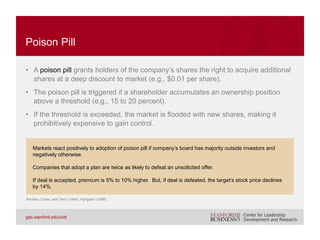
• A poison pill grants current shareholders the right to acquire additional
shares at a deep discount to market (e.g., $0.01 per share).
• The poison pill is triggered if a shareholder accumulates an ownership
position above a threshold (e.g., 15 to 20 percent).
• If the threshold is exceeded, the market is flooded with new shares, making
it prohibitively expensive to gain control.
POISON PILL
• Companies that adopt a plan are twice as likely to defeat an unsolicited offer.
• If deal is accepted, premium is 5% to 10% higher. But, if deal is defeated, the
target’s stock price declines by 14%.
• Market reaction to adoption of plan is mixed. Negative, if company is perceived
to be a takeover candidate. Positive or neutral otherwise.
Brickley, Coles, and Terry (1994); Ryngaert (1988)
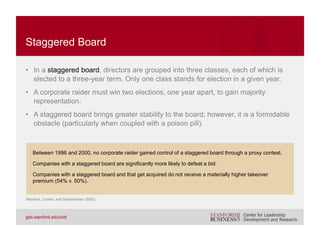
• In a staggered board, directors are grouped into three classes, each of
which is elected to a three-year term. Only one class stands for election in a
given year.
• An activist must win two elections, one year apart, to gain majority control.
• A staggered board brings greater stability to the board; however, it is a
formidable obstacle (particularly when coupled with a poison pill).
STAGGERED BOARDS
• Companies with a staggered board are significantly more likely to defeat a bid. Between
1996 and 2000, no activist gained control of a staggered board through a proxy contest.
• Companies with a staggered board that get acquired do not receive a materially higher
takeover premium (54% v. 50%).
• Market reaction to decision to stagger (or destagger) board is mixed.
Bebchuk, Coates, and Subramanian (2002); Guo, Kruse, and Nohel (2008); Cremers, Litov, and Sepe (2014);
Ge, Tanlu, and Zhang (2014)
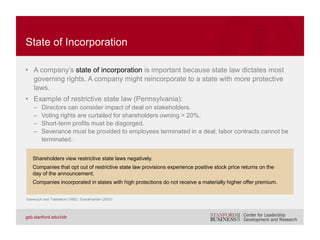
• A company’s state of incorporation is important because state law dictates
most governing rights. A company might reincorporate to a state with more
protective laws.
• Example of restrictive state law (Pennsylvania):
– Directors can consider impact of deal on stakeholders.
– Voting rights are curtailed for shareholders owning > 20%.
– Short-term profits must be disgorged.
– Severance must be provided to employees terminated in a deal; labor
contracts cannot be terminated.
STATE OF INCORPORATION
• Shareholders have a negative reaction to restrictive state laws.
• Companies that opt out of restrictive provisions experience
positive returns.
Szewczyk and Tsetsekos (1992); Subramanian (2003)
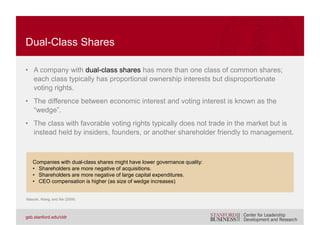
• A company with dual-class shares has more than one class of common
shares; each class typically has proportional ownership interests but
disproportionate voting rights.
• The difference between economic interest and voting interest is known as
the “wedge”.
• The class with favorable voting rights typically does not trade in the market
but is instead held by insiders, founders, or another shareholder friendly to
management.
DUAL-CLASS SHARES
Companies with dual-class shares might have lower governance quality:
• Shareholders react more negatively to acquisitions.
• Shareholders react more negatively to large capital expenditures.
• CEO compensation is higher (as size of wedge increases).
Masulis, Wang, and Xie (2009); Gompers, Ishii, and Metrick (2010)
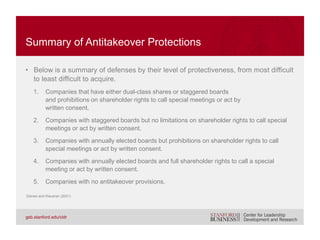
Summary of defenses, from most protective to least protective.
1. Companies that have either dual-class shares or staggered boards
and prohibitions on shareholder rights to call special meetings or act by
written consent.
2. Companies with staggered boards but no limitations on shareholder rights
to call special meetings or act by written consent.
3. Companies with annually elected boards but prohibitions on shareholder
rights to call special meetings or act by written consent.
4. Companies with annually elected boards and full shareholder rights to call
a special meeting or act by written consent.
5. Companies with no antitakeover provisions.
SUMMARY OF ANTITAKEOVER PROTECTIONS
Daines and Klausner (2001)
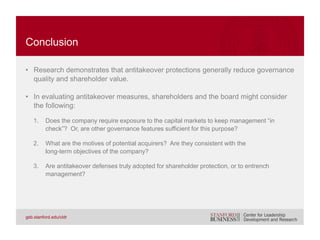
• Antitakeover protections generally reduce governance quality and
shareholder value.
• In evaluating antitakeover measures, shareholders and the board might
consider the following:
1. Does the company require exposure to the capital markets to keep
management “in check”? Or, are other governance features sufficient?
2. What are the motives of potential acquirers? Are they consistent with the
long-term objectives of the company?
3. Are antitakeover defenses adopted for shareholder protection or to entrench
management?
CONCLUSION
H. G. Manne. Mergers and the Market for Corporate Control. 1965. Journal of Political Economy.
Equilar. Executive Compensation Trends—June: CEO Exit Packages, Fortune 200 CEO Severance & Change-in-Control Packages.
2007.
B. Espen Eckbo. Bidding Strategies and Takeover Premiums: A Review. 2009. Journal of Corporate Finance.
Henri Servaes. Tobin’s Q and Gains from Takeovers. 1991. Journal of Finance.
Gregor Andrade, Mark Mitchell, and Erik Stafford. New Evidence and Perspectives on Mergers. 2001. Journal of Economic
Perspectives.
Marina Martynova and Luc Renneboog. A Century of Corporate Takeovers: What Have We Learned and Where Do We Stand? 2008.
Journal of Banking and Finance.
Mark Goergen and Luc Renneboog. Shareholder Wealth Effects of European Domestic and Cross-border Takeover Bids. 2004.
European Financial Management.
Jeffrey A. Krug and Walt Shill. The Big Exit: Executive Churn in the Wake of M&As. 2008. Journal of Business Strategy.
SharkRepellent. Sample includes 1,871 companies. 2014.
James A. Brickley, Jeffrey L. Coles, and Rory L. Terry. Outside Directors and the Adoption of Poison Pills. 1994. Journal of Financial
Economics.
Michael Ryngaert. The Effect of Poison Pill Securities on Shareholder Wealth. 1988. Journal of Financial Economics.
BIBLIOGRAPHY
Lucian Arye Bebchuk, John C. Coates IV, and Guhan Subramanian. The Powerful Antitakeover Force of Staggered Boards: Theory,
Evidence, and Policy. 2002. Stanford Law Review.
Re-Jin Guo, Timothy A. Kruse, and Tom Nohel. Undoing the Powerful Antitakeover Force of Staggered Boards. 2008. Journal of
Corporate Finance.
Martijn Cremers, Lubomir P. Litov, and Simone M. Sepe. Staggered Boards and Firm Value, Revisited. 2014. Social Science Research
Network.
Weili Ge, Lloyd Tanlu, and Jenny Li Zhang. Board Destaggering: Corporate Governance Out of Focus? AAA 2014 Management
Accounting Section (MAS) Meeting Paper. 2014. Social Science Research Network.
Samuel H. Szewczyk and George P. Tsetsekos. State Intervention in the Market for Corporate Control: The Case of Pennsylvania
Senate Bill 1310. 1992. Journal of Financial Economics.
Guhan Subramanian. Bargaining in the Shadow of Takeover Defenses. 2003. Yale Law Journal.
Ronald W. Masulis, Cong Wang, and Fei Xie. Agency Problems at Dual-Class Companies. 2009. Journal of Finance.
Paul A. Gompers, Joy Ishii, and Andrew Metrick. Extreme Governance: An Analysis of Dual-Class Firms in the United States. 2010.
Review of Financial Studies.
Robert Daines and Michael Klausner. Do IPO Charters Maximize Firm Value? Antitakeover Protection in IPOs. 2001. Journal of Law
Economics & Organization.
BIBLIOGRAPHY

The Market for Corporate Control - Quick Guide

  • 1.
    David F. Larckerand Brian Tayan Corporate Governance Research Initiative Stanford Graduate School of Business THE MARKET FOR CORPORATE CONTROL
  • 2.
    • The priceof a stock reflects not only the value of corporate assets but also the performance of management in realizing that value. • The board of an underperforming company has the choice: – Replace management, or – Sell entire company to new owners who can manage its assets more profitability (e.g., change strategy, cost structure, capital structure, etc.). • The market for corporate control puts pressure on CEO to perform or risk sale of the company. MARKET FOR CORPORATE CONTROL “The lower the stock price, relative to what it could be with more efficient management, the more attractive the takeover becomes to those who believe that they can manage the company more efficiently.” Manne (1965)
  • 3.
    • The marketfor corporate control consists of all mergers, acquisitions, and reorganizations—including those by a competitor, a conglomerate, or a private equity buyer. • The company making the offer is the acquirer (or bidder); the subject of the offer is the target. • When the target is open to receiving an offer the acquisition is said to be friendly. Otherwise, it is hostile. • In a tender offer, the acquirer makes an offer directly to the target shareholders to purchase their shares at a stated price. • In a proxy contest, the acquirer asks target shareholders to elect a dissident slate of directors to approve the deal. THE MARKET FOR CORPORATE CONTROL
  • 4.
    • Financial synergies.The acquiring firm believes it can increase profits through revenue improvements, cost reduction, or vertical integration. This is the logic behind a strategic buyer. • Diversification. Two companies whose earnings are uncorrelated might benefit by relying on the capital generated when one business is thriving to help the other when it is struggling. This is the logic behind a conglomerate structure. • Change in ownership. New owner group might have superior access to capital, managerial expertise, or other resources. This is the logic behind a private equity buyer. STRATEGIC REASONS FOR AN ACQUISITION
  • 5.
    • Empire building.The acquirer purchases a target primarily for the sake of managing a larger enterprise. • Hubris. Overconfidence on the part of management that it can more efficiently manage a target than current owners can. • Herding behavior. The senior management of one company pursues an acquisition because its competitors have recently completed acquisitions. • Compensation incentives. The management of the target company agrees to an acquisition primarily because it stands to receive a large payment upon change in control. NONSTRATEGIC REASONS FOR AN ACQUISITION The average CEO of a large U.S. company stands to receive $29 million in cash and accelerated equity grants following a change in control. Equilar (2007)
  • 6.
    • Research hasroutinely shown that markets expect the incremental value of an acquisition to flow to the target rather than to the acquirer. • The target: – Receives double-digit takeover premium offer. – Experiences greater excess returns in hostile deals. – Experiences greater excess returns in all-cash deals. • The acquirer: – Experiences no excess returns following bid. – Experiences negative excess returns for hostile bid. – Experiences greater declines if equity-financed bid. THE EXPECTED VALUE OF A TAKEOVER Eckbo (2009); Servaes (1991); Andrade, Mitchell, and Stafford (2001); Martynova and Renneboog (2008); Goergen and Renneboog (2004)
  • 7.
    • Research hasalso shown that acquirers realize less value following a merger than originally expected. • The acquirer: – Underperforms peers on a one- to three-year basis. – Performs worse if acquisition is financed with equity. – Decreases investment in working capital and cap ex. • Acquisitions are highly disruptive: – Require significant management attention. – Lead to elevated turnover up to 10 years following the deal. THE REALIZED VALUE OF A TAKEOVER Martynova and Renneboog (2008); Krug and Shill (2008)
  • 8.
    • A companythat does not want to become the target of an unsolicited takeover might adopt defense mechanisms to discourage or prevent a bid. • Antitakeover protections might give a company time to pursue long-term value creation without threat of takeover; or to enhance bargaining power to secure a higher bid. • Common antitakeover protections include: – Poison pill (9% of companies currently have in place) – Dual-class shares (10%) – Staggered board (53%) – Restricted rights to call a special meeting (46%) – Shareholders cannot vote by written consent (73%) ANTITAKEOVER PROTECTIONS SharkRepellent (2014)
  • 9.
    • A poisonpill grants current shareholders the right to acquire additional shares at a deep discount to market (e.g., $0.01 per share). • The poison pill is triggered if a shareholder accumulates an ownership position above a threshold (e.g., 15 to 20 percent). • If the threshold is exceeded, the market is flooded with new shares, making it prohibitively expensive to gain control. POISON PILL • Companies that adopt a plan are twice as likely to defeat an unsolicited offer. • If deal is accepted, premium is 5% to 10% higher. But, if deal is defeated, the target’s stock price declines by 14%. • Market reaction to adoption of plan is mixed. Negative, if company is perceived to be a takeover candidate. Positive or neutral otherwise. Brickley, Coles, and Terry (1994); Ryngaert (1988)
  • 10.
    • In astaggered board, directors are grouped into three classes, each of which is elected to a three-year term. Only one class stands for election in a given year. • An activist must win two elections, one year apart, to gain majority control. • A staggered board brings greater stability to the board; however, it is a formidable obstacle (particularly when coupled with a poison pill). STAGGERED BOARDS • Companies with a staggered board are significantly more likely to defeat a bid. Between 1996 and 2000, no activist gained control of a staggered board through a proxy contest. • Companies with a staggered board that get acquired do not receive a materially higher takeover premium (54% v. 50%). • Market reaction to decision to stagger (or destagger) board is mixed. Bebchuk, Coates, and Subramanian (2002); Guo, Kruse, and Nohel (2008); Cremers, Litov, and Sepe (2014); Ge, Tanlu, and Zhang (2014)
  • 11.
    • A company’sstate of incorporation is important because state law dictates most governing rights. A company might reincorporate to a state with more protective laws. • Example of restrictive state law (Pennsylvania): – Directors can consider impact of deal on stakeholders. – Voting rights are curtailed for shareholders owning > 20%. – Short-term profits must be disgorged. – Severance must be provided to employees terminated in a deal; labor contracts cannot be terminated. STATE OF INCORPORATION • Shareholders have a negative reaction to restrictive state laws. • Companies that opt out of restrictive provisions experience positive returns. Szewczyk and Tsetsekos (1992); Subramanian (2003)
  • 12.
    • A companywith dual-class shares has more than one class of common shares; each class typically has proportional ownership interests but disproportionate voting rights. • The difference between economic interest and voting interest is known as the “wedge”. • The class with favorable voting rights typically does not trade in the market but is instead held by insiders, founders, or another shareholder friendly to management. DUAL-CLASS SHARES Companies with dual-class shares might have lower governance quality: • Shareholders react more negatively to acquisitions. • Shareholders react more negatively to large capital expenditures. • CEO compensation is higher (as size of wedge increases). Masulis, Wang, and Xie (2009); Gompers, Ishii, and Metrick (2010)
  • 13.
    Summary of defenses,from most protective to least protective. 1. Companies that have either dual-class shares or staggered boards and prohibitions on shareholder rights to call special meetings or act by written consent. 2. Companies with staggered boards but no limitations on shareholder rights to call special meetings or act by written consent. 3. Companies with annually elected boards but prohibitions on shareholder rights to call special meetings or act by written consent. 4. Companies with annually elected boards and full shareholder rights to call a special meeting or act by written consent. 5. Companies with no antitakeover provisions. SUMMARY OF ANTITAKEOVER PROTECTIONS Daines and Klausner (2001)
  • 14.
    • Antitakeover protectionsgenerally reduce governance quality and shareholder value. • In evaluating antitakeover measures, shareholders and the board might consider the following: 1. Does the company require exposure to the capital markets to keep management “in check”? Or, are other governance features sufficient? 2. What are the motives of potential acquirers? Are they consistent with the long-term objectives of the company? 3. Are antitakeover defenses adopted for shareholder protection or to entrench management? CONCLUSION
  • 15.
    H. G. Manne.Mergers and the Market for Corporate Control. 1965. Journal of Political Economy. Equilar. Executive Compensation Trends—June: CEO Exit Packages, Fortune 200 CEO Severance & Change-in-Control Packages. 2007. B. Espen Eckbo. Bidding Strategies and Takeover Premiums: A Review. 2009. Journal of Corporate Finance. Henri Servaes. Tobin’s Q and Gains from Takeovers. 1991. Journal of Finance. Gregor Andrade, Mark Mitchell, and Erik Stafford. New Evidence and Perspectives on Mergers. 2001. Journal of Economic Perspectives. Marina Martynova and Luc Renneboog. A Century of Corporate Takeovers: What Have We Learned and Where Do We Stand? 2008. Journal of Banking and Finance. Mark Goergen and Luc Renneboog. Shareholder Wealth Effects of European Domestic and Cross-border Takeover Bids. 2004. European Financial Management. Jeffrey A. Krug and Walt Shill. The Big Exit: Executive Churn in the Wake of M&As. 2008. Journal of Business Strategy. SharkRepellent. Sample includes 1,871 companies. 2014. James A. Brickley, Jeffrey L. Coles, and Rory L. Terry. Outside Directors and the Adoption of Poison Pills. 1994. Journal of Financial Economics. Michael Ryngaert. The Effect of Poison Pill Securities on Shareholder Wealth. 1988. Journal of Financial Economics. BIBLIOGRAPHY
  • 16.
    Lucian Arye Bebchuk,John C. Coates IV, and Guhan Subramanian. The Powerful Antitakeover Force of Staggered Boards: Theory, Evidence, and Policy. 2002. Stanford Law Review. Re-Jin Guo, Timothy A. Kruse, and Tom Nohel. Undoing the Powerful Antitakeover Force of Staggered Boards. 2008. Journal of Corporate Finance. Martijn Cremers, Lubomir P. Litov, and Simone M. Sepe. Staggered Boards and Firm Value, Revisited. 2014. Social Science Research Network. Weili Ge, Lloyd Tanlu, and Jenny Li Zhang. Board Destaggering: Corporate Governance Out of Focus? AAA 2014 Management Accounting Section (MAS) Meeting Paper. 2014. Social Science Research Network. Samuel H. Szewczyk and George P. Tsetsekos. State Intervention in the Market for Corporate Control: The Case of Pennsylvania Senate Bill 1310. 1992. Journal of Financial Economics. Guhan Subramanian. Bargaining in the Shadow of Takeover Defenses. 2003. Yale Law Journal. Ronald W. Masulis, Cong Wang, and Fei Xie. Agency Problems at Dual-Class Companies. 2009. Journal of Finance. Paul A. Gompers, Joy Ishii, and Andrew Metrick. Extreme Governance: An Analysis of Dual-Class Firms in the United States. 2010. Review of Financial Studies. Robert Daines and Michael Klausner. Do IPO Charters Maximize Firm Value? Antitakeover Protection in IPOs. 2001. Journal of Law Economics & Organization. BIBLIOGRAPHY