CASE PRESENTATION
Dr Asad
Presenting complain
 A 12 year old boy presented in CLF-P2 with
complain of
 Fever for 1 month
 Pain in the right flank region for 1 month
 Swelling in the right flank region for 15 days.
History of presenting complain
 According to the uncle boy was in his usual health
then developed Fever one month back, low grade
fever, undocumented, intermittent, temperature
increases at night without rigors, chills and
sweating, relieved with paracetamol. Associated
with the pain in the right flank region for 1 month.
Continues dull pain, radiating to the back ,
aggravate with walking and relieved with ibrufen,
the intensity of pain is increasing day by day.
 From last 15 days patient developed swelling in
the right flank region, hard tender swelling and
slowly increasing in size with time. There is no
history of trauma to the right flank.
Past medical history
 There is previous history of hospital admission
2 years back with complain of fever and pain
in the right flank region and pt diagnosed with
RT renal calculi and was treated
conservatively by urology department and was
advised to visit again after 2 weeks but patient
didn’t comply.
 Past drug history
 According to the uncle doctor prescribed
antibiotic for 10 days and syp brufen for pain.
And pt have been taking ibrufen on and off for
pain since then.
Family history
 Grand mother had TB and was on ATT and
died during therapy 6 months back, mother
also has TB and was taking ATT but then she
stopped after 3 to 4 months of treatment.
Uncle also has TB but he lives in other city.
 HCV: no
 HBV: mother is positive
 HTN: grand mother
 DM-II : grand mother
 Vaccination history:
 Partialy vaccinated card is not available and
BCG mark is absent.
 Birth history: unremarkable
 Developmental histroy: all mile stones
achieved according to age.
 Socioeconomic Status: poor
 Father died due to excessive use of alcohol
leads to CLD
 Line water without boiling
Nutritional history
 DMF: for 2 years
 Complementry feed started after 6 to7 months
of age.
 breakfast: 2 slices of bread with cup of tea
 Sometimes with one egg and half paratha.
 Lunch: ½ chapati with salan of daal or
vegetable.
 Dinner: one bowl of rice with glass of milk.
 They usually have meat twice a week
 Total calories intake per day: 575
On examination
 G/ look: patient is wasted , pallor, no edema , jaundice
, cyanosis and clubbing
 MUAC= 11.5cm
 Lt= 128.5cm
 CNS: conscious and well oriented
 CVS: S1+ S2 audible
 Chest: b/l normal and equal air entry with no added
sounds
 Abdomen soft and tender in RHC and RT flank region.
There is swelling in the right flank region
 Inspection of swelling: the overlying skin is red & no
visible pulsation and scar makrs
 Palpation: hot & tender to touch , mobile, hard
consistency, smooth surface and measuring size
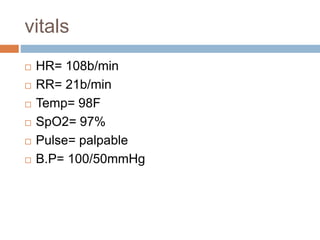
vitals
 HR= 108b/min
 RR= 21b/min
 Temp= 98F
 SpO2= 97%
 Pulse= palpable
 B.P= 100/50mmHg
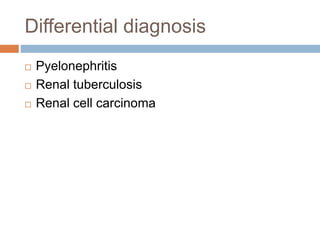
Differential diagnosis
 Pyelonephritis
 Renal tuberculosis
 Renal cell carcinoma
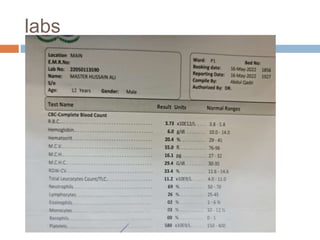
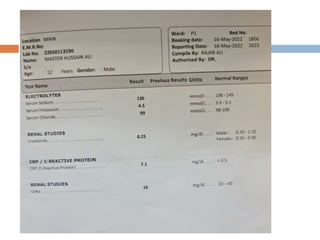
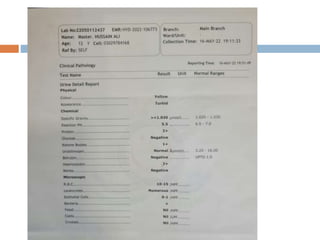
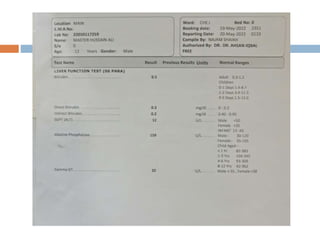
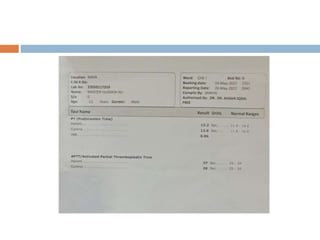
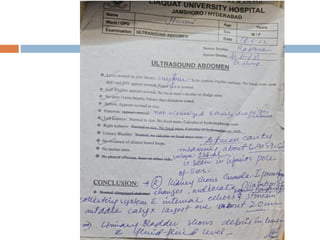
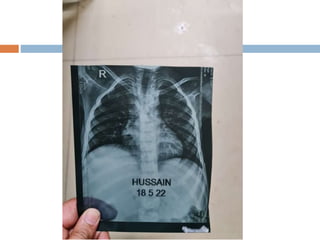
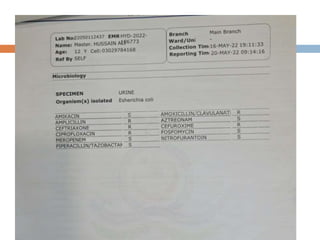
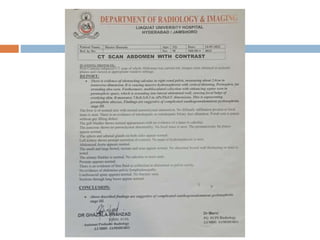
labs
Pyelonephritis
 Inflammation of renal parenchyma.
 Pyelonephritis is the most common serious
bacterial infection in infants younger than
24months of age who have fever without an
obvious focus.
 Pyelonephritis is one of the basic form of UTIs.
 Classified into acute and chronic pyelonephritis .
 Xanthogranulomatous pyelonephritis is a rare and
aggressive variant of chronic pyelonephritis. It
usually occurs due to chronic nephrolithiasis and
infection. The diagnosis is often confused with
renal cell carcinoma. It is characterised by
granulomatous inflammation with giant cells and
foamy histiocytes.
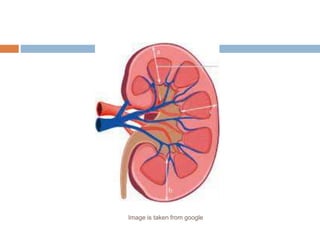
Image is taken from google
Urinary tract infection
 UTIs often are separated into infections of the
lower urinary tract that involve the bladder and
urethra and those of the upper tract that
involve the kidneys, renal pelvis, and ureters.
Infections of the upper tract are designated
pyelonephritis.
 Age and sex are the most important factors.
 UTI is more common in preschool-age
children.
 During first year of life male:female ratio is
2.8:5.4 and beyond 1-2yrs there female
preponderance having ratio of male:female
Classification of UTI and clinical
manifestations
 UTI is classified into two basic forms
 1/ Pylonephritis
 2/ cystitis
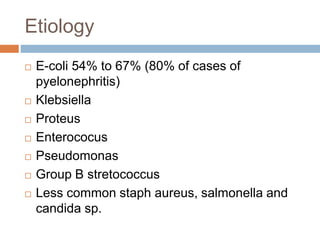
Etiology
 E-coli 54% to 67% (80% of cases of
pyelonephritis)
 Klebsiella
 Proteus
 Enterococus
 Pseudomonas
 Group B stretococcus
 Less common staph aureus, salmonella and
candida sp.
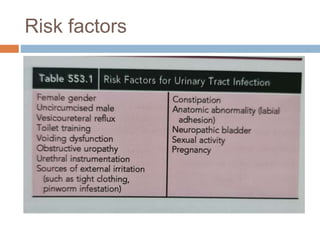
Risk factors
Clinical features of
pyelonephritis
 Abdominal pain or flank pain
 Fever
 Malaise
 Nausea
 Vomiting
 Occasional diarrhea
 Fever and irritability are the most common
presenting findings in infants who have
pyelonephritis.
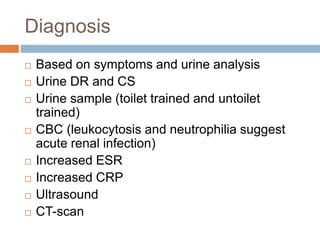
Diagnosis
 Based on symptoms and urine analysis
 Urine DR and CS
 Urine sample (toilet trained and untoilet
trained)
 CBC (leukocytosis and neutrophilia suggest
acute renal infection)
 Increased ESR
 Increased CRP
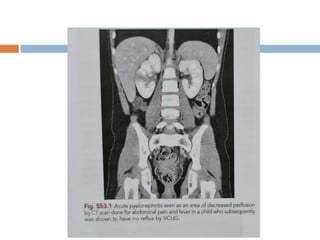
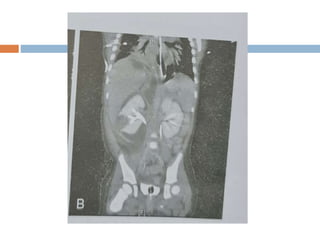
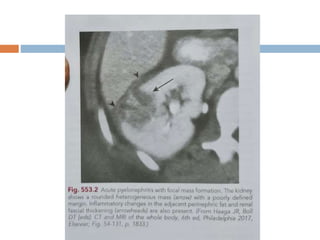
 Ultrasound
 CT-scan
Treatment
 Lower UTI(cystitis)
 Trimethoprim-sulfamethoxazole 6-12mg/kg/day
divided into 2 doses (e-coli).
 Nitrofurantoin 5-7mg/kg/day divided into 3-4
doses.
 Amoxicillin 50mg/kg/day divided into 2 doses.
 Upper UTI (pyelonephritis)
 7 to14days therapy
 Ceftriaxone 50mg/kg/day or cefotaxime 100-
150mg/kg/day divided 3-4 doses and pt is able to
take oral then shift to cefixime, cefixime is as
effective as ceftriaxone.
Complications
 Bacteremia
 Renal scarring
 Hypertension
 Renal or perinephric abscess
 End stage renal insufficiency
 Pleasure is mine

Case presentation of pyelonephritis.pptx

  • 1.
  • 2.
    Presenting complain  A12 year old boy presented in CLF-P2 with complain of  Fever for 1 month  Pain in the right flank region for 1 month  Swelling in the right flank region for 15 days.
  • 3.
    History of presentingcomplain  According to the uncle boy was in his usual health then developed Fever one month back, low grade fever, undocumented, intermittent, temperature increases at night without rigors, chills and sweating, relieved with paracetamol. Associated with the pain in the right flank region for 1 month. Continues dull pain, radiating to the back , aggravate with walking and relieved with ibrufen, the intensity of pain is increasing day by day.  From last 15 days patient developed swelling in the right flank region, hard tender swelling and slowly increasing in size with time. There is no history of trauma to the right flank.
  • 4.
    Past medical history There is previous history of hospital admission 2 years back with complain of fever and pain in the right flank region and pt diagnosed with RT renal calculi and was treated conservatively by urology department and was advised to visit again after 2 weeks but patient didn’t comply.  Past drug history  According to the uncle doctor prescribed antibiotic for 10 days and syp brufen for pain. And pt have been taking ibrufen on and off for pain since then.
  • 5.
    Family history  Grandmother had TB and was on ATT and died during therapy 6 months back, mother also has TB and was taking ATT but then she stopped after 3 to 4 months of treatment. Uncle also has TB but he lives in other city.  HCV: no  HBV: mother is positive  HTN: grand mother  DM-II : grand mother
  • 6.
     Vaccination history: Partialy vaccinated card is not available and BCG mark is absent.  Birth history: unremarkable  Developmental histroy: all mile stones achieved according to age.  Socioeconomic Status: poor  Father died due to excessive use of alcohol leads to CLD  Line water without boiling
  • 7.
    Nutritional history  DMF:for 2 years  Complementry feed started after 6 to7 months of age.  breakfast: 2 slices of bread with cup of tea  Sometimes with one egg and half paratha.  Lunch: ½ chapati with salan of daal or vegetable.  Dinner: one bowl of rice with glass of milk.  They usually have meat twice a week  Total calories intake per day: 575
  • 8.
    On examination  G/look: patient is wasted , pallor, no edema , jaundice , cyanosis and clubbing  MUAC= 11.5cm  Lt= 128.5cm  CNS: conscious and well oriented  CVS: S1+ S2 audible  Chest: b/l normal and equal air entry with no added sounds  Abdomen soft and tender in RHC and RT flank region. There is swelling in the right flank region  Inspection of swelling: the overlying skin is red & no visible pulsation and scar makrs  Palpation: hot & tender to touch , mobile, hard consistency, smooth surface and measuring size
  • 9.
    vitals  HR= 108b/min RR= 21b/min  Temp= 98F  SpO2= 97%  Pulse= palpable  B.P= 100/50mmHg
  • 10.
    Differential diagnosis  Pyelonephritis Renal tuberculosis  Renal cell carcinoma
  • 11.
  • 26.
    Pyelonephritis  Inflammation ofrenal parenchyma.  Pyelonephritis is the most common serious bacterial infection in infants younger than 24months of age who have fever without an obvious focus.  Pyelonephritis is one of the basic form of UTIs.  Classified into acute and chronic pyelonephritis .  Xanthogranulomatous pyelonephritis is a rare and aggressive variant of chronic pyelonephritis. It usually occurs due to chronic nephrolithiasis and infection. The diagnosis is often confused with renal cell carcinoma. It is characterised by granulomatous inflammation with giant cells and foamy histiocytes.
  • 27.
    Image is takenfrom google
  • 28.
    Urinary tract infection UTIs often are separated into infections of the lower urinary tract that involve the bladder and urethra and those of the upper tract that involve the kidneys, renal pelvis, and ureters. Infections of the upper tract are designated pyelonephritis.  Age and sex are the most important factors.  UTI is more common in preschool-age children.  During first year of life male:female ratio is 2.8:5.4 and beyond 1-2yrs there female preponderance having ratio of male:female
  • 29.
    Classification of UTIand clinical manifestations  UTI is classified into two basic forms  1/ Pylonephritis  2/ cystitis
  • 30.
    Etiology  E-coli 54%to 67% (80% of cases of pyelonephritis)  Klebsiella  Proteus  Enterococus  Pseudomonas  Group B stretococcus  Less common staph aureus, salmonella and candida sp.
  • 31.
  • 32.
    Clinical features of pyelonephritis Abdominal pain or flank pain  Fever  Malaise  Nausea  Vomiting  Occasional diarrhea  Fever and irritability are the most common presenting findings in infants who have pyelonephritis.
  • 33.
    Diagnosis  Based onsymptoms and urine analysis  Urine DR and CS  Urine sample (toilet trained and untoilet trained)  CBC (leukocytosis and neutrophilia suggest acute renal infection)  Increased ESR  Increased CRP  Ultrasound  CT-scan
  • 37.
    Treatment  Lower UTI(cystitis) Trimethoprim-sulfamethoxazole 6-12mg/kg/day divided into 2 doses (e-coli).  Nitrofurantoin 5-7mg/kg/day divided into 3-4 doses.  Amoxicillin 50mg/kg/day divided into 2 doses.  Upper UTI (pyelonephritis)  7 to14days therapy  Ceftriaxone 50mg/kg/day or cefotaxime 100- 150mg/kg/day divided 3-4 doses and pt is able to take oral then shift to cefixime, cefixime is as effective as ceftriaxone.
  • 38.
    Complications  Bacteremia  Renalscarring  Hypertension  Renal or perinephric abscess  End stage renal insufficiency
  • 39.