Controversies in
Hypertrophic Cardiomyopathy:
Case Presentation
Ethan Rowin, MD
Associate Director, Hypertrophic Cardiomyopathy Center
Tufts Medical Center, Boston MA
Chanin T. Mast Center for Hypertrophic Cardiomyopathy
Morristown Medical Center, Morristown NJ
HCM Case Presentation
• 40-year-old male with HCM referred for
management of progressive heart failure
symptoms over the past 3 years.
• Limiting exertional dyspnea (stairs and gradual
inclines; NYHA Class II) and atypical chest
pain despite Toprol XL 150mg.
• In addition, severe post-prandial SOB resulting
in significant limitation, even walking on level
ground (class III); and 30 pound weight loss
• One syncopal episode, 1 year prior, occurred
with exertion, 30 minutes after ingestion of a
large meal
Past Medical History
• Atypical chest pain prompted cardiac catheterization
which demonstrated no CAD
• No other significant medical history
• Employed as a transporter of raw materials
• No family history of HCM or unexplained sudden death
• 14 year-old asymptomatic daughter underwent a recent
screening echocardiogram without LV hypertrophy
• No NSVT on 24 hour Holter monitoring
Exercise
Echocardiogram…
Echocardiogram at Rest
Parasternal Long-Axis Apical 4-Chamber
Post Exercise Echocardiogram…
LV
LA
Ao
2.6 m/s
Cardiac MRI…
16mm
LV
RV
LV
RV
2% LGE
Basal Short-Axis Contrast Enhanced CMR
HCM Case
• Maximum LV wall thickness of 16mm
• Ejection Fraction of 60%
• SAM at rest and with exercise but no LVOT
obstruction
• Trace mitral regurgitation
• Normal BP response to exercise
• Minimal LGE on CMR (2% of LV myocardium)
• MYPC3 Arg502Trp positive pathogenic mutation
What is the next step?
1. Evaluation/ management of his
symptoms
2. Risk stratification
3. Family Screening
Exercise echo was
repeated several days
later off medications for
24 hours and one hour
after a small meal…
6:00 minutes on Bruce Protocol…
Mild MR
130 mmHg
LV
LA
Ao
Management
• Initially not interested in moving forward with
invasive option
• Started on Disopyramide…
• Limiting symptoms improved for several
months before eventually recurred
• An exercise echocardiogram was repeated
which confirmed prior findings
• At this point patient elected to move
forward with invasive option…
Management
• Alcohol Septal Ablation
• Surgical Myectomy
• Mitral valve replacement
Pre-operative TEE
Rest Isuprel
Pre-operative TEE
IsuprelIsuprel
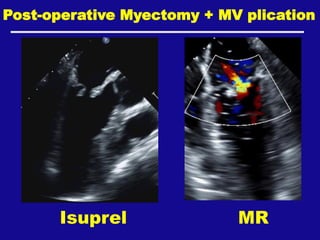
Post-operative Myectomy + MV plication
Isuprel MR
One Year Later…
Asymptomatic… Able to eat all
foods without symptoms. Very
happy with his improved quality
of life.
Symptomatic HCM
patient without
obstruction at rest
Exercise
Echocardiography
Provocable
obstruction
(≥30mmHg)
Nonobstructive
(<30mmHg)
Myectomy/
Alcohol
Ablation
Uncertainty
Persists
BB/CCB/Norpace
Pharmacologic
Provocation
Transplant
BB/CCB
Provocable
obstruction
n=220
I/II
80%
III/IV
20%NYHA
Class
I/II
6.5 ± 2
Rate of Heart Failure
progression = 3.2%/year
Exercise Echocardiogram Predicts Progressive
Heart Failure Symptoms in HCM Patients with
No/Mild Symptoms
What is the next step?
1. Evaluation/ management of his
symptoms
2. Risk stratification
3. Family Screening
Sudden Death Risk Assessment
• Maximum LV wall thickness = 16mm
• Ejection Fraction of 60%
• Unexplained Syncope 2 years ago
• Normal BP response to exercise
• No FH of SD due to HCM
• No NSVT on Holter
• MYPC3 Arg502Trp positive pathogenic
mutation
• CMR with 2% LGE
Family evaluation
• Underwent genetic testing which
returned positive for MYPC3 Arg502Trp
positive pathogenic mutation
• He has an asymptomatic 14 year old
daughter who has had a recent
echocardiogram without LV
hypertrophy
• Next step in the approach to screening
his family?
0.50
0.60
0.70
0.80
0.90
1.00
FreedomfromProgressionto
NYHAClassIII/IV
0 2 4 6 8 10
Time from Initial Visit (years)
p=.003
Nonobstructive
Provocable Obstruction
1.5%/yr
3.2%/yr
0.40
Exercise Echocardiogram Predicts Progressive
Heart Failure Symptoms in HCM Patients with
No/Mild Symptoms
Family evaluation
• Underwent genetic testing which
returned positive for MYPC3 Arg502Trp
positive pathogenic mutation
• He has a 14 year old daughter who has
had a recent echocardiogram without
LV hypertrophy
• Next step in the approach to
screening his family?
Non-
obstructive
Provocable
obstruction
n=220
I/II
90%
III/IV
10%
I/II
80%
III/IV
20%
NYHA Class
n=249
NYHA
Class
I/II
NYHA
Class
I/II
6.5 ± 2
6.5 ± 2
1.5%/year
3.2%/year
p=0.003
Exercise Echocardiogram Predicts Progressive
Heart Failure Symptoms in HCM Patients with
No/Mild Symptoms
HCM patients
without LV outflow
obstruction at rest
(<30mmHg) and
NYHA class I or II
n=469
Exercise
Echocardiogram
Provocable
Obstruction
(≥ 30mmHg)
n=220
Progression to
Class III/IV
n=43 (20%)
Myectomy or
Alchol Septal
Ablation
n=32/43
Class I/II
N=30/32
(94%)
Nonobstructive
(<30mmHg)
n=249
Progression to
Class III/IV
N=24 (10%)
Heart
Transplant
n=10/24
(42%)
Follow-up
6.5 ± 2 yrs
Rate of
heart failure
progression
to NYHA
class III/IV
= 1.5%/year
Rate of
heart failure
progression
to NYHA
class III/IV
= 3.2%/year
Outflow obstruction can be effectively relieved with
myectomy even in HCM patients with minimal hypertrophy
without need for MV replacement…
Pre-Op
Gradient/MR
100±35 mmHg
Mild MR (n=9)
Post-Op
Complications
Post-Op
Gradient/MR
Complete Heart Block
(n=3*)
6±2 mmHg
Mild MR (n=9)
*1 patient with pre-op right bundle branch block
93±34 mmHg
Mild-Mod MR (n=10)
Severe MR (n=2)
Complete Heart Block (n=1)
Tamponade (n=2)
6±1 mmHg
Mild MR (n=12)
60 mmHg
Mild MR
None
9 mmHg
Mild MR
Should this patient be
considered for primary
prevention ICD
placement?
Surgical Approach?
• Extended Myectomy
• Myectomy plus MV repair (plication)
• Mitral valve replacement

Case presentation ethan

  • 1.
    Controversies in Hypertrophic Cardiomyopathy: CasePresentation Ethan Rowin, MD Associate Director, Hypertrophic Cardiomyopathy Center Tufts Medical Center, Boston MA Chanin T. Mast Center for Hypertrophic Cardiomyopathy Morristown Medical Center, Morristown NJ
  • 2.
    HCM Case Presentation •40-year-old male with HCM referred for management of progressive heart failure symptoms over the past 3 years. • Limiting exertional dyspnea (stairs and gradual inclines; NYHA Class II) and atypical chest pain despite Toprol XL 150mg. • In addition, severe post-prandial SOB resulting in significant limitation, even walking on level ground (class III); and 30 pound weight loss • One syncopal episode, 1 year prior, occurred with exertion, 30 minutes after ingestion of a large meal
  • 3.
    Past Medical History •Atypical chest pain prompted cardiac catheterization which demonstrated no CAD • No other significant medical history • Employed as a transporter of raw materials • No family history of HCM or unexplained sudden death • 14 year-old asymptomatic daughter underwent a recent screening echocardiogram without LV hypertrophy • No NSVT on 24 hour Holter monitoring
  • 4.
  • 5.
    Echocardiogram at Rest ParasternalLong-Axis Apical 4-Chamber
  • 6.
  • 7.
  • 8.
  • 9.
    HCM Case • MaximumLV wall thickness of 16mm • Ejection Fraction of 60% • SAM at rest and with exercise but no LVOT obstruction • Trace mitral regurgitation • Normal BP response to exercise • Minimal LGE on CMR (2% of LV myocardium) • MYPC3 Arg502Trp positive pathogenic mutation
  • 10.
    What is thenext step? 1. Evaluation/ management of his symptoms 2. Risk stratification 3. Family Screening
  • 11.
    Exercise echo was repeatedseveral days later off medications for 24 hours and one hour after a small meal…
  • 12.
    6:00 minutes onBruce Protocol… Mild MR 130 mmHg LV LA Ao
  • 13.
    Management • Initially notinterested in moving forward with invasive option • Started on Disopyramide… • Limiting symptoms improved for several months before eventually recurred • An exercise echocardiogram was repeated which confirmed prior findings • At this point patient elected to move forward with invasive option…
  • 14.
    Management • Alcohol SeptalAblation • Surgical Myectomy • Mitral valve replacement
  • 15.
  • 16.
  • 17.
    Post-operative Myectomy +MV plication Isuprel MR
  • 18.
    One Year Later… Asymptomatic…Able to eat all foods without symptoms. Very happy with his improved quality of life.
  • 19.
    Symptomatic HCM patient without obstructionat rest Exercise Echocardiography Provocable obstruction (≥30mmHg) Nonobstructive (<30mmHg) Myectomy/ Alcohol Ablation Uncertainty Persists BB/CCB/Norpace Pharmacologic Provocation Transplant BB/CCB
  • 20.
    Provocable obstruction n=220 I/II 80% III/IV 20%NYHA Class I/II 6.5 ± 2 Rateof Heart Failure progression = 3.2%/year Exercise Echocardiogram Predicts Progressive Heart Failure Symptoms in HCM Patients with No/Mild Symptoms
  • 21.
    What is thenext step? 1. Evaluation/ management of his symptoms 2. Risk stratification 3. Family Screening
  • 22.
    Sudden Death RiskAssessment • Maximum LV wall thickness = 16mm • Ejection Fraction of 60% • Unexplained Syncope 2 years ago • Normal BP response to exercise • No FH of SD due to HCM • No NSVT on Holter • MYPC3 Arg502Trp positive pathogenic mutation • CMR with 2% LGE
  • 23.
    Family evaluation • Underwentgenetic testing which returned positive for MYPC3 Arg502Trp positive pathogenic mutation • He has an asymptomatic 14 year old daughter who has had a recent echocardiogram without LV hypertrophy • Next step in the approach to screening his family?
  • 25.
    0.50 0.60 0.70 0.80 0.90 1.00 FreedomfromProgressionto NYHAClassIII/IV 0 2 46 8 10 Time from Initial Visit (years) p=.003 Nonobstructive Provocable Obstruction 1.5%/yr 3.2%/yr 0.40 Exercise Echocardiogram Predicts Progressive Heart Failure Symptoms in HCM Patients with No/Mild Symptoms
  • 26.
    Family evaluation • Underwentgenetic testing which returned positive for MYPC3 Arg502Trp positive pathogenic mutation • He has a 14 year old daughter who has had a recent echocardiogram without LV hypertrophy • Next step in the approach to screening his family?
  • 27.
    Non- obstructive Provocable obstruction n=220 I/II 90% III/IV 10% I/II 80% III/IV 20% NYHA Class n=249 NYHA Class I/II NYHA Class I/II 6.5 ±2 6.5 ± 2 1.5%/year 3.2%/year p=0.003 Exercise Echocardiogram Predicts Progressive Heart Failure Symptoms in HCM Patients with No/Mild Symptoms
  • 28.
    HCM patients without LVoutflow obstruction at rest (<30mmHg) and NYHA class I or II n=469 Exercise Echocardiogram Provocable Obstruction (≥ 30mmHg) n=220 Progression to Class III/IV n=43 (20%) Myectomy or Alchol Septal Ablation n=32/43 Class I/II N=30/32 (94%) Nonobstructive (<30mmHg) n=249 Progression to Class III/IV N=24 (10%) Heart Transplant n=10/24 (42%) Follow-up 6.5 ± 2 yrs Rate of heart failure progression to NYHA class III/IV = 1.5%/year Rate of heart failure progression to NYHA class III/IV = 3.2%/year
  • 29.
    Outflow obstruction canbe effectively relieved with myectomy even in HCM patients with minimal hypertrophy without need for MV replacement… Pre-Op Gradient/MR 100±35 mmHg Mild MR (n=9) Post-Op Complications Post-Op Gradient/MR Complete Heart Block (n=3*) 6±2 mmHg Mild MR (n=9) *1 patient with pre-op right bundle branch block 93±34 mmHg Mild-Mod MR (n=10) Severe MR (n=2) Complete Heart Block (n=1) Tamponade (n=2) 6±1 mmHg Mild MR (n=12) 60 mmHg Mild MR None 9 mmHg Mild MR
  • 30.
    Should this patientbe considered for primary prevention ICD placement?
  • 31.
    Surgical Approach? • ExtendedMyectomy • Myectomy plus MV repair (plication) • Mitral valve replacement