Case conference
Ext.Atthaya Raksuan
Case
• ผู้ป่วยเด็กหญิงไทย อายุ 12 ปี ภูมิลาเนา อ.ปักธงชัย จ.นครราชสีมา
• สิทธิการรักษา บัตรทอง
• อาชีพ นักเรียนชั้นมัธยมศึกษาตอนต้น
• ประวัติได้จากผู้ป่วยและเวชระเบียน ความน่าเชื่อถือมาก
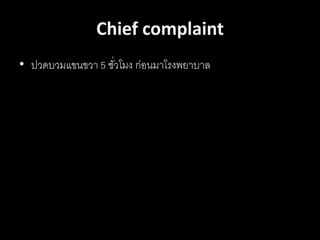
Chief complaint
• ปวดบวมแขนขวา 5 ชั่วโมง ก่อนมาโรงพยาบาล
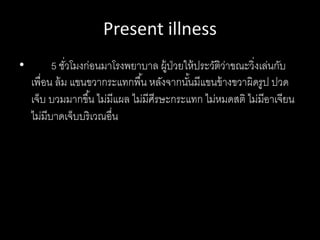
Present illness
• 5 ชั่วโมงก่อนมาโรงพยาบาล ผู้ป่วยให้ประวัติว่าขณะวิ่งเล่นกับ
เพื่อน ล้ม แขนขวากระแทกพื้น หลังจากนั้นมีแขนข้างขวาผิดรูป ปวด
เจ็บ บวมมากขึ้น ไม่มีแผล ไม่มีศีรษะกระแทก ไม่หมดสติ ไม่มีอาเจียน
ไม่มีบาดเจ็บบริเวณอื่น
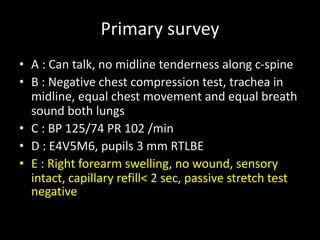
Primary survey
• A : Can talk, no midline tenderness along c-spine
• B : Negative chest compression test, trachea in
midline, equal chest movement and equal breath
sound both lungs
• C : BP 125/74 PR 102 /min
• D : E4V5M6, pupils 3 mm RTLBE
• E : Right forearm swelling, no wound, sensory
intact, capillary refill< 2 sec, passive stretch test
negative
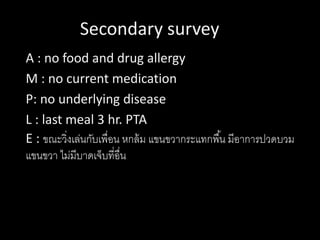
Secondary survey
A : no food and drug allergy
M : no current medication
P: no underlying disease
L : last meal 3 hr. PTA
E : ขณะวิ่งเล่นกับเพื่อน หกล้ม แขนขวากระแทกพื้น มีอาการปวดบวม
แขนขวา ไม่มีบาดเจ็บที่อื่น
Investigation
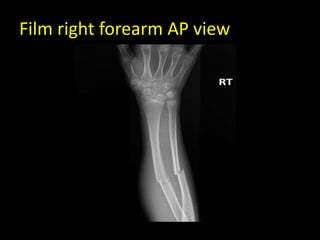
Film right forearm AP view
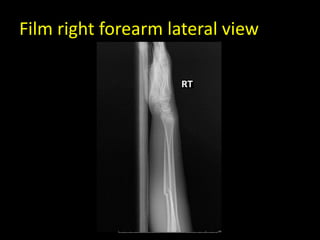
Film right forearm lateral view
• Film : minimally displaced fracture midshaft
both bone of right forearm
• Diagnosis : Close fracture both bone right
forearm
Investigation
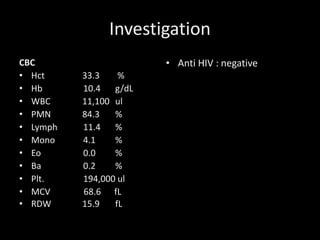
CBC
• Hct 33.3 %
• Hb 10.4 g/dL
• WBC 11,100 ul
• PMN 84.3 %
• Lymph 11.4 %
• Mono 4.1 %
• Eo 0.0 %
• Ba 0.2 %
• Plt. 194,000 ul
• MCV 68.6 fL
• RDW 15.9 fL
• Anti HIV : negative
Management
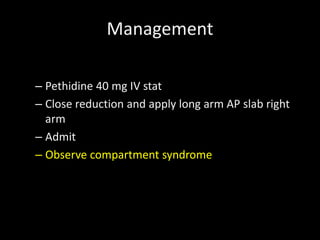
– Pethidine 40 mg IV stat
– Close reduction and apply long arm AP slab right
arm
– Admit
– Observe compartment syndrome
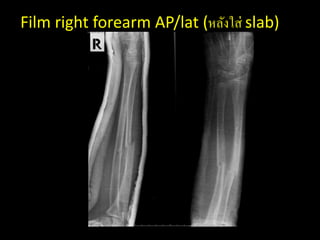
Film right forearm AP/lat (หลังใส่ slab)
Compartment syndrome
Definition
- Elevated tissue pressure within a closed fascial
space
- Ruduces tissue perfusion – ischemia
- Results in cell death – necrosis
True Orthopaedic Emergency
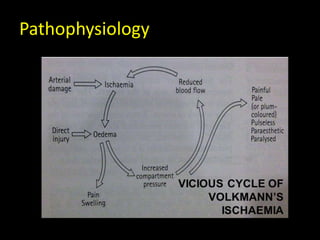
Pathophysiology
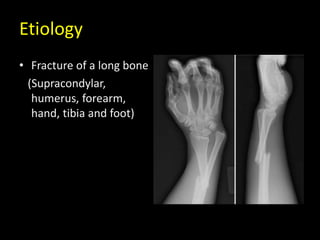
Etiology
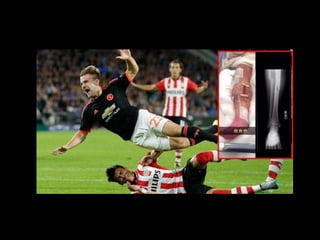
• Fracture of a long bone
(Supracondylar,
humerus, forearm,
hand, tibia and foot)
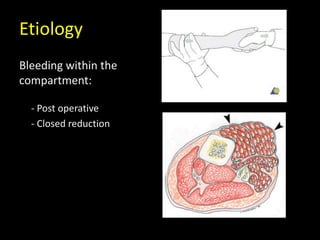
Etiology
Bleeding within the
compartment:
- Post operative
- Closed reduction
Etiology
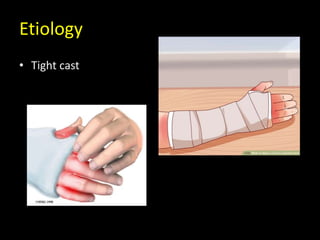
• Tight cast
Etiology
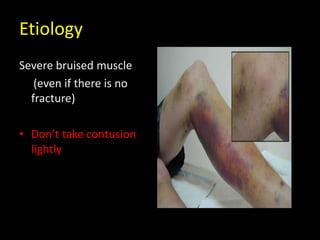
Severe bruised muscle
(even if there is no
fracture)
• Don’t take contusion
lightly
Signs and symptoms
5 P’s
1. Pain : The earliest sign
2. Paraesthesia
3. Pallor
4. Paralysis
5. Pulselessness
Signs :
1. tight swelling
2. Loss of strength
3. Loss of sensation
4. Blister
(presence of a pulse does not exclude the diagnosis)
The earliest sign : PAIN
• Pain that out of proportion to the injury
• Describe as ‘bursting’ sensation
• Pain that is not responsive to the normal
dosage of pain medication
• Severe pain with passive stretch
Diagnosis
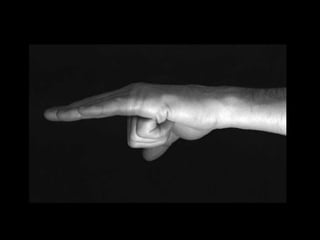
• Passive stretching of fingers or toes (muscle
stretch)will lead to severe pain (diagnostic
sign)
• Compartment syndrome is a clinical diagnosis
• Never wait for signs of ischemia (5 Ps) :
irreversible damage
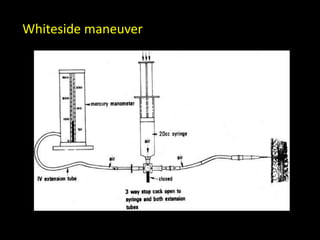
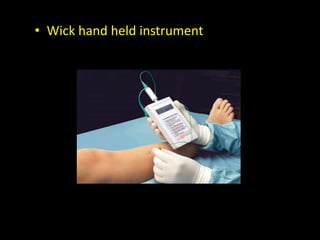
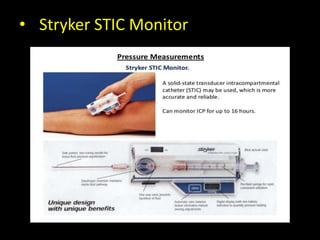
For obtunded, intubated, or unreliable patients
who have a swollen extremity but who
otherwise cannot be evaluated
Whiteside maneuver
• Wick hand held instrument
• Stryker STIC Monitor
MANAGEMENT
Non surgical management:
• Remove any tight bandage or soaked dressing
• Cast should be removed completely
• Elevation
MANAGEMENT
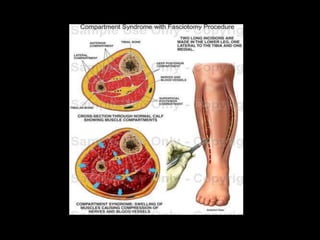
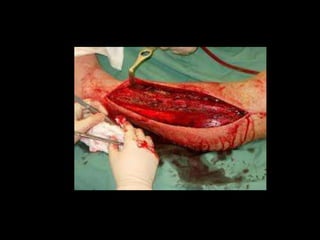
Surgical management:
FASCIOTOMY
Open skin and fascia down to a compartment
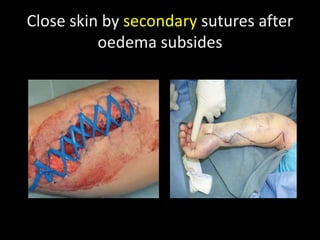
Close skin by secondary sutures after
oedema subsides
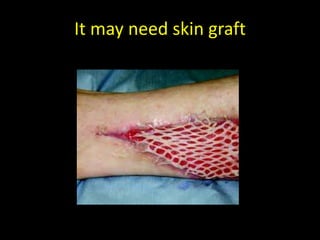
It may need skin graft
Complications
• Acute renal failure secondary to
rhabdomyolysis
• Disseminated intravascular coagulation
• Volkmann’s contracture (where infarcted
muscle is replaced by inelastic fibrous tissue)
• Amputation
• Compartment syndrome is a serious
syndrome, Which needs to be diagnosed
early.
• Palpable pulse doesn’t exclude compartment
syndrome
• If diagnosis and fasciotomy were done within
24 hrs, the prognosis is good.
• If delayed, complications will develop.
The earlier you diagnose, the safer you are
If not sure Admit patient for Close monitoring
Take home message!!

Thank you
for your attention…

Case conference compartment syndrome

  • 1.
  • 2.
    Case • ผู้ป่วยเด็กหญิงไทย อายุ12 ปี ภูมิลาเนา อ.ปักธงชัย จ.นครราชสีมา • สิทธิการรักษา บัตรทอง • อาชีพ นักเรียนชั้นมัธยมศึกษาตอนต้น • ประวัติได้จากผู้ป่วยและเวชระเบียน ความน่าเชื่อถือมาก
  • 3.
    Chief complaint • ปวดบวมแขนขวา5 ชั่วโมง ก่อนมาโรงพยาบาล
  • 4.
    Present illness • 5ชั่วโมงก่อนมาโรงพยาบาล ผู้ป่วยให้ประวัติว่าขณะวิ่งเล่นกับ เพื่อน ล้ม แขนขวากระแทกพื้น หลังจากนั้นมีแขนข้างขวาผิดรูป ปวด เจ็บ บวมมากขึ้น ไม่มีแผล ไม่มีศีรษะกระแทก ไม่หมดสติ ไม่มีอาเจียน ไม่มีบาดเจ็บบริเวณอื่น
  • 5.
    Primary survey • A: Can talk, no midline tenderness along c-spine • B : Negative chest compression test, trachea in midline, equal chest movement and equal breath sound both lungs • C : BP 125/74 PR 102 /min • D : E4V5M6, pupils 3 mm RTLBE • E : Right forearm swelling, no wound, sensory intact, capillary refill< 2 sec, passive stretch test negative
  • 6.
    Secondary survey A :no food and drug allergy M : no current medication P: no underlying disease L : last meal 3 hr. PTA E : ขณะวิ่งเล่นกับเพื่อน หกล้ม แขนขวากระแทกพื้น มีอาการปวดบวม แขนขวา ไม่มีบาดเจ็บที่อื่น
  • 7.
  • 8.
  • 9.
    Film right forearmlateral view
  • 10.
    • Film :minimally displaced fracture midshaft both bone of right forearm • Diagnosis : Close fracture both bone right forearm
  • 11.
    Investigation CBC • Hct 33.3% • Hb 10.4 g/dL • WBC 11,100 ul • PMN 84.3 % • Lymph 11.4 % • Mono 4.1 % • Eo 0.0 % • Ba 0.2 % • Plt. 194,000 ul • MCV 68.6 fL • RDW 15.9 fL • Anti HIV : negative
  • 12.
    Management – Pethidine 40mg IV stat – Close reduction and apply long arm AP slab right arm – Admit – Observe compartment syndrome
  • 13.
    Film right forearmAP/lat (หลังใส่ slab)
  • 14.
  • 15.
    Definition - Elevated tissuepressure within a closed fascial space - Ruduces tissue perfusion – ischemia - Results in cell death – necrosis True Orthopaedic Emergency
  • 16.
  • 17.
    Etiology • Fracture ofa long bone (Supracondylar, humerus, forearm, hand, tibia and foot)
  • 18.
    Etiology Bleeding within the compartment: -Post operative - Closed reduction
  • 19.
  • 20.
    Etiology Severe bruised muscle (evenif there is no fracture) • Don’t take contusion lightly
  • 22.
    Signs and symptoms 5P’s 1. Pain : The earliest sign 2. Paraesthesia 3. Pallor 4. Paralysis 5. Pulselessness Signs : 1. tight swelling 2. Loss of strength 3. Loss of sensation 4. Blister (presence of a pulse does not exclude the diagnosis)
  • 23.
    The earliest sign: PAIN • Pain that out of proportion to the injury • Describe as ‘bursting’ sensation • Pain that is not responsive to the normal dosage of pain medication • Severe pain with passive stretch
  • 24.
    Diagnosis • Passive stretchingof fingers or toes (muscle stretch)will lead to severe pain (diagnostic sign) • Compartment syndrome is a clinical diagnosis • Never wait for signs of ischemia (5 Ps) : irreversible damage
  • 26.
    For obtunded, intubated,or unreliable patients who have a swollen extremity but who otherwise cannot be evaluated
  • 27.
  • 28.
    • Wick handheld instrument
  • 29.
  • 30.
    MANAGEMENT Non surgical management: •Remove any tight bandage or soaked dressing • Cast should be removed completely • Elevation
  • 31.
  • 34.
    Close skin bysecondary sutures after oedema subsides
  • 35.
    It may needskin graft
  • 36.
    Complications • Acute renalfailure secondary to rhabdomyolysis • Disseminated intravascular coagulation • Volkmann’s contracture (where infarcted muscle is replaced by inelastic fibrous tissue) • Amputation
  • 37.
    • Compartment syndromeis a serious syndrome, Which needs to be diagnosed early. • Palpable pulse doesn’t exclude compartment syndrome • If diagnosis and fasciotomy were done within 24 hrs, the prognosis is good. • If delayed, complications will develop. The earlier you diagnose, the safer you are If not sure Admit patient for Close monitoring Take home message!!
  • 38.
    Thank you for yourattention…