Successes and Best Practices of Financial Supply Chain Automation in Asia. 2005 APEC Symposium on the Assessment and Benchmark of Paperless Trading, Beijing Carl Wegner, VP Business Development TradeCard September 2005
Growth of Cross-Border Trade “ 80 percent of manufacturers in [the U.S. and Europe] currently purchase, or plan to purchase in the next three years, components or goods produced outside their home countries” Deloitte Research study "Mastering Complexity in Global Manufacturing," based on a survey of nearly 600 U.S. and European executives, 2003 “ Nearly 30 percent of world gross domestic product (GDP) currently crosses borders” World Trade Organization, 2003
The Trouble With Paper-based Trade In a world of just-in-time inventories, common systems for paying suppliers remain slow and complex.  Cost of processing trade documentation is more than 5% of the total annual value of world trade. Cost of processing a simple transaction is about $400.  Up to 24 forms must be completed for each transaction.  Half of all letter-of-credit transactions are rejected by banks because of incorrect information from the buyer or seller.  Source: Gartner G2 report, June 2002 The real trouble is that this data hasn’t changed much in two years… Companies need to automate in order to cope with the growth in cross-border trade
What Overseas Buyers Want “ Leaders are embracing a clear set of processes and enabling technologies to drive down the frequency and cost of supply disruptions.” (Aberdeen Group, Sept 2004) “ AMR Research predict an 8% growth in sales of Procurement and sourcing software [in the US] for the 2003-2008 period”. Where large buyers choose to source depends not only on price, but on efficiency of communications in the supply chain with their suppliers.
Inefficient, Outdated Processes Add to Cost of Goods EXPENSIVE Bank fees are high Ineffective use of credit lines Approximately 90% of LCs result in discrepancies Each amendment incurs a fee but amendments to POs are common in the apparel industry TIME INTENSIVE  A lot of paperwork creating many errors through re-keying of data More work for Accounts Payable department  DISCONNECTED Paperwork is completely disconnected from existing ERP and EDI systems Example: Letter of Credit Transactions MORE COSTLY THAN IT SEEMS Supplier requires financing for the period after goods shipped and before payment is received, usually at unfavorable rates TIME INTENSIVE  Document matching needs to be performed in-house by buyer’s accounts department Payments need to be reconciled manually creating more work for Accounts Payable department  DISCONNECTED Paperwork is completely disconnected from existing ERP and EDI systems Although suppliers bear the brunt of direct costs, time and cost trickle back to the buyer in the cost of goods Example: Open Account
How the Supply Chain is Completed:  The Financial Supply Chain Raw  Goods Supplier Manufacturer Retailer / Distributor Customer Financial Supply Chain Questions What and how to pay? When to pay? How much to pay? Who to pay? Just-in-time-cash Currently being  optimized Movement of  Documents Data & Money Physical Supply Chain Questions What to buy? When to buy? How much to buy? From whom to buy? Just-in-time-manufacturing Optimized over  last 10 years Movement of Documents Data & Physical Goods
A Common Electronic Platform to Coordinate Information and Money Flows With The Physical Supply Chain Logistics Suppliers Electronic compliance  compares documents Customer and supplier agree on purchase order  B ENEFITS OF  A UTOMATING THE  F INANCIAL  S UPPLY  C HAIN Transparency into the status of transactions Automated processes create efficiencies and eliminate errors Immediate cost savings Optimized financial and procurement decisions through access to information Innovative financial programs Shortened trade cycles  Rapid online discrepancy resolution Improved trading partner relations Factories Inspection Customs Distribution  Centers Financial Institution Buying Offices BUYER
TradeCard Transaction Management  “Best Practice” Process Trading Partner Management Buyer-Supplier connectivity Purchase order management Workflow and event management Electronic invoicing Document management Integration module Accounts Payable Management Patented automated compliance checking Discrepancy management Payment decisioning and scheduling Financial Services Management Money movement Payment Assurance (LC replacement) Automated Supply Chain Financing Discrepancy Resolution; Payment Decision 7 Patented Electronic Compliance: Compares Procurement and Fulfillment Data/Documents 6 Logistics Service Provider Proof of Delivery (optional) 5 Buying Office or Agent Payment Approval and/or Inspection Certificate 4 Send Commercial Invoice and/or Packing List 3 Purchase Order Advised, Approved, and Stored 2 Create Purchase Order  (UI, EDI, ERP interfaces) 1 A/R Visibility A/P Visibility Determine Value Date;  Schedule Funds Transfer 8 Supplier Buyer
A Complete FSC Solution is Flexible T RADING PARTNER MANAGEMENT F INANCIAL MANAGEMENT T RANSACTION  S OLUTIONS Money Movement Platform automatically initiates electronic payment to suppliers with  automated wire transfers and ACH transactions. Payment Assurance Have access for suppliers to payment assurance, without tying up credit lines, and to electronic Letters of Credit. Financing Electronically apply for pre-and post-export financing online.  Early Payment Discount Program Optimize credit availability and usage across the supply chain   with innovative programs, including terms extension program. Workflow and Event Management   Move tasks within and among enterprises on a common platform, with real-time notification of supply chain events. Purchase Order Management   Manage the delivery, negotiation and amendments of purchase orders. Electronic Invoicing Present invoices electronically. Document Management  Route, store, and organize electronic documents. Shipping/Logistics Documents   Have access to transaction data, including proof of delivery. Integration Module Connect to ERP systems, EDI interfaces, and other services or solutions. Patented Automated Compliance Checking   Electronically compare procurement and fulfillment documents to make or support payment decisions.  Discrepancy Management and Dispute Resolution Identify and resolve discrepancies between procurement and fulfillment documents to enable payment.  Payment Decisioning and Payment Scheduling   Decide when and how payments should be made, whether upon compliance or triggered by the customer.  Warehouse Reconciliation and Chargeback Management   Electronically compare warehouse goods receipt with invoice and automate chargebacks. TRANSACTION  MANAGEMENT
TradeCard Enables Best Practices Connect to trading partners electronically Automate global trading processes including finance Manage documents and amendments electronically Know what invoices are “OK to pay” Automate payment scheduling and settlement Electronic discrepancy resolution Replace Letters of Credit with alternative payment assurance Offer automated export financing to suppliers Take advantage of early payment discount programs Preserve or extend DPO Optimize credit throughout the supply chain
TradeCard as Part of a Regional Paperless Trading Initiative TradeCard’s focus is on enabling international trade and providing paperless connectivity, transactional functionality with workflow and event management and financial services to ensure automation of the financial processes in global supply chains In a regional set-up, TradeCard can provide any part of its system to enable paperless trade for example to manage invoice, packing list, proof of delivery, advanced shipping notice and financial guarantees electronically
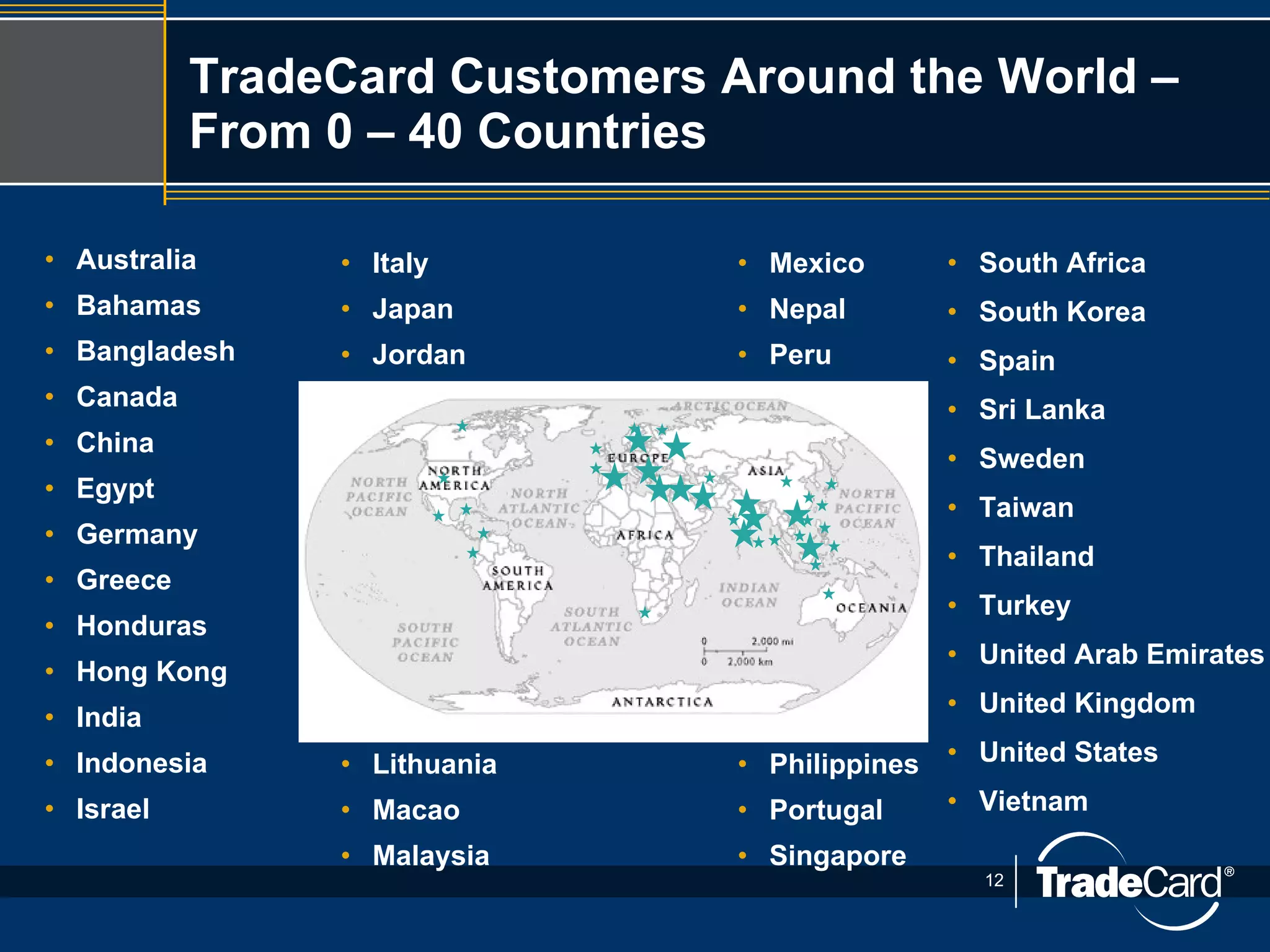
TradeCard Customers Around the World – From 0 – 40 Countries Australia Bahamas Bangladesh Canada China Egypt Germany Greece Honduras Hong Kong India Indonesia Israel South Africa South Korea Spain Sri Lanka Sweden Taiwan Thailand Turkey United Arab Emirates United Kingdom United States Vietnam Italy Japan Jordan Lithuania Macao Malaysia Mexico Nepal Peru Philippines Portugal Singapore
TradeCard’s Success 600 + new members in 2005 20+ financial institutions, 100’s LSP More suppliers converting to buyers Intra-Asia business is growing faster Penetration into our core verticals apparel and footwear is also accelerating TradeCard is not just a concept or plan - it is live and expanding customers and capabilities
More Than 1300 Client Members Use TradeCard for Their Global Supply Chains F OOTWEAR A PPAREL R ETAIL    
Case Study: Burton Snowboards Best Practices in Cross-Border Trade Management
Burton Snowboards Profile Profile $320M company with $130M procurement Approximately 40 vendors in: Hong Kong Taiwan China Europe U.S.A. Using ERP system from SAP
Burton’s Suppliers in Asia S.Korea China Hong Kong Taiwan
Business Challenges to growth Transactions created mountains of paperwork Letters of credit tied-up time and working capital Excessive paperwork made it difficult to capture more early payment discounts
Burton’s Solution:  Implement TradeCard   Selected TradeCard in December 2003; Burton implemented in February 2004 Used holiday period for integration with SAP system and vendor on-boarding Live in 6 weeks Jointly visited vendors in Asia and North America Using full suite of TradeCard products including early payment program for suppliers (Automated Supply Chain Financing (ASCF)).
Successes for Burton Snowboards Greater visibility between financial and operational processes allows improved working capital forecasts Through automated transactions, Burton Snowboards can offer suppliers payment in five days at a discounted rate and surpass return from extending payment terms Time and working capital freed up through letter of credit elimination Integrated TradeCard with its SAP implementation in under 25 business days Procurement-to-payment  costs expected to be one-third to one-half of last year because of TradeCard Visibility of being able to find transactions anywhere in the system and knowing when the cash flows are coming in Suppliers sometimes ship 30 to 40 times on a single purchase order. Because TradeCard automatically matches relevant procurement and fulfillment documents, Burton benefits from time savings.
Successes on Supplier Side Easier for finance departments to keep tabs on receivables Better working capital management and reduction in short-term borrowing Production department gets advanced notice on material and manufacturing requirements. Working capital no longer stretched thin when buyer’s business growth needs to be supported – working capital freed up through early payment
Burton Results: Source: Retail Systems Alert “Top of the Net”

Carl Wegner

  • 1.
    Successes and BestPractices of Financial Supply Chain Automation in Asia. 2005 APEC Symposium on the Assessment and Benchmark of Paperless Trading, Beijing Carl Wegner, VP Business Development TradeCard September 2005
  • 2.
    Growth of Cross-BorderTrade “ 80 percent of manufacturers in [the U.S. and Europe] currently purchase, or plan to purchase in the next three years, components or goods produced outside their home countries” Deloitte Research study "Mastering Complexity in Global Manufacturing," based on a survey of nearly 600 U.S. and European executives, 2003 “ Nearly 30 percent of world gross domestic product (GDP) currently crosses borders” World Trade Organization, 2003
  • 3.
    The Trouble WithPaper-based Trade In a world of just-in-time inventories, common systems for paying suppliers remain slow and complex. Cost of processing trade documentation is more than 5% of the total annual value of world trade. Cost of processing a simple transaction is about $400. Up to 24 forms must be completed for each transaction. Half of all letter-of-credit transactions are rejected by banks because of incorrect information from the buyer or seller. Source: Gartner G2 report, June 2002 The real trouble is that this data hasn’t changed much in two years… Companies need to automate in order to cope with the growth in cross-border trade
  • 4.
    What Overseas BuyersWant “ Leaders are embracing a clear set of processes and enabling technologies to drive down the frequency and cost of supply disruptions.” (Aberdeen Group, Sept 2004) “ AMR Research predict an 8% growth in sales of Procurement and sourcing software [in the US] for the 2003-2008 period”. Where large buyers choose to source depends not only on price, but on efficiency of communications in the supply chain with their suppliers.
  • 5.
    Inefficient, Outdated ProcessesAdd to Cost of Goods EXPENSIVE Bank fees are high Ineffective use of credit lines Approximately 90% of LCs result in discrepancies Each amendment incurs a fee but amendments to POs are common in the apparel industry TIME INTENSIVE A lot of paperwork creating many errors through re-keying of data More work for Accounts Payable department DISCONNECTED Paperwork is completely disconnected from existing ERP and EDI systems Example: Letter of Credit Transactions MORE COSTLY THAN IT SEEMS Supplier requires financing for the period after goods shipped and before payment is received, usually at unfavorable rates TIME INTENSIVE Document matching needs to be performed in-house by buyer’s accounts department Payments need to be reconciled manually creating more work for Accounts Payable department DISCONNECTED Paperwork is completely disconnected from existing ERP and EDI systems Although suppliers bear the brunt of direct costs, time and cost trickle back to the buyer in the cost of goods Example: Open Account
  • 6.
    How the SupplyChain is Completed: The Financial Supply Chain Raw Goods Supplier Manufacturer Retailer / Distributor Customer Financial Supply Chain Questions What and how to pay? When to pay? How much to pay? Who to pay? Just-in-time-cash Currently being optimized Movement of Documents Data & Money Physical Supply Chain Questions What to buy? When to buy? How much to buy? From whom to buy? Just-in-time-manufacturing Optimized over last 10 years Movement of Documents Data & Physical Goods
  • 7.
    A Common ElectronicPlatform to Coordinate Information and Money Flows With The Physical Supply Chain Logistics Suppliers Electronic compliance compares documents Customer and supplier agree on purchase order B ENEFITS OF A UTOMATING THE F INANCIAL S UPPLY C HAIN Transparency into the status of transactions Automated processes create efficiencies and eliminate errors Immediate cost savings Optimized financial and procurement decisions through access to information Innovative financial programs Shortened trade cycles Rapid online discrepancy resolution Improved trading partner relations Factories Inspection Customs Distribution Centers Financial Institution Buying Offices BUYER
  • 8.
    TradeCard Transaction Management “Best Practice” Process Trading Partner Management Buyer-Supplier connectivity Purchase order management Workflow and event management Electronic invoicing Document management Integration module Accounts Payable Management Patented automated compliance checking Discrepancy management Payment decisioning and scheduling Financial Services Management Money movement Payment Assurance (LC replacement) Automated Supply Chain Financing Discrepancy Resolution; Payment Decision 7 Patented Electronic Compliance: Compares Procurement and Fulfillment Data/Documents 6 Logistics Service Provider Proof of Delivery (optional) 5 Buying Office or Agent Payment Approval and/or Inspection Certificate 4 Send Commercial Invoice and/or Packing List 3 Purchase Order Advised, Approved, and Stored 2 Create Purchase Order (UI, EDI, ERP interfaces) 1 A/R Visibility A/P Visibility Determine Value Date; Schedule Funds Transfer 8 Supplier Buyer
  • 9.
    A Complete FSCSolution is Flexible T RADING PARTNER MANAGEMENT F INANCIAL MANAGEMENT T RANSACTION S OLUTIONS Money Movement Platform automatically initiates electronic payment to suppliers with automated wire transfers and ACH transactions. Payment Assurance Have access for suppliers to payment assurance, without tying up credit lines, and to electronic Letters of Credit. Financing Electronically apply for pre-and post-export financing online. Early Payment Discount Program Optimize credit availability and usage across the supply chain with innovative programs, including terms extension program. Workflow and Event Management Move tasks within and among enterprises on a common platform, with real-time notification of supply chain events. Purchase Order Management Manage the delivery, negotiation and amendments of purchase orders. Electronic Invoicing Present invoices electronically. Document Management Route, store, and organize electronic documents. Shipping/Logistics Documents Have access to transaction data, including proof of delivery. Integration Module Connect to ERP systems, EDI interfaces, and other services or solutions. Patented Automated Compliance Checking Electronically compare procurement and fulfillment documents to make or support payment decisions. Discrepancy Management and Dispute Resolution Identify and resolve discrepancies between procurement and fulfillment documents to enable payment. Payment Decisioning and Payment Scheduling Decide when and how payments should be made, whether upon compliance or triggered by the customer. Warehouse Reconciliation and Chargeback Management Electronically compare warehouse goods receipt with invoice and automate chargebacks. TRANSACTION MANAGEMENT
  • 10.
    TradeCard Enables BestPractices Connect to trading partners electronically Automate global trading processes including finance Manage documents and amendments electronically Know what invoices are “OK to pay” Automate payment scheduling and settlement Electronic discrepancy resolution Replace Letters of Credit with alternative payment assurance Offer automated export financing to suppliers Take advantage of early payment discount programs Preserve or extend DPO Optimize credit throughout the supply chain
  • 11.
    TradeCard as Partof a Regional Paperless Trading Initiative TradeCard’s focus is on enabling international trade and providing paperless connectivity, transactional functionality with workflow and event management and financial services to ensure automation of the financial processes in global supply chains In a regional set-up, TradeCard can provide any part of its system to enable paperless trade for example to manage invoice, packing list, proof of delivery, advanced shipping notice and financial guarantees electronically
  • 12.
    TradeCard Customers Aroundthe World – From 0 – 40 Countries Australia Bahamas Bangladesh Canada China Egypt Germany Greece Honduras Hong Kong India Indonesia Israel South Africa South Korea Spain Sri Lanka Sweden Taiwan Thailand Turkey United Arab Emirates United Kingdom United States Vietnam Italy Japan Jordan Lithuania Macao Malaysia Mexico Nepal Peru Philippines Portugal Singapore
  • 13.
    TradeCard’s Success 600+ new members in 2005 20+ financial institutions, 100’s LSP More suppliers converting to buyers Intra-Asia business is growing faster Penetration into our core verticals apparel and footwear is also accelerating TradeCard is not just a concept or plan - it is live and expanding customers and capabilities
  • 14.
    More Than 1300Client Members Use TradeCard for Their Global Supply Chains F OOTWEAR A PPAREL R ETAIL  
  • 15.
    Case Study: BurtonSnowboards Best Practices in Cross-Border Trade Management
  • 16.
    Burton Snowboards ProfileProfile $320M company with $130M procurement Approximately 40 vendors in: Hong Kong Taiwan China Europe U.S.A. Using ERP system from SAP
  • 17.
    Burton’s Suppliers inAsia S.Korea China Hong Kong Taiwan
  • 18.
    Business Challenges togrowth Transactions created mountains of paperwork Letters of credit tied-up time and working capital Excessive paperwork made it difficult to capture more early payment discounts
  • 19.
    Burton’s Solution: Implement TradeCard Selected TradeCard in December 2003; Burton implemented in February 2004 Used holiday period for integration with SAP system and vendor on-boarding Live in 6 weeks Jointly visited vendors in Asia and North America Using full suite of TradeCard products including early payment program for suppliers (Automated Supply Chain Financing (ASCF)).
  • 20.
    Successes for BurtonSnowboards Greater visibility between financial and operational processes allows improved working capital forecasts Through automated transactions, Burton Snowboards can offer suppliers payment in five days at a discounted rate and surpass return from extending payment terms Time and working capital freed up through letter of credit elimination Integrated TradeCard with its SAP implementation in under 25 business days Procurement-to-payment costs expected to be one-third to one-half of last year because of TradeCard Visibility of being able to find transactions anywhere in the system and knowing when the cash flows are coming in Suppliers sometimes ship 30 to 40 times on a single purchase order. Because TradeCard automatically matches relevant procurement and fulfillment documents, Burton benefits from time savings.
  • 21.
    Successes on SupplierSide Easier for finance departments to keep tabs on receivables Better working capital management and reduction in short-term borrowing Production department gets advanced notice on material and manufacturing requirements. Working capital no longer stretched thin when buyer’s business growth needs to be supported – working capital freed up through early payment
  • 22.
    Burton Results: Source:Retail Systems Alert “Top of the Net”