
Ten Tips to Ensure that Your
Suppliers are Real
Hi, thanks for joining us! We will begin the webcast
shortly but in the meantime, please keep in mind:
•  Enter your questions and comments in the chat box, there
will be time at the end of the webinar for Q&A
•  Presentation and recording will be sent afterwards
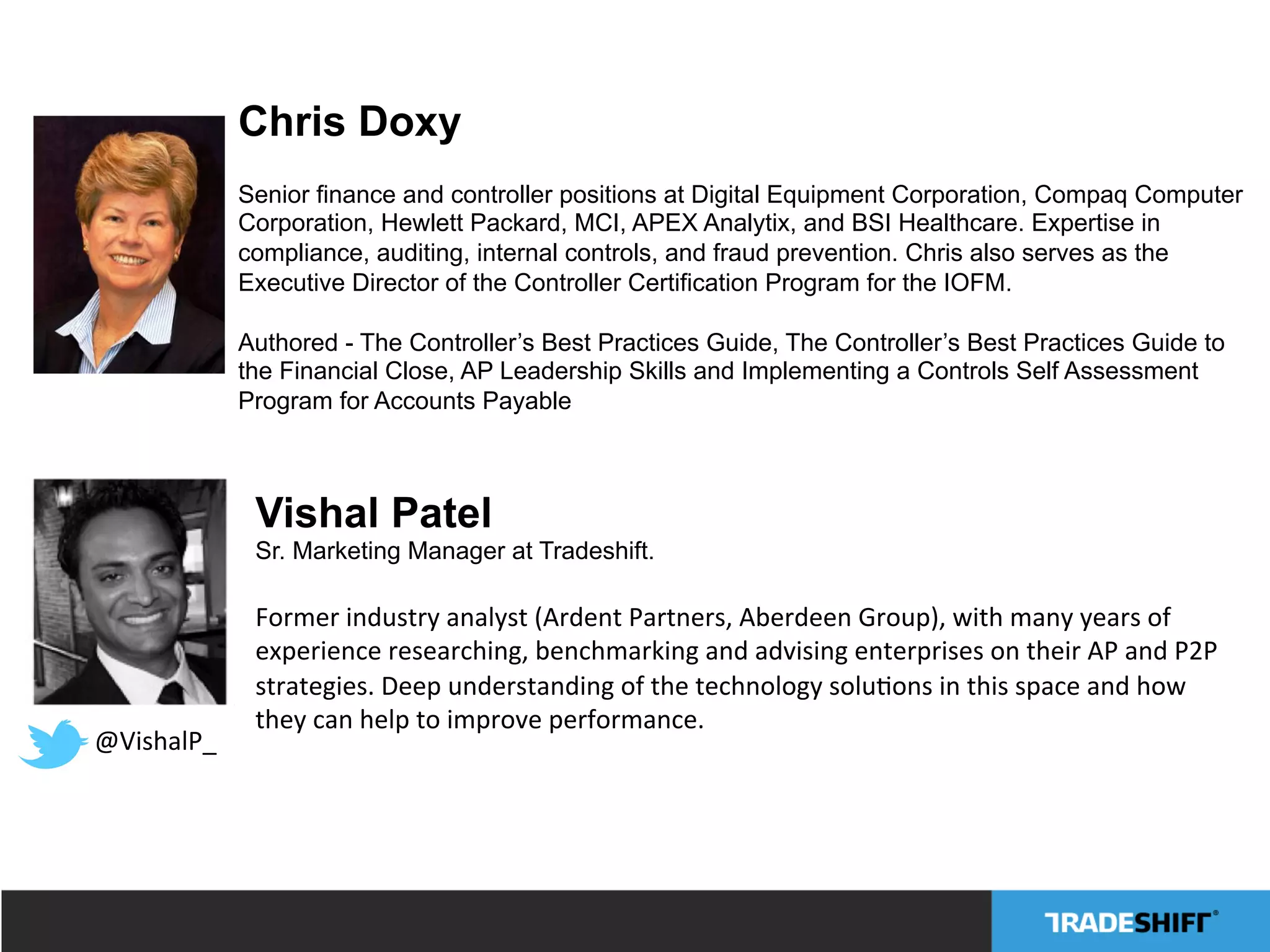
Chris Doxy
Senior finance and controller positions at Digital Equipment Corporation, Compaq Computer
Corporation, Hewlett Packard, MCI, APEX Analytix, and BSI Healthcare. Expertise in
compliance, auditing, internal controls, and fraud prevention. Chris also serves as the
Executive Director of the Controller Certification Program for the IOFM.
Authored - The Controller’s Best Practices Guide, The Controller’s Best Practices Guide to
the Financial Close, AP Leadership Skills and Implementing a Controls Self Assessment
Program for Accounts Payable
Vishal Patel
Sr. Marketing Manager at Tradeshift.
Former	
  industry	
  analyst	
  (Ardent	
  Partners,	
  Aberdeen	
  Group),	
  with	
  many	
  years	
  of	
  
experience	
  researching,	
  benchmarking	
  and	
  advising	
  enterprises	
  on	
  their	
  AP	
  and	
  P2P	
  
strategies.	
  Deep	
  understanding	
  of	
  the	
  technology	
  soluCons	
  in	
  this	
  space	
  and	
  how	
  
they	
  can	
  help	
  to	
  improve	
  performance.
@VishalP_	
  
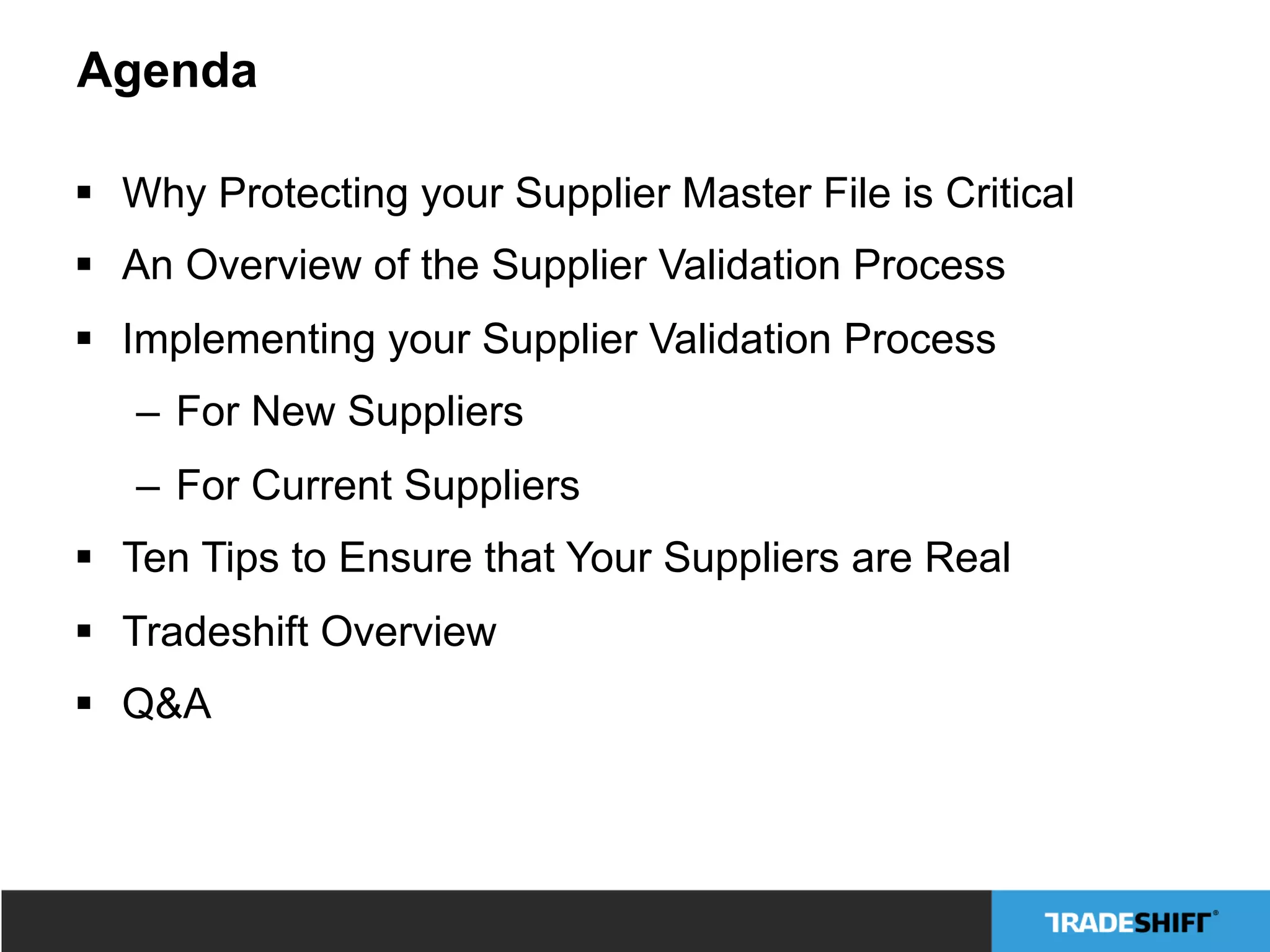
Agenda
§  Why Protecting your Supplier Master File is Critical
§  An Overview of the Supplier Validation Process
§  Implementing your Supplier Validation Process
–  For New Suppliers
–  For Current Suppliers
§  Ten Tips to Ensure that Your Suppliers are Real
§  Tradeshift Overview
§  Q&A
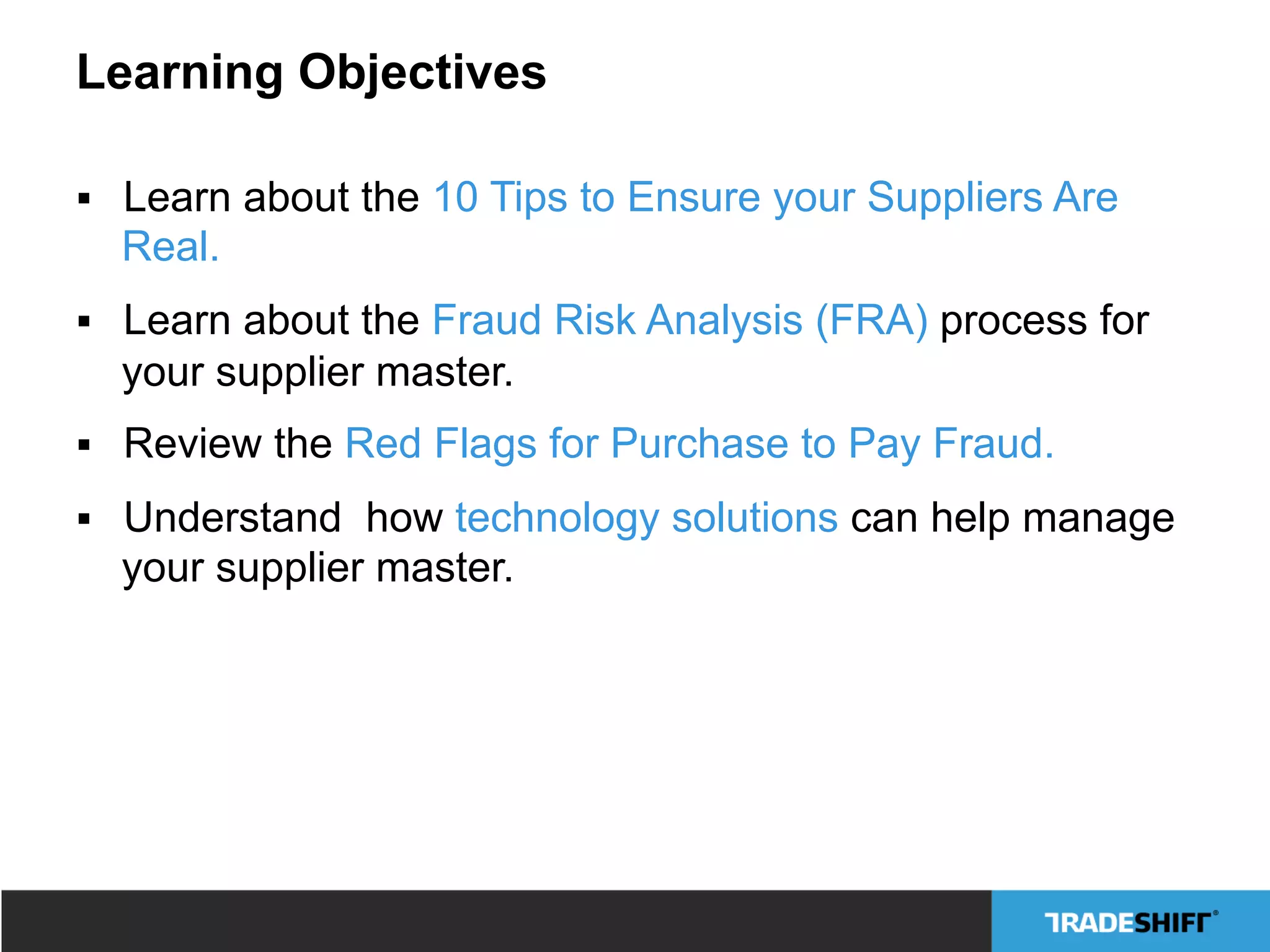
Learning Objectives
§  Learn about the 10 Tips to Ensure your Suppliers Are
Real.
§  Learn about the Fraud Risk Analysis (FRA) process for
your supplier master.
§  Review the Red Flags for Purchase to Pay Fraud.
§  Understand how technology solutions can help manage
your supplier master.
Protecting Your Supplier
Master
Why Protecting your Supplier Master File is Critical
The Procure to Pay (P2P) cycle is fundamental to the profitability of
an organization, especially in economically challenging times.
Source: KPMG
Why Protecting your Supplier Master File is Critical
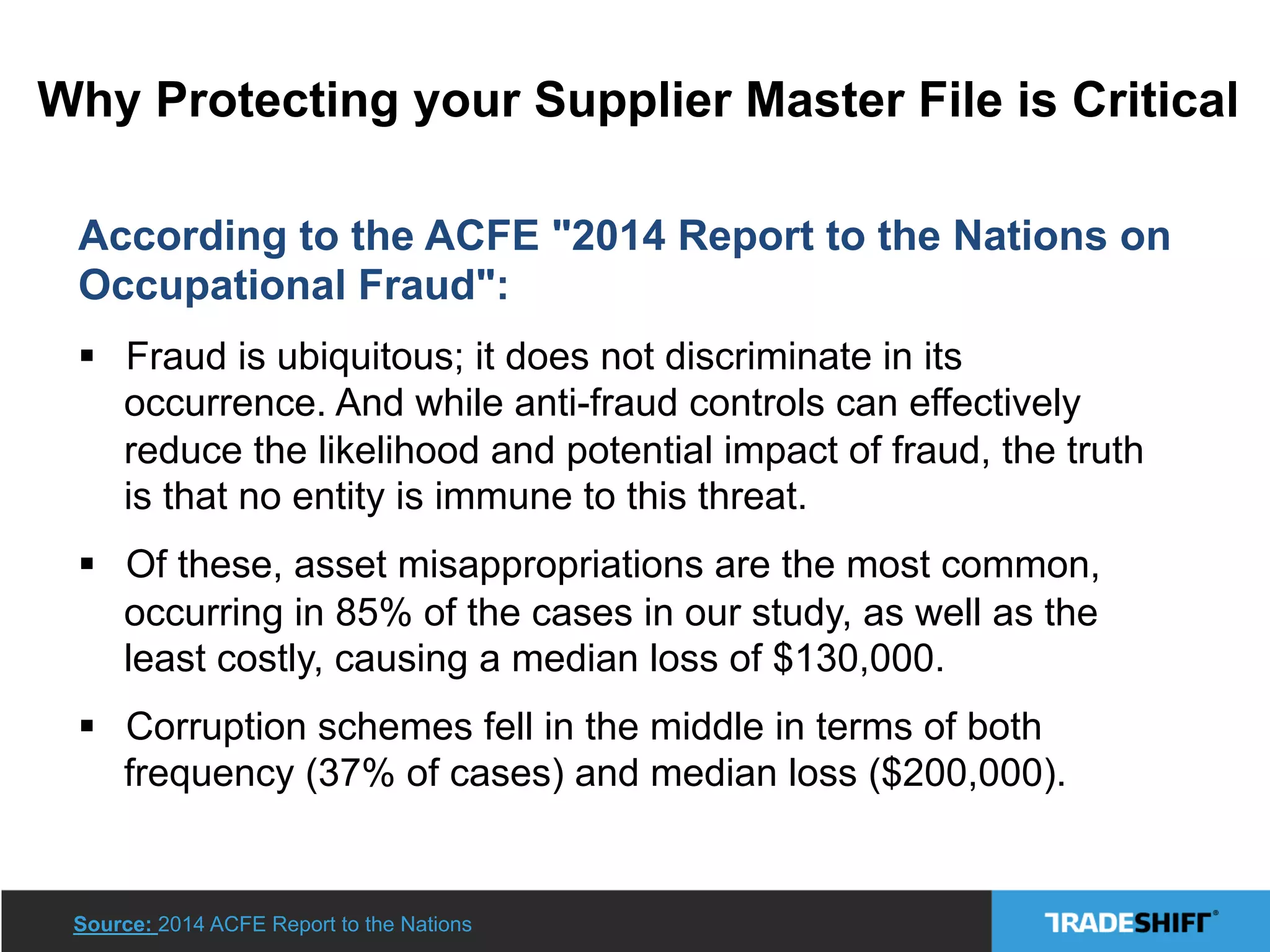
According to the ACFE "2014 Report to the Nations on
Occupational Fraud":
§  Fraud is ubiquitous; it does not discriminate in its
occurrence. And while anti-fraud controls can effectively
reduce the likelihood and potential impact of fraud, the truth
is that no entity is immune to this threat.
§  Of these, asset misappropriations are the most common,
occurring in 85% of the cases in our study, as well as the
least costly, causing a median loss of $130,000.
§  Corruption schemes fell in the middle in terms of both
frequency (37% of cases) and median loss ($200,000).
Source: 2014 ACFE Report to the Nations
Frequency of Fraud Cases: Purchasing and
Finance
Source: 2014 ACFE Report to the Nations
Supplier Validation Process
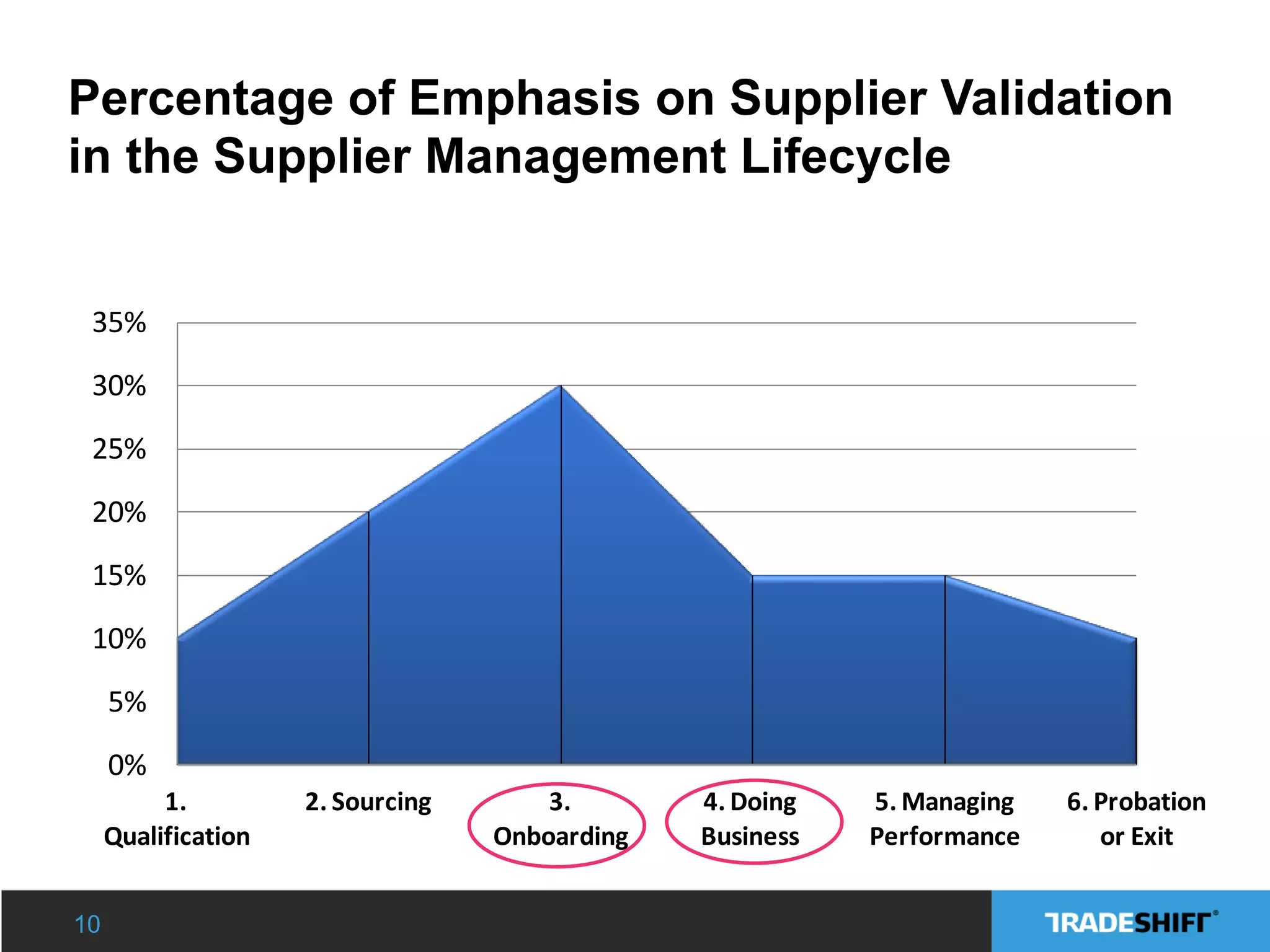
Percentage of Emphasis on Supplier Validation
in the Supplier Management Lifecycle
0%
5%
10%
15%
20%
25%
30%
35%
1.	
  
Qualification
2.	
  Sourcing 3.	
  
Onboarding
4.	
  Doing	
  
Business	
  
5.	
  Managing	
  
Performance
6.	
  Probation	
  
or	
  Exit
10
Ten Tips to Ensure that Your
Suppliers are Real
Best Practices for Supplier Management
Compliance
Qualification
•  Establish a Supplier Qualification Process
Sourcing
•  Request for Proposal (RFP) and Request for Information (RFI)
•  Utilize an Objective Supplier Evaluation and Selection Process
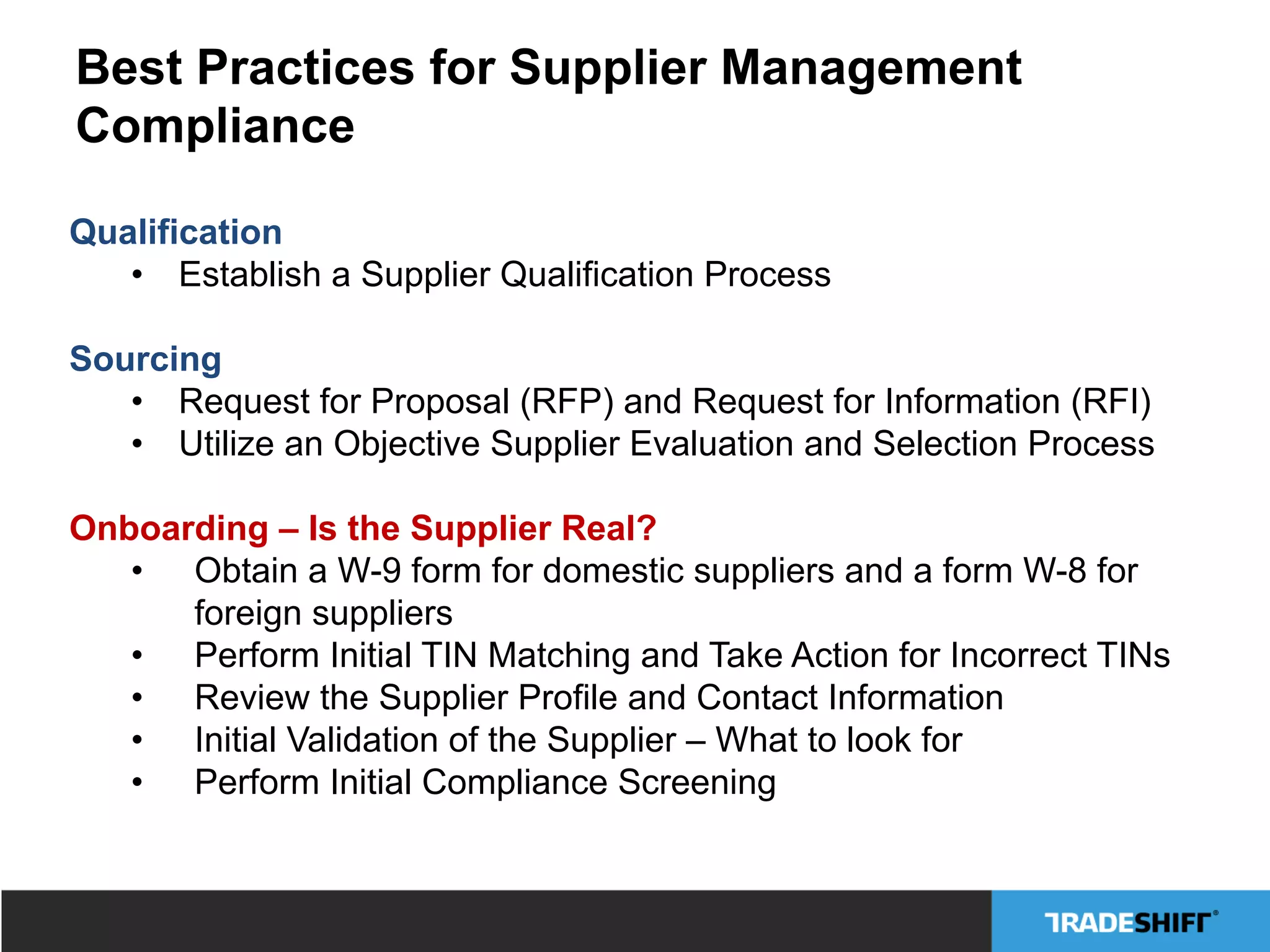
Onboarding – Is the Supplier Real?
•  Obtain a W-9 form for domestic suppliers and a form W-8 for
foreign suppliers
•  Perform Initial TIN Matching and Take Action for Incorrect TINs
•  Review the Supplier Profile and Contact Information
•  Initial Validation of the Supplier – What to look for
•  Perform Initial Compliance Screening
Best Practices for Supplier Management
Compliance
Doing Business – Is the Supplier Still Real?
•  Perform Ongoing Compliance Screening
•  Complete a Comparison of Your Employee and Supplier Master
•  Complete TIN Matching for your Supplier Master at Least Annually
•  Complete a Supplier Fraud Risk Analysis (FRA)
•  Fine Tune Your Supplier Master Annually
Managing Performance
•  Establish Supplier Service Level Agreement Reviews
Probation or Exit
•  Supplier Performance Continuous Monitoring
•  Watch for Compliance Issues
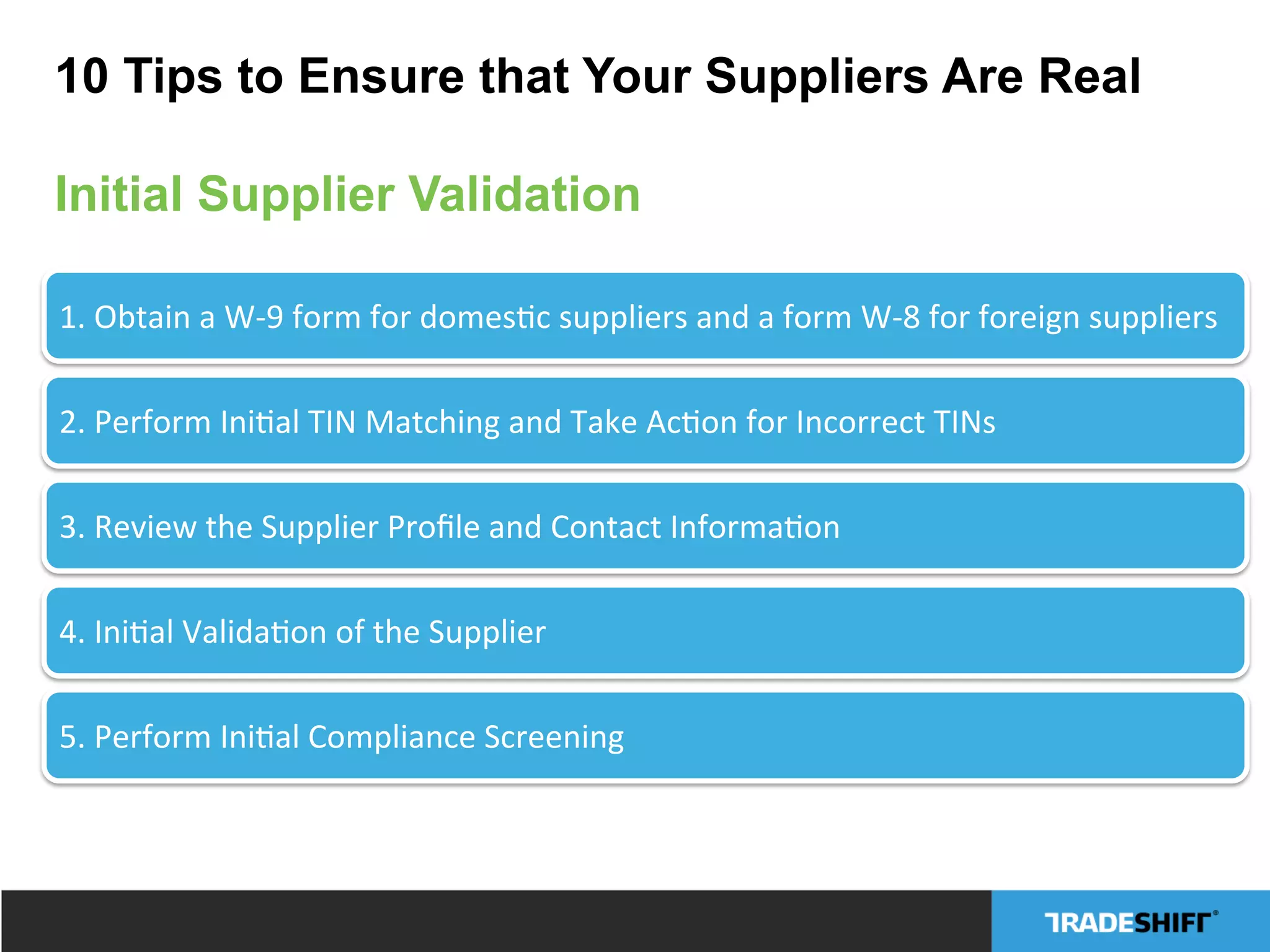
1.	
  Obtain	
  a	
  W-­‐9	
  form	
  for	
  domesCc	
  suppliers	
  and	
  a	
  form	
  W-­‐8	
  for	
  foreign	
  suppliers	
  
2.	
  Perform	
  IniCal	
  TIN	
  Matching	
  and	
  Take	
  AcCon	
  for	
  Incorrect	
  TINs	
  
3.	
  Review	
  the	
  Supplier	
  Profile	
  and	
  Contact	
  InformaCon	
  
4.	
  IniCal	
  ValidaCon	
  of	
  the	
  Supplier	
  
5.	
  Perform	
  IniCal	
  Compliance	
  Screening	
  
10 Tips to Ensure that Your Suppliers Are Real
Initial Supplier Validation
10 Tips to Ensure that Your Suppliers Are Real
Doing Business
6.	
  Perform	
  Ongoing	
  Compliance	
  Screening	
  
7.	
  Complete	
  a	
  Comparison	
  of	
  Your	
  Employee	
  and	
  Supplier	
  Master	
  
8.	
  Complete	
  TIN	
  Matching	
  for	
  your	
  Supplier	
  Master	
  
9.	
  Complete	
  a	
  Supplier	
  Fraud	
  Risk	
  Analysis	
  (FRA)	
  
10.	
  Fine	
  Tune	
  Your	
  Supplier	
  Master	
  Annually	
  
15	
  
1.	
  Obtain	
  a	
  W-­‐9	
  and	
  W-­‐8	
  Forms	
  For	
  All	
  New	
  Suppliers	
  
Use Form W-9 only for U.S. Suppliers (including a resident
alien), to provide correct TIN to the person requesting it (the
requester) and, when applicable, to:
1.  Certify that the TIN provided is correct (or the supplier is
waiting for a number to be issued)
2.  Certify that the supplier is not subject to backup
withholding
www.irs.gov/pub/irs-pdf/fw9.pdf
2.	
  Perform	
  Ini@al	
  TIN	
  Matching	
  and	
  Take	
  Ac@on	
  for	
  Missing	
  or	
  
Invalid	
  TINs	
  
§  The National Taxpayer Advocate has also recommended
that all payees be required to certify their TINs (i.e.,
through use of Forms W-9 signed under penalty of
perjury).
§  The TIN Matching service is available at no cost
§  TINs can be validated either in an interactive session or by
the bulk uploading process.
http://www.irs.gov/Tax-Professionals/e-services---Online-
Tools-for-Tax-Professionals
www.irs.gov/pub/irs-pdf/p2108a.pdf
3.	
  Review	
  the	
  Supplier	
  Profile	
  and	
  Contact	
  Informa@on	
  
§  Ensure all supplier information is
complete and reasonable
§  The Supplier Profile Form can be
a component of the qualification
process and can be used with
major suppliers as part of the
supplier clean up process
Supplier Profile Form
Business Name/Taxpayer Name (Exact Legal Name):
Federal ID Number/Social Security Number:
Parent Company (if applicable):
□ Domestic □ Foreign
Business Type: Officers:
q Corporation Principal/Owner:
q Partnership Chief Executive/President:
q Sole Proprietorship CFO/Controller:
q Individual
Contact Name for Negotiations: Telephone:
E-mail:
Contact Name for Billing Inquiries: Telephone:
E-mail:
Primary Remittance Address: Physical Business Address:
Address 1: Address 1:
Address 2: Address 2:
City: State: Zip: City: State: Zip:
Telephone Number: Fax Number:
Company Website (if applicable):
Please attach at least three of the following:
Proof of Existence: ο - Corporate Charter ο - Federal Tax Return
ο - Recent Audited Annual Report ο - Vendor Contract/Agreement
ο - City/County Business License ο - Product Catalog
ο - Sales Tax Certificate ο - 1099
ο - IRS Document/Notice ο - W-9
Description of Business (or commodity code, i.e. SIC, NAICS, etc.):
Please check techniques you are currently using with your customers:
q Evaluated Receipts Settlement (ERS)
q Electronic Data Interchange (EDI)
q Electronic Funds Transfer (EFT)
q On-line Pricing Catalog
How would you like to receive payments? □ ACH □ Wire □ Check □ Other ____________________
I hereby certify, under the penalty of perjury, that to the best of my knowledge, the information
presented here is true and correct.
Respondent’s Name: Respondent’s Signature:
4.	
  Perform	
  the	
  Ini@al	
  Screening	
  –	
  What	
  to	
  Look	
  For	
  
§  Valid and complete supplier website
§  Address provided is reasonable
§  Review suppliers operating out of the same address
§  Determine if another supplier has the same TIN number
§  Determine if your company has any past or present legal
actions with the supplier
§  Determine the validity of the corporation by reviewing
state of incorporation data
§  Review Better Business Bureau data
5.	
  Perform	
  Ini@al	
  Compliance	
  Screening	
  
Periodically screen your supplier master file against the compliance
requirements applicable to your industry.
§  OFAC – Office of Foreign Asset Control
§  BIS - Bureau of Industry and Security
§  SAM/EPLS – System of Award Management (SAM) which includes
the Excluded Parties List System (EPLS)
§  SDNs - Specially Designated Nationals are considered enemies of
the United States. OIG – Office of Inspector General (Healthcare)
§  FCPA – Check Politically Exposed Persons (PEP) Listings
http://www.treasury.gov/about/organizational-structure/offices/Pages/Office-of-Foreign-Assets-
Control.aspx
http://www.bis.doc.gov/
https://oig.hhs.gov/
https://www.sam.gov/portal/SAM/#1
http://www.accuity.com/compliance/pep-due-diligence-database/?cmpid=PSC|
BAML|BAML-2014-GLOB-adwd-
pep&sfid=701D0000000KzwY&gclid=CNOu_bf9xb8CFUIQ7Aod3lAAYw
6.	
  Perform	
  Ongoing	
  Compliance	
  Screening	
  
§  Basic screening should include comparing supplier master
records the compliance requirements applicable to your
industry.
§  Quarterly screening using a compliance solution is a
recommended best practice.
§  Supplier master screening should be included in your P2P
internal controls program with defined roles and
responsibilities for procedures for due diligence.
http://www.treasury.gov/about/organizational-structure/offices/Pages/Office-of-Foreign-Assets-
Control.aspx
http://www.bis.doc.gov/
https://oig.hhs.gov/
https://www.sam.gov/portal/SAM/#1
http://www.accuity.com/compliance/pep-due-diligence-database/?cmpid=PSC|
BAML|BAML-2014-GLOB-adwd-
pep&sfid=701D0000000KzwY&gclid=CNOu_bf9xb8CFUIQ7Aod3lAAYw
7.	
  Complete	
  a	
  Comparison	
  of	
  Your	
  Employee	
  Master	
  Against	
  
Your	
  Supplier	
  Master	
  
§  Complete the comparison at least annually
§  Compare the following:
–  Name
•  Exact Match
•  Last Name
–  Address
–  TIN, EIN, and SSN
–  Bank Account
8.	
  Complete	
  TIN	
  Matching	
  for	
  your	
  Supplier	
  Master	
  at	
  Least	
  
Annually	
  
§  Use the Bulk Upload capability to complete TIN Matching
for your supplier master file.
§  Your supplier master file must be submitted in the IRS
format using your e-services account.
§  Results are provided in a secure mailbox within 1-2
business days.
§  This process will help to alleviate B-Notices resulting from
incorrect TINs provided on 1099s issued.
9.	
  Complete	
  a	
  Supplier	
  Fraud	
  Risk	
  Analysis	
  (FRA)	
  	
  
What is an FRA?
§  An FRA considers vulnerability to management overrides and potential
schemes to circumvent existing control activities such as segregation of
duties and delegation of automation
§  A review of supplier data and payment history highlights anomalies,
duplicate payments, pricing discrepancies, and payment issues.
Objectives of an FRA are to:
1.  Identify the vulnerabilities for fraud, and
2.  Implement proactive measures such as specific internal controls
to prevent the fraud from occurring.
The three phases of an FRA include:
1)  Access - The current internal controls structure and identifies specific
weaknesses where potential fraud schemes could occur.
2)  Respond - Fraud risks are linked to controls to determine: risk tolerance,
cost benefit analysis, stakeholder expectations, and remediation
monitoring.
3)  Sustain - A report is developed to communicate the results of the FRA
process, the fraud audit plan is developed and executed, and a
continuous monitoring process in implemented.
9.	
  Complete	
  a	
  Supplier	
  Fraud	
  Risk	
  Analysis	
  (FRA)	
  	
  -­‐	
  Cont	
  
Purchase to Pay (P2P) Fraud Flags
§  Poor segregation of duties throughout the P2P process
§  Round dollar value invoices
§  First invoice is for a low dollar amount followed by larger dollar
invoices
§  Lack of control around the bidding process including poor
documentation, absence of appropriate competition
§  Poor documentation of expenditures or failure to complete a match of
invoices to receiving and order documentation
§  Consistent use of a supplier who is delivering poor quality goods,
particularly where this issue is concentrated with one buyer
§  Duplicate invoice payments
Source: Best Practices and KPMG
Purchase to Pay (P2P) Fraud Flags (Continued)
§  Excessive entertaining of procurement staff by suppliers
§  Suppliers with a post office box as the sole address
§  Absence of a legitimate TIN Number
§  Off-hour transactions
§  Out-of-sequence invoice numbers for a particular supplier
§  Payments to inactive suppliers
§  Low initial bids followed by excessive change orders
§  Poor cash management practices (i.e., paying invoices right away
despite the accepted practice of 30 to 60 day payment terms in a
particular industry)
§  Checks set aside for special handling
Source: Best Practices and KPMG
10.	
  Fine	
  Tune	
  Your	
  Supplier	
  Master	
  on	
  an	
  Annual	
  Basis	
  
§  Use Supplier Coding Standards to ensure data
consistency within your Supplier Master that include
business rules for:
–  Supplier Name, Address, Phone Number, and Contact Information.
§  Identify possible duplicate suppliers.
§  Identify suppliers with multiple addresses and consolidate
when possible.
§  Block or purge suppliers with no activity within 18 months.
Recap - Learning Objectives
§  Learn about the Ten Tips to Ensure your Suppliers Are Real.
§  Discuss how non-compliance can put your company at significant
risk if your suppliers are not initially validated and reviewed on an
ongoing basis.
§  Learn about the Fraud Risk Analysis (FRA) process for your
supplier master.
§  Review the Red Flags for Purchase to Pay Fraud.
§  Understand how technology solutions can help manage your
supplier master.
Tradeshift Overview
▪  Flexible cloud platform enabling businesses to
connect, collaborate and transact with their
supply chain
▪  State-of-the art automation, data intelligence
and collaboration technology that is cloud
based, mobile ready, and simple to use
▪  Our mission is to help businesses and their
employees connect to and create value for their
entire supply chain
•  Over	
  500,000	
  suppliers	
  in	
  over	
  100	
  countries	
  
•  5	
  million	
  suppliers	
  connected	
  through	
  pla]orm	
  partners	
  such	
  as	
  
Intuit	
  
•  Fastest	
  growing	
  B2B	
  pla]orm	
  in	
  the	
  world	
  today	
  with	
  more	
  than	
  
2000	
  suppliers	
  joining	
  every	
  week	
  
About Tradeshift
Tradeshift’s Open Platform Approach
	
  
TRADESHIFT	
  	
  PLATFORM	
  
Document Transmission, Statuses, Messages, Integration, Security, API
	
  
Supplier
Buyer
Order
Management
Electronic
Invoicing
Business
Firewall
CloudScan®
(Paper/PDF)
Collaborative
Workflow
Financial
Solutions
Build Your Own
App
Supplier
Management
Ability to expand functionality as needed
Global Customers
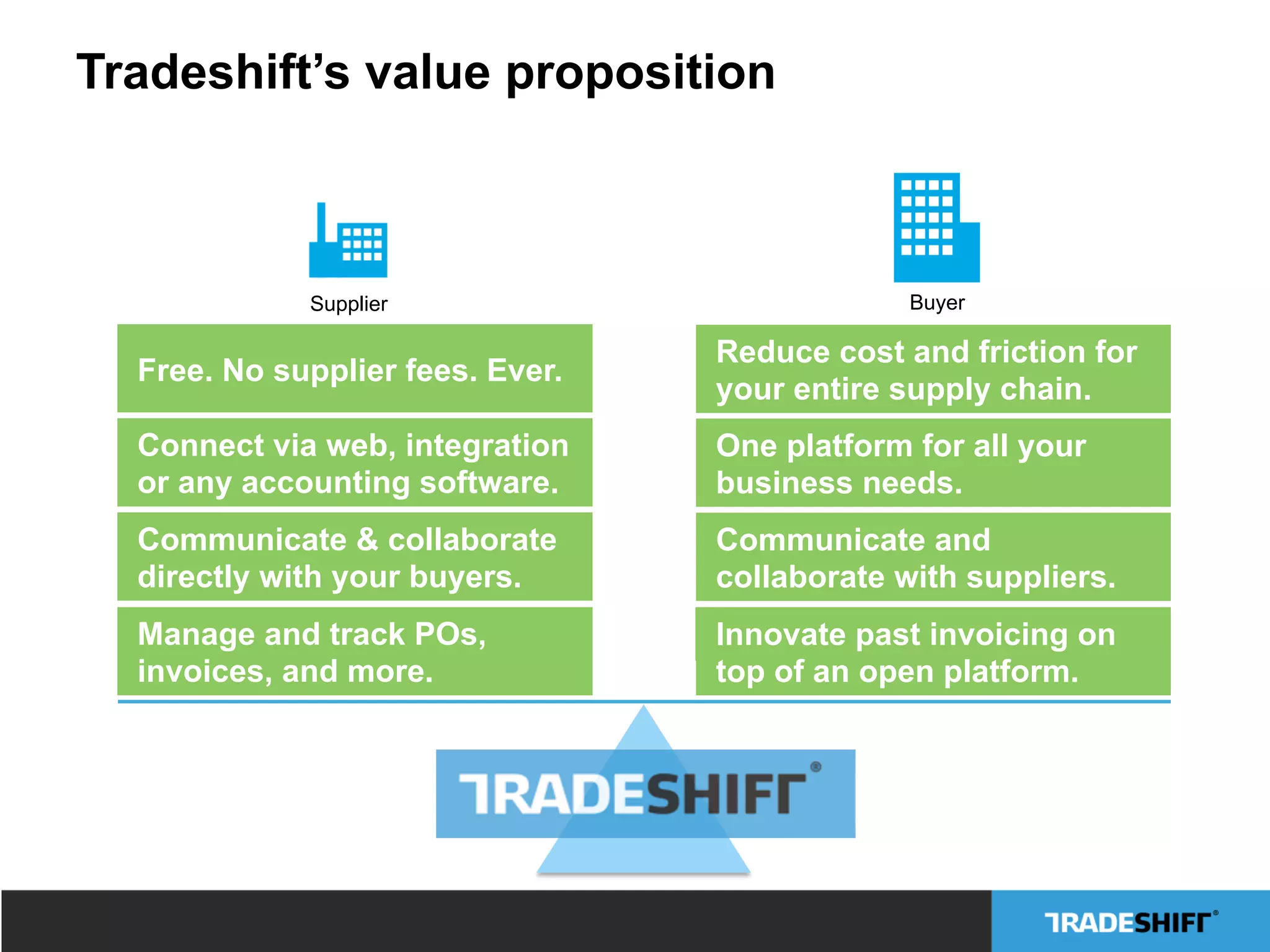
Tradeshift’s value proposition
Supplier Buyer
Communicate & collaborate
directly with your buyers.
Lower costs for your entire supply chain.Manage and track POs,
invoices, and more.
Connect via web, integration
or any accounting software.
Free. No supplier fees. Ever.
Communicate and
collaborate with suppliers.
Innovate past invoicing on
top of an open platform.
One platform for all your
business needs.
Reduce cost and friction for
your entire supply chain.
Live Demo
Questions
Speaker Contact Information
Chris Doxey, CAPP, CCSA, CICA, CPC
Subject Matter Expert and Management Consultant
chris@chrisdoxey.com
571-267-9107
Ten Tips to Ensure that Your
Suppliers are Real
Thanks for joining us!
•  Register for our next webinar on Supplier Responsibility
August 20, 2014.
•  Stay relevant, visit blog.tradeshift.com
•  Presentation and recording will be sent afterwards

Ten Tips to Ensue that Your Suppliers are Real

  • 1.
    Ten Tips toEnsure that Your Suppliers are Real Hi, thanks for joining us! We will begin the webcast shortly but in the meantime, please keep in mind: •  Enter your questions and comments in the chat box, there will be time at the end of the webinar for Q&A •  Presentation and recording will be sent afterwards
  • 2.
    Chris Doxy Senior financeand controller positions at Digital Equipment Corporation, Compaq Computer Corporation, Hewlett Packard, MCI, APEX Analytix, and BSI Healthcare. Expertise in compliance, auditing, internal controls, and fraud prevention. Chris also serves as the Executive Director of the Controller Certification Program for the IOFM. Authored - The Controller’s Best Practices Guide, The Controller’s Best Practices Guide to the Financial Close, AP Leadership Skills and Implementing a Controls Self Assessment Program for Accounts Payable Vishal Patel Sr. Marketing Manager at Tradeshift. Former  industry  analyst  (Ardent  Partners,  Aberdeen  Group),  with  many  years  of   experience  researching,  benchmarking  and  advising  enterprises  on  their  AP  and  P2P   strategies.  Deep  understanding  of  the  technology  soluCons  in  this  space  and  how   they  can  help  to  improve  performance. @VishalP_  
  • 3.
    Agenda §  Why Protectingyour Supplier Master File is Critical §  An Overview of the Supplier Validation Process §  Implementing your Supplier Validation Process –  For New Suppliers –  For Current Suppliers §  Ten Tips to Ensure that Your Suppliers are Real §  Tradeshift Overview §  Q&A
  • 4.
    Learning Objectives §  Learnabout the 10 Tips to Ensure your Suppliers Are Real. §  Learn about the Fraud Risk Analysis (FRA) process for your supplier master. §  Review the Red Flags for Purchase to Pay Fraud. §  Understand how technology solutions can help manage your supplier master.
  • 5.
  • 6.
    Why Protecting yourSupplier Master File is Critical The Procure to Pay (P2P) cycle is fundamental to the profitability of an organization, especially in economically challenging times. Source: KPMG
  • 7.
    Why Protecting yourSupplier Master File is Critical According to the ACFE "2014 Report to the Nations on Occupational Fraud": §  Fraud is ubiquitous; it does not discriminate in its occurrence. And while anti-fraud controls can effectively reduce the likelihood and potential impact of fraud, the truth is that no entity is immune to this threat. §  Of these, asset misappropriations are the most common, occurring in 85% of the cases in our study, as well as the least costly, causing a median loss of $130,000. §  Corruption schemes fell in the middle in terms of both frequency (37% of cases) and median loss ($200,000). Source: 2014 ACFE Report to the Nations
  • 8.
    Frequency of FraudCases: Purchasing and Finance Source: 2014 ACFE Report to the Nations
  • 9.
  • 10.
    Percentage of Emphasison Supplier Validation in the Supplier Management Lifecycle 0% 5% 10% 15% 20% 25% 30% 35% 1.   Qualification 2.  Sourcing 3.   Onboarding 4.  Doing   Business   5.  Managing   Performance 6.  Probation   or  Exit 10
  • 11.
    Ten Tips toEnsure that Your Suppliers are Real
  • 12.
    Best Practices forSupplier Management Compliance Qualification •  Establish a Supplier Qualification Process Sourcing •  Request for Proposal (RFP) and Request for Information (RFI) •  Utilize an Objective Supplier Evaluation and Selection Process Onboarding – Is the Supplier Real? •  Obtain a W-9 form for domestic suppliers and a form W-8 for foreign suppliers •  Perform Initial TIN Matching and Take Action for Incorrect TINs •  Review the Supplier Profile and Contact Information •  Initial Validation of the Supplier – What to look for •  Perform Initial Compliance Screening
  • 13.
    Best Practices forSupplier Management Compliance Doing Business – Is the Supplier Still Real? •  Perform Ongoing Compliance Screening •  Complete a Comparison of Your Employee and Supplier Master •  Complete TIN Matching for your Supplier Master at Least Annually •  Complete a Supplier Fraud Risk Analysis (FRA) •  Fine Tune Your Supplier Master Annually Managing Performance •  Establish Supplier Service Level Agreement Reviews Probation or Exit •  Supplier Performance Continuous Monitoring •  Watch for Compliance Issues
  • 14.
    1.  Obtain  a  W-­‐9  form  for  domesCc  suppliers  and  a  form  W-­‐8  for  foreign  suppliers   2.  Perform  IniCal  TIN  Matching  and  Take  AcCon  for  Incorrect  TINs   3.  Review  the  Supplier  Profile  and  Contact  InformaCon   4.  IniCal  ValidaCon  of  the  Supplier   5.  Perform  IniCal  Compliance  Screening   10 Tips to Ensure that Your Suppliers Are Real Initial Supplier Validation
  • 15.
    10 Tips toEnsure that Your Suppliers Are Real Doing Business 6.  Perform  Ongoing  Compliance  Screening   7.  Complete  a  Comparison  of  Your  Employee  and  Supplier  Master   8.  Complete  TIN  Matching  for  your  Supplier  Master   9.  Complete  a  Supplier  Fraud  Risk  Analysis  (FRA)   10.  Fine  Tune  Your  Supplier  Master  Annually   15  
  • 16.
    1.  Obtain  a  W-­‐9  and  W-­‐8  Forms  For  All  New  Suppliers   Use Form W-9 only for U.S. Suppliers (including a resident alien), to provide correct TIN to the person requesting it (the requester) and, when applicable, to: 1.  Certify that the TIN provided is correct (or the supplier is waiting for a number to be issued) 2.  Certify that the supplier is not subject to backup withholding www.irs.gov/pub/irs-pdf/fw9.pdf
  • 17.
    2.  Perform  Ini@al  TIN  Matching  and  Take  Ac@on  for  Missing  or   Invalid  TINs   §  The National Taxpayer Advocate has also recommended that all payees be required to certify their TINs (i.e., through use of Forms W-9 signed under penalty of perjury). §  The TIN Matching service is available at no cost §  TINs can be validated either in an interactive session or by the bulk uploading process. http://www.irs.gov/Tax-Professionals/e-services---Online- Tools-for-Tax-Professionals www.irs.gov/pub/irs-pdf/p2108a.pdf
  • 18.
    3.  Review  the  Supplier  Profile  and  Contact  Informa@on   §  Ensure all supplier information is complete and reasonable §  The Supplier Profile Form can be a component of the qualification process and can be used with major suppliers as part of the supplier clean up process Supplier Profile Form Business Name/Taxpayer Name (Exact Legal Name): Federal ID Number/Social Security Number: Parent Company (if applicable): □ Domestic □ Foreign Business Type: Officers: q Corporation Principal/Owner: q Partnership Chief Executive/President: q Sole Proprietorship CFO/Controller: q Individual Contact Name for Negotiations: Telephone: E-mail: Contact Name for Billing Inquiries: Telephone: E-mail: Primary Remittance Address: Physical Business Address: Address 1: Address 1: Address 2: Address 2: City: State: Zip: City: State: Zip: Telephone Number: Fax Number: Company Website (if applicable): Please attach at least three of the following: Proof of Existence: ο - Corporate Charter ο - Federal Tax Return ο - Recent Audited Annual Report ο - Vendor Contract/Agreement ο - City/County Business License ο - Product Catalog ο - Sales Tax Certificate ο - 1099 ο - IRS Document/Notice ο - W-9 Description of Business (or commodity code, i.e. SIC, NAICS, etc.): Please check techniques you are currently using with your customers: q Evaluated Receipts Settlement (ERS) q Electronic Data Interchange (EDI) q Electronic Funds Transfer (EFT) q On-line Pricing Catalog How would you like to receive payments? □ ACH □ Wire □ Check □ Other ____________________ I hereby certify, under the penalty of perjury, that to the best of my knowledge, the information presented here is true and correct. Respondent’s Name: Respondent’s Signature:
  • 19.
    4.  Perform  the  Ini@al  Screening  –  What  to  Look  For   §  Valid and complete supplier website §  Address provided is reasonable §  Review suppliers operating out of the same address §  Determine if another supplier has the same TIN number §  Determine if your company has any past or present legal actions with the supplier §  Determine the validity of the corporation by reviewing state of incorporation data §  Review Better Business Bureau data
  • 20.
    5.  Perform  Ini@al  Compliance  Screening   Periodically screen your supplier master file against the compliance requirements applicable to your industry. §  OFAC – Office of Foreign Asset Control §  BIS - Bureau of Industry and Security §  SAM/EPLS – System of Award Management (SAM) which includes the Excluded Parties List System (EPLS) §  SDNs - Specially Designated Nationals are considered enemies of the United States. OIG – Office of Inspector General (Healthcare) §  FCPA – Check Politically Exposed Persons (PEP) Listings http://www.treasury.gov/about/organizational-structure/offices/Pages/Office-of-Foreign-Assets- Control.aspx http://www.bis.doc.gov/ https://oig.hhs.gov/ https://www.sam.gov/portal/SAM/#1 http://www.accuity.com/compliance/pep-due-diligence-database/?cmpid=PSC| BAML|BAML-2014-GLOB-adwd- pep&sfid=701D0000000KzwY&gclid=CNOu_bf9xb8CFUIQ7Aod3lAAYw
  • 21.
    6.  Perform  Ongoing  Compliance  Screening   §  Basic screening should include comparing supplier master records the compliance requirements applicable to your industry. §  Quarterly screening using a compliance solution is a recommended best practice. §  Supplier master screening should be included in your P2P internal controls program with defined roles and responsibilities for procedures for due diligence. http://www.treasury.gov/about/organizational-structure/offices/Pages/Office-of-Foreign-Assets- Control.aspx http://www.bis.doc.gov/ https://oig.hhs.gov/ https://www.sam.gov/portal/SAM/#1 http://www.accuity.com/compliance/pep-due-diligence-database/?cmpid=PSC| BAML|BAML-2014-GLOB-adwd- pep&sfid=701D0000000KzwY&gclid=CNOu_bf9xb8CFUIQ7Aod3lAAYw
  • 22.
    7.  Complete  a  Comparison  of  Your  Employee  Master  Against   Your  Supplier  Master   §  Complete the comparison at least annually §  Compare the following: –  Name •  Exact Match •  Last Name –  Address –  TIN, EIN, and SSN –  Bank Account
  • 23.
    8.  Complete  TIN  Matching  for  your  Supplier  Master  at  Least   Annually   §  Use the Bulk Upload capability to complete TIN Matching for your supplier master file. §  Your supplier master file must be submitted in the IRS format using your e-services account. §  Results are provided in a secure mailbox within 1-2 business days. §  This process will help to alleviate B-Notices resulting from incorrect TINs provided on 1099s issued.
  • 24.
    9.  Complete  a  Supplier  Fraud  Risk  Analysis  (FRA)     What is an FRA? §  An FRA considers vulnerability to management overrides and potential schemes to circumvent existing control activities such as segregation of duties and delegation of automation §  A review of supplier data and payment history highlights anomalies, duplicate payments, pricing discrepancies, and payment issues. Objectives of an FRA are to: 1.  Identify the vulnerabilities for fraud, and 2.  Implement proactive measures such as specific internal controls to prevent the fraud from occurring.
  • 25.
    The three phasesof an FRA include: 1)  Access - The current internal controls structure and identifies specific weaknesses where potential fraud schemes could occur. 2)  Respond - Fraud risks are linked to controls to determine: risk tolerance, cost benefit analysis, stakeholder expectations, and remediation monitoring. 3)  Sustain - A report is developed to communicate the results of the FRA process, the fraud audit plan is developed and executed, and a continuous monitoring process in implemented. 9.  Complete  a  Supplier  Fraud  Risk  Analysis  (FRA)    -­‐  Cont  
  • 26.
    Purchase to Pay(P2P) Fraud Flags §  Poor segregation of duties throughout the P2P process §  Round dollar value invoices §  First invoice is for a low dollar amount followed by larger dollar invoices §  Lack of control around the bidding process including poor documentation, absence of appropriate competition §  Poor documentation of expenditures or failure to complete a match of invoices to receiving and order documentation §  Consistent use of a supplier who is delivering poor quality goods, particularly where this issue is concentrated with one buyer §  Duplicate invoice payments Source: Best Practices and KPMG
  • 27.
    Purchase to Pay(P2P) Fraud Flags (Continued) §  Excessive entertaining of procurement staff by suppliers §  Suppliers with a post office box as the sole address §  Absence of a legitimate TIN Number §  Off-hour transactions §  Out-of-sequence invoice numbers for a particular supplier §  Payments to inactive suppliers §  Low initial bids followed by excessive change orders §  Poor cash management practices (i.e., paying invoices right away despite the accepted practice of 30 to 60 day payment terms in a particular industry) §  Checks set aside for special handling Source: Best Practices and KPMG
  • 28.
    10.  Fine  Tune  Your  Supplier  Master  on  an  Annual  Basis   §  Use Supplier Coding Standards to ensure data consistency within your Supplier Master that include business rules for: –  Supplier Name, Address, Phone Number, and Contact Information. §  Identify possible duplicate suppliers. §  Identify suppliers with multiple addresses and consolidate when possible. §  Block or purge suppliers with no activity within 18 months.
  • 29.
    Recap - LearningObjectives §  Learn about the Ten Tips to Ensure your Suppliers Are Real. §  Discuss how non-compliance can put your company at significant risk if your suppliers are not initially validated and reviewed on an ongoing basis. §  Learn about the Fraud Risk Analysis (FRA) process for your supplier master. §  Review the Red Flags for Purchase to Pay Fraud. §  Understand how technology solutions can help manage your supplier master.
  • 30.
  • 31.
    ▪  Flexible cloudplatform enabling businesses to connect, collaborate and transact with their supply chain ▪  State-of-the art automation, data intelligence and collaboration technology that is cloud based, mobile ready, and simple to use ▪  Our mission is to help businesses and their employees connect to and create value for their entire supply chain •  Over  500,000  suppliers  in  over  100  countries   •  5  million  suppliers  connected  through  pla]orm  partners  such  as   Intuit   •  Fastest  growing  B2B  pla]orm  in  the  world  today  with  more  than   2000  suppliers  joining  every  week   About Tradeshift
  • 33.
    Tradeshift’s Open PlatformApproach   TRADESHIFT    PLATFORM   Document Transmission, Statuses, Messages, Integration, Security, API   Supplier Buyer Order Management Electronic Invoicing Business Firewall CloudScan® (Paper/PDF) Collaborative Workflow Financial Solutions Build Your Own App Supplier Management Ability to expand functionality as needed
  • 34.
  • 35.
    Tradeshift’s value proposition SupplierBuyer Communicate & collaborate directly with your buyers. Lower costs for your entire supply chain.Manage and track POs, invoices, and more. Connect via web, integration or any accounting software. Free. No supplier fees. Ever. Communicate and collaborate with suppliers. Innovate past invoicing on top of an open platform. One platform for all your business needs. Reduce cost and friction for your entire supply chain.
  • 36.
  • 37.
  • 38.
    Speaker Contact Information ChrisDoxey, CAPP, CCSA, CICA, CPC Subject Matter Expert and Management Consultant chris@chrisdoxey.com 571-267-9107
  • 39.
    Ten Tips toEnsure that Your Suppliers are Real Thanks for joining us! •  Register for our next webinar on Supplier Responsibility August 20, 2014. •  Stay relevant, visit blog.tradeshift.com •  Presentation and recording will be sent afterwards