Accounts Payable Transformation
          Better, Faster, Cheaper


             December 2007
Accounts Payable Transformation: Better, Faster, Cheaper
Page 2


                      Executive Summary
Enterprises constantly seek ways to drive savings to their bottom line and      Research Benchmark
establish process efficiencies across the organization. As a critical multi-    Aberdeen’s Research
faceted cog in the cash management machine, the A/P function is ripe with       Benchmarks provide an in-
opportunity for a makeover that will deliver value to the organization. Often   depth and comprehensive look
considered more of a tactical organizational activity, accounts payable is      into process, procedure,
now being viewed as a rising opportunity for outsourcing. However,              methodologies, and
automation is also a critical driver for the transformation, which will         technologies with best practice
generate operational efficiencies and optimize the financial value of A/P to    identification and actionable
the enterprise.                                                                 recommendations


Best-in-Class Performance
Aberdeen evaluated over 150 enterprises in November and December of
2007 and distinguished Best-in-Class enterprises by the cost and cycle time
required to process a single invoice. Best-in-Class enterprises in this study
are notable for their superior performance. They credit outsourcing and
automation of accounts payable functions to the following benefits:
    •   Invoice processing costs 88% lower than all others
    •   Invoice processing cycle times 52% faster than their peers
    •   66% higher rates of on-time payments

Competitive Maturity Assessment
Best-in-Class performers shared many common characteristics with respect
to accounts payable. Best-in-Class companies:
    •   Are 68% more likely to standardize A/P operations
    •   Utilize a shared services center model 69% more frequently than
        other enterprises
    •   Are nearly twice as likely to benchmark A/P processes and
        technology capabilities against peers

Required Actions
    •   Evaluate accounts payable competencies to establish a baseline and
        identify outsourcing and automation needs
    •   Establish executive support for A/P transformation efforts –
        outsourcing and technology investment
    •   Implement a shared services center model for A/P operations


© 2007 Aberdeen Group.                                                                     Telephone: 617 723 7890
www.aberdeen.com                                                                                 Fax: 617 723 7897
Accounts Payable Transformation: Better, Faster, Cheaper
Page 3


Table of Contents
Executive Summary....................................................................................................... 2
  Best-in-Class Performance..................................................................................... 2
  Competitive Maturity Assessment....................................................................... 2
  Required Actions...................................................................................................... 2
Chapter One: Benchmarking the Best-in-Class ..................................................... 4
  Business Context ..................................................................................................... 4
     The Maturity Class Framework ....................................................................... 7
     The Best-in-Class PACE Model ....................................................................... 8
Chapter Two: Benchmarking Requirements for Success ..................................10
  Competitive Assessment......................................................................................12
  Capabilities and Enablers......................................................................................13
Chapter Three: Required Actions .........................................................................15
  All Enterprises Steps to Success.........................................................................15
  Laggard Steps to Success......................................................................................15
  Industry Average Steps to Success ....................................................................15
  Best-in-Class Steps to Success ............................................................................16
Appendix A: Research Methodology.....................................................................18
Appendix B: Related Aberdeen Research............................................................20
Figures
Figure 1: Top Pressures Driving a Focus on A/P Transformation..................... 4
Figure 2: A/P Outsourcing Activity ........................................................................... 5
Figure 3: A/P Processes Currently Outsourced .................................................... 6
Figure 4: A/P Processes Planned for Outsourcing ................................................ 6
Figure 5: Visibility into A/P Operations ................................................................... 8
Figure 6: A/P Outsourcing Structure......................................................................10
Figure 7: Automation of A/P Processes.................................................................11
Figure 8: Additional A/P Processes Automated...................................................14
Figure 9: Top Challenges to Effective A/P Outsourcing ....................................17
Tables
Table 1: Average Invoice Processing Costs – Electronic vs. Manual ................ 5
Table 2: A/P Benchmark Performance ..................................................................... 7
Table 3: Best-in-Class A/P Performance.................................................................. 8
Table 4: The Best-in-Class PACE Framework ....................................................... 9
Table 5: The Competitive Framework...................................................................12
Table 6: The PACE Framework Key ......................................................................19
Table 7: The Competitive Framework Key ..........................................................19
Table 8: The Relationship Between PACE and the Competitive Framework
.........................................................................................................................................19


© 2007 Aberdeen Group.                                                                                                                        Telephone: 617 723 7890
www.aberdeen.com                                                                                                                                    Fax: 617 723 7897
Accounts Payable Transformation: Better, Faster, Cheaper
Page 4


                   Chapter One:
            Benchmarking the Best-in-Class
Business Context
                                                                                  Fast Facts
In the world of sports, the head coach is looked at as the face of the team
and the person tasked with developing and implementing the key strategies         √   Electronic invoice
that drive success. However once a game begins, the assistant coaches and             processing costs are 33%
                                                                                      to 41% lower than manual
others that work behind the scenes are the individuals who provide tactical
                                                                                      processing costs
support to ensure a winning strategy. This scenario is also applicable to the
world of corporate finance, where the CFO must drive strategic decisions          √   Best-in-Class enterprises
that ensure the financial welfare of the organization. Yet enterprise leaders         enjoy 76% to 94% lower
also rely on behind-the-scenes leaders of critical processes that have long           invoice processing rates
been regarded as back-office functions (such as accounts payable) to serve            than their peers
as their “assistant coaches.” Often considered more of a tactical                 √   Best-in-Class enterprises
organizational activity, accounts payable is now being viewed as a rising             process invoices 51% to
opportunity for outsourcing, which opens the door to increased automation             59% faster than other
to further generate operational efficiencies and optimize the financial value         enterprises
of A/P to the enterprise.
                                                                                  √   Lower transaction costs
                                                                                      drives enterprises to
Driving Action: Costs and Beyond                                                      pursue outsourcing as a
Enterprises constantly seek ways to drive savings to their bottom line and            strategy for A/P
establish process efficiencies across the organization. As a critical multi-
faceted cog in the cash management machine, the A/P function is ripe with
opportunity for transformations that will deliver value to the organization
and outsourcing is proving to be a beneficial solution.
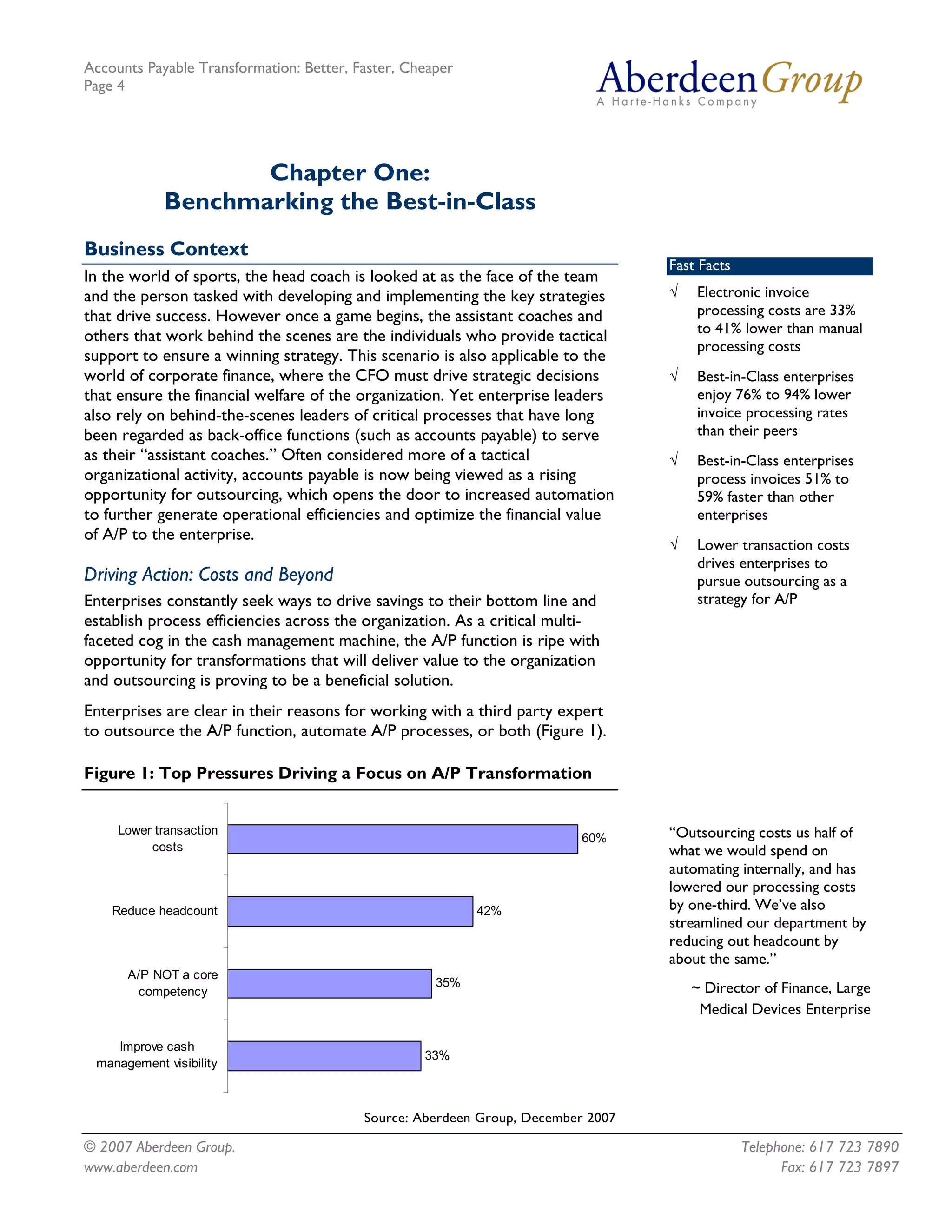
Enterprises are clear in their reasons for working with a third party expert
to outsource the A/P function, automate A/P processes, or both (Figure 1).

Figure 1: Top Pressures Driving a Focus on A/P Transformation


     Lower transaction
                                                                          60%     “Outsourcing costs us half of
          costs                                                                   what we would spend on
                                                                                  automating internally, and has
                                                                                  lowered our processing costs
    Reduce headcount                                       42%                    by one-third. We’ve also
                                                                                  streamlined our department by
                                                                                  reducing out headcount by
                                                                                  about the same.”
      A/P NOT a core
                                                     35%                              ~ Director of Finance, Large
       competency
                                                                                       Medical Devices Enterprise

    Improve cash
                                                   33%
 management visibility


                                          Source: Aberdeen Group, December 2007

© 2007 Aberdeen Group.                                                                         Telephone: 617 723 7890
www.aberdeen.com                                                                                     Fax: 617 723 7897
Accounts Payable Transformation: Better, Faster, Cheaper
Page 5


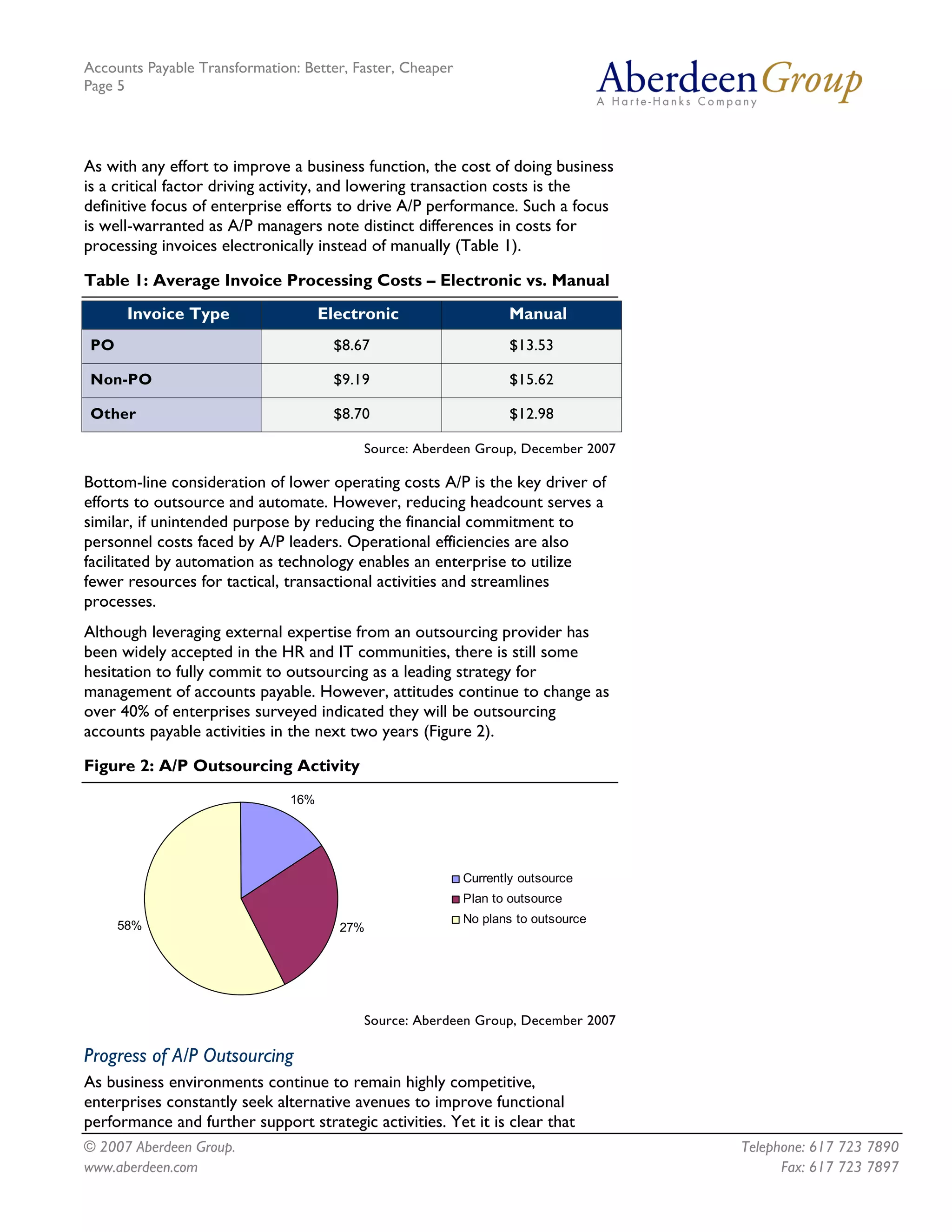
As with any effort to improve a business function, the cost of doing business
is a critical factor driving activity, and lowering transaction costs is the
definitive focus of enterprise efforts to drive A/P performance. Such a focus
is well-warranted as A/P managers note distinct differences in costs for
processing invoices electronically instead of manually (Table 1).

Table 1: Average Invoice Processing Costs – Electronic vs. Manual
      Invoice Type                   Electronic                   Manual
PO                                    $8.67                        $13.53

Non-PO                                $9.19                        $15.62

Other                                 $8.70                        $12.98

                                          Source: Aberdeen Group, December 2007

Bottom-line consideration of lower operating costs A/P is the key driver of
efforts to outsource and automate. However, reducing headcount serves a
similar, if unintended purpose by reducing the financial commitment to
personnel costs faced by A/P leaders. Operational efficiencies are also
facilitated by automation as technology enables an enterprise to utilize
fewer resources for tactical, transactional activities and streamlines
processes.
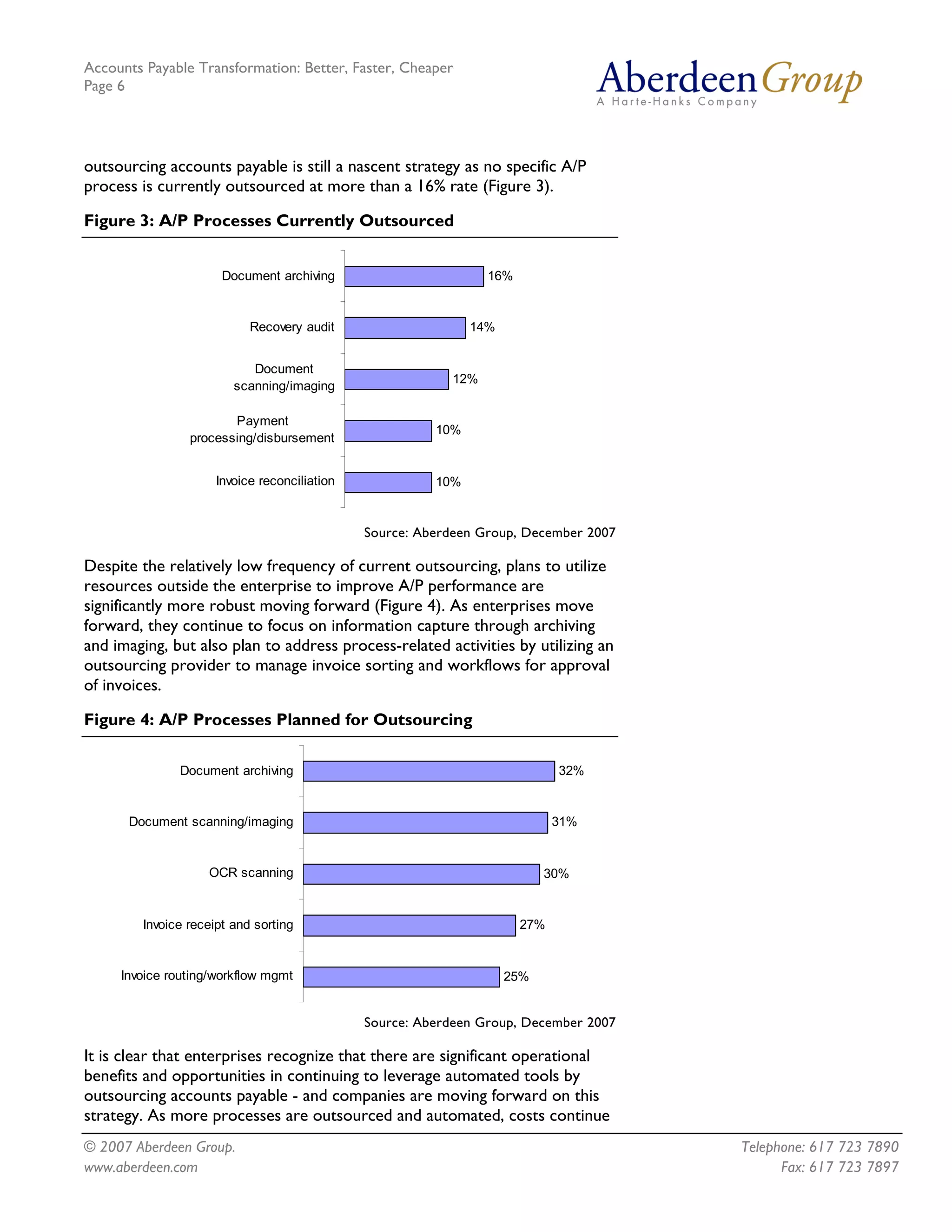
Although leveraging external expertise from an outsourcing provider has
been widely accepted in the HR and IT communities, there is still some
hesitation to fully commit to outsourcing as a leading strategy for
management of accounts payable. However, attitudes continue to change as
over 40% of enterprises surveyed indicated they will be outsourcing
accounts payable activities in the next two years (Figure 2).

Figure 2: A/P Outsourcing Activity
                               16%


                                                           Currently outsource
                                                           Plan to outsource
                                                           No plans to outsource
     58%                               27%


                                          Source: Aberdeen Group, December 2007

Progress of A/P Outsourcing
As business environments continue to remain highly competitive,
enterprises constantly seek alternative avenues to improve functional
performance and further support strategic activities. Yet it is clear that
© 2007 Aberdeen Group.                                                             Telephone: 617 723 7890
www.aberdeen.com                                                                         Fax: 617 723 7897
Accounts Payable Transformation: Better, Faster, Cheaper
Page 6


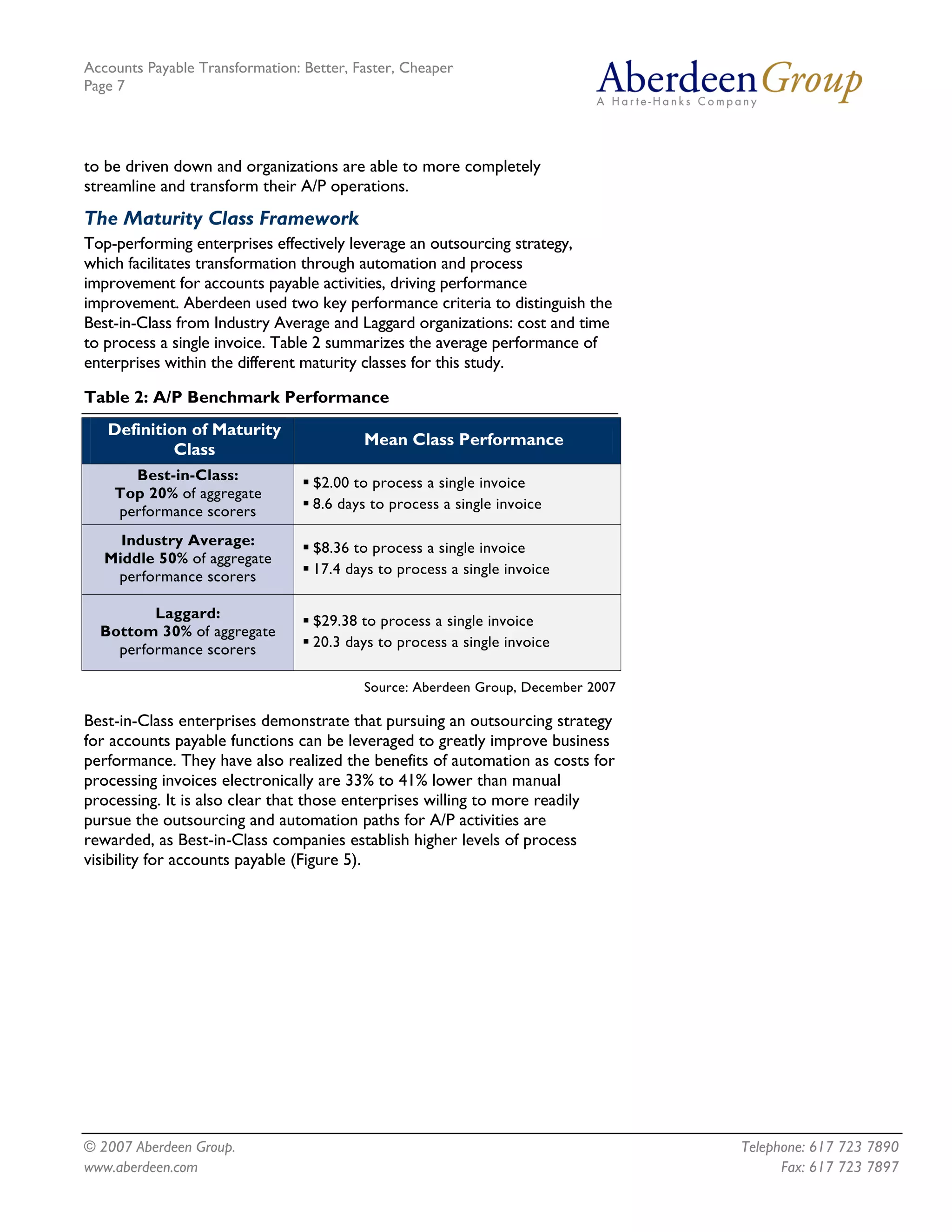
outsourcing accounts payable is still a nascent strategy as no specific A/P
process is currently outsourced at more than a 16% rate (Figure 3).

Figure 3: A/P Processes Currently Outsourced


                      Document archiving                         16%


                           Recovery audit                     14%


                           Document
                                                           12%
                        scanning/imaging

                       Payment
                                                        10%
                processing/disbursement


                     Invoice reconciliation             10%


                                              Source: Aberdeen Group, December 2007

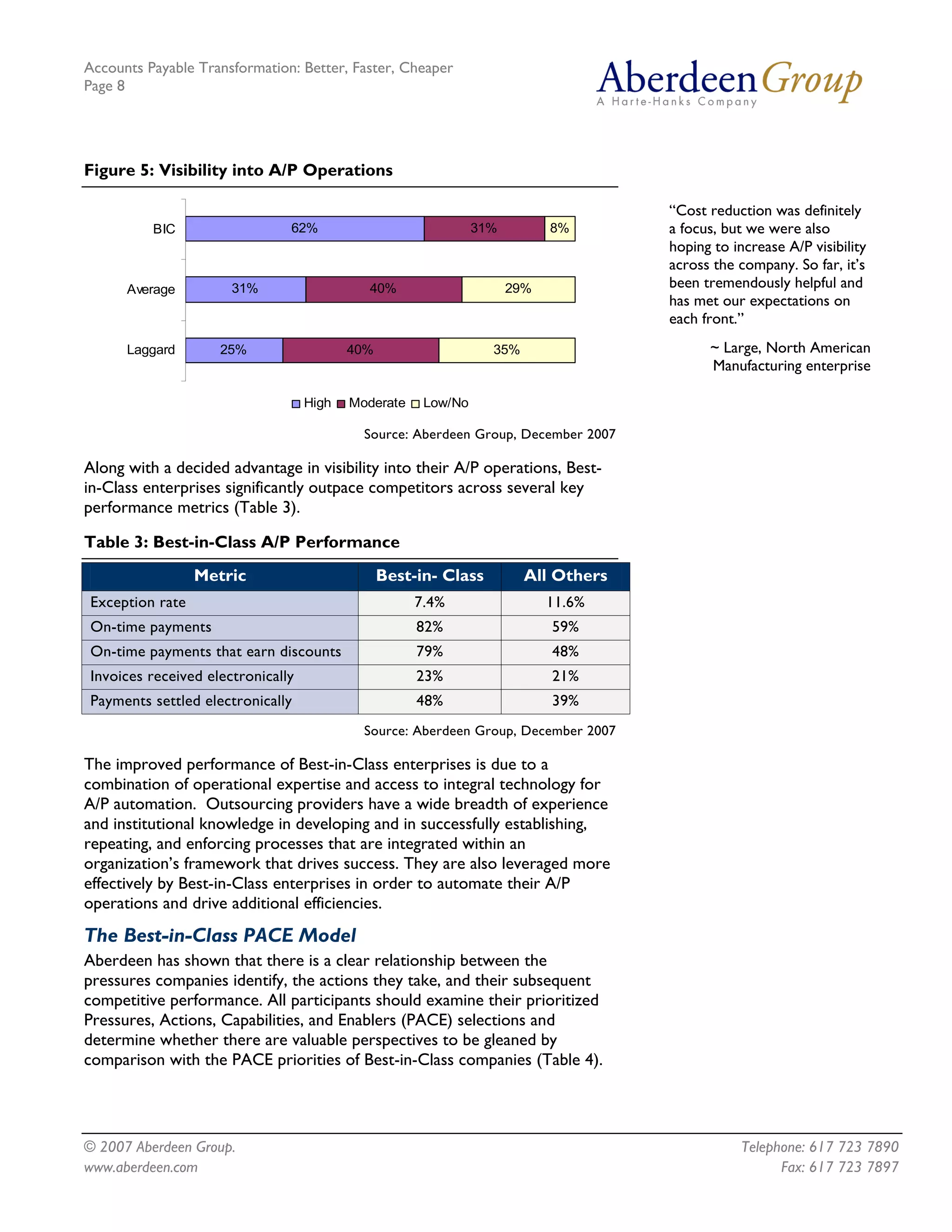
Despite the relatively low frequency of current outsourcing, plans to utilize
resources outside the enterprise to improve A/P performance are
significantly more robust moving forward (Figure 4). As enterprises move
forward, they continue to focus on information capture through archiving
and imaging, but also plan to address process-related activities by utilizing an
outsourcing provider to manage invoice sorting and workflows for approval
of invoices.

Figure 4: A/P Processes Planned for Outsourcing

              Document archiving                                             32%


      Document scanning/imaging                                              31%


                   OCR scanning                                           30%


        Invoice receipt and sorting                                    27%


     Invoice routing/workflow mgmt                                  25%


                                              Source: Aberdeen Group, December 2007

It is clear that enterprises recognize that there are significant operational
benefits and opportunities in continuing to leverage automated tools by
outsourcing accounts payable - and companies are moving forward on this
strategy. As more processes are outsourced and automated, costs continue
© 2007 Aberdeen Group.                                                                Telephone: 617 723 7890
www.aberdeen.com                                                                            Fax: 617 723 7897
Accounts Payable Transformation: Better, Faster, Cheaper
Page 7


to be driven down and organizations are able to more completely
streamline and transform their A/P operations.
The Maturity Class Framework
Top-performing enterprises effectively leverage an outsourcing strategy,
which facilitates transformation through automation and process
improvement for accounts payable activities, driving performance
improvement. Aberdeen used two key performance criteria to distinguish the
Best-in-Class from Industry Average and Laggard organizations: cost and time
to process a single invoice. Table 2 summarizes the average performance of
enterprises within the different maturity classes for this study.

Table 2: A/P Benchmark Performance
   Definition of Maturity
                                          Mean Class Performance
            Class
      Best-in-Class:              $2.00 to process a single invoice
    Top 20% of aggregate
    performance scorers           8.6 days to process a single invoice

     Industry Average:            $8.36 to process a single invoice
   Middle 50% of aggregate
    performance scorers           17.4 days to process a single invoice

         Laggard:                 $29.38 to process a single invoice
  Bottom 30% of aggregate
    performance scorers           20.3 days to process a single invoice

                                          Source: Aberdeen Group, December 2007

Best-in-Class enterprises demonstrate that pursuing an outsourcing strategy
for accounts payable functions can be leveraged to greatly improve business
performance. They have also realized the benefits of automation as costs for
processing invoices electronically are 33% to 41% lower than manual
processing. It is also clear that those enterprises willing to more readily
pursue the outsourcing and automation paths for A/P activities are
rewarded, as Best-in-Class companies establish higher levels of process
visibility for accounts payable (Figure 5).


© 2007 Aberdeen Group.                                                            Telephone: 617 723 7890
www.aberdeen.com                                                                        Fax: 617 723 7897
Accounts Payable Transformation: Better, Faster, Cheaper
Page 8


Figure 5: Visibility into A/P Operations

                                                                                    “Cost reduction was definitely
          BIC                  62%                             31%         8%       a focus, but we were also
                                                                                    hoping to increase A/P visibility
                                                                                    across the company. So far, it’s
      Average         31%                   40%                      29%            been tremendously helpful and
                                                                                    has met our expectations on
                                                                                    each front.”
      Laggard       25%                   40%                    35%                      ~ Large, North American
                                                                                          Manufacturing enterprise

                                   High   Moderate    Low/No

                                            Source: Aberdeen Group, December 2007

Along with a decided advantage in visibility into their A/P operations, Best-
in-Class enterprises significantly outpace competitors across several key
performance metrics (Table 3).

Table 3: Best-in-Class A/P Performance
                 Metric                         Best-in- Class         All Others
Exception rate                                       7.4%                  11.6%
On-time payments                                     82%                   59%
On-time payments that earn discounts                 79%                   48%
Invoices received electronically                     23%                   21%
Payments settled electronically                      48%                   39%
                                            Source: Aberdeen Group, December 2007

The improved performance of Best-in-Class enterprises is due to a
combination of operational expertise and access to integral technology for
A/P automation. Outsourcing providers have a wide breadth of experience
and institutional knowledge in developing and in successfully establishing,
repeating, and enforcing processes that are integrated within an
organization’s framework that drives success. They are also leveraged more
effectively by Best-in-Class enterprises in order to automate their A/P
operations and drive additional efficiencies.
The Best-in-Class PACE Model
Aberdeen has shown that there is a clear relationship between the
pressures companies identify, the actions they take, and their subsequent
competitive performance. All participants should examine their prioritized
Pressures, Actions, Capabilities, and Enablers (PACE) selections and
determine whether there are valuable perspectives to be gleaned by
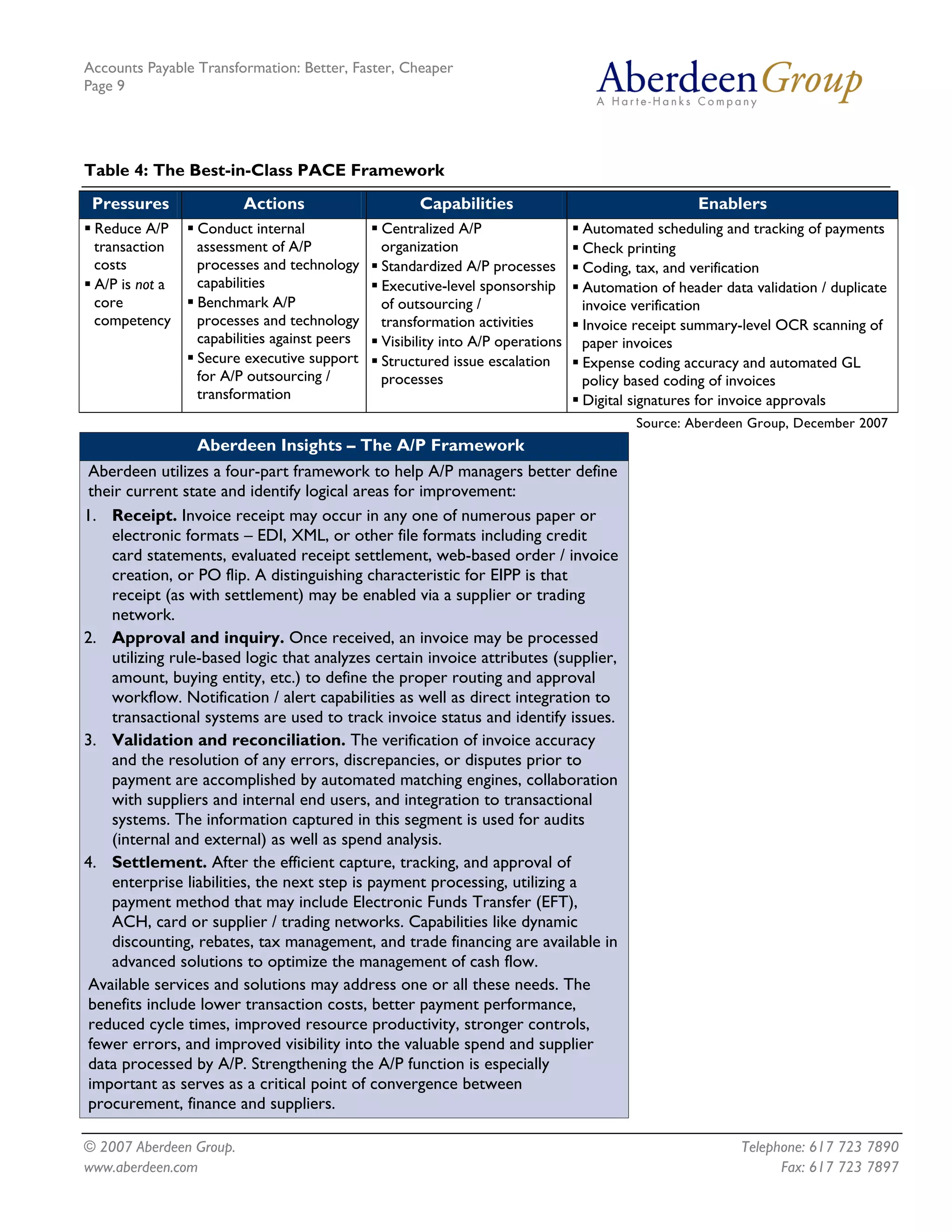
comparison with the PACE priorities of Best-in-Class companies (Table 4).


© 2007 Aberdeen Group.                                                                          Telephone: 617 723 7890
www.aberdeen.com                                                                                      Fax: 617 723 7897
Accounts Payable Transformation: Better, Faster, Cheaper
Page 9


Table 4: The Best-in-Class PACE Framework
 Pressures               Actions                    Capabilities                                 Enablers
 Reduce A/P      Conduct internal             Centralized A/P                  Automated scheduling and tracking of payments
 transaction     assessment of A/P            organization                     Check printing
 costs           processes and technology     Standardized A/P processes       Coding, tax, and verification
 A/P is not a    capabilities                 Executive-level sponsorship      Automation of header data validation / duplicate
 core            Benchmark A/P                of outsourcing /                 invoice verification
 competency      processes and technology     transformation activities        Invoice receipt summary-level OCR scanning of
                 capabilities against peers   Visibility into A/P operations   paper invoices
                 Secure executive support     Structured issue escalation      Expense coding accuracy and automated GL
                 for A/P outsourcing /        processes                        policy based coding of invoices
                 transformation                                                Digital signatures for invoice approvals
                                                                                       Source: Aberdeen Group, December 2007
                 Aberdeen Insights – The A/P Framework
Aberdeen utilizes a four-part framework to help A/P managers better define
their current state and identify logical areas for improvement:
1. Receipt. Invoice receipt may occur in any one of numerous paper or
   electronic formats – EDI, XML, or other file formats including credit
   card statements, evaluated receipt settlement, web-based order / invoice
   creation, or PO flip. A distinguishing characteristic for EIPP is that
   receipt (as with settlement) may be enabled via a supplier or trading
   network.
2. Approval and inquiry. Once received, an invoice may be processed
   utilizing rule-based logic that analyzes certain invoice attributes (supplier,
   amount, buying entity, etc.) to define the proper routing and approval
   workflow. Notification / alert capabilities as well as direct integration to
   transactional systems are used to track invoice status and identify issues.
3. Validation and reconciliation. The verification of invoice accuracy
   and the resolution of any errors, discrepancies, or disputes prior to
   payment are accomplished by automated matching engines, collaboration
   with suppliers and internal end users, and integration to transactional
   systems. The information captured in this segment is used for audits
   (internal and external) as well as spend analysis.
4. Settlement. After the efficient capture, tracking, and approval of
   enterprise liabilities, the next step is payment processing, utilizing a
   payment method that may include Electronic Funds Transfer (EFT),
   ACH, card or supplier / trading networks. Capabilities like dynamic
   discounting, rebates, tax management, and trade financing are available in
   advanced solutions to optimize the management of cash flow.
Available services and solutions may address one or all these needs. The
benefits include lower transaction costs, better payment performance,
reduced cycle times, improved resource productivity, stronger controls,
fewer errors, and improved visibility into the valuable spend and supplier
data processed by A/P. Strengthening the A/P function is especially
important as serves as a critical point of convergence between
procurement, finance and suppliers.

© 2007 Aberdeen Group.                                                                                  Telephone: 617 723 7890
www.aberdeen.com                                                                                              Fax: 617 723 7897
Accounts Payable Transformation: Better, Faster, Cheaper
Page 10


               Chapter Two:
    Benchmarking Requirements for Success
The difficulties faced by an organization’s accounts payable group in reducing          Fast Facts
the cost of transactions and concurrently delivering operational efficiencies
                                                                                        √   A majority of enterprises
are alleviated by looking to a third-party for assistance. Underlying this need
                                                                                            (64%)engage in A/P
is the fact that A/P is not considered a core competency by 35% of                          outsourcing as either a
respondents to this research effort, highlighting the need for an external                  stand-alone engagement or
expert. However, a standard, predominant structure for engaging and A/P                     as part of a larger Finance
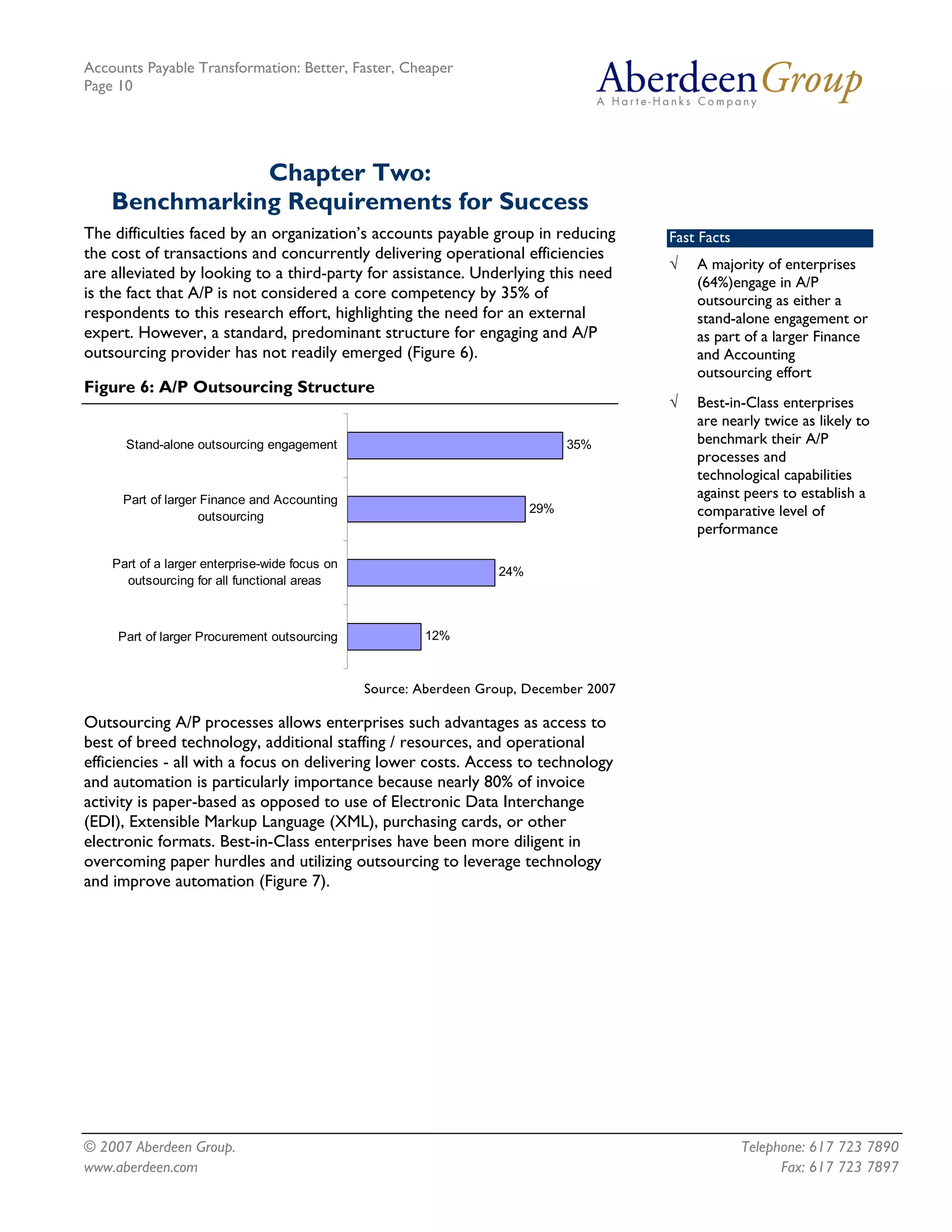
outsourcing provider has not readily emerged (Figure 6).                                    and Accounting
                                                                                            outsourcing effort
Figure 6: A/P Outsourcing Structure
                                                                                        √   Best-in-Class enterprises
                                                                                            are nearly twice as likely to
      Stand-alone outsourcing engagement                                       35%          benchmark their A/P
                                                                                            processes and
                                                                                            technological capabilities
     Part of larger Finance and Accounting                                                  against peers to establish a
                   outsourcing
                                                                         29%                comparative level of
                                                                                            performance

    Part of a larger enterprise-wide focus on
                                                                   24%
      outsourcing for all functional areas


     Part of larger Procurement outsourcing             12%


                                                Source: Aberdeen Group, December 2007

Outsourcing A/P processes allows enterprises such advantages as access to
best of breed technology, additional staffing / resources, and operational
efficiencies - all with a focus on delivering lower costs. Access to technology
and automation is particularly importance because nearly 80% of invoice
activity is paper-based as opposed to use of Electronic Data Interchange
(EDI), Extensible Markup Language (XML), purchasing cards, or other
electronic formats. Best-in-Class enterprises have been more diligent in
overcoming paper hurdles and utilizing outsourcing to leverage technology
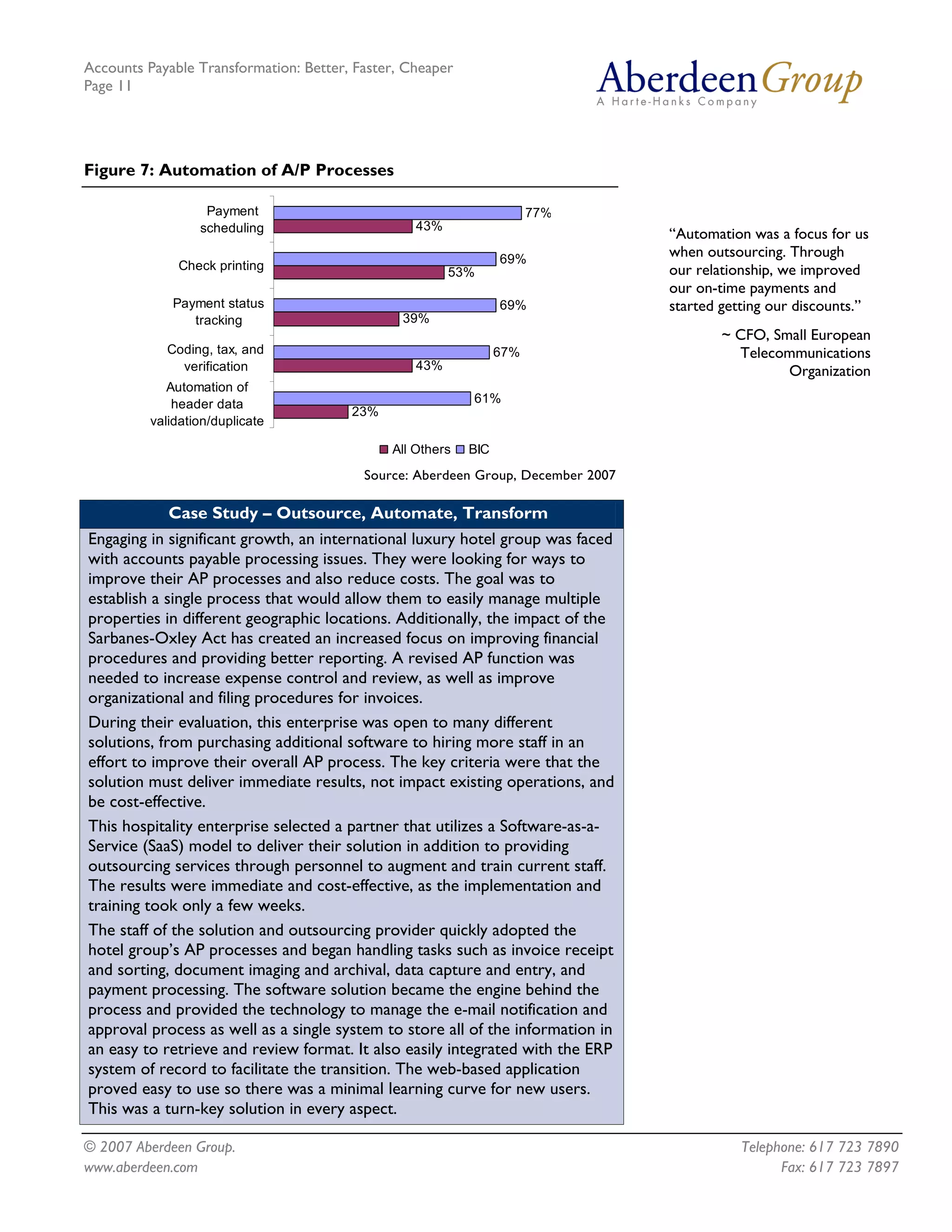
and improve automation (Figure 7).


© 2007 Aberdeen Group.                                                                               Telephone: 617 723 7890
www.aberdeen.com                                                                                           Fax: 617 723 7897
Accounts Payable Transformation: Better, Faster, Cheaper
Page 11


Figure 7: Automation of A/P Processes

                   Payment                                             77%
                  scheduling                      43%
                                                                                  “Automation was a focus for us
                                                                 69%
                                                                                  when outsourcing. Through
              Check printing                            53%                       our relationship, we improved
                                                                                  our on-time payments and
             Payment status                                      69%              started getting our discounts.”
                tracking                        39%
                                                                                          ~ CFO, Small European
            Coding, tax, and                                     67%                        Telecommunications
              verification                        43%                                              Organization
             Automation of
              header data                                  61%
                                        23%
          validation/duplicate

                                              All Others   BIC
                                          Source: Aberdeen Group, December 2007

             Case Study – Outsource, Automate, Transform
Engaging in significant growth, an international luxury hotel group was faced
with accounts payable processing issues. They were looking for ways to
improve their AP processes and also reduce costs. The goal was to
establish a single process that would allow them to easily manage multiple
properties in different geographic locations. Additionally, the impact of the
Sarbanes-Oxley Act has created an increased focus on improving financial
procedures and providing better reporting. A revised AP function was
needed to increase expense control and review, as well as improve
organizational and filing procedures for invoices.
During their evaluation, this enterprise was open to many different
solutions, from purchasing additional software to hiring more staff in an
effort to improve their overall AP process. The key criteria were that the
solution must deliver immediate results, not impact existing operations, and
be cost-effective.
This hospitality enterprise selected a partner that utilizes a Software-as-a-
Service (SaaS) model to deliver their solution in addition to providing
outsourcing services through personnel to augment and train current staff.
The results were immediate and cost-effective, as the implementation and
training took only a few weeks.
The staff of the solution and outsourcing provider quickly adopted the
hotel group’s AP processes and began handling tasks such as invoice receipt
and sorting, document imaging and archival, data capture and entry, and
payment processing. The software solution became the engine behind the
process and provided the technology to manage the e-mail notification and
approval process as well as a single system to store all of the information in
an easy to retrieve and review format. It also easily integrated with the ERP
system of record to facilitate the transition. The web-based application
proved easy to use so there was a minimal learning curve for new users.
This was a turn-key solution in every aspect.

© 2007 Aberdeen Group.                                                                       Telephone: 617 723 7890
www.aberdeen.com                                                                                   Fax: 617 723 7897
Accounts Payable Transformation: Better, Faster, Cheaper
Page 12


Competitive Assessment
Survey respondents fell into one of three categories: Best-in-Class, Industry
Average, or Laggard. Companies were characterized in five major areas: (1)
process – the level of standardization and scope the accounts payable group
has defined for their current processes; (2) organization – the structure,
skills, and capabilities of the organization as well as its general alignment
with the strategic direction of the enterprise; (3) knowledge – the
accessibility and visibility of information and data related to accounts payable
performance, and the ability to leverage it across the enterprise; (4)
outsourced processes – the level of outsourcing for specific accounts payable-
related functions to improve performance; and (5) performance – the ability
to identify, track, and then improve upon key performance indicators such
as invoice processing costs and cycle times, exception rates, electronic
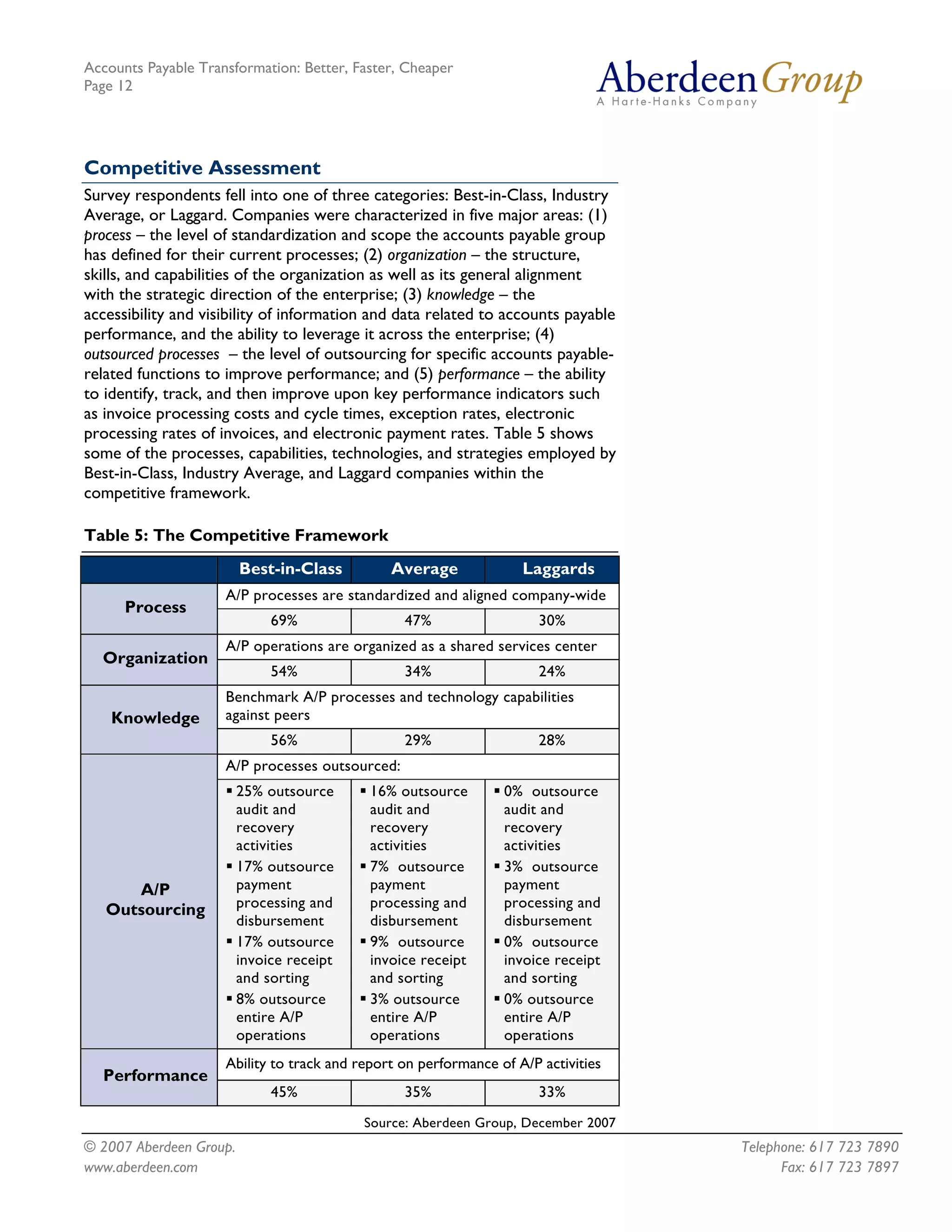
processing rates of invoices, and electronic payment rates. Table 5 shows
some of the processes, capabilities, technologies, and strategies employed by
Best-in-Class, Industry Average, and Laggard companies within the
competitive framework.

Table 5: The Competitive Framework
                         Best-in-Class         Average              Laggards
                     A/P processes are standardized and aligned company-wide
      Process
                              69%                47%                   30%
                     A/P operations are organized as a shared services center
  Organization
                              54%                34%                   24%
                     Benchmark A/P processes and technology capabilities
    Knowledge        against peers
                              56%                29%                   28%
                     A/P processes outsourced:
                         25% outsource      16% outsource        0% outsource
                         audit and          audit and            audit and
                         recovery           recovery             recovery
                         activities         activities           activities
                         17% outsource      7% outsource         3% outsource
      A/P                payment            payment              payment
   Outsourcing           processing and     processing and       processing and
                         disbursement       disbursement         disbursement
                         17% outsource      9% outsource         0% outsource
                         invoice receipt    invoice receipt      invoice receipt
                         and sorting        and sorting          and sorting
                         8% outsource       3% outsource         0% outsource
                         entire A/P         entire A/P           entire A/P
                         operations         operations           operations
                     Ability to track and report on performance of A/P activities
  Performance
                              45%                35%                   33%
                                           Source: Aberdeen Group, December 2007
© 2007 Aberdeen Group.                                                              Telephone: 617 723 7890
www.aberdeen.com                                                                          Fax: 617 723 7897
Accounts Payable Transformation: Better, Faster, Cheaper
Page 13


Capabilities and Enablers
Aberdeen’s global supply management research has shown time and again
that leveraging accounts payable services and tools allows A/P organizations
to lower transaction costs and reduce cycle times for invoice processing. In
addition to third-party expertise and resources, outsourcing also opens the
window to automation as A/P outsourcing providers provide access to best
of breed technologies. Organizations that outsource and leverage
automation for A/P transformation position themselves ahead of their peers
and enjoy distinct performance and organizational advantages.
Process
In the nascent but growing area of A/P outsourcing, Best-in-Class
enterprises are taking advantage of the opportunities presented. Facilitating
the success of outsourcing, Best-in-Class organizations are 1.7-times more
likely to standardize A/P processes company-wide. Implementing
standardized processes ensures that A/P activities can be repeated for
optimal results and performance.
Organization
Utilizing a shared services model for corporate functions enables
organizations to deliver the services required as effectively and efficiently as
possible. Best-in-Class enterprises are 69% more likely to utilize a single
shared services model for A/P operations, establishing a platform for
operational efficiencies and removing operational tasks from the corporate
headquarters to allow corporate leaders to focus on governance and the
strategic direction of the enterprise.
Knowledge Management
Best-in-Class organizations are 93% more likely than their peers to
benchmark A/P processes and technology capabilities against their peers.
Doing so allows these better performing enterprises to stay apprised of
different practices and advancements in use by other companies, helping
ensure that they remain at the leading edge of their competition. The Best-
in-Class are also able to establish a best practice approach to A/P based on
the intelligence and information collected.
A/P Processes Outsourced
There are a variety of sub-processes that comprise the accounts payable
processes. While organizations in each competitive group outsource
different A/P functions to some degree, there is a distinct difference
between the rates and specific functions outsourced by the Best-in-Class
compared to the other companies:
    •     Best-in-Class enterprises outsource audit and recovery activities
          150% more frequently than all other companies, ensuring that any
          errors resulting from A/P activities do not ultimately result in
          financial loss due to inaccurate billing or payment of invoices.


© 2007 Aberdeen Group.                                                             Telephone: 617 723 7890
www.aberdeen.com                                                                         Fax: 617 723 7897
Accounts Payable Transformation: Better, Faster, Cheaper
Page 14


    •    Best-in-Class companies are over four-times more likely than their
         competitors to outsource payment processing and disbursement.
         Utilizing an experienced and effective third-party provider for this
         A/P function effectively delivers invoice processing cycle times that
         are 2.1-times lower than all others.
    •    Best-in-Class enterprises are 104% more likely than Industry Average
         and Laggard companies to outsource invoice receipt and sorting.
         Outsourcing this function delivers both operational and cost benefits
         by centralizing and streamlining invoice processing responsibilities.
    •    Best-in-Class enterprises are four-times more likely to outsource
         their entire A/P operations.
Performance Management
Best-in-Class enterprises are 36% more likely to demonstrate the ability to
measure the performance of their accounts payable activities. This is
imperative for the A/P group as a whole, but especially as it relates to the
procurement outsourcing relationship. Without the ability to measure and
monitor performance, there is no way to identify areas for improvement,
whether improvement has occurred, or whether any other tangible benefits
of procurement outsourcing have taken place. Information and data
gathered also allow for benchmarking against competitors as well to
establish a comparative level of performance.

             Aberdeen Insights – The BIC Widen Their Scope
Accounts payable includes a variety of sub-processes that can be automated
and outsourced to drive cost reductions and operational efficiencies. Best-
in-Class organizations have also begun to engage in automation for a
significant number of these sub-processes to supplement a function that is
often not a core competency. In addition to those outlined earlier, Best-in-
Class enterprises also automate several additional A/P processes more
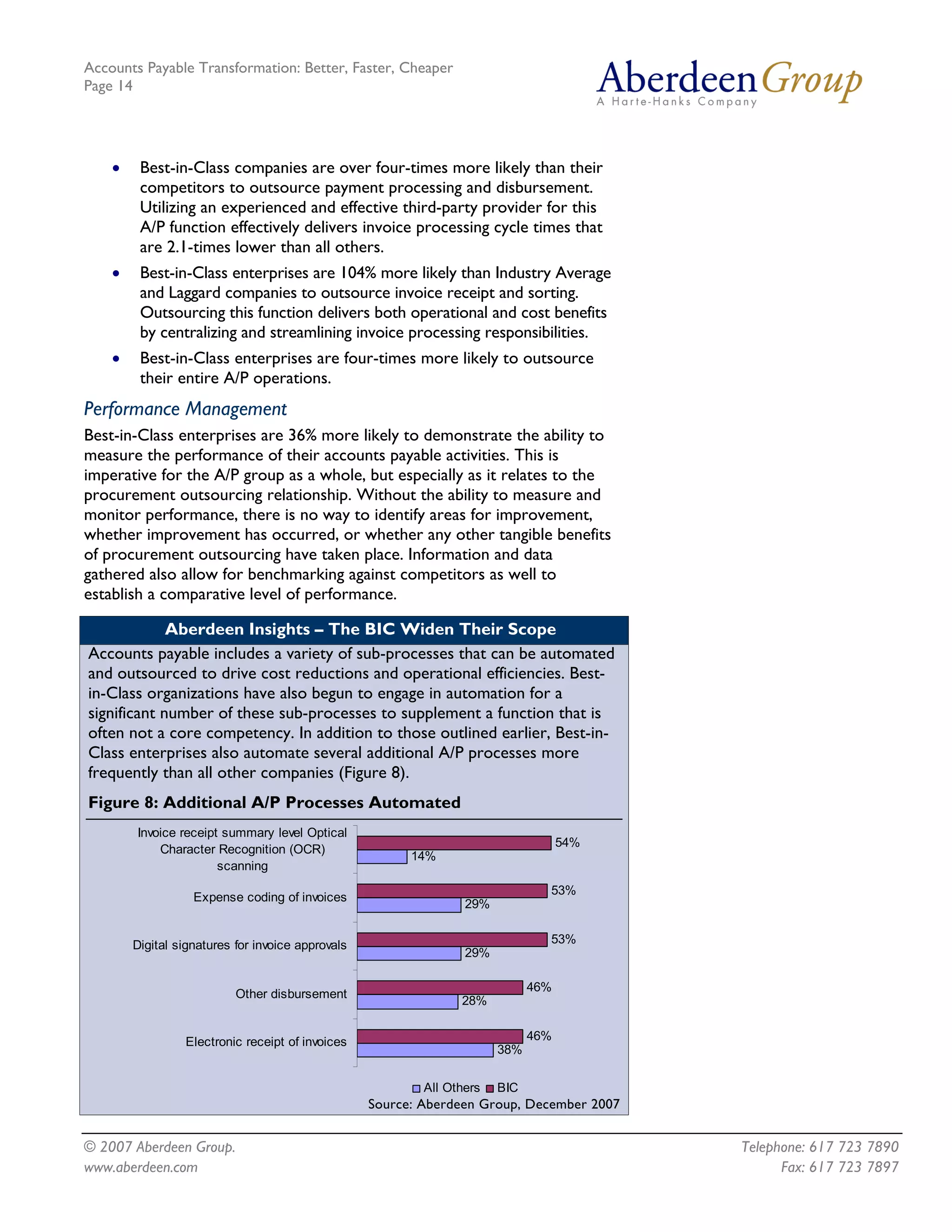
frequently than all other companies (Figure 8).
Figure 8: Additional A/P Processes Automated
        Invoice receipt summary level Optical
                                                                                    54%
            Character Recognition (OCR)
                                                         14%
                       scanning
                                                                                53%
                   Expense coding of invoices
                                                                  29%


        Digital signatures for invoice approvals                                53%
                                                                  29%

                                                                              46%
                           Other disbursement
                                                                 28%


                 Electronic receipt of invoices                               46%
                                                                        38%

                                                           All Others   BIC
                                                   Source: Aberdeen Group, December 2007


© 2007 Aberdeen Group.                                                                     Telephone: 617 723 7890
www.aberdeen.com                                                                                 Fax: 617 723 7897
Accounts Payable Transformation: Better, Faster, Cheaper
Page 15


                          Chapter Three:
                         Required Actions
Accounts payable outsourcing continues to gain traction. Finance                 Fast Facts
organizations recognize the benefits that can be realized by leveraging third-   √   All enterprises should first
party expertise and are now moving this function along the same path                 conduct an assessment of
already tread by HR and IT groups. The value that an external partner can            their accounts payable
deliver is being leveraged on a go-forward basis to drive cost savings and           processes, structures, and
operational improvements. Based on our research, Aberdeen recommends                 technologies to identify the
the following strategies for improved results from accounts payable                  scope of outsourcing and
                                                                                     automation required
outsourcing:
                                                                                 √   Standardize accounts
All Enterprises Steps to Success                                                     payable processes across
                                                                                     the organization
    •   Evaluate accounts payable competencies. Conduct an internal
        assessment of accounts payable processes, organizational structures,     √   Establish executive support
        and technology capabilities to identify the specific skills and              to facilitate acceptance of
                                                                                     outsourcing
        functions for which the group lacks capabilities and can be
        subsequently outsourced or automated to drive performance                √   Leverage outsourcing
        improvement. It is critical to have a baseline understanding of              providers for technology
        enterprise A/P capabilities before deciding on what should or should         access and not just services
        not be addressed.                                                        √   Outsource accounts
                                                                                     payable as a stand-alone
Laggard Steps to Success                                                             engagement instead of as a
                                                                                     larger finance and
    •   Establish standardized accounts payable processes and                        accounting initiative, as is
        baseline core competencies. Best-in-Class enterprises are 130%               common
        more likely than Laggards to have standardized procurement
        processes in place that are aligned across the enterprise. Process
        standardization enables knowledge, and those practices that are
        most effective, to be readily exchanged between the enterprise and
        its outsourcing partner. They also facilitate automation by
        establishing routine workflows to which technology can be applied
        to extract even greater efficiencies.
    •   Secure executive support for accounts payable outsourcing.
        Best-in-Class organizations are 13% more likely to establish
        executive-level support for A/P transformation activities such as
        outsourcing and automation than Laggards. Executive support
        facilitates organizational acceptance of these initiatives and also
        ensures that funding is available to support the investment in both
        the outsourcing relationship and enabling technologies that buoy
        performance.

Industry Average Steps to Success
    •   Leverage technology – not just services. Outsourcing provides
        organizations with unique opportunities to access best of breed
        technologies to automate the A/P lifecycle and improve

© 2007 Aberdeen Group.                                                                        Telephone: 617 723 7890
www.aberdeen.com                                                                                    Fax: 617 723 7897
Accounts Payable Transformation: Better, Faster, Cheaper
Page 16


        performance. Automation of the A/P process not only drives
        efficiencies and reduces costs, but serves the additional benefit of
        reducing and eliminating paper from the operation to make A/P
        more “green” and environmentally friendly. Best-in-Class
        organizations are 17% to 143% more likely to automate check
        printing, payment scheduling, coding and verification, and data
        validation / duplicate invoice verification than Industry Average
        organizations.
    •   Structure accounts payable as a shared services center.
        Best-in-Class enterprises are nearly 60% more likely than Industry
        Average enterprises to utilize a shared services center model for
        A/P operations. Centralizing the A/P function drives greater control
        over standardization of processes and alignment across the
        organization, which occurs in the Best-in-Class 42% more frequently
        than in Industry Average companies.

Best-in-Class Steps to Success
    •   Outsource accounts payable as its own engagement. A/P is
        outsourced under a variety of guises – as a stand-alone outsourcing
        engagement, as part of a larger finance and accounting project, as
        part of a procurement transformation effort, or as an enterprise-
        wide strategy to outsource all or most corporate functions.
        However, Best-in-Class organizations are over three-times more
        likely to outsource A/P as a distinct engagement. Such a strategy
        allows companies to focus on the relationship with the outsourcing
        provider exclusively for A/P. Focusing on A/P as a stand-alone
        engagement ensures that the outsourcing partnership is
        appropriately managed and there is a dedicated group (or leader) to
        review Service Level Agreements (SLAs) and monitor the
        performance of the A/P outsourcing provider.
    •   Emphasize process improvements equally with cost
        reductions. While cost is, and always will be, a critical pressure for
        pursuing outsourcing and automating A/P, Best-in-Class enterprises
        have shifted the focus to process and organizational competency.
        These Best-in-Class companies are nearly six-times more likely than
        others to outsource A/P to drive process standardization. While
        costs are a concern, the Best-in-Class are more acutely aware that
        their A/P operations are not a core business competency (50%
        versus 34% for all others) and therefore seek out third-party
        expertise to drive value from the function.


© 2007 Aberdeen Group.                                                           Telephone: 617 723 7890
www.aberdeen.com                                                                       Fax: 617 723 7897
Accounts Payable Transformation: Better, Faster, Cheaper
Page 17


               Aberdeen Insights – A/P Outsourcing Hurdles
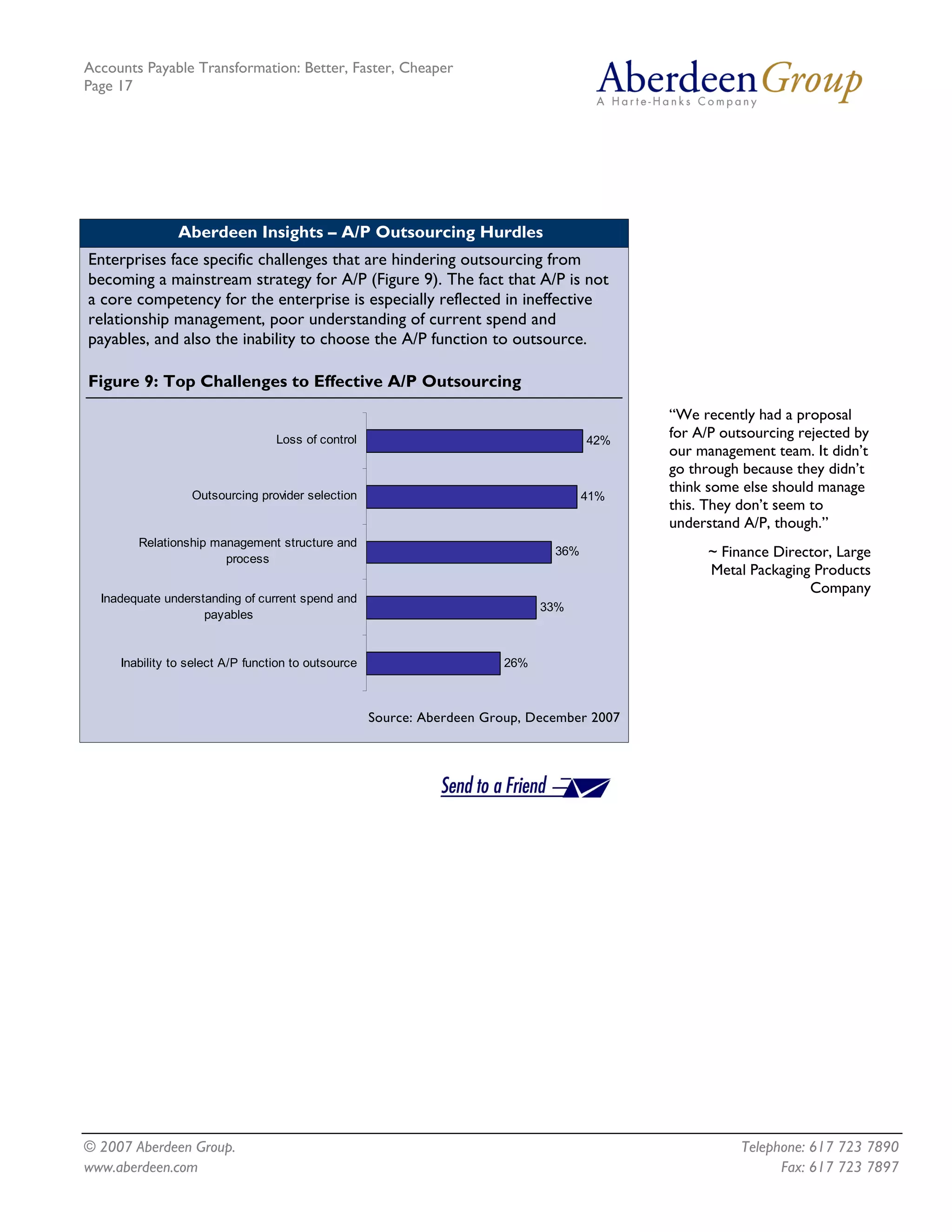
Enterprises face specific challenges that are hindering outsourcing from
becoming a mainstream strategy for A/P (Figure 9). The fact that A/P is not
a core competency for the enterprise is especially reflected in ineffective
relationship management, poor understanding of current spend and
payables, and also the inability to choose the A/P function to outsource.

Figure 9: Top Challenges to Effective A/P Outsourcing
                                                                                             “We recently had a proposal
                                  Loss of control                                     42%
                                                                                             for A/P outsourcing rejected by
                                                                                             our management team. It didn’t
                                                                                             go through because they didn’t
                  Outsourcing provider selection
                                                                                             think some else should manage
                                                                                      41%
                                                                                             this. They don’t seem to
                                                                                             understand A/P, though.”
        Relationship management structure and
                       process
                                                                                36%                ~ Finance Director, Large
                                                                                                   Metal Packaging Products
                                                                                                                  Company
  Inadequate understanding of current spend and
                                                                              33%
                    payables


     Inability to select A/P function to outsource                      26%


                                                     Source: Aberdeen Group, December 2007


© 2007 Aberdeen Group.                                                                                  Telephone: 617 723 7890
www.aberdeen.com                                                                                              Fax: 617 723 7897
Accounts Payable Transformation: Better, Faster, Cheaper
Page 18


                        Appendix A:
                    Research Methodology
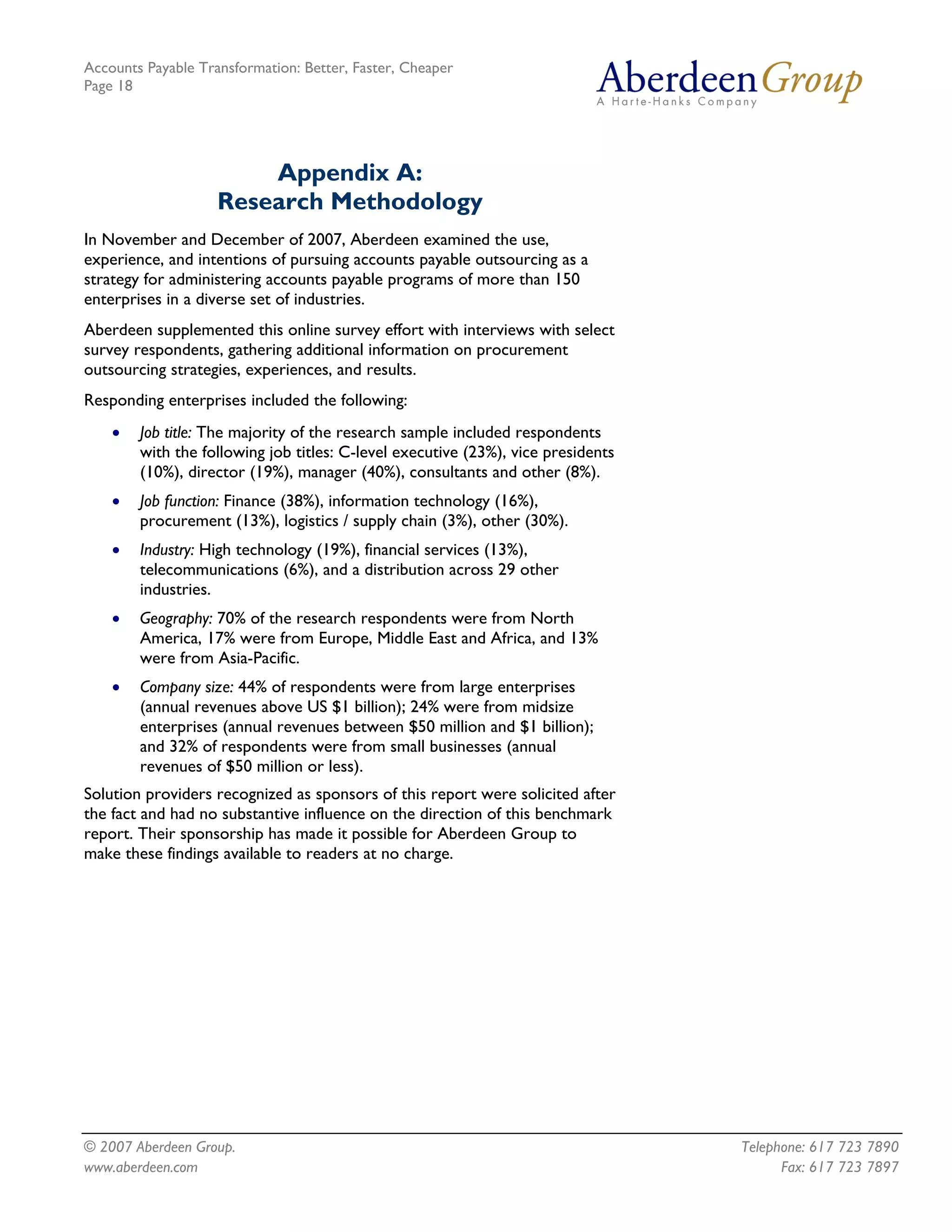
In November and December of 2007, Aberdeen examined the use,
experience, and intentions of pursuing accounts payable outsourcing as a
strategy for administering accounts payable programs of more than 150
enterprises in a diverse set of industries.
Aberdeen supplemented this online survey effort with interviews with select
survey respondents, gathering additional information on procurement
outsourcing strategies, experiences, and results.
Responding enterprises included the following:
    •   Job title: The majority of the research sample included respondents
        with the following job titles: C-level executive (23%), vice presidents
        (10%), director (19%), manager (40%), consultants and other (8%).
    •   Job function: Finance (38%), information technology (16%),
        procurement (13%), logistics / supply chain (3%), other (30%).
    •   Industry: High technology (19%), financial services (13%),
        telecommunications (6%), and a distribution across 29 other
        industries.
    •   Geography: 70% of the research respondents were from North
        America, 17% were from Europe, Middle East and Africa, and 13%
        were from Asia-Pacific.
    •   Company size: 44% of respondents were from large enterprises
        (annual revenues above US $1 billion); 24% were from midsize
        enterprises (annual revenues between $50 million and $1 billion);
        and 32% of respondents were from small businesses (annual
        revenues of $50 million or less).
Solution providers recognized as sponsors of this report were solicited after
the fact and had no substantive influence on the direction of this benchmark
report. Their sponsorship has made it possible for Aberdeen Group to
make these findings available to readers at no charge.


© 2007 Aberdeen Group.                                                            Telephone: 617 723 7890
www.aberdeen.com                                                                        Fax: 617 723 7897
Accounts Payable Transformation: Better, Faster, Cheaper
Page 19


Table 6: The PACE Framework Key
                                                           Overview
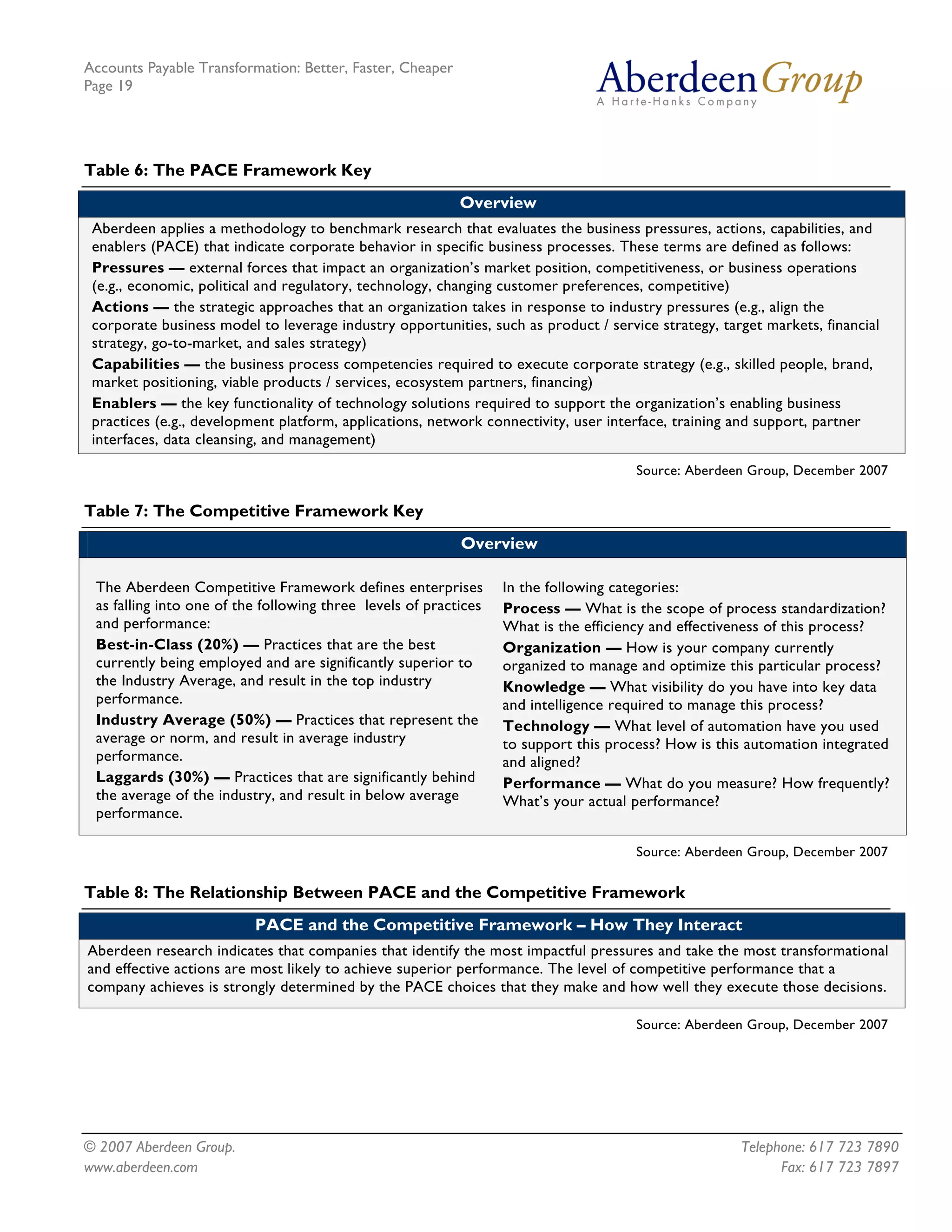
 Aberdeen applies a methodology to benchmark research that evaluates the business pressures, actions, capabilities, and
 enablers (PACE) that indicate corporate behavior in specific business processes. These terms are defined as follows:
 Pressures — external forces that impact an organization’s market position, competitiveness, or business operations
 (e.g., economic, political and regulatory, technology, changing customer preferences, competitive)
 Actions — the strategic approaches that an organization takes in response to industry pressures (e.g., align the
 corporate business model to leverage industry opportunities, such as product / service strategy, target markets, financial
 strategy, go-to-market, and sales strategy)
 Capabilities — the business process competencies required to execute corporate strategy (e.g., skilled people, brand,
 market positioning, viable products / services, ecosystem partners, financing)
 Enablers — the key functionality of technology solutions required to support the organization’s enabling business
 practices (e.g., development platform, applications, network connectivity, user interface, training and support, partner
 interfaces, data cleansing, and management)
                                                                                      Source: Aberdeen Group, December 2007

Table 7: The Competitive Framework Key
                                                           Overview

 The Aberdeen Competitive Framework defines enterprises           In the following categories:
 as falling into one of the following three levels of practices   Process — What is the scope of process standardization?
 and performance:                                                 What is the efficiency and effectiveness of this process?
 Best-in-Class (20%) — Practices that are the best                Organization — How is your company currently
 currently being employed and are significantly superior to       organized to manage and optimize this particular process?
 the Industry Average, and result in the top industry             Knowledge — What visibility do you have into key data
 performance.                                                     and intelligence required to manage this process?
 Industry Average (50%) — Practices that represent the            Technology — What level of automation have you used
 average or norm, and result in average industry                  to support this process? How is this automation integrated
 performance.                                                     and aligned?
 Laggards (30%) — Practices that are significantly behind         Performance — What do you measure? How frequently?
 the average of the industry, and result in below average         What’s your actual performance?
 performance.

                                                                                      Source: Aberdeen Group, December 2007

Table 8: The Relationship Between PACE and the Competitive Framework
                          PACE and the Competitive Framework – How They Interact
Aberdeen research indicates that companies that identify the most impactful pressures and take the most transformational
and effective actions are most likely to achieve superior performance. The level of competitive performance that a
company achieves is strongly determined by the PACE choices that they make and how well they execute those decisions.

                                                                                      Source: Aberdeen Group, December 2007


© 2007 Aberdeen Group.                                                                               Telephone: 617 723 7890
www.aberdeen.com                                                                                           Fax: 617 723 7897
Accounts Payable Transformation: Better, Faster, Cheaper
Page 20


                             Appendix B:
                      Related Aberdeen Research
Related Aberdeen research that forms a companion or reference to this
report include:
      •     E-Payables solution Selection: Your 2007-2008 Guide to A/P
            Transformation, September 2007
      •     Spend Analysis: Working Too Hard for the Money, August 2007
      •     Supplier Enablement: Connecting with Suppliers to Build Lasting
            Relationships, May 2007
      •     E-Payables: Advancing A/P Automation, March 2007
      •     Accounts Payable: Strategies for Success, December 2006
      •     Invoice Reconciliation and Payment Benchmark Study, June 2006
Information on these and any other Aberdeen publications can be found at
http://www.aberdeen.com/channel/procs.asp.
Aberdeen’s 2007 Global Supply Management Research Agenda is also
available.
Subscribe to the Global Supply Management RSS FEED at:
http://www.aberdeen.com/2-0/rss/procurement.xml


    Author: William Browning, Research Analyst, Global Supply Management,
    william.browning@aberdeen.com
Founded in 1988, Aberdeen Group is the technology- driven research destination of choice for the global business
executive. Aberdeen Group has 400,000 research members in over 36 countries around the world that both
participate in and direct the most comprehensive technology-driven value chain research in the market. Through its
continued fact-based research, benchmarking, and actionable analysis, Aberdeen Group offers global business and
technology executives a unique mix of actionable research, KPIs, tools, and services. This document is the result of
primary research performed by Aberdeen Group. Aberdeen Group's methodologies provides for objective fact based
research and represent the best analysis available at the time of publication. Unless otherwise noted, the entire
contents of this publication are copyrighted by Aberdeen Group, Inc. and may not be reproduced, distributed,
archived, or transmitted in any form or by any means without prior written consent by Aberdeen Group, Inc.

As a Harte-Hanks Company, Aberdeen plays a key role of putting content in context for the global direct and targeted
marketing company. Aberdeen's analytical and independent view of the "customer optimization" process of Harte-
Hanks (Information – Opportunity – Insight – Engagement – Interaction) extends the client value and accentuates the
strategic role Harte-Hanks brings to the market. For additional information, visit Aberdeen http://www.aberdeen.com
or call (617) 723-7890, or to learn more about Harte-Hanks, call (800) 456-9748 or go to http://www.harte-hanks.com


© 2007 Aberdeen Group.                                                                                                 Telephone: 617 723 7890
www.aberdeen.com                                                                                                             Fax: 617 723 7897

Aberdeen Group: Accounts Payable Transformation

  • 1.
    Accounts Payable Transformation Better, Faster, Cheaper December 2007
  • 2.
    Accounts Payable Transformation:Better, Faster, Cheaper Page 2 Executive Summary Enterprises constantly seek ways to drive savings to their bottom line and Research Benchmark establish process efficiencies across the organization. As a critical multi- Aberdeen’s Research faceted cog in the cash management machine, the A/P function is ripe with Benchmarks provide an in- opportunity for a makeover that will deliver value to the organization. Often depth and comprehensive look considered more of a tactical organizational activity, accounts payable is into process, procedure, now being viewed as a rising opportunity for outsourcing. However, methodologies, and automation is also a critical driver for the transformation, which will technologies with best practice generate operational efficiencies and optimize the financial value of A/P to identification and actionable the enterprise. recommendations Best-in-Class Performance Aberdeen evaluated over 150 enterprises in November and December of 2007 and distinguished Best-in-Class enterprises by the cost and cycle time required to process a single invoice. Best-in-Class enterprises in this study are notable for their superior performance. They credit outsourcing and automation of accounts payable functions to the following benefits: • Invoice processing costs 88% lower than all others • Invoice processing cycle times 52% faster than their peers • 66% higher rates of on-time payments Competitive Maturity Assessment Best-in-Class performers shared many common characteristics with respect to accounts payable. Best-in-Class companies: • Are 68% more likely to standardize A/P operations • Utilize a shared services center model 69% more frequently than other enterprises • Are nearly twice as likely to benchmark A/P processes and technology capabilities against peers Required Actions • Evaluate accounts payable competencies to establish a baseline and identify outsourcing and automation needs • Establish executive support for A/P transformation efforts – outsourcing and technology investment • Implement a shared services center model for A/P operations © 2007 Aberdeen Group. Telephone: 617 723 7890 www.aberdeen.com Fax: 617 723 7897
  • 3.
    Accounts Payable Transformation:Better, Faster, Cheaper Page 3 Table of Contents Executive Summary....................................................................................................... 2 Best-in-Class Performance..................................................................................... 2 Competitive Maturity Assessment....................................................................... 2 Required Actions...................................................................................................... 2 Chapter One: Benchmarking the Best-in-Class ..................................................... 4 Business Context ..................................................................................................... 4 The Maturity Class Framework ....................................................................... 7 The Best-in-Class PACE Model ....................................................................... 8 Chapter Two: Benchmarking Requirements for Success ..................................10 Competitive Assessment......................................................................................12 Capabilities and Enablers......................................................................................13 Chapter Three: Required Actions .........................................................................15 All Enterprises Steps to Success.........................................................................15 Laggard Steps to Success......................................................................................15 Industry Average Steps to Success ....................................................................15 Best-in-Class Steps to Success ............................................................................16 Appendix A: Research Methodology.....................................................................18 Appendix B: Related Aberdeen Research............................................................20 Figures Figure 1: Top Pressures Driving a Focus on A/P Transformation..................... 4 Figure 2: A/P Outsourcing Activity ........................................................................... 5 Figure 3: A/P Processes Currently Outsourced .................................................... 6 Figure 4: A/P Processes Planned for Outsourcing ................................................ 6 Figure 5: Visibility into A/P Operations ................................................................... 8 Figure 6: A/P Outsourcing Structure......................................................................10 Figure 7: Automation of A/P Processes.................................................................11 Figure 8: Additional A/P Processes Automated...................................................14 Figure 9: Top Challenges to Effective A/P Outsourcing ....................................17 Tables Table 1: Average Invoice Processing Costs – Electronic vs. Manual ................ 5 Table 2: A/P Benchmark Performance ..................................................................... 7 Table 3: Best-in-Class A/P Performance.................................................................. 8 Table 4: The Best-in-Class PACE Framework ....................................................... 9 Table 5: The Competitive Framework...................................................................12 Table 6: The PACE Framework Key ......................................................................19 Table 7: The Competitive Framework Key ..........................................................19 Table 8: The Relationship Between PACE and the Competitive Framework .........................................................................................................................................19 © 2007 Aberdeen Group. Telephone: 617 723 7890 www.aberdeen.com Fax: 617 723 7897
  • 4.
    Accounts Payable Transformation:Better, Faster, Cheaper Page 4 Chapter One: Benchmarking the Best-in-Class Business Context Fast Facts In the world of sports, the head coach is looked at as the face of the team and the person tasked with developing and implementing the key strategies √ Electronic invoice that drive success. However once a game begins, the assistant coaches and processing costs are 33% to 41% lower than manual others that work behind the scenes are the individuals who provide tactical processing costs support to ensure a winning strategy. This scenario is also applicable to the world of corporate finance, where the CFO must drive strategic decisions √ Best-in-Class enterprises that ensure the financial welfare of the organization. Yet enterprise leaders enjoy 76% to 94% lower also rely on behind-the-scenes leaders of critical processes that have long invoice processing rates been regarded as back-office functions (such as accounts payable) to serve than their peers as their “assistant coaches.” Often considered more of a tactical √ Best-in-Class enterprises organizational activity, accounts payable is now being viewed as a rising process invoices 51% to opportunity for outsourcing, which opens the door to increased automation 59% faster than other to further generate operational efficiencies and optimize the financial value enterprises of A/P to the enterprise. √ Lower transaction costs drives enterprises to Driving Action: Costs and Beyond pursue outsourcing as a Enterprises constantly seek ways to drive savings to their bottom line and strategy for A/P establish process efficiencies across the organization. As a critical multi- faceted cog in the cash management machine, the A/P function is ripe with opportunity for transformations that will deliver value to the organization and outsourcing is proving to be a beneficial solution. Enterprises are clear in their reasons for working with a third party expert to outsource the A/P function, automate A/P processes, or both (Figure 1). Figure 1: Top Pressures Driving a Focus on A/P Transformation Lower transaction 60% “Outsourcing costs us half of costs what we would spend on automating internally, and has lowered our processing costs Reduce headcount 42% by one-third. We’ve also streamlined our department by reducing out headcount by about the same.” A/P NOT a core 35% ~ Director of Finance, Large competency Medical Devices Enterprise Improve cash 33% management visibility Source: Aberdeen Group, December 2007 © 2007 Aberdeen Group. Telephone: 617 723 7890 www.aberdeen.com Fax: 617 723 7897
  • 5.
    Accounts Payable Transformation:Better, Faster, Cheaper Page 5 As with any effort to improve a business function, the cost of doing business is a critical factor driving activity, and lowering transaction costs is the definitive focus of enterprise efforts to drive A/P performance. Such a focus is well-warranted as A/P managers note distinct differences in costs for processing invoices electronically instead of manually (Table 1). Table 1: Average Invoice Processing Costs – Electronic vs. Manual Invoice Type Electronic Manual PO $8.67 $13.53 Non-PO $9.19 $15.62 Other $8.70 $12.98 Source: Aberdeen Group, December 2007 Bottom-line consideration of lower operating costs A/P is the key driver of efforts to outsource and automate. However, reducing headcount serves a similar, if unintended purpose by reducing the financial commitment to personnel costs faced by A/P leaders. Operational efficiencies are also facilitated by automation as technology enables an enterprise to utilize fewer resources for tactical, transactional activities and streamlines processes. Although leveraging external expertise from an outsourcing provider has been widely accepted in the HR and IT communities, there is still some hesitation to fully commit to outsourcing as a leading strategy for management of accounts payable. However, attitudes continue to change as over 40% of enterprises surveyed indicated they will be outsourcing accounts payable activities in the next two years (Figure 2). Figure 2: A/P Outsourcing Activity 16% Currently outsource Plan to outsource No plans to outsource 58% 27% Source: Aberdeen Group, December 2007 Progress of A/P Outsourcing As business environments continue to remain highly competitive, enterprises constantly seek alternative avenues to improve functional performance and further support strategic activities. Yet it is clear that © 2007 Aberdeen Group. Telephone: 617 723 7890 www.aberdeen.com Fax: 617 723 7897
  • 6.
    Accounts Payable Transformation:Better, Faster, Cheaper Page 6 outsourcing accounts payable is still a nascent strategy as no specific A/P process is currently outsourced at more than a 16% rate (Figure 3). Figure 3: A/P Processes Currently Outsourced Document archiving 16% Recovery audit 14% Document 12% scanning/imaging Payment 10% processing/disbursement Invoice reconciliation 10% Source: Aberdeen Group, December 2007 Despite the relatively low frequency of current outsourcing, plans to utilize resources outside the enterprise to improve A/P performance are significantly more robust moving forward (Figure 4). As enterprises move forward, they continue to focus on information capture through archiving and imaging, but also plan to address process-related activities by utilizing an outsourcing provider to manage invoice sorting and workflows for approval of invoices. Figure 4: A/P Processes Planned for Outsourcing Document archiving 32% Document scanning/imaging 31% OCR scanning 30% Invoice receipt and sorting 27% Invoice routing/workflow mgmt 25% Source: Aberdeen Group, December 2007 It is clear that enterprises recognize that there are significant operational benefits and opportunities in continuing to leverage automated tools by outsourcing accounts payable - and companies are moving forward on this strategy. As more processes are outsourced and automated, costs continue © 2007 Aberdeen Group. Telephone: 617 723 7890 www.aberdeen.com Fax: 617 723 7897
  • 7.
    Accounts Payable Transformation:Better, Faster, Cheaper Page 7 to be driven down and organizations are able to more completely streamline and transform their A/P operations. The Maturity Class Framework Top-performing enterprises effectively leverage an outsourcing strategy, which facilitates transformation through automation and process improvement for accounts payable activities, driving performance improvement. Aberdeen used two key performance criteria to distinguish the Best-in-Class from Industry Average and Laggard organizations: cost and time to process a single invoice. Table 2 summarizes the average performance of enterprises within the different maturity classes for this study. Table 2: A/P Benchmark Performance Definition of Maturity Mean Class Performance Class Best-in-Class: $2.00 to process a single invoice Top 20% of aggregate performance scorers 8.6 days to process a single invoice Industry Average: $8.36 to process a single invoice Middle 50% of aggregate performance scorers 17.4 days to process a single invoice Laggard: $29.38 to process a single invoice Bottom 30% of aggregate performance scorers 20.3 days to process a single invoice Source: Aberdeen Group, December 2007 Best-in-Class enterprises demonstrate that pursuing an outsourcing strategy for accounts payable functions can be leveraged to greatly improve business performance. They have also realized the benefits of automation as costs for processing invoices electronically are 33% to 41% lower than manual processing. It is also clear that those enterprises willing to more readily pursue the outsourcing and automation paths for A/P activities are rewarded, as Best-in-Class companies establish higher levels of process visibility for accounts payable (Figure 5). © 2007 Aberdeen Group. Telephone: 617 723 7890 www.aberdeen.com Fax: 617 723 7897
  • 8.
    Accounts Payable Transformation:Better, Faster, Cheaper Page 8 Figure 5: Visibility into A/P Operations “Cost reduction was definitely BIC 62% 31% 8% a focus, but we were also hoping to increase A/P visibility across the company. So far, it’s Average 31% 40% 29% been tremendously helpful and has met our expectations on each front.” Laggard 25% 40% 35% ~ Large, North American Manufacturing enterprise High Moderate Low/No Source: Aberdeen Group, December 2007 Along with a decided advantage in visibility into their A/P operations, Best- in-Class enterprises significantly outpace competitors across several key performance metrics (Table 3). Table 3: Best-in-Class A/P Performance Metric Best-in- Class All Others Exception rate 7.4% 11.6% On-time payments 82% 59% On-time payments that earn discounts 79% 48% Invoices received electronically 23% 21% Payments settled electronically 48% 39% Source: Aberdeen Group, December 2007 The improved performance of Best-in-Class enterprises is due to a combination of operational expertise and access to integral technology for A/P automation. Outsourcing providers have a wide breadth of experience and institutional knowledge in developing and in successfully establishing, repeating, and enforcing processes that are integrated within an organization’s framework that drives success. They are also leveraged more effectively by Best-in-Class enterprises in order to automate their A/P operations and drive additional efficiencies. The Best-in-Class PACE Model Aberdeen has shown that there is a clear relationship between the pressures companies identify, the actions they take, and their subsequent competitive performance. All participants should examine their prioritized Pressures, Actions, Capabilities, and Enablers (PACE) selections and determine whether there are valuable perspectives to be gleaned by comparison with the PACE priorities of Best-in-Class companies (Table 4). © 2007 Aberdeen Group. Telephone: 617 723 7890 www.aberdeen.com Fax: 617 723 7897
  • 9.
    Accounts Payable Transformation:Better, Faster, Cheaper Page 9 Table 4: The Best-in-Class PACE Framework Pressures Actions Capabilities Enablers Reduce A/P Conduct internal Centralized A/P Automated scheduling and tracking of payments transaction assessment of A/P organization Check printing costs processes and technology Standardized A/P processes Coding, tax, and verification A/P is not a capabilities Executive-level sponsorship Automation of header data validation / duplicate core Benchmark A/P of outsourcing / invoice verification competency processes and technology transformation activities Invoice receipt summary-level OCR scanning of capabilities against peers Visibility into A/P operations paper invoices Secure executive support Structured issue escalation Expense coding accuracy and automated GL for A/P outsourcing / processes policy based coding of invoices transformation Digital signatures for invoice approvals Source: Aberdeen Group, December 2007 Aberdeen Insights – The A/P Framework Aberdeen utilizes a four-part framework to help A/P managers better define their current state and identify logical areas for improvement: 1. Receipt. Invoice receipt may occur in any one of numerous paper or electronic formats – EDI, XML, or other file formats including credit card statements, evaluated receipt settlement, web-based order / invoice creation, or PO flip. A distinguishing characteristic for EIPP is that receipt (as with settlement) may be enabled via a supplier or trading network. 2. Approval and inquiry. Once received, an invoice may be processed utilizing rule-based logic that analyzes certain invoice attributes (supplier, amount, buying entity, etc.) to define the proper routing and approval workflow. Notification / alert capabilities as well as direct integration to transactional systems are used to track invoice status and identify issues. 3. Validation and reconciliation. The verification of invoice accuracy and the resolution of any errors, discrepancies, or disputes prior to payment are accomplished by automated matching engines, collaboration with suppliers and internal end users, and integration to transactional systems. The information captured in this segment is used for audits (internal and external) as well as spend analysis. 4. Settlement. After the efficient capture, tracking, and approval of enterprise liabilities, the next step is payment processing, utilizing a payment method that may include Electronic Funds Transfer (EFT), ACH, card or supplier / trading networks. Capabilities like dynamic discounting, rebates, tax management, and trade financing are available in advanced solutions to optimize the management of cash flow. Available services and solutions may address one or all these needs. The benefits include lower transaction costs, better payment performance, reduced cycle times, improved resource productivity, stronger controls, fewer errors, and improved visibility into the valuable spend and supplier data processed by A/P. Strengthening the A/P function is especially important as serves as a critical point of convergence between procurement, finance and suppliers. © 2007 Aberdeen Group. Telephone: 617 723 7890 www.aberdeen.com Fax: 617 723 7897
  • 10.
    Accounts Payable Transformation:Better, Faster, Cheaper Page 10 Chapter Two: Benchmarking Requirements for Success The difficulties faced by an organization’s accounts payable group in reducing Fast Facts the cost of transactions and concurrently delivering operational efficiencies √ A majority of enterprises are alleviated by looking to a third-party for assistance. Underlying this need (64%)engage in A/P is the fact that A/P is not considered a core competency by 35% of outsourcing as either a respondents to this research effort, highlighting the need for an external stand-alone engagement or expert. However, a standard, predominant structure for engaging and A/P as part of a larger Finance outsourcing provider has not readily emerged (Figure 6). and Accounting outsourcing effort Figure 6: A/P Outsourcing Structure √ Best-in-Class enterprises are nearly twice as likely to Stand-alone outsourcing engagement 35% benchmark their A/P processes and technological capabilities Part of larger Finance and Accounting against peers to establish a outsourcing 29% comparative level of performance Part of a larger enterprise-wide focus on 24% outsourcing for all functional areas Part of larger Procurement outsourcing 12% Source: Aberdeen Group, December 2007 Outsourcing A/P processes allows enterprises such advantages as access to best of breed technology, additional staffing / resources, and operational efficiencies - all with a focus on delivering lower costs. Access to technology and automation is particularly importance because nearly 80% of invoice activity is paper-based as opposed to use of Electronic Data Interchange (EDI), Extensible Markup Language (XML), purchasing cards, or other electronic formats. Best-in-Class enterprises have been more diligent in overcoming paper hurdles and utilizing outsourcing to leverage technology and improve automation (Figure 7). © 2007 Aberdeen Group. Telephone: 617 723 7890 www.aberdeen.com Fax: 617 723 7897
  • 11.
    Accounts Payable Transformation:Better, Faster, Cheaper Page 11 Figure 7: Automation of A/P Processes Payment 77% scheduling 43% “Automation was a focus for us 69% when outsourcing. Through Check printing 53% our relationship, we improved our on-time payments and Payment status 69% started getting our discounts.” tracking 39% ~ CFO, Small European Coding, tax, and 67% Telecommunications verification 43% Organization Automation of header data 61% 23% validation/duplicate All Others BIC Source: Aberdeen Group, December 2007 Case Study – Outsource, Automate, Transform Engaging in significant growth, an international luxury hotel group was faced with accounts payable processing issues. They were looking for ways to improve their AP processes and also reduce costs. The goal was to establish a single process that would allow them to easily manage multiple properties in different geographic locations. Additionally, the impact of the Sarbanes-Oxley Act has created an increased focus on improving financial procedures and providing better reporting. A revised AP function was needed to increase expense control and review, as well as improve organizational and filing procedures for invoices. During their evaluation, this enterprise was open to many different solutions, from purchasing additional software to hiring more staff in an effort to improve their overall AP process. The key criteria were that the solution must deliver immediate results, not impact existing operations, and be cost-effective. This hospitality enterprise selected a partner that utilizes a Software-as-a- Service (SaaS) model to deliver their solution in addition to providing outsourcing services through personnel to augment and train current staff. The results were immediate and cost-effective, as the implementation and training took only a few weeks. The staff of the solution and outsourcing provider quickly adopted the hotel group’s AP processes and began handling tasks such as invoice receipt and sorting, document imaging and archival, data capture and entry, and payment processing. The software solution became the engine behind the process and provided the technology to manage the e-mail notification and approval process as well as a single system to store all of the information in an easy to retrieve and review format. It also easily integrated with the ERP system of record to facilitate the transition. The web-based application proved easy to use so there was a minimal learning curve for new users. This was a turn-key solution in every aspect. © 2007 Aberdeen Group. Telephone: 617 723 7890 www.aberdeen.com Fax: 617 723 7897
  • 12.
    Accounts Payable Transformation:Better, Faster, Cheaper Page 12 Competitive Assessment Survey respondents fell into one of three categories: Best-in-Class, Industry Average, or Laggard. Companies were characterized in five major areas: (1) process – the level of standardization and scope the accounts payable group has defined for their current processes; (2) organization – the structure, skills, and capabilities of the organization as well as its general alignment with the strategic direction of the enterprise; (3) knowledge – the accessibility and visibility of information and data related to accounts payable performance, and the ability to leverage it across the enterprise; (4) outsourced processes – the level of outsourcing for specific accounts payable- related functions to improve performance; and (5) performance – the ability to identify, track, and then improve upon key performance indicators such as invoice processing costs and cycle times, exception rates, electronic processing rates of invoices, and electronic payment rates. Table 5 shows some of the processes, capabilities, technologies, and strategies employed by Best-in-Class, Industry Average, and Laggard companies within the competitive framework. Table 5: The Competitive Framework Best-in-Class Average Laggards A/P processes are standardized and aligned company-wide Process 69% 47% 30% A/P operations are organized as a shared services center Organization 54% 34% 24% Benchmark A/P processes and technology capabilities Knowledge against peers 56% 29% 28% A/P processes outsourced: 25% outsource 16% outsource 0% outsource audit and audit and audit and recovery recovery recovery activities activities activities 17% outsource 7% outsource 3% outsource A/P payment payment payment Outsourcing processing and processing and processing and disbursement disbursement disbursement 17% outsource 9% outsource 0% outsource invoice receipt invoice receipt invoice receipt and sorting and sorting and sorting 8% outsource 3% outsource 0% outsource entire A/P entire A/P entire A/P operations operations operations Ability to track and report on performance of A/P activities Performance 45% 35% 33% Source: Aberdeen Group, December 2007 © 2007 Aberdeen Group. Telephone: 617 723 7890 www.aberdeen.com Fax: 617 723 7897
  • 13.
    Accounts Payable Transformation:Better, Faster, Cheaper Page 13 Capabilities and Enablers Aberdeen’s global supply management research has shown time and again that leveraging accounts payable services and tools allows A/P organizations to lower transaction costs and reduce cycle times for invoice processing. In addition to third-party expertise and resources, outsourcing also opens the window to automation as A/P outsourcing providers provide access to best of breed technologies. Organizations that outsource and leverage automation for A/P transformation position themselves ahead of their peers and enjoy distinct performance and organizational advantages. Process In the nascent but growing area of A/P outsourcing, Best-in-Class enterprises are taking advantage of the opportunities presented. Facilitating the success of outsourcing, Best-in-Class organizations are 1.7-times more likely to standardize A/P processes company-wide. Implementing standardized processes ensures that A/P activities can be repeated for optimal results and performance. Organization Utilizing a shared services model for corporate functions enables organizations to deliver the services required as effectively and efficiently as possible. Best-in-Class enterprises are 69% more likely to utilize a single shared services model for A/P operations, establishing a platform for operational efficiencies and removing operational tasks from the corporate headquarters to allow corporate leaders to focus on governance and the strategic direction of the enterprise. Knowledge Management Best-in-Class organizations are 93% more likely than their peers to benchmark A/P processes and technology capabilities against their peers. Doing so allows these better performing enterprises to stay apprised of different practices and advancements in use by other companies, helping ensure that they remain at the leading edge of their competition. The Best- in-Class are also able to establish a best practice approach to A/P based on the intelligence and information collected. A/P Processes Outsourced There are a variety of sub-processes that comprise the accounts payable processes. While organizations in each competitive group outsource different A/P functions to some degree, there is a distinct difference between the rates and specific functions outsourced by the Best-in-Class compared to the other companies: • Best-in-Class enterprises outsource audit and recovery activities 150% more frequently than all other companies, ensuring that any errors resulting from A/P activities do not ultimately result in financial loss due to inaccurate billing or payment of invoices. © 2007 Aberdeen Group. Telephone: 617 723 7890 www.aberdeen.com Fax: 617 723 7897
  • 14.
    Accounts Payable Transformation:Better, Faster, Cheaper Page 14 • Best-in-Class companies are over four-times more likely than their competitors to outsource payment processing and disbursement. Utilizing an experienced and effective third-party provider for this A/P function effectively delivers invoice processing cycle times that are 2.1-times lower than all others. • Best-in-Class enterprises are 104% more likely than Industry Average and Laggard companies to outsource invoice receipt and sorting. Outsourcing this function delivers both operational and cost benefits by centralizing and streamlining invoice processing responsibilities. • Best-in-Class enterprises are four-times more likely to outsource their entire A/P operations. Performance Management Best-in-Class enterprises are 36% more likely to demonstrate the ability to measure the performance of their accounts payable activities. This is imperative for the A/P group as a whole, but especially as it relates to the procurement outsourcing relationship. Without the ability to measure and monitor performance, there is no way to identify areas for improvement, whether improvement has occurred, or whether any other tangible benefits of procurement outsourcing have taken place. Information and data gathered also allow for benchmarking against competitors as well to establish a comparative level of performance. Aberdeen Insights – The BIC Widen Their Scope Accounts payable includes a variety of sub-processes that can be automated and outsourced to drive cost reductions and operational efficiencies. Best- in-Class organizations have also begun to engage in automation for a significant number of these sub-processes to supplement a function that is often not a core competency. In addition to those outlined earlier, Best-in- Class enterprises also automate several additional A/P processes more frequently than all other companies (Figure 8). Figure 8: Additional A/P Processes Automated Invoice receipt summary level Optical 54% Character Recognition (OCR) 14% scanning 53% Expense coding of invoices 29% Digital signatures for invoice approvals 53% 29% 46% Other disbursement 28% Electronic receipt of invoices 46% 38% All Others BIC Source: Aberdeen Group, December 2007 © 2007 Aberdeen Group. Telephone: 617 723 7890 www.aberdeen.com Fax: 617 723 7897
  • 15.
    Accounts Payable Transformation:Better, Faster, Cheaper Page 15 Chapter Three: Required Actions Accounts payable outsourcing continues to gain traction. Finance Fast Facts organizations recognize the benefits that can be realized by leveraging third- √ All enterprises should first party expertise and are now moving this function along the same path conduct an assessment of already tread by HR and IT groups. The value that an external partner can their accounts payable deliver is being leveraged on a go-forward basis to drive cost savings and processes, structures, and operational improvements. Based on our research, Aberdeen recommends technologies to identify the the following strategies for improved results from accounts payable scope of outsourcing and automation required outsourcing: √ Standardize accounts All Enterprises Steps to Success payable processes across the organization • Evaluate accounts payable competencies. Conduct an internal assessment of accounts payable processes, organizational structures, √ Establish executive support and technology capabilities to identify the specific skills and to facilitate acceptance of outsourcing functions for which the group lacks capabilities and can be subsequently outsourced or automated to drive performance √ Leverage outsourcing improvement. It is critical to have a baseline understanding of providers for technology enterprise A/P capabilities before deciding on what should or should access and not just services not be addressed. √ Outsource accounts payable as a stand-alone Laggard Steps to Success engagement instead of as a larger finance and • Establish standardized accounts payable processes and accounting initiative, as is baseline core competencies. Best-in-Class enterprises are 130% common more likely than Laggards to have standardized procurement processes in place that are aligned across the enterprise. Process standardization enables knowledge, and those practices that are most effective, to be readily exchanged between the enterprise and its outsourcing partner. They also facilitate automation by establishing routine workflows to which technology can be applied to extract even greater efficiencies. • Secure executive support for accounts payable outsourcing. Best-in-Class organizations are 13% more likely to establish executive-level support for A/P transformation activities such as outsourcing and automation than Laggards. Executive support facilitates organizational acceptance of these initiatives and also ensures that funding is available to support the investment in both the outsourcing relationship and enabling technologies that buoy performance. Industry Average Steps to Success • Leverage technology – not just services. Outsourcing provides organizations with unique opportunities to access best of breed technologies to automate the A/P lifecycle and improve © 2007 Aberdeen Group. Telephone: 617 723 7890 www.aberdeen.com Fax: 617 723 7897
  • 16.
    Accounts Payable Transformation:Better, Faster, Cheaper Page 16 performance. Automation of the A/P process not only drives efficiencies and reduces costs, but serves the additional benefit of reducing and eliminating paper from the operation to make A/P more “green” and environmentally friendly. Best-in-Class organizations are 17% to 143% more likely to automate check printing, payment scheduling, coding and verification, and data validation / duplicate invoice verification than Industry Average organizations. • Structure accounts payable as a shared services center. Best-in-Class enterprises are nearly 60% more likely than Industry Average enterprises to utilize a shared services center model for A/P operations. Centralizing the A/P function drives greater control over standardization of processes and alignment across the organization, which occurs in the Best-in-Class 42% more frequently than in Industry Average companies. Best-in-Class Steps to Success • Outsource accounts payable as its own engagement. A/P is outsourced under a variety of guises – as a stand-alone outsourcing engagement, as part of a larger finance and accounting project, as part of a procurement transformation effort, or as an enterprise- wide strategy to outsource all or most corporate functions. However, Best-in-Class organizations are over three-times more likely to outsource A/P as a distinct engagement. Such a strategy allows companies to focus on the relationship with the outsourcing provider exclusively for A/P. Focusing on A/P as a stand-alone engagement ensures that the outsourcing partnership is appropriately managed and there is a dedicated group (or leader) to review Service Level Agreements (SLAs) and monitor the performance of the A/P outsourcing provider. • Emphasize process improvements equally with cost reductions. While cost is, and always will be, a critical pressure for pursuing outsourcing and automating A/P, Best-in-Class enterprises have shifted the focus to process and organizational competency. These Best-in-Class companies are nearly six-times more likely than others to outsource A/P to drive process standardization. While costs are a concern, the Best-in-Class are more acutely aware that their A/P operations are not a core business competency (50% versus 34% for all others) and therefore seek out third-party expertise to drive value from the function. © 2007 Aberdeen Group. Telephone: 617 723 7890 www.aberdeen.com Fax: 617 723 7897
  • 17.
    Accounts Payable Transformation:Better, Faster, Cheaper Page 17 Aberdeen Insights – A/P Outsourcing Hurdles Enterprises face specific challenges that are hindering outsourcing from becoming a mainstream strategy for A/P (Figure 9). The fact that A/P is not a core competency for the enterprise is especially reflected in ineffective relationship management, poor understanding of current spend and payables, and also the inability to choose the A/P function to outsource. Figure 9: Top Challenges to Effective A/P Outsourcing “We recently had a proposal Loss of control 42% for A/P outsourcing rejected by our management team. It didn’t go through because they didn’t Outsourcing provider selection think some else should manage 41% this. They don’t seem to understand A/P, though.” Relationship management structure and process 36% ~ Finance Director, Large Metal Packaging Products Company Inadequate understanding of current spend and 33% payables Inability to select A/P function to outsource 26% Source: Aberdeen Group, December 2007 © 2007 Aberdeen Group. Telephone: 617 723 7890 www.aberdeen.com Fax: 617 723 7897
  • 18.
    Accounts Payable Transformation:Better, Faster, Cheaper Page 18 Appendix A: Research Methodology In November and December of 2007, Aberdeen examined the use, experience, and intentions of pursuing accounts payable outsourcing as a strategy for administering accounts payable programs of more than 150 enterprises in a diverse set of industries. Aberdeen supplemented this online survey effort with interviews with select survey respondents, gathering additional information on procurement outsourcing strategies, experiences, and results. Responding enterprises included the following: • Job title: The majority of the research sample included respondents with the following job titles: C-level executive (23%), vice presidents (10%), director (19%), manager (40%), consultants and other (8%). • Job function: Finance (38%), information technology (16%), procurement (13%), logistics / supply chain (3%), other (30%). • Industry: High technology (19%), financial services (13%), telecommunications (6%), and a distribution across 29 other industries. • Geography: 70% of the research respondents were from North America, 17% were from Europe, Middle East and Africa, and 13% were from Asia-Pacific. • Company size: 44% of respondents were from large enterprises (annual revenues above US $1 billion); 24% were from midsize enterprises (annual revenues between $50 million and $1 billion); and 32% of respondents were from small businesses (annual revenues of $50 million or less). Solution providers recognized as sponsors of this report were solicited after the fact and had no substantive influence on the direction of this benchmark report. Their sponsorship has made it possible for Aberdeen Group to make these findings available to readers at no charge. © 2007 Aberdeen Group. Telephone: 617 723 7890 www.aberdeen.com Fax: 617 723 7897
  • 19.
    Accounts Payable Transformation:Better, Faster, Cheaper Page 19 Table 6: The PACE Framework Key Overview Aberdeen applies a methodology to benchmark research that evaluates the business pressures, actions, capabilities, and enablers (PACE) that indicate corporate behavior in specific business processes. These terms are defined as follows: Pressures — external forces that impact an organization’s market position, competitiveness, or business operations (e.g., economic, political and regulatory, technology, changing customer preferences, competitive) Actions — the strategic approaches that an organization takes in response to industry pressures (e.g., align the corporate business model to leverage industry opportunities, such as product / service strategy, target markets, financial strategy, go-to-market, and sales strategy) Capabilities — the business process competencies required to execute corporate strategy (e.g., skilled people, brand, market positioning, viable products / services, ecosystem partners, financing) Enablers — the key functionality of technology solutions required to support the organization’s enabling business practices (e.g., development platform, applications, network connectivity, user interface, training and support, partner interfaces, data cleansing, and management) Source: Aberdeen Group, December 2007 Table 7: The Competitive Framework Key Overview The Aberdeen Competitive Framework defines enterprises In the following categories: as falling into one of the following three levels of practices Process — What is the scope of process standardization? and performance: What is the efficiency and effectiveness of this process? Best-in-Class (20%) — Practices that are the best Organization — How is your company currently currently being employed and are significantly superior to organized to manage and optimize this particular process? the Industry Average, and result in the top industry Knowledge — What visibility do you have into key data performance. and intelligence required to manage this process? Industry Average (50%) — Practices that represent the Technology — What level of automation have you used average or norm, and result in average industry to support this process? How is this automation integrated performance. and aligned? Laggards (30%) — Practices that are significantly behind Performance — What do you measure? How frequently? the average of the industry, and result in below average What’s your actual performance? performance. Source: Aberdeen Group, December 2007 Table 8: The Relationship Between PACE and the Competitive Framework PACE and the Competitive Framework – How They Interact Aberdeen research indicates that companies that identify the most impactful pressures and take the most transformational and effective actions are most likely to achieve superior performance. The level of competitive performance that a company achieves is strongly determined by the PACE choices that they make and how well they execute those decisions. Source: Aberdeen Group, December 2007 © 2007 Aberdeen Group. Telephone: 617 723 7890 www.aberdeen.com Fax: 617 723 7897
  • 20.
    Accounts Payable Transformation:Better, Faster, Cheaper Page 20 Appendix B: Related Aberdeen Research Related Aberdeen research that forms a companion or reference to this report include: • E-Payables solution Selection: Your 2007-2008 Guide to A/P Transformation, September 2007 • Spend Analysis: Working Too Hard for the Money, August 2007 • Supplier Enablement: Connecting with Suppliers to Build Lasting Relationships, May 2007 • E-Payables: Advancing A/P Automation, March 2007 • Accounts Payable: Strategies for Success, December 2006 • Invoice Reconciliation and Payment Benchmark Study, June 2006 Information on these and any other Aberdeen publications can be found at http://www.aberdeen.com/channel/procs.asp. Aberdeen’s 2007 Global Supply Management Research Agenda is also available. Subscribe to the Global Supply Management RSS FEED at: http://www.aberdeen.com/2-0/rss/procurement.xml Author: William Browning, Research Analyst, Global Supply Management, william.browning@aberdeen.com Founded in 1988, Aberdeen Group is the technology- driven research destination of choice for the global business executive. Aberdeen Group has 400,000 research members in over 36 countries around the world that both participate in and direct the most comprehensive technology-driven value chain research in the market. Through its continued fact-based research, benchmarking, and actionable analysis, Aberdeen Group offers global business and technology executives a unique mix of actionable research, KPIs, tools, and services. This document is the result of primary research performed by Aberdeen Group. Aberdeen Group's methodologies provides for objective fact based research and represent the best analysis available at the time of publication. Unless otherwise noted, the entire contents of this publication are copyrighted by Aberdeen Group, Inc. and may not be reproduced, distributed, archived, or transmitted in any form or by any means without prior written consent by Aberdeen Group, Inc. As a Harte-Hanks Company, Aberdeen plays a key role of putting content in context for the global direct and targeted marketing company. Aberdeen's analytical and independent view of the "customer optimization" process of Harte- Hanks (Information – Opportunity – Insight – Engagement – Interaction) extends the client value and accentuates the strategic role Harte-Hanks brings to the market. For additional information, visit Aberdeen http://www.aberdeen.com or call (617) 723-7890, or to learn more about Harte-Hanks, call (800) 456-9748 or go to http://www.harte-hanks.com © 2007 Aberdeen Group. Telephone: 617 723 7890 www.aberdeen.com Fax: 617 723 7897