










CLYD CYLL N. VERBOSIDAD, MPA I
Southwestern University
Cebu City
Definition:
 the process by which the
individual worker patterns
and orchestrates his separate but
related work activities to prepare
him together with the organization
to take greater job responsibility
for his future
 the individual determines if
the organization meets
his expectations or
if these are aligned
with the
organization
 the person introspects if he is
willing to blend both
expectations
Organization’s end:
 therefore, that phase of
human resources management
that sets up paths along which
the individual moves and
progresses over time
in the organization
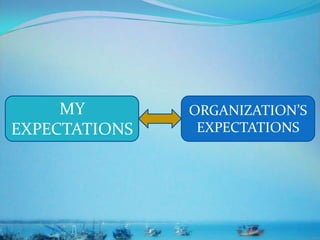
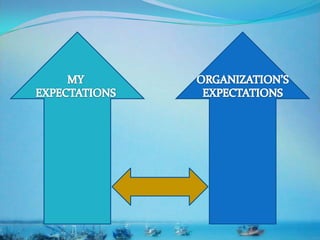
MY
EXPECTATIONS
ORGANIZATION’S
EXPECTATIONS
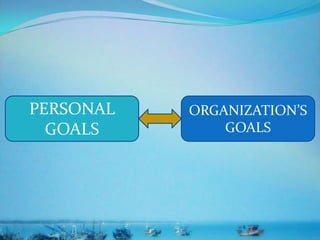
PERSONAL
GOALS
ORGANIZATION’S
GOALS
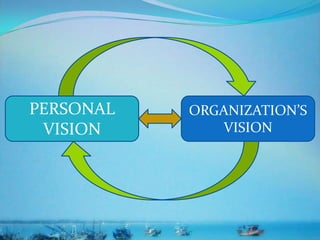
PERSONAL
VISION
ORGANIZATION’S
VISION
DO
THEY
MEET?
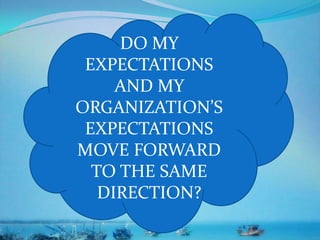
DO MY
EXPECTATIONS
AND MY
ORGANIZATION’S
EXPECTATIONS
MOVE FORWARD
TO THE SAME
DIRECTION?
Objective/Ultimate Aim:
 to make the individual accept
responsibility for whatever
he achieves
IS MY
ORGANIZATION
MAKING WAYS FOR
ME TO BE AWARE
OF MY
RESPONSIBILITY TO
MY ACHIEVEMENT?
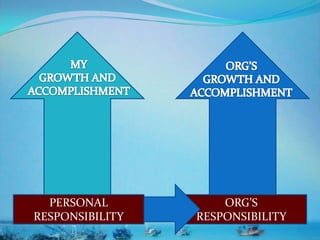
PERSONAL
RESPONSIBILITY
ORG’S
RESPONSIBILITY
Assumption:
 status quo in one’s position is not
the agenda of his employment
(we all seek a happier new year in
our jobs, and not just the
same every year =
boredom/burnout)
Value:
 the process makes him more
motivated because HE IS DOING
WHAT HE WANTS and HE IS
ABLE AND WILLING to accept
RESPONSIBILITY FOR HIS
GROWTH AND
ACCOMPLISHMENT
WOULDN’T YOU BE
HAPPIER, HAPPIEST IF
YOU ARE DOING WHAT
YOU WANT AND IT IS FOR
YOUR OWN GROWTH
AND ACCOMPLISHMENT?
Limitation:
“Don’t let people burnout—
let them do their thing.”
(Couture is a New York born authority who has
stayed in the country for more than twenty
years and thus, has extreme empathy
with Philippine culture.)
General vs. Specific, and…
to work mainly for work, or…
if you love your work you don’t have to be
paid for what you do, but since you are
working anyway, you get paid—but you
enjoy!!! Getting paid for enjoying!
“One problem we had in the States
for many years as people working
for the organization, because that
was how they could get the money,
period.”
To work for money, or…
to enjoy while being paid?
“I’m sure 95% of the people on Ayala
Avenue work from nine to five and
then enjoy themselves afterwards.
When the clock ticks at five, they
start enjoying themselves. But they
can enjoy now by doing what they
want to do. By thinking about their
future in the organization.”
“If we do this, the company won’t be
wasting so much money training
everybody for everything. As it is
now, we run a supervisory training
program and everybody takes it.
But not everybody is interested in
supervisory work. Companies
don’t zero in on things people are
particularly interested in.”
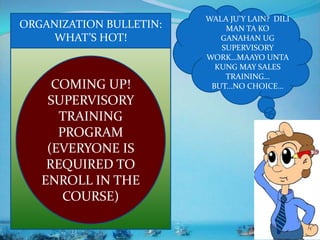
COMING UP!
SUPERVISORY
TRAINING
PROGRAM
(EVERYONE IS
REQUIRED TO
ENROLL IN THE
COURSE)
WALA JU’Y LAIN? DILI
MAN TA KO
GANAHAN UG
SUPERVISORY
WORK…MAAYO UNTA
KUNG MAY SALES
TRAINING…
BUT...NO CHOICE…
ORGANIZATION BULLETIN:
WHAT’S HOT!
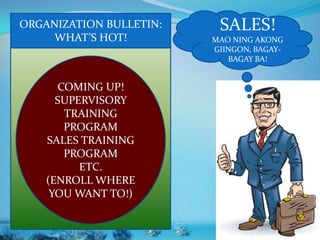
SALES!
MAO NING AKONG
GIINGON, BAGAY-
BAGAY BA!
ORGANIZATION BULLETIN:
WHAT’S HOT!
COMING UP!
SUPERVISORY
TRAINING
PROGRAM
SALES TRAINING
PROGRAM
ETC.
(ENROLL WHERE
YOU WANT TO!)
Career Planning:
Professionalizes management and
worker’s concept of growth; puts an
imprimatur on the need and
importance of career system not
only in the private sector (as
practiced in some orgs) but also in
the public sector where careerism
has given way to politicization of
positions and appointments
Limitation:
1) The typical Filipino
worker, unlike his Western
counterpart, is shy and far from
being assertive and therefore
generally does not ventilate himself
in coursing his career path, much
less talk about it openly to
management or to his peer group.
He fears his being branded as
ambitious or “hambug” so he
tacitly awaits management to open
up the topic before he dares
articulate his desire
to plot out his future.
Limitation:
2) At the other end, a supervisor
who, because of his job insecurity
and tinge of jealousy over a younger
but efficient fellow, stays mum
about his subordinate.
Limitation:
Moreover, the average Filipino
supervisor DOES NOT KNOW
ABOUT HIS ROLE in career
planning and how to implement it.
Implication:
In this type of atmosphere, the
Filipino
employee, however, manages in a
covert way to push himself up
sometimes to the chagrin of his
supervisor who somehow feels
threatened in his position causing
both to look at each other in
mysterious ways = a not too healthy
A Closer Look:
Considering such cultural
phenomena, it behooves
management to institutionalize
career planning to free the worker
from the shackles of shyness, timidity
and fear and to make the supervisor
take the initiative of opening up and
providing channels to the employee
in mapping out his career goals.
As Part of the Organization’s
Concern for the Employee’s
Development:
He picks up formally and officially
even against his personal need
system, the cudgels of the important
career planning program.
However,
it is also the organization’s
responsibility to reshape the
supervisor’s need system in this area
that deters employee and
organization growth.
An All-Important Question:
The supervisor asks:
IF I AM TO PUT THE PROGRAM
IN ACTION,
HOW CAN I DO IT?
Flippo’s List of Main Ingredients:
1) Utilize the career growth cycle.
The individual sets up with
management regarding his work.
Based on this challenge,
he exerts effort and
performs.
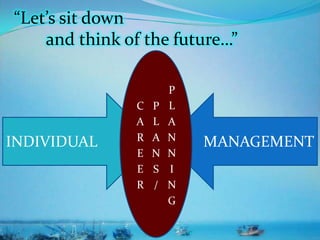
INDIVIDUAL MANAGEMENT
C
A
R
E
E
R
P
L
A
N
S
/
P
L
A
N
N
I
N
G
“Let’s sit down
and think of the future…”
Success—material and psychic—
earns status and esteem and thus
feels recognized. More feedback is
received. Unattainable goals can
reshaped to insure complete success.
The loop is repeated until
all rational goals are achieved.
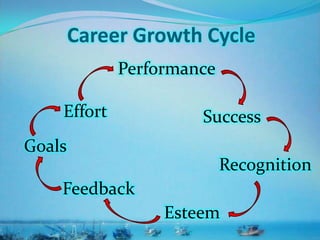
Career Growth Cycle
Performance
Success
Recognition
Esteem
Feedback
Goals
Effort
Flippo’s List of Main Ingredients:
2) Plan and utilize the job itself.
The job is the locus of attention at
this point. Abilities, skills and
attitudes are considered re level of
job difficulty.
3) Set goals. Both organization and
individual goals are identified,
explained and established.
4) Conduct frequent performance
review and feedback. Using
performance as the main criterion
of evaluation, it is pitted against
goals. Unattainable goals are
discussed in light of how
performance can be improved.
For excellent performance, the
supervisor suggests promotion or
transfer that carries implied and
explicit expression of movement
along the path plotted by both
supervisor and employee.
1) Assist employees in evaluating
their own career needs.
Key words: JOINT EFFORT
of EMPLOYEE and
ORGANIZATION
2) Develop and disseminate
available career opportunities in
the organization.
Key words: Career Path
and
KASH (Knowledge, Attitude,
Skills, Habit)
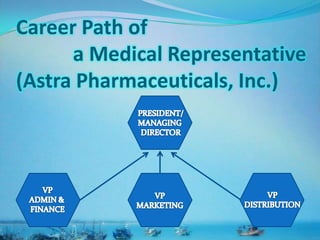
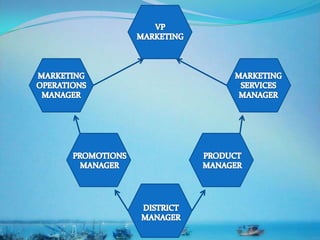
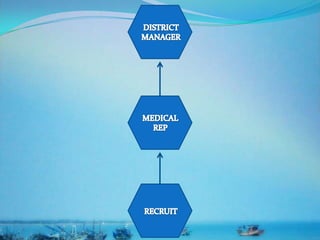
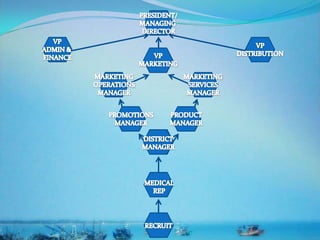
Career Path of
a Medical Representative
(Astra Pharmaceuticals, Inc.)
3) Align needs and abilities of
employees with career
opportunities.
4) Train and reward supervisors for
career planning skills.
Various exercises have been
formulated by career path specialists
and used by organizations with their
employees in their sincere effort to
assist the latter in career planning
and development.
Fabro’s Study (1980) on
Career Development and
Performance Levels
Respondents: 57 first line supervisors
in a food manufacturing
conglomerate
About: Background and Career
Development
1) Respondents who have at least one
year of college education performed
better when compared with the rest.
Results:
2) Communicating was found to be
“the strongest rival factor” which
affected 25% of the respondents
who performed below standard.
3) Performance and attitudinal views
towards rival factors affecting
performance were found to be
strongly correlated with individual
effort for self-development.
4)
Benefits, promotion, developmental
training, refresher training, getting
feedback and job training were the
top rival factors which affect the
performance of the
respondents.
5) A relationship existed between
career development variables and
performance levels of the
respondents.
Questions!
WHAT WOULD YOU WANT TO BE
3-5 YEARS FROM NOW?
IS YOUR
ORGANIZATION/COMPANY
AWARE OF YOUR
PLANS/GOALS/DESIRES/
EXPECTATIONS?
IS THE COMPANY/ORGANIZATION
GUIDING YOU TO ACHIEVE THAT
3-5 YEARS VISION/DESIRE/GOAL
AND THUS HAVE FULFILMENT?
ARE YOU SATISFIED WITH YOUR
CURRENT WORK? OR, ARE YOU A
CANDIDATE FOR BURNOUT?
CLYD CYLL N. VERBOSIDAD, MPA I
Southwestern University
Cebu City

Career planning

  • 1.
    CLYD CYLL N.VERBOSIDAD, MPA I Southwestern University Cebu City
  • 2.
    Definition:  the processby which the individual worker patterns and orchestrates his separate but related work activities to prepare him together with the organization to take greater job responsibility for his future
  • 3.
     the individualdetermines if the organization meets his expectations or if these are aligned with the organization
  • 4.
     the personintrospects if he is willing to blend both expectations
  • 5.
    Organization’s end:  therefore,that phase of human resources management that sets up paths along which the individual moves and progresses over time in the organization
  • 6.
  • 7.
  • 8.
  • 9.
  • 11.
  • 12.
    Objective/Ultimate Aim:  tomake the individual accept responsibility for whatever he achieves
  • 13.
    IS MY ORGANIZATION MAKING WAYSFOR ME TO BE AWARE OF MY RESPONSIBILITY TO MY ACHIEVEMENT?
  • 14.
  • 15.
    Assumption:  status quoin one’s position is not the agenda of his employment (we all seek a happier new year in our jobs, and not just the same every year = boredom/burnout)
  • 16.
    Value:  the processmakes him more motivated because HE IS DOING WHAT HE WANTS and HE IS ABLE AND WILLING to accept RESPONSIBILITY FOR HIS GROWTH AND ACCOMPLISHMENT
  • 17.
    WOULDN’T YOU BE HAPPIER,HAPPIEST IF YOU ARE DOING WHAT YOU WANT AND IT IS FOR YOUR OWN GROWTH AND ACCOMPLISHMENT?
  • 18.
    Limitation: “Don’t let peopleburnout— let them do their thing.” (Couture is a New York born authority who has stayed in the country for more than twenty years and thus, has extreme empathy with Philippine culture.)
  • 19.
    General vs. Specific,and… to work mainly for work, or… if you love your work you don’t have to be paid for what you do, but since you are working anyway, you get paid—but you enjoy!!! Getting paid for enjoying! “One problem we had in the States for many years as people working for the organization, because that was how they could get the money, period.”
  • 20.
    To work formoney, or… to enjoy while being paid? “I’m sure 95% of the people on Ayala Avenue work from nine to five and then enjoy themselves afterwards. When the clock ticks at five, they start enjoying themselves. But they can enjoy now by doing what they want to do. By thinking about their future in the organization.”
  • 21.
    “If we dothis, the company won’t be wasting so much money training everybody for everything. As it is now, we run a supervisory training program and everybody takes it. But not everybody is interested in supervisory work. Companies don’t zero in on things people are particularly interested in.”
  • 22.
    COMING UP! SUPERVISORY TRAINING PROGRAM (EVERYONE IS REQUIREDTO ENROLL IN THE COURSE) WALA JU’Y LAIN? DILI MAN TA KO GANAHAN UG SUPERVISORY WORK…MAAYO UNTA KUNG MAY SALES TRAINING… BUT...NO CHOICE… ORGANIZATION BULLETIN: WHAT’S HOT!
  • 23.
    SALES! MAO NING AKONG GIINGON,BAGAY- BAGAY BA! ORGANIZATION BULLETIN: WHAT’S HOT! COMING UP! SUPERVISORY TRAINING PROGRAM SALES TRAINING PROGRAM ETC. (ENROLL WHERE YOU WANT TO!)
  • 24.
    Career Planning: Professionalizes managementand worker’s concept of growth; puts an imprimatur on the need and importance of career system not only in the private sector (as practiced in some orgs) but also in the public sector where careerism has given way to politicization of positions and appointments
  • 25.
    Limitation: 1) The typicalFilipino worker, unlike his Western counterpart, is shy and far from being assertive and therefore generally does not ventilate himself in coursing his career path, much less talk about it openly to management or to his peer group.
  • 26.
    He fears hisbeing branded as ambitious or “hambug” so he tacitly awaits management to open up the topic before he dares articulate his desire to plot out his future.
  • 27.
    Limitation: 2) At theother end, a supervisor who, because of his job insecurity and tinge of jealousy over a younger but efficient fellow, stays mum about his subordinate.
  • 28.
    Limitation: Moreover, the averageFilipino supervisor DOES NOT KNOW ABOUT HIS ROLE in career planning and how to implement it.
  • 29.
    Implication: In this typeof atmosphere, the Filipino employee, however, manages in a covert way to push himself up sometimes to the chagrin of his supervisor who somehow feels threatened in his position causing both to look at each other in mysterious ways = a not too healthy
  • 30.
    A Closer Look: Consideringsuch cultural phenomena, it behooves management to institutionalize career planning to free the worker from the shackles of shyness, timidity and fear and to make the supervisor take the initiative of opening up and providing channels to the employee in mapping out his career goals.
  • 31.
    As Part ofthe Organization’s Concern for the Employee’s Development: He picks up formally and officially even against his personal need system, the cudgels of the important career planning program.
  • 32.
    However, it is alsothe organization’s responsibility to reshape the supervisor’s need system in this area that deters employee and organization growth.
  • 34.
    An All-Important Question: Thesupervisor asks: IF I AM TO PUT THE PROGRAM IN ACTION, HOW CAN I DO IT?
  • 35.
    Flippo’s List ofMain Ingredients: 1) Utilize the career growth cycle. The individual sets up with management regarding his work. Based on this challenge, he exerts effort and performs.
  • 36.
  • 37.
    Success—material and psychic— earnsstatus and esteem and thus feels recognized. More feedback is received. Unattainable goals can reshaped to insure complete success. The loop is repeated until all rational goals are achieved.
  • 38.
  • 39.
    Flippo’s List ofMain Ingredients: 2) Plan and utilize the job itself. The job is the locus of attention at this point. Abilities, skills and attitudes are considered re level of job difficulty.
  • 40.
    3) Set goals.Both organization and individual goals are identified, explained and established.
  • 41.
    4) Conduct frequentperformance review and feedback. Using performance as the main criterion of evaluation, it is pitted against goals. Unattainable goals are discussed in light of how performance can be improved.
  • 42.
    For excellent performance,the supervisor suggests promotion or transfer that carries implied and explicit expression of movement along the path plotted by both supervisor and employee.
  • 44.
    1) Assist employeesin evaluating their own career needs. Key words: JOINT EFFORT of EMPLOYEE and ORGANIZATION
  • 45.
    2) Develop anddisseminate available career opportunities in the organization. Key words: Career Path and KASH (Knowledge, Attitude, Skills, Habit)
  • 46.
    Career Path of aMedical Representative (Astra Pharmaceuticals, Inc.)
  • 50.
    3) Align needsand abilities of employees with career opportunities.
  • 51.
    4) Train andreward supervisors for career planning skills. Various exercises have been formulated by career path specialists and used by organizations with their employees in their sincere effort to assist the latter in career planning and development.
  • 53.
    Fabro’s Study (1980)on Career Development and Performance Levels Respondents: 57 first line supervisors in a food manufacturing conglomerate About: Background and Career Development
  • 54.
    1) Respondents whohave at least one year of college education performed better when compared with the rest. Results:
  • 55.
    2) Communicating wasfound to be “the strongest rival factor” which affected 25% of the respondents who performed below standard.
  • 56.
    3) Performance andattitudinal views towards rival factors affecting performance were found to be strongly correlated with individual effort for self-development.
  • 57.
    4) Benefits, promotion, developmental training,refresher training, getting feedback and job training were the top rival factors which affect the performance of the respondents.
  • 58.
    5) A relationshipexisted between career development variables and performance levels of the respondents.
  • 59.
    Questions! WHAT WOULD YOUWANT TO BE 3-5 YEARS FROM NOW? IS YOUR ORGANIZATION/COMPANY AWARE OF YOUR PLANS/GOALS/DESIRES/ EXPECTATIONS?
  • 60.
    IS THE COMPANY/ORGANIZATION GUIDINGYOU TO ACHIEVE THAT 3-5 YEARS VISION/DESIRE/GOAL AND THUS HAVE FULFILMENT? ARE YOU SATISFIED WITH YOUR CURRENT WORK? OR, ARE YOU A CANDIDATE FOR BURNOUT?
  • 63.
    CLYD CYLL N.VERBOSIDAD, MPA I Southwestern University Cebu City