Career Management
&
Development
Prepared By:
Nivedita Shrivastava (177020592049)
Meha Shah (177020592048)
Mosmi Patel (177020592035)
MBA Sem IV
Introduction
• Career
The property of an occupation or organization: Which means the
occupation itself (e.g. sales career)
• Advancement
One’s progression and increasing success within an organization.
According to Greenhause & colleague: “Career is the pattern of work
related experiences that span the course of person’s life”
Career Development
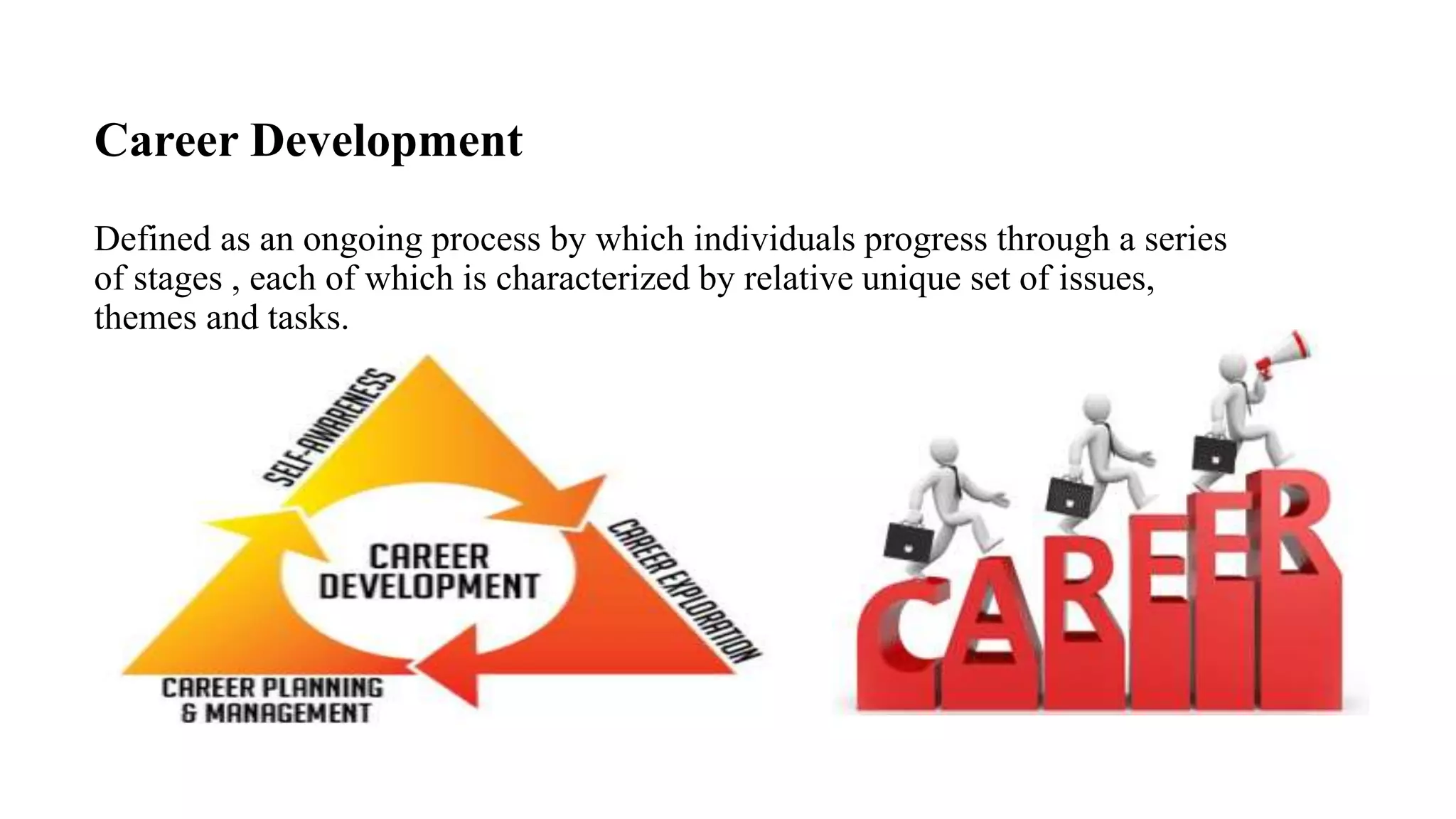
Defined as an ongoing process by which individuals progress through a series
of stages , each of which is characterized by relative unique set of issues,
themes and tasks.
Career Planning
• Deliberate process of becoming Self-aware, awareness of opportunities,
constraints, choices and consequences, identifying career related goals
and programming work, education and related development
experiences to provide the direction , timing and sequence of steps to
attain a specific career goal
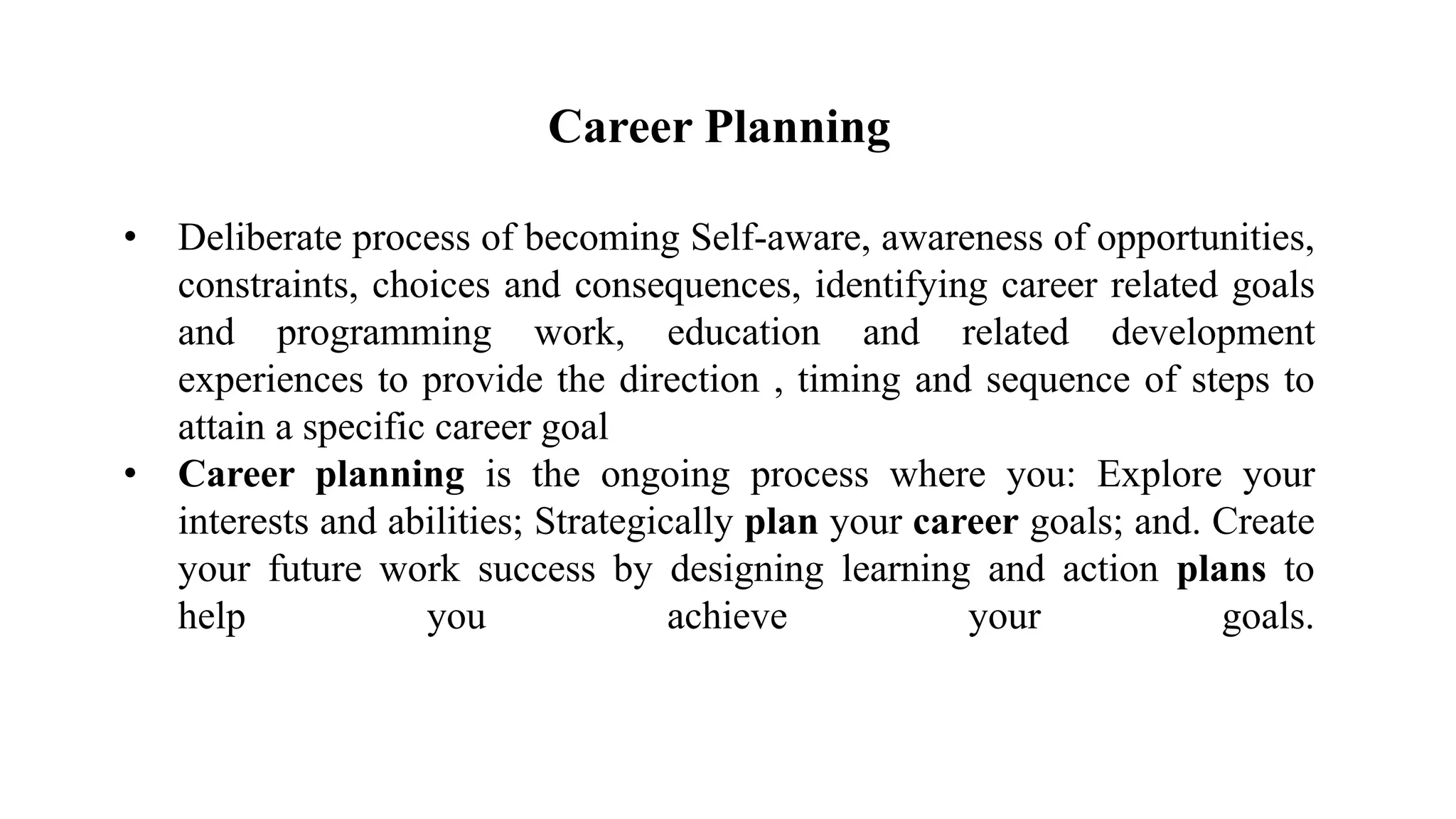
• Career planning is the ongoing process where you: Explore your
interests and abilities; Strategically plan your career goals; and. Create
your future work success by designing learning and action plans to
help you achieve your goals.
Steps of Career Planning
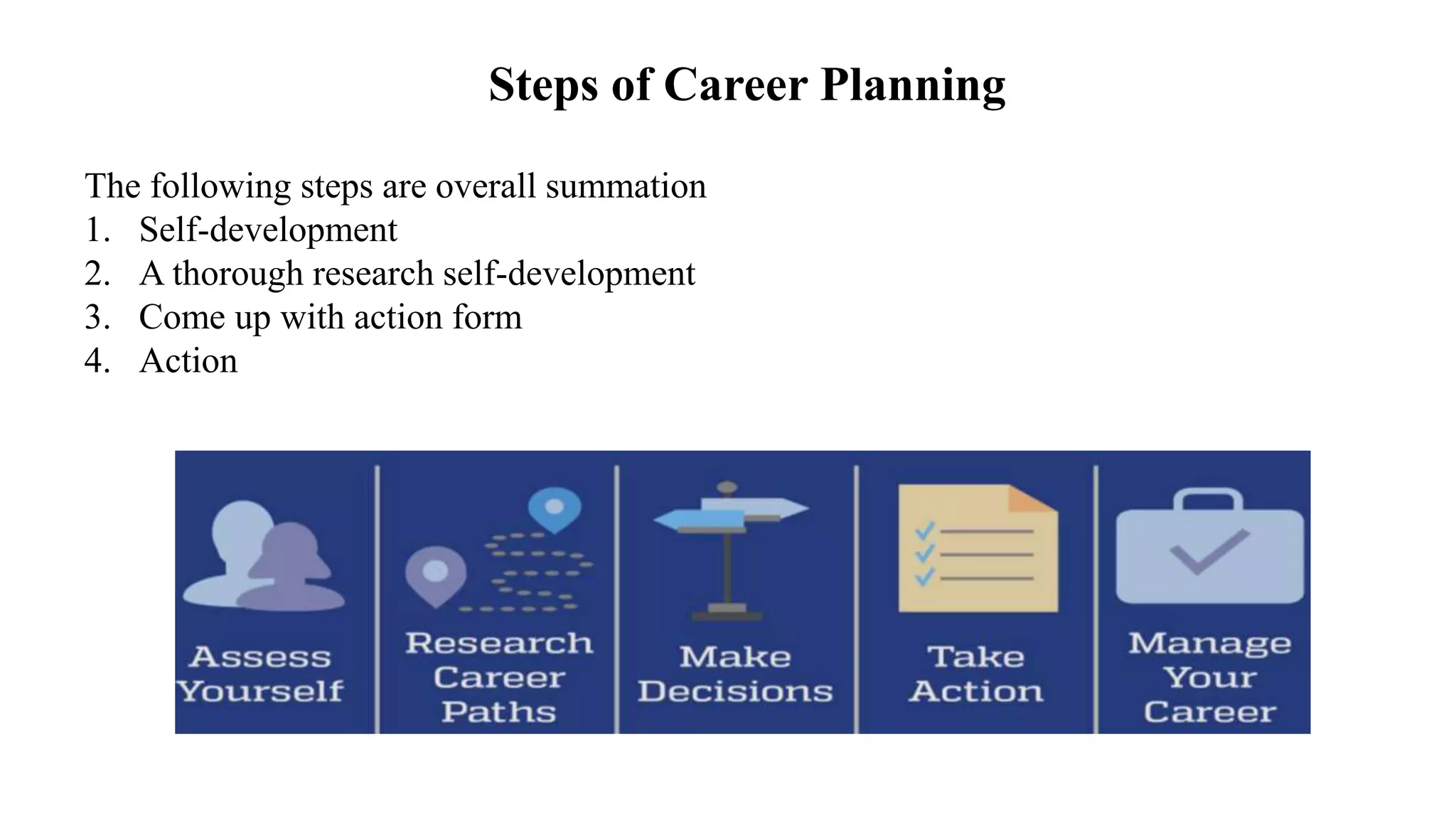
The following steps are overall summation
1. Self-development
2. A thorough research self-development
3. Come up with action form
4. Action
Career Management
Career management is conscious planning of one's activities and engagements in
the jobs one undertakes in the course of his life for better fulfilment, growth and
financial stability. It is a sequential process that starts from an understanding of
oneself and encompasses occupational awareness.
• Career Management Process
The onus of career management is more on the individual self than the
employee
Stages Of Life And Career Development
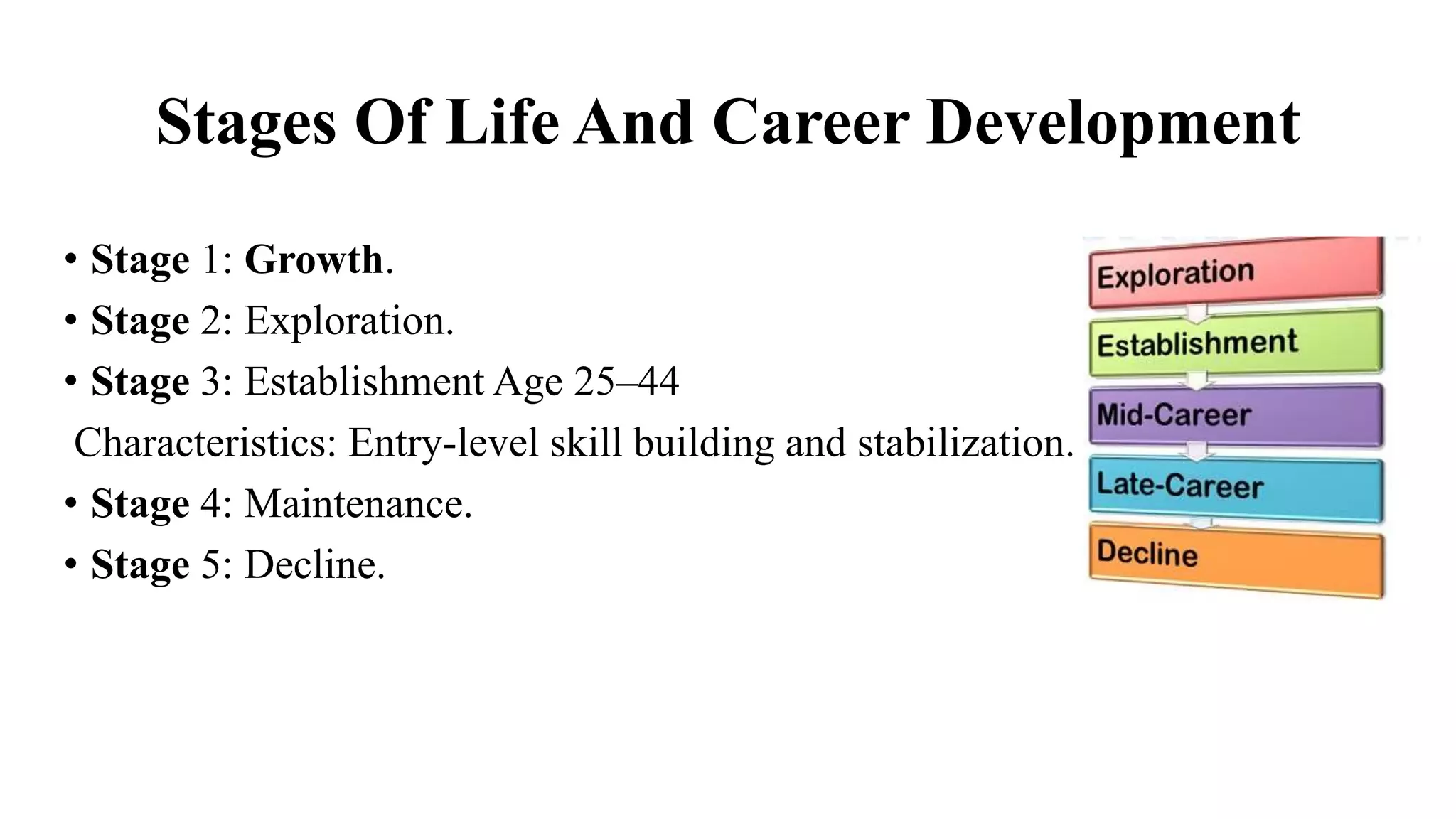
• Stage 1: Growth.
• Stage 2: Exploration.
• Stage 3: Establishment Age 25–44
Characteristics: Entry-level skill building and stabilization.
• Stage 4: Maintenance.
• Stage 5: Decline.
Stage views of Adult Development
1. ERIKSON’S MODEL OF ADULT DEVELOPMENT
• Based on Psychological and social issues
• Every stage poses a challenge
• Must solve that for development
• Challenge to develop capacity to focus on the generations that will follow is posed
in middle adulthood
• Proves that there is a predictable order to issues individuals face as they develop
2. LEVINSON’S “ERAS APPROACH TO ADULT
DEVELOPMENT
Traditional Models Of Career Development
Occupational & Organizational
Choice
Early Career Mid Career Late Career
Initially in between 0-25, than
variable
Age range between 25-40 Age range in between 40-
55
55- retirement
• Develop professional self image • Establishment • Remain productive in work • Still remains productive
• Self- assessments • Maintain self- esteem • Modify the dream • Prepare for effective
retirement
• Identify interest • Achievement • Decision- making ability
sharpness with past
experiences
• Peruse education • Learn job, organization norms
• Obtain job offers from various
organisations
• Increase competence
• Select appropriate job according to his/her
interest
Other ways of career development
• Reconciling the contrasting career models
• Life stage & career models as the conceptual base for career
development
Process of Career Management
An individually oriented career management model:
Career management activities are:
I. Career exploration
II. Awareness of self & environment
III. Goal setting
IV. Strategy development
V. Strategy implementation
VI. Progress toward the goal
VII. Feedback from work & non work sources
VIII. Career appraisal
Organizationally Oriented Career
Management Models
1.THE PLURALISTIC APPROACH
Three types of career management methods: (BROUSSEAU &
COLLEAGUES)
a) Counseling.
b) Individual career development program contracts.
c) Cafeteria approach that includes a verity of career track options, training
opportunities, performance evaluations schemes & reward system.
2. A SYSTEM VIEW OF CAREER MANAGEMENT
Three main elements of a career development system (NICHOLSON)
a) People system.
b) Job market system.
c) Management & information system.
3.TEAM- BASED CAREER DEVELOPMENT
Stage:1 Designed to integrate the individuals in to the team
stage: 2 Designed to continue team development
Stage: 3 Intended to make the team more independent & accountable
Roles in career management
1.THE INDIVIDUAL’S ROLE
Jones & Defillippi present six competencies:
a) Knowing what- Understanding the industry’s opportunities, threats, and
requirements
b) Knowing why- Understanding the meaning, motives, and interests for pursuing a
career
c) Knowing where- Understanding the locations and boundaries for entering, training,
and advancing within a career system
d) Knowing whom- Forming relationships based on attraction and social capital that
will gain access to opportunities and resources
e) Knowing when- Understanding the timing and choice of activities within one’s
career
f) Knowing how- Understanding and acquiring the skill and talents needed for
effective performance in assignments and responsibilities
2. THE MANAGERS RESPONSIBILITY
These roles include:
a) Coach- one who listens, clarifies, probes & defines employee career concerns.
b) Appraisal- one who gives feedback, clarifies performance standards & job
responsibilities.
c) Adviser- one who generates options, helps set goals makes recommendations
& give advise.
d) Referral Agent- one who consults with the employee on action plans and links
the employee to available organizational people and resources
Career Development Practices And
Activities
• Self-assessment activities – Workshops, workbooks, Holland
• Individual counseling
• Internal labor market – Postings, career paths, career enhancement
opportunities, skills inventories
• Organizational potential assessment – Potential ratings, succession
planning
• Developmental programs – Job rotation, mentoring
Issues in Career Development
• Developing career motivation – resilience, insight, identity
• Career plateau
• Career development for nonexempt employees
• Enrichment: effective career development without
advancement – certification, retraining, transfers/rotation
Delivering Effective Career Development
Systems
 Identify Needs
1. Link career development to business strategy.
2. Align employee and organization needs.
 Build a Vision for Change
3. Build system and link them to other management and HR systems(e.g.,
quality initiatives, orientation, performance evaluation, compensation).
4. Use a verity of tools and approaches.
 Develop a Plan for Action
5. Create a corporate infrastructure, but implement career development
system in individual business units or divisions.
6. Ensure line manager participation, starting with system development.
 Implement for Impact and Longevity
7. Hold line manager accountable and give them the skills they will need to
fulfill their responsibilities.
8. Follow up initial implementation with a series of activates that keep
career development salient (e.g., information sharing, career action teams).
 Evaluate and Maintain Results
9. Evaluate.
10. Continuously improve the career development effort.
11. Maintain high visibility and ongoing communication of career
development.
Career Planning, management & Development

Career Planning, management & Development

  • 1.
    Career Management & Development Prepared By: NiveditaShrivastava (177020592049) Meha Shah (177020592048) Mosmi Patel (177020592035) MBA Sem IV
  • 2.
    Introduction • Career The propertyof an occupation or organization: Which means the occupation itself (e.g. sales career) • Advancement One’s progression and increasing success within an organization. According to Greenhause & colleague: “Career is the pattern of work related experiences that span the course of person’s life”
  • 3.
    Career Development Defined asan ongoing process by which individuals progress through a series of stages , each of which is characterized by relative unique set of issues, themes and tasks.
  • 4.
    Career Planning • Deliberateprocess of becoming Self-aware, awareness of opportunities, constraints, choices and consequences, identifying career related goals and programming work, education and related development experiences to provide the direction , timing and sequence of steps to attain a specific career goal • Career planning is the ongoing process where you: Explore your interests and abilities; Strategically plan your career goals; and. Create your future work success by designing learning and action plans to help you achieve your goals.
  • 5.
    Steps of CareerPlanning The following steps are overall summation 1. Self-development 2. A thorough research self-development 3. Come up with action form 4. Action
  • 6.
    Career Management Career managementis conscious planning of one's activities and engagements in the jobs one undertakes in the course of his life for better fulfilment, growth and financial stability. It is a sequential process that starts from an understanding of oneself and encompasses occupational awareness. • Career Management Process The onus of career management is more on the individual self than the employee
  • 7.
    Stages Of LifeAnd Career Development • Stage 1: Growth. • Stage 2: Exploration. • Stage 3: Establishment Age 25–44 Characteristics: Entry-level skill building and stabilization. • Stage 4: Maintenance. • Stage 5: Decline.
  • 8.
    Stage views ofAdult Development 1. ERIKSON’S MODEL OF ADULT DEVELOPMENT • Based on Psychological and social issues • Every stage poses a challenge • Must solve that for development • Challenge to develop capacity to focus on the generations that will follow is posed in middle adulthood • Proves that there is a predictable order to issues individuals face as they develop
  • 10.
    2. LEVINSON’S “ERASAPPROACH TO ADULT DEVELOPMENT
  • 12.
    Traditional Models OfCareer Development Occupational & Organizational Choice Early Career Mid Career Late Career Initially in between 0-25, than variable Age range between 25-40 Age range in between 40- 55 55- retirement • Develop professional self image • Establishment • Remain productive in work • Still remains productive • Self- assessments • Maintain self- esteem • Modify the dream • Prepare for effective retirement • Identify interest • Achievement • Decision- making ability sharpness with past experiences • Peruse education • Learn job, organization norms • Obtain job offers from various organisations • Increase competence • Select appropriate job according to his/her interest
  • 13.
    Other ways ofcareer development • Reconciling the contrasting career models • Life stage & career models as the conceptual base for career development
  • 14.
    Process of CareerManagement An individually oriented career management model: Career management activities are: I. Career exploration II. Awareness of self & environment III. Goal setting IV. Strategy development V. Strategy implementation VI. Progress toward the goal VII. Feedback from work & non work sources VIII. Career appraisal
  • 15.
    Organizationally Oriented Career ManagementModels 1.THE PLURALISTIC APPROACH Three types of career management methods: (BROUSSEAU & COLLEAGUES) a) Counseling. b) Individual career development program contracts. c) Cafeteria approach that includes a verity of career track options, training opportunities, performance evaluations schemes & reward system.
  • 16.
    2. A SYSTEMVIEW OF CAREER MANAGEMENT Three main elements of a career development system (NICHOLSON) a) People system. b) Job market system. c) Management & information system. 3.TEAM- BASED CAREER DEVELOPMENT Stage:1 Designed to integrate the individuals in to the team stage: 2 Designed to continue team development Stage: 3 Intended to make the team more independent & accountable
  • 17.
    Roles in careermanagement 1.THE INDIVIDUAL’S ROLE Jones & Defillippi present six competencies: a) Knowing what- Understanding the industry’s opportunities, threats, and requirements b) Knowing why- Understanding the meaning, motives, and interests for pursuing a career c) Knowing where- Understanding the locations and boundaries for entering, training, and advancing within a career system d) Knowing whom- Forming relationships based on attraction and social capital that will gain access to opportunities and resources e) Knowing when- Understanding the timing and choice of activities within one’s career f) Knowing how- Understanding and acquiring the skill and talents needed for effective performance in assignments and responsibilities
  • 18.
    2. THE MANAGERSRESPONSIBILITY These roles include: a) Coach- one who listens, clarifies, probes & defines employee career concerns. b) Appraisal- one who gives feedback, clarifies performance standards & job responsibilities. c) Adviser- one who generates options, helps set goals makes recommendations & give advise. d) Referral Agent- one who consults with the employee on action plans and links the employee to available organizational people and resources
  • 19.
    Career Development PracticesAnd Activities • Self-assessment activities – Workshops, workbooks, Holland • Individual counseling • Internal labor market – Postings, career paths, career enhancement opportunities, skills inventories • Organizational potential assessment – Potential ratings, succession planning • Developmental programs – Job rotation, mentoring
  • 21.
    Issues in CareerDevelopment • Developing career motivation – resilience, insight, identity • Career plateau • Career development for nonexempt employees • Enrichment: effective career development without advancement – certification, retraining, transfers/rotation
  • 22.
    Delivering Effective CareerDevelopment Systems  Identify Needs 1. Link career development to business strategy. 2. Align employee and organization needs.  Build a Vision for Change 3. Build system and link them to other management and HR systems(e.g., quality initiatives, orientation, performance evaluation, compensation). 4. Use a verity of tools and approaches.  Develop a Plan for Action 5. Create a corporate infrastructure, but implement career development system in individual business units or divisions. 6. Ensure line manager participation, starting with system development.
  • 23.
     Implement forImpact and Longevity 7. Hold line manager accountable and give them the skills they will need to fulfill their responsibilities. 8. Follow up initial implementation with a series of activates that keep career development salient (e.g., information sharing, career action teams).  Evaluate and Maintain Results 9. Evaluate. 10. Continuously improve the career development effort. 11. Maintain high visibility and ongoing communication of career development.