CAREER COUNSELLING
RAMEES ABDUL RAZZAK
Msc Clinical & Counselling Psy
• Definition
• Changing Nature of work
• Theories of career development
• Career Planning & Decision Making in schools
• Counseling is a broad field that aims at helping people
and providing them with assistance with their mental
health and well-being.
• There are several types of counseling that deal with
different domains of an individual's life, such as
Marriage and Family Counseling, School Counseling,
Crisis Counseling etc. etc.
• THEN WHAT IS A CAREER COUNSELLING?
• In olden days what used to be called vocational
guidance at that time is now referred to as career
counselling.
• Career counselling can be defined as a process that
helps an individual to gain an understanding of oneself
and the various interests to make a firm decision about
the career choice and further education plans.
• It helps in managing a variety of problems such as
managing time, help in increasing the concentration
levels, resolving various conflicts between parents and
children in a family regarding what profession should
a child choose.
• Career counselling is a domain of counseling that
focuses on helping individuals find the right career
pathway.
• In career counselling the individuals receive guidance
from professional counselors that provide expert
advice on the potentials, aptitude, motivations, skills
and shortcomings with the use of carefully designed
assessment tools.
• After carefully studying the individual's interests and
aptitude, career counselors guide individuals to set
their career goals.
WHAT to expect from
career counselling
• Career counselors work along with their clients in a
systematic pattern.
• They determine the individual's strengths, weaknesses,
learning patterns and their interests.
• Usually, tools like, aptitude test, IQ or interest tests are used
to understand the individual.
• Based on the reports the counselor then works along with
the individual to find for a potential career choice.
• From helping choose the right board, course, college to
choosing the right job, the counselor guides the individual
in mapping the entire pathway to the desired goal.
Significance of Career counselling
• With increasingly myriad career options rising, career
counselling has become an essential part of people's
life.
• Students after completing their 10th are often
indecisive of what to do further.
• This indecisiveness could be a result of social pressure,
lack of parental guidance, multiple career options,
ignorance of personal potentials etc.
• career counselors cater to these issues effectively.
Although career counselling is vital to all age groups,
teenagers can benefit most from it.
• Besides students, career counselling also caters to
employees who have already chosen a career and are
not satisfied with it.
• Factors like life satisfaction, self-efficacy, happiness
etc.are all co-dependent to job satisfaction therefore
there is a lot of importance given to career counselling.
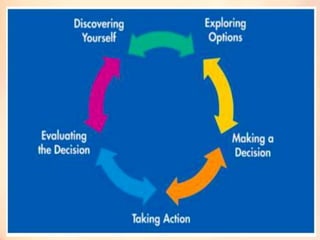
CAREER PLANNING & DECISION
MAKING PROCESS
STEP 1: DISCOVERING YOURSELF
• What are my interests? Values? Skills? Personality
preferences? Strengths?
• What are careers that interest me?
• What are college majors that I want to explore?
STEP 2: EXPLORING OPTIONS
• What information or individuals can help me to
explore my college or career options?
• What classes or activities can help me to develop my
strengths?
• How can I learn more about informational interviews,
job shadowing, internships, service learning, or
student organizations to gain firsthand experience
about a field?
STEP 3: MAKING A DECISION
• How much time and energy am I willing to invest to
make a career decision?
• Who is part of my support system to help me evaluate
the pros and cons?
• What are my top priorities to consider for this
decision?
STEP 4: TAKING ACTION
• How can I strengthen my readiness for success in a
college major?
• What is one goal that I have? How can I reach it? What
action can I take now?
• Which one of my talents can I develop through classes
or outside activities?
STEP 5: EVALUATING THE DECISION
• Is my decision a realistic option?
• Is there anything preventing me from achieving this
goal?
• Who in my support system can assist me with
achieving this goal?
THEORIES OF CAREER
COUNSELLING
MAJOR THEORIES
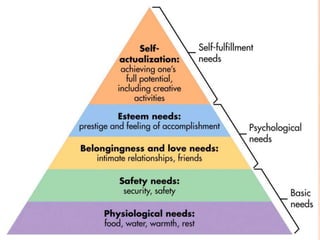
• Maslow’s Hierarchy of Need theory
• Frank Parson’s Trait and Factor Theory
• John Holland Person Environment Fit Theory
• Ginzberg Developmental Theory
• Super’s Lifelong Career Devolopmental Theory
• Krumboltz Social Learning Theory
Importance of Maslow’s Hierarchy of
Needs to the work of CDP
• According to the Maslow’s Theory needs related to our
work roles begin at his third level – Love and
Belonging
• Level 3 refers to becoming part of the work
environment Need to be sure that there are no deficits
in physiological and safety needs before working with
an individual on their work-related need.
• At Level 4, we are achieving status at work and have a
reputation in our field
Frank Parson’s Trait and Factor Theory
• Frank Parson is known as the Father of Career
Counselling
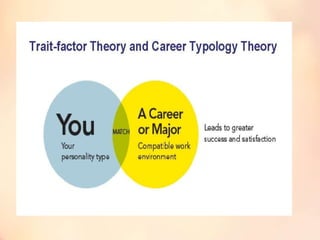
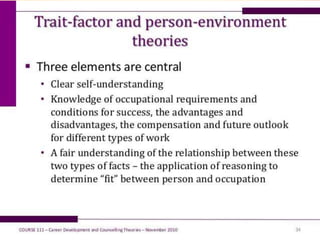
• He argued that a wise vocational choice was made
first by studying the individual, second by
understanding the relevant characteristics of
occupations, and finally by matching the individual
with the occupation.
Theory Emphasizes
• Traits: interests, values, aptitudes and personality
characteristics
#with •
• A work environment which is congruent (a “good fit”)
with those traits
According to Parsons’
• the choice of a vocation assumes
• self-knowledge and knowledge of occupations
• No one can decide for someone else
• A person can benefit from expert advice
• The counsellor’s role is to give clients accurate
feedback on their strengths and weaknesses
• This process, trait-and-factor theory, became the
foundation for many career counseling programs and
is still in use today.
• It has led to the development of assessment
instruments, as well as to the study of individual job
requirements.
• This theory focuses on individual traits but does not
account for changes in values, interest, skills,
achievement, and personality over the course of a
lifetime.
• Thus, although assessments based on the trait-and-
factor approach are quite useful in career counseling,
this theory is generally considered to be quite limited.
John Holland Person Environment Fit
Theory
• According to Holland (1985), the choice of a career is
an extension of one’s personality into the world of
work.
• Individuals choose careers that satisfy their preferred
personal orientations.
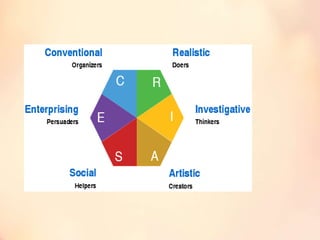
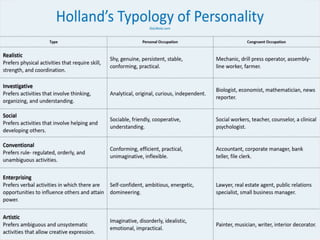
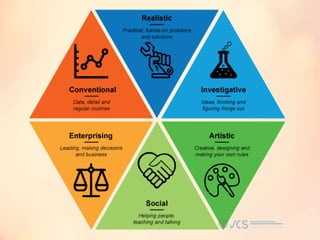
• Holland developed six modal personal styles and six
matching work environments:
• Realistic, Investigative, Artistic, Social, Enterprising,
and Conventional.
John Holland Person Environment Fit
Theory
• Personality is a basic factor in career choice
• Interest inventories are really personality inventories
• Different tasks require different workers
• A person is attracted to the particular role demand of
an occupational environment that meets his or her
needs.
• For example, someone who is socially oriented would
seek out a work environment that provides
interactions with others, such as nursing in a hospital
setting.
• Holland and his colleagues have developed a number
of instruments (e.g., Strong Interest Inventory)
designed to assist in identifying individual personality
traits and matching those traits to occupational
groups.
• Differentiation – refers to the degree of certainty or
definition of an individual’s interest – is there a clear
distinction between the individual’s likes and dislikes.
• If all six are quite low or quite high, the profile is called
“flat” or “undifferentiated”.
• If some scores are high and some are low, the profile
has “peaks and valleys” and is called differentiated
profile.
• it means that the person has some areas of interest
that are considerably higher than others
• Flat profiles can mean that individuals don’t really
know their interests
• High flat profiles mean they could have many interests
and might need to work on narrowing down
• A low flat profile could show minimal exposure to
occupations and work activities but could also show a
weak self-concept or low self-esteem
• Congruence – describes the degree of fit between an
individual’s personality type and work environment
• Client’s response may be assessed on instruments, like
on Strong-Campbell Interest Inventory.
• A person gets a three-letter code which describes the
kind of work that person is suitable for. For example, if
a person gets a code of “RIA”, it will indicate that the
person is Realistic, investigative, and artistic.
• The next task will be to determine the kind of jobs that
are congruent with that RIA profile, for example,
architectural draftsman, and dental technician.
• The counselor then looks for the congruence between
personality and job requirement. He may look for the
details of different suitable jobs for that person.
GINZBERG DEVOLOPMENTAL
THEORY
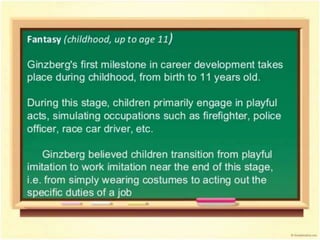
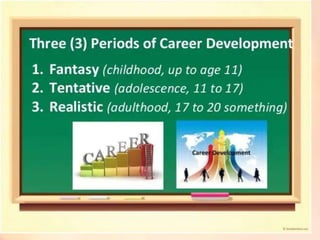
• Ginzberg Viewed career development as a lifelong
process.
• Recognizing that vocational choice is influenced by
four facts:
• the reality factor,
• the influence of the educational process,
• the emotional factor
• individual values
• The theory proposes that it is a development path that
leads to career choice.
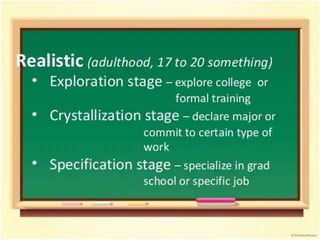
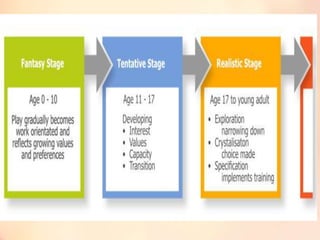
• Starting in preteen and ending in young adulthood,
individuals pass through three stages
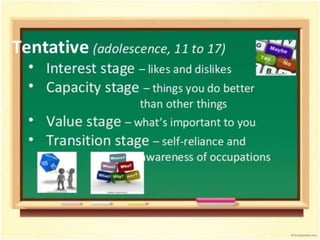
• From 11 to 17 years of age, adolescent children are
able to better focus on, and recognize, work
requirements.
• "interest," where children learn likes and dislikes.
• "capacity," where the child learns how much her
abilities align with her interests.
• "values," sees the child become aware of how work
may fulfill her values.
• "transition,“- individual assumes responsibility for her
own actions, becomes independent and exercises her
freedom of choice
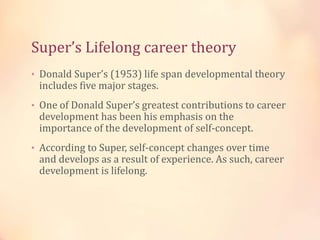
Super’s Lifelong career theory
• Donald Super’s (1953) life span developmental theory
includes five major stages.
• One of Donald Super’s greatest contributions to career
development has been his emphasis on the
importance of the development of self-concept.
• According to Super, self-concept changes over time
and develops as a result of experience. As such, career
development is lifelong.
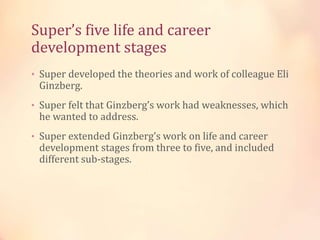
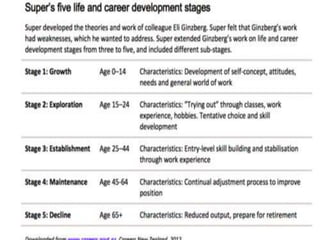
Super’s five life and career
development stages
• Super developed the theories and work of colleague Eli
Ginzberg.

• Super felt that Ginzberg’s work had weaknesses, which
he wanted to address.
• Super extended Ginzberg’s work on life and career
development stages from three to five, and included
different sub-stages.
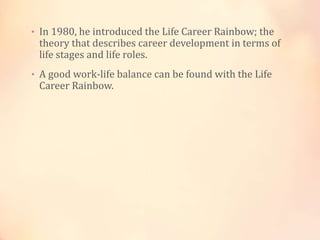
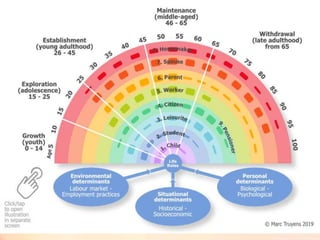
• In 1980, he introduced the Life Career Rainbow; the
theory that describes career development in terms of
life stages and life roles.
• A good work-life balance can be found with the Life
Career Rainbow.
CAREER COUNSELLING.pptx

CAREER COUNSELLING.pptx

  • 1.
    CAREER COUNSELLING RAMEES ABDULRAZZAK Msc Clinical & Counselling Psy
  • 2.
    • Definition • ChangingNature of work • Theories of career development • Career Planning & Decision Making in schools
  • 3.
    • Counseling isa broad field that aims at helping people and providing them with assistance with their mental health and well-being. • There are several types of counseling that deal with different domains of an individual's life, such as Marriage and Family Counseling, School Counseling, Crisis Counseling etc. etc. • THEN WHAT IS A CAREER COUNSELLING? • In olden days what used to be called vocational guidance at that time is now referred to as career counselling.
  • 5.
    • Career counsellingcan be defined as a process that helps an individual to gain an understanding of oneself and the various interests to make a firm decision about the career choice and further education plans. • It helps in managing a variety of problems such as managing time, help in increasing the concentration levels, resolving various conflicts between parents and children in a family regarding what profession should a child choose. • Career counselling is a domain of counseling that focuses on helping individuals find the right career pathway.
  • 6.
    • In careercounselling the individuals receive guidance from professional counselors that provide expert advice on the potentials, aptitude, motivations, skills and shortcomings with the use of carefully designed assessment tools. • After carefully studying the individual's interests and aptitude, career counselors guide individuals to set their career goals.
  • 7.
    WHAT to expectfrom career counselling • Career counselors work along with their clients in a systematic pattern. • They determine the individual's strengths, weaknesses, learning patterns and their interests. • Usually, tools like, aptitude test, IQ or interest tests are used to understand the individual. • Based on the reports the counselor then works along with the individual to find for a potential career choice. • From helping choose the right board, course, college to choosing the right job, the counselor guides the individual in mapping the entire pathway to the desired goal.
  • 8.
    Significance of Careercounselling • With increasingly myriad career options rising, career counselling has become an essential part of people's life. • Students after completing their 10th are often indecisive of what to do further. • This indecisiveness could be a result of social pressure, lack of parental guidance, multiple career options, ignorance of personal potentials etc.
  • 9.
    • career counselorscater to these issues effectively. Although career counselling is vital to all age groups, teenagers can benefit most from it. • Besides students, career counselling also caters to employees who have already chosen a career and are not satisfied with it. • Factors like life satisfaction, self-efficacy, happiness etc.are all co-dependent to job satisfaction therefore there is a lot of importance given to career counselling.
  • 10.
    CAREER PLANNING &DECISION MAKING PROCESS
  • 12.
    STEP 1: DISCOVERINGYOURSELF • What are my interests? Values? Skills? Personality preferences? Strengths? • What are careers that interest me? • What are college majors that I want to explore?
  • 13.
    STEP 2: EXPLORINGOPTIONS • What information or individuals can help me to explore my college or career options? • What classes or activities can help me to develop my strengths? • How can I learn more about informational interviews, job shadowing, internships, service learning, or student organizations to gain firsthand experience about a field?
  • 14.
    STEP 3: MAKINGA DECISION • How much time and energy am I willing to invest to make a career decision? • Who is part of my support system to help me evaluate the pros and cons? • What are my top priorities to consider for this decision?
  • 15.
    STEP 4: TAKINGACTION • How can I strengthen my readiness for success in a college major? • What is one goal that I have? How can I reach it? What action can I take now? • Which one of my talents can I develop through classes or outside activities?
  • 16.
    STEP 5: EVALUATINGTHE DECISION • Is my decision a realistic option? • Is there anything preventing me from achieving this goal? • Who in my support system can assist me with achieving this goal?
  • 17.
  • 18.
    MAJOR THEORIES • Maslow’sHierarchy of Need theory • Frank Parson’s Trait and Factor Theory • John Holland Person Environment Fit Theory • Ginzberg Developmental Theory • Super’s Lifelong Career Devolopmental Theory • Krumboltz Social Learning Theory
  • 19.
    Importance of Maslow’sHierarchy of Needs to the work of CDP • According to the Maslow’s Theory needs related to our work roles begin at his third level – Love and Belonging • Level 3 refers to becoming part of the work environment Need to be sure that there are no deficits in physiological and safety needs before working with an individual on their work-related need. • At Level 4, we are achieving status at work and have a reputation in our field
  • 21.
    Frank Parson’s Traitand Factor Theory • Frank Parson is known as the Father of Career Counselling • He argued that a wise vocational choice was made first by studying the individual, second by understanding the relevant characteristics of occupations, and finally by matching the individual with the occupation.
  • 23.
    Theory Emphasizes • Traits:interests, values, aptitudes and personality characteristics #with • • A work environment which is congruent (a “good fit”) with those traits
  • 24.
    According to Parsons’ •the choice of a vocation assumes • self-knowledge and knowledge of occupations • No one can decide for someone else • A person can benefit from expert advice • The counsellor’s role is to give clients accurate feedback on their strengths and weaknesses
  • 26.
    • This process,trait-and-factor theory, became the foundation for many career counseling programs and is still in use today. • It has led to the development of assessment instruments, as well as to the study of individual job requirements. • This theory focuses on individual traits but does not account for changes in values, interest, skills, achievement, and personality over the course of a lifetime. • Thus, although assessments based on the trait-and- factor approach are quite useful in career counseling, this theory is generally considered to be quite limited.
  • 27.
    John Holland PersonEnvironment Fit Theory • According to Holland (1985), the choice of a career is an extension of one’s personality into the world of work. • Individuals choose careers that satisfy their preferred personal orientations. • Holland developed six modal personal styles and six matching work environments: • Realistic, Investigative, Artistic, Social, Enterprising, and Conventional.
  • 28.
    John Holland PersonEnvironment Fit Theory • Personality is a basic factor in career choice • Interest inventories are really personality inventories • Different tasks require different workers
  • 32.
    • A personis attracted to the particular role demand of an occupational environment that meets his or her needs. • For example, someone who is socially oriented would seek out a work environment that provides interactions with others, such as nursing in a hospital setting. • Holland and his colleagues have developed a number of instruments (e.g., Strong Interest Inventory) designed to assist in identifying individual personality traits and matching those traits to occupational groups.
  • 33.
    • Differentiation –refers to the degree of certainty or definition of an individual’s interest – is there a clear distinction between the individual’s likes and dislikes. • If all six are quite low or quite high, the profile is called “flat” or “undifferentiated”. • If some scores are high and some are low, the profile has “peaks and valleys” and is called differentiated profile. • it means that the person has some areas of interest that are considerably higher than others
  • 34.
    • Flat profilescan mean that individuals don’t really know their interests • High flat profiles mean they could have many interests and might need to work on narrowing down • A low flat profile could show minimal exposure to occupations and work activities but could also show a weak self-concept or low self-esteem • Congruence – describes the degree of fit between an individual’s personality type and work environment
  • 35.
    • Client’s responsemay be assessed on instruments, like on Strong-Campbell Interest Inventory. • A person gets a three-letter code which describes the kind of work that person is suitable for. For example, if a person gets a code of “RIA”, it will indicate that the person is Realistic, investigative, and artistic. • The next task will be to determine the kind of jobs that are congruent with that RIA profile, for example, architectural draftsman, and dental technician. • The counselor then looks for the congruence between personality and job requirement. He may look for the details of different suitable jobs for that person.
  • 36.
    GINZBERG DEVOLOPMENTAL THEORY • GinzbergViewed career development as a lifelong process. • Recognizing that vocational choice is influenced by four facts: • the reality factor, • the influence of the educational process, • the emotional factor • individual values
  • 37.
    • The theoryproposes that it is a development path that leads to career choice. • Starting in preteen and ending in young adulthood, individuals pass through three stages
  • 42.
    • From 11to 17 years of age, adolescent children are able to better focus on, and recognize, work requirements. • "interest," where children learn likes and dislikes. • "capacity," where the child learns how much her abilities align with her interests. • "values," sees the child become aware of how work may fulfill her values. • "transition,“- individual assumes responsibility for her own actions, becomes independent and exercises her freedom of choice
  • 45.
    Super’s Lifelong careertheory • Donald Super’s (1953) life span developmental theory includes five major stages. • One of Donald Super’s greatest contributions to career development has been his emphasis on the importance of the development of self-concept. • According to Super, self-concept changes over time and develops as a result of experience. As such, career development is lifelong.
  • 46.
    Super’s five lifeand career development stages • Super developed the theories and work of colleague Eli Ginzberg. • Super felt that Ginzberg’s work had weaknesses, which he wanted to address. • Super extended Ginzberg’s work on life and career development stages from three to five, and included different sub-stages.
  • 48.
    • In 1980,he introduced the Life Career Rainbow; the theory that describes career development in terms of life stages and life roles. • A good work-life balance can be found with the Life Career Rainbow.