SERVICE QUALITY : Critical part of
your marketing mix
A gap between rhetoric and action will
adversely affect the your business
Feedback mechanisms bridge the gap
Why Me?
• Business background: Cadbury Schweppes
– Cost reductions, productivity analysis, systems
analysis and other ‘stuff’ based on quality info
• Business lecturer
• Database & info manager:
– data, quality, audit, feedback, reporting on
performance, reporting to contract, management
info.
• Linemere Consultants Ltd
– Care2 Improve: performance audit for Care.
Businesses are effective and generate
more profit when they
:
– Have a good product for which there is demand
– Are well lead
• Have simple systematic processes
• Are people orientated
• Manage their costs
• Have monitoring and feedback mechanisms that
ensure they know what is happening
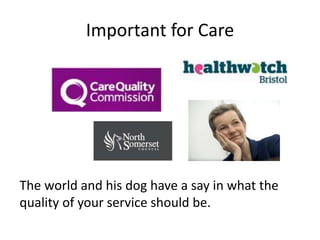
Important for Care
The world and his dog have a say in what the
quality of your service should be.
Everyone is prepared to comment
The LA tap flows less strongly
• Council contracting practice changes
• Tighter criteria for council funding
• More dependence on privately funded clients
You have to
• Provide Good Quality Service
• Prove you provide Good Quality Service
• Maintain & improve service over time.
Increasingly CQC look for quantifiable evidence
of performance and improvement.
You need feedback systems
But you know your own business, don’t you?
You have your finger on the pulse?
……
Why focus on ‘systems’?
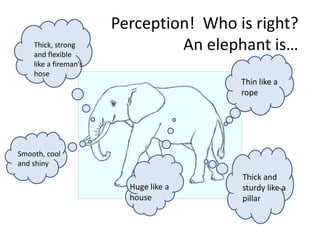
Perception! Who is right?
An elephant is…
Thin like a
rope
Thick and
sturdy like a
pillar
Thick, strong
and flexible
like a fireman’s
hose
Smooth, cool
and shiny
Huge like a
house
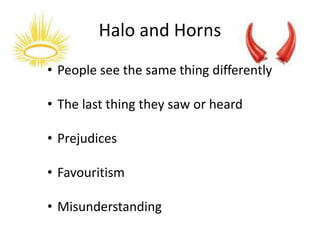
Halo and Horns
• People see the same thing differently
• The last thing they saw or heard
• Prejudices
• Favouritism
• Misunderstanding
Cutting to the chase
• Loads of management models of quality.
• All involve robust feedback mechanisms
• CQC have a feedback model
• Local authorities have a feedback model
• NHS choices have a feedback model
• LA or CQC feedback can damage your business
You need feedback mechanisms that
– Isolate and measure critical performance
indicators
– Deal with perceptions and the halo / horns bias
– Provide accurate, measurable results
– Are objective and verifiable
– Are reliable
– Are a tool that will help you prioritise and make
decisions
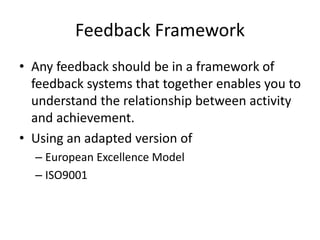
Feedback Framework
• Any feedback should be in a framework of
feedback systems that together enables you to
understand the relationship between activity
and achievement.
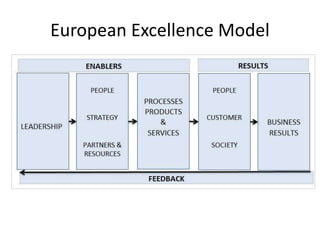
• Using an adapted version of
– European Excellence Model
– ISO9001
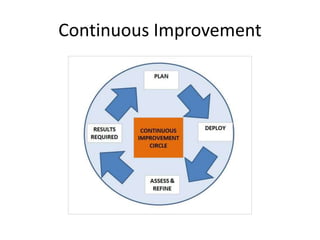
Continuous Improvement
European Excellence Model
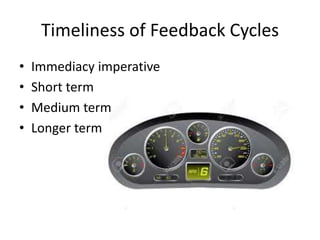
Timeliness of Feedback Cycles
• Immediacy imperative
• Short term
• Medium term
• Longer term
Fitting it into business routines
Example 1: Client in Domiciliary care wanted an
Employee Performance Monitor
Workbook per employee:
• Input sheet
• Chart
Using natural opportunities for
assessment
• 1:1 supervisions
• QA visits
• Spotchecks
• Observations from the office on compliance
etc
• Comments from clients (complaints or
commendations)
Critical Performance Indicators
• Punctuality
• Appearance
• Flexibility
• Reliability
• Personal care skills
• Cooking skills
• Client feedback
• Teamwork
• Confidence
Performance standards
Wanted to use marks out of 10
• 7 is a standard acceptable standard
• 6 is underperforming
• under 6 would be a disciplinary issue
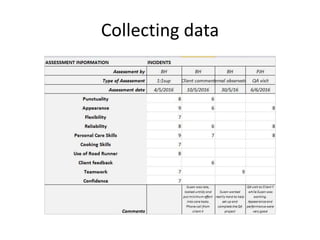
Scoring and Use
At each assessment incident:
• Date, time and nature of assessment is
recorded
• 1 or more indicators are scored as
appropriate.
• Comments are added
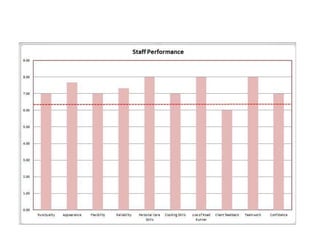
The data is compiled over time to show average
performance for each indicator
Collecting data
Embedding the process
• Accepted as part of the ongoing business
process.
• Used as part of the appraisal process
• Staff like it because it
– Is methodical and demonstrable, not ‘opinion’
– Specific incidents
– Framework for discussion
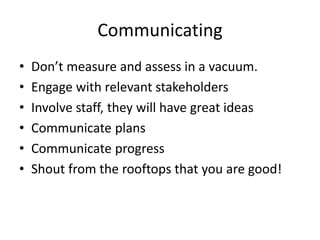
Communicating
• Don’t measure and assess in a vacuum.
• Engage with relevant stakeholders
• Involve staff, they will have great ideas
• Communicate plans
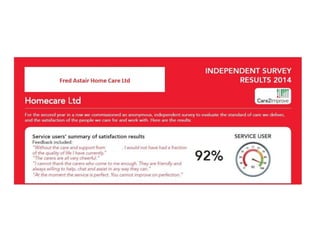
• Communicate progress
• Shout from the rooftops that you are good!
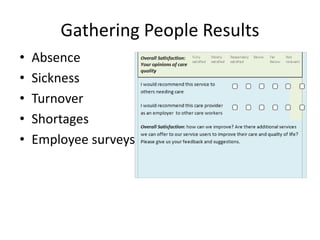
Gathering People Results
• Absence
• Sickness
• Turnover
• Shortages
• Employee surveys
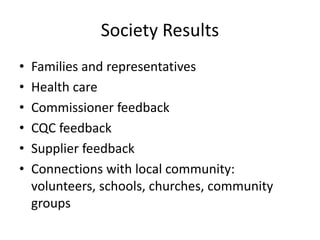
Society Results
• Families and representatives
• Health care
• Commissioner feedback
• CQC feedback
• Supplier feedback
• Connections with local community:
volunteers, schools, churches, community
groups
Customer Results
• Retention rate
• Reasons for leaving
• Client referrals
• Customer satisfaction
• Focus groups
• Complaints
Process and Service Monitoring
Quality audit:
• Maintenance and housekeeping
• Stock
• Client Records
• Referral processes and referral quality
• Data quality
• Spot checks on service
• Secret shopper
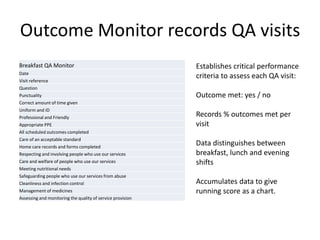
Outcome Monitor records QA visits
Breakfast QA Monitor
Date
Visit reference
Question
Punctuality
Correct amount of time given
Uniform and ID
Professional and Friendly
Appropriate PPE
All scheduled outcomes completed
Care of an acceptable standard
Home care records and forms completed
Respecting and involving people who use our services
Care and welfare of people who use our services
Meeting nutritional needs
Safeguarding people who use our services from abuse
Cleanliness and infection control
Management of medicines
Assessing and monitoring the quality of service provision
Establishes critical performance
criteria to assess each QA visit:
Outcome met: yes / no
Records % outcomes met per
visit
Data distinguishes between
breakfast, lunch and evening
shifts
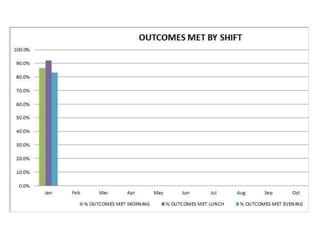
Accumulates data to give
running score as a chart.
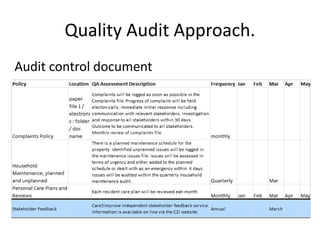
Quality Audit Approach.
Audit control document
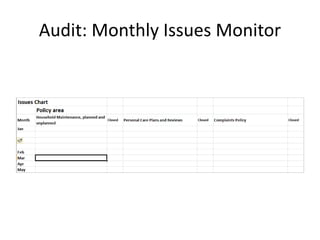
Audit: Monthly Issues Monitor
Care2Improve Survey Cycle
• Enables structured feedback from 4
stakeholder groups:
– Service users / Relatives / representatives
– Staff / other professional
• Data fed into a software package
– an online dashboard of quantitative results
– qualitative comment.
• Benchmark performance over time.
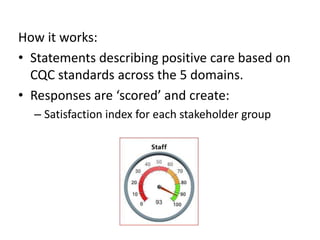
How it works:
• Statements describing positive care based on
CQC standards across the 5 domains.
• Responses are ‘scored’ and create:
– Satisfaction index for each stakeholder group
http://www.care2improve.co.uk/
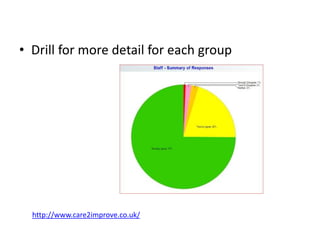
• Drill for more detail for each group
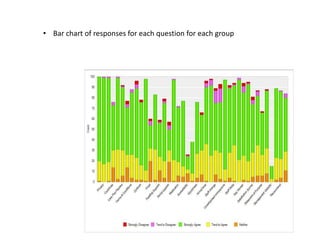
• Bar chart of responses for each question for each group
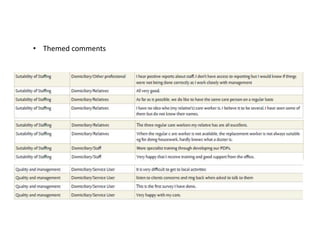
• Themed comments
What can C&SW do to help?
• Help with policies and process improvement
• Registered manager’s network
• Help with communication of results /
newsletters for clients, relatives, staff, other
professionals
• Help putting together monitors to help
measure critical performance
• Care2Improve surveys: discounts for members

Care2 improve

  • 1.
    SERVICE QUALITY :Critical part of your marketing mix A gap between rhetoric and action will adversely affect the your business Feedback mechanisms bridge the gap
  • 2.
    Why Me? • Businessbackground: Cadbury Schweppes – Cost reductions, productivity analysis, systems analysis and other ‘stuff’ based on quality info • Business lecturer • Database & info manager: – data, quality, audit, feedback, reporting on performance, reporting to contract, management info. • Linemere Consultants Ltd – Care2 Improve: performance audit for Care.
  • 3.
    Businesses are effectiveand generate more profit when they : – Have a good product for which there is demand – Are well lead • Have simple systematic processes • Are people orientated • Manage their costs • Have monitoring and feedback mechanisms that ensure they know what is happening
  • 4.
    Important for Care Theworld and his dog have a say in what the quality of your service should be.
  • 5.
  • 6.
    The LA tapflows less strongly • Council contracting practice changes • Tighter criteria for council funding • More dependence on privately funded clients
  • 7.
    You have to •Provide Good Quality Service • Prove you provide Good Quality Service • Maintain & improve service over time. Increasingly CQC look for quantifiable evidence of performance and improvement.
  • 8.
    You need feedbacksystems But you know your own business, don’t you? You have your finger on the pulse? …… Why focus on ‘systems’?
  • 9.
    Perception! Who isright? An elephant is… Thin like a rope Thick and sturdy like a pillar Thick, strong and flexible like a fireman’s hose Smooth, cool and shiny Huge like a house
  • 10.
    Halo and Horns •People see the same thing differently • The last thing they saw or heard • Prejudices • Favouritism • Misunderstanding
  • 11.
    Cutting to thechase • Loads of management models of quality. • All involve robust feedback mechanisms • CQC have a feedback model • Local authorities have a feedback model • NHS choices have a feedback model • LA or CQC feedback can damage your business
  • 12.
    You need feedbackmechanisms that – Isolate and measure critical performance indicators – Deal with perceptions and the halo / horns bias – Provide accurate, measurable results – Are objective and verifiable – Are reliable – Are a tool that will help you prioritise and make decisions
  • 13.
    Feedback Framework • Anyfeedback should be in a framework of feedback systems that together enables you to understand the relationship between activity and achievement. • Using an adapted version of – European Excellence Model – ISO9001
  • 14.
  • 15.
  • 16.
    Timeliness of FeedbackCycles • Immediacy imperative • Short term • Medium term • Longer term
  • 17.
    Fitting it intobusiness routines Example 1: Client in Domiciliary care wanted an Employee Performance Monitor Workbook per employee: • Input sheet • Chart
  • 18.
    Using natural opportunitiesfor assessment • 1:1 supervisions • QA visits • Spotchecks • Observations from the office on compliance etc • Comments from clients (complaints or commendations)
  • 19.
    Critical Performance Indicators •Punctuality • Appearance • Flexibility • Reliability • Personal care skills • Cooking skills • Client feedback • Teamwork • Confidence
  • 20.
    Performance standards Wanted touse marks out of 10 • 7 is a standard acceptable standard • 6 is underperforming • under 6 would be a disciplinary issue
  • 21.
    Scoring and Use Ateach assessment incident: • Date, time and nature of assessment is recorded • 1 or more indicators are scored as appropriate. • Comments are added The data is compiled over time to show average performance for each indicator
  • 22.
  • 24.
    Embedding the process •Accepted as part of the ongoing business process. • Used as part of the appraisal process • Staff like it because it – Is methodical and demonstrable, not ‘opinion’ – Specific incidents – Framework for discussion
  • 25.
    Communicating • Don’t measureand assess in a vacuum. • Engage with relevant stakeholders • Involve staff, they will have great ideas • Communicate plans • Communicate progress • Shout from the rooftops that you are good!
  • 27.
    Gathering People Results •Absence • Sickness • Turnover • Shortages • Employee surveys
  • 28.
    Society Results • Familiesand representatives • Health care • Commissioner feedback • CQC feedback • Supplier feedback • Connections with local community: volunteers, schools, churches, community groups
  • 29.
    Customer Results • Retentionrate • Reasons for leaving • Client referrals • Customer satisfaction • Focus groups • Complaints
  • 30.
    Process and ServiceMonitoring Quality audit: • Maintenance and housekeeping • Stock • Client Records • Referral processes and referral quality • Data quality • Spot checks on service • Secret shopper
  • 31.
    Outcome Monitor recordsQA visits Breakfast QA Monitor Date Visit reference Question Punctuality Correct amount of time given Uniform and ID Professional and Friendly Appropriate PPE All scheduled outcomes completed Care of an acceptable standard Home care records and forms completed Respecting and involving people who use our services Care and welfare of people who use our services Meeting nutritional needs Safeguarding people who use our services from abuse Cleanliness and infection control Management of medicines Assessing and monitoring the quality of service provision Establishes critical performance criteria to assess each QA visit: Outcome met: yes / no Records % outcomes met per visit Data distinguishes between breakfast, lunch and evening shifts Accumulates data to give running score as a chart.
  • 33.
  • 34.
  • 35.
    Care2Improve Survey Cycle •Enables structured feedback from 4 stakeholder groups: – Service users / Relatives / representatives – Staff / other professional • Data fed into a software package – an online dashboard of quantitative results – qualitative comment. • Benchmark performance over time.
  • 36.
    How it works: •Statements describing positive care based on CQC standards across the 5 domains. • Responses are ‘scored’ and create: – Satisfaction index for each stakeholder group
  • 37.
  • 38.
    • Bar chartof responses for each question for each group
  • 39.
  • 40.
    What can C&SWdo to help? • Help with policies and process improvement • Registered manager’s network • Help with communication of results / newsletters for clients, relatives, staff, other professionals • Help putting together monitors to help measure critical performance • Care2Improve surveys: discounts for members