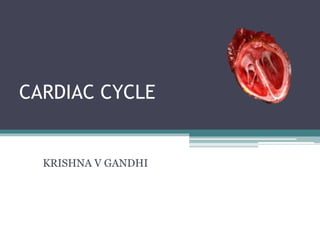
CARDIAC CYCLE
KRISHNA V GANDHI
OBJECTIVES
AT THE END OF THE TEACHING GROUP WILL
BE ABLE TO LEARN :
• To define the cardiac cycle.
• To describe terminologies related to cardiac
cycle.
• To discuss systole and diastole.
• To describe quiescent period.
• To enlist and explain phases of cardiac cycle.
• To conclude phases diagrammatically.
REVIEW OF ANATOMY
OF HEART
Introduction
• Heart act as a pump.
• 2 separate pump in series:
 Systole: Period of contraction.
 Diastole: Period of relaxation , during which
heart fills with blood.
Protodiastole: The early part of ventricular
relaxation terminating when semilunar valve
closes.
DEFINITION
“The electrical and mechanical cardiac events that
occur from the beginning of one heart beat to
beginning of next are called cardiac cycle”
This also includes changes in pressure, blood
flow and volumes in the heart chamber.
TERMINOLOGY:
Isovolumetric contraction:
Early phase of systole during which the ventricular
volume does not change, the pressure in ventricles rises
rapidly, but not enough to over come the aortic and
pulmonary end diastolic pressures and open the aortic and
pulmonary valves.
Isovolumetric relaxations:
The phase of diastole following closure of
semilunar valves during which the ventricular pressures
fall rapidly but ventricular volume does not change.
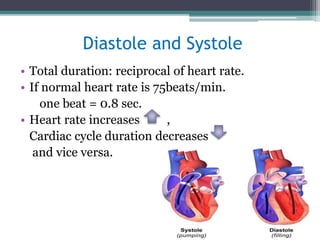
Diastole and Systole
• Total duration: reciprocal of heart rate.
• If normal heart rate is 75beats/min.
one beat = 0.8 sec.
• Heart rate increases ,
Cardiac cycle duration decreases
and vice versa.
Phases of Cardiac Cycle
Quiescent Period
• All the heart chamber are in diastole (relaxed
state) for a period of 0.4sec of cardiac cycle
Write the pressure changes in the heart chamber
during systole and diastole.
1. What is total
duration of
cardiac cycle?
2. Define cardiac
cycle?
3. What do you
understand by
systole?
4. Enlist the
phases of atrial
cycle with
duration?
5. What is
Quiescent period?
6. What happens
to cardiac cycle if
heart rate
increases?
REFERENCES
• Ashalatha P R ,Textbook of anatomy and physiology
for nurses, 2nd edition Jaypee publication 2018
pg 411-412
• Geetha N, Textbook of physiology for nursing
students ,1st edition Jaypeebrothers medical
publication , 2014 , Newdelhi pg 124
• Waugh Anne,ross and wilson,anatomy and
physiology in health and illness ,11th edition
Elesiver publication 2011 Pg 84-85
• Yalayyaswamy N N,anatomy and physiology for
nurses ,3rd edition , CBS publication 2013,
pg 193
THANK - YOU
Life is like riding a bicycle, to stay
balance you must keep moving.

Cardiac cycle

  • 2.
  • 3.
    OBJECTIVES AT THE ENDOF THE TEACHING GROUP WILL BE ABLE TO LEARN : • To define the cardiac cycle. • To describe terminologies related to cardiac cycle. • To discuss systole and diastole. • To describe quiescent period. • To enlist and explain phases of cardiac cycle. • To conclude phases diagrammatically.
  • 4.
  • 5.
    Introduction • Heart actas a pump. • 2 separate pump in series:  Systole: Period of contraction.  Diastole: Period of relaxation , during which heart fills with blood. Protodiastole: The early part of ventricular relaxation terminating when semilunar valve closes.
  • 6.
    DEFINITION “The electrical andmechanical cardiac events that occur from the beginning of one heart beat to beginning of next are called cardiac cycle” This also includes changes in pressure, blood flow and volumes in the heart chamber.
  • 7.
    TERMINOLOGY: Isovolumetric contraction: Early phaseof systole during which the ventricular volume does not change, the pressure in ventricles rises rapidly, but not enough to over come the aortic and pulmonary end diastolic pressures and open the aortic and pulmonary valves. Isovolumetric relaxations: The phase of diastole following closure of semilunar valves during which the ventricular pressures fall rapidly but ventricular volume does not change.
  • 8.
    Diastole and Systole •Total duration: reciprocal of heart rate. • If normal heart rate is 75beats/min. one beat = 0.8 sec. • Heart rate increases , Cardiac cycle duration decreases and vice versa.
  • 9.
  • 10.
    Quiescent Period • Allthe heart chamber are in diastole (relaxed state) for a period of 0.4sec of cardiac cycle
  • 13.
    Write the pressurechanges in the heart chamber during systole and diastole.
  • 15.
    1. What istotal duration of cardiac cycle?
  • 16.
  • 17.
    3. What doyou understand by systole?
  • 18.
    4. Enlist the phasesof atrial cycle with duration?
  • 19.
  • 20.
    6. What happens tocardiac cycle if heart rate increases?
  • 21.
    REFERENCES • Ashalatha PR ,Textbook of anatomy and physiology for nurses, 2nd edition Jaypee publication 2018 pg 411-412 • Geetha N, Textbook of physiology for nursing students ,1st edition Jaypeebrothers medical publication , 2014 , Newdelhi pg 124 • Waugh Anne,ross and wilson,anatomy and physiology in health and illness ,11th edition Elesiver publication 2011 Pg 84-85 • Yalayyaswamy N N,anatomy and physiology for nurses ,3rd edition , CBS publication 2013, pg 193
  • 22.
    THANK - YOU Lifeis like riding a bicycle, to stay balance you must keep moving.