Cancer
Cancer is a disease caused by an uncontrolled division of
abnormal cells in a part of the body. Cancer cells divide
abnormally and cause tumors. The division of normal cells is
precisely controlled. New cells are only formed for growth or to
replace dead ones while Cancerous cells divide repeatedly out of
control even though they are not needed, they crowd out other
normal cells and function abnormally. They can also destroy the
correct functioning of major organs.There are two types of tumors.
Benign tumor: It is not harmful and remain at a fixed position.
Malignant tumor: It is a dangerous type and can travel to other
parts of body and can effect the normal cells, this process is
known as "metastasis“.
***‘’Cancer cells are self sufficient on growth factors. This means
that they can continue to proliferate and divide independently.
They can resist inhibitory signals that normally come from
neighboring cells’’***.
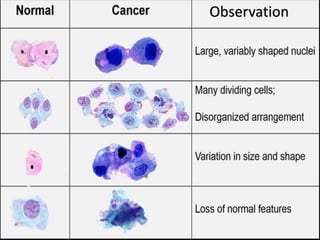
Observation
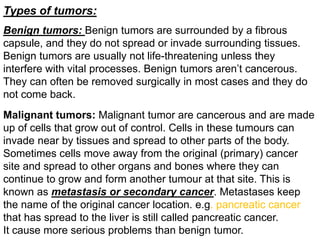
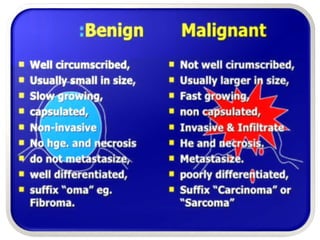
Types of tumors:
Malignant tumors: Malignant tumor are cancerous and are made
up of cells that grow out of control. Cells in these tumours can
invade near by tissues and spread to other parts of the body.
Sometimes cells move away from the original (primary) cancer
site and spread to other organs and bones where they can
continue to grow and form another tumour at that site. This is
known as metastasis or secondary cancer. Metastases keep
the name of the original cancer location. e.g. pancreatic cancer
that has spread to the liver is still called pancreatic cancer.
It cause more serious problems than benign tumor.
Benign tumors: Benign tumors are surrounded by a fibrous
capsule, and they do not spread or invade surrounding tissues.
Benign tumors are usually not life-threatening unless they
interfere with vital processes. Benign tumors aren’t cancerous.
They can often be removed surgically in most cases and they do
not come back.
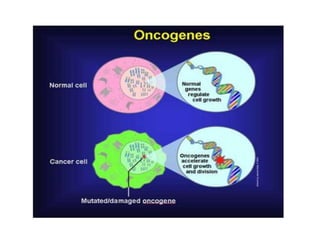
Oncogene: An oncogene is a gene that has potential to cause
cancer. In tumor cells they are often mutated or expressed at high
level. Most normal cells will undergo a programmed form of rapid
cell death (apoptosis) and in critical condition their function
altered. Mutation of normal gene byUV light, X-rays, and
chemicals. Tumor suppressor gene: It is also called
antioncogene. It is a gene that protect the cell from one step on
the path to cancer. When this gene mutates to cause a loss or
reduction in its function, the cell can progress to cancer, usually
in combination with other Genetic changes. 2nd group: It makes
proteins that normally prevent cell division or cause cell death.
The third group contains DNA repair genes, which help prevent
mutations that lead to cancer. Proto-oncogenes and tumor
suppressor genes work much like the accelerator and brakes of
a car, respectively.
Factors Causing Cancer:
Stress has been implicated increased
susceptibility to ‘’S’’ types of cancer.
Sleep disturbance, diet, or
combination of factors may weaken
the body's immune system.
Occupational factors: Occupational
exposure to chemicals, dust,
radiation and certain industrial
processes have been tied to cancer.
The cancer causing chemicals called
carcinogens, may cause mutations
that allow cells to grow out of control,
causing cancer. Chemicals include:
Anilines, chromate, arsenic, nickel.
Environmental factors:
Contact with certain harmful substances in the natural
environment or at workplace cause cancer like Asbestos and
Natural radiation.
Biological factors:
Some cancer such as breast, colon, prostate, uterus, ovaries, lung
appears to run in family, Hodgkin's disease and certain
leukemia's show similar pattern, A rare form of eye cancer
appears to be transmitted genetically from mother to child.
Cancer causing food:
Processed Meat, Microwave popcorn, Soda Pop, Diet food,
Beverages, Refined white flours, Refined sugar, Conventional
apple, grapes.
‘’Cancer cells are self sufficient on growth factors. This means that
they can continue to proliferate and divide independently. They
can resist inhibitory signals that normally come from neighboring
cells’’.
Get regular cancer screening tests. Regular screening tests can
catch some cancers early, when they're small, have not spread,
and are easier to treat.
Get to and stay at a healthy weight. Exercise regularly.
Eat a healthy diet. Avoid tobacco. Limit alcohol.
CANCER DIAGNOSIS TEST:
This common blood test measures the amount of various types of
blood cells in a sample of your blood. Blood cancers may be
detected using this test if too many or too few of a type of blood cell
or abnormal cells are found. A bone marrow biopsy may help
confirm a diagnosis of a blood cancer.
A Biopsy is a procedure to remove a piece of tissue or a sample
of cells from your body so that it can be analyzed in a laboratory.
REDUCING CANCER RISK:
What would happen if a cell multiplied randomly without:
specific rules?
cell would multiply Continuously And if it continues division it
cause Tumors.
But if you are growing more cells so what is bad in it?
These abnormally growing cells rob the blood supply and nutrients
of normal cells.
How Cancers Develop and Spread:
Cancer develops only in cells with damaged genes (mutations)
and causes cells to divide abnormally. Mutations can be inherited
or caused by exposure to:
1. Low-dose radiation.
2. Drugs.
3. Toxic chemicals.
4. Infection with certain viruses can cause mutations.
Characteristics of Cancer Cell:
• ***Telomerase (terminal transferase), a ribonucleoprotein that
adds a species-dependent telomere repeat sequence to the 3'
end of telomeres. A telomere is a region of repetitive sequences
at each end of a eukaryotic chromosomes in most eukaryotes.***
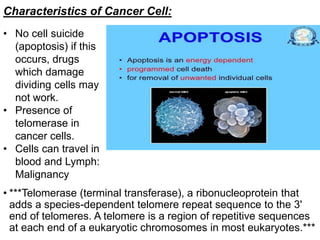
• No cell suicide
(apoptosis) if this
occurs, drugs
which damage
dividing cells may
not work.
• Presence of
telomerase in
cancer cells.
• Cells can travel in
blood and Lymph:
Malignancy
Cell Cycle:
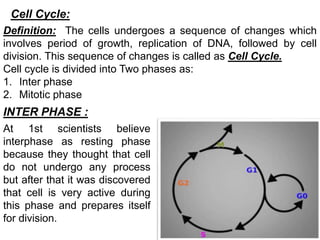
Definition: The cells undergoes a sequence of changes which
involves period of growth, replication of DNA, followed by cell
division. This sequence of changes is called as Cell Cycle.
Cell cycle is divided into Two phases as:
1. Inter phase
2. Mitotic phase
INTER PHASE :
At 1st scientists believe
interphase as resting phase
because they thought that cell
do not undergo any process
but after that it was discovered
that cell is very active during
this phase and prepares itself
for division.
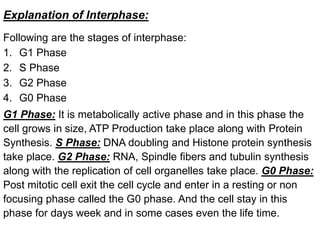
Explanation of Interphase:
Following are the stages of interphase:
1. G1 Phase
2. S Phase
3. G2 Phase
4. G0 Phase
G1 Phase: It is metabolically active phase and in this phase the
cell grows in size, ATP Production take place along with Protein
Synthesis. S Phase: DNA doubling and Histone protein synthesis
take place. G2 Phase: RNA, Spindle fibers and tubulin synthesis
along with the replication of cell organelles take place. G0 Phase:
Post mitotic cell exit the cell cycle and enter in a resting or non
focusing phase called the G0 phase. And the cell stay in this
phase for days week and in some cases even the life time.
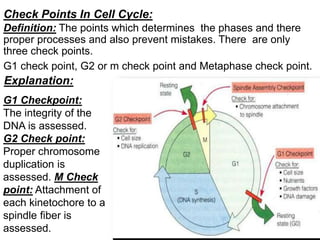
Check Points In Cell Cycle:
Definition: The points which determines the phases and there
proper processes and also prevent mistakes. There are only
three check points.
G1 check point, G2 or m check point and Metaphase check point.
G1 Checkpoint:
The integrity of the
DNA is assessed.
G2 Check point:
Proper chromosome
duplication is
assessed. M Check
point: Attachment of
each kinetochore to a
spindle fiber is
assessed.
Explanation:
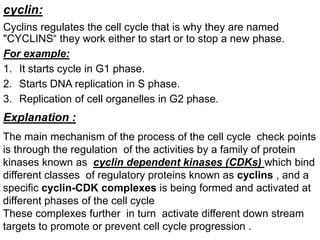
cyclin:
Cyclins regulates the cell cycle that is why they are named
"CYCLINS“ they work either to start or to stop a new phase.
For example:
1. It starts cycle in G1 phase.
2. Starts DNA replication in S phase.
3. Replication of cell organelles in G2 phase.
Explanation :
The main mechanism of the process of the cell cycle check points
is through the regulation of the activities by a family of protein
kinases known as cyclin dependent kinases (CDKs) which bind
different classes of regulatory proteins known as cyclins , and a
specific cyclin-CDK complexes is being formed and activated at
different phases of the cell cycle
These complexes further in turn activate different down stream
targets to promote or prevent cell cycle progression .
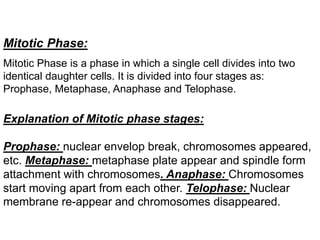
Mitotic Phase:
Mitotic Phase is a phase in which a single cell divides into two
identical daughter cells. It is divided into four stages as:
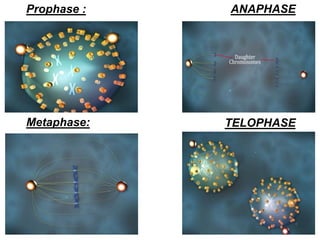
Prophase, Metaphase, Anaphase and Telophase.
Explanation of Mitotic phase stages:
Prophase: nuclear envelop break, chromosomes appeared,
etc. Metaphase: metaphase plate appear and spindle form
attachment with chromosomes. Anaphase: Chromosomes
start moving apart from each other. Telophase: Nuclear
membrane re-appear and chromosomes disappeared.
Metaphase:
Prophase :
TELOPHASE
ANAPHASE
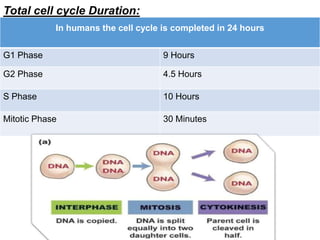
Total cell cycle Duration:
In humans the cell cycle is completed in 24 hours
G1 Phase 9 Hours
G2 Phase 4.5 Hours
S Phase 10 Hours
Mitotic Phase 30 Minutes

Cancer

  • 2.
    Cancer Cancer is adisease caused by an uncontrolled division of abnormal cells in a part of the body. Cancer cells divide abnormally and cause tumors. The division of normal cells is precisely controlled. New cells are only formed for growth or to replace dead ones while Cancerous cells divide repeatedly out of control even though they are not needed, they crowd out other normal cells and function abnormally. They can also destroy the correct functioning of major organs.There are two types of tumors. Benign tumor: It is not harmful and remain at a fixed position. Malignant tumor: It is a dangerous type and can travel to other parts of body and can effect the normal cells, this process is known as "metastasis“. ***‘’Cancer cells are self sufficient on growth factors. This means that they can continue to proliferate and divide independently. They can resist inhibitory signals that normally come from neighboring cells’’***.
  • 3.
  • 4.
    Types of tumors: Malignanttumors: Malignant tumor are cancerous and are made up of cells that grow out of control. Cells in these tumours can invade near by tissues and spread to other parts of the body. Sometimes cells move away from the original (primary) cancer site and spread to other organs and bones where they can continue to grow and form another tumour at that site. This is known as metastasis or secondary cancer. Metastases keep the name of the original cancer location. e.g. pancreatic cancer that has spread to the liver is still called pancreatic cancer. It cause more serious problems than benign tumor. Benign tumors: Benign tumors are surrounded by a fibrous capsule, and they do not spread or invade surrounding tissues. Benign tumors are usually not life-threatening unless they interfere with vital processes. Benign tumors aren’t cancerous. They can often be removed surgically in most cases and they do not come back.
  • 6.
    Oncogene: An oncogeneis a gene that has potential to cause cancer. In tumor cells they are often mutated or expressed at high level. Most normal cells will undergo a programmed form of rapid cell death (apoptosis) and in critical condition their function altered. Mutation of normal gene byUV light, X-rays, and chemicals. Tumor suppressor gene: It is also called antioncogene. It is a gene that protect the cell from one step on the path to cancer. When this gene mutates to cause a loss or reduction in its function, the cell can progress to cancer, usually in combination with other Genetic changes. 2nd group: It makes proteins that normally prevent cell division or cause cell death. The third group contains DNA repair genes, which help prevent mutations that lead to cancer. Proto-oncogenes and tumor suppressor genes work much like the accelerator and brakes of a car, respectively.
  • 8.
    Factors Causing Cancer: Stresshas been implicated increased susceptibility to ‘’S’’ types of cancer. Sleep disturbance, diet, or combination of factors may weaken the body's immune system. Occupational factors: Occupational exposure to chemicals, dust, radiation and certain industrial processes have been tied to cancer. The cancer causing chemicals called carcinogens, may cause mutations that allow cells to grow out of control, causing cancer. Chemicals include: Anilines, chromate, arsenic, nickel.
  • 9.
    Environmental factors: Contact withcertain harmful substances in the natural environment or at workplace cause cancer like Asbestos and Natural radiation. Biological factors: Some cancer such as breast, colon, prostate, uterus, ovaries, lung appears to run in family, Hodgkin's disease and certain leukemia's show similar pattern, A rare form of eye cancer appears to be transmitted genetically from mother to child. Cancer causing food: Processed Meat, Microwave popcorn, Soda Pop, Diet food, Beverages, Refined white flours, Refined sugar, Conventional apple, grapes. ‘’Cancer cells are self sufficient on growth factors. This means that they can continue to proliferate and divide independently. They can resist inhibitory signals that normally come from neighboring cells’’.
  • 10.
    Get regular cancerscreening tests. Regular screening tests can catch some cancers early, when they're small, have not spread, and are easier to treat. Get to and stay at a healthy weight. Exercise regularly. Eat a healthy diet. Avoid tobacco. Limit alcohol. CANCER DIAGNOSIS TEST: This common blood test measures the amount of various types of blood cells in a sample of your blood. Blood cancers may be detected using this test if too many or too few of a type of blood cell or abnormal cells are found. A bone marrow biopsy may help confirm a diagnosis of a blood cancer. A Biopsy is a procedure to remove a piece of tissue or a sample of cells from your body so that it can be analyzed in a laboratory. REDUCING CANCER RISK:
  • 11.
    What would happenif a cell multiplied randomly without: specific rules? cell would multiply Continuously And if it continues division it cause Tumors. But if you are growing more cells so what is bad in it? These abnormally growing cells rob the blood supply and nutrients of normal cells. How Cancers Develop and Spread: Cancer develops only in cells with damaged genes (mutations) and causes cells to divide abnormally. Mutations can be inherited or caused by exposure to: 1. Low-dose radiation. 2. Drugs. 3. Toxic chemicals. 4. Infection with certain viruses can cause mutations.
  • 12.
    Characteristics of CancerCell: • ***Telomerase (terminal transferase), a ribonucleoprotein that adds a species-dependent telomere repeat sequence to the 3' end of telomeres. A telomere is a region of repetitive sequences at each end of a eukaryotic chromosomes in most eukaryotes.*** • No cell suicide (apoptosis) if this occurs, drugs which damage dividing cells may not work. • Presence of telomerase in cancer cells. • Cells can travel in blood and Lymph: Malignancy
  • 13.
    Cell Cycle: Definition: Thecells undergoes a sequence of changes which involves period of growth, replication of DNA, followed by cell division. This sequence of changes is called as Cell Cycle. Cell cycle is divided into Two phases as: 1. Inter phase 2. Mitotic phase INTER PHASE : At 1st scientists believe interphase as resting phase because they thought that cell do not undergo any process but after that it was discovered that cell is very active during this phase and prepares itself for division.
  • 14.
    Explanation of Interphase: Followingare the stages of interphase: 1. G1 Phase 2. S Phase 3. G2 Phase 4. G0 Phase G1 Phase: It is metabolically active phase and in this phase the cell grows in size, ATP Production take place along with Protein Synthesis. S Phase: DNA doubling and Histone protein synthesis take place. G2 Phase: RNA, Spindle fibers and tubulin synthesis along with the replication of cell organelles take place. G0 Phase: Post mitotic cell exit the cell cycle and enter in a resting or non focusing phase called the G0 phase. And the cell stay in this phase for days week and in some cases even the life time.
  • 15.
    Check Points InCell Cycle: Definition: The points which determines the phases and there proper processes and also prevent mistakes. There are only three check points. G1 check point, G2 or m check point and Metaphase check point. G1 Checkpoint: The integrity of the DNA is assessed. G2 Check point: Proper chromosome duplication is assessed. M Check point: Attachment of each kinetochore to a spindle fiber is assessed. Explanation:
  • 16.
    cyclin: Cyclins regulates thecell cycle that is why they are named "CYCLINS“ they work either to start or to stop a new phase. For example: 1. It starts cycle in G1 phase. 2. Starts DNA replication in S phase. 3. Replication of cell organelles in G2 phase. Explanation : The main mechanism of the process of the cell cycle check points is through the regulation of the activities by a family of protein kinases known as cyclin dependent kinases (CDKs) which bind different classes of regulatory proteins known as cyclins , and a specific cyclin-CDK complexes is being formed and activated at different phases of the cell cycle These complexes further in turn activate different down stream targets to promote or prevent cell cycle progression .
  • 17.
    Mitotic Phase: Mitotic Phaseis a phase in which a single cell divides into two identical daughter cells. It is divided into four stages as: Prophase, Metaphase, Anaphase and Telophase. Explanation of Mitotic phase stages: Prophase: nuclear envelop break, chromosomes appeared, etc. Metaphase: metaphase plate appear and spindle form attachment with chromosomes. Anaphase: Chromosomes start moving apart from each other. Telophase: Nuclear membrane re-appear and chromosomes disappeared.
  • 18.
  • 19.
    Total cell cycleDuration: In humans the cell cycle is completed in 24 hours G1 Phase 9 Hours G2 Phase 4.5 Hours S Phase 10 Hours Mitotic Phase 30 Minutes