The Market System
The Market Economy (Capitalism) is mostly responsible for the following… You can shop for a TV 24 hours a day form home.  In 1971 a 25” color TV cost the average worker  171 hours  of wages Today a 32” set costs and average of  20 hours  of wages (with more channels, more reliable, HD, etc.) Did you know we live in the wealthiest society in the history of the planet.
During the 20 th  Century… Life expectancy has gone from 47 to 79 Infant mortality plunged 93% Diseases such as Polio, TB, Typhoid and Whooping cough have been wiped out.  The average household spends about 10 times as much on recreation as the average family did in 1900. Women usually faced 70 hours a week of work in 1900. …  just inside the house
During the 20 th  Century… In 1900 just 1 in 5 homes had running water, flush toilets, a vacuum cleaner, or gas and electric heat. We now need our farmers to grow less food.  Most people in poverty today own a car, a color TV, a DVD Player, and a microwave, and consumer more calories than wealthy families. Today, a $999 laptop contains more computing  power than was available to all nations during WW II.  Illiteracy has fallen by 2/3’s in the US since 1900.  30 years ago, almost no homes had computers; Now over 60% do.  Source:  It’s Getting Better All The Time: 100 Greatest Trends of the Last 100 Years  by Steven Moore and Julian Simon, © 2000
” In the 20 th  Century, the US led in virtually everything.  Growth, productivity and incomes, new products, and applying new ideas first or most effectively even if it did not invent them ”    -- From  The   Economist ( a British  magazine )
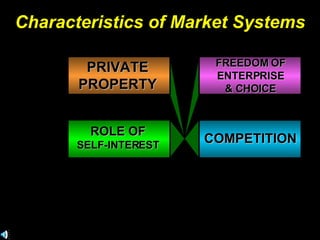
Characteristics of Market Systems FREEDOM OF ENTERPRISE & CHOICE PRIVATE PROPERTY ROLE OF SELF-INTEREST COMPETITION
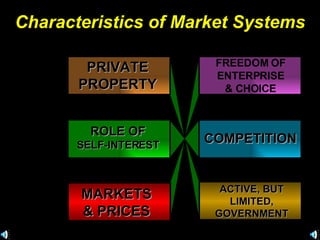
Characteristics of Market Systems MARKETS & PRICES FREEDOM OF ENTERPRISE & CHOICE PRIVATE PROPERTY ACTIVE, BUT LIMITED, GOVERNMENT ROLE OF SELF-INTEREST COMPETITION
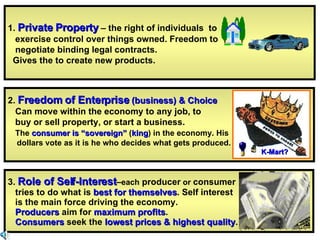
2.  Freedom of Enterprise   (business) & Choice Can move within the economy to any job, to buy or sell property, or start a business. The  consumer is “sovereign”  ( king ) in the economy. His dollars vote as it is he who decides what gets produced. 1.  Private Property  – the right of individuals  to exercise control over things owned. Freedom to  negotiate binding legal contracts. Gives the to create new products.  3.  Role of Self-Interest – each  producer  or  consumer tries to do what is  best for themselves . Self interest is the main force driving the economy.  Producers  aim for  maximum profits . Consumers  seek the  lowest prices & highest quality . K-Mart?
Pure Capitalism  (No G)  and the Circular Flow [Capitalism – “private ownership of capital”] Monopolies can charge  an   arm   and a   leg . And – an appendage to be named later, like a -  4.  Competition  – economic rivalry of a large number of buyers & sellers.  [central mechanism of market economy] Monopolies become fat & unresponsive  to  consumers ( higher prices & fewer choices ).  Competition  prevents one  seller  from  controlling  the  market.  “ Competition”   and  “ self-interest”  are like  an  “invisible hand”.
5.  Markets  &  prices . Markets bring the buyers  and  sellers into contact. Prices send signals (Like HUGE NEON BILLBOARDS.  High prices  send signals to  increase production  and  for  other producers to  enter the market . Low prices  send signals to  decrease production   and for producers to  exit the market .  Nobel Prize winning economist Milton Friedman 6.  Limited Government Intervention  in the economy. The role of government was one of  “laissez faire.”  [ “hands off” ] In the words of Adam Smith, the  government should not interfere with the operation of the  economy except serve as an  arbitrator in settling disputes .  Arbitrator [settling disputes]
“ Who Feeds Paris?”  How does a restaurant in Paris have just the right amount of Tuna?  Diners order more tuna (tuna becomes more popular in Paris) Restaurants order more tuna, causing the wholesale price of tuna to go up Fisherman in the Pacific Ocean will now get paid more for their tuna catch.  Many fisherman will start fishing for tuna instead of salmon. Some fisherman will switch to more expensive fishing methods justified by the higher price of tuna These fisherman don’t care about the diners in Paris, only the wholesale price of tuna Everyone acts in their own “self-interest.”
“ Capitalism advantages the poor because, for the first time in history, it takes the dignity and the worth of individuals seriously and gives all people, especially the powerless and dispossessed, a sphere of action that is immune from the control of others.” -- Prof. P.J. Hill, Wheaton College  Milton Friedman on Welfare, Communism
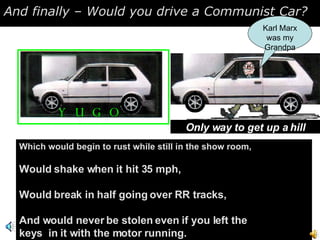
And finally – Would you drive a Communist Car?  Which would begin to rust while still in the show room, Would shake when it hit 35 mph, Would break in half going over RR tracks, And would never be stolen even if you left the keys  in it with the motor running. YUGO Only way to get up a hill Karl Marx was my Grandpa
The  Yugo  on the inside or under the hood Anytime you filled the   Yugo  with gas,  you doubled its value.  Putting seats in tripled its value.]
Virtues of Markets By providing strong incentives for individuals to become entrepreneurs, capitalism encourages diligence, initiative, and hard work.  The spirit of enterprise requires effort to maintain; thus the incentive of profit rewards diligence and discourages slothfulness. Regardless of his or her individual character, the entrepreneur motivated by profit will practice virtuous behaviors like diligence, initiative, and hard work because those behaviors are associated with successful enterprise.
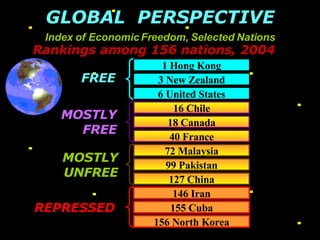
GLOBAL  PERSPECTIVE Index of Economic Freedom, Selected Nations FREE MOSTLY FREE MOSTLY UNFREE REPRESSED Rankings among 156 nations, 2004 Source: Heritage Foundation & The Wall Street Journal 1 Hong Kong 3 New Zealand 6 United States 16 Chile 18 Canada 40 France 72 Malaysia 99 Pakistan 127 China 146 Iran 155 Cuba 156 North Korea
Multilateral Trade [when bilateral trade is not beneficial]
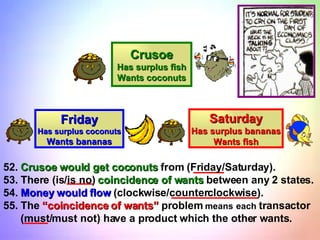
Saturday Has surplus bananas Wants fish Friday Has surplus coconuts Wants bananas Crusoe Has surplus fish Wants coconuts 52.  Crusoe would get coconuts  from (Friday/Saturday). 53. There (is/is no)  coincidence of wants  between any 2 states. 54.  Money would flow  (clockwise/counterclockwise). 55. The  “coincidence of wants”  problem  means   each  transactor (must/must not) have a product which the other wants.
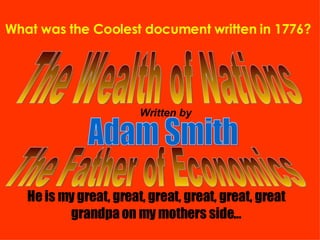
What was the Coolest document written in 1776?   The Wealth of Nations Written by Adam Smith The Father of Economics He is my great, great, great, great, great, great grandpa on my mothers side…
What made  The Wealth of Nations  “THE” most important document written in 1776? Adam Smith wrote about a pin factory.
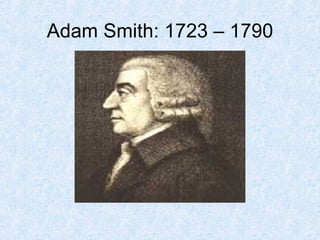
Adam Smith: 1723 – 1790
When he first observed the factory, he noticed that each worker was producing his or her own pins.  By  the end of the day, the total production by the workers was 2,000 pins.  He stated that each worker should specialize in the production stage rather than produce his or her own pins.  Through specialization, the total output by the factory increased to 48,000 pins per day.
Leads to an increase in  wealth and productivity Specialization of Labor
Adam Smith’s famous Pin Factory Example One man could do maybe  1 pin per day   [1 man = 1 pin] Now if there is  specialization 1 man draws the wire out 1 man straightens the wire 1 man cuts the wire 1 man sharpens the point 1 man flattens the head There  are  18 distinct operations   - some perform 2 or 3 operations 10 people  do  48,000  pins per   day 1 man = 4,800 pins per day
“ THE INVISIBLE HAND”
“…  he intends only his own gain, and he is in this, as in many other cases, led by an  invisible hand  to promote an end which was no part of his intention… By pursuing his own interest he frequently promotes that of the society more effectually than when he really intends to promote it.” …  Adam Smith
“ The Invisible Hand” Translated for you… Individuals, acting in their own self interest, in a market economy, will together,  as guided by an “invisible hand,” promote the public or social interest.
“ The Invisible Hand” Example:  A Entrepreneur starts a business to make a profit and earn a good living, but also gives people what they want. Both sides benefit.  A Doctor wants to earn a very high income good salary, and also helps people live longer and improves peoples’ lives.  Both sides benefit.
Creative Destruction … the creation of new products and more efficient production methods completely destroys the old way of doing business.
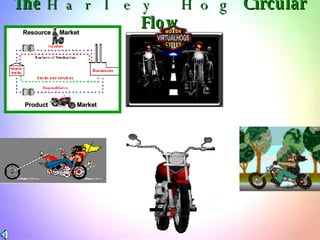
The  Harley Hog  Circular Flow Product  Market Resource  Market
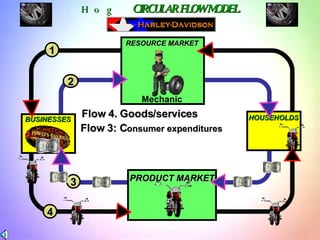
Hog  CIRCULAR FLOW MODEL BUSINESSES HOUSEHOLDS PRODUCT MARKET Mechanic RESOURCE MARKET 1 2 3 4 Flow 4. Goods/services Flow 3: C onsumer expenditures
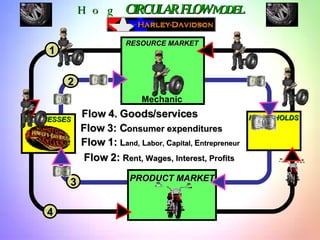
Hog  CIRCULAR FLOW  MODEL BUSINESSES HOUSEHOLDS PRODUCT MARKET Mechanic RESOURCE MARKET 1 2 3 4 Flow 4. Goods/services Flow 3: C onsumer expenditures Flow 1:  L and,  L abor,  C apital,  E ntrepreneur Flow 2:  R ent, Wages, Interest, Profits
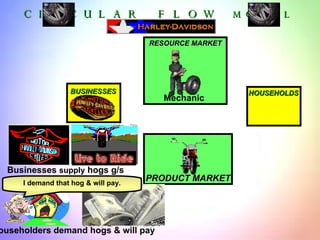
CIRCULAR FLOW  MODEL BUSINESSES HOUSEHOLDS PRODUCT MARKET Householders demand hogs & will pay Mechanic RESOURCE MARKET Businesses  supply  hogs g/s I demand that hog & will pay.
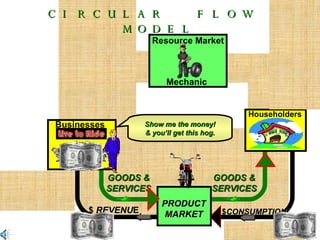
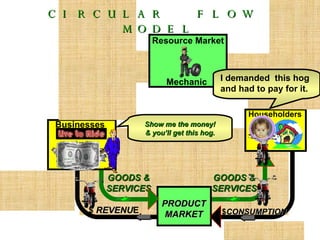
BUSINESSES HOUSEHOLDS RESOURCE MARKET PRODUCT MARKET GOODS & SERVICES GOODS & SERVICES $ CONSUMPTION $  REVENU E Resource Market Mechanic Businesses Show me the money! & you’ll get this hog. CIRCULAR  FLOW  MODEL Householders
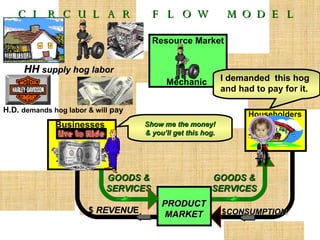
BUSINESSES HOUSEHOLDS RESOURCE MARKET PRODUCT MARKET GOODS & SERVICES GOODS & SERVICES $ CONSUMPTION $  REVENU E Resource Market Mechanic Householders Businesses I demanded  this hog and had to pay for it. Show me the money! & you’ll get this hog. CIRCULAR  FLOW  MODEL
BUSINESSES HOUSEHOLDS RESOURCE MARKET PRODUCT MARKET GOODS & SERVICES GOODS & SERVICES $ CONSUMPTION $  REVENU E Resource Market Mechanic Householders HH  supply hog labor H.D.  demands hog labor & will  pay Businesses Show me the money! & you’ll get this hog. I demanded  this hog and had to pay for it. CIRCULAR FLOW MODEL
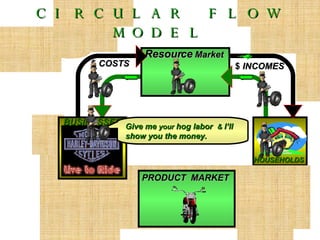
HOUSEHOLDS $  COSTS $  INCOMES GOODS & SERVICES GOODS & SERVICES PRODUCT  MARKET Resource  Market  BUSINESSES Give me  your  hog labor  &  I’ll show you the money. CIRCULAR FLOW MODEL
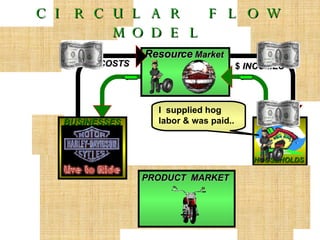
HOUSEHOLDS $  COSTS $  INCOMES GOODS & SERVICES GOODS & SERVICES PRODUCT  MARKET Resource  Market  BUSINESSES CIRCULAR FLOW MODEL I  supplied hog labor & was paid..
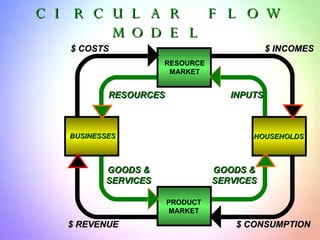
BUSINESSES HOUSEHOLDS RESOURCE MARKET RESOURCES INPUTS $ COSTS $ INCOMES PRODUCT MARKET GOODS & SERVICES GOODS & SERVICES $ CONSUMPTION $ REVENUE CIRCULAR FLOW MODEL
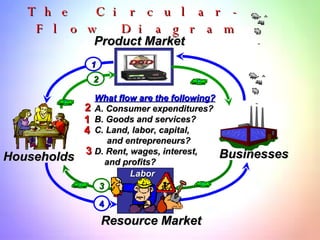
The Circular-Flow Diagram Businesses Product Market Resource Market Households 1 2 3 4 Labor What flow are the following? A. Consumer expenditures? B. Goods and services? C. Land, labor, capital,  and entrepreneurs? D. Rent, wages, interest,  and profits? 2 1 4 3
NS  56-59 56. In the  product market  (householders/businesses) are the demanders  and (householders/businesses) are the  suppliers . 57. In the  resource market  (householders/businesses) are the  demanders   and (householders/businesses) are the  suppliers . 58. In the  resource market , (householders/businesses)  sell resources  to (householders/businesses). 59. In the  product market , (householders/businesses)  sell products  [goods/services] to (householders/businesses). Fuzzy Wuzzy
 
The End

Capitalism and Markets

  • 1.
  • 2.
    The Market Economy(Capitalism) is mostly responsible for the following… You can shop for a TV 24 hours a day form home. In 1971 a 25” color TV cost the average worker 171 hours of wages Today a 32” set costs and average of 20 hours of wages (with more channels, more reliable, HD, etc.) Did you know we live in the wealthiest society in the history of the planet.
  • 3.
    During the 20th Century… Life expectancy has gone from 47 to 79 Infant mortality plunged 93% Diseases such as Polio, TB, Typhoid and Whooping cough have been wiped out. The average household spends about 10 times as much on recreation as the average family did in 1900. Women usually faced 70 hours a week of work in 1900. … just inside the house
  • 4.
    During the 20th Century… In 1900 just 1 in 5 homes had running water, flush toilets, a vacuum cleaner, or gas and electric heat. We now need our farmers to grow less food. Most people in poverty today own a car, a color TV, a DVD Player, and a microwave, and consumer more calories than wealthy families. Today, a $999 laptop contains more computing power than was available to all nations during WW II. Illiteracy has fallen by 2/3’s in the US since 1900. 30 years ago, almost no homes had computers; Now over 60% do. Source: It’s Getting Better All The Time: 100 Greatest Trends of the Last 100 Years by Steven Moore and Julian Simon, © 2000
  • 5.
    ” In the20 th Century, the US led in virtually everything. Growth, productivity and incomes, new products, and applying new ideas first or most effectively even if it did not invent them ” -- From The Economist ( a British magazine )
  • 6.
    Characteristics of MarketSystems FREEDOM OF ENTERPRISE & CHOICE PRIVATE PROPERTY ROLE OF SELF-INTEREST COMPETITION
  • 7.
    Characteristics of MarketSystems MARKETS & PRICES FREEDOM OF ENTERPRISE & CHOICE PRIVATE PROPERTY ACTIVE, BUT LIMITED, GOVERNMENT ROLE OF SELF-INTEREST COMPETITION
  • 8.
    2. Freedomof Enterprise (business) & Choice Can move within the economy to any job, to buy or sell property, or start a business. The consumer is “sovereign” ( king ) in the economy. His dollars vote as it is he who decides what gets produced. 1. Private Property – the right of individuals to exercise control over things owned. Freedom to negotiate binding legal contracts. Gives the to create new products. 3. Role of Self-Interest – each producer or consumer tries to do what is best for themselves . Self interest is the main force driving the economy. Producers aim for maximum profits . Consumers seek the lowest prices & highest quality . K-Mart?
  • 9.
    Pure Capitalism (No G) and the Circular Flow [Capitalism – “private ownership of capital”] Monopolies can charge an arm and a leg . And – an appendage to be named later, like a - 4. Competition – economic rivalry of a large number of buyers & sellers. [central mechanism of market economy] Monopolies become fat & unresponsive to consumers ( higher prices & fewer choices ). Competition prevents one seller from controlling the market. “ Competition” and “ self-interest” are like an “invisible hand”.
  • 10.
    5. Markets & prices . Markets bring the buyers and sellers into contact. Prices send signals (Like HUGE NEON BILLBOARDS. High prices send signals to increase production and for other producers to enter the market . Low prices send signals to decrease production and for producers to exit the market . Nobel Prize winning economist Milton Friedman 6. Limited Government Intervention in the economy. The role of government was one of “laissez faire.” [ “hands off” ] In the words of Adam Smith, the government should not interfere with the operation of the economy except serve as an arbitrator in settling disputes . Arbitrator [settling disputes]
  • 11.
    “ Who FeedsParis?” How does a restaurant in Paris have just the right amount of Tuna? Diners order more tuna (tuna becomes more popular in Paris) Restaurants order more tuna, causing the wholesale price of tuna to go up Fisherman in the Pacific Ocean will now get paid more for their tuna catch. Many fisherman will start fishing for tuna instead of salmon. Some fisherman will switch to more expensive fishing methods justified by the higher price of tuna These fisherman don’t care about the diners in Paris, only the wholesale price of tuna Everyone acts in their own “self-interest.”
  • 12.
    “ Capitalism advantagesthe poor because, for the first time in history, it takes the dignity and the worth of individuals seriously and gives all people, especially the powerless and dispossessed, a sphere of action that is immune from the control of others.” -- Prof. P.J. Hill, Wheaton College Milton Friedman on Welfare, Communism
  • 13.
    And finally –Would you drive a Communist Car? Which would begin to rust while still in the show room, Would shake when it hit 35 mph, Would break in half going over RR tracks, And would never be stolen even if you left the keys in it with the motor running. YUGO Only way to get up a hill Karl Marx was my Grandpa
  • 14.
    The Yugo on the inside or under the hood Anytime you filled the Yugo with gas, you doubled its value. Putting seats in tripled its value.]
  • 15.
    Virtues of MarketsBy providing strong incentives for individuals to become entrepreneurs, capitalism encourages diligence, initiative, and hard work. The spirit of enterprise requires effort to maintain; thus the incentive of profit rewards diligence and discourages slothfulness. Regardless of his or her individual character, the entrepreneur motivated by profit will practice virtuous behaviors like diligence, initiative, and hard work because those behaviors are associated with successful enterprise.
  • 16.
    GLOBAL PERSPECTIVEIndex of Economic Freedom, Selected Nations FREE MOSTLY FREE MOSTLY UNFREE REPRESSED Rankings among 156 nations, 2004 Source: Heritage Foundation & The Wall Street Journal 1 Hong Kong 3 New Zealand 6 United States 16 Chile 18 Canada 40 France 72 Malaysia 99 Pakistan 127 China 146 Iran 155 Cuba 156 North Korea
  • 17.
    Multilateral Trade [whenbilateral trade is not beneficial]
  • 18.
    Saturday Has surplusbananas Wants fish Friday Has surplus coconuts Wants bananas Crusoe Has surplus fish Wants coconuts 52. Crusoe would get coconuts from (Friday/Saturday). 53. There (is/is no) coincidence of wants between any 2 states. 54. Money would flow (clockwise/counterclockwise). 55. The “coincidence of wants” problem means each transactor (must/must not) have a product which the other wants.
  • 19.
    What was theCoolest document written in 1776? The Wealth of Nations Written by Adam Smith The Father of Economics He is my great, great, great, great, great, great grandpa on my mothers side…
  • 20.
    What made The Wealth of Nations “THE” most important document written in 1776? Adam Smith wrote about a pin factory.
  • 21.
  • 22.
    When he firstobserved the factory, he noticed that each worker was producing his or her own pins. By the end of the day, the total production by the workers was 2,000 pins. He stated that each worker should specialize in the production stage rather than produce his or her own pins. Through specialization, the total output by the factory increased to 48,000 pins per day.
  • 23.
    Leads to anincrease in wealth and productivity Specialization of Labor
  • 24.
    Adam Smith’s famousPin Factory Example One man could do maybe 1 pin per day [1 man = 1 pin] Now if there is specialization 1 man draws the wire out 1 man straightens the wire 1 man cuts the wire 1 man sharpens the point 1 man flattens the head There are 18 distinct operations - some perform 2 or 3 operations 10 people do 48,000 pins per day 1 man = 4,800 pins per day
  • 25.
  • 26.
    “… heintends only his own gain, and he is in this, as in many other cases, led by an invisible hand to promote an end which was no part of his intention… By pursuing his own interest he frequently promotes that of the society more effectually than when he really intends to promote it.” … Adam Smith
  • 27.
    “ The InvisibleHand” Translated for you… Individuals, acting in their own self interest, in a market economy, will together, as guided by an “invisible hand,” promote the public or social interest.
  • 28.
    “ The InvisibleHand” Example: A Entrepreneur starts a business to make a profit and earn a good living, but also gives people what they want. Both sides benefit. A Doctor wants to earn a very high income good salary, and also helps people live longer and improves peoples’ lives. Both sides benefit.
  • 29.
    Creative Destruction …the creation of new products and more efficient production methods completely destroys the old way of doing business.
  • 30.
    The HarleyHog Circular Flow Product Market Resource Market
  • 31.
    Hog CIRCULARFLOW MODEL BUSINESSES HOUSEHOLDS PRODUCT MARKET Mechanic RESOURCE MARKET 1 2 3 4 Flow 4. Goods/services Flow 3: C onsumer expenditures
  • 32.
    Hog CIRCULARFLOW MODEL BUSINESSES HOUSEHOLDS PRODUCT MARKET Mechanic RESOURCE MARKET 1 2 3 4 Flow 4. Goods/services Flow 3: C onsumer expenditures Flow 1: L and, L abor, C apital, E ntrepreneur Flow 2: R ent, Wages, Interest, Profits
  • 33.
    CIRCULAR FLOW MODEL BUSINESSES HOUSEHOLDS PRODUCT MARKET Householders demand hogs & will pay Mechanic RESOURCE MARKET Businesses supply hogs g/s I demand that hog & will pay.
  • 34.
    BUSINESSES HOUSEHOLDS RESOURCEMARKET PRODUCT MARKET GOODS & SERVICES GOODS & SERVICES $ CONSUMPTION $ REVENU E Resource Market Mechanic Businesses Show me the money! & you’ll get this hog. CIRCULAR FLOW MODEL Householders
  • 35.
    BUSINESSES HOUSEHOLDS RESOURCEMARKET PRODUCT MARKET GOODS & SERVICES GOODS & SERVICES $ CONSUMPTION $ REVENU E Resource Market Mechanic Householders Businesses I demanded this hog and had to pay for it. Show me the money! & you’ll get this hog. CIRCULAR FLOW MODEL
  • 36.
    BUSINESSES HOUSEHOLDS RESOURCEMARKET PRODUCT MARKET GOODS & SERVICES GOODS & SERVICES $ CONSUMPTION $ REVENU E Resource Market Mechanic Householders HH supply hog labor H.D. demands hog labor & will pay Businesses Show me the money! & you’ll get this hog. I demanded this hog and had to pay for it. CIRCULAR FLOW MODEL
  • 37.
    HOUSEHOLDS $ COSTS $ INCOMES GOODS & SERVICES GOODS & SERVICES PRODUCT MARKET Resource Market BUSINESSES Give me your hog labor & I’ll show you the money. CIRCULAR FLOW MODEL
  • 38.
    HOUSEHOLDS $ COSTS $ INCOMES GOODS & SERVICES GOODS & SERVICES PRODUCT MARKET Resource Market BUSINESSES CIRCULAR FLOW MODEL I supplied hog labor & was paid..
  • 39.
    BUSINESSES HOUSEHOLDS RESOURCEMARKET RESOURCES INPUTS $ COSTS $ INCOMES PRODUCT MARKET GOODS & SERVICES GOODS & SERVICES $ CONSUMPTION $ REVENUE CIRCULAR FLOW MODEL
  • 40.
    The Circular-Flow DiagramBusinesses Product Market Resource Market Households 1 2 3 4 Labor What flow are the following? A. Consumer expenditures? B. Goods and services? C. Land, labor, capital, and entrepreneurs? D. Rent, wages, interest, and profits? 2 1 4 3
  • 41.
    NS 56-5956. In the product market (householders/businesses) are the demanders and (householders/businesses) are the suppliers . 57. In the resource market (householders/businesses) are the demanders and (householders/businesses) are the suppliers . 58. In the resource market , (householders/businesses) sell resources to (householders/businesses). 59. In the product market , (householders/businesses) sell products [goods/services] to (householders/businesses). Fuzzy Wuzzy
  • 42.
  • 43.