
1


ECONOMIC SYSTEMS         Chapter 2:
                          2.1 , 2.2,
                          2.3,2.4.


Done by :…

             Economics
               Date:…
              Ms./Mr
2.1                                                    2


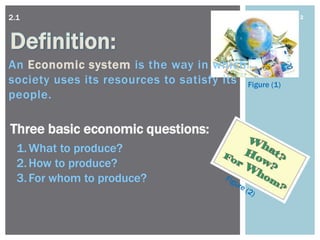
An Economic system is the way in which
society uses its resources to satisfy its Figure (1)
people.

Three basic economic questions:
  1. What to produce?
  2. How to produce?
  3. For whom to produce?
2.1
                                                          3


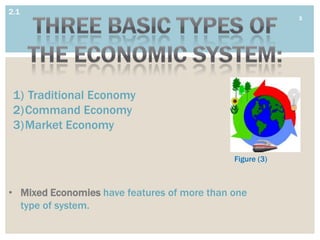
 1) Traditional Economy
 2)Command Economy
 3)Market Economy

                                             Figure (3)


• Mixed Economies have features of more than one
  type of system.
2.1
                                                                          4


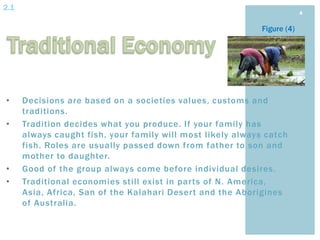
                                                             Figure (4)


•     Decisions are based on a societies values, customs and
      traditions.
•     Tradition decides what you produce. If your family has
      always caught fish, your family will most likely always catch
      fish. Roles are usually passed down from father to son and
      mother to daughter.
•     Good of the group always come before individual desires.
•     Traditional economies still exist in parts of N. America,
      Asia, Africa, San of the Kalahari Desert and the Aborigines
      of Australia.
2.1                                                       5


                TRADITIONAL ECONOMY

            Advantages                Disadvantages
       Little disagreement       As a result of
        over goals, roles.         resistance to change,
                                   less productive.
      - Methods of production,
      distribution determined    - Do not use new
                                   methods; people not in
      by custom.                   they jobs they are best
                                   suited for.
                                 - Low productivity results
                                   in low standard of
                                   living.
2.1                                                        6


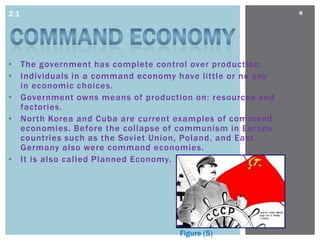
• The government has complete control over production.
• Individuals in a command economy have little or no say
  in economic choices.
• Government owns means of production on: resources and
  factories.
• North Korea and Cuba are current examples of command
  economies. Before the collapse of communism in Europe,
  countries such as the Soviet Union, Poland, and East
  Germany also were command economies.
• It is also called Planned Economy.


                                   Figure (5)
2.1                                                            7


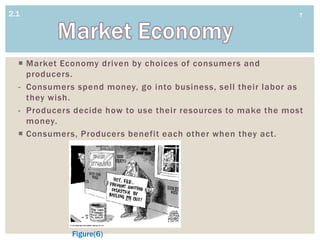
   Market Economy driven by choices of consumers and
    producers.
  - Consumers spend money, go into business, sell their labor as
    they wish.
  - Producers decide how to use their resources to make the most
    money.
   Consumers, Producers benefit each other when they act.


             Figure(6)
2.1                                                8


  • Many traditional economies under pressure to
    change.
  • Kavango people of Namibia as subsistence
    farmers for centuries.
  • Modern telecommunication brought Kavango
    images of the outside world.
  - Thousands moved to cities.
  - A few have turned to commercial farming.
9
2.2 Command Economies


Centrally planned economy - central government
makes all decisions.


GOVERNMENT PLANNING:
• In all societies government exerts some control over
   people’s lives.
• In centrally planned economy, government exerts great
   control.
-Determines businesses to operate, amount produced each
month.
-Determines who employed, work hours, pay scales.
2.2                                                               10


 Karl Marx influenced some societies to adopt command
   economies.
-Socialism: government owns some of the factors of production.
-Communism: no private property, little political freedom.
 Authoritarian: system requires total obedience to government.
-Communism is authoritarian socialism.
 Democratic socialism established under democratic political
   process.
-Government basic industries.
-Other industries private.
-Central planners make decisions for government owned
industries.
-Central planners might control other sectors, such as health
care.
11
2.2


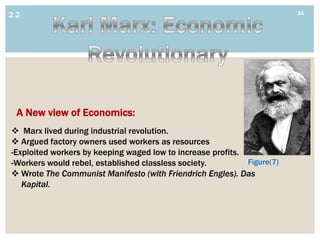
  A New view of Economics:
 Marx lived during industrial revolution.
 Argued factory owners used workers as resources
-Exploited workers by keeping waged low to increase profits.
-Workers would rebel, established classless society.         Figure(7)
 Wrote The Communist Manifesto (with Friendrich Engles). Das
   Kapital.
12
2.2


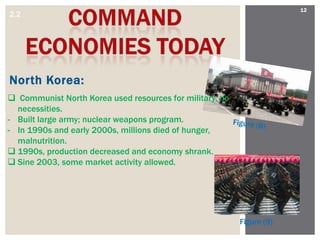
North Korea:
 Communist North Korea used resources for military, no
  necessities.
- Built large army; nuclear weapons program.
- In 1990s and early 2000s, millions died of hunger,
  malnutrition.
 1990s, production decreased and economy shrank.
 Sine 2003, some market activity allowed.


                                                          Figure (9)
2.2
                                                          13


  Theory- command systems fair to everyone; but in
   practice – many disadvantages.
 - Central planners do not understand local conditions.
 - Workers have little motive to be productive or
   conserve resources.
 - Artificially how prices lead to shortages.
 - People sacrificed to carry out centrally planned
   policies.
14
2.3 Market Economies


• Private property rights– right to own business and resources.
• Property means material objects, money, intellectual property, labor.
• Market– place or situations where people buy and sell goods, services.


Private property and Markets:
• Private property rights must be defined and protected by law.
• Buyers must be sure sellers have right to sell products they offer.
• Sellers must be sure they will be paid for their products.
2.3                                                            15


o Laissez faire—government should not interfere in economy.
o Capitalism—system having private ownership of factors of
   production.
-Says producers will create products consumers demand.
o Actual market economies all have some government
   involvement.


o Voluntary exchange—traders believe they get more than they
  give up.
o In market economy, most trade is exchange of product for
  money.
o Profit– financial gain from business transaction.
16
2.3


• Competition– sellers’ efforts to get business by offering best deal.
• Consumer sovereignty– buyers choose products, control what is produced.
• Competition controls self--interested behavior.
- Sellers offer low price or high value to please consumers, make profit.


• Specialization—people concentrate their efforts in the
  activities they do best.
- Encourages efficient use of resources.
- Leads to higher—quality, lower-priced products.
2.3                                                                       12


    Product Markets:
• Product Markets– markets where goods and services bought and sold.
- Includes all purchases by individuals from businesses.

    Factor Markets:
•    Factor Markets– market for the factors of production.
-    Land, labor, capital, entrepreneurship.
•    Individuals own all factors of production.
-    Own some outright, such as labor; some indirectly, such as stocks.
-    Individual are producers; businesses are customers.

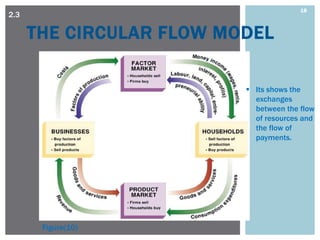
    Circular Flow:
• Circular flow model shows how market economies operate.
- Outside arrow shows flow of money.
- Inside arrow shows flow of resources and products.
18
2.3

      THE CIRCULAR FLOW MODEL

                           Its shows the
                            exchanges
                            between the flow
                            of resources and
                            the flow of
                            payments.


       Figure(10)
2.3                                                                  19


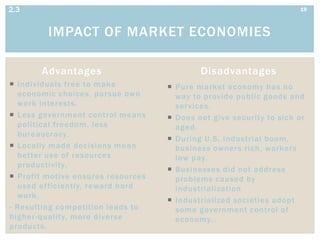
         IMPACT OF MARKET ECONOMIES

       Advantages                           Disadvantages
 Individuals free to make           Pure market economy has no
  economic choices, pur sue own       way to provide public goods and
  work interests.                     ser vices.
 Less government control means      Does not give security to sick or
  political freedom, less             aged.
  bureaucracy.
                                     During U.S. industrial boom,
 Locally made decisions mean         business owners rich, workers
  better use of resources             low pay.
  productivity.
                                     Businesses did not address
 Profit motive ensures resources     problems caused by
  used ef ficiently, reward hard      industrialization
  work .
                                     Industrialized societies adopt
- Resulting competition leads to      some government control of
higher-quality, more diver se         economy..
products.
20
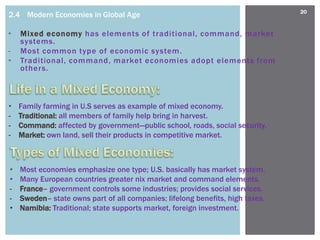
2.4 Modern Economies in Global Age

•   Mixed economy has elements of traditional, command, market
    systems.
-   Most common type of economic system.
•   Traditional, command, market economies adopt elements from
    others.


•   Family farming in U.S serves as example of mixed economy.
-   Traditional: all members of family help bring in harvest.
-   Command: affected by government—public school, roads, social security.
-   Market: own land, sell their products in competitive market.


•   Most economies emphasize one type; U.S. basically has market system.
•   Many European countries greater nix market and command elements.
-   France– government controls some industries; provides social services.
-   Sweden– state owns part of all companies; lifelong benefits, high taxes.
•   Namibia: Traditional; state supports market, foreign investment.
2.4                                                                                21


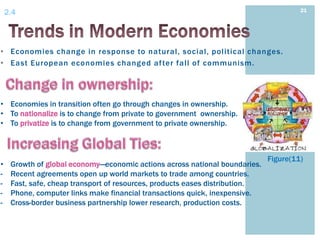
• Economies change in response to natural, social, political changes.
• East European economies changed af ter fall of communism.


• Economies in transition often go through changes in ownership.
• To nationalize is to change from private to government ownership.
• To privatize is to change from government to private ownership.


                                                                              Figure(11)
•    Growth of global economy—economic actions across national boundaries.
-    Recent agreements open up world markets to trade among countries.
-    Fast, safe, cheap transport of resources, products eases distribution.
-    Phone, computer links make financial transactions quick, inexpensive.
-    Cross-border business partnership lower research, production costs.
22

    WHY DO ECONOMIC GOALS SOMETIMES
               CONFLICT?


 People’s needs and wants may conflict, priorities can conflict,
  solutions can conflict and priorities can change.
 To fix this, the nation will depict what economic goals are more
  important, then assign which goal they will plan to meet first.
23


Information:
• Holt Economies concepts and choices book.
• ClassZone.com

Figures:
•   Figure (1):http://www.brandeberry.net/
•   Figure(2):lerner.udel.edu
•   Figure(3):home.comcast.net
•   Figure(4):felena.edu.glogster.com
•   Figure(5):avuc92.wordpress.com
•   Figure(6):worldculturepictorial.com
•   Figure(7):fineartamerica.com
•   figure(8):1x1.fi
•   figure(9):komonews.com
•   Figure(10):justdan93.wordpress.com
•   Figure(11):globalhajemohammadi.blogspot.com

Economic systems

  • 1.
    1 ECONOMIC SYSTEMS Chapter 2: 2.1 , 2.2, 2.3,2.4. Done by :… Economics Date:… Ms./Mr
  • 2.
    2.1 2 An Economic system is the way in which society uses its resources to satisfy its Figure (1) people. Three basic economic questions: 1. What to produce? 2. How to produce? 3. For whom to produce?
  • 3.
    2.1 3 1) Traditional Economy 2)Command Economy 3)Market Economy Figure (3) • Mixed Economies have features of more than one type of system.
  • 4.
    2.1 4 Figure (4) • Decisions are based on a societies values, customs and traditions. • Tradition decides what you produce. If your family has always caught fish, your family will most likely always catch fish. Roles are usually passed down from father to son and mother to daughter. • Good of the group always come before individual desires. • Traditional economies still exist in parts of N. America, Asia, Africa, San of the Kalahari Desert and the Aborigines of Australia.
  • 5.
    2.1 5 TRADITIONAL ECONOMY Advantages Disadvantages  Little disagreement  As a result of over goals, roles. resistance to change, less productive. - Methods of production, distribution determined - Do not use new methods; people not in by custom. they jobs they are best suited for. - Low productivity results in low standard of living.
  • 6.
    2.1 6 • The government has complete control over production. • Individuals in a command economy have little or no say in economic choices. • Government owns means of production on: resources and factories. • North Korea and Cuba are current examples of command economies. Before the collapse of communism in Europe, countries such as the Soviet Union, Poland, and East Germany also were command economies. • It is also called Planned Economy. Figure (5)
  • 7.
    2.1 7  Market Economy driven by choices of consumers and producers. - Consumers spend money, go into business, sell their labor as they wish. - Producers decide how to use their resources to make the most money.  Consumers, Producers benefit each other when they act. Figure(6)
  • 8.
    2.1 8 • Many traditional economies under pressure to change. • Kavango people of Namibia as subsistence farmers for centuries. • Modern telecommunication brought Kavango images of the outside world. - Thousands moved to cities. - A few have turned to commercial farming.
  • 9.
    9 2.2 Command Economies Centrallyplanned economy - central government makes all decisions. GOVERNMENT PLANNING: • In all societies government exerts some control over people’s lives. • In centrally planned economy, government exerts great control. -Determines businesses to operate, amount produced each month. -Determines who employed, work hours, pay scales.
  • 10.
    2.2 10  Karl Marx influenced some societies to adopt command economies. -Socialism: government owns some of the factors of production. -Communism: no private property, little political freedom.  Authoritarian: system requires total obedience to government. -Communism is authoritarian socialism.  Democratic socialism established under democratic political process. -Government basic industries. -Other industries private. -Central planners make decisions for government owned industries. -Central planners might control other sectors, such as health care.
  • 11.
    11 2.2 ANew view of Economics:  Marx lived during industrial revolution.  Argued factory owners used workers as resources -Exploited workers by keeping waged low to increase profits. -Workers would rebel, established classless society. Figure(7)  Wrote The Communist Manifesto (with Friendrich Engles). Das Kapital.
  • 12.
    12 2.2 North Korea:  CommunistNorth Korea used resources for military, no necessities. - Built large army; nuclear weapons program. - In 1990s and early 2000s, millions died of hunger, malnutrition.  1990s, production decreased and economy shrank.  Sine 2003, some market activity allowed. Figure (9)
  • 13.
    2.2 13  Theory- command systems fair to everyone; but in practice – many disadvantages. - Central planners do not understand local conditions. - Workers have little motive to be productive or conserve resources. - Artificially how prices lead to shortages. - People sacrificed to carry out centrally planned policies.
  • 14.
    14 2.3 Market Economies •Private property rights– right to own business and resources. • Property means material objects, money, intellectual property, labor. • Market– place or situations where people buy and sell goods, services. Private property and Markets: • Private property rights must be defined and protected by law. • Buyers must be sure sellers have right to sell products they offer. • Sellers must be sure they will be paid for their products.
  • 15.
    2.3 15 o Laissez faire—government should not interfere in economy. o Capitalism—system having private ownership of factors of production. -Says producers will create products consumers demand. o Actual market economies all have some government involvement. o Voluntary exchange—traders believe they get more than they give up. o In market economy, most trade is exchange of product for money. o Profit– financial gain from business transaction.
  • 16.
    16 2.3 • Competition– sellers’efforts to get business by offering best deal. • Consumer sovereignty– buyers choose products, control what is produced. • Competition controls self--interested behavior. - Sellers offer low price or high value to please consumers, make profit. • Specialization—people concentrate their efforts in the activities they do best. - Encourages efficient use of resources. - Leads to higher—quality, lower-priced products.
  • 17.
    2.3 12 Product Markets: • Product Markets– markets where goods and services bought and sold. - Includes all purchases by individuals from businesses. Factor Markets: • Factor Markets– market for the factors of production. - Land, labor, capital, entrepreneurship. • Individuals own all factors of production. - Own some outright, such as labor; some indirectly, such as stocks. - Individual are producers; businesses are customers. Circular Flow: • Circular flow model shows how market economies operate. - Outside arrow shows flow of money. - Inside arrow shows flow of resources and products.
  • 18.
    18 2.3 THE CIRCULAR FLOW MODEL  Its shows the exchanges between the flow of resources and the flow of payments. Figure(10)
  • 19.
    2.3 19 IMPACT OF MARKET ECONOMIES Advantages Disadvantages  Individuals free to make  Pure market economy has no economic choices, pur sue own way to provide public goods and work interests. ser vices.  Less government control means  Does not give security to sick or political freedom, less aged. bureaucracy.  During U.S. industrial boom,  Locally made decisions mean business owners rich, workers better use of resources low pay. productivity.  Businesses did not address  Profit motive ensures resources problems caused by used ef ficiently, reward hard industrialization work .  Industrialized societies adopt - Resulting competition leads to some government control of higher-quality, more diver se economy.. products.
  • 20.
    20 2.4 Modern Economiesin Global Age • Mixed economy has elements of traditional, command, market systems. - Most common type of economic system. • Traditional, command, market economies adopt elements from others. • Family farming in U.S serves as example of mixed economy. - Traditional: all members of family help bring in harvest. - Command: affected by government—public school, roads, social security. - Market: own land, sell their products in competitive market. • Most economies emphasize one type; U.S. basically has market system. • Many European countries greater nix market and command elements. - France– government controls some industries; provides social services. - Sweden– state owns part of all companies; lifelong benefits, high taxes. • Namibia: Traditional; state supports market, foreign investment.
  • 21.
    2.4 21 • Economies change in response to natural, social, political changes. • East European economies changed af ter fall of communism. • Economies in transition often go through changes in ownership. • To nationalize is to change from private to government ownership. • To privatize is to change from government to private ownership. Figure(11) • Growth of global economy—economic actions across national boundaries. - Recent agreements open up world markets to trade among countries. - Fast, safe, cheap transport of resources, products eases distribution. - Phone, computer links make financial transactions quick, inexpensive. - Cross-border business partnership lower research, production costs.
  • 22.
    22 WHY DO ECONOMIC GOALS SOMETIMES CONFLICT?  People’s needs and wants may conflict, priorities can conflict, solutions can conflict and priorities can change.  To fix this, the nation will depict what economic goals are more important, then assign which goal they will plan to meet first.
  • 23.
    23 Information: • Holt Economiesconcepts and choices book. • ClassZone.com Figures: • Figure (1):http://www.brandeberry.net/ • Figure(2):lerner.udel.edu • Figure(3):home.comcast.net • Figure(4):felena.edu.glogster.com • Figure(5):avuc92.wordpress.com • Figure(6):worldculturepictorial.com • Figure(7):fineartamerica.com • figure(8):1x1.fi • figure(9):komonews.com • Figure(10):justdan93.wordpress.com • Figure(11):globalhajemohammadi.blogspot.com