Adam Smith contribution
to International Trade.
 Adam Smith (5 June 1723 OS (16 June 1723 NS) – 17
July 1790) was a Scottish moral philosopher and a
pioneer of political economy. One of the key figures of
the Scottish Enlightenment,[1]Adam Smith is best
known for two classic works: The Theory of Moral
Sentiments (1759), and An Inquiry into the Nature and
Causes of the Wealth of Nations (1776). The latter,
usually abbreviated as The Wealth of Nations, is
considered his magnum opus and the first modern
work of economics. Smith is cited as the "father of
modern economics" and is still among the most
influential thinkers in the field of economics today
Adam Smith and David Hume were the
founding fathers of anti-mercantilist thought.
A number of scholars found important flaws
with mercantilism long before Adam
Smith developed an ideology that could fully
replace it.
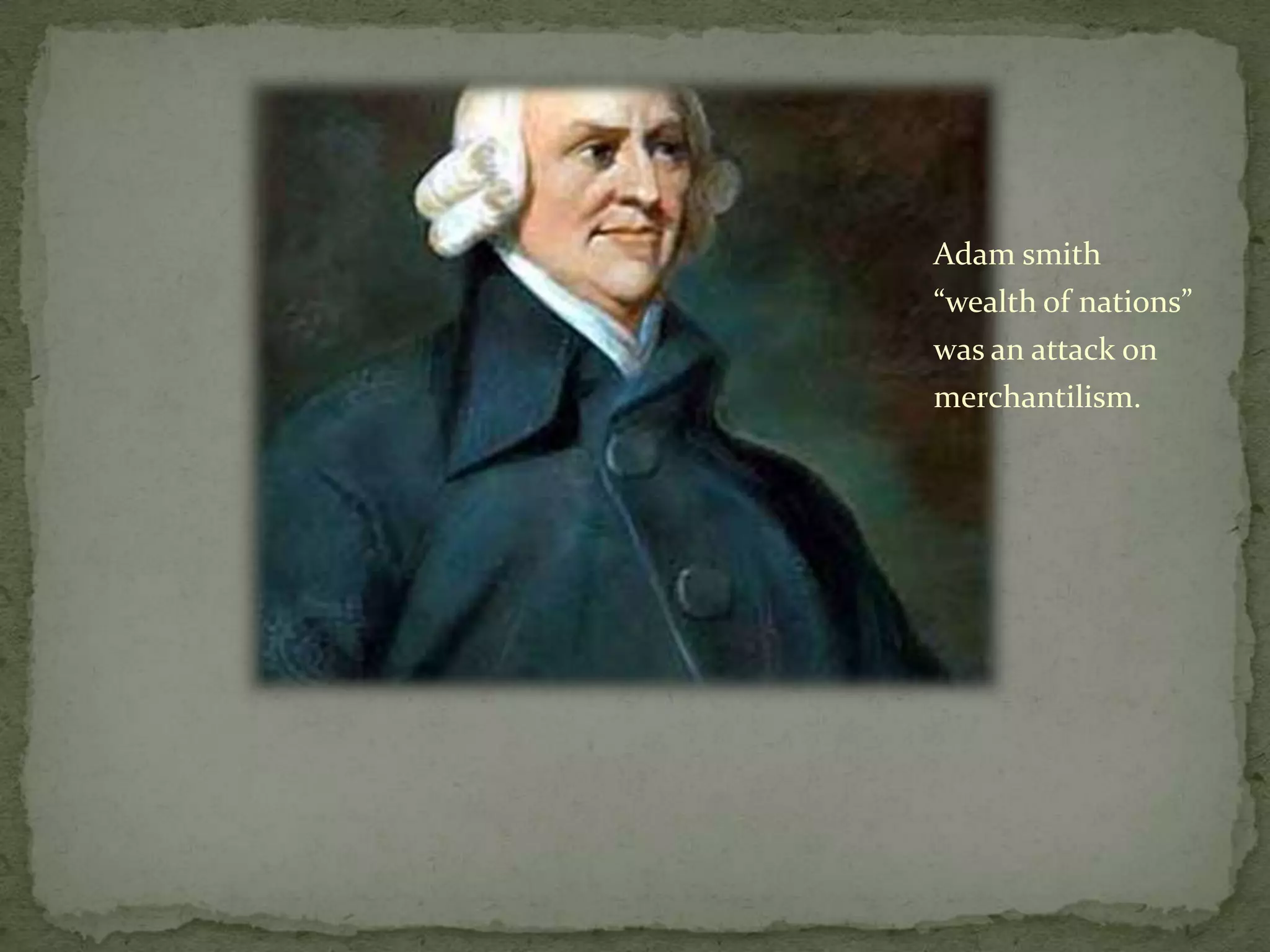
Adam smith
“wealth of nations”
was an attack on
merchantilism.
•laissez-faire capitalism
•Division of labour
•Invisible hand
Absolute advantage theory was derived from
this book “wealth of nations”
 Adam Smith's Absolute Advantage Theory says that
one country would have an absolute advantage over
the other if it can produce same amount of goods with
fewer resources. This is then the ability of a company
or a country to produce more goods than its
competitors using same or less resources. The
principle was described by Adam Smith in the context
of international trade.
 The main concept of absolute advantage is generally attributed
to Adam Smith for his 1776 publication An Inquiry into the
Nature and Causes of the Wealth of Nations in which he
countered mercantilist ideas. Smith argued that it was
impossible for all nations to become rich simultaneously by
following mercantilism because the export of one nation is
another nation’s import and instead stated that all nations would
gain simultaneously if they practiced free trade and specialized
in accordance with their absolute advantage. Smith also stated
that the wealth of nations depends upon the goods and services
available to their citizens, rather than their gold reserves. While
there are possible gains from trade with absolute advantage, the
gains may not be mutually beneficial. Comparative advantage
focuses on the range of possible mutually beneficial exchange
 Party A can produce 5 widgets per hour with 3
employees.
 Party B can produce 10 widgets per hour with 3
employees.
 Assuming that the employees of both parties are paid
equally, Party B has an absolute advantage over Party A
in producing widgets per hour. This is because Party B
can produce twice as many widgets as Party A can with
the same number of employees.
 Alpinia produces cuckoo clocks at a prodigious rate, requiring only 60 worker hours to
produce each clock. Nearby Oceania is relatively inefficient at producing such clocks, and
it needs 100 hours to make each one. However the artisans of Oceania are dab hands at
making rocking horses, producing each one in just 50 worker hours. The clockmakers of
Alpinia are unable to transfer their clockmaking skills to other forms of manufacturing
and the Alpinians require 80 worker hours to produce a rocking horse.
 As Alpinia can make a cuckoo clock in 60 hours while Oceania needs 100 hours for the
same task, Alpinia has an absolute advantage in this activity and would increase its
national income by specializing in this form of manufacture. In the case of rocking
horses, Oceania can complete each one in 50 worker hours while the Alpinians need 80
worker hours, so Oceania clearly has an absolute advantage in the manufacture of
rocking horses and should specialize in their manufacture.
 This specialization combined with international trade would benefit both parties.
However if we look at the statistics for a third country, Desertia, we find that this country
requires 120 hours to produce a cuckoo clock and 90 hours to produce a rocking horse.
Desertia does not have an absolute advantage in either of these activities and according to
the theory of absolute advantage it would not benefit by specializing in either activity.
 The theory of absolute advantage was a step forward in
explaining the need for countries to specialize in
certain products and engage in international trade to
increase their productivity. The theory was however
not helpful to those countries who did not have an
absolute advantage in certain goods. Such countries
would, according to the theory, not gain any benefit
from specializing.

Adam smith theory on International Trade

  • 1.
    Adam Smith contribution toInternational Trade.
  • 2.
     Adam Smith(5 June 1723 OS (16 June 1723 NS) – 17 July 1790) was a Scottish moral philosopher and a pioneer of political economy. One of the key figures of the Scottish Enlightenment,[1]Adam Smith is best known for two classic works: The Theory of Moral Sentiments (1759), and An Inquiry into the Nature and Causes of the Wealth of Nations (1776). The latter, usually abbreviated as The Wealth of Nations, is considered his magnum opus and the first modern work of economics. Smith is cited as the "father of modern economics" and is still among the most influential thinkers in the field of economics today
  • 3.
    Adam Smith andDavid Hume were the founding fathers of anti-mercantilist thought. A number of scholars found important flaws with mercantilism long before Adam Smith developed an ideology that could fully replace it.
  • 4.
    Adam smith “wealth ofnations” was an attack on merchantilism.
  • 5.
    •laissez-faire capitalism •Division oflabour •Invisible hand Absolute advantage theory was derived from this book “wealth of nations”
  • 6.
     Adam Smith'sAbsolute Advantage Theory says that one country would have an absolute advantage over the other if it can produce same amount of goods with fewer resources. This is then the ability of a company or a country to produce more goods than its competitors using same or less resources. The principle was described by Adam Smith in the context of international trade.
  • 7.
     The mainconcept of absolute advantage is generally attributed to Adam Smith for his 1776 publication An Inquiry into the Nature and Causes of the Wealth of Nations in which he countered mercantilist ideas. Smith argued that it was impossible for all nations to become rich simultaneously by following mercantilism because the export of one nation is another nation’s import and instead stated that all nations would gain simultaneously if they practiced free trade and specialized in accordance with their absolute advantage. Smith also stated that the wealth of nations depends upon the goods and services available to their citizens, rather than their gold reserves. While there are possible gains from trade with absolute advantage, the gains may not be mutually beneficial. Comparative advantage focuses on the range of possible mutually beneficial exchange
  • 8.
     Party Acan produce 5 widgets per hour with 3 employees.  Party B can produce 10 widgets per hour with 3 employees.  Assuming that the employees of both parties are paid equally, Party B has an absolute advantage over Party A in producing widgets per hour. This is because Party B can produce twice as many widgets as Party A can with the same number of employees.
  • 9.
     Alpinia producescuckoo clocks at a prodigious rate, requiring only 60 worker hours to produce each clock. Nearby Oceania is relatively inefficient at producing such clocks, and it needs 100 hours to make each one. However the artisans of Oceania are dab hands at making rocking horses, producing each one in just 50 worker hours. The clockmakers of Alpinia are unable to transfer their clockmaking skills to other forms of manufacturing and the Alpinians require 80 worker hours to produce a rocking horse.  As Alpinia can make a cuckoo clock in 60 hours while Oceania needs 100 hours for the same task, Alpinia has an absolute advantage in this activity and would increase its national income by specializing in this form of manufacture. In the case of rocking horses, Oceania can complete each one in 50 worker hours while the Alpinians need 80 worker hours, so Oceania clearly has an absolute advantage in the manufacture of rocking horses and should specialize in their manufacture.  This specialization combined with international trade would benefit both parties. However if we look at the statistics for a third country, Desertia, we find that this country requires 120 hours to produce a cuckoo clock and 90 hours to produce a rocking horse. Desertia does not have an absolute advantage in either of these activities and according to the theory of absolute advantage it would not benefit by specializing in either activity.
  • 10.
     The theoryof absolute advantage was a step forward in explaining the need for countries to specialize in certain products and engage in international trade to increase their productivity. The theory was however not helpful to those countries who did not have an absolute advantage in certain goods. Such countries would, according to the theory, not gain any benefit from specializing.