
Unit - II
Classical Economists
Adam Smith; David Ricardo; Malthus; Karl Marx
Adam Smith (1723-1790)
Born in 1723 Kirkcaldy in Scotland.
Was a posthumous child.
Raised by his mother and older brother.
School at Kirkcaldy; Degree at Glasgow and Oxford.
Taught at the University of Glasgow (Logic and Moral
Philosophy).
Has personal library consisted of nearly 1500 books.
He never married.
Books:
1. "The Theory of Moral Sentiments," released in 1759.
2. "An Inquiry Into the Nature and Causes of the Wealth of
Nations," released in 1776.
Ideas or Doctrines or Views of Adamsmith
1. Wealth definition
2. Division of Labour
3.Theory of Value
4.Capital Accumulation
5.Free Trade
6.Stationary State
2.Division of Labour
Meaning:
"By division of labor is meant the specialization, of work.
Definition:
"The division of labor by reducing every man business to
some one simple operation and by making this operation
the sole employment of his life necessarily increases very
much the dexterity of the worker".
- Adam Smith
Types of Division of Labour
Division of Labor may be simple, complex, and territorial.
1. Simple:
When different groups of people specialize in different
kinds of works, it is called simple.
Example: one man specializes in weaving cloth, the other in
making shoes.
2. Complex:
When a particular work is split up into different
processes and sub-processes and each process is carried
out by a single person or a group of persons, it is said to be
complex.
Example: Needle, Car Factory etc.
3. Territorial
When a certain locality specializes in the production of
a particular commodity, it is said to be territorial.
Example: Dindigul> __________
Tirunelveli>_________
Merits of Division of Labour
a. Increase in Productivity.
b. Increase in Dexterity and Skill.
c. Division of Labor stimulates Inventions.
d. Diversity of Employment.
e.Economy in the use of Machinery and Tools.
f.Saving in Time and Efforts.
g.Large Scale Production at Cheaper Cost.
h. Right man for the Right Job.
i.Increase in the use of Machinery.
Demerits of Division of Labour
a. Repetition Increases Monotony.
b. Loss of Responsibility.
c. Risk of Unemployment.
d. Evils of Factory System.
e. Disruption of Family Life.
Conclusion:
It is found that the advantages far outweigh the disadvantages.
Role of State - Stationary State
• Adam Smith Advocated the concept of Laissez-faire.
• He was against state-inference in economic activities.
Arguments:
The government have to spend more; not economise
expenditure.
The state should not give minutest attention on
producers.
The agents of state are negligent and thriftless
Role of State:
a.Protection against foreign countries
b.Administration of Law and Justice
c.Establishment and maintenance of public works
i. Canals, harbour, roads, etc
ii.Education of youth by schools
iii.Education of people by churches
• On Taxation
The revenue of the state derived from two sources
i. Funds,Land and Capital of the state
ii.Taxes
Canons of Taxation
a.Canon of equity: Proportion to their respective abilities
b.Canon of Certainty: To be certain not arbitrary
c.Canon of Convenience: to be convenient for the payer
d.Canon of Economy: Economy in tax collection.
Thomas Robert Malthus (1766-1834)
Born in 1766 in Rockery, England.
Graduated in 1788.
Professor of History and Political Economy
Books:
Essay on Population - 1798
The Poor Law - 1817
Measure of Value - 1823
Theory of Market Gluts
• An excess of supply over demand is called Market Gluts.
Such market gluts are unwelcome because they lead to
unemployment
• Malthus felt that the key to avoiding such gluts lay in the
amount spent by the land-owning class.
• If they spent freely, there would be adequate demand,
gluts would be avoided and unemployment would be low.
• One way to ensure this, Malthus argued in his contribution
to the debate on the Corn Laws that had imposed tariffs
on imports of cheap corn, was to retain those tariffs.
• This would raise the price of British agricultural produce,
raise the incomes of the landlords, increase their
spending and thereby avoid the occurrence of a market
glut.
• Elements of this theory were later revived as the
Keynesian theory of the short-run role of tariffs under
fixed exchange rates.
• Classical theory denied the likelihood of demand being
less than supply
• Whether theoretically sound or not, many economists
continue to believe in the real- world truth of this idea.
Ricardian Theory of Rent
Definition:
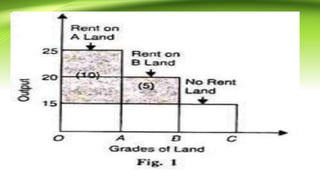
Rent is that portion of the produce of the earth which is
paid to the landlord for the use of the original and
indestructible powers of the soil.
Assumptions:
1.Land differ in fertility.
2.Law of Diminishing Returns operates in agriculture.
3.Rent depends upon the fertility and location.
4.Rent is not a part of cost of production
5.Land is used for cultivation only.
6.Most fertile lands are cultivated first.
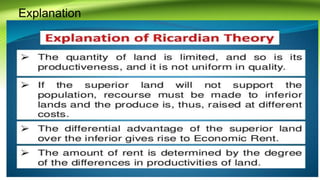
Explanation
Criticism
1. Assumption of Land is subject to Law of Diminishing
Returns, can crack with science and technology.
2. Assumption of perfect competition is unrealistic.
3.No rent land is not possible in practical.
4.Most fertile lands are not always cultivated first.
5.Rent is not due to fertility, but for scarcity of land.
6.Ignored the alternative uses of land.
•
Theory of Distribution
Introduction:
This theory is based on the marginal and surplus principles.
The marginal principle explains the share of rent in national
output.
The surplus principle explains the division of the remaining share
between wages and profits.
Assumptions:
1.Supply of land is fixed.
2.Law of diminishing returns operates on land.
3.Demand for corn is perfectly inelastic.
4.Labour and capital are variable inputs.
5.Capital consists of circulating capital.
6. There is capital homogeneity.
7.All workers are paid subsistence wages.
8.The state of technological knowledge is given.
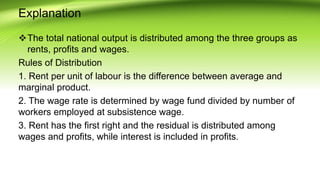
Explanation
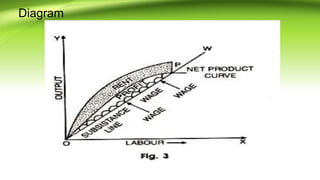
The total national output is distributed among the three groups as
rents, profits and wages.
Rules of Distribution
1. Rent per unit of labour is the difference between average and
marginal product.
2. The wage rate is determined by wage fund divided by number of
workers employed at subsistence wage.
3. Rent has the first right and the residual is distributed among
wages and profits, while interest is included in profits.
Diagram
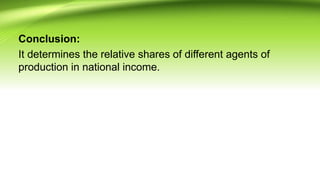
Conclusion:
It determines the relative shares of different agents of
production in national income.
Ricardian Theory of International Trade
Introduction
• David Ricardo developed this international trade theory
based in comparative advantage and specialization.
• He introduced this theory for the first time in his book “On
the Principles of Political Economy and Taxation”, 1817.
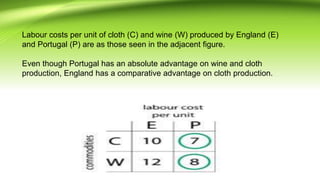
Labour costs per unit of cloth (C) and wine (W) produced by England (E)
and Portugal (P) are as those seen in the adjacent figure.
Even though Portugal has an absolute advantage on wine and cloth
production, England has a comparative advantage on cloth production.
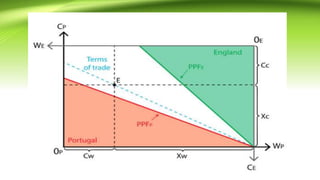
• Without international trade, each country would only be
able to produce at the country’s production-possibility
frontier (green for England and red for Portugal).
• As a result of international trade, point E would become
reachable.
Conclusion:
The implications of this theory were great as it meant a
breakthrough in the economic science.
Karl Marx’s Materialistic Interpretation of History
Introduction:
• Marx’s general ideas about society are known as his theory of historical
materialism.
• Materialism is the basis of his sociological thought.
• Also called Dialectical Materialism.
Explanation:
• According to Marx, People’s way of thinking, life and activities are moulded
by economic forces.
• Non economic forces exert only little influence.
• People’s way of living is governed by the way they earn their livelihood.
• History is mainly a record of class struggles, strifes and conflicts.
• Marx’s history of society is as following
Primitive Communism → Slavery → Feudalism→
Capitalism →Socialism →Communism
Conclusion:
Marx suggest that, knowledge of the society can be used
to change the society as human knowledge increases.
Reference
• www.economicsdiscussion.net
• www.age-of-the-sage.org
• www.economicsconcepts.com
• History of Economic Thought by Dr.S.Sankaran, Margham
Publications.

Classical Economists

  • 1.
    Unit - II ClassicalEconomists Adam Smith; David Ricardo; Malthus; Karl Marx
  • 2.
    Adam Smith (1723-1790) Bornin 1723 Kirkcaldy in Scotland. Was a posthumous child. Raised by his mother and older brother. School at Kirkcaldy; Degree at Glasgow and Oxford. Taught at the University of Glasgow (Logic and Moral Philosophy). Has personal library consisted of nearly 1500 books. He never married.
  • 3.
    Books: 1. "The Theoryof Moral Sentiments," released in 1759. 2. "An Inquiry Into the Nature and Causes of the Wealth of Nations," released in 1776.
  • 4.
    Ideas or Doctrinesor Views of Adamsmith 1. Wealth definition 2. Division of Labour 3.Theory of Value 4.Capital Accumulation 5.Free Trade 6.Stationary State
  • 5.
    2.Division of Labour Meaning: "Bydivision of labor is meant the specialization, of work. Definition: "The division of labor by reducing every man business to some one simple operation and by making this operation the sole employment of his life necessarily increases very much the dexterity of the worker". - Adam Smith
  • 6.
    Types of Divisionof Labour Division of Labor may be simple, complex, and territorial. 1. Simple: When different groups of people specialize in different kinds of works, it is called simple. Example: one man specializes in weaving cloth, the other in making shoes.
  • 7.
    2. Complex: When aparticular work is split up into different processes and sub-processes and each process is carried out by a single person or a group of persons, it is said to be complex. Example: Needle, Car Factory etc.
  • 8.
    3. Territorial When acertain locality specializes in the production of a particular commodity, it is said to be territorial. Example: Dindigul> __________ Tirunelveli>_________
  • 9.
    Merits of Divisionof Labour a. Increase in Productivity. b. Increase in Dexterity and Skill. c. Division of Labor stimulates Inventions. d. Diversity of Employment. e.Economy in the use of Machinery and Tools. f.Saving in Time and Efforts. g.Large Scale Production at Cheaper Cost. h. Right man for the Right Job. i.Increase in the use of Machinery.
  • 10.
    Demerits of Divisionof Labour a. Repetition Increases Monotony. b. Loss of Responsibility. c. Risk of Unemployment. d. Evils of Factory System. e. Disruption of Family Life. Conclusion: It is found that the advantages far outweigh the disadvantages.
  • 11.
    Role of State- Stationary State • Adam Smith Advocated the concept of Laissez-faire. • He was against state-inference in economic activities. Arguments: The government have to spend more; not economise expenditure. The state should not give minutest attention on producers. The agents of state are negligent and thriftless
  • 12.
    Role of State: a.Protectionagainst foreign countries b.Administration of Law and Justice c.Establishment and maintenance of public works i. Canals, harbour, roads, etc ii.Education of youth by schools iii.Education of people by churches
  • 13.
    • On Taxation Therevenue of the state derived from two sources i. Funds,Land and Capital of the state ii.Taxes Canons of Taxation a.Canon of equity: Proportion to their respective abilities b.Canon of Certainty: To be certain not arbitrary c.Canon of Convenience: to be convenient for the payer d.Canon of Economy: Economy in tax collection.
  • 14.
    Thomas Robert Malthus(1766-1834) Born in 1766 in Rockery, England. Graduated in 1788. Professor of History and Political Economy Books: Essay on Population - 1798 The Poor Law - 1817 Measure of Value - 1823
  • 15.
    Theory of MarketGluts • An excess of supply over demand is called Market Gluts. Such market gluts are unwelcome because they lead to unemployment • Malthus felt that the key to avoiding such gluts lay in the amount spent by the land-owning class. • If they spent freely, there would be adequate demand, gluts would be avoided and unemployment would be low.
  • 16.
    • One wayto ensure this, Malthus argued in his contribution to the debate on the Corn Laws that had imposed tariffs on imports of cheap corn, was to retain those tariffs. • This would raise the price of British agricultural produce, raise the incomes of the landlords, increase their spending and thereby avoid the occurrence of a market glut.
  • 17.
    • Elements ofthis theory were later revived as the Keynesian theory of the short-run role of tariffs under fixed exchange rates. • Classical theory denied the likelihood of demand being less than supply • Whether theoretically sound or not, many economists continue to believe in the real- world truth of this idea.
  • 18.
    Ricardian Theory ofRent Definition: Rent is that portion of the produce of the earth which is paid to the landlord for the use of the original and indestructible powers of the soil.
  • 19.
    Assumptions: 1.Land differ infertility. 2.Law of Diminishing Returns operates in agriculture. 3.Rent depends upon the fertility and location. 4.Rent is not a part of cost of production 5.Land is used for cultivation only. 6.Most fertile lands are cultivated first.
  • 20.
  • 22.
    Criticism 1. Assumption ofLand is subject to Law of Diminishing Returns, can crack with science and technology. 2. Assumption of perfect competition is unrealistic. 3.No rent land is not possible in practical. 4.Most fertile lands are not always cultivated first. 5.Rent is not due to fertility, but for scarcity of land. 6.Ignored the alternative uses of land. •
  • 23.
    Theory of Distribution Introduction: Thistheory is based on the marginal and surplus principles. The marginal principle explains the share of rent in national output. The surplus principle explains the division of the remaining share between wages and profits.
  • 24.
    Assumptions: 1.Supply of landis fixed. 2.Law of diminishing returns operates on land. 3.Demand for corn is perfectly inelastic. 4.Labour and capital are variable inputs. 5.Capital consists of circulating capital. 6. There is capital homogeneity. 7.All workers are paid subsistence wages. 8.The state of technological knowledge is given.
  • 25.
    Explanation The total nationaloutput is distributed among the three groups as rents, profits and wages. Rules of Distribution 1. Rent per unit of labour is the difference between average and marginal product. 2. The wage rate is determined by wage fund divided by number of workers employed at subsistence wage. 3. Rent has the first right and the residual is distributed among wages and profits, while interest is included in profits.
  • 26.
  • 27.
    Conclusion: It determines therelative shares of different agents of production in national income.
  • 28.
    Ricardian Theory ofInternational Trade Introduction • David Ricardo developed this international trade theory based in comparative advantage and specialization. • He introduced this theory for the first time in his book “On the Principles of Political Economy and Taxation”, 1817.
  • 29.
    Labour costs perunit of cloth (C) and wine (W) produced by England (E) and Portugal (P) are as those seen in the adjacent figure. Even though Portugal has an absolute advantage on wine and cloth production, England has a comparative advantage on cloth production.
  • 31.
    • Without internationaltrade, each country would only be able to produce at the country’s production-possibility frontier (green for England and red for Portugal). • As a result of international trade, point E would become reachable. Conclusion: The implications of this theory were great as it meant a breakthrough in the economic science.
  • 32.
    Karl Marx’s MaterialisticInterpretation of History Introduction: • Marx’s general ideas about society are known as his theory of historical materialism. • Materialism is the basis of his sociological thought. • Also called Dialectical Materialism. Explanation: • According to Marx, People’s way of thinking, life and activities are moulded by economic forces. • Non economic forces exert only little influence. • People’s way of living is governed by the way they earn their livelihood. • History is mainly a record of class struggles, strifes and conflicts.
  • 33.
    • Marx’s historyof society is as following Primitive Communism → Slavery → Feudalism→ Capitalism →Socialism →Communism Conclusion: Marx suggest that, knowledge of the society can be used to change the society as human knowledge increases.
  • 34.
    Reference • www.economicsdiscussion.net • www.age-of-the-sage.org •www.economicsconcepts.com • History of Economic Thought by Dr.S.Sankaran, Margham Publications.