Theory & Practical
By: Dr Sonam Arora
 Capital Budgeting is a process of making
investment decisions in capital expenditure.
It involves the planning and control of capital
expenditures.
 It decide whether or not to commit resource
in particular long term projects whose
benefits are to be realized over a period of
time.
1. Large Investment
2. Decisions for equity or borrowed funds
3. Long Term Commitment of Funds
4. Decisions are irreversible in nature
5. Long term effect on profitability
1. Expansion & Diversification
2. Replacement & Modernization
3. Independent Investment
4. Contingent Investment (Dependent
Project Investment)
5. Mutually Exclusive Investment
Evaluation
Techniques of a
Project
Traditional Method
Pay Back
Period
Rate of
Return
Method
Discounted
Method
NPV Method IRR Method
Profitability
Method
 The payback period is the length of time
required to recover the cost of an
investment. The payback period of a given
investment or project is an important
determinant of whether to undertake the
position or project, as longer payback
periods are typically not desirable for
investment positions.
 The payback period ignores the time value of
money.
Payback= Initial Investment/Annual Cash Inflow
Acceptance Rule:
 It is good method of ranking.
 They compared the payback on pre
determined standards.
 The project is accepted if payback period is
less than standard.
 It is effective in short term.
 In this method various projects are ranked
in order of rate of earnings (return).
 The method take into account the
earnings (profits rather than inflows)
expected from the investment over the
period of time.
 The project with higher rate of return is
accepted rather than the lower rate of
return.
 A project require an investment of Rs.
500,000 and has a scrap value of Rs. 20,000
after 5 yrs. it is expected to yield profit after
tax during the 5 years are: Rs. 40000, 60000,
70000, 50000, 20000.
 ARR= Average PAT/Net Investment*100
 Net present value (NPV) is the difference
between the present value of cash inflows and
the present value of cash outflows over a period
of time.
 Because of the time value, money in the present
is worth more than the same amount in the
future.
 This is both because of earnings that could
potentially be made using the money during the
intervening time and because of inflation. In
other words, a dollar earned in the future won’t
be worth as much as one earned in the
present. The discount rate element of the NPV
formula is a way to account for this.
 The management of Fine Electronics
Company is considering to purchase an
equipment to be attached with the main
manufacturing machine. The equipment will
cost $6,000 and will increase annual cash
inflow by $2,200. The useful life of the
equipment is 6 years. After 6 years it will
have no salvage value. The management
wants a 20% return on all investments.
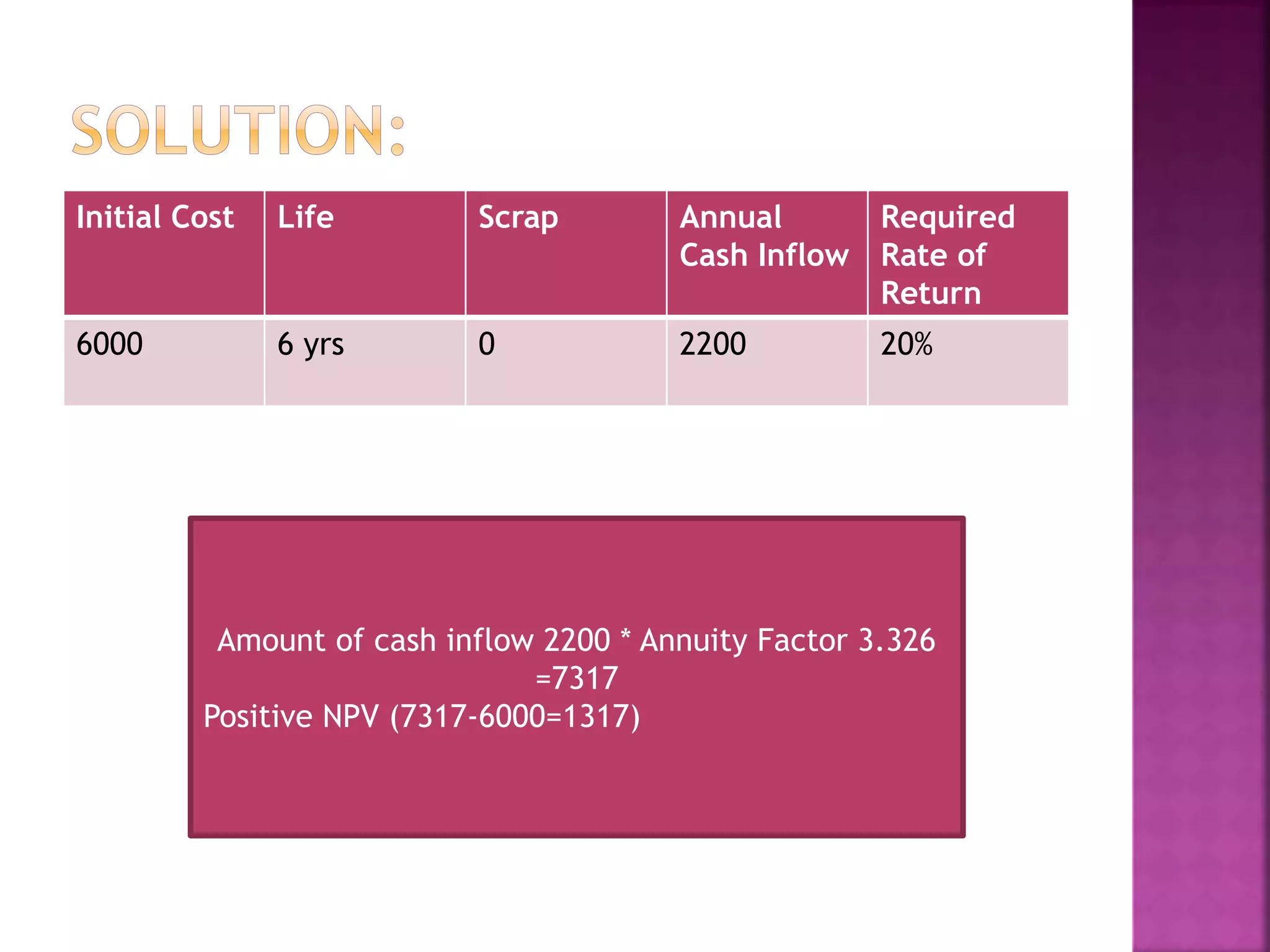
Initial Cost Life Scrap Annual
Cash Inflow
Required
Rate of
Return
6000 6 yrs 0 2200 20%
Amount of cash inflow 2200 * Annuity Factor 3.326
=7317
Positive NPV (7317-6000=1317)
 Positive NPV (PV of Inflows > PV of Outflows)
= Acceptable
 Zero NPV (PV of Inflows = PV of Outflows) =
Acceptable
 Negative NPV (PV of Inflows < PV of
Outflows)= Rejected
 The internal rate of return is the rate at which an
investment project promises to generate a return during
its useful life. It is the discount rate at which the present
value of a project’s net cash inflows becomes equal to the
present value of its net cash outflows.
 In other words, internal rate of return is the discount rate
at which a project’s net present value becomes equal to
zero.
 Under this method, If the internal rate of return promised
by the investment project is greater than or equal to the
minimum required rate of return, the project is
considered acceptable otherwise the project is rejected.
Internal rate of return method is also known as time-
adjusted rate of return method.
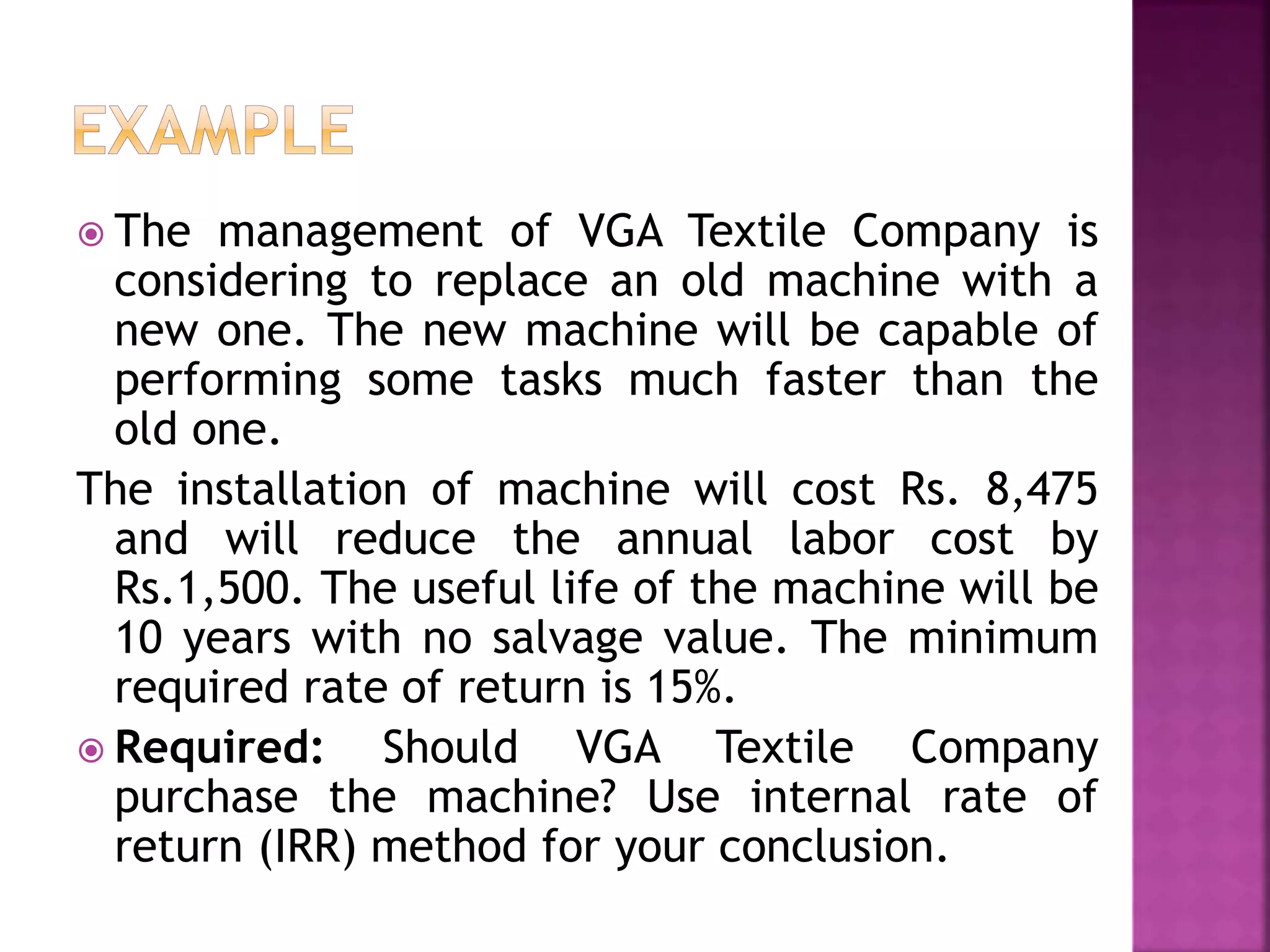
 The management of VGA Textile Company is
considering to replace an old machine with a
new one. The new machine will be capable of
performing some tasks much faster than the
old one.
The installation of machine will cost Rs. 8,475
and will reduce the annual labor cost by
Rs.1,500. The useful life of the machine will be
10 years with no salvage value. The minimum
required rate of return is 15%.
 Required: Should VGA Textile Company
purchase the machine? Use internal rate of
return (IRR) method for your conclusion.
 Formula of IRR
=Net Initial Investment/Annual Cash Inflow
Here, 8475/1500 = 5.650
After computing discount rate, next step is to
locate discount factor in PV of an annuity
table at 10th year, the answer is 12%.
It is less than the required rate of return
which is 15%, thus the project is
unacceptable.
 The profitability index (PI) is one of the
methods used in capital budgeting for project
valuation. In itself it is a modification of the
net present value (NPV) method.
The difference between them is that the NPV is
an absolute measure, and the PI is a relative
measure of a project. In other words, the
profitability index is a ratio that shows how
much profit results from a project per Rs.1 of
initial cost.
 PI = Present Value of expected cash flows
Initial Cost
 The breakeven value of a ratio is equal to 1. If a
project has a profitability index greater than 1, it
should be accepted; if lower than 1, it should be
rejected. The value of 1 is the point of indifference
regarding whether to accept or reject the project. In
terms of net present value, a ratio greater than 1
means that the project’s NPV is positive and it should
be accepted, and a value lower than 1 means a
negative NPV.

Capital budgeting ppt

  • 1.
    Theory & Practical By:Dr Sonam Arora
  • 2.
     Capital Budgetingis a process of making investment decisions in capital expenditure. It involves the planning and control of capital expenditures.  It decide whether or not to commit resource in particular long term projects whose benefits are to be realized over a period of time.
  • 3.
    1. Large Investment 2.Decisions for equity or borrowed funds 3. Long Term Commitment of Funds 4. Decisions are irreversible in nature 5. Long term effect on profitability
  • 4.
    1. Expansion &Diversification 2. Replacement & Modernization 3. Independent Investment 4. Contingent Investment (Dependent Project Investment) 5. Mutually Exclusive Investment
  • 5.
    Evaluation Techniques of a Project TraditionalMethod Pay Back Period Rate of Return Method Discounted Method NPV Method IRR Method Profitability Method
  • 6.
     The paybackperiod is the length of time required to recover the cost of an investment. The payback period of a given investment or project is an important determinant of whether to undertake the position or project, as longer payback periods are typically not desirable for investment positions.  The payback period ignores the time value of money.
  • 7.
    Payback= Initial Investment/AnnualCash Inflow Acceptance Rule:  It is good method of ranking.  They compared the payback on pre determined standards.  The project is accepted if payback period is less than standard.  It is effective in short term.
  • 8.
     In thismethod various projects are ranked in order of rate of earnings (return).  The method take into account the earnings (profits rather than inflows) expected from the investment over the period of time.  The project with higher rate of return is accepted rather than the lower rate of return.
  • 9.
     A projectrequire an investment of Rs. 500,000 and has a scrap value of Rs. 20,000 after 5 yrs. it is expected to yield profit after tax during the 5 years are: Rs. 40000, 60000, 70000, 50000, 20000.  ARR= Average PAT/Net Investment*100
  • 10.
     Net presentvalue (NPV) is the difference between the present value of cash inflows and the present value of cash outflows over a period of time.  Because of the time value, money in the present is worth more than the same amount in the future.  This is both because of earnings that could potentially be made using the money during the intervening time and because of inflation. In other words, a dollar earned in the future won’t be worth as much as one earned in the present. The discount rate element of the NPV formula is a way to account for this.
  • 11.
     The managementof Fine Electronics Company is considering to purchase an equipment to be attached with the main manufacturing machine. The equipment will cost $6,000 and will increase annual cash inflow by $2,200. The useful life of the equipment is 6 years. After 6 years it will have no salvage value. The management wants a 20% return on all investments.
  • 12.
    Initial Cost LifeScrap Annual Cash Inflow Required Rate of Return 6000 6 yrs 0 2200 20% Amount of cash inflow 2200 * Annuity Factor 3.326 =7317 Positive NPV (7317-6000=1317)
  • 13.
     Positive NPV(PV of Inflows > PV of Outflows) = Acceptable  Zero NPV (PV of Inflows = PV of Outflows) = Acceptable  Negative NPV (PV of Inflows < PV of Outflows)= Rejected
  • 14.
     The internalrate of return is the rate at which an investment project promises to generate a return during its useful life. It is the discount rate at which the present value of a project’s net cash inflows becomes equal to the present value of its net cash outflows.  In other words, internal rate of return is the discount rate at which a project’s net present value becomes equal to zero.  Under this method, If the internal rate of return promised by the investment project is greater than or equal to the minimum required rate of return, the project is considered acceptable otherwise the project is rejected. Internal rate of return method is also known as time- adjusted rate of return method.
  • 15.
     The managementof VGA Textile Company is considering to replace an old machine with a new one. The new machine will be capable of performing some tasks much faster than the old one. The installation of machine will cost Rs. 8,475 and will reduce the annual labor cost by Rs.1,500. The useful life of the machine will be 10 years with no salvage value. The minimum required rate of return is 15%.  Required: Should VGA Textile Company purchase the machine? Use internal rate of return (IRR) method for your conclusion.
  • 16.
     Formula ofIRR =Net Initial Investment/Annual Cash Inflow Here, 8475/1500 = 5.650 After computing discount rate, next step is to locate discount factor in PV of an annuity table at 10th year, the answer is 12%. It is less than the required rate of return which is 15%, thus the project is unacceptable.
  • 17.
     The profitabilityindex (PI) is one of the methods used in capital budgeting for project valuation. In itself it is a modification of the net present value (NPV) method. The difference between them is that the NPV is an absolute measure, and the PI is a relative measure of a project. In other words, the profitability index is a ratio that shows how much profit results from a project per Rs.1 of initial cost.
  • 18.
     PI =Present Value of expected cash flows Initial Cost  The breakeven value of a ratio is equal to 1. If a project has a profitability index greater than 1, it should be accepted; if lower than 1, it should be rejected. The value of 1 is the point of indifference regarding whether to accept or reject the project. In terms of net present value, a ratio greater than 1 means that the project’s NPV is positive and it should be accepted, and a value lower than 1 means a negative NPV.