CAPIRE E CONSENTIRE ALLA
MEDICINA DI PRECISIONE
Department of Drug Sciences – University of Pavia
• Il nuovo ruolo attivo dei pazienti
• Dottor Google (and crowd
medicine)
• La scelta difficile
• Data access/sharing
Department of Drug Sciences – University of Pavia
Ampliare l’orizzonte
Department of Drug Sciences – University of Pavia
• Il nuovo ruolo attivo dei pazienti
• Dottor Google (and crowd
medicine)
• La scelta difficile
• Data access/sharing
Department of Drug Sciences – University of Pavia
1999
Shattuck Lecture – Medical
and societal consequences of
the human genome project
Francis S. Collins, NEJM 341, 28-37, 1999.
Department of Drug Sciences – University of Pavia
A HYPOTHETICAL CASE IN
2010
Francis S. Collins, NEJM 341, 28-37, 1999.
Department of Drug Sciences – University of Pavia
A Hypothetical Case in 2010 (I)
John, a 23-year-old college graduate, is referred to his
physician because a serum cholesterol level of 255
mg/dl was detected in the course of a medical
examination required for employment.
He is in good health but has smoked one pack of
cigarettes per day for six years. Aided by an
interactive computer program that takes John's
family history, his physician notes that there is a
strong paternal history of myocardial infarction and
that John's father died at the age of 48 years.
Francis S. Collins, NEJM 341, 28-37, 1999.
Department of Drug Sciences – University of Pavia
A Hypothetical Case in 2010 (II)
To obtain more precise information about his risks of
contracting coronary artery disease and other illnesses in
the future, John agrees to consider a battery of genetic tests
that are available in 2010.
After working through an interactive computer program
that explains the benefits and risks of such tests, John
agrees (and signs informed consent) to undergo 15
genetic tests that provide risk information for illnesses for
which preventive strategies are available.
He decides against an additional 10 tests involving
disorders for which no clinically validated preventive
interventions are yet available.
Francis S. Collins, NEJM 341, 28-37, 1999.
Department of Drug Sciences – University of Pavia
A Hypothetical Case in 2010 (III)
A cheek-swab DNA specimen is sent off for
testing, and the results are returned in one week.
John's subsequent counseling session with the
physician and a genetic nurse specialist
focuses on the conditions for which his risk
differs substantially (by a factor of more than
two) from that of the general population.
Like most patients, John is interested in both
his relative risk and his absolute risk.
Francis S. Collins, NEJM 341, 28-37, 1999.
Department of Drug Sciences – University of Pavia
A Hypothetical Case in 2010 (IV)
John is pleased to learn that genetic testing does
not always give bad news - his risks of
contracting prostate cancer and Alzheimer's
disease are reduced, because he carries low-
risk variants of the several genes known in 2010
to contribute to these illnesses.
John is sobered by the evidence of his
increased risks of contracting coronary artery
disease, colon cancer, and lung cancer.
Francis S. Collins, NEJM 341, 28-37, 1999.
Department of Drug Sciences – University of Pavia
A Hypothetical Case in 2010 (V)
Confronted with the reality of his own genetic data, he
arrives at that crucial "teachable moment" when a
lifelong change in health-related behavior, focused
on reducing specific risks, is possible.
By 2010, the field of pharmacogenomics has
blossomed, and a prophylactic drug regimen based
on the knowledge of John's personal genetic data
can be precisely prescribed to reduce his
cholesterol level and the risk of coronary artery
disease to normal levels.
Francis S. Collins, NEJM 341, 28-37, 1999.
Department of Drug Sciences – University of Pavia
His risk of colon cancer can be addressed by
beginning a program of annual colonoscopy at the age
of 45, which in his situation is a very cost-effective way
to avoid colon cancer.
His substantial risk of contracting lung cancer provides
the key motivation for him to join a support group of
persons at genetically high risk for serious
complications of smoking, and he successfully kicks
the habit.
A Hypothetical Case in 2010 (VI)
Francis S. Collins, NEJM 341, 28-37, 1999.
Department of Drug Sciences – University of Pavia
• Il nuovo ruolo attivo dei pazienti
• Dottor Google (and crowd
medicine)
• La scelta difficile
• Data access/sharing
Department of Drug Sciences – University of Pavia
Far capire e ottenere il consenso
non prepararsi alla difesa!
Department of Drug Sciences – University of Pavia
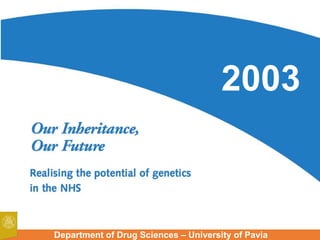
2003
Department of Drug Sciences – University of Pavia
Chapter six – Ensuring
public confidence
Promoting public understanding of
genetics, a robust regulatory
framework responsive to public
concerns and transparency in genetic
policy making
Department of Drug Sciences – University of Pavia
2018
Department of Drug Sciences – University of Pavia
• Il nuovo ruolo attivo dei pazienti
• Dottor Google (and crowd
medicine)
• La scelta difficile
• Data access/sharing
Department of Drug Sciences – University of Pavia
In Italia?
Department of Drug Sciences – University of Pavia
Autorizzazione n. 8/2016 -
Autorizzazione generale al
trattamento dei dati genetici - 15
dicembre 2016
(Pubblicato sulla Gazzetta Ufficiale
n. 303 del 29 dicembre 2016)
Department of Drug Sciences – University of Pavia
Interpretare e implementare le
norme
Department of Drug Sciences – University of Pavia
Il rapido e deciso ampliamento
dell’orizzonte
Department of Drug Sciences – University of Pavia
[…] Ciò significa che non è più l’etica a
scegliere i fini e a incaricare la tecnica di
reperire i mezzi, ma è la tecnica che,
assumendo come fini i risultati delle sue
procedure, condiziona l’etica obbligandola
a prendere posizione su una realtà, non più
naturale ma artificiale, che la tecnica non
cessa di costruire e rendere possibile,
qualunque sia la posizione assunta
dall’etica.
Umberto Galimberti, Psiche e Techne
Feltrinelli, Milano 2002, p.39.
Department of Drug Sciences – University of Pavia
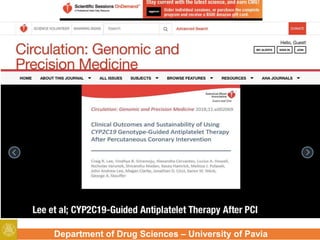
ADDITIONAL READINGS
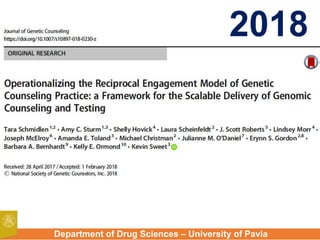
Tara Schmidlen et al., J.Genetic Counseling, 2018
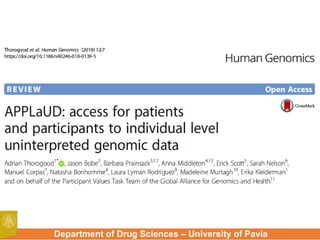
Adrian Thorogood et al., Human Genomics, 2018
Deborah Josko, Clinical Laboratory Science 27, 185-190,
2014
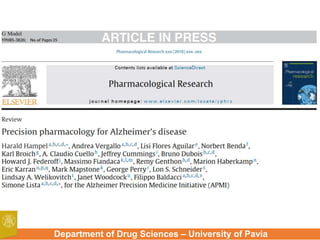
Harald Hamper, et al., Pharmacological Research, 2018
Editorial, Nature medicine, 22, 325, 2016

Capire e consentire alla medicina di precisione

  • 1.
    CAPIRE E CONSENTIREALLA MEDICINA DI PRECISIONE Department of Drug Sciences – University of Pavia
  • 2.
    Department of DrugSciences – University of Pavia • Il nuovo ruolo attivo dei pazienti • Dottor Google (and crowd medicine) • La scelta difficile • Data access/sharing
  • 3.
    Department of DrugSciences – University of Pavia Ampliare l’orizzonte
  • 4.
    Department of DrugSciences – University of Pavia • Il nuovo ruolo attivo dei pazienti • Dottor Google (and crowd medicine) • La scelta difficile • Data access/sharing
  • 5.
    Department of DrugSciences – University of Pavia 1999 Shattuck Lecture – Medical and societal consequences of the human genome project Francis S. Collins, NEJM 341, 28-37, 1999.
  • 6.
    Department of DrugSciences – University of Pavia A HYPOTHETICAL CASE IN 2010 Francis S. Collins, NEJM 341, 28-37, 1999.
  • 7.
    Department of DrugSciences – University of Pavia A Hypothetical Case in 2010 (I) John, a 23-year-old college graduate, is referred to his physician because a serum cholesterol level of 255 mg/dl was detected in the course of a medical examination required for employment. He is in good health but has smoked one pack of cigarettes per day for six years. Aided by an interactive computer program that takes John's family history, his physician notes that there is a strong paternal history of myocardial infarction and that John's father died at the age of 48 years. Francis S. Collins, NEJM 341, 28-37, 1999.
  • 8.
    Department of DrugSciences – University of Pavia A Hypothetical Case in 2010 (II) To obtain more precise information about his risks of contracting coronary artery disease and other illnesses in the future, John agrees to consider a battery of genetic tests that are available in 2010. After working through an interactive computer program that explains the benefits and risks of such tests, John agrees (and signs informed consent) to undergo 15 genetic tests that provide risk information for illnesses for which preventive strategies are available. He decides against an additional 10 tests involving disorders for which no clinically validated preventive interventions are yet available. Francis S. Collins, NEJM 341, 28-37, 1999.
  • 9.
    Department of DrugSciences – University of Pavia A Hypothetical Case in 2010 (III) A cheek-swab DNA specimen is sent off for testing, and the results are returned in one week. John's subsequent counseling session with the physician and a genetic nurse specialist focuses on the conditions for which his risk differs substantially (by a factor of more than two) from that of the general population. Like most patients, John is interested in both his relative risk and his absolute risk. Francis S. Collins, NEJM 341, 28-37, 1999.
  • 10.
    Department of DrugSciences – University of Pavia A Hypothetical Case in 2010 (IV) John is pleased to learn that genetic testing does not always give bad news - his risks of contracting prostate cancer and Alzheimer's disease are reduced, because he carries low- risk variants of the several genes known in 2010 to contribute to these illnesses. John is sobered by the evidence of his increased risks of contracting coronary artery disease, colon cancer, and lung cancer. Francis S. Collins, NEJM 341, 28-37, 1999.
  • 11.
    Department of DrugSciences – University of Pavia A Hypothetical Case in 2010 (V) Confronted with the reality of his own genetic data, he arrives at that crucial "teachable moment" when a lifelong change in health-related behavior, focused on reducing specific risks, is possible. By 2010, the field of pharmacogenomics has blossomed, and a prophylactic drug regimen based on the knowledge of John's personal genetic data can be precisely prescribed to reduce his cholesterol level and the risk of coronary artery disease to normal levels. Francis S. Collins, NEJM 341, 28-37, 1999.
  • 12.
    Department of DrugSciences – University of Pavia His risk of colon cancer can be addressed by beginning a program of annual colonoscopy at the age of 45, which in his situation is a very cost-effective way to avoid colon cancer. His substantial risk of contracting lung cancer provides the key motivation for him to join a support group of persons at genetically high risk for serious complications of smoking, and he successfully kicks the habit. A Hypothetical Case in 2010 (VI) Francis S. Collins, NEJM 341, 28-37, 1999.
  • 13.
    Department of DrugSciences – University of Pavia • Il nuovo ruolo attivo dei pazienti • Dottor Google (and crowd medicine) • La scelta difficile • Data access/sharing
  • 14.
    Department of DrugSciences – University of Pavia Far capire e ottenere il consenso non prepararsi alla difesa!
  • 15.
    Department of DrugSciences – University of Pavia 2003
  • 16.
    Department of DrugSciences – University of Pavia Chapter six – Ensuring public confidence Promoting public understanding of genetics, a robust regulatory framework responsive to public concerns and transparency in genetic policy making
  • 17.
    Department of DrugSciences – University of Pavia 2018
  • 18.
    Department of DrugSciences – University of Pavia
  • 19.
    Department of DrugSciences – University of Pavia • Il nuovo ruolo attivo dei pazienti • Dottor Google (and crowd medicine) • La scelta difficile • Data access/sharing
  • 20.
    Department of DrugSciences – University of Pavia
  • 21.
    Department of DrugSciences – University of Pavia In Italia?
  • 22.
    Department of DrugSciences – University of Pavia Autorizzazione n. 8/2016 - Autorizzazione generale al trattamento dei dati genetici - 15 dicembre 2016 (Pubblicato sulla Gazzetta Ufficiale n. 303 del 29 dicembre 2016)
  • 23.
    Department of DrugSciences – University of Pavia Interpretare e implementare le norme
  • 24.
    Department of DrugSciences – University of Pavia Il rapido e deciso ampliamento dell’orizzonte
  • 25.
    Department of DrugSciences – University of Pavia
  • 26.
    Department of DrugSciences – University of Pavia
  • 27.
    Department of DrugSciences – University of Pavia […] Ciò significa che non è più l’etica a scegliere i fini e a incaricare la tecnica di reperire i mezzi, ma è la tecnica che, assumendo come fini i risultati delle sue procedure, condiziona l’etica obbligandola a prendere posizione su una realtà, non più naturale ma artificiale, che la tecnica non cessa di costruire e rendere possibile, qualunque sia la posizione assunta dall’etica. Umberto Galimberti, Psiche e Techne Feltrinelli, Milano 2002, p.39.
  • 28.
    Department of DrugSciences – University of Pavia ADDITIONAL READINGS Tara Schmidlen et al., J.Genetic Counseling, 2018 Adrian Thorogood et al., Human Genomics, 2018 Deborah Josko, Clinical Laboratory Science 27, 185-190, 2014 Harald Hamper, et al., Pharmacological Research, 2018 Editorial, Nature medicine, 22, 325, 2016