Integration and analysis of heterogeneous big data for precision
medicine and suggested treatments for different types of patients.
SC1-PM-18-2016: Big Data supporting Public Health policies
iASiS: Big Data to Support
Precision Medicine and
Public Health Policy
Anastasia Krithara
Inst. of Informatics & Telecommunications
NCSR “Demokritos”, Greece
http://project-iasis.eu
@Project_IASIS
iASiS Basic Facts
• Title: Integration and analysis of heterogeneous big data for precision
medicine and suggested treatments for different types of patients
• Topic: H2020-SC1-PM-18-2016 - Big Data supporting Public Health policies
• Contract No.: 727658
• Budget: € 4.3M
Motivation
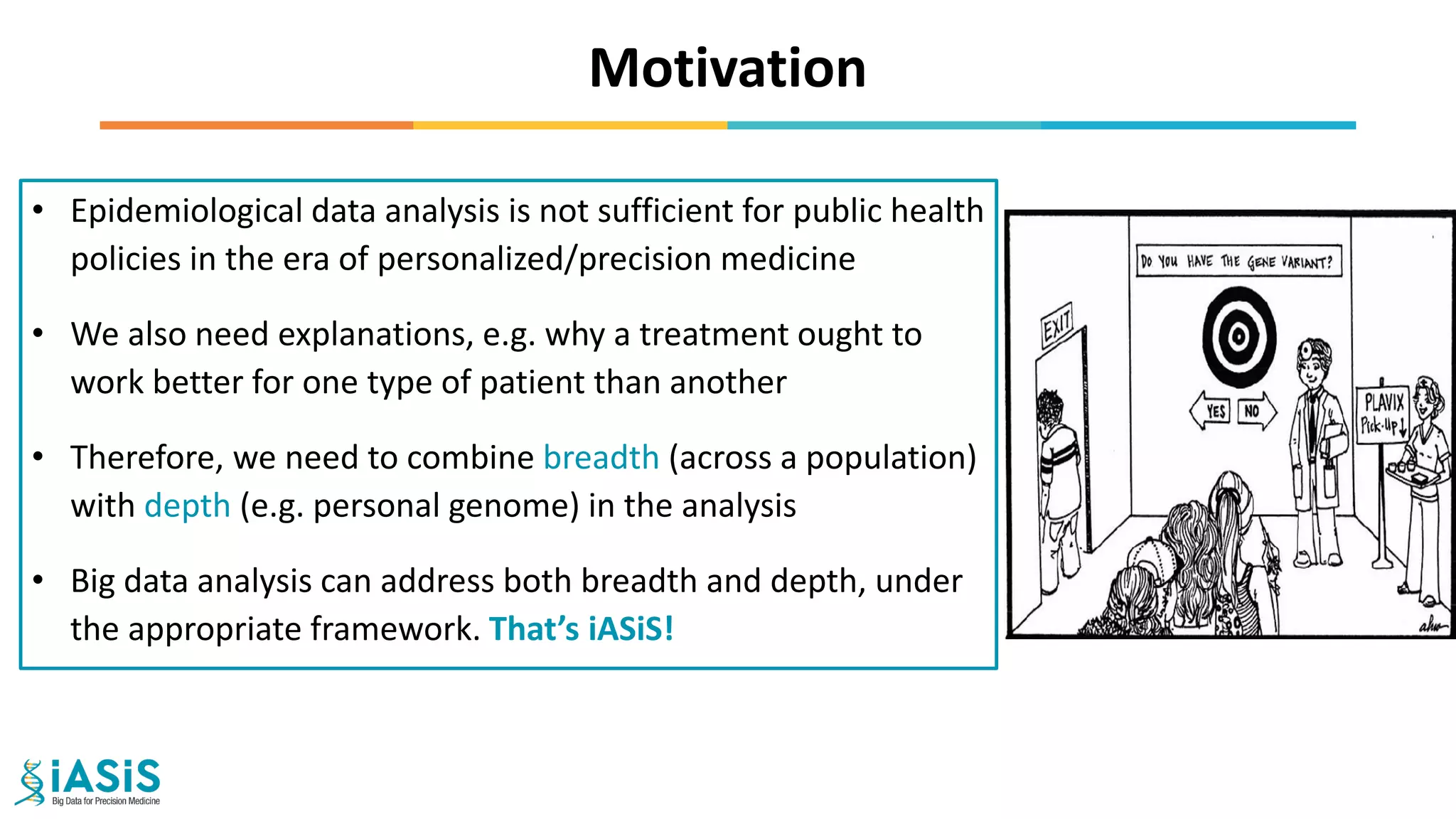
• Epidemiological data analysis is not sufficient for public health
policies in the era of personalized/precision medicine
• We also need explanations, e.g. why a treatment ought to
work better for one type of patient than another
• Therefore, we need to combine breadth (across a population)
with depth (e.g. personal genome) in the analysis
• Big data analysis can address both breadth and depth, under
the appropriate framework. That’s iASiS!
Vision and Objectives
iASiS Vision:
Turn clinical, pharmacogenomics, and other Big Data into actionable
knowledge for personalized medicine and health policy-making
iASiS Objectives:
• Integrate automated unstructured and structured data analysis,
image analysis, and sequence analysis into a Big Data framework
• Use the iASiS framework to support personalized diagnosis and
treatment
The iASiS Framework
• iASiS focuses on two use cases:
• Lung cancer
• Alzheimer’s disease
• General-purpose drugs are often ineffective
The iASiS Framework
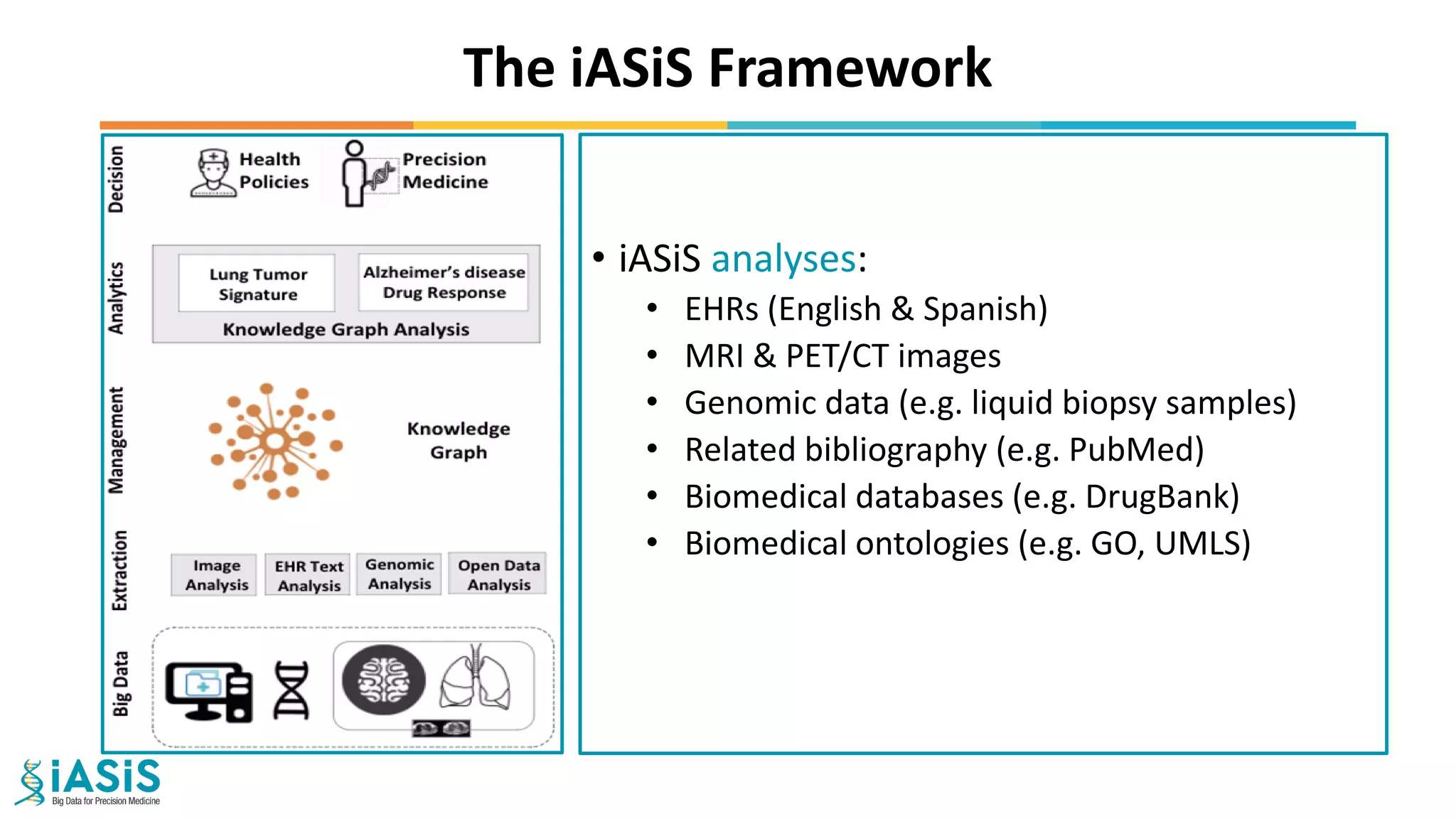
• iASiS analyses:
• EHRs (English & Spanish)
• MRI & PET/CT images
• Genomic data (e.g. liquid biopsy samples)
• Related bibliography (e.g. PubMed)
• Biomedical databases (e.g. DrugBank)
• Biomedical ontologies (e.g. GO, UMLS)
The iASiS Framework
• Extracted knowledge is fused in the iASiS
knowledge graph
• Unified semantic schema
• Linked data
• Machine-processable knowledge
• iASiS end-users can:
• Perform natural language questions
• Receive answers along with justifications
• Identify patterns in patient populations
• Make informed decisions
• All steps of data management and analytics
enforce privacy and access control
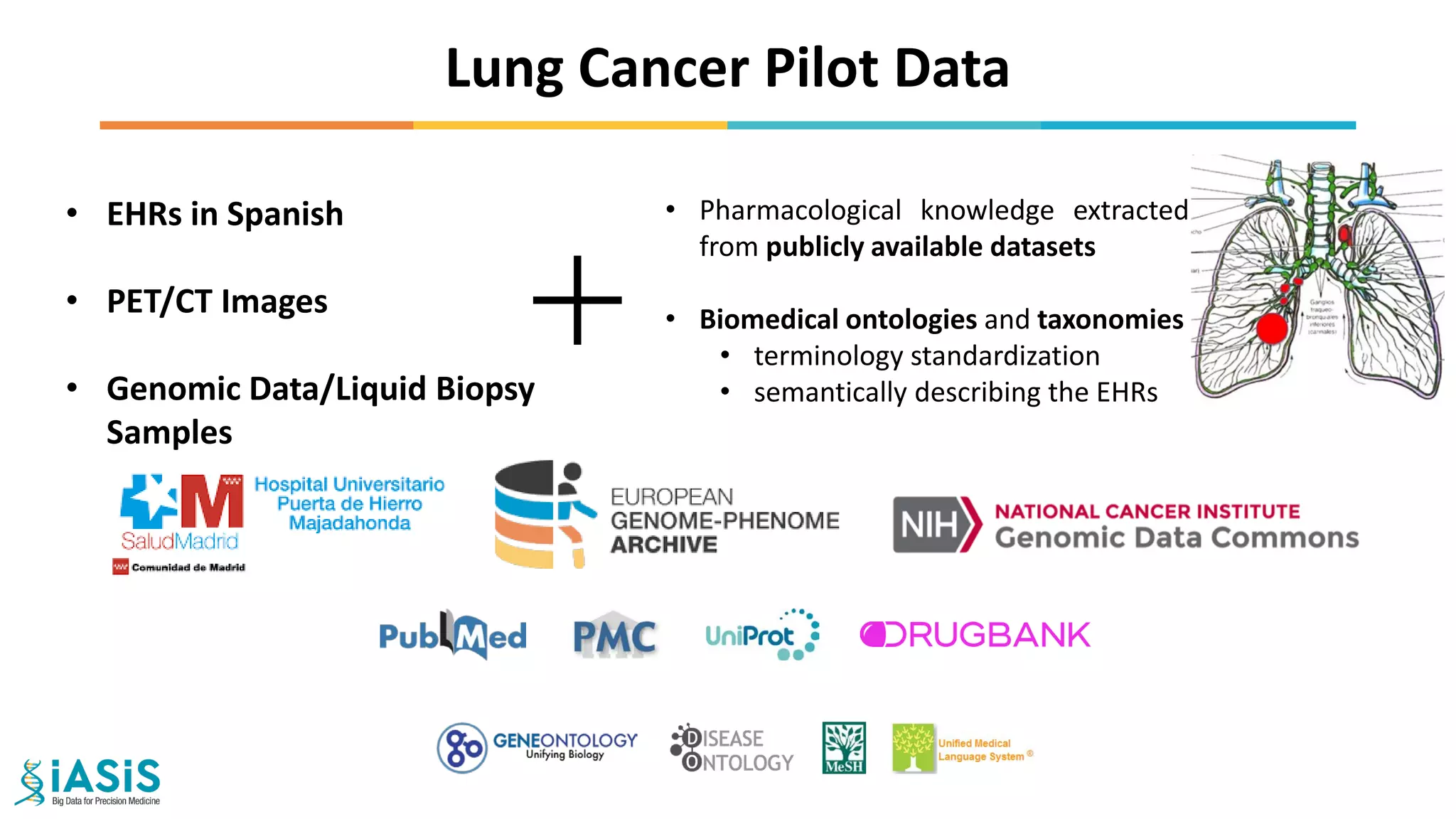
Lung Cancer Pilot Data
• Pharmacological knowledge extracted
from publicly available datasets
• Biomedical ontologies and taxonomies
• terminology standardization
• semantically describing the EHRs
• EHRs in Spanish
• PET/CT Images
• Genomic Data/Liquid Biopsy
Samples
Lung Cancer Use case
Improvement of treatment schemes for lung cancer
Aim: improve
treatment schemes,
based on long
surviving patients
Patient data:
• Clinical notes
• clinical reports
• age at diagnosis
• stage and type of
tumour
• gender
• ...
Input Output
Optimal personalised
treatment schemes
1. Patient categorization in long
survival group based on discovered
correlations:
• females vs males survival
• risk factors, like high blood pressure,
smoking habits and COPD
offline
online
• Analysis of patient clinical records (EHR, images, liquid biopsy data)
• Analysis of open data (related publications, ontologies, structured databases)
Analysis
9
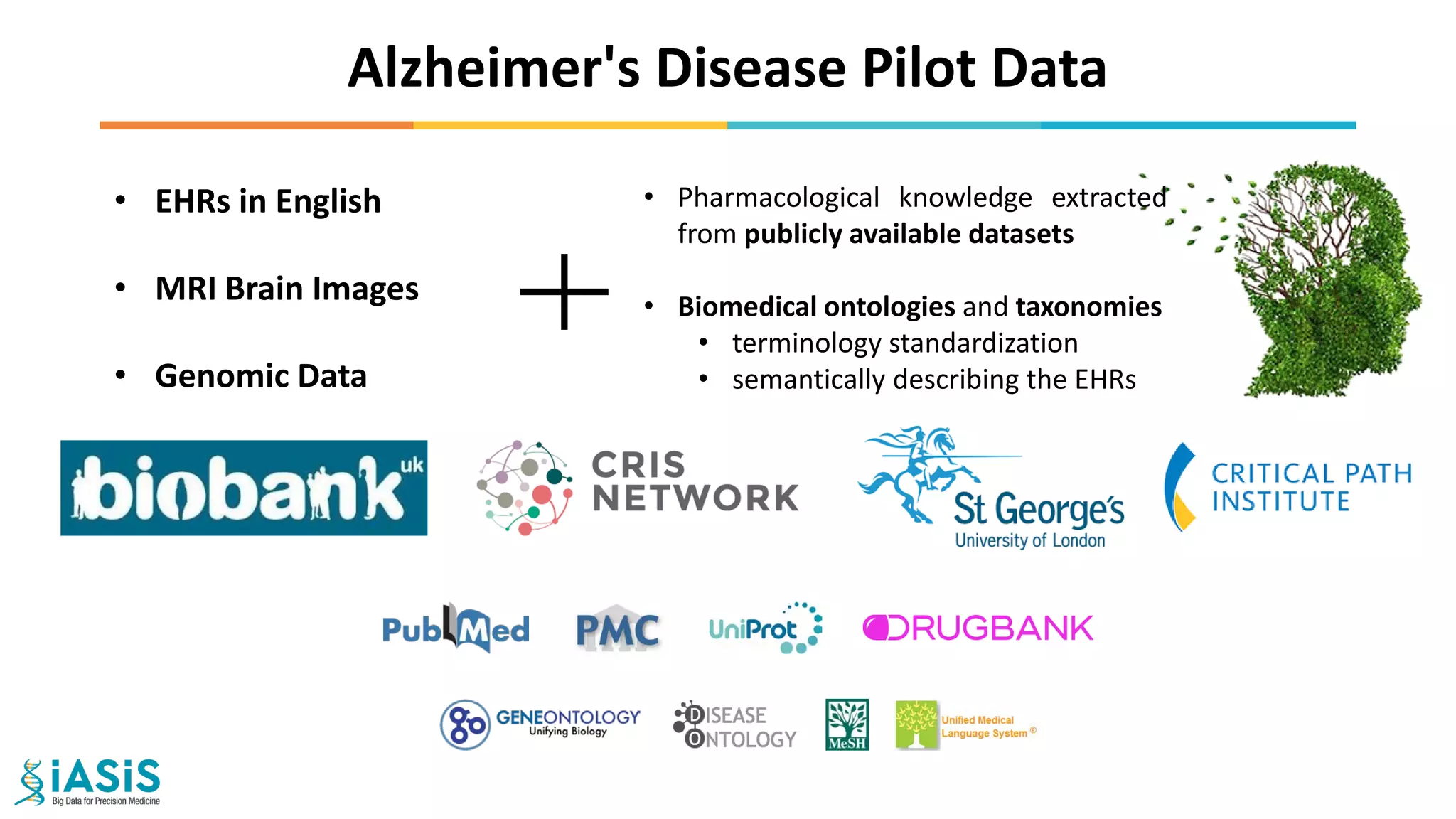
• EHRs in English
• MRI Brain Images
• Genomic Data
• Pharmacological knowledge extracted
from publicly available datasets
• Biomedical ontologies and taxonomies
• terminology standardization
• semantically describing the EHRs
Alzheimer's Disease Pilot Data
Alzheimer’s use case
Optimal choice of drug in Alzheimer’s disease
Which of the available
drugs is most suitable
for a particular
patient?
Patient’s data:
• Disease stage (MMSE)
• Allelic status
• Cognitive enhancing drugs
• Age, Sex
• Comorbidities
• Lifestyle
• Family history
Input Output
1. Positive response estimates
for each available drug:
Donepezil, Galantamine,
Rivastigmine etc.
2. Supporting data:
• Publications that support
the results
• Statistics for similar
patients
offline
online
Analysis
Decision on drug
prescription
• Analysis of patient clinical records (EHR, images, genotype)
• Analysis of open data (related publications, ontologies, structured databases)
11
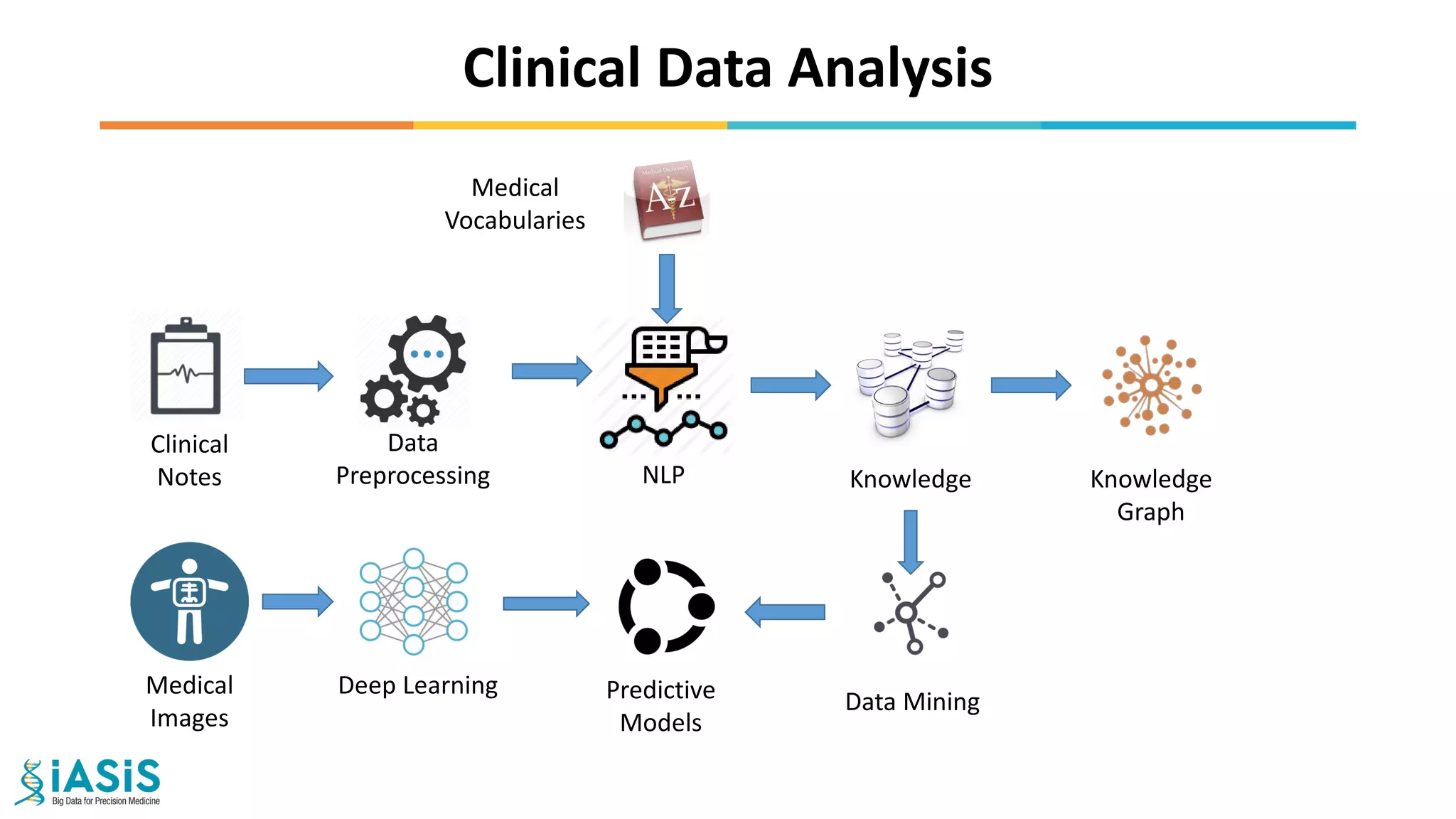
Clinical Data Analysis
Clinical
Notes NLP
Data
Preprocessing
Medical
Images
Deep Learning Predictive
Models
Medical
Vocabularies
Knowledge
Data Mining
Knowledge
Graph
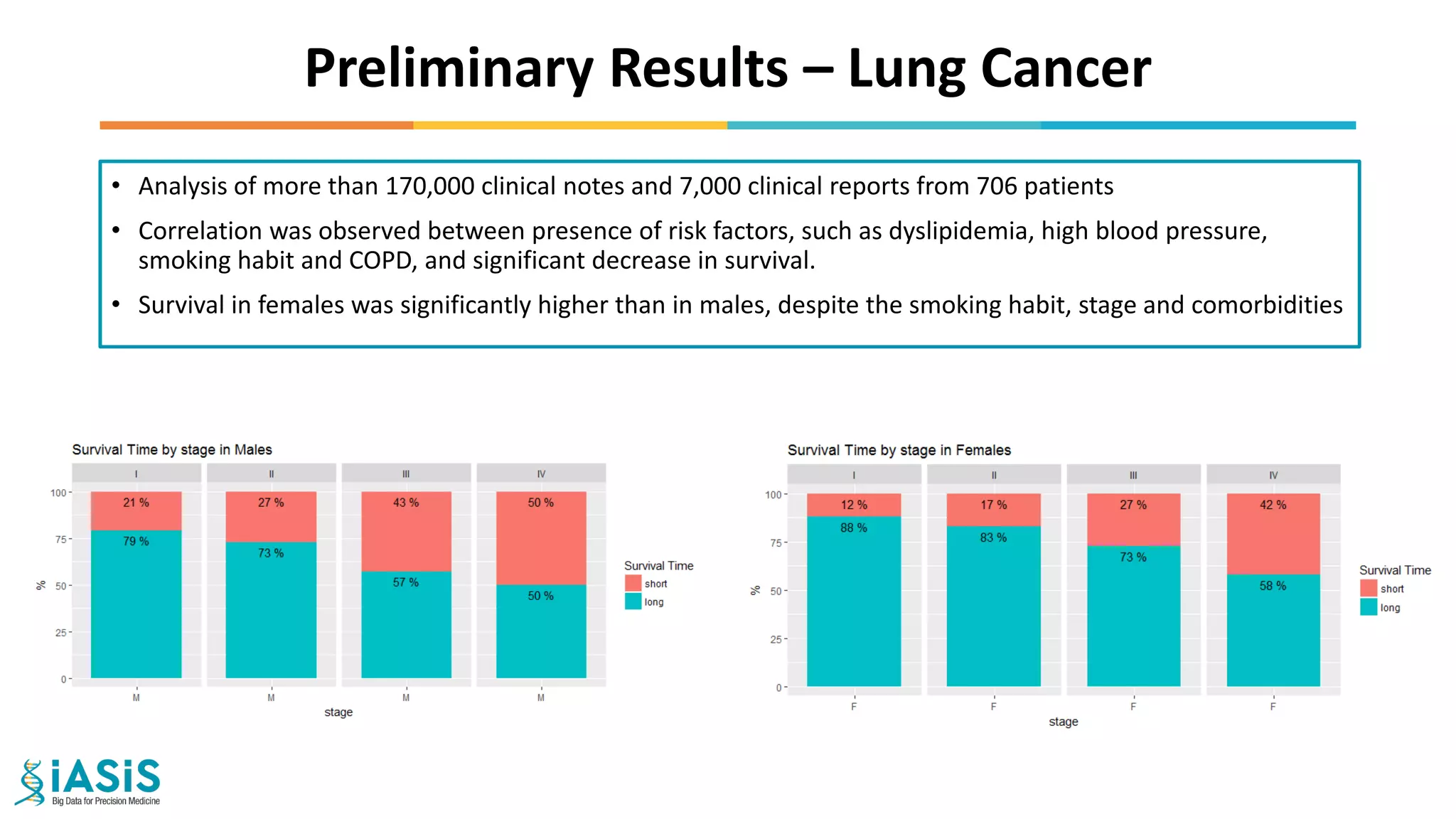
Preliminary Results – Lung Cancer
• Analysis of more than 170,000 clinical notes and 7,000 clinical reports from 706 patients
• Correlation was observed between presence of risk factors, such as dyslipidemia, high blood pressure,
smoking habit and COPD, and significant decrease in survival.
• Survival in females was significantly higher than in males, despite the smoking habit, stage and comorbidities
Genomic Data Analysis
Identification of
RNAs regulated
by RBP
Comparison
with available
information
Integration with
transcriptomic
data
Hospital-derived
data
Knowledge
Graph
Identification of
key genes and
interactions
Genomic Data Analysis
Protein-RNA Expression Correlation (AUC) [%]
-1 1
Protein-RNA Interaction Propensity (AUC) [%]
-200 200
number of interactions: 20x105
number of interactions: 20x106
ENRICHMENT
INTERACTINGNOT INTERACTING
CO-EXPRESSEDANTI-EXPRESSED
# OF INTERACTIONS: 20x105
# OF INTERACTIONS: 20x106
Cirillo et al. Genome Biology 2014
RNAseq
catRAPID
The correlation between co-expressed
protein-RNA pairs (RNAseq) and their
interactions (catRAPID) identifies cases of
interest
Open Data Analysis
Preliminary Results –Alzheimer’s
Identification of alleles of risk with related treatments according to the current bibliography
• APOE4 in AD relevant literature: 2,201 articles have APOE4 as Topic / APOE4 occurs in 1,908 articles
• Knowledge about APOE4: 883 distinct relations of 22 types between APOE4 and 561 concepts
• 317 incoming relations (APOE4 as object, e.g. “Therapeutic procedure USES APOE4”)
• 564 outgoing relations (APOE4 as subject, e.g. “APOE4 CAUSES Asthenia” )
In ~2x10³ out of
~100x103 articles
“relevant to AD”
72
41
19 1 1
86
29
45
7
77
1 4 7 11 17 19 24 27
34
42
20
75
60 55
20 18 17 11 10 9 8 7 4 2 1
0
10
20
30
40
50
60
70
80
90
Extracted relations for APOE4
564 outgoing 317 incoming
Data Management
Ontario
Knowledge Graph
18
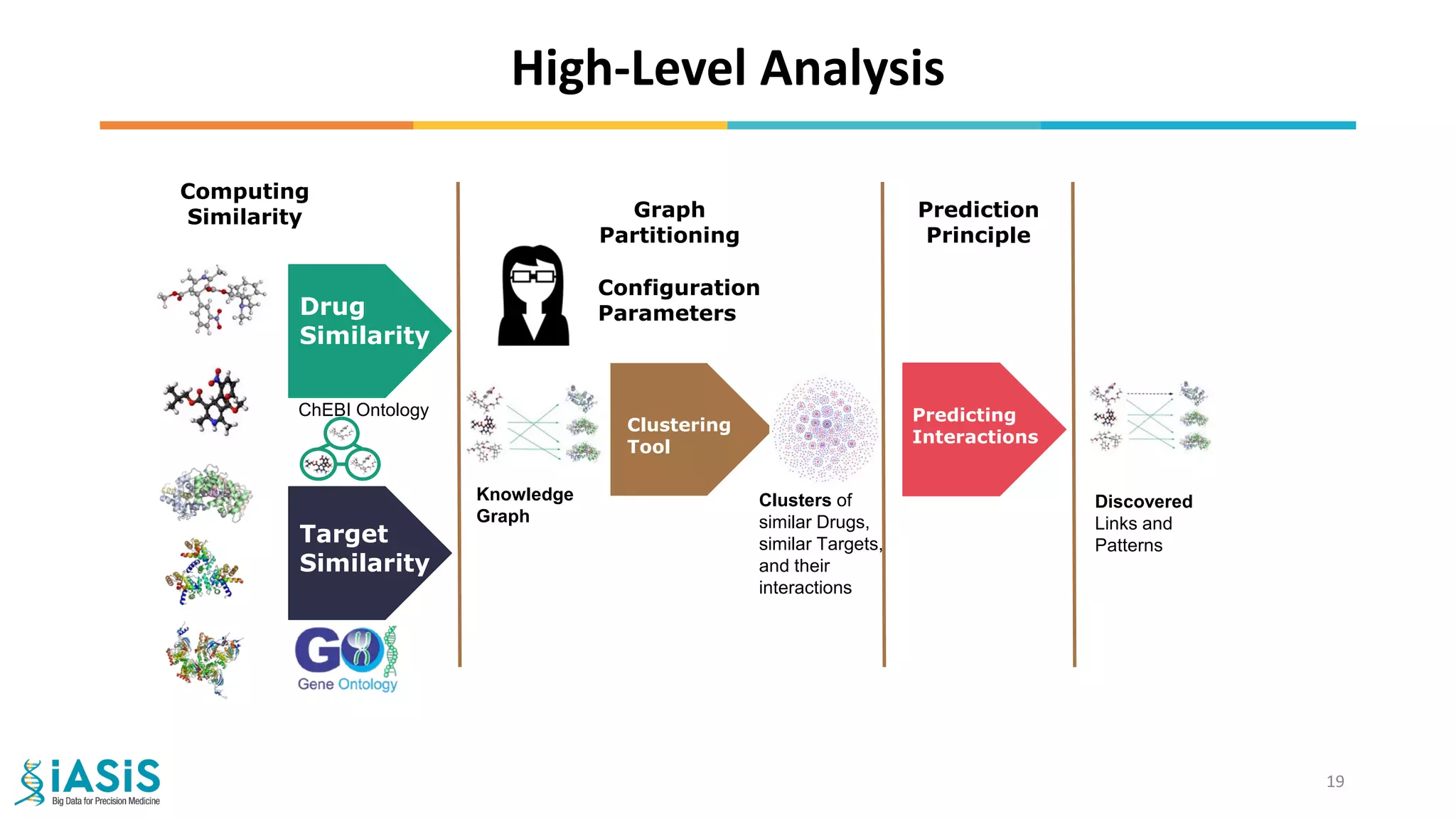
High-Level Analysis
Pragmatics
ContextSemantics
Drug
Similarity
Target
Similarity
Clustering
Tool
Predicting
Interactions
Computing
Similarity Graph
Partitioning
Prediction
Principle
Knowledge
Graph
Clusters of
similar Drugs,
similar Targets,
and their
interactions
Discovered
Links and
Patterns
ChEBI Ontology
Configuration
Parameters
19
Beyond Data Analysis
• iASiS handles sensitive patient data from hospitals: EHRs, MRI and PET/CT
images, blood and liquid biopsy samples
• Ethics Committee led by external advisor to oversee the adherence to
rules, regulations and patient consent per data source.
• Data management plan using FAIR principles and corresponding tools.
• Data access control, including anonymization, hardware and software
protection, regulated access.
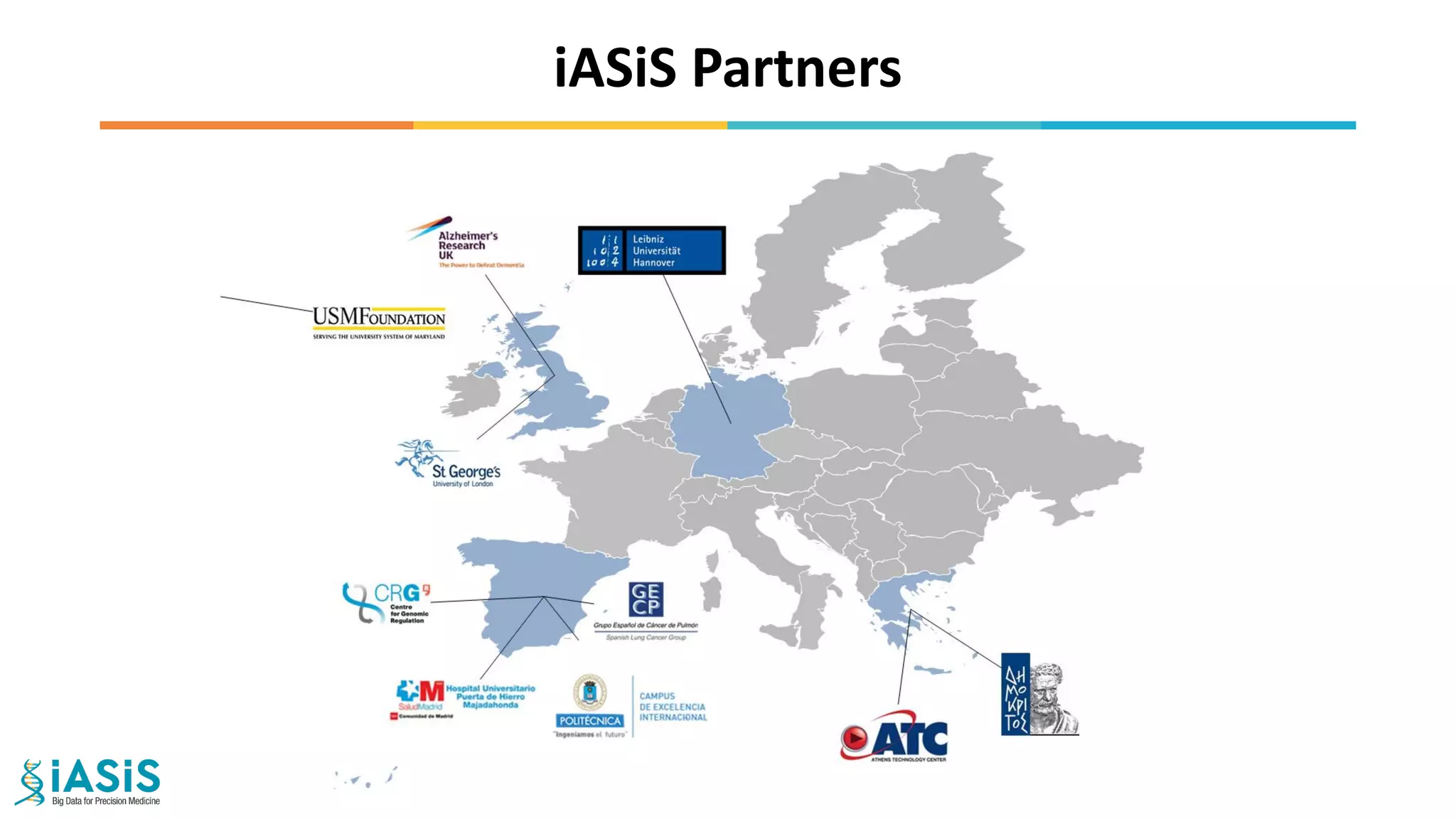
iASiS Partners
Upcoming event
Symposium on "Big Data for Precision Medicine“
http://events.demokritos.gr/?session=big-data-for-precision-medicine
Wednesday 11 July 2018
6th Hellenic Forum For Science
Technology and Innovation
http://events.demokritos.gr/
NCSR “Demokritos”, Athens, Greece
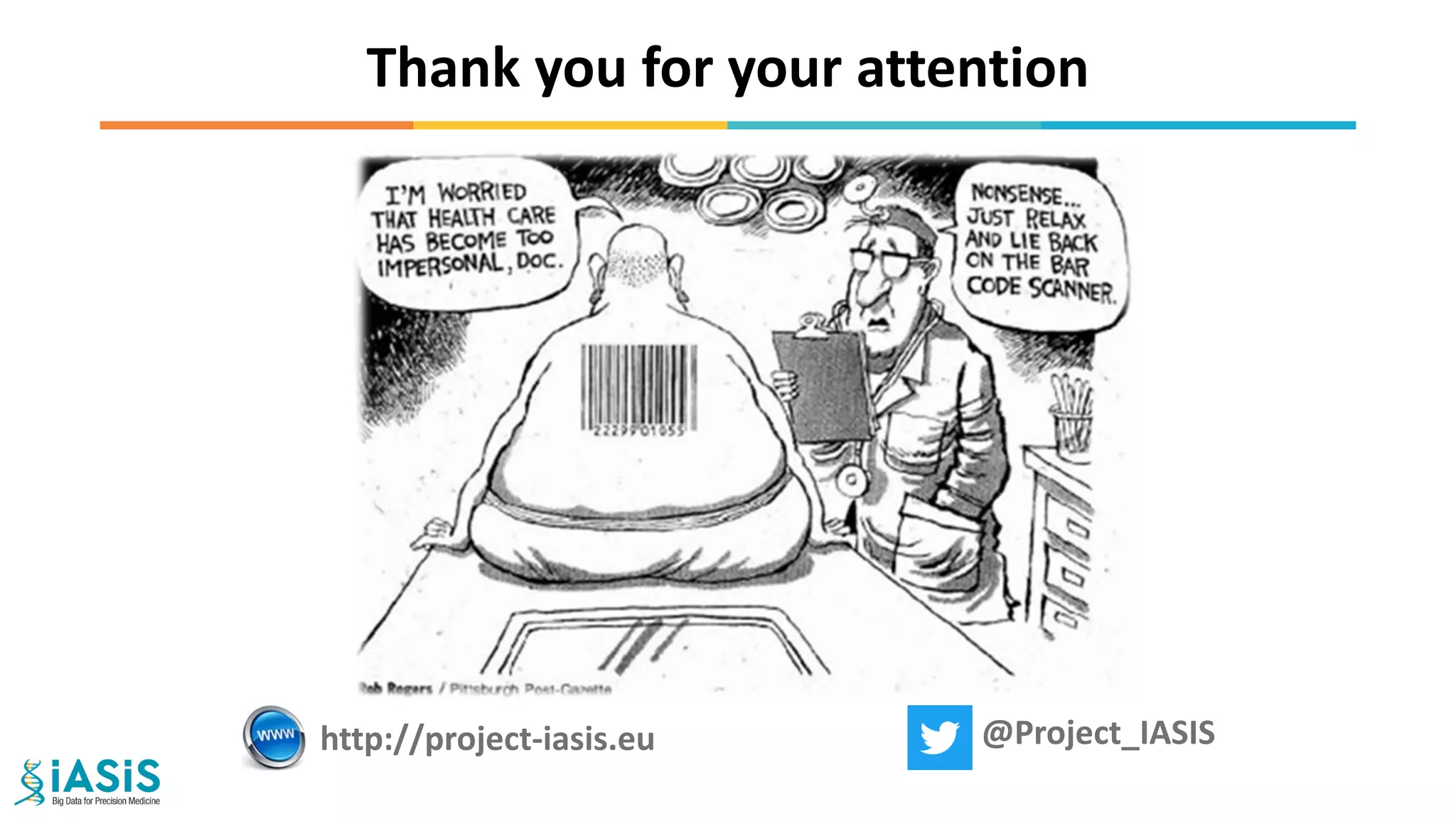
Thank you for your attention
http://project-iasis.eu @Project_IASIS

Krithara meetup may18_final (1)

  • 1.
    Integration and analysisof heterogeneous big data for precision medicine and suggested treatments for different types of patients. SC1-PM-18-2016: Big Data supporting Public Health policies iASiS: Big Data to Support Precision Medicine and Public Health Policy Anastasia Krithara Inst. of Informatics & Telecommunications NCSR “Demokritos”, Greece http://project-iasis.eu @Project_IASIS
  • 2.
    iASiS Basic Facts •Title: Integration and analysis of heterogeneous big data for precision medicine and suggested treatments for different types of patients • Topic: H2020-SC1-PM-18-2016 - Big Data supporting Public Health policies • Contract No.: 727658 • Budget: € 4.3M
  • 3.
    Motivation • Epidemiological dataanalysis is not sufficient for public health policies in the era of personalized/precision medicine • We also need explanations, e.g. why a treatment ought to work better for one type of patient than another • Therefore, we need to combine breadth (across a population) with depth (e.g. personal genome) in the analysis • Big data analysis can address both breadth and depth, under the appropriate framework. That’s iASiS!
  • 4.
    Vision and Objectives iASiSVision: Turn clinical, pharmacogenomics, and other Big Data into actionable knowledge for personalized medicine and health policy-making iASiS Objectives: • Integrate automated unstructured and structured data analysis, image analysis, and sequence analysis into a Big Data framework • Use the iASiS framework to support personalized diagnosis and treatment
  • 5.
    The iASiS Framework •iASiS focuses on two use cases: • Lung cancer • Alzheimer’s disease • General-purpose drugs are often ineffective
  • 6.
    The iASiS Framework •iASiS analyses: • EHRs (English & Spanish) • MRI & PET/CT images • Genomic data (e.g. liquid biopsy samples) • Related bibliography (e.g. PubMed) • Biomedical databases (e.g. DrugBank) • Biomedical ontologies (e.g. GO, UMLS)
  • 7.
    The iASiS Framework •Extracted knowledge is fused in the iASiS knowledge graph • Unified semantic schema • Linked data • Machine-processable knowledge • iASiS end-users can: • Perform natural language questions • Receive answers along with justifications • Identify patterns in patient populations • Make informed decisions • All steps of data management and analytics enforce privacy and access control
  • 8.
    Lung Cancer PilotData • Pharmacological knowledge extracted from publicly available datasets • Biomedical ontologies and taxonomies • terminology standardization • semantically describing the EHRs • EHRs in Spanish • PET/CT Images • Genomic Data/Liquid Biopsy Samples
  • 9.
    Lung Cancer Usecase Improvement of treatment schemes for lung cancer Aim: improve treatment schemes, based on long surviving patients Patient data: • Clinical notes • clinical reports • age at diagnosis • stage and type of tumour • gender • ... Input Output Optimal personalised treatment schemes 1. Patient categorization in long survival group based on discovered correlations: • females vs males survival • risk factors, like high blood pressure, smoking habits and COPD offline online • Analysis of patient clinical records (EHR, images, liquid biopsy data) • Analysis of open data (related publications, ontologies, structured databases) Analysis 9
  • 10.
    • EHRs inEnglish • MRI Brain Images • Genomic Data • Pharmacological knowledge extracted from publicly available datasets • Biomedical ontologies and taxonomies • terminology standardization • semantically describing the EHRs Alzheimer's Disease Pilot Data
  • 11.
    Alzheimer’s use case Optimalchoice of drug in Alzheimer’s disease Which of the available drugs is most suitable for a particular patient? Patient’s data: • Disease stage (MMSE) • Allelic status • Cognitive enhancing drugs • Age, Sex • Comorbidities • Lifestyle • Family history Input Output 1. Positive response estimates for each available drug: Donepezil, Galantamine, Rivastigmine etc. 2. Supporting data: • Publications that support the results • Statistics for similar patients offline online Analysis Decision on drug prescription • Analysis of patient clinical records (EHR, images, genotype) • Analysis of open data (related publications, ontologies, structured databases) 11
  • 12.
    Clinical Data Analysis Clinical NotesNLP Data Preprocessing Medical Images Deep Learning Predictive Models Medical Vocabularies Knowledge Data Mining Knowledge Graph
  • 13.
    Preliminary Results –Lung Cancer • Analysis of more than 170,000 clinical notes and 7,000 clinical reports from 706 patients • Correlation was observed between presence of risk factors, such as dyslipidemia, high blood pressure, smoking habit and COPD, and significant decrease in survival. • Survival in females was significantly higher than in males, despite the smoking habit, stage and comorbidities
  • 14.
    Genomic Data Analysis Identificationof RNAs regulated by RBP Comparison with available information Integration with transcriptomic data Hospital-derived data Knowledge Graph Identification of key genes and interactions
  • 15.
    Genomic Data Analysis Protein-RNAExpression Correlation (AUC) [%] -1 1 Protein-RNA Interaction Propensity (AUC) [%] -200 200 number of interactions: 20x105 number of interactions: 20x106 ENRICHMENT INTERACTINGNOT INTERACTING CO-EXPRESSEDANTI-EXPRESSED # OF INTERACTIONS: 20x105 # OF INTERACTIONS: 20x106 Cirillo et al. Genome Biology 2014 RNAseq catRAPID The correlation between co-expressed protein-RNA pairs (RNAseq) and their interactions (catRAPID) identifies cases of interest
  • 16.
  • 17.
    Preliminary Results –Alzheimer’s Identificationof alleles of risk with related treatments according to the current bibliography • APOE4 in AD relevant literature: 2,201 articles have APOE4 as Topic / APOE4 occurs in 1,908 articles • Knowledge about APOE4: 883 distinct relations of 22 types between APOE4 and 561 concepts • 317 incoming relations (APOE4 as object, e.g. “Therapeutic procedure USES APOE4”) • 564 outgoing relations (APOE4 as subject, e.g. “APOE4 CAUSES Asthenia” ) In ~2x10³ out of ~100x103 articles “relevant to AD” 72 41 19 1 1 86 29 45 7 77 1 4 7 11 17 19 24 27 34 42 20 75 60 55 20 18 17 11 10 9 8 7 4 2 1 0 10 20 30 40 50 60 70 80 90 Extracted relations for APOE4 564 outgoing 317 incoming
  • 18.
  • 19.
  • 20.
    Beyond Data Analysis •iASiS handles sensitive patient data from hospitals: EHRs, MRI and PET/CT images, blood and liquid biopsy samples • Ethics Committee led by external advisor to oversee the adherence to rules, regulations and patient consent per data source. • Data management plan using FAIR principles and corresponding tools. • Data access control, including anonymization, hardware and software protection, regulated access.
  • 21.
  • 22.
    Upcoming event Symposium on"Big Data for Precision Medicine“ http://events.demokritos.gr/?session=big-data-for-precision-medicine Wednesday 11 July 2018 6th Hellenic Forum For Science Technology and Innovation http://events.demokritos.gr/ NCSR “Demokritos”, Athens, Greece
  • 23.
    Thank you foryour attention http://project-iasis.eu @Project_IASIS