
Big data, machine learning e medicina di precisione
•Download as PPTX, PDF•
0 likes•349 views

di Matteo Santoro Camelot Biomedical System Slide per l'incontro dal titolo "Big data, machine learning e medicina di precisione." 10 maggio 2018, Milano, Fondazione Giannino Bassetti Video integrale: https://www.fondazionebassetti.org/it/focus/2018/08/big_data_machine_learning_e_me.html

Recommended
More Related Content
What's hot
What's hot (20)
Similar to Big data, machine learning e medicina di precisione
Similar to Big data, machine learning e medicina di precisione (20)
More from Fondazione Giannino Bassetti
More from Fondazione Giannino Bassetti (20)
Recently uploaded
Recently uploaded (20)
Big data, machine learning e medicina di precisione
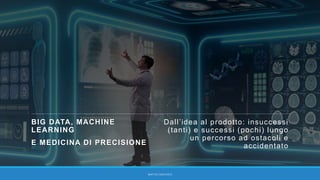
- 1. BIG DATA, MACHINE LEARNING E MEDICINA DI PRECISIONE Dall’idea al prodotto: insuccessi (tanti) e successi (pochi) lungo un percorso ad ostacoli e accidentato MATTEO SANTORO
- 3. D'Urso et al., Biomodeling as an aid to spinal instrumentation, 2005 Wagner et al., Rapid 3-dimensional prototyping for surgical repair of maxillofacial fractures, 2004 Image Acquistion MRI/CT/3DUS Image Segmentation and Volumes Computation Image Segmentation and Volumes Computation Image Segmentation and Volumes Computation
- 7. Calibrated Sensor Position (exported on request) Stereo 3D Reconstruction Patient Registration Data Referenced 3D US Data US + MR + Microscope
- 10. The underlying concept of precision medicine, in which health care is individually tailored on the basis of a person's genes, lifestyle and environment, is not new: transfusion patients have been matched with donors according to blood type for more than a century. But advances in genetics, and the growing availability of health data, present an opportunity to make precise personalized patient care a clinical reality. Precision medicine is powered by patient data. The health records and genetic codes of patients and healthy volunteers are vital, and help people to influence their own health care and the direction of research. Securing participants' trust is crucial to the success of large-scale programmes such as the US National Institutes of Health's Precision Medicine Initiative. But this is hard when the promised anonymity is revealed to be little more than a fig leaf.