1© Capgemini 2020. All rights reserved |
Connected Autonomous Planning
A global offering
2© Capgemini 2020. All rights reserved |
Capgemini’s Connected Autonomous Planning
Capgemini’s Connected Autonomous Planning is a holistic approach to
addressing some of the most complex challenges that large CP
organizations face today. From the interpretation and integration of
demand data and consumer insights to core digital operations,
Capgemini will help accelerate your performance to ensure the right
products to the right location … at the right time and cost.
Bringing together our expertise across the CP industry in supply chain
strategy, operating models, continuous touchless planning, and insights
and analytics, we partner with our clients to not only understand their
barriers but also to develop the planning solutions – from demand right
through to fulfillment – to adapt and to thrive in this increasingly
complex world.
3© Capgemini 2020. All rights reserved |
As a CP organization, supply chain is the
lifeblood of your operations. Modern
supply chains represent a delicate balance
of disparate processes and organizational
silos that can ultimately make or break
your business. Transforming your digital
operations and supply chain is a complex
undertaking and, without the right
expertise and guidance, transformation
can disrupt your business negatively
instead of enhancing it.
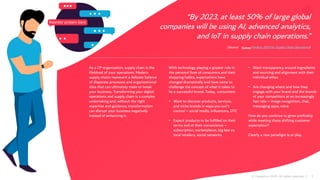
“By 2023, at least 50% of large global
companies will be using AI, advanced analytics,
and IoT in supply chain operations.”
(Source: Predicts 2019 for Supply Chain Operations)
With technology playing a greater role in
the personal lives of consumers and their
shopping habits, expectations have
changed dramatically and have come to
challenge the concept of what it takes to
be a successful brand. Today, consumers:
• Want to discover products, services,
and niche brands in ways you can’t
control – social media, influencers, DTC
• Expect products to be fulfilled on their
terms and at their convenience –
subscription, marketplaces, big box vs.
local retailers, social networks
• Want transparency around ingredients
and sourcing and alignment with their
individual ethos
• Are changing where and how they
engage with your brand and the brands
of your competitors at an increasingly
fast rate – image recognition, chat,
messaging apps, voice.
How do you continue to grow profitably
while meeting these shifting customer
expectation?
Clearly a new paradigm is at play.
Reorder protein bars
4© Capgemini 2020. All rights reserved |
The new world for
Consumer Products
Leveraging our deep industry experience, our global strategy,
innovation, implementation, and operations capabilities, Capgemini
partners with some of the world’s leading CP organizations to help
them create supply chains that are more agile and responsive in an
increasingly volatile market, helping them sustainably improve
cost, cash, and service while driving
growth.
Capgemini’s Connected Autonomous Planning sets organizations up for success with
the benefits of:
• Human-centric design thinking
• Operational analytics
• AI-enriched forecasting
• Touchless, continuous, end-to-end planning using machine learning and automation
• Collaboration across an ecosystem of partners.
5© Capgemini 2020. All rights reserved |
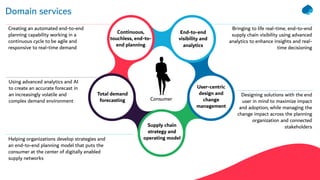
Bringing to life real-time, end-to-end
supply chain visibility using advanced
analytics to enhance insights and real-
time decisioning
Creating an automated end-to-end
planning capability working in a
continuous cycle to be agile and
responsive to real-time demand
Consumer
Supply chain
strategy and
operating model
User-centric
design and
change
management
Continuous,
touchless, end-to-
end planning
Total demand
forecasting
End-to-end
visibility and
analytics
Domain services
Helping organizations develop strategies and
an end-to-end planning model that puts the
consumer at the center of digitally enabled
supply networks
Using advanced analytics and AI
to create an accurate forecast in
an increasingly volatile and
complex demand environment
Designing solutions with the end
user in mind to maximize impact
and adoption, while managing the
change impact across the planning
organization and connected
stakeholders
6© Capgemini 2020. All rights reserved |
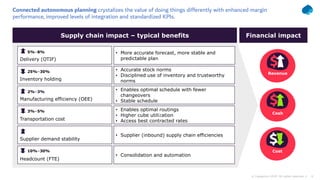
Supply chain impact – typical benefits
Delivery (OTIF)
Manufacturing efficiency (OEE)
Transportation cost
Inventory holding
Financial impact
5%–8%
25%–30%
2%–3%
3%–5%
Supplier demand stability
Headcount (FTE)
• Enables optimal schedule with fewer
changeovers
• Stable schedule
• Enables optimal routings
• Higher cube utilization
• Access best contracted rates
• Accurate stock norms
• Disciplined use of inventory and trustworthy
norms
• Supplier (inbound) supply chain efficiencies
• Consolidation and automation
• More accurate forecast, more stable and
predictable plan
Connected autonomous planning crystalizes the value of doing things differently with enhanced margin
performance, improved levels of integration and standardized KPIs.
Revenue
Cash
Cost10%–30%
7© Capgemini 2020. All rights reserved |
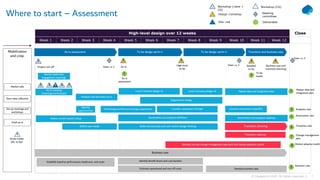
Where to start – Assessment
High-level design over 12 weeks Close
Week 1 Week 2 Week 3 Week 4 Week 5 Week 6 Week 7 Week 8 Week 9 Week 10 Week 11 Week 12
As-is assessment To-be design sprint 1
Business case
Establish baseline performance, headcount, and costs Identify benefit levers and cost buckets
Estimate operational and one-off costs Develop business case
As-is mapping
(meetings/workshops)
Assess current system setup
Identify
opportunities
Analysis and document as-is
Mobilization
and prep:
Project kick-off
Market leadership
engagement meetings
Define user needs
As-isSteer co. 1 High-level
to-be
Steer co. 2 Business case and
transition planning
Steer co. 3
Build user journeys and user-centric design thinking
Develop roll-out change management approach and market adoption toolkit
Level 3 process design v1
Technology architecture and gap assessment
Automation and analytics definition
Level 3 process design v2
Straw model
(HL to-be)
Organization design
Location assessment (broad)
To-be design sprint 2 Transition and business case
Automation and analytics roadmap
Transition roadmap
Transition planning
1 21 4
3 4 52 1
Workshop (client +
CG)
Design workshop
Site visit
1
Workshop (CG)
Location assessment (specific)
Steering
committee
5
6
7
8
2
3
4
1
Deliverable
As-is
assessment
To-be
model
Business case
Analytics plan
Automation plan
Transition plan
Change-management
plan
Market adoption toolkit
Master data and integration plan 2 Master data and
integration plan
Set up meetings and
workshops
Start data collection
Market calls
Draft as-is
Detailed
to-be
3
8© Capgemini 2020. All rights reserved |
Deliverables
As-is assessment
• Processes – Mapping processes to organization and
location (“who does what where?”)
• Organization – Organizational chart, job roles, FTE, RACI,
and reporting lines
• Supply chain performance – Organizational chart, job
roles , FTE, RACI, and reporting lines
• Planning technology – Technology architecture.
To-be design
• Processes – Mapping of high-level process steps to
organization and location (“who does what where?”)
• Organization – Organizational chart showing job roles and
reporting lines
• Supply chain performance – Performance metrics and
target levels
• Planning technology – Technology architecture required
to support the to-be model, building on the client’s latest
planning technology roadmap
• Automation – Definition of opportunities to automate
outside of core planning technology.
Business case
Business case looking at efficiency and effectiveness
Transition plans
Transition plan showing the key activities,
milestones, and overall timescale for transition to the
to-be model
Change management plan
Change management approach for transition to the
to-be model
Market adoption approach and toolkit
Approach to adoption of a market onto the to-be
model, from initial engagement to post-go-live
support
A global leader in consulting, technology services and digital transformation, Capgemini is at the
forefront of innovation to address the entire breadth of clients’ opportunities in the evolving world
of cloud, digital and platforms. Building on its strong 50-year heritage and deep industry-specific
expertise, Capgemini enables organizations to realize their business ambitions through an array of
services from strategy to operations. Capgemini is driven by the conviction that the business value
of technology comes from and through people. It is a multicultural company of 200,000 team
members in over 40 countries. The Group reported 2017 global revenues of EUR 12.8 billion
(about $14.4 billion USD at 2017 average rate).
About Capgemini
Learn more about us at
www.capgemini.com
This message is intended only for the person to whom it is addressed. If you are not the
intended recipient, you are not authorized to read, print, retain, copy, disseminate, distribute, or
use this message or any part thereof. If you receive this message in error, please notify the
sender immediately and delete all copies of this message.
This message contains information that may be privileged
or confidential and is the property of the Capgemini Group.
Copyright © 2020 Capgemini. All rights reserved.
Rightshore® is a trademark belonging to Capgemini.
This presentation contains information that may be privileged or
confidential and is the property of the Capgemini Group.
Copyright © 2020 Capgemini. All rights reserved.
For more information, reach out to our experts:
Phil Davies
Global Head of Consumer Products
U.K.
phil.davies@capgemini.com
Hein Regeer
Global Lead
The Netherlands
hein.regeer@capgemini.com
Susan Davies
Lead
U.K.
susan.a.davies@capgemini.com
Stephane Ghioldi
Deputy Head of Consumer Products & Retail
France
stephane.ghioldi@capgemini.com
Cyndi Lago
Lead
N.A.
cyndi.lago@capgemini.com
Gabi Ledesma
Lead
Global
gabriel.ledesma@capgemini.com
Romain Pasquale
Lead
APAC
romain.pasquale@capgemini.com
Torsten Schmalbach
Principal Consumer Products
Germany
Torsten.schmalbach@capgemini.com

Capgemini’s Connected Autonomous Planning

  • 1.
    1© Capgemini 2020.All rights reserved | Connected Autonomous Planning A global offering
  • 2.
    2© Capgemini 2020.All rights reserved | Capgemini’s Connected Autonomous Planning Capgemini’s Connected Autonomous Planning is a holistic approach to addressing some of the most complex challenges that large CP organizations face today. From the interpretation and integration of demand data and consumer insights to core digital operations, Capgemini will help accelerate your performance to ensure the right products to the right location … at the right time and cost. Bringing together our expertise across the CP industry in supply chain strategy, operating models, continuous touchless planning, and insights and analytics, we partner with our clients to not only understand their barriers but also to develop the planning solutions – from demand right through to fulfillment – to adapt and to thrive in this increasingly complex world.
  • 3.
    3© Capgemini 2020.All rights reserved | As a CP organization, supply chain is the lifeblood of your operations. Modern supply chains represent a delicate balance of disparate processes and organizational silos that can ultimately make or break your business. Transforming your digital operations and supply chain is a complex undertaking and, without the right expertise and guidance, transformation can disrupt your business negatively instead of enhancing it. “By 2023, at least 50% of large global companies will be using AI, advanced analytics, and IoT in supply chain operations.” (Source: Predicts 2019 for Supply Chain Operations) With technology playing a greater role in the personal lives of consumers and their shopping habits, expectations have changed dramatically and have come to challenge the concept of what it takes to be a successful brand. Today, consumers: • Want to discover products, services, and niche brands in ways you can’t control – social media, influencers, DTC • Expect products to be fulfilled on their terms and at their convenience – subscription, marketplaces, big box vs. local retailers, social networks • Want transparency around ingredients and sourcing and alignment with their individual ethos • Are changing where and how they engage with your brand and the brands of your competitors at an increasingly fast rate – image recognition, chat, messaging apps, voice. How do you continue to grow profitably while meeting these shifting customer expectation? Clearly a new paradigm is at play. Reorder protein bars
  • 4.
    4© Capgemini 2020.All rights reserved | The new world for Consumer Products Leveraging our deep industry experience, our global strategy, innovation, implementation, and operations capabilities, Capgemini partners with some of the world’s leading CP organizations to help them create supply chains that are more agile and responsive in an increasingly volatile market, helping them sustainably improve cost, cash, and service while driving growth. Capgemini’s Connected Autonomous Planning sets organizations up for success with the benefits of: • Human-centric design thinking • Operational analytics • AI-enriched forecasting • Touchless, continuous, end-to-end planning using machine learning and automation • Collaboration across an ecosystem of partners.
  • 5.
    5© Capgemini 2020.All rights reserved | Bringing to life real-time, end-to-end supply chain visibility using advanced analytics to enhance insights and real- time decisioning Creating an automated end-to-end planning capability working in a continuous cycle to be agile and responsive to real-time demand Consumer Supply chain strategy and operating model User-centric design and change management Continuous, touchless, end-to- end planning Total demand forecasting End-to-end visibility and analytics Domain services Helping organizations develop strategies and an end-to-end planning model that puts the consumer at the center of digitally enabled supply networks Using advanced analytics and AI to create an accurate forecast in an increasingly volatile and complex demand environment Designing solutions with the end user in mind to maximize impact and adoption, while managing the change impact across the planning organization and connected stakeholders
  • 6.
    6© Capgemini 2020.All rights reserved | Supply chain impact – typical benefits Delivery (OTIF) Manufacturing efficiency (OEE) Transportation cost Inventory holding Financial impact 5%–8% 25%–30% 2%–3% 3%–5% Supplier demand stability Headcount (FTE) • Enables optimal schedule with fewer changeovers • Stable schedule • Enables optimal routings • Higher cube utilization • Access best contracted rates • Accurate stock norms • Disciplined use of inventory and trustworthy norms • Supplier (inbound) supply chain efficiencies • Consolidation and automation • More accurate forecast, more stable and predictable plan Connected autonomous planning crystalizes the value of doing things differently with enhanced margin performance, improved levels of integration and standardized KPIs. Revenue Cash Cost10%–30%
  • 7.
    7© Capgemini 2020.All rights reserved | Where to start – Assessment High-level design over 12 weeks Close Week 1 Week 2 Week 3 Week 4 Week 5 Week 6 Week 7 Week 8 Week 9 Week 10 Week 11 Week 12 As-is assessment To-be design sprint 1 Business case Establish baseline performance, headcount, and costs Identify benefit levers and cost buckets Estimate operational and one-off costs Develop business case As-is mapping (meetings/workshops) Assess current system setup Identify opportunities Analysis and document as-is Mobilization and prep: Project kick-off Market leadership engagement meetings Define user needs As-isSteer co. 1 High-level to-be Steer co. 2 Business case and transition planning Steer co. 3 Build user journeys and user-centric design thinking Develop roll-out change management approach and market adoption toolkit Level 3 process design v1 Technology architecture and gap assessment Automation and analytics definition Level 3 process design v2 Straw model (HL to-be) Organization design Location assessment (broad) To-be design sprint 2 Transition and business case Automation and analytics roadmap Transition roadmap Transition planning 1 21 4 3 4 52 1 Workshop (client + CG) Design workshop Site visit 1 Workshop (CG) Location assessment (specific) Steering committee 5 6 7 8 2 3 4 1 Deliverable As-is assessment To-be model Business case Analytics plan Automation plan Transition plan Change-management plan Market adoption toolkit Master data and integration plan 2 Master data and integration plan Set up meetings and workshops Start data collection Market calls Draft as-is Detailed to-be 3
  • 8.
    8© Capgemini 2020.All rights reserved | Deliverables As-is assessment • Processes – Mapping processes to organization and location (“who does what where?”) • Organization – Organizational chart, job roles, FTE, RACI, and reporting lines • Supply chain performance – Organizational chart, job roles , FTE, RACI, and reporting lines • Planning technology – Technology architecture. To-be design • Processes – Mapping of high-level process steps to organization and location (“who does what where?”) • Organization – Organizational chart showing job roles and reporting lines • Supply chain performance – Performance metrics and target levels • Planning technology – Technology architecture required to support the to-be model, building on the client’s latest planning technology roadmap • Automation – Definition of opportunities to automate outside of core planning technology. Business case Business case looking at efficiency and effectiveness Transition plans Transition plan showing the key activities, milestones, and overall timescale for transition to the to-be model Change management plan Change management approach for transition to the to-be model Market adoption approach and toolkit Approach to adoption of a market onto the to-be model, from initial engagement to post-go-live support
  • 9.
    A global leaderin consulting, technology services and digital transformation, Capgemini is at the forefront of innovation to address the entire breadth of clients’ opportunities in the evolving world of cloud, digital and platforms. Building on its strong 50-year heritage and deep industry-specific expertise, Capgemini enables organizations to realize their business ambitions through an array of services from strategy to operations. Capgemini is driven by the conviction that the business value of technology comes from and through people. It is a multicultural company of 200,000 team members in over 40 countries. The Group reported 2017 global revenues of EUR 12.8 billion (about $14.4 billion USD at 2017 average rate). About Capgemini Learn more about us at www.capgemini.com This message is intended only for the person to whom it is addressed. If you are not the intended recipient, you are not authorized to read, print, retain, copy, disseminate, distribute, or use this message or any part thereof. If you receive this message in error, please notify the sender immediately and delete all copies of this message. This message contains information that may be privileged or confidential and is the property of the Capgemini Group. Copyright © 2020 Capgemini. All rights reserved. Rightshore® is a trademark belonging to Capgemini. This presentation contains information that may be privileged or confidential and is the property of the Capgemini Group. Copyright © 2020 Capgemini. All rights reserved. For more information, reach out to our experts: Phil Davies Global Head of Consumer Products U.K. phil.davies@capgemini.com Hein Regeer Global Lead The Netherlands hein.regeer@capgemini.com Susan Davies Lead U.K. susan.a.davies@capgemini.com Stephane Ghioldi Deputy Head of Consumer Products & Retail France stephane.ghioldi@capgemini.com Cyndi Lago Lead N.A. cyndi.lago@capgemini.com Gabi Ledesma Lead Global gabriel.ledesma@capgemini.com Romain Pasquale Lead APAC romain.pasquale@capgemini.com Torsten Schmalbach Principal Consumer Products Germany Torsten.schmalbach@capgemini.com