Using Forecast Collaboration Tools to
Align the Supply and Demand Sides of the
Supply Chain
Presented by Simon Ellis, IDC Manufacturing Insights
Dudley Lance, TAKE Solutions
Using Forecast Collaboration Tools to Align the
Supply and Demand Sides of the Supply Chain
TAKE Solutions Webinar - October 2012
Simon Ellis, Kimberly Knickle, IDC Manufacturing Insights
© IDC Manufacturing Insights. Reproduction is forbidden unless authorized. All rights reserved. Page 3
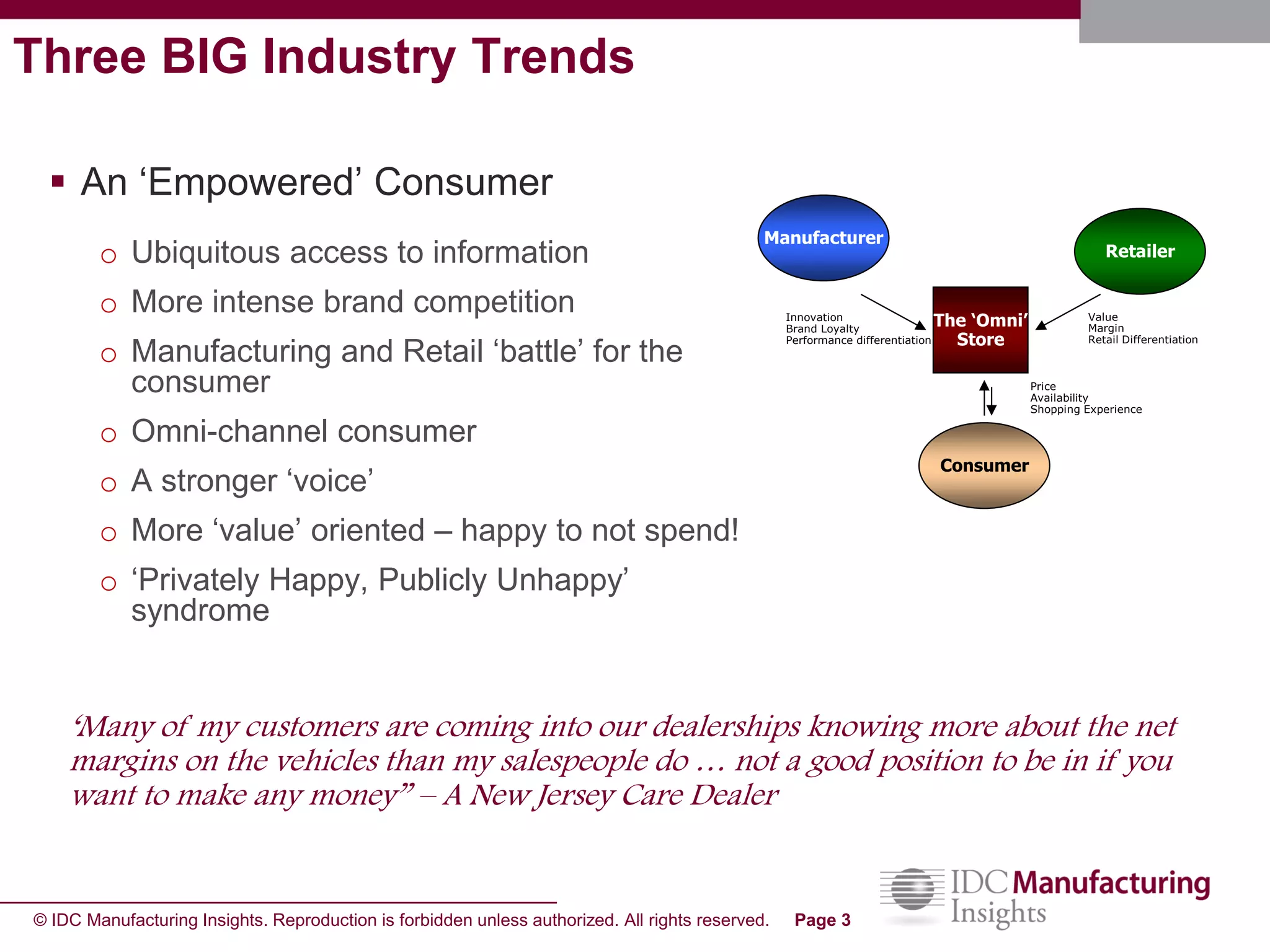
o Ubiquitous access to information
o More intense brand competition
o Manufacturing and Retail ‘battle’ for the
consumer
o Omni-channel consumer
o A stronger ‘voice’
o More ‘value’ oriented – happy to not spend!
o ‘Privately Happy, Publicly Unhappy’
syndrome
Manufacturer
Retailer
The ‘Omni’
Store
Consumer
Innovation
Brand Loyalty
Performance differentiation
Value
Margin
Retail Differentiation
Price
Availability
Shopping Experience
‘Many of my customers are coming into our dealerships knowing more about the net
margins on the vehicles than my salespeople do … not a good position to be in if you
want to make any money” – A New Jersey Care Dealer
Three BIG Industry Trends
 An ‘Empowered’ Consumer
© IDC Manufacturing Insights. Reproduction is forbidden unless authorized. All rights reserved. Page 4
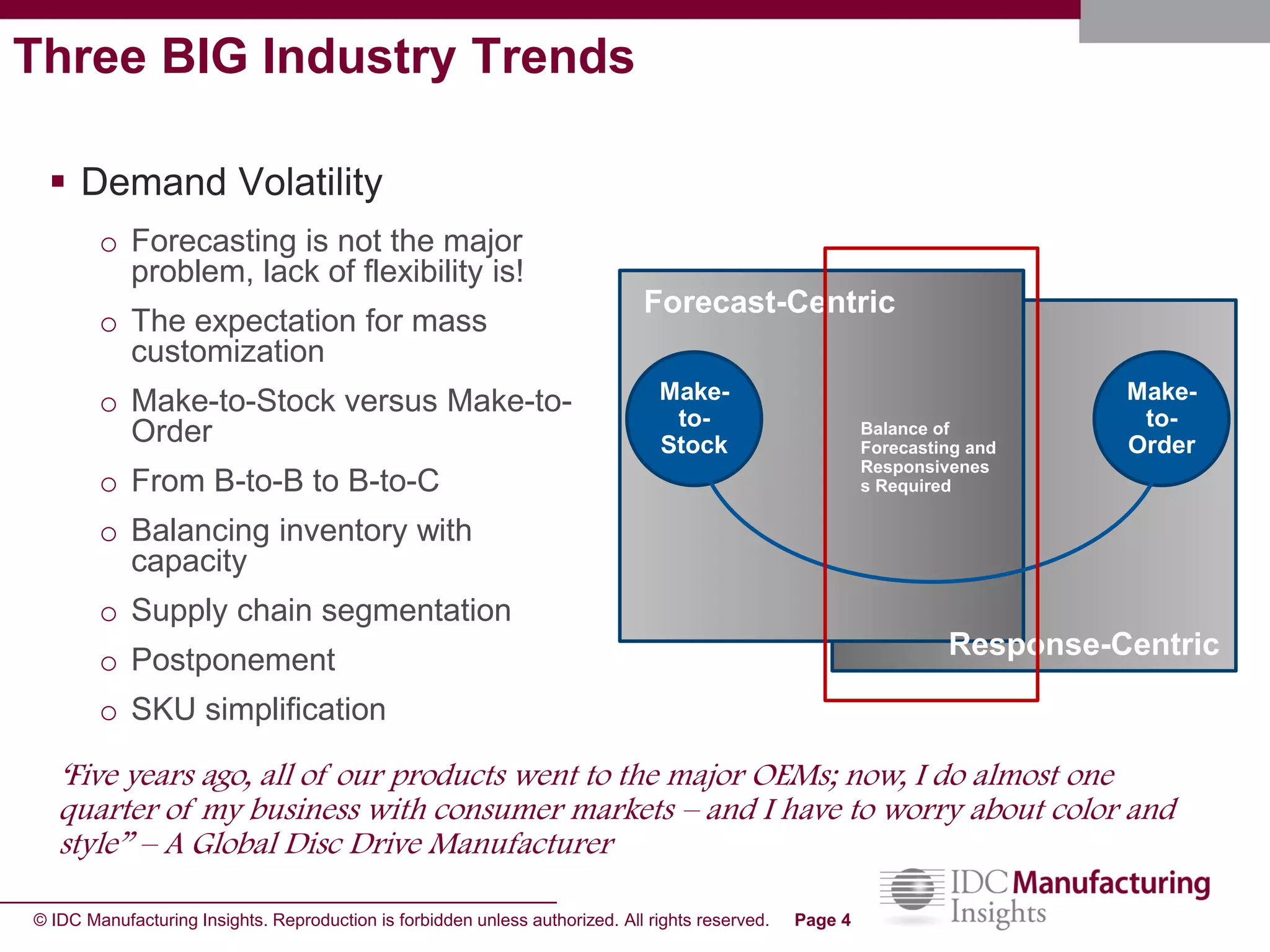
o Forecasting is not the major
problem, lack of flexibility is!
o The expectation for mass
customization
o Make-to-Stock versus Make-to-
Order
o From B-to-B to B-to-C
o Balancing inventory with
capacity
o Supply chain segmentation
o Postponement
o SKU simplification
Make-
to-
Stock
Make-
to-
Order
Forecast-Centric
Response-Centric
Balance of
Forecasting and
Responsivenes
s Required
‘Five years ago, all of our products went to the major OEMs; now, I do almost one
quarter of my business with consumer markets – and I have to worry about color and
style” – A Global Disc Drive Manufacturer
 Demand Volatility
Three BIG Industry Trends
© IDC Manufacturing Insights. Reproduction is forbidden unless authorized. All rights reserved. Page 5
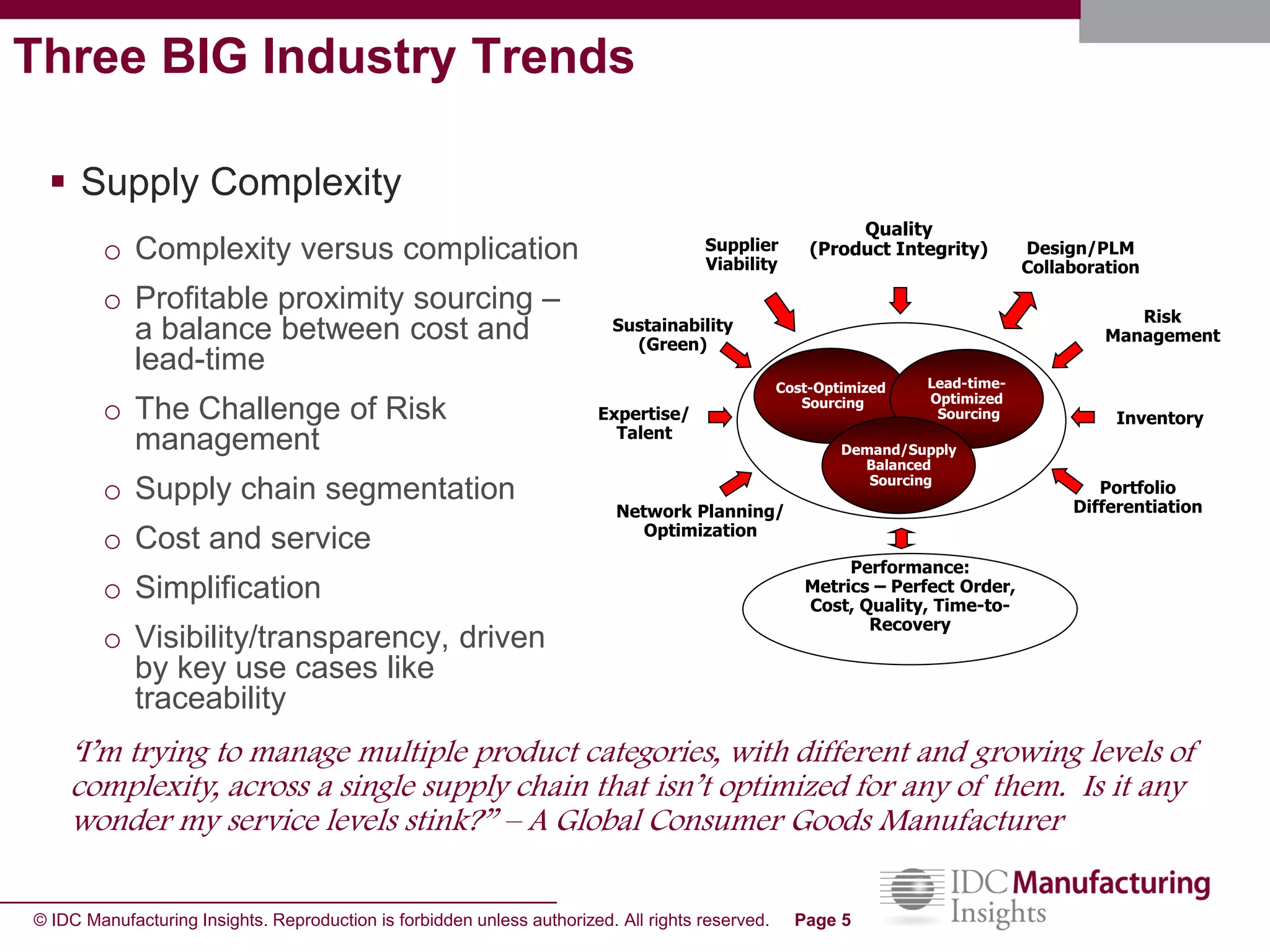
o Complexity versus complication
o Profitable proximity sourcing –
a balance between cost and
lead-time
o The Challenge of Risk
management
o Supply chain segmentation
o Cost and service
o Simplification
o Visibility/transparency, driven
by key use cases like
traceability
‘I’m trying to manage multiple product categories, with different and growing levels of
complexity, across a single supply chain that isn’t optimized for any of them. Is it any
wonder my service levels stink?” – A Global Consumer Goods Manufacturer
Cost-Optimized
Sourcing
Lead-time-
Optimized
Sourcing
Demand/Supply
Balanced
Sourcing
Sustainability
(Green)
Risk
Management
Quality
(Product Integrity)
Performance:
Metrics – Perfect Order,
Cost, Quality, Time-to-
Recovery
Network Planning/
Optimization
Portfolio
Differentiation
Inventory
Optimization
Expertise/
Talent
Design/PLM
Collaboration
Supplier
Viability
Three BIG Industry Trends
 Supply Complexity
© IDC Manufacturing Insights. Reproduction is forbidden unless authorized. All rights reserved. Page 6
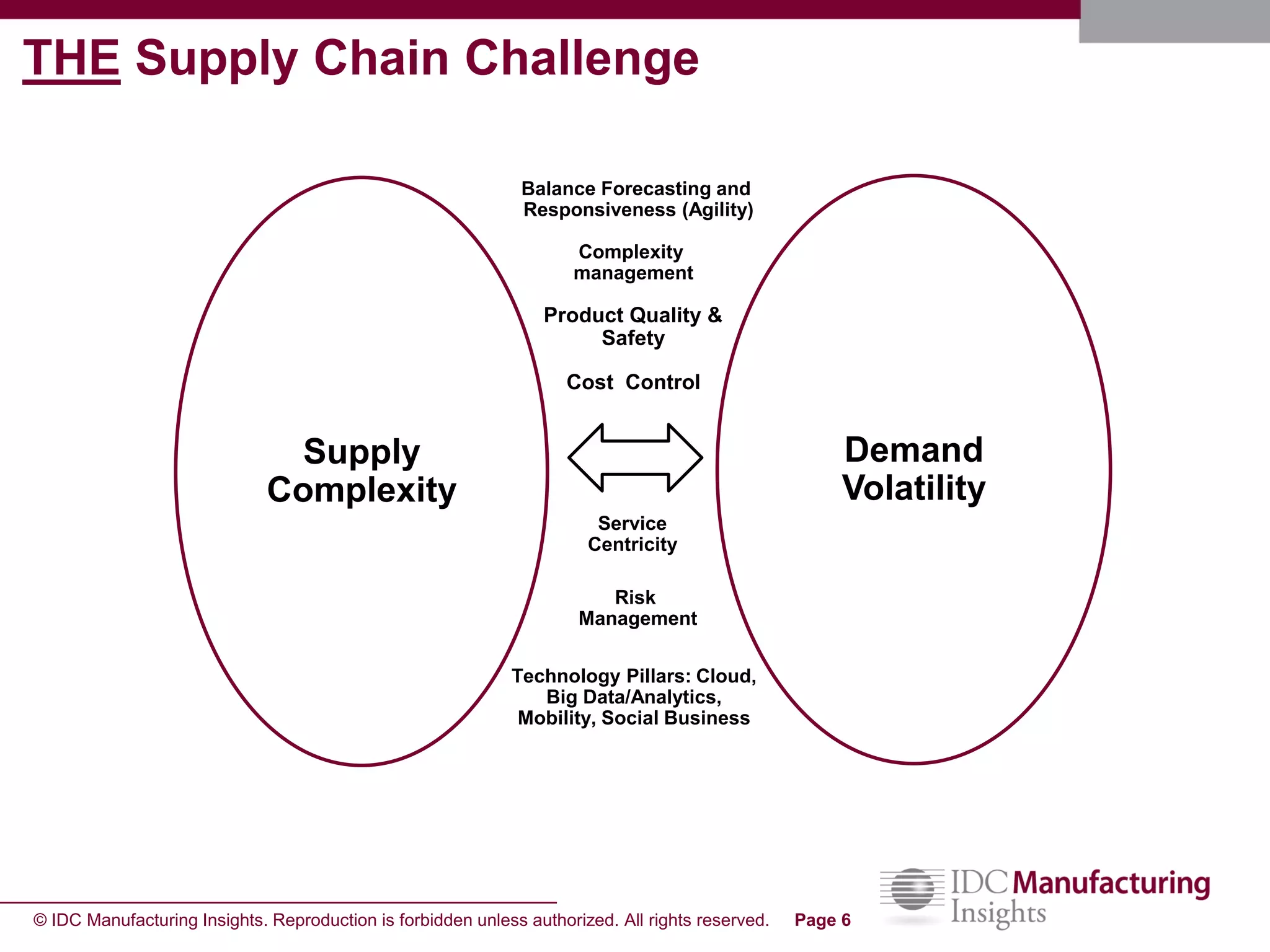
Demand
Volatility
Supply
Complexity
Complexity
management
Cost Control
Risk
Management
Service
Centricity
Balance Forecasting and
Responsiveness (Agility)
Technology Pillars: Cloud,
Big Data/Analytics,
Mobility, Social Business
THE Supply Chain Challenge
Product Quality &
Safety
© IDC Manufacturing Insights. Reproduction is forbidden unless authorized. All rights reserved. Page 7
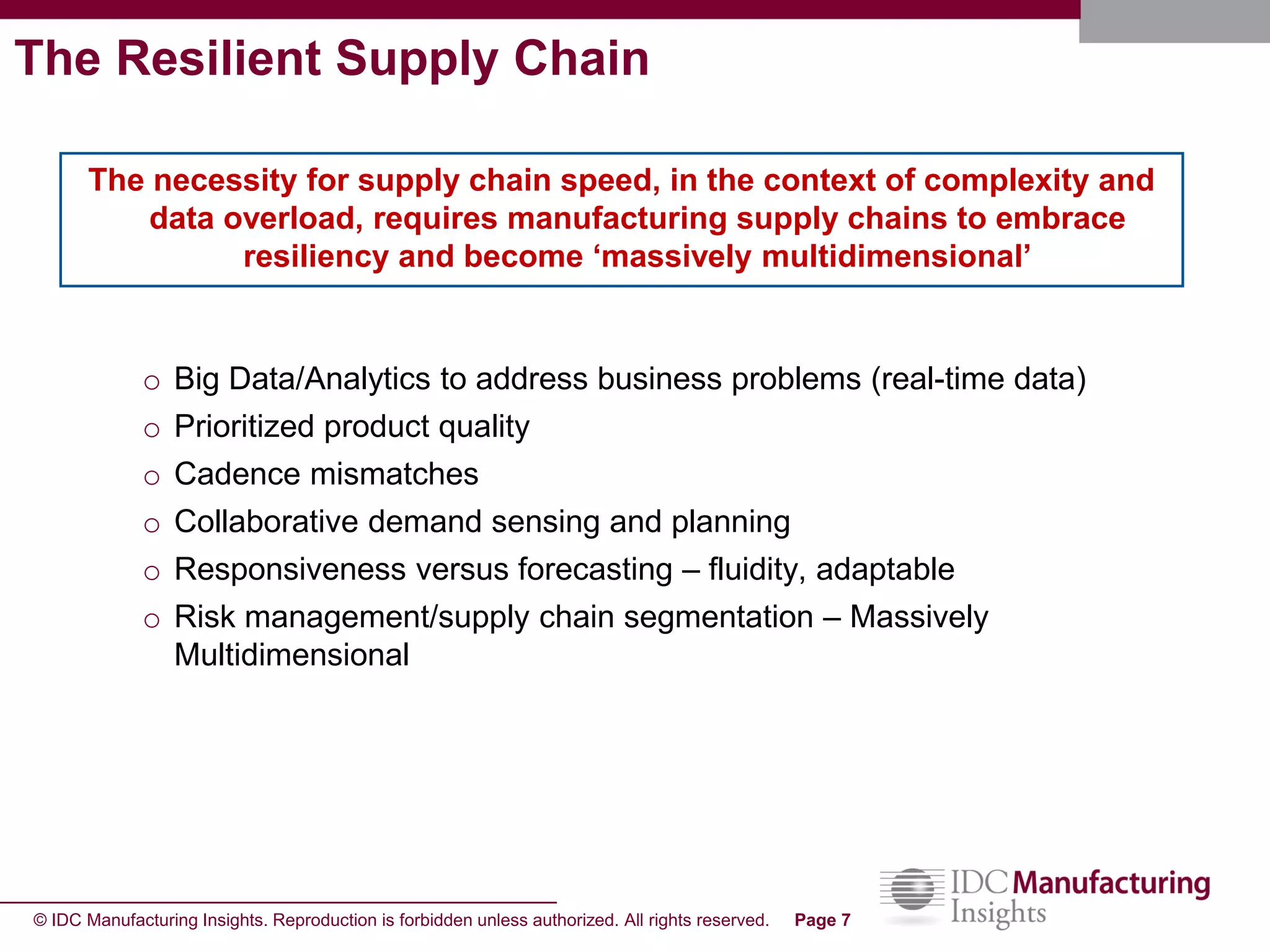
The Resilient Supply Chain
o Big Data/Analytics to address business problems (real-time data)
o Prioritized product quality
o Cadence mismatches
o Collaborative demand sensing and planning
o Responsiveness versus forecasting – fluidity, adaptable
o Risk management/supply chain segmentation – Massively
Multidimensional
The necessity for supply chain speed, in the context of complexity and
data overload, requires manufacturing supply chains to embrace
resiliency and become ‘massively multidimensional’
© IDC Manufacturing Insights. Reproduction is forbidden unless authorized. All rights reserved. Page 8
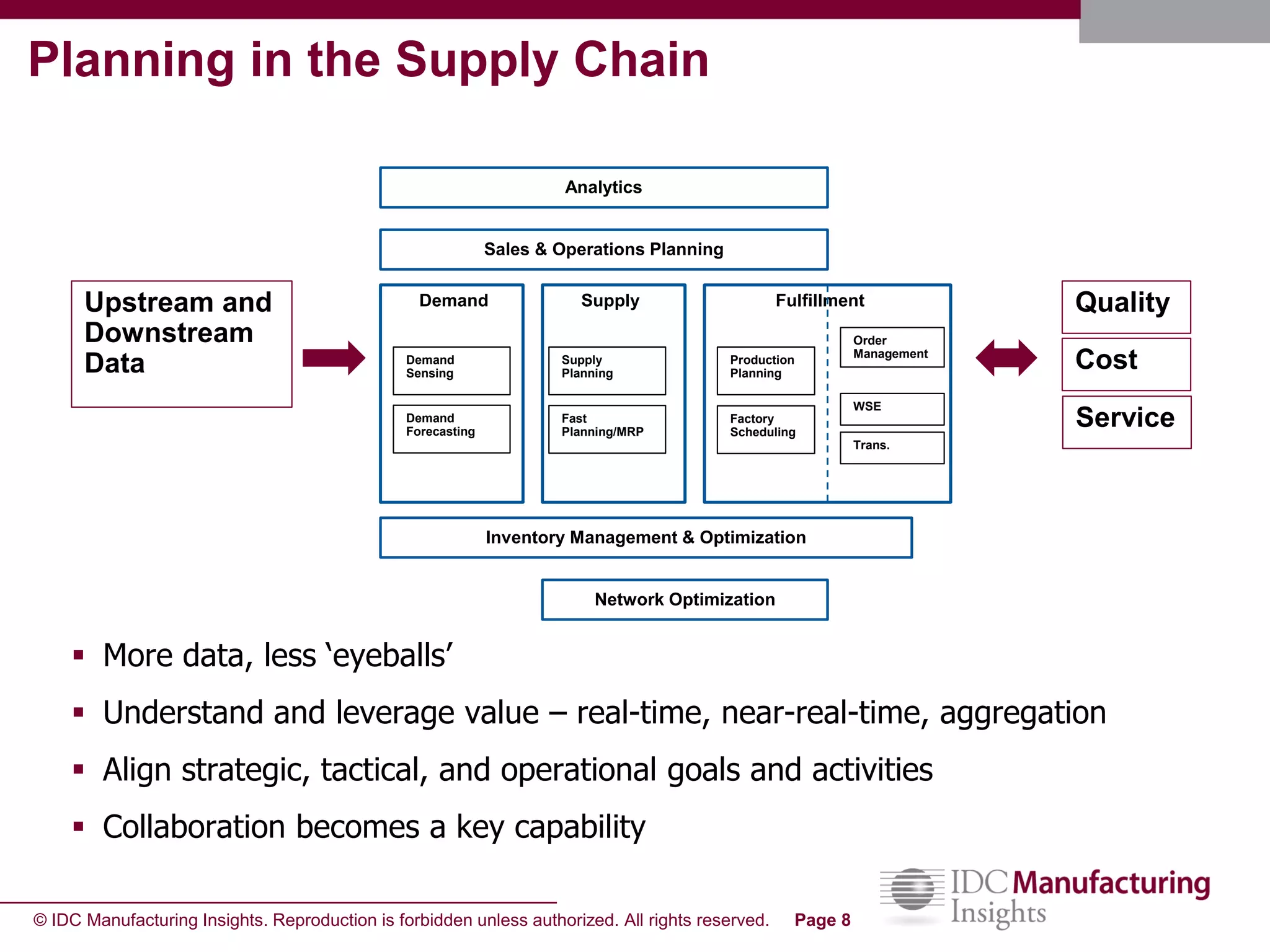
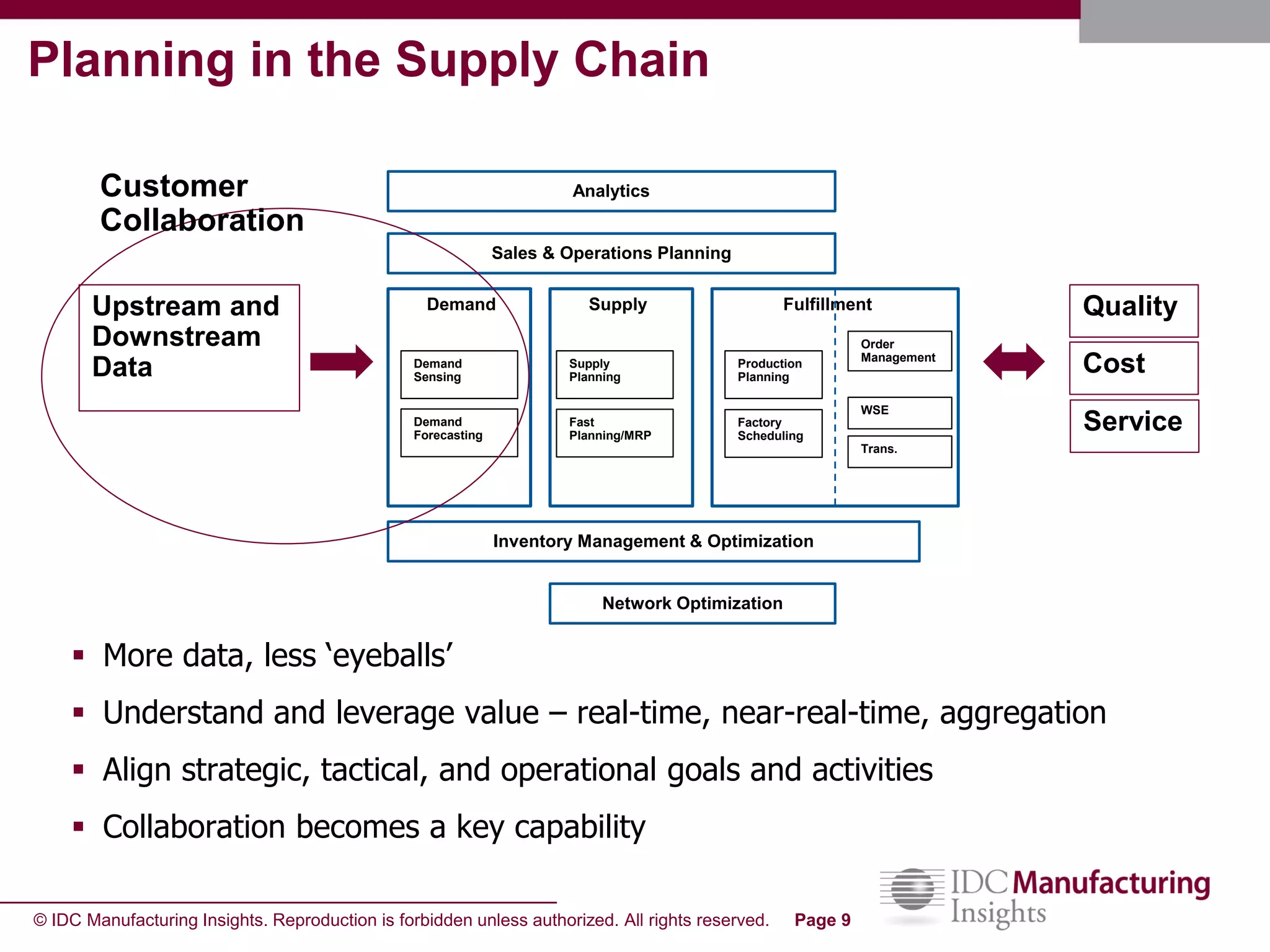
Analytics
Sales & Operations Planning
FulfillmentDemand Supply
Inventory Management & Optimization
Network Optimization
Production
Planning
Factory
Scheduling
WSE
Trans.
Order
Management
Supply
Planning
Fast
Planning/MRP
Demand
Sensing
Demand
Forecasting
Upstream and
Downstream
Data
Quality
Service
Cost
Planning in the Supply Chain
 More data, less ‘eyeballs’
 Understand and leverage value – real-time, near-real-time, aggregation
 Align strategic, tactical, and operational goals and activities
 Collaboration becomes a key capability
© IDC Manufacturing Insights. Reproduction is forbidden unless authorized. All rights reserved. Page 9
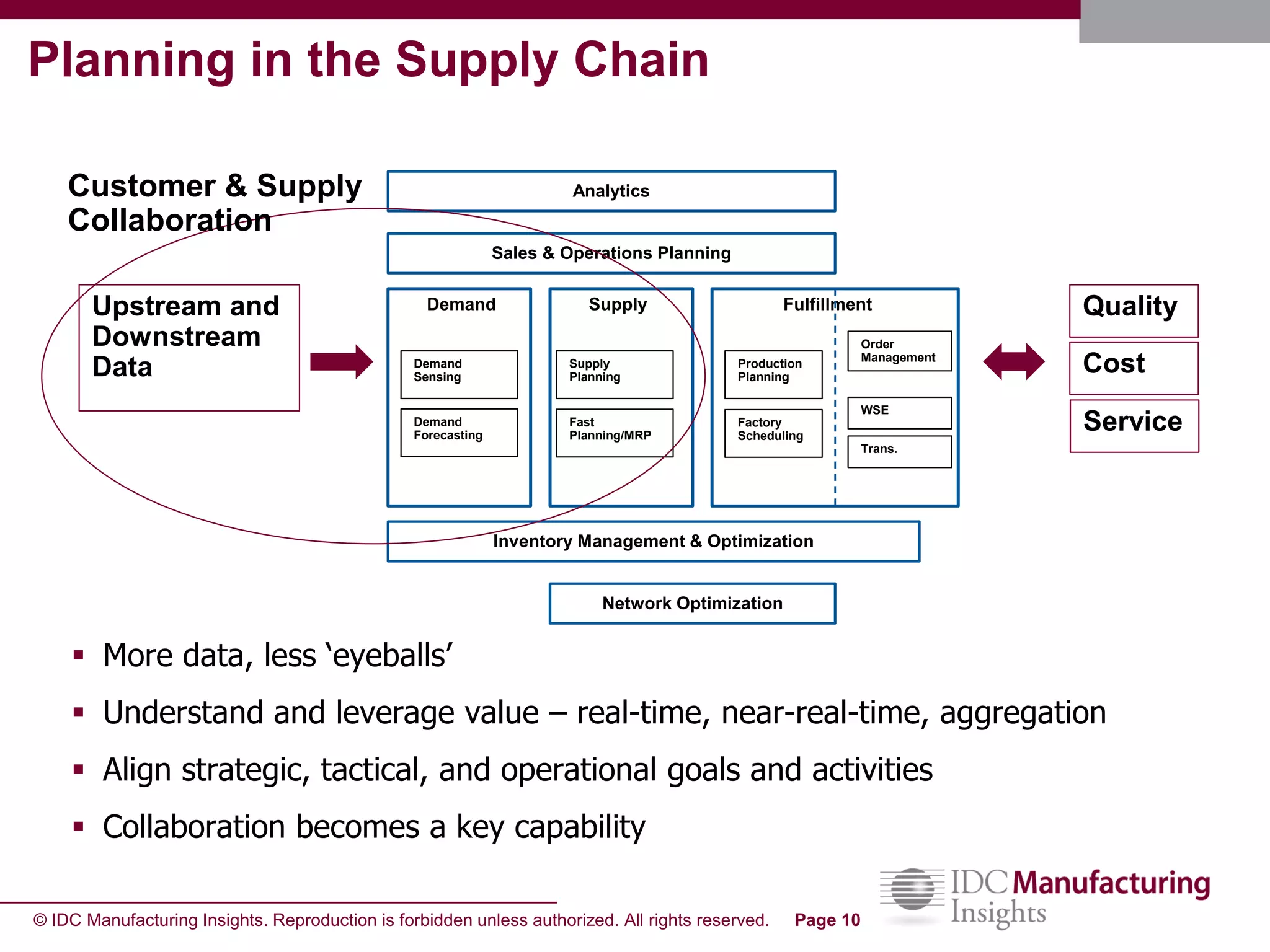
Analytics
Sales & Operations Planning
FulfillmentDemand Supply
Inventory Management & Optimization
Network Optimization
Production
Planning
Factory
Scheduling
WSE
Trans.
Order
Management
Supply
Planning
Fast
Planning/MRP
Demand
Sensing
Demand
Forecasting
Upstream and
Downstream
Data
Quality
Service
Cost
Planning in the Supply Chain
 More data, less ‘eyeballs’
 Understand and leverage value – real-time, near-real-time, aggregation
 Align strategic, tactical, and operational goals and activities
 Collaboration becomes a key capability
Customer
Collaboration
© IDC Manufacturing Insights. Reproduction is forbidden unless authorized. All rights reserved. Page 10
Analytics
Sales & Operations Planning
FulfillmentDemand Supply
Inventory Management & Optimization
Network Optimization
Production
Planning
Factory
Scheduling
WSE
Trans.
Order
Management
Supply
Planning
Fast
Planning/MRP
Demand
Sensing
Demand
Forecasting
Upstream and
Downstream
Data
Quality
Service
Cost
Planning in the Supply Chain
 More data, less ‘eyeballs’
 Understand and leverage value – real-time, near-real-time, aggregation
 Align strategic, tactical, and operational goals and activities
 Collaboration becomes a key capability
Customer & Supply
Collaboration
© IDC Manufacturing Insights. Reproduction is forbidden unless authorized. All rights reserved. Page 11
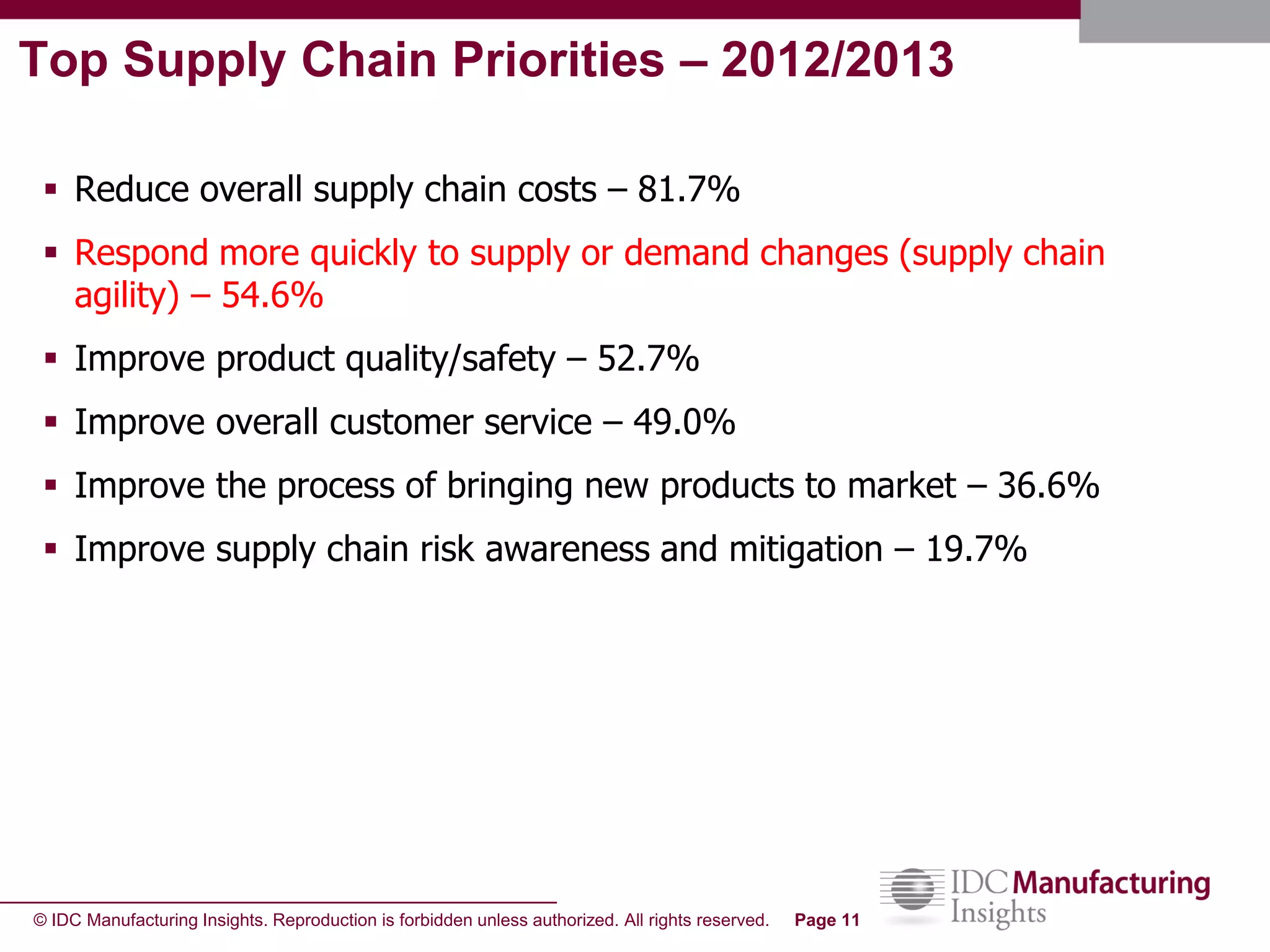
Top Supply Chain Priorities – 2012/2013
 Reduce overall supply chain costs – 81.7%
 Respond more quickly to supply or demand changes (supply chain
agility) – 54.6%
 Improve product quality/safety – 52.7%
 Improve overall customer service – 49.0%
 Improve the process of bringing new products to market – 36.6%
 Improve supply chain risk awareness and mitigation – 19.7%
© IDC Manufacturing Insights. Reproduction is forbidden unless authorized. All rights reserved. Page 12
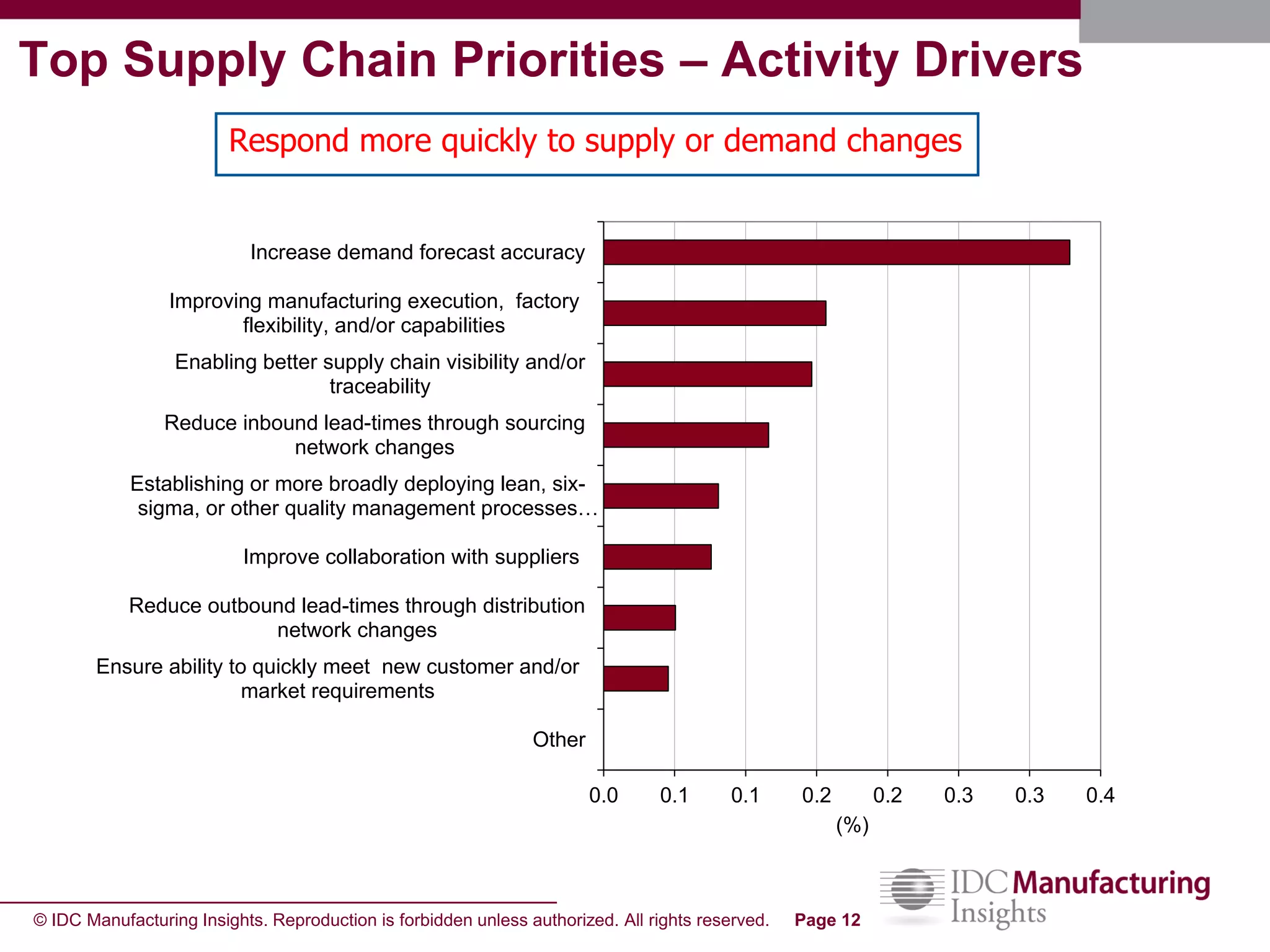
Top Supply Chain Priorities – Activity Drivers
Respond more quickly to supply or demand changes
0.0 0.1 0.1 0.2 0.2 0.3 0.3 0.4
Other
Ensure ability to quickly meet new customer and/or
market requirements
Reduce outbound lead-times through distribution
network changes
Improve collaboration with suppliers
Establishing or more broadly deploying lean, six-
sigma, or other quality management processes…
Reduce inbound lead-times through sourcing
network changes
Enabling better supply chain visibility and/or
traceability
Improving manufacturing execution, factory
flexibility, and/or capabilities
Increase demand forecast accuracy
(%)
© IDC Manufacturing Insights. Reproduction is forbidden unless authorized. All rights reserved. Page 13
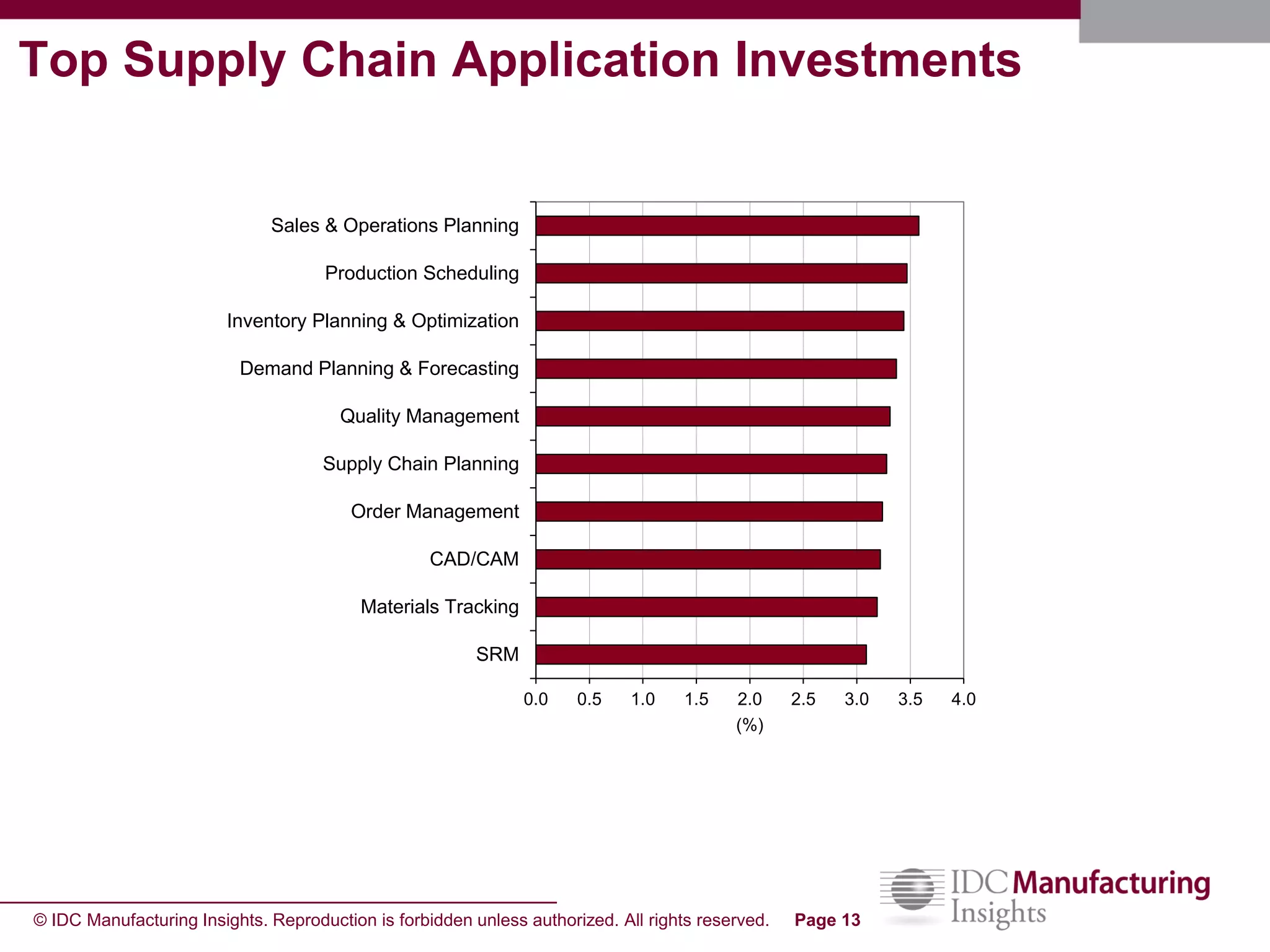
Top Supply Chain Application Investments
0.0 0.5 1.0 1.5 2.0 2.5 3.0 3.5 4.0
SRM
Materials Tracking
CAD/CAM
Order Management
Supply Chain Planning
Quality Management
Demand Planning & Forecasting
Inventory Planning & Optimization
Production Scheduling
Sales & Operations Planning
(%)
© IDC Manufacturing Insights. Reproduction is forbidden unless authorized. All rights reserved. Page 14
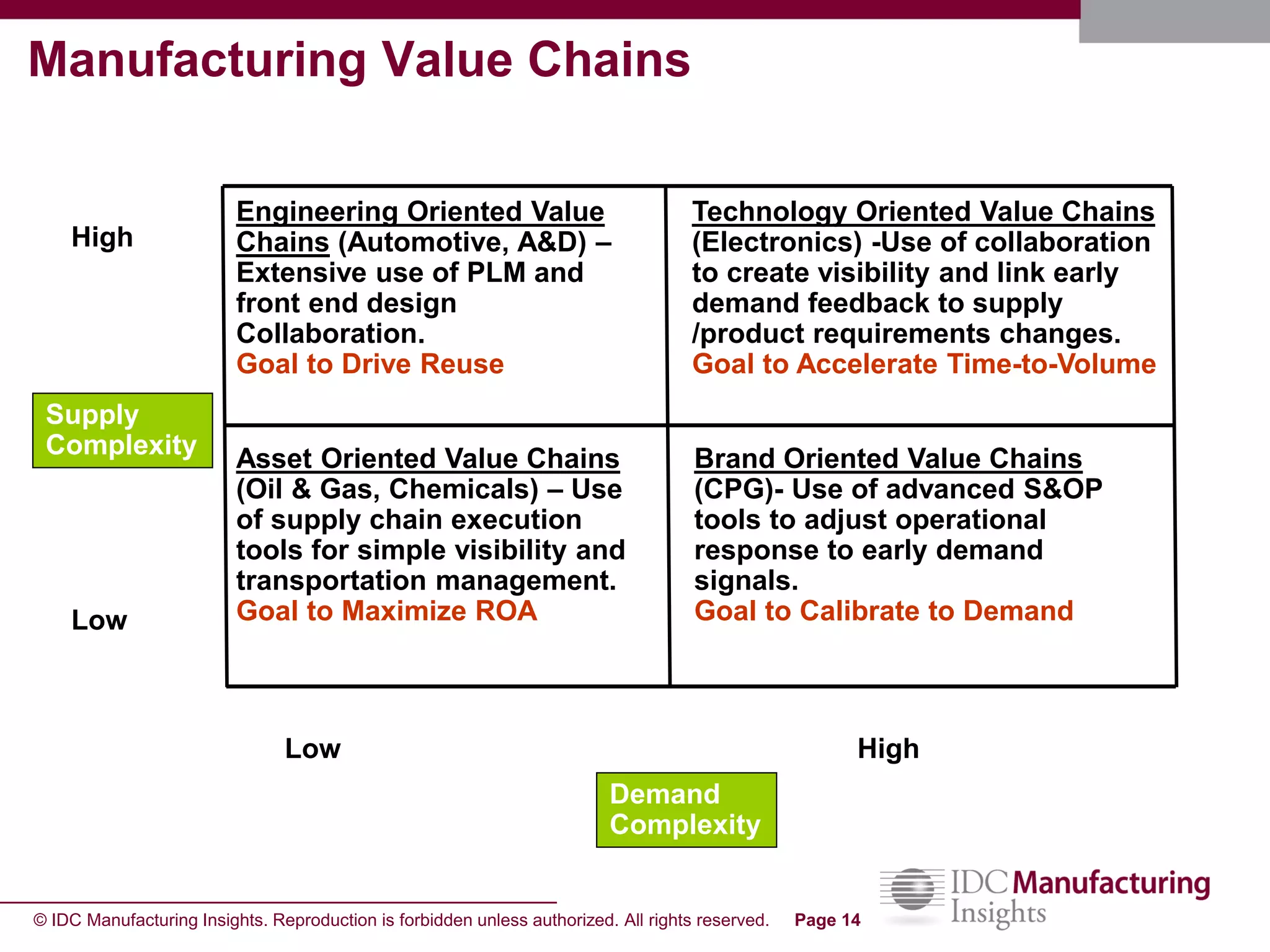
Demand
Complexity
Supply
Complexity
Low
Low
High
High
Technology Oriented Value Chains
(Electronics) -Use of collaboration
to create visibility and link early
demand feedback to supply
/product requirements changes.
Goal to Accelerate Time-to-Volume
Brand Oriented Value Chains
(CPG)- Use of advanced S&OP
tools to adjust operational
response to early demand
signals.
Goal to Calibrate to Demand
Engineering Oriented Value
Chains (Automotive, A&D) –
Extensive use of PLM and
front end design
Collaboration.
Goal to Drive Reuse
Asset Oriented Value Chains
(Oil & Gas, Chemicals) – Use
of supply chain execution
tools for simple visibility and
transportation management.
Goal to Maximize ROA
Figure 4Manufacturing Value Chains
© IDC Manufacturing Insights. Reproduction is forbidden unless authorized. All rights reserved. Page 15
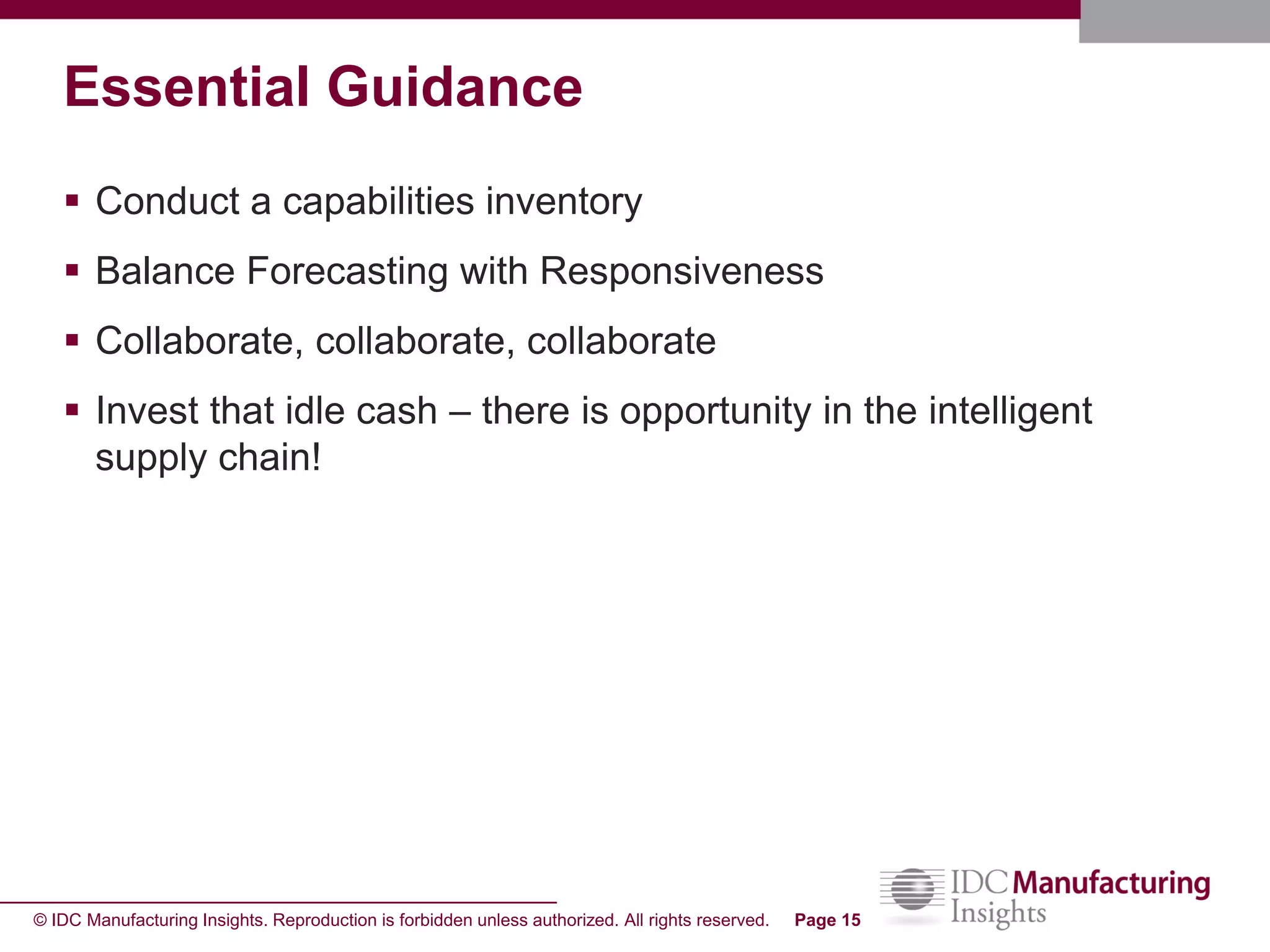
Essential Guidance
 Conduct a capabilities inventory
 Balance Forecasting with Responsiveness
 Collaborate, collaborate, collaborate
 Invest that idle cash – there is opportunity in the intelligent
supply chain!
Using Forecast Collaboration Tools to
Align the Supply and Demand Sides of the
Supply Chain
Dudley Lance, Sales Director
TAKE Solutions
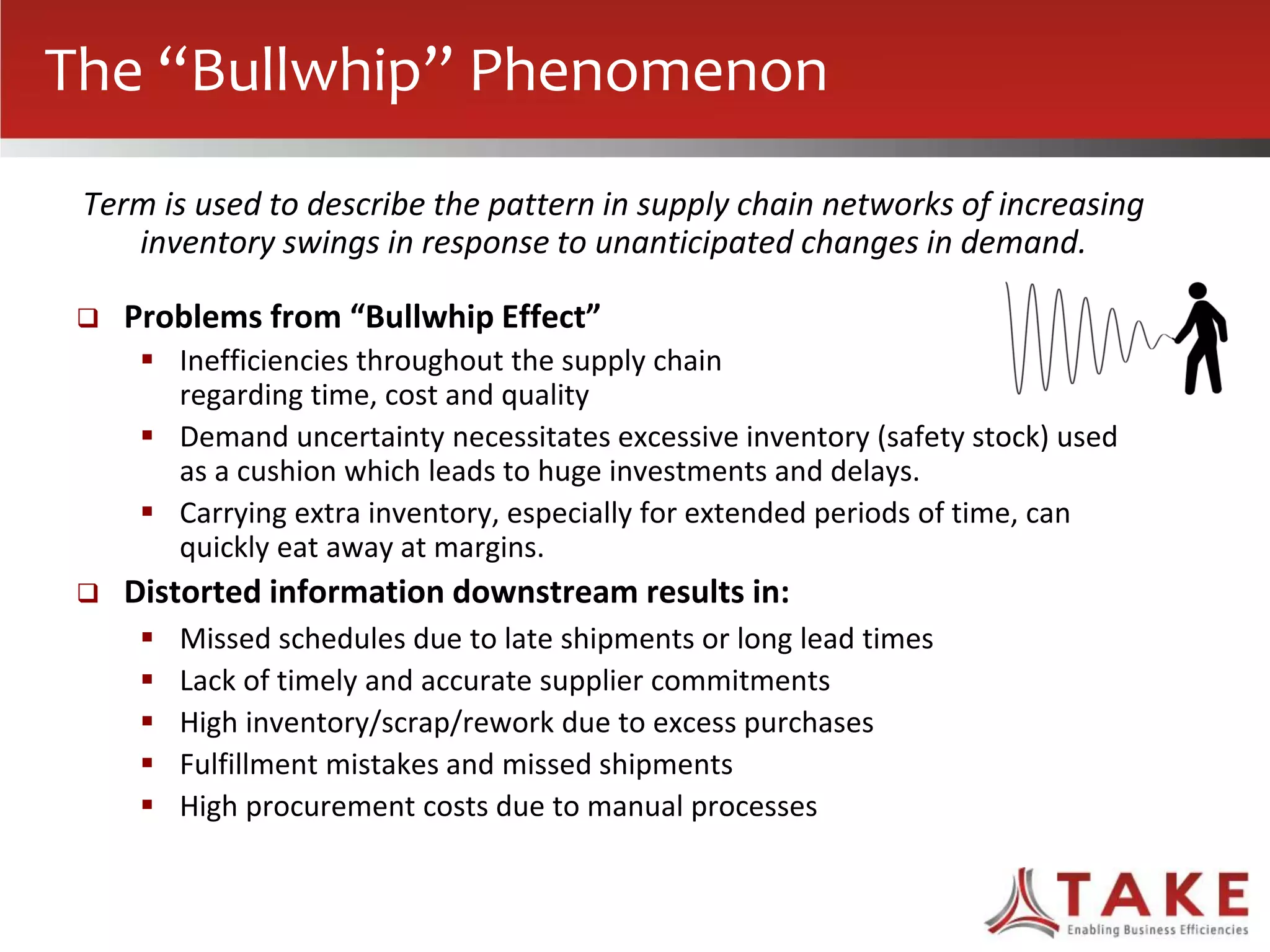
The “Bullwhip” Phenomenon
Term is used to describe the pattern in supply chain networks of increasing
inventory swings in response to unanticipated changes in demand.
 Problems from “Bullwhip Effect”
 Inefficiencies throughout the supply chain
regarding time, cost and quality
 Demand uncertainty necessitates excessive inventory (safety stock) used
as a cushion which leads to huge investments and delays.
 Carrying extra inventory, especially for extended periods of time, can
quickly eat away at margins.
 Distorted information downstream results in:
 Missed schedules due to late shipments or long lead times
 Lack of timely and accurate supplier commitments
 High inventory/scrap/rework due to excess purchases
 Fulfillment mistakes and missed shipments
 High procurement costs due to manual processes
Traditional Technology used…
 Demand Planning & Forecasting
 MRP, ERP, WMS
 Spreadsheets
 B2B Technology
The problem with traditional tools…
 Multiple systems of record
 Information latency
 Lack of “business logic” w/ B2B connectivity tools
 No “Closed Loop” collaboration capabilities
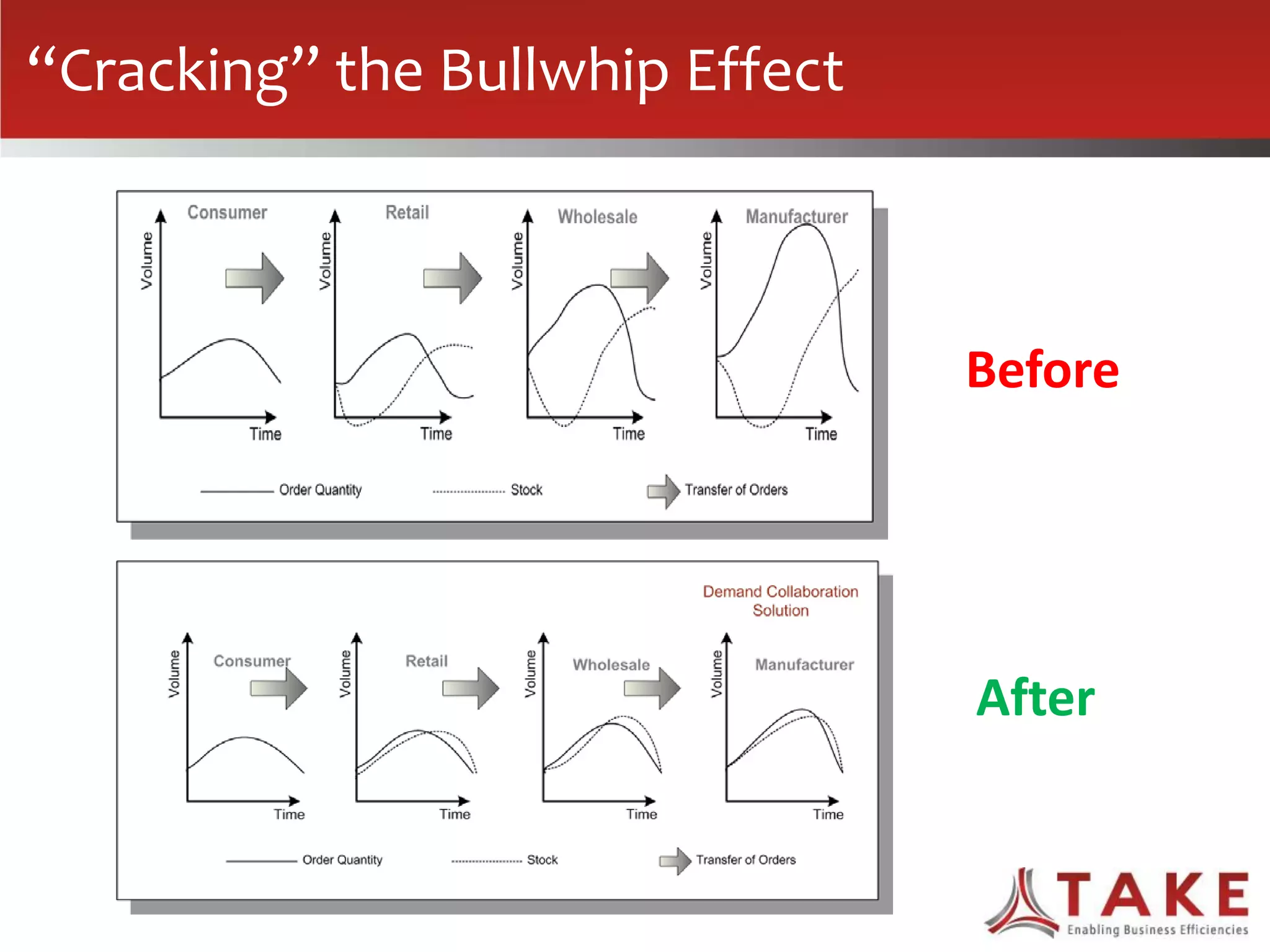
“Cracking” the Bullwhip Effect
Before
After
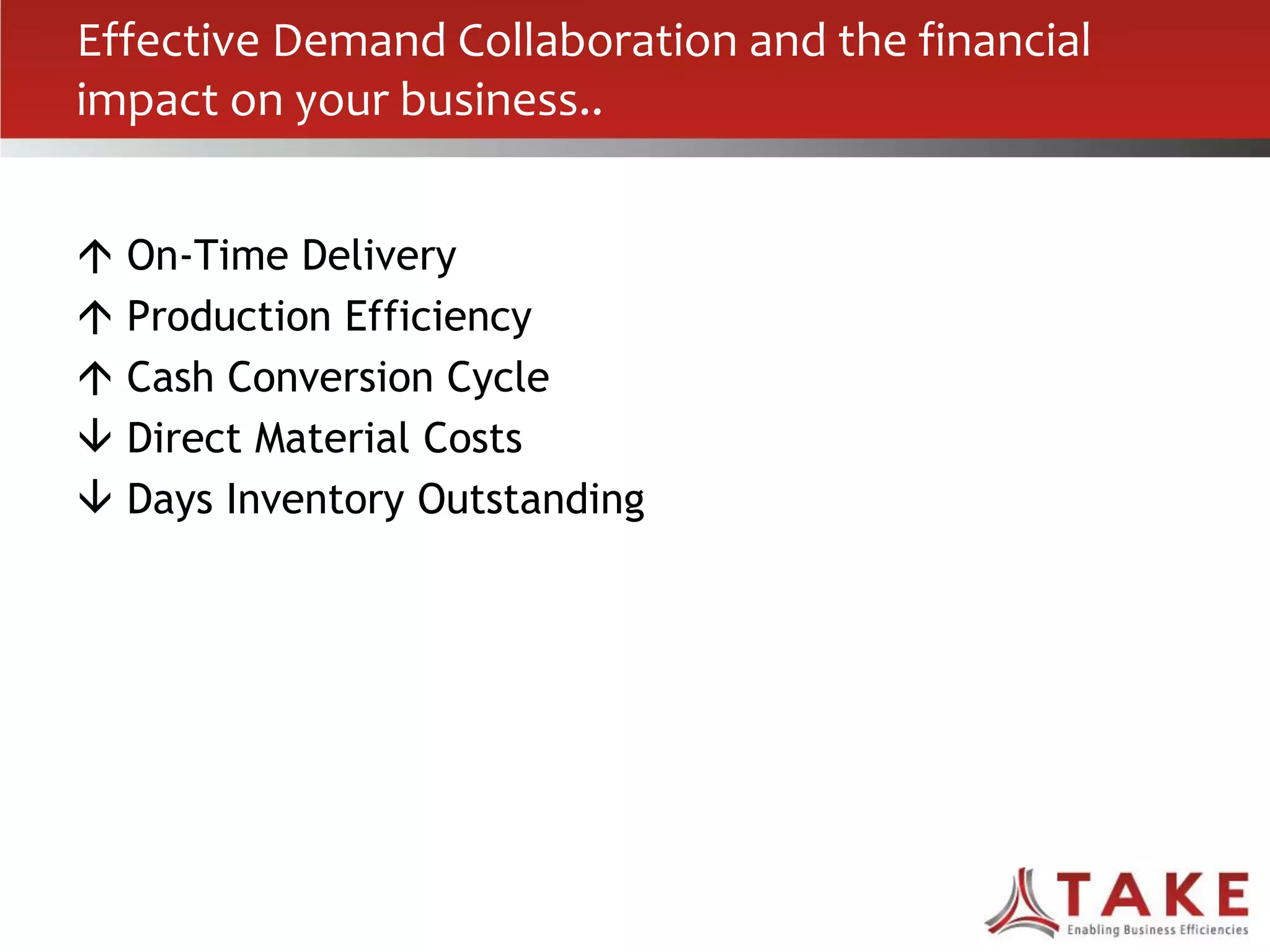
Effective Demand Collaboration and the financial
impact on your business..
 On-Time Delivery
 Production Efficiency
 Cash Conversion Cycle
 Direct Material Costs
 Days Inventory Outstanding
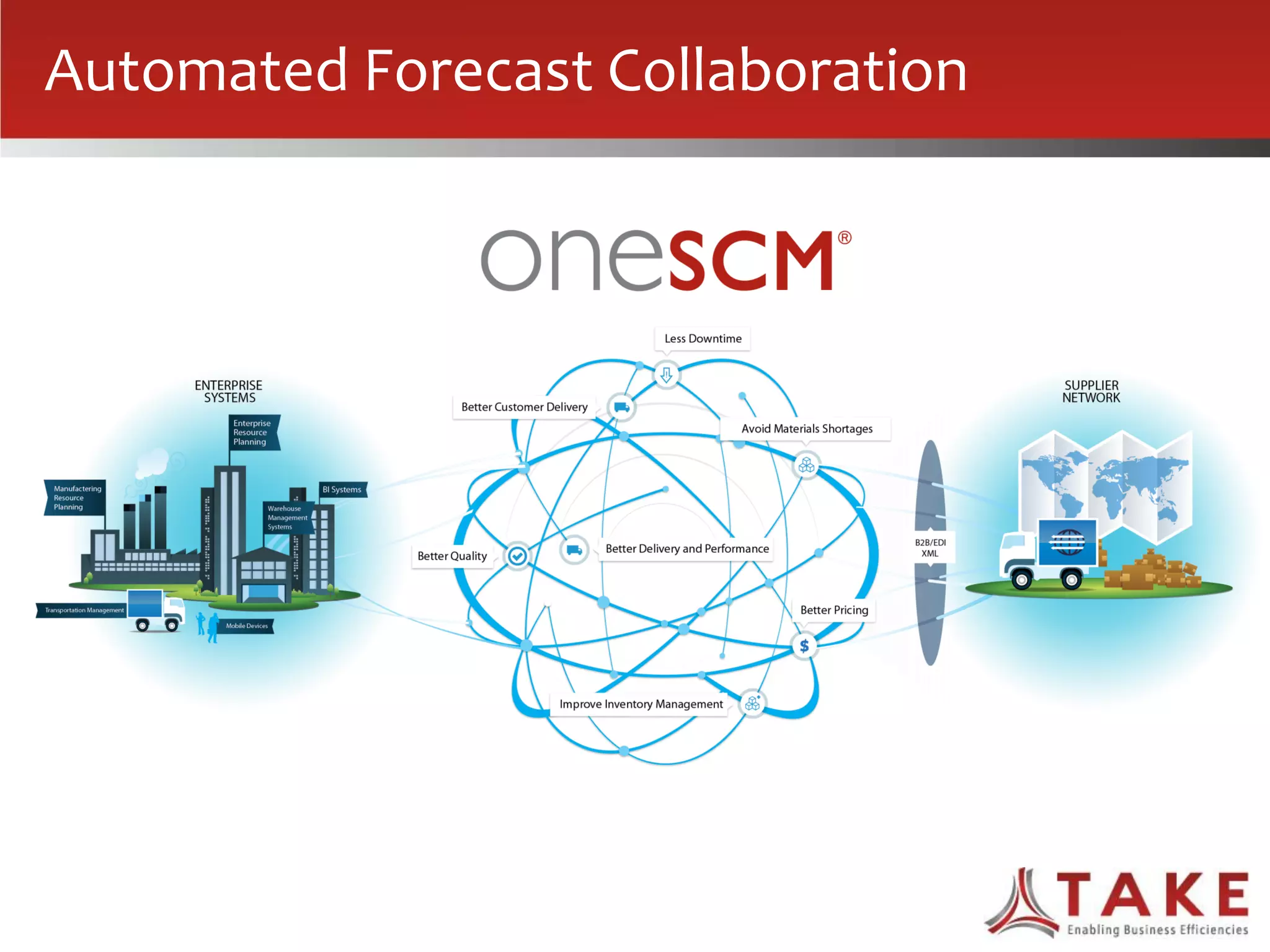
Automated Forecast Collaboration
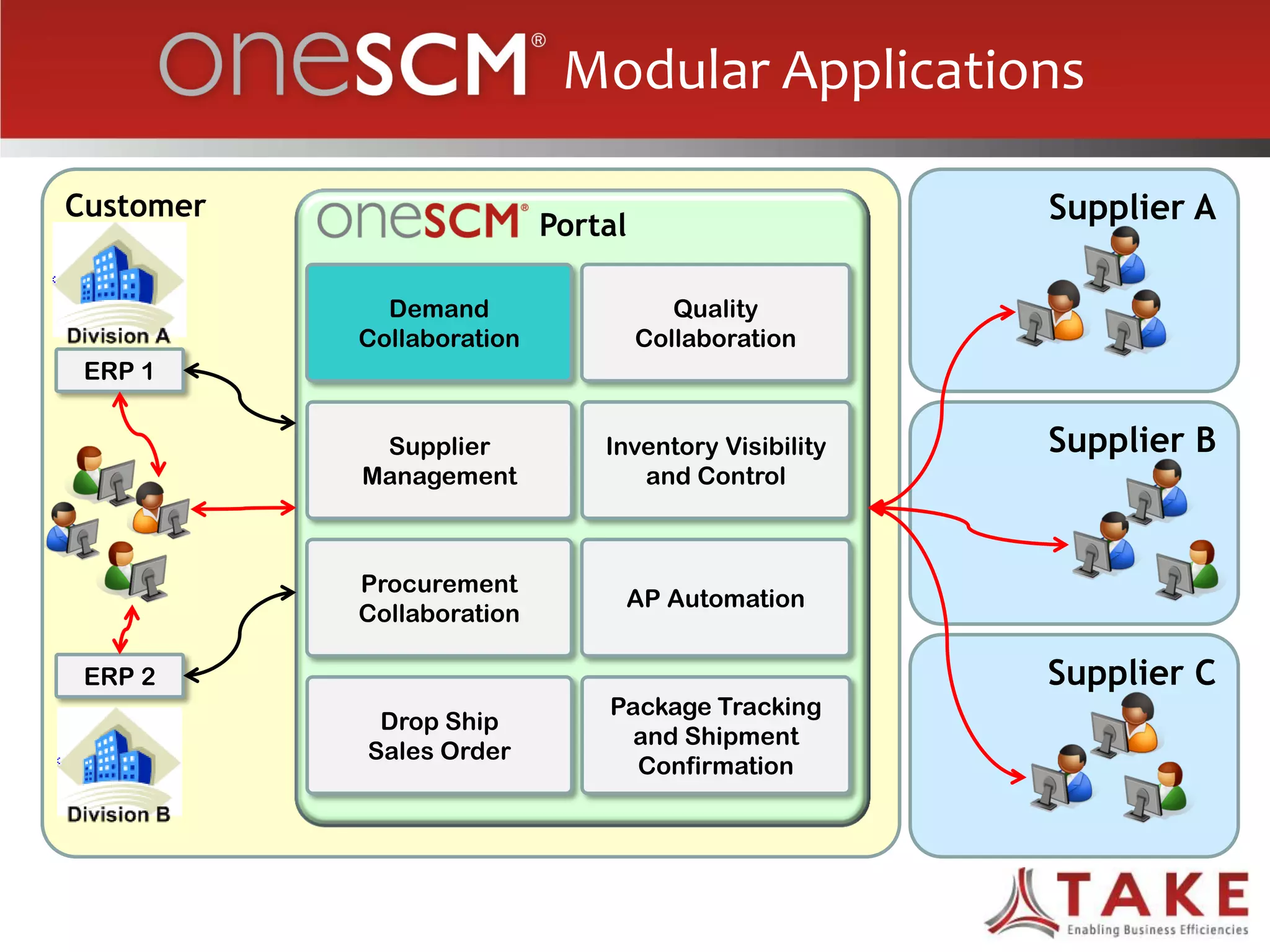
Modular Applications
Customer Supplier A
Supplier B
Supplier C
Portal
Demand
Collaboration
Quality
Collaboration
Supplier
Management
Inventory Visibility
and Control
Procurement
Collaboration
AP Automation
Drop Ship
Sales Order
Package Tracking
and Shipment
Confirmation
ERP 1
ERP 2
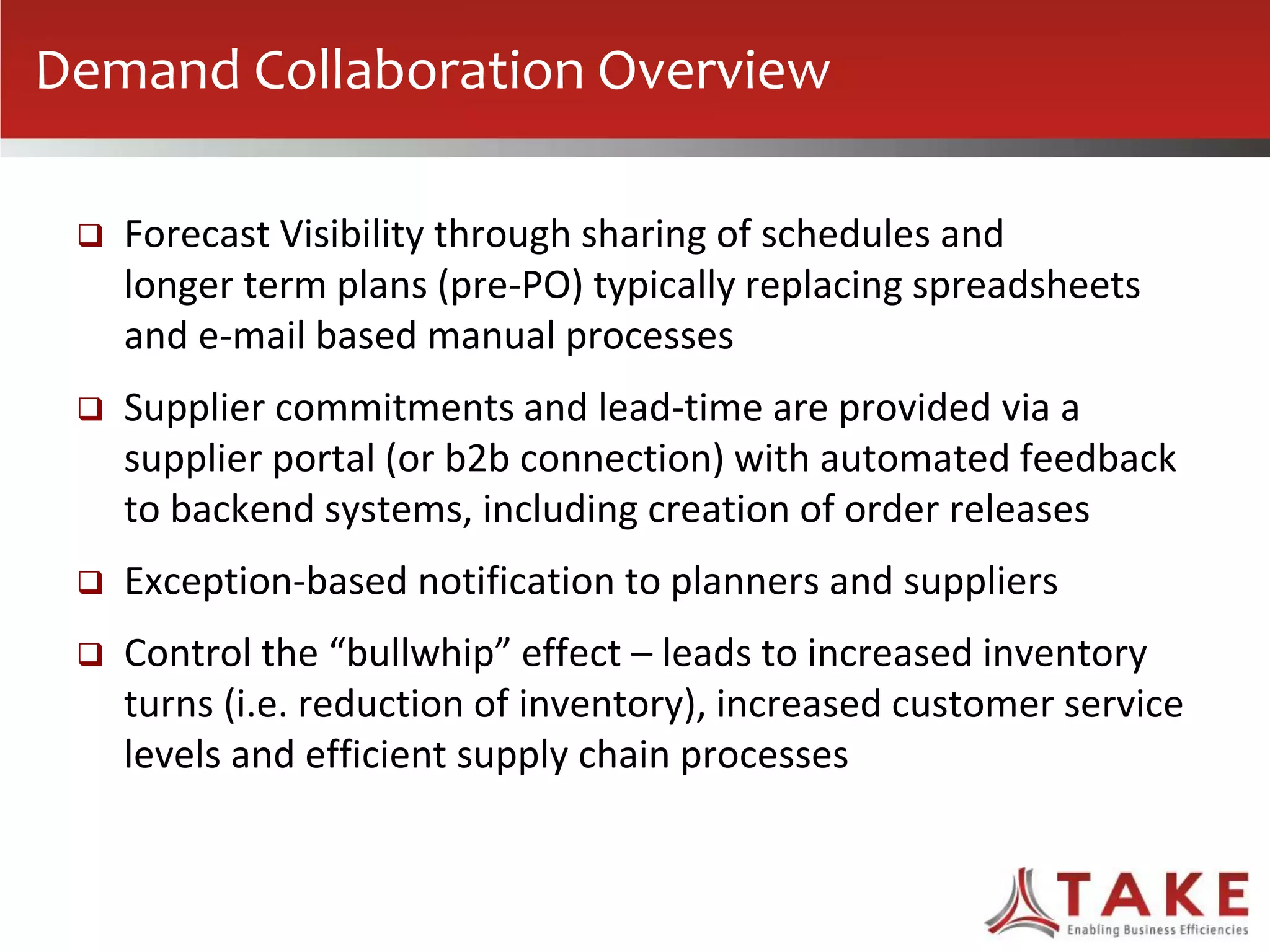
 Forecast Visibility through sharing of schedules and
longer term plans (pre-PO) typically replacing spreadsheets
and e-mail based manual processes
 Supplier commitments and lead-time are provided via a
supplier portal (or b2b connection) with automated feedback
to backend systems, including creation of order releases
 Exception-based notification to planners and suppliers
 Control the “bullwhip” effect – leads to increased inventory
turns (i.e. reduction of inventory), increased customer service
levels and efficient supply chain processes
Demand Collaboration Overview
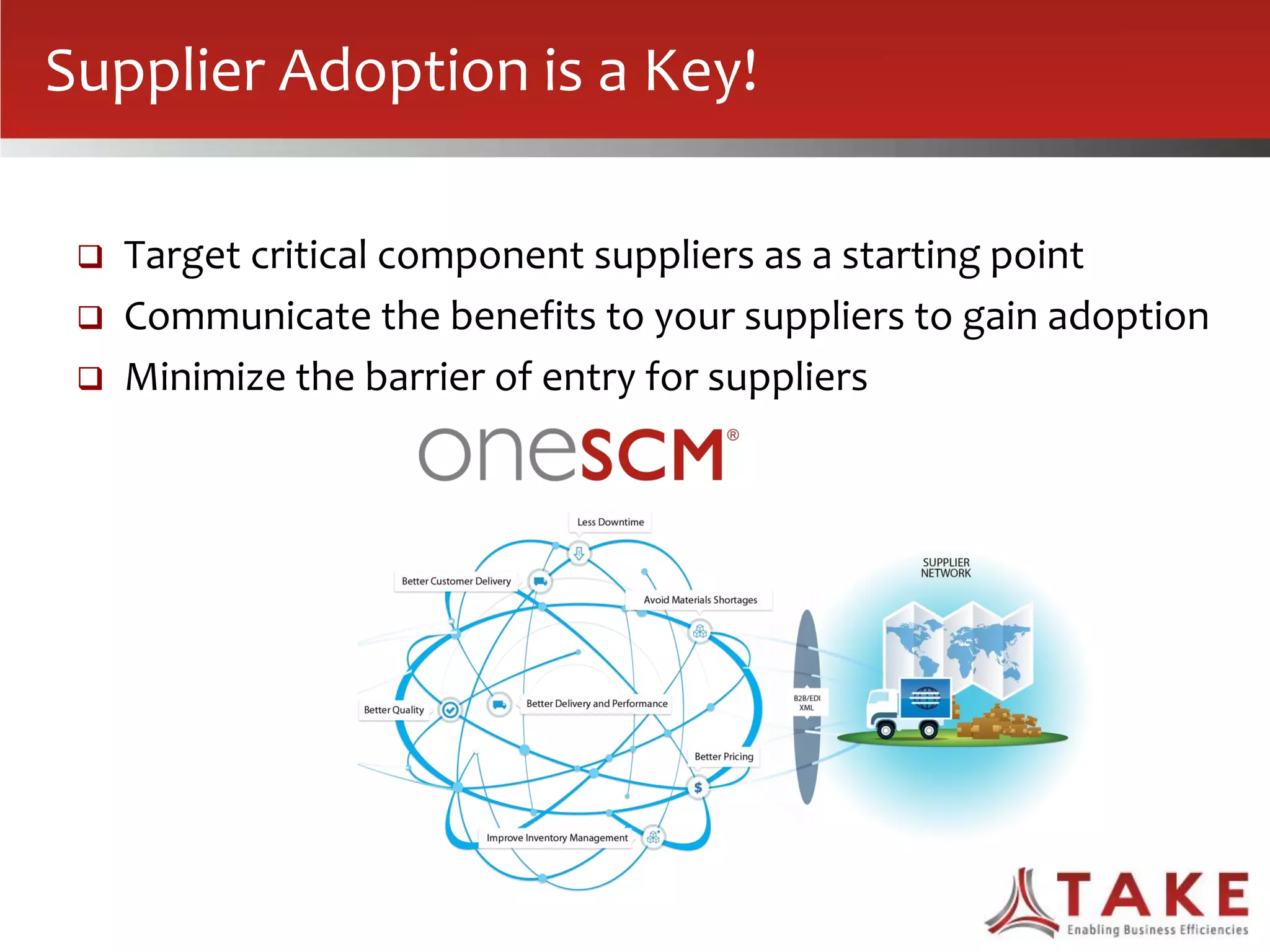
Supplier Adoption is a Key!
 Target critical component suppliers as a starting point
 Communicate the benefits to your suppliers to gain adoption
 Minimize the barrier of entry for suppliers
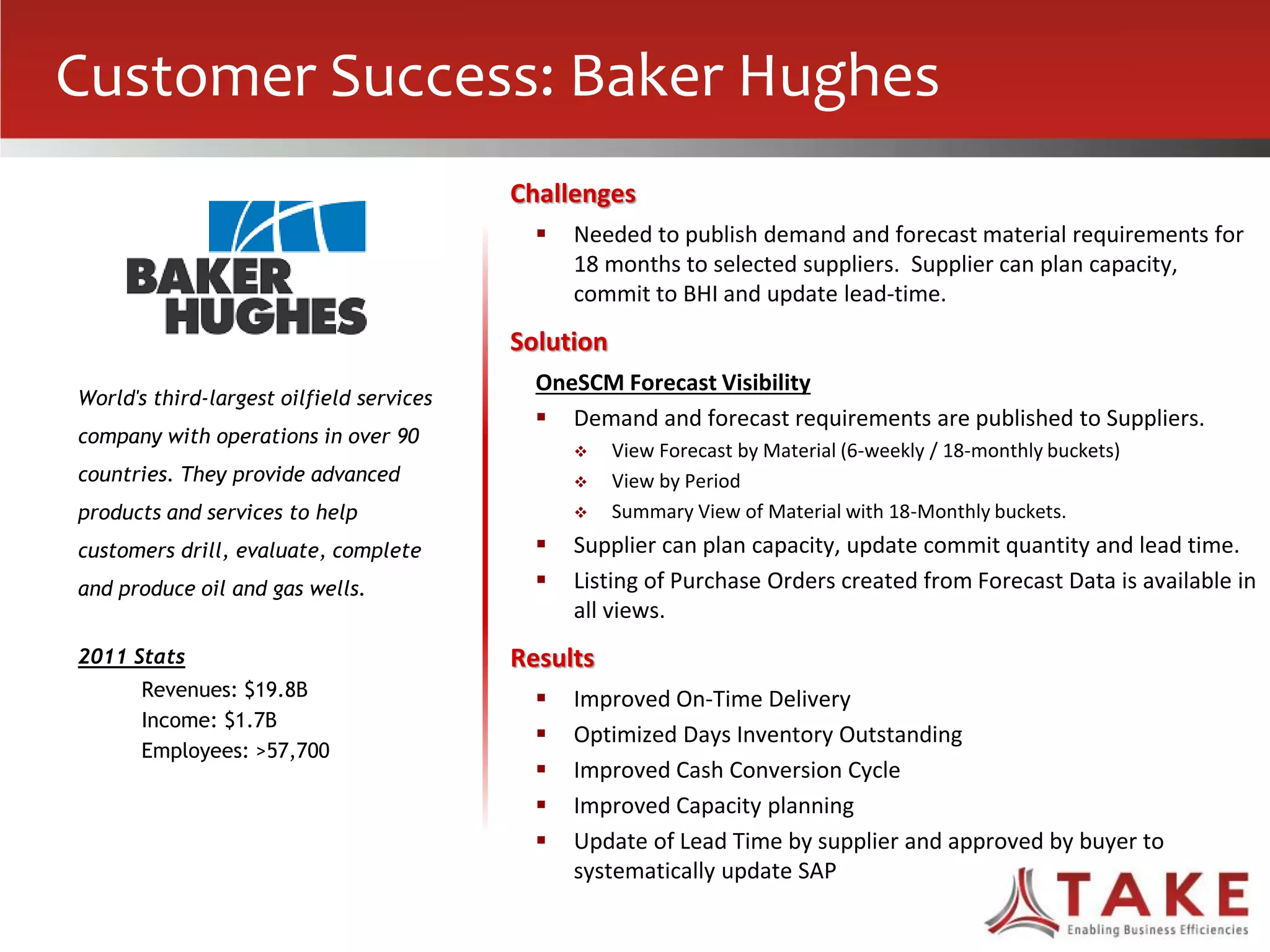
Challenges
 Needed to publish demand and forecast material requirements for
18 months to selected suppliers. Supplier can plan capacity,
commit to BHI and update lead-time.
Solution
OneSCM Forecast Visibility
 Demand and forecast requirements are published to Suppliers.
 View Forecast by Material (6-weekly / 18-monthly buckets)
 View by Period
 Summary View of Material with 18-Monthly buckets.
 Supplier can plan capacity, update commit quantity and lead time.
 Listing of Purchase Orders created from Forecast Data is available in
all views.
Results
 Improved On-Time Delivery
 Optimized Days Inventory Outstanding
 Improved Cash Conversion Cycle
 Improved Capacity planning
 Update of Lead Time by supplier and approved by buyer to
systematically update SAP
World's third-largest oilfield services
company with operations in over 90
countries. They provide advanced
products and services to help
customers drill, evaluate, complete
and produce oil and gas wells.
2011 Stats
Revenues: $19.8B
Income: $1.7B
Employees: >57,700
Customer Success: Baker Hughes
Challenges
 Order fulfillment is predicated on short lead times
 Final assemblies have an average BOM of more than 2,000
components (75% of BOM parts are directly sourced)
 Required improved accuracy of inbound deliveries in key areas
of time, quality and quantity, while reducing inventory levels
and direct spend costs.
Solution
 OneSCM PO Collaboration and Demand Collaboration
 Over 400 OEM and Contract Manufacturers worldwide
 Increased visibility to purchasing data, acknowledgements and
use of rule-based MRP changes to open orders
 Shipping controls to collaborate on delivery dates
 12-month forecast visibility and collaboration
Results
 $22 million in savings with an ROI of nearly 500% and $2.5
million in recurring annualized savings
 33% reduction in warehouse space
 20-40% reduction in inventory
 25-30% reduction in receiving discrepancies
 30% reduction in premium freight costs
For more than 40 years, Applied
Materials has provided innovative
equipment, services and software to
enable the manufacture of advanced
semiconductor, flat panel display and
solar photovoltaic products. Applied’s
technologies help make innovations
like smartphones, flat screen TVs and
solar panels more affordable and
accessible to consumers and businesses
around the world.
Customer Success: Applied Materials
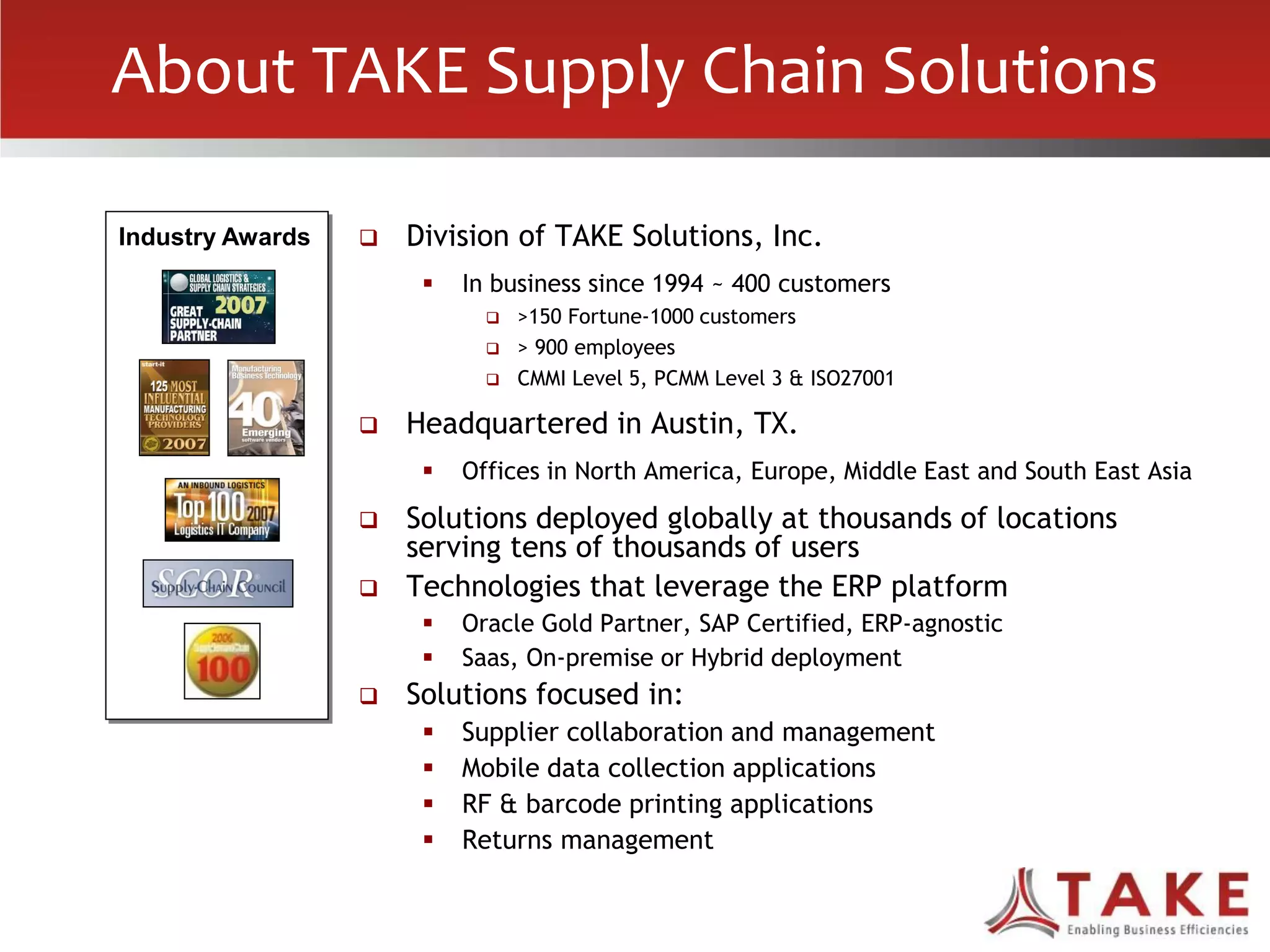
About TAKE Supply Chain Solutions
 Division of TAKE Solutions, Inc.
 In business since 1994 ~ 400 customers
 >150 Fortune-1000 customers
 > 900 employees
 CMMI Level 5, PCMM Level 3 & ISO27001
 Headquartered in Austin, TX.
 Offices in North America, Europe, Middle East and South East Asia
 Solutions deployed globally at thousands of locations
serving tens of thousands of users
 Technologies that leverage the ERP platform
 Oracle Gold Partner, SAP Certified, ERP-agnostic
 Saas, On-premise or Hybrid deployment
 Solutions focused in:
 Supplier collaboration and management
 Mobile data collection applications
 RF & barcode printing applications
 Returns management
Industry Awards
Thank you
We’d be happy to answer any questions you have
right now.
Or, please contact
TAKE Solutions: 800-324-5143
dudley.lance@takesolutions.com
donna.fritz@takesolutions.com

Using Forecast Collaboration

  • 1.
    Using Forecast CollaborationTools to Align the Supply and Demand Sides of the Supply Chain Presented by Simon Ellis, IDC Manufacturing Insights Dudley Lance, TAKE Solutions
  • 2.
    Using Forecast CollaborationTools to Align the Supply and Demand Sides of the Supply Chain TAKE Solutions Webinar - October 2012 Simon Ellis, Kimberly Knickle, IDC Manufacturing Insights
  • 3.
    © IDC ManufacturingInsights. Reproduction is forbidden unless authorized. All rights reserved. Page 3 o Ubiquitous access to information o More intense brand competition o Manufacturing and Retail ‘battle’ for the consumer o Omni-channel consumer o A stronger ‘voice’ o More ‘value’ oriented – happy to not spend! o ‘Privately Happy, Publicly Unhappy’ syndrome Manufacturer Retailer The ‘Omni’ Store Consumer Innovation Brand Loyalty Performance differentiation Value Margin Retail Differentiation Price Availability Shopping Experience ‘Many of my customers are coming into our dealerships knowing more about the net margins on the vehicles than my salespeople do … not a good position to be in if you want to make any money” – A New Jersey Care Dealer Three BIG Industry Trends  An ‘Empowered’ Consumer
  • 4.
    © IDC ManufacturingInsights. Reproduction is forbidden unless authorized. All rights reserved. Page 4 o Forecasting is not the major problem, lack of flexibility is! o The expectation for mass customization o Make-to-Stock versus Make-to- Order o From B-to-B to B-to-C o Balancing inventory with capacity o Supply chain segmentation o Postponement o SKU simplification Make- to- Stock Make- to- Order Forecast-Centric Response-Centric Balance of Forecasting and Responsivenes s Required ‘Five years ago, all of our products went to the major OEMs; now, I do almost one quarter of my business with consumer markets – and I have to worry about color and style” – A Global Disc Drive Manufacturer  Demand Volatility Three BIG Industry Trends
  • 5.
    © IDC ManufacturingInsights. Reproduction is forbidden unless authorized. All rights reserved. Page 5 o Complexity versus complication o Profitable proximity sourcing – a balance between cost and lead-time o The Challenge of Risk management o Supply chain segmentation o Cost and service o Simplification o Visibility/transparency, driven by key use cases like traceability ‘I’m trying to manage multiple product categories, with different and growing levels of complexity, across a single supply chain that isn’t optimized for any of them. Is it any wonder my service levels stink?” – A Global Consumer Goods Manufacturer Cost-Optimized Sourcing Lead-time- Optimized Sourcing Demand/Supply Balanced Sourcing Sustainability (Green) Risk Management Quality (Product Integrity) Performance: Metrics – Perfect Order, Cost, Quality, Time-to- Recovery Network Planning/ Optimization Portfolio Differentiation Inventory Optimization Expertise/ Talent Design/PLM Collaboration Supplier Viability Three BIG Industry Trends  Supply Complexity
  • 6.
    © IDC ManufacturingInsights. Reproduction is forbidden unless authorized. All rights reserved. Page 6 Demand Volatility Supply Complexity Complexity management Cost Control Risk Management Service Centricity Balance Forecasting and Responsiveness (Agility) Technology Pillars: Cloud, Big Data/Analytics, Mobility, Social Business THE Supply Chain Challenge Product Quality & Safety
  • 7.
    © IDC ManufacturingInsights. Reproduction is forbidden unless authorized. All rights reserved. Page 7 The Resilient Supply Chain o Big Data/Analytics to address business problems (real-time data) o Prioritized product quality o Cadence mismatches o Collaborative demand sensing and planning o Responsiveness versus forecasting – fluidity, adaptable o Risk management/supply chain segmentation – Massively Multidimensional The necessity for supply chain speed, in the context of complexity and data overload, requires manufacturing supply chains to embrace resiliency and become ‘massively multidimensional’
  • 8.
    © IDC ManufacturingInsights. Reproduction is forbidden unless authorized. All rights reserved. Page 8 Analytics Sales & Operations Planning FulfillmentDemand Supply Inventory Management & Optimization Network Optimization Production Planning Factory Scheduling WSE Trans. Order Management Supply Planning Fast Planning/MRP Demand Sensing Demand Forecasting Upstream and Downstream Data Quality Service Cost Planning in the Supply Chain  More data, less ‘eyeballs’  Understand and leverage value – real-time, near-real-time, aggregation  Align strategic, tactical, and operational goals and activities  Collaboration becomes a key capability
  • 9.
    © IDC ManufacturingInsights. Reproduction is forbidden unless authorized. All rights reserved. Page 9 Analytics Sales & Operations Planning FulfillmentDemand Supply Inventory Management & Optimization Network Optimization Production Planning Factory Scheduling WSE Trans. Order Management Supply Planning Fast Planning/MRP Demand Sensing Demand Forecasting Upstream and Downstream Data Quality Service Cost Planning in the Supply Chain  More data, less ‘eyeballs’  Understand and leverage value – real-time, near-real-time, aggregation  Align strategic, tactical, and operational goals and activities  Collaboration becomes a key capability Customer Collaboration
  • 10.
    © IDC ManufacturingInsights. Reproduction is forbidden unless authorized. All rights reserved. Page 10 Analytics Sales & Operations Planning FulfillmentDemand Supply Inventory Management & Optimization Network Optimization Production Planning Factory Scheduling WSE Trans. Order Management Supply Planning Fast Planning/MRP Demand Sensing Demand Forecasting Upstream and Downstream Data Quality Service Cost Planning in the Supply Chain  More data, less ‘eyeballs’  Understand and leverage value – real-time, near-real-time, aggregation  Align strategic, tactical, and operational goals and activities  Collaboration becomes a key capability Customer & Supply Collaboration
  • 11.
    © IDC ManufacturingInsights. Reproduction is forbidden unless authorized. All rights reserved. Page 11 Top Supply Chain Priorities – 2012/2013  Reduce overall supply chain costs – 81.7%  Respond more quickly to supply or demand changes (supply chain agility) – 54.6%  Improve product quality/safety – 52.7%  Improve overall customer service – 49.0%  Improve the process of bringing new products to market – 36.6%  Improve supply chain risk awareness and mitigation – 19.7%
  • 12.
    © IDC ManufacturingInsights. Reproduction is forbidden unless authorized. All rights reserved. Page 12 Top Supply Chain Priorities – Activity Drivers Respond more quickly to supply or demand changes 0.0 0.1 0.1 0.2 0.2 0.3 0.3 0.4 Other Ensure ability to quickly meet new customer and/or market requirements Reduce outbound lead-times through distribution network changes Improve collaboration with suppliers Establishing or more broadly deploying lean, six- sigma, or other quality management processes… Reduce inbound lead-times through sourcing network changes Enabling better supply chain visibility and/or traceability Improving manufacturing execution, factory flexibility, and/or capabilities Increase demand forecast accuracy (%)
  • 13.
    © IDC ManufacturingInsights. Reproduction is forbidden unless authorized. All rights reserved. Page 13 Top Supply Chain Application Investments 0.0 0.5 1.0 1.5 2.0 2.5 3.0 3.5 4.0 SRM Materials Tracking CAD/CAM Order Management Supply Chain Planning Quality Management Demand Planning & Forecasting Inventory Planning & Optimization Production Scheduling Sales & Operations Planning (%)
  • 14.
    © IDC ManufacturingInsights. Reproduction is forbidden unless authorized. All rights reserved. Page 14 Demand Complexity Supply Complexity Low Low High High Technology Oriented Value Chains (Electronics) -Use of collaboration to create visibility and link early demand feedback to supply /product requirements changes. Goal to Accelerate Time-to-Volume Brand Oriented Value Chains (CPG)- Use of advanced S&OP tools to adjust operational response to early demand signals. Goal to Calibrate to Demand Engineering Oriented Value Chains (Automotive, A&D) – Extensive use of PLM and front end design Collaboration. Goal to Drive Reuse Asset Oriented Value Chains (Oil & Gas, Chemicals) – Use of supply chain execution tools for simple visibility and transportation management. Goal to Maximize ROA Figure 4Manufacturing Value Chains
  • 15.
    © IDC ManufacturingInsights. Reproduction is forbidden unless authorized. All rights reserved. Page 15 Essential Guidance  Conduct a capabilities inventory  Balance Forecasting with Responsiveness  Collaborate, collaborate, collaborate  Invest that idle cash – there is opportunity in the intelligent supply chain!
  • 16.
    Using Forecast CollaborationTools to Align the Supply and Demand Sides of the Supply Chain Dudley Lance, Sales Director TAKE Solutions
  • 17.
    The “Bullwhip” Phenomenon Termis used to describe the pattern in supply chain networks of increasing inventory swings in response to unanticipated changes in demand.  Problems from “Bullwhip Effect”  Inefficiencies throughout the supply chain regarding time, cost and quality  Demand uncertainty necessitates excessive inventory (safety stock) used as a cushion which leads to huge investments and delays.  Carrying extra inventory, especially for extended periods of time, can quickly eat away at margins.  Distorted information downstream results in:  Missed schedules due to late shipments or long lead times  Lack of timely and accurate supplier commitments  High inventory/scrap/rework due to excess purchases  Fulfillment mistakes and missed shipments  High procurement costs due to manual processes
  • 18.
    Traditional Technology used… Demand Planning & Forecasting  MRP, ERP, WMS  Spreadsheets  B2B Technology
  • 19.
    The problem withtraditional tools…  Multiple systems of record  Information latency  Lack of “business logic” w/ B2B connectivity tools  No “Closed Loop” collaboration capabilities
  • 20.
    “Cracking” the BullwhipEffect Before After
  • 21.
    Effective Demand Collaborationand the financial impact on your business..  On-Time Delivery  Production Efficiency  Cash Conversion Cycle  Direct Material Costs  Days Inventory Outstanding
  • 22.
  • 23.
    Modular Applications Customer SupplierA Supplier B Supplier C Portal Demand Collaboration Quality Collaboration Supplier Management Inventory Visibility and Control Procurement Collaboration AP Automation Drop Ship Sales Order Package Tracking and Shipment Confirmation ERP 1 ERP 2
  • 24.
     Forecast Visibilitythrough sharing of schedules and longer term plans (pre-PO) typically replacing spreadsheets and e-mail based manual processes  Supplier commitments and lead-time are provided via a supplier portal (or b2b connection) with automated feedback to backend systems, including creation of order releases  Exception-based notification to planners and suppliers  Control the “bullwhip” effect – leads to increased inventory turns (i.e. reduction of inventory), increased customer service levels and efficient supply chain processes Demand Collaboration Overview
  • 25.
    Supplier Adoption isa Key!  Target critical component suppliers as a starting point  Communicate the benefits to your suppliers to gain adoption  Minimize the barrier of entry for suppliers
  • 26.
    Challenges  Needed topublish demand and forecast material requirements for 18 months to selected suppliers. Supplier can plan capacity, commit to BHI and update lead-time. Solution OneSCM Forecast Visibility  Demand and forecast requirements are published to Suppliers.  View Forecast by Material (6-weekly / 18-monthly buckets)  View by Period  Summary View of Material with 18-Monthly buckets.  Supplier can plan capacity, update commit quantity and lead time.  Listing of Purchase Orders created from Forecast Data is available in all views. Results  Improved On-Time Delivery  Optimized Days Inventory Outstanding  Improved Cash Conversion Cycle  Improved Capacity planning  Update of Lead Time by supplier and approved by buyer to systematically update SAP World's third-largest oilfield services company with operations in over 90 countries. They provide advanced products and services to help customers drill, evaluate, complete and produce oil and gas wells. 2011 Stats Revenues: $19.8B Income: $1.7B Employees: >57,700 Customer Success: Baker Hughes
  • 27.
    Challenges  Order fulfillmentis predicated on short lead times  Final assemblies have an average BOM of more than 2,000 components (75% of BOM parts are directly sourced)  Required improved accuracy of inbound deliveries in key areas of time, quality and quantity, while reducing inventory levels and direct spend costs. Solution  OneSCM PO Collaboration and Demand Collaboration  Over 400 OEM and Contract Manufacturers worldwide  Increased visibility to purchasing data, acknowledgements and use of rule-based MRP changes to open orders  Shipping controls to collaborate on delivery dates  12-month forecast visibility and collaboration Results  $22 million in savings with an ROI of nearly 500% and $2.5 million in recurring annualized savings  33% reduction in warehouse space  20-40% reduction in inventory  25-30% reduction in receiving discrepancies  30% reduction in premium freight costs For more than 40 years, Applied Materials has provided innovative equipment, services and software to enable the manufacture of advanced semiconductor, flat panel display and solar photovoltaic products. Applied’s technologies help make innovations like smartphones, flat screen TVs and solar panels more affordable and accessible to consumers and businesses around the world. Customer Success: Applied Materials
  • 28.
    About TAKE SupplyChain Solutions  Division of TAKE Solutions, Inc.  In business since 1994 ~ 400 customers  >150 Fortune-1000 customers  > 900 employees  CMMI Level 5, PCMM Level 3 & ISO27001  Headquartered in Austin, TX.  Offices in North America, Europe, Middle East and South East Asia  Solutions deployed globally at thousands of locations serving tens of thousands of users  Technologies that leverage the ERP platform  Oracle Gold Partner, SAP Certified, ERP-agnostic  Saas, On-premise or Hybrid deployment  Solutions focused in:  Supplier collaboration and management  Mobile data collection applications  RF & barcode printing applications  Returns management Industry Awards
  • 29.
    Thank you We’d behappy to answer any questions you have right now. Or, please contact TAKE Solutions: 800-324-5143 dudley.lance@takesolutions.com donna.fritz@takesolutions.com