Central Asia FP:
What we are
going to do?
Drafting concept
based on previous
developments
Local
governments
Local
communities
NARS
NGOs
IRT
Farmers,
Growers,
Unions
Local
service
providers
CSOs
Province
Government
Fergana Valley Action site
Ministries
Development
agencies
Private sector
Universities
Rural Advisory
Services
Local
governments
Local
communities
NARS
NGOs
IRT
Farmers,
Growers,
Unions
Local
service
providers
CSOs
Province
Government
Ministries
Development
agencies
Private sector
Universities
Rural Advisory
Services
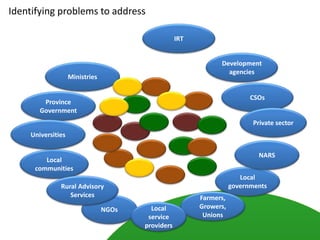
Identifying problems to address
Community based Multidisciplinary
Research Partnership Identifies main
issues, then draws up a “Problem tree”
using causalities approach, labeling:
• Socio-economic issues
• Institutional and management issues
• Technological issues
• Environmental issues
• Economic issues (value chain)
• Policy issues
Structuring problems
Formulation of
measures / objectives
While identifying objectives, they are not necessarily to be addressed by
Interdisciplinary Research Team, but they could be important when formulating policy
changes required for achieving IDOs, when the CRP DS products are up-scaled.
Problems Objectives
Objectives
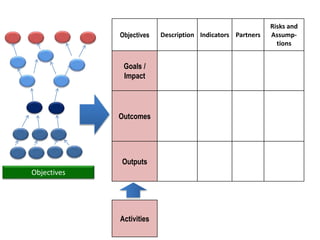
Objectives Description Indicators Partners
Risks and
Assump-
tions
Goals /
Impact
Outcomes
Outputs
Activities
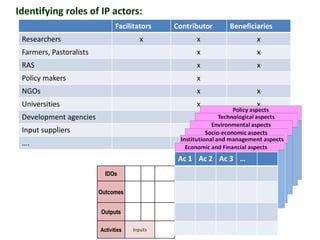
Facilitators Contributor Beneficiaries
Researchers x x x
Farmers, Pastoralists x x
RAS x x
Policy makers x
NGOs x x
Universities x x
Development agencies x x
Input suppliers x
….
IDOs
Outcomes
Outputs
Activities Inputs
Identifying roles of IP actors:
Ac 1 Ac 2 Ac 3 …
Objectives
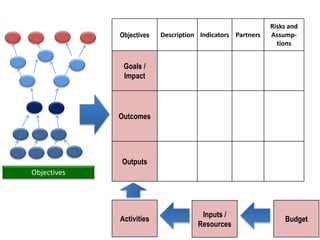
Objectives Description Indicators Partners
Risks and
Assump-
tions
Goals /
Impact
Outcomes
Outputs
Activities
Inputs /
Resources
Budget
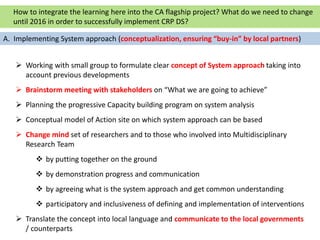
A. Implementing System approach (conceptualization, ensuring “buy-in” by local partners)
 Working with small group to formulate clear concept of System approach taking into
account previous developments
 Brainstorm meeting with stakeholders on “What we are going to achieve”
 Planning the progressive Capacity building program on system analysis
 Conceptual model of Action site on which system approach can be based
 Change mind set of researchers and to those who involved into Multidisciplinary
Research Team
 by putting together on the ground
 by demonstration progress and communication
 by agreeing what is the system approach and get common understanding
 participatory and inclusiveness of defining and implementation of interventions
 Translate the concept into local language and communicate to the local governments
/ counterparts
How to integrate the learning here into the CA flagship project? What do we need to change
until 2016 in order to successfully implement CRP DS?
 Inventory of NARS 5-year, 3-year, and annual research agenda and identify where
CRP DS system research can be help
 Embedding system research in NARS program , that will ensure ‘buy-in’ by local
partners
 Identify those from NARS / Local partners who can co-implement agreed
interventions
 Analyze all issues across disciplines at national / action site level
 Set-up a mechanism with local partners for M&E of the system approach
progress
 National partners will work with local partners and obtain feedbacks from
actions sites, collect primary data and process then and carry out the research
 Re-packaging, reformulating and fine-tuning interventions with local partners
involved in interdisciplinary Research Team to fill gaps and enhance linkages between
different disciplines
How to integrate the learning here into the CA flagship project? What do we need to change
until 2016 in order to successfully implement CRP DS?
A. . Implementing System approach (involvement of local partners)
How to integrate the learning here into the CA flagship project? What do we need to change
until 2016 in order to successfully implement CRP DS?
 New science is interdisciplinary
 Identification of key science issues in term of system approach
 New science can be in place in the “hard component” of the research is modernized,
management is atomized, that would require the improving soft component, e.g.
Improving capacity
 Establishing Centers of excellence
 Engaging ARI
 New science to resolve issue at the focus of system approach
 Empower farmers with capacity in decision making
B. Science and new science
 Knowledge synthesis, generation, packaging and dissemination (knowledge
platform) of sustainable land management practices in Central Asia (CACILM Phase-ii)
 Knowledge synthesis (existing knowledge and knowledge gaps identification)
 Knowledge generation about approaches and technologies (filling knowledge
gaps)
 Typology of stakeholders and knowledge dissemination pathways
 Knowledge exchange on technical packages
 Capacity building and sustainable access to knowledge
 Enhancing evidence-based knowledge
 Policy dialogue to facilitate adoption of technologies
 Selecting and prioritization of most promising technologies and approaches,
description and presenting them in in standard format
 Development of similarity maps where selected SLM technologies and approaches
can be applied
 Development of a web-based knowledge platform
D. Knowledge management
How to integrate the learning here into the CA flagship project? What do we need to change
until 2016 in order to successfully implement CRP DS?
 Improve public relation
 We need to develop bilateral projects, and have some products to expose, before
communicating donors
 Target audience should be regularly informed about the progress
 Using social networks and blogs
 Conduct thematic e-consultations
 Innovation platforms approach
 Regional forum for AR4D
E. Communication / Visibility
How to integrate the learning here into the CA flagship project? What do we need to change
until 2016 in order to successfully implement CRP DS?
F. Partnership for impact
 Strategy for scaling up based on system analysis and extrapolation domains
 Addressing the issues that preventing us from scaling up
 Involve policy makers in prioritization of activities and decision making
 Ex-ante situation endorsement
 Expertise
 Specific, tailored
 Funds
 Bonuses, rewards
G. Scaling up / out
How to integrate the learning here into the CA flagship project? What do we need to change
until 2016 in order to successfully implement CRP DS?
H. Incentives
 Concentrate efforts in one action site
 Developing work-plan for first year
 System analysis
 Developing coherent proposal for donors with work-plan for next two year
 Engage external resources for system analysis
 Defining the concept of “operationalizing the best fit” as the process of
characterizing the context through identifying bounding conditions (funding,
policies…), understanding the attributes of actor groups, and recognizing independent
factors, in order for system approach to be as relevant, effective, and efficient as
possible.
How we will operationalize these changes and develop a more coherent flagship aligned to
the overall research questions
 Identify capacity gaps at levels: IRT, Multidisciplinary RT, Action site level
 Develop a strategy for capacity development
 Identify different methods for building capacity
 How can CRP DS doers contribute to make agriculture more attractive to youth?
What are critical gaps in terms of capacity or implementation support we have and how thy
should be addressed

Can we integrate learning in Central Asia Flagship Project?

  • 1.
  • 2.
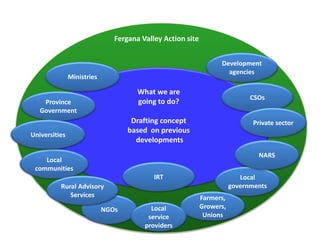
    What we are goingto do? Drafting concept based on previous developments Local governments Local communities NARS NGOs IRT Farmers, Growers, Unions Local service providers CSOs Province Government Fergana Valley Action site Ministries Development agencies Private sector Universities Rural Advisory Services
  • 3.
  • 4.
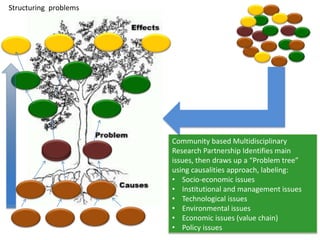
    Community based Multidisciplinary ResearchPartnership Identifies main issues, then draws up a “Problem tree” using causalities approach, labeling: • Socio-economic issues • Institutional and management issues • Technological issues • Environmental issues • Economic issues (value chain) • Policy issues Structuring problems
  • 5.
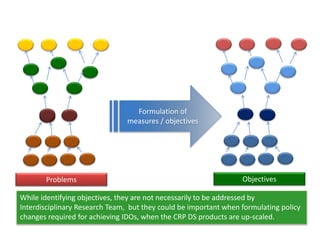
    Formulation of measures /objectives While identifying objectives, they are not necessarily to be addressed by Interdisciplinary Research Team, but they could be important when formulating policy changes required for achieving IDOs, when the CRP DS products are up-scaled. Problems Objectives
  • 6.
    Objectives Objectives Description IndicatorsPartners Risks and Assump- tions Goals / Impact Outcomes Outputs Activities
  • 7.
    Facilitators Contributor Beneficiaries Researchersx x x Farmers, Pastoralists x x RAS x x Policy makers x NGOs x x Universities x x Development agencies x x Input suppliers x …. IDOs Outcomes Outputs Activities Inputs Identifying roles of IP actors: Ac 1 Ac 2 Ac 3 …
  • 8.
    Objectives Objectives Description IndicatorsPartners Risks and Assump- tions Goals / Impact Outcomes Outputs Activities Inputs / Resources Budget
  • 9.
    A. Implementing Systemapproach (conceptualization, ensuring “buy-in” by local partners)  Working with small group to formulate clear concept of System approach taking into account previous developments  Brainstorm meeting with stakeholders on “What we are going to achieve”  Planning the progressive Capacity building program on system analysis  Conceptual model of Action site on which system approach can be based  Change mind set of researchers and to those who involved into Multidisciplinary Research Team  by putting together on the ground  by demonstration progress and communication  by agreeing what is the system approach and get common understanding  participatory and inclusiveness of defining and implementation of interventions  Translate the concept into local language and communicate to the local governments / counterparts How to integrate the learning here into the CA flagship project? What do we need to change until 2016 in order to successfully implement CRP DS?
  • 10.
     Inventory ofNARS 5-year, 3-year, and annual research agenda and identify where CRP DS system research can be help  Embedding system research in NARS program , that will ensure ‘buy-in’ by local partners  Identify those from NARS / Local partners who can co-implement agreed interventions  Analyze all issues across disciplines at national / action site level  Set-up a mechanism with local partners for M&E of the system approach progress  National partners will work with local partners and obtain feedbacks from actions sites, collect primary data and process then and carry out the research  Re-packaging, reformulating and fine-tuning interventions with local partners involved in interdisciplinary Research Team to fill gaps and enhance linkages between different disciplines How to integrate the learning here into the CA flagship project? What do we need to change until 2016 in order to successfully implement CRP DS? A. . Implementing System approach (involvement of local partners)
  • 11.
    How to integratethe learning here into the CA flagship project? What do we need to change until 2016 in order to successfully implement CRP DS?  New science is interdisciplinary  Identification of key science issues in term of system approach  New science can be in place in the “hard component” of the research is modernized, management is atomized, that would require the improving soft component, e.g. Improving capacity  Establishing Centers of excellence  Engaging ARI  New science to resolve issue at the focus of system approach  Empower farmers with capacity in decision making B. Science and new science
  • 12.
     Knowledge synthesis,generation, packaging and dissemination (knowledge platform) of sustainable land management practices in Central Asia (CACILM Phase-ii)  Knowledge synthesis (existing knowledge and knowledge gaps identification)  Knowledge generation about approaches and technologies (filling knowledge gaps)  Typology of stakeholders and knowledge dissemination pathways  Knowledge exchange on technical packages  Capacity building and sustainable access to knowledge  Enhancing evidence-based knowledge  Policy dialogue to facilitate adoption of technologies  Selecting and prioritization of most promising technologies and approaches, description and presenting them in in standard format  Development of similarity maps where selected SLM technologies and approaches can be applied  Development of a web-based knowledge platform D. Knowledge management How to integrate the learning here into the CA flagship project? What do we need to change until 2016 in order to successfully implement CRP DS?
  • 13.
     Improve publicrelation  We need to develop bilateral projects, and have some products to expose, before communicating donors  Target audience should be regularly informed about the progress  Using social networks and blogs  Conduct thematic e-consultations  Innovation platforms approach  Regional forum for AR4D E. Communication / Visibility How to integrate the learning here into the CA flagship project? What do we need to change until 2016 in order to successfully implement CRP DS? F. Partnership for impact
  • 14.
     Strategy forscaling up based on system analysis and extrapolation domains  Addressing the issues that preventing us from scaling up  Involve policy makers in prioritization of activities and decision making  Ex-ante situation endorsement  Expertise  Specific, tailored  Funds  Bonuses, rewards G. Scaling up / out How to integrate the learning here into the CA flagship project? What do we need to change until 2016 in order to successfully implement CRP DS? H. Incentives
  • 15.
     Concentrate effortsin one action site  Developing work-plan for first year  System analysis  Developing coherent proposal for donors with work-plan for next two year  Engage external resources for system analysis  Defining the concept of “operationalizing the best fit” as the process of characterizing the context through identifying bounding conditions (funding, policies…), understanding the attributes of actor groups, and recognizing independent factors, in order for system approach to be as relevant, effective, and efficient as possible. How we will operationalize these changes and develop a more coherent flagship aligned to the overall research questions
  • 16.
     Identify capacitygaps at levels: IRT, Multidisciplinary RT, Action site level  Develop a strategy for capacity development  Identify different methods for building capacity  How can CRP DS doers contribute to make agriculture more attractive to youth? What are critical gaps in terms of capacity or implementation support we have and how thy should be addressed