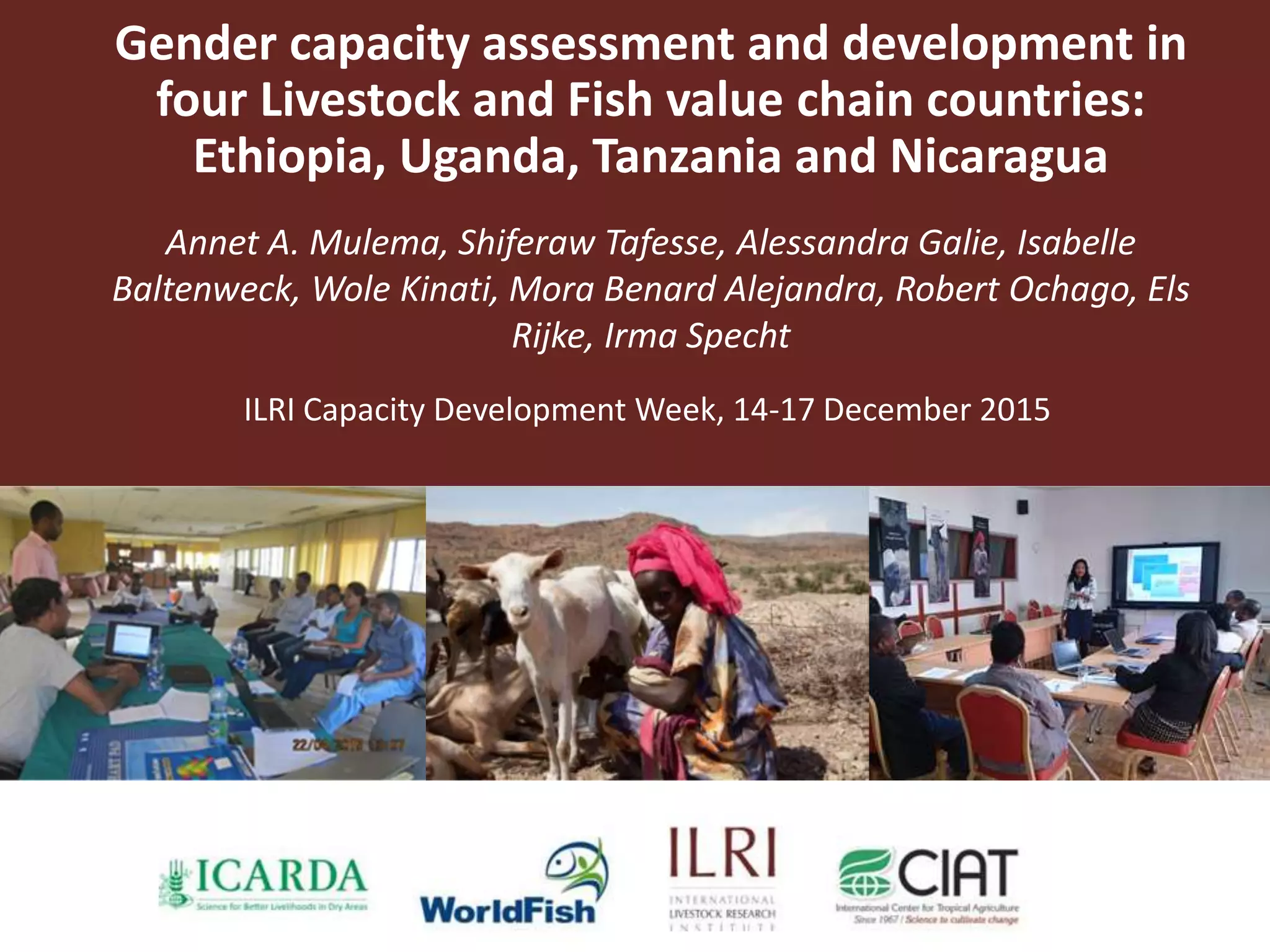
Gender capacity assessment and development in
four Livestock and Fish value chain countries:
Ethiopia, Uganda, Tanzania and Nicaragua
Annet A. Mulema, Shiferaw Tafesse, Alessandra Galie, Isabelle
Baltenweck, Wole Kinati, Mora Benard Alejandra, Robert Ochago, Els
Rijke, Irma Specht
ILRI Capacity Development Week, 14-17 December 2015
Outline of the presentation
• Why gender capacity assessment?
• Framework for gender capacity assessment
• Levels of analysis of gender capacities
• Tools used to assess gender capacities
• Number of research and development organizations per
country
• Major findings
• Conclusions
• The way forward
Why gender capacity assessment of partners?
• Identifies gender capacity gaps in a project, program,
organization and along the value chains
• Provides a starting point for working on a gender
capacity development response strategy
• Identifies opportunities for resource investment
(human and financial)
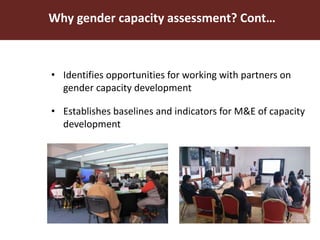
Why gender capacity assessment? Cont…
• Identifies opportunities for working with partners on
gender capacity development
• Establishes baselines and indicators for M&E of capacity
development
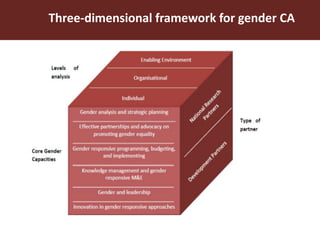
Three-dimensional framework for gender CA
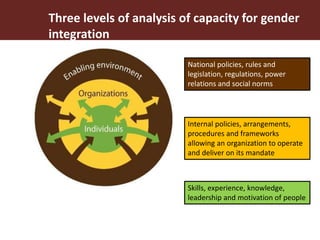
National policies, rules and
legislation, regulations, power
relations and social norms
Internal policies, arrangements,
procedures and frameworks
allowing an organization to operate
and deliver on its mandate
Skills, experience, knowledge,
leadership and motivation of people
Three levels of analysis of capacity for gender
integration
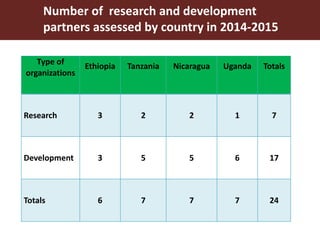
Number of research and development
partners assessed by country in 2014-2015
Type of
organizations
Ethiopia Tanzania Nicaragua Uganda Totals
Research 3 2 2 1 7
Development 3 5 5 6 17
Totals 6 7 7 7 24
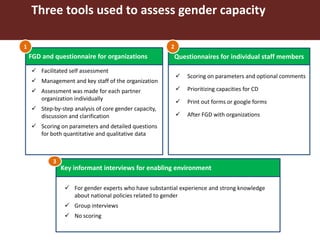
FGD and questionnaire for organizations
1
Key informant interviews for enabling environment
3
Questionnaires for individual staff members
2
 Facilitated self assessment
 Management and key staff of the organization
 Assessment was made for each partner
organization individually
 Step-by-step analysis of core gender capacity,
discussion and clarification
 Scoring on parameters and detailed questions
for both quantitative and qualitative data
 Scoring on parameters and optional comments
 Prioritizing capacities for CD
 Print out forms or google forms
 After FGD with organizations
 For gender experts who have substantial experience and strong knowledge
about national policies related to gender
 Group interviews
 No scoring
Three tools used to assess gender capacity
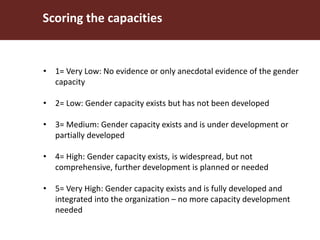
Scoring the capacities
• 1= Very Low: No evidence or only anecdotal evidence of the gender
capacity
• 2= Low: Gender capacity exists but has not been developed
• 3= Medium: Gender capacity exists and is under development or
partially developed
• 4= High: Gender capacity exists, is widespread, but not
comprehensive, further development is planned or needed
• 5= Very High: Gender capacity exists and is fully developed and
integrated into the organization – no more capacity development
needed
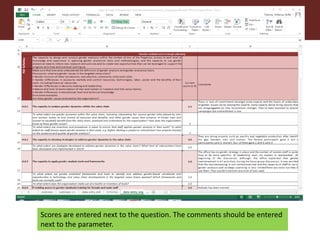
Scores are entered next to the question. The comments should be entered
next to the parameter.
Major Findings
Overall findings in the four countries
• The governments of Nicaragua and Ethiopia have
relatively well-developed and specific gender policies
• Comparing our partners in the four countries, those
from Nicaragua stand out with the best-developed
gender capacities.
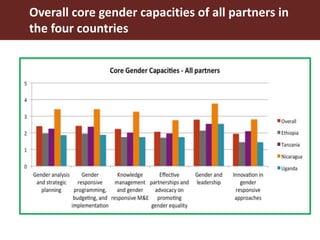
• Nicaragua partners have an overall average score of
3.2 (out of 5), compared to Tanzania (2.2), Uganda
(1.9), and Ethiopia (1.8).
Overall findings…
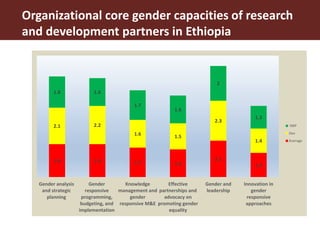
• Development partners score higher on all core
gender capacities than research partners in each
country
• Organizational ‘interest in and commitment’ to
support ‘gender and leadership’ scored highest
not matched by actual capacity
• The capacity for ‘innovation in gender responsive
approaches’ is the least developed.
Overall core gender capacities of all partners in
the four countries
Organizational core gender capacities of research
and development partners in Ethiopia
1.9 1.9 1.7 1.6
2.1
1.4
2.1 2.2
1.6 1.5
2.3
1.4
1.8 1.6
1.7
1.6
2
1.3
Gender analysis
and strategic
planning
Gender
responsive
programming,
budgeting, and
implementation
Knowledge
management and
gender
responsive M&E
Effective
partnerships and
advocacy on
promoting gender
equality
Gender and
leadership
Innovation in
gender
responsive
approaches
NRP
Dev
Average
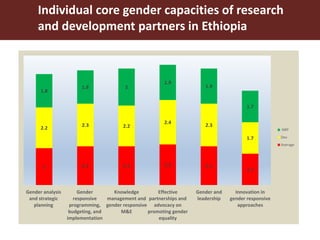
Individual core gender capacities of research
and development partners in Ethiopia
2 2.1 2.1 2.2 2.1
1.7
2.2
2.3 2.2
2.4
2.3
1.7
1.8
1.8 2
1.9
1.9
1.7
Gender analysis
and strategic
planning
Gender
responsive
programming,
budgeting, and
implementation
Knowledge
management and
gender responsive
M&E
Effective
partnerships and
advocacy on
promoting gender
equality
Gender and
leadership
Innovation in
gender responsive
approaches
NRP
Dev
Average
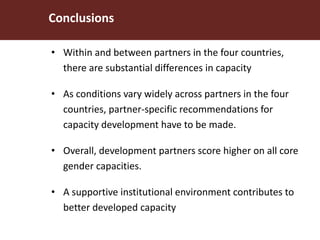
• Within and between partners in the four countries,
there are substantial differences in capacity
• As conditions vary widely across partners in the four
countries, partner-specific recommendations for
capacity development have to be made.
• Overall, development partners score higher on all core
gender capacities.
• A supportive institutional environment contributes to
better developed capacity
Conclusions
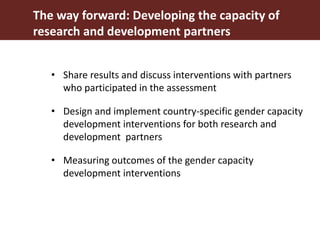
• Share results and discuss interventions with partners
who participated in the assessment
• Design and implement country-specific gender capacity
development interventions for both research and
development partners
• Measuring outcomes of the gender capacity
development interventions
The way forward: Developing the capacity of
research and development partners
Information sources
• ILRI and Transition International. 2015. Gender Capacity
Assessment and Development Guide. ILRI.
• http://livestock-fish.wikispaces.com/capdev
This work is financed by
Livestock and Fish CGIAR research program
It is implemented in a partnership with
CIAT and ICARDA
Acknowledgements
Acknowledgements
• Special thanks to:
– The country teams: Barbara Rischkowsky and
Aynalem Haile (ICARDA), Emily Ouma and Amos
Omore (ILRI)
– The national researchers and development partners
who participated in the assessment
– Diana Brandes, Millicent Liani and Violet Barasa
Contact persons
• Annet A. Mulema (A.Mulema@cgiar.org)
• Alessandra Galie' (A.Galie@cgiar.org)
The presentation has a Creative Commons licence. You are free to re-use or distribute this work, provided credit is given to ILRI.
better lives through livestock
ilri.org

Gender capacity assessment and development in four Livestock and Fish value chain countries: Ethiopia, Uganda, Tanzania and Nicaragua

  • 1.
    Gender capacity assessmentand development in four Livestock and Fish value chain countries: Ethiopia, Uganda, Tanzania and Nicaragua Annet A. Mulema, Shiferaw Tafesse, Alessandra Galie, Isabelle Baltenweck, Wole Kinati, Mora Benard Alejandra, Robert Ochago, Els Rijke, Irma Specht ILRI Capacity Development Week, 14-17 December 2015
  • 2.
    Outline of thepresentation • Why gender capacity assessment? • Framework for gender capacity assessment • Levels of analysis of gender capacities • Tools used to assess gender capacities • Number of research and development organizations per country • Major findings • Conclusions • The way forward
  • 3.
    Why gender capacityassessment of partners? • Identifies gender capacity gaps in a project, program, organization and along the value chains • Provides a starting point for working on a gender capacity development response strategy • Identifies opportunities for resource investment (human and financial)
  • 4.
    Why gender capacityassessment? Cont… • Identifies opportunities for working with partners on gender capacity development • Establishes baselines and indicators for M&E of capacity development
  • 5.
  • 6.
    National policies, rulesand legislation, regulations, power relations and social norms Internal policies, arrangements, procedures and frameworks allowing an organization to operate and deliver on its mandate Skills, experience, knowledge, leadership and motivation of people Three levels of analysis of capacity for gender integration
  • 7.
    Number of researchand development partners assessed by country in 2014-2015 Type of organizations Ethiopia Tanzania Nicaragua Uganda Totals Research 3 2 2 1 7 Development 3 5 5 6 17 Totals 6 7 7 7 24
  • 8.
    FGD and questionnairefor organizations 1 Key informant interviews for enabling environment 3 Questionnaires for individual staff members 2  Facilitated self assessment  Management and key staff of the organization  Assessment was made for each partner organization individually  Step-by-step analysis of core gender capacity, discussion and clarification  Scoring on parameters and detailed questions for both quantitative and qualitative data  Scoring on parameters and optional comments  Prioritizing capacities for CD  Print out forms or google forms  After FGD with organizations  For gender experts who have substantial experience and strong knowledge about national policies related to gender  Group interviews  No scoring Three tools used to assess gender capacity
  • 9.
    Scoring the capacities •1= Very Low: No evidence or only anecdotal evidence of the gender capacity • 2= Low: Gender capacity exists but has not been developed • 3= Medium: Gender capacity exists and is under development or partially developed • 4= High: Gender capacity exists, is widespread, but not comprehensive, further development is planned or needed • 5= Very High: Gender capacity exists and is fully developed and integrated into the organization – no more capacity development needed
  • 10.
    Scores are enterednext to the question. The comments should be entered next to the parameter.
  • 11.
  • 12.
    Overall findings inthe four countries • The governments of Nicaragua and Ethiopia have relatively well-developed and specific gender policies • Comparing our partners in the four countries, those from Nicaragua stand out with the best-developed gender capacities. • Nicaragua partners have an overall average score of 3.2 (out of 5), compared to Tanzania (2.2), Uganda (1.9), and Ethiopia (1.8).
  • 13.
    Overall findings… • Developmentpartners score higher on all core gender capacities than research partners in each country • Organizational ‘interest in and commitment’ to support ‘gender and leadership’ scored highest not matched by actual capacity • The capacity for ‘innovation in gender responsive approaches’ is the least developed.
  • 14.
    Overall core gendercapacities of all partners in the four countries
  • 15.
    Organizational core gendercapacities of research and development partners in Ethiopia 1.9 1.9 1.7 1.6 2.1 1.4 2.1 2.2 1.6 1.5 2.3 1.4 1.8 1.6 1.7 1.6 2 1.3 Gender analysis and strategic planning Gender responsive programming, budgeting, and implementation Knowledge management and gender responsive M&E Effective partnerships and advocacy on promoting gender equality Gender and leadership Innovation in gender responsive approaches NRP Dev Average
  • 16.
    Individual core gendercapacities of research and development partners in Ethiopia 2 2.1 2.1 2.2 2.1 1.7 2.2 2.3 2.2 2.4 2.3 1.7 1.8 1.8 2 1.9 1.9 1.7 Gender analysis and strategic planning Gender responsive programming, budgeting, and implementation Knowledge management and gender responsive M&E Effective partnerships and advocacy on promoting gender equality Gender and leadership Innovation in gender responsive approaches NRP Dev Average
  • 17.
    • Within andbetween partners in the four countries, there are substantial differences in capacity • As conditions vary widely across partners in the four countries, partner-specific recommendations for capacity development have to be made. • Overall, development partners score higher on all core gender capacities. • A supportive institutional environment contributes to better developed capacity Conclusions
  • 18.
    • Share resultsand discuss interventions with partners who participated in the assessment • Design and implement country-specific gender capacity development interventions for both research and development partners • Measuring outcomes of the gender capacity development interventions The way forward: Developing the capacity of research and development partners
  • 19.
    Information sources • ILRIand Transition International. 2015. Gender Capacity Assessment and Development Guide. ILRI. • http://livestock-fish.wikispaces.com/capdev
  • 20.
    This work isfinanced by Livestock and Fish CGIAR research program It is implemented in a partnership with CIAT and ICARDA Acknowledgements
  • 21.
    Acknowledgements • Special thanksto: – The country teams: Barbara Rischkowsky and Aynalem Haile (ICARDA), Emily Ouma and Amos Omore (ILRI) – The national researchers and development partners who participated in the assessment – Diana Brandes, Millicent Liani and Violet Barasa
  • 22.
    Contact persons • AnnetA. Mulema (A.Mulema@cgiar.org) • Alessandra Galie' (A.Galie@cgiar.org)
  • 23.
    The presentation hasa Creative Commons licence. You are free to re-use or distribute this work, provided credit is given to ILRI. better lives through livestock ilri.org