PRESENTATION : CANOPY MANAGEMENT OF GUAVA
PRESENTED BY
SHIVANSH KUMAWAT
PRESENTED TO
Dr. ROHIT SHUKLA
➔ INTRODUCTION
● The guava (Psidium guajava L.) is a common tropical fruit crop in India.
● It is a hardy, prolific bearer, and highly profitable fruit crop that can be
cultivated successfully in a variety of soil and climatic conditions.
● guava flowers in the axils of new leaves and bears on the current
season's growth, so it responds well to pruning. Guava pruning is one of
the most time-consuming tasks.
● Our activities affects vigour, competitiveness, fruit’s quality and
ultimately fruit profitability
● So for that reason it is necessary to manage canopy in such way that
will give high quality fruits.
….. cont.
➔ FLOWERING
SEASON
● In general guava flowers twice a year (cymose)
- April may & Aug - sep
- Which respectively fruits ripen in rainy & winter season
- Sometimes a third flowering occur in oct.- nov. particularly
in MH & TN
➔ CORE OBJECTIVES OF CANOPY
MANAGEMENT
★ Maximize Light Utilization
★ Maximize Quality & Productivity
★ Facilitate Cultural Operations
★ Canopy management practices in guava
❖ Training and pruning :-
● Guava bears its flowers and resultant fruit exclusively on the current
season's emerging vegetative shoots. This specific bearing habit
dictates that regular, systematic pruning is mandatory.
● Trees are pruned to increase the yield of quality fruits by removing the
crowded and crises- crossed branches.
● Trees are trained to a uniform height of 60-75 cm from the ground. As a
result, new shoots emerge.
● Three to four equally spaced shoots are retained around the stem to form
the main scaffold limbs of tree
● The selected shoots are further pruned to 50% of their length for inducing
multiple shoots from the buds below the cut end.
➔ INITIAL TRAINING AND FRAMEWORK
DEVELOPMENT
Modified Central Leader (MCL) System
● Maintains a central leader initially, establishing 5-6 strong side branches.
● The central shoot is later headed back (e.g., at six feet) to an outward-
growing lateral branch.
● This provides robust structure while effectively limiting eventual height,
balancing strength with size control.
➔ TRAINING METHOD
★ Pruning in guava done three times in a year
○ May-june
○ Sept- oct
○ jan-feb
★ Pruning usually involves three basic techniques:
■ Thinning
■ Heading Back
■ Pinching or Tipping
cont…..
➔ PRUNING
● Thinning involves the removal of entire branches at the point of
origin.
● By thinning, the plant is reduced without obviously altering its size
or form.
● Heading back is the process of pruning to shorten branches.
● Heading back is usually used to induce production of flowers and
fruit and to limit tree size.
● Pinching involves the removal of the growth tip of the stem.
● This action will stimulate the growth of side branches.
● Plant growth substances play a vital role in development of axillary
shoots.
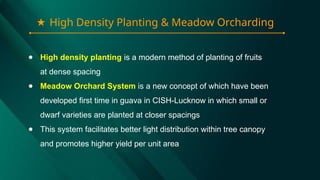
★ High Density Planting & Meadow Orcharding
● High density planting is a modern method of planting of fruits
at dense spacing
● Meadow Orchard System is a new concept of which have been
developed first time in guava in CISH-Lucknow in which small or
dwarf varieties are planted at closer spacings
● This system facilitates better light distribution within tree canopy
and promotes higher yield per unit area
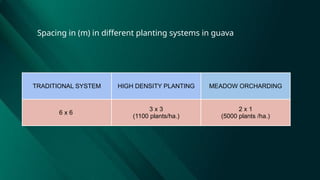
Spacing in (m) in different planting systems in guava
TRADITIONAL SYSTEM HIGH DENSITY PLANTING MEADOW ORCHARDING
6 x 6
3 x 3
(1100 plants/ha.)
2 x 1
(5000 plants /ha.)
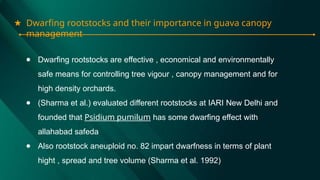
★ Dwarfing rootstocks and their importance in guava canopy
management
● Dwarfing rootstocks are effective , economical and environmentally
safe means for controlling tree vigour , canopy management and for
high density orchards.
● (Sharma et al.) evaluated different rootstocks at IARI New Delhi and
founded that Psidium pumilum has some dwarfing effect with
allahabad safeda
● Also rootstock aneuploid no. 82 impart dwarfness in terms of plant
hight , spread and tree volume (Sharma et al. 1992)
➔ CHEMICAL INTERVENTION (USE OF PGR’s)-
Paclobutrazol - PBZ
PBZ acts as a gibberellin inhibitor, chemically retarding vegetative
growth, reducing plant height (3.49 m vs. 3.79 m for control), and
promoting flower buds. A combination of Light pruning + PBZ (500
PPM) is often recommended .
➔ CONCLUSION
For canopy management in guava following practices should be done:
1. Using suitable training system(i.e. MSL system)
2. Timely pruning practices for controlling excess branches
3. Using of HDP & meadow orcharding
4. Using of dwarf varieties and rootstocks
5. Use of PGRs in combination of pruning.
Canopy management in guava crop- presentation.pptx

Canopy management in guava crop- presentation.pptx

  • 1.
    PRESENTATION : CANOPYMANAGEMENT OF GUAVA PRESENTED BY SHIVANSH KUMAWAT PRESENTED TO Dr. ROHIT SHUKLA
  • 2.
    ➔ INTRODUCTION ● Theguava (Psidium guajava L.) is a common tropical fruit crop in India. ● It is a hardy, prolific bearer, and highly profitable fruit crop that can be cultivated successfully in a variety of soil and climatic conditions. ● guava flowers in the axils of new leaves and bears on the current season's growth, so it responds well to pruning. Guava pruning is one of the most time-consuming tasks.
  • 3.
    ● Our activitiesaffects vigour, competitiveness, fruit’s quality and ultimately fruit profitability ● So for that reason it is necessary to manage canopy in such way that will give high quality fruits. ….. cont. ➔ FLOWERING SEASON ● In general guava flowers twice a year (cymose) - April may & Aug - sep - Which respectively fruits ripen in rainy & winter season - Sometimes a third flowering occur in oct.- nov. particularly in MH & TN
  • 4.
    ➔ CORE OBJECTIVESOF CANOPY MANAGEMENT ★ Maximize Light Utilization ★ Maximize Quality & Productivity ★ Facilitate Cultural Operations
  • 5.
    ★ Canopy managementpractices in guava ❖ Training and pruning :- ● Guava bears its flowers and resultant fruit exclusively on the current season's emerging vegetative shoots. This specific bearing habit dictates that regular, systematic pruning is mandatory. ● Trees are pruned to increase the yield of quality fruits by removing the crowded and crises- crossed branches.
  • 6.
    ● Trees aretrained to a uniform height of 60-75 cm from the ground. As a result, new shoots emerge. ● Three to four equally spaced shoots are retained around the stem to form the main scaffold limbs of tree ● The selected shoots are further pruned to 50% of their length for inducing multiple shoots from the buds below the cut end. ➔ INITIAL TRAINING AND FRAMEWORK DEVELOPMENT
  • 7.
    Modified Central Leader(MCL) System ● Maintains a central leader initially, establishing 5-6 strong side branches. ● The central shoot is later headed back (e.g., at six feet) to an outward- growing lateral branch. ● This provides robust structure while effectively limiting eventual height, balancing strength with size control. ➔ TRAINING METHOD
  • 8.
    ★ Pruning inguava done three times in a year ○ May-june ○ Sept- oct ○ jan-feb ★ Pruning usually involves three basic techniques: ■ Thinning ■ Heading Back ■ Pinching or Tipping cont….. ➔ PRUNING
  • 9.
    ● Thinning involvesthe removal of entire branches at the point of origin. ● By thinning, the plant is reduced without obviously altering its size or form. ● Heading back is the process of pruning to shorten branches. ● Heading back is usually used to induce production of flowers and fruit and to limit tree size. ● Pinching involves the removal of the growth tip of the stem. ● This action will stimulate the growth of side branches. ● Plant growth substances play a vital role in development of axillary shoots.
  • 10.
    ★ High DensityPlanting & Meadow Orcharding ● High density planting is a modern method of planting of fruits at dense spacing ● Meadow Orchard System is a new concept of which have been developed first time in guava in CISH-Lucknow in which small or dwarf varieties are planted at closer spacings ● This system facilitates better light distribution within tree canopy and promotes higher yield per unit area
  • 11.
    Spacing in (m)in different planting systems in guava TRADITIONAL SYSTEM HIGH DENSITY PLANTING MEADOW ORCHARDING 6 x 6 3 x 3 (1100 plants/ha.) 2 x 1 (5000 plants /ha.)
  • 12.
    ★ Dwarfing rootstocksand their importance in guava canopy management ● Dwarfing rootstocks are effective , economical and environmentally safe means for controlling tree vigour , canopy management and for high density orchards. ● (Sharma et al.) evaluated different rootstocks at IARI New Delhi and founded that Psidium pumilum has some dwarfing effect with allahabad safeda ● Also rootstock aneuploid no. 82 impart dwarfness in terms of plant hight , spread and tree volume (Sharma et al. 1992)
  • 13.
    ➔ CHEMICAL INTERVENTION(USE OF PGR’s)- Paclobutrazol - PBZ PBZ acts as a gibberellin inhibitor, chemically retarding vegetative growth, reducing plant height (3.49 m vs. 3.79 m for control), and promoting flower buds. A combination of Light pruning + PBZ (500 PPM) is often recommended .
  • 14.
    ➔ CONCLUSION For canopymanagement in guava following practices should be done: 1. Using suitable training system(i.e. MSL system) 2. Timely pruning practices for controlling excess branches 3. Using of HDP & meadow orcharding 4. Using of dwarf varieties and rootstocks 5. Use of PGRs in combination of pruning.