Modern concepts in fertilizer application; soil fertility evaluation
techniques; role of soil tests in fertilizer use recommendations;
site-specific nutrient management for precision agriculture
.
PRESENTED BY:
SUSHRITA NAYAK
DEPARTMENT OF FRUIT SCIENCE AND HORTICULTURE
TECHNOLOGY, COLLEGE OF AGRICULTURE, OUAT,
BHUBANESWER
AN ASSIGNMENT ON MODERN CONCEPTS IN FERTILIZER APPLICATION; SOIL
FERTILITY EVALUATION TECHNIQUES; ROLE OF SOIL TESTS IN FERTILIZER USE
RECOMMENDATIONS; SITE-SPECIFIC NUTRIENT MANAGEMENT FOR PRECISION
AGRICULTURE
COLLEGE OF AGRICULTURE, OUAT, BHUBANESWER
CONTENTS
 INTRODUCTION
 WHAT IS FERTILIZER?
 CLASSIFICATIONSOF FERTILIZER
 FERTILIZER RECOMMENDATION PHILOSOPHIESOR APPROACHES
 DIFFERENT CONCEPT INTHE CONTEXTON FERTILIZERAPPLICATION
 THE CONCEPT OF FERTILIZATION
 METHODSOF FERTILIZERAPPLICATION
 SOIL FERTILITY EVALUATION
 SOILTESTING RESEARCH IN INDIA
 CROP RESPONSE DATA
CONTENTS (Cont…)
 SOIL FERTILITY EVALUATIONTECHNIQUES
 METHODSOF EVALUATING SOIL FERTILITY
 FERTILIZER RECOMMENDATIONSAPPROACHES
 PRESENT APPROACHES IN FORMULATION OF FERTILIZER RECOMMENDATIONS
EXTENSIVELYUSED IN INDIA
 SITE-SPECIFIC NUTRIENT MANAGEMENT FOR PRECISIONAGRICULTURE
 APPLICATIONSOF PRECISION FARMINGTECHNOLOGY IN FERTILIZER MANAGEMENT
 MANAGEMENT OF FERTILIZER FOR MAXIMUM ECONOMICS AND MINIMUM
ENVIRONMENTAL IMPACT
 REFERANCES
INTRODUCTION
 Soil is a marvellous gift of nature to mankind. Without the presence of this thin layer
on the top of lithosphere, there would have been no life on the planet Earth.
 The major function of soil is to provide enough food and ensure human health.
Increasingly, there is an awareness of the direct link between soils and human health in
terms of elements that enhance health such as N, P and zinc (Zn), and other elements
such as cadmium (Cd) and arsenic (As) that are harmful to human health (Brevik and
Burgess, 2013).
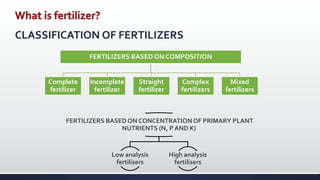
CLASSIFICATION OF FERTILIZERS
FERTILIZERS BASED ON COMPOSITION
Complete
fertilizer
Incomplete
fertilizer
Straight
fertilizer
Complex
fertilizers
Mixed
fertilizers
FERTILIZERS BASED ON CONCENTRATIONOF PRIMARY PLANT
NUTRIENTS (N, P AND K)
Low analysis
fertilisers
High analysis
fertilisers
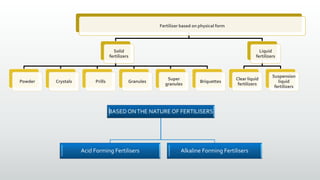
Fertilizer based on physical form
Solid
fertilizers
Powder Crystals Prills Granules
Super
granules
Briquettes
Liquid
fertilizers
Clear liquid
fertilizers
Suspension
liquid
fertilizers
BASED ONTHE NATURE OF FERTILISERS
Acid Forming Fertilisers Alkaline Forming Fertilisers
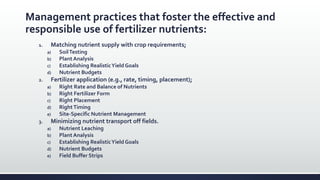
Management practices that foster the effective and
responsible use of fertilizer nutrients:
1. Matching nutrient supply with crop requirements;
a) SoilTesting
b) Plant Analysis
c) Establishing RealisticYield Goals
d) Nutrient Budgets
2. Fertilizer application (e.g., rate, timing, placement);
a) Right Rate and Balance of Nutrients
b) Right Fertilizer Form
c) Right Placement
d) RightTiming
e) Site-Specific Nutrient Management
3. Minimizing nutrient transport off fields.
a) Nutrient Leaching
b) Plant Analysis
c) Establishing RealisticYield Goals
d) Nutrient Budgets
e) Field Buffer Strips
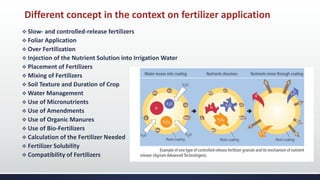
Different concept in the context on fertilizer application
 Slow- and controlled-release fertilizers
 Foliar Application
 Over Fertilization
 Injection of the Nutrient Solution into Irrigation Water
 Placement of Fertilizers
 Mixing of Fertilizers
 Soil Texture and Duration of Crop
 Water Management
 Use of Micronutrients
 Use of Amendments
 Use of Organic Manures
 Use of Bio-Fertilizers
 Calculation of the Fertilizer Needed
 Fertilizer Solubility
 Compatibility of Fertilizers
Fertilizer Recommendation Philosophies or
Approaches
1. The Sufficiency Level of Available Nutrient (SLAN)
2. The Build-Up and Maintenance philosophy
3. The Basic Cation Saturation Ratio (BCSR) concept
Efficient Use of Fertilizers
 Researchers have shown that plants cannot utilize which could more than 40–50% of nitrogen
and 15–20% of phosphorous applied through fertilizers, even though the best management
practices are adopted.
 Under ordinary conditions plants hardly avail more than 30% nitrogen and 10% phosphorus
applied through fertilizers.
 Major part of the nitrogenous fertilizer is either lost to the atmosphere in the form of gas or
leached down from the surface fertile soil.
 Likewise a large portion of phosphorous is fixed with the soil particles and plants cannot avail it.
Therefore, the following measures should be considered in order to obtain maximum benefit
with the may minimum dose of fertilizer applied.

Fertilizer Scheduling Should be based upon SoilTest
and Crop Response
 The optimum requirement of a fertilizer for maximum production depends upon the requirements of
the crop on the one hand and the presence of various nutrients in the soil on the other.
 Soil testing gives an idea about the status of nutrients as well as fertilizer recommendations for crops.
Soil testing also gives the information about soil reaction. The selection of fertilizer should be based
on the soil reaction.
 In acidic soils only those fertilizers should be used which have alkaline residual effect. In alkaline soils
acid forming fertilizers should be preferred.
 Rock phosphate is always preferred to super phosphate for strongly acidic soils, because in acidic soils
rock phosphate gets dissolved easily and becomes available to plants.
 Secondly, rock phosphate exerts alkaline residual effect which counteracts acidity of the soil. In India,
where about 30–40% of the cultivated land is acidic, use of rock phosphate is to be encouraged.
C0nt…
 There are, of course, many limitations to soil testing such as lack of skill in sample
collection, non-availability of testing facilities and low reliability of testing methods.
 Yet the soil testing is a useful management tool for the farmer, in spite of its limitations.
Regular soil test results from the same lab, sampled at the same time of year, should be
compared with field information from year to year.
 This information will be a valuable gauge of progress in soil fertility management and
fertilizer scheduling.
The Concept of Fertilization
 How to Determine Root Zone
 How to determine the area to fertilize under a tree
 How to Determine the Amount of Fertilizer to Use under aTree
 How to Determine the Area to Fertilize Under Hedge
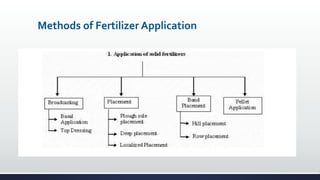
Methods of Fertilizer Application
SOIL FERTILITY EVALUATION
.
SOILTESTING RESEARCH IN INDIA
 Farming is a business and, like all businesspersons, the farmer operates farming business for profit. Obviously, to
reach a decision before planting a crop,a farmer needs all of the reliable information from the country’s soil
evaluation programme. In our country, system of fertility evaluation is being modified from time to time in various
stages incorporating crop response data.
 Soils are very heterogeneous in respect to forms of nutrients they contain, which greatly complicates the
interpretation of Soil Test for assessing fertilizer needs. The total amount of a nutrient present in a soil offers little
information relative to the amount of that nutrient which is available. Numerous extracting solutions and
procedures have been used to remove nutrient elements from the soil, but none remove exactly the amount that
plant roots obtain.
 This means that, in order to interpret the data, the results from each analytical procedure must be correlated with
the plant response obtained in field experiments by applying that fertilizer nutrient.
 By this calibration, the requirement of fertilizer is calculated for achieving specific yield target. Soil fertility
evaluation preferably employs a particular method of calibration as per the utility of the outcome.
CROP RESPONSE DATA
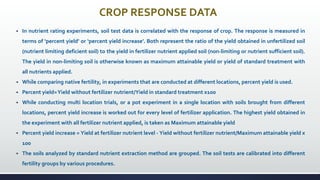
 In nutrient rating experiments, soil test data is correlated with the response of crop. The response is measured in
terms of ‘percent yield’ or ‘percent yield increase’. Both represent the ratio of the yield obtained in unfertilized soil
(nutrient limiting deficient soil) to the yield in fertilizer nutrient applied soil (non-limiting or nutrient sufficient soil).
The yield in non-limiting soil is otherwise known as maximum attainable yield or yield of standard treatment with
all nutrients applied.
 While comparing native fertility, in experiments that are conducted at different locations, percent yield is used.
 Percent yield=Yield without fertilizer nutrient/Yield in standard treatment x100
 While conducting multi location trials, or a pot experiment in a single location with soils brought from different
locations, percent yield increase is worked out for every level of fertilizer application. The highest yield obtained in
the experiment with all fertilizer nutrient applied, is taken as Maximum attainable yield
 Percent yield increase = Yield at fertilizer nutrient level - Yield without fertilizer nutrient/Maximum attainable yield x
100
 The soils analyzed by standard nutrient extraction method are grouped. The soil tests are calibrated into different
fertility groups by various procedures.
SOIL FERTILITY EVALUATIONTECHNIQUES
 Soil Fertility: It is the potential of the earth or inherent capacity of the soil to supply plant nutrients in
quantity, forms and proportion required for the growth and development of the crop.
 Fertility is measured by the amount of chemical elements or compounds required for plant growth
 Productivity of a soil is defined as its capacity to produce plants under specified programme of
management. It is measured by the yield of the crop per unit area of the land
 Fertility is one of the factors of soil productivity. Sometimes a soil may be fertile but may not be productive.
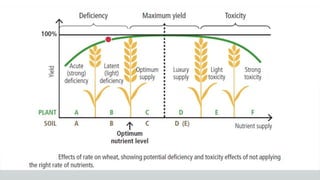
 Liebig’s Law of Minimum: The growth or yield of a crop is limited by that factor which is present in relatively
least amount.
 Law of diminishing return: where increases in yield of a crop per unit of available nutrient decreases as the
level of available nutrient approaches sufficiency. “The increase in yield by a unit increment of the deficient
factor is proportional to the decrement of that factor from the maximum.
METHODS OF EVALUATING SOIL FERTILITY
1. Visual symptoms of nutrient deficiency
 LCC (Leaf Colour Chart)
 Symptoms
2. Plant analysis and tissue testing tissue analysis
i. Plant analysis
ii. Tissue testing
a) Critical nutrient concentration ranges (sufficiency ranges)
b) Using Plant Analysis as a Diagnostic Tool
c) DRIS (Diagnostic & Recommendation Integrated System)
d) Crop logging (Clements,1960)
Cont…
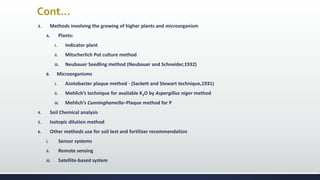
3. Methods involving the growing of higher plants and microorganism
A. Plants:
i. Indicator plant
ii. Mitscherlich Pot culture method
iii. Neubauer Seedling method (Neubauer and Schneider,1932)
B. Microorganisms
i. Azotobacter plaque method - (Sackett and Stewart technique,1931)
ii. Mehlich’s technique for available K2O by Aspergillus niger method
iii. Mehlich’s Cunninghamella–Plaque method for P
4. Soil Chemical analysis
5. Isotopic dilution method
6. Other methods use for soil test and fortilizer recommendation
i. Sensor systems
ii. Remote sensing
iii. Satellite-based system
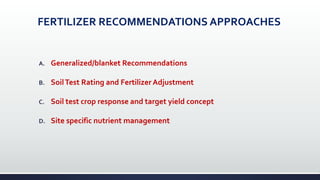
FERTILIZER RECOMMENDATIONS APPROACHES
A. Generalized/blanket Recommendations
B. SoilTest Rating and Fertilizer Adjustment
C. Soil test crop response and target yield concept
D. Site specific nutrient management
Present approaches in formulation of fertilizer
recommendations extensively used in India
Soil testing programme was initially started adopting the International soil
fertility evaluation and improvement programme (Fitts,1956). In this approach much
stress is laid on laboratory characterization, followed by potted-plant studies
ultimately leading to field-verification trials. These two initial steps help in
eliminating arbitrariness of field trials. However, this approach had low adoption as
it arrived one critical value below which economic responses are possible. Later,
many improvements were suggested.
Cont…
a. AGRONOMICAPPROACH
b. CRITICAL LIMITAPPROACH
c. DEDUCTIVEAPPROACH
d. INDUCTIVE APPROACH
e. QUADRATIC MODEL: Presently, this approach is modified and used by the
Department of Agriculture, Tamil Nadu for giving site-specific fertilizer
recommendations.
SITE-SPECIFIC NUTRIENT
MANAGEMENT FOR PRECISION
AGRICULTURE
.
Applications of precision farming technology in fertilizer
management
 Developments in computer technology, geographic information systems (GIS), global positioning system
(GPS), electronic sensors and controllers, and a wide variety of communication tools during the 1990s and
into the 21st century have provided exciting new technologies that can be applied in agriculture. Under the
collective term, precision farming, these technologies have opened many new opportunities for improving
crop and soil management on a site-specific basis.
 SSNM fits anywhere in the world, and often may be easier to implement on small-scale farms where each
field is more carefully monitored and managed. It is not limited to large fields and large equipment. The
concept of SSNM attempts to match best management practices to the individual location, considering that
location has unique soil and climate, and the unique management skills and experience of the grower. It is
matching management decisions to the resources of the site, the knowledge base of farmer about his fields
and the needs of his crops, and any information about previous management responses unique to the farm.
The unique combination of these resources allows each farmer to use them to his advantage in optimizing
yields and profits for his production system
Cont…
 Building a nutrient management GIS database for each field
 Details of nutrient management and maintaining records of fertilizer use, crop yields, and nutrient
removal should be kept for every field on every farm in the world. The goal should be to develop a
database for each field with geographically-referenced data that can be analyzed for nutrient balance,
productivity, profitability, and environmental impacts. Where GPS and GIS technology are not
available, other methods of documenting location can be used, but GPS/GIS is the best approach for
larger production areas. The important point for all is to begin keeping records to document
production and fertilizer use.
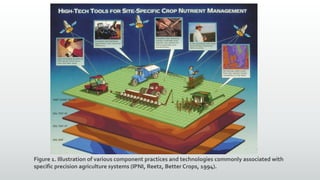
 GIS analysis allows the data from different layers (Figure 1) (years, crops, yields, soil characteristics,
nutrient additions, pest problems, etc.) to be analyzed for each part of a field. This allows for
interpretation of the cause-effect relationships among the various variables for which data are
available. It becomes a very powerful management tool that gets better with each year of data that is
added.
Figure 1. Illustration of various component practices and technologies commonly associated with
specific precision agriculture systems (IPNI, Reetz, Better Crops, 1994).
Cont…
 Documentation of needs, rates of application and yield responses
 Soil testing, either on a uniform grid basis, or based upon management zones, is the best way
to determine and document variability in nutrient supplying power of the soil in a field.
 Along with documentation of variability in crop nutrient removal (such as by use of a yield
monitor), soil test data can be used to estimate the nutrients needed from fertilizer and
manure to maintain or improve the soil productivity.
 These data then guide the development of a site- specific nutrient application map to make
most efficient use of the nutrients applied and protect against over-application that can cause
environmental problems and excess expense, as well as prevent under-application that can
affect yield potential and also lead to environmental problems.
Cont…
 How site-specific management fits all scales of operation and all parts of the World
 SSNM enables farmers to tailor nutrient management to the specific conditions of their field and
provides a framework for best management practices. The total fertilizer needed to achieve a profitable
target yield is determined from the anticipated yield gain, applied fertilizer, and a targeted efficiency of
fertilizer use. Fertilizer is supplied to match the crop’s need for supplemental nutrients. SSNM is an
important nutrient management concept for all parts of the world.
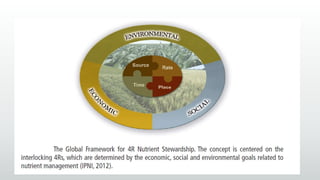
 Managing the right source at the right rate, right time, and in the right place may be best accomplished
with the right tools. Various technologies are available to help farmers and crop advisers make decisions
related to nutrient management, from soil sampling to fertilizer application to yield measurement.
These tools enhance the ability to fine-tune nutrient management decisions and develop the SSNM plan
for each field. Farmers and the farm employees, management and agronomic advisers, and input
suppliers are all part of a team, each contributing to the decision process in different ways.
Cont…
 Geo-referenced records are a key element
 On-board sensors, monitors and controllers make huge amounts of data available to help
farmers and their advisers refine the management system. To best utilize the information
collected on the farm, a geographic information system (GIS) is important. GIS is a powerful
tool for managing and analyzing large amounts of geo-referenced data–the kinds of data
generated by modern agriculture’s tools and practices. Decision-support services for farmers,
consultants, and input suppliers help interpret the GIS data for better-informed decisions.
GIS-based records enable all members of the management team to have access to the
details for each field, so that they can help choose the right sources, rates, timing, and
placement for best results.
Cont…
 Comprehensive shared data management systems
 Software and communication systems have continued to improve. New outside databases, such as digitized soil
surveys and weather information are now available to complement the farm data for use in decision-support tools.
 More farmers with more data leads toward the “critical mass” of customers needed to sustain a support service
offering, either as an independent operation or as an add-on support service offering by an input supplier.
 Managing and interpreting those data often require outside help. Farmers can gain much more benefit by sharing
the data with their adviser partners. Farmers who share their data with other farmers have a broader base of
information upon which to make decisions.
 Each can still benefit from his unique experience and resources to make decisions on his own farm. Programs being
implemented by seed, fertilizer, and chemical companies, or by technology data service providers, may be the
answer to the growing information management needs of 21st century farmers–helping them to put the right
nutrient source on at the right rate at the right time in the right place.
 Thus precision farming takes nutrient stewardship to another level, adding the provisions of using the right tools
with the right information in the hands of the right people to fine-tune the nutrient management plan for a given
field.
Cont…
 SSNM for rice in Asia
 The International Rice Research Institute (IRRI) has developed a SSNM program, based on scientific principles for supplying rice
with optimum levels of essential nutrients at the critical growth stages of active tillering and panicle initiation.
 SSNM helps farmers apply adequate fertilizer for their rice crop in a specific field and season, for efficient nutrient use, and high
yields, translating to high cash value of the harvest.
 The concept of SSNM in rice was developed in cooperation with researchers across Asia, and tested on farms in eight rice
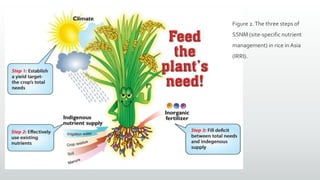
growing regions in six countries. It consists of three steps as shown in Figure 2.
 In the first step, an attainable yield target is established. The yield target for a given location and season is the estimated grain
yield attainable when N, P and K constraints are overcome. As the amount of nutrients taken up by a rice crop is directly related
to yield, the yield target indicates the total amount of nutrients that must be taken up by the crop.
 The second step consists of effectively using the indigenous nutrients coming from the soil, organic amendments, crop
residues, manure and irrigation water. An estimate of the nutrients taken up by the crop from indigenous sources can be
obtained from the grain yield of a crop not fertilized with the nutrient of interest but fertilized with other nutrients to ensure
they do not limit yield.
 In the third step, the quantity of required fertilizer is applied to fill the deficit between the crop’s total needs for nutrients as
determined by the yield target and the supply of these nutrients from indigenous sources.
 The total quantity of fertilizer to be applied is determined by the efficiency of fertilizer use by the crop. The required fertilizer N
is distributed in several applications during the crop growing season using tools like the leaf color chart.
Figure 2.The three steps of
SSNM (site-specific nutrient
management) in rice in Asia
(IRRI).
Cont…
 Spatial variability and SSNM of spring wheat production in China
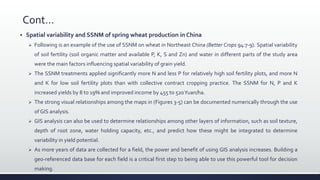
 Following is an example of the use of SSNM on wheat in Northeast China (Better Crops 94:7-9). Spatial variability
of soil fertility (soil organic matter and available P, K, S and Zn) and water in different parts of the study area
were the main factors influencing spatial variability of grain yield.
 The SSNM treatments applied significantly more N and less P for relatively high soil fertility plots, and more N
and K for low soil fertility plots than with collective contract cropping practice. The SSNM for N, P and K
increased yields by 8 to 19% and improved income by 455 to 520Yuan/ha.
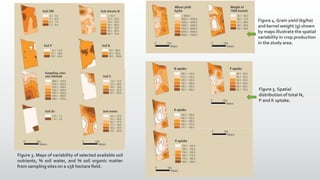
 The strong visual relationships among the maps in (Figures 3-5) can be documented numerically through the use
of GIS analysis.
 GIS analysis can also be used to determine relationships among other layers of information, such as soil texture,
depth of root zone, water holding capacity, etc., and predict how these might be integrated to determine
variability in yield potential.
 As more years of data are collected for a field, the power and benefit of using GIS analysis increases. Building a
geo-referenced data base for each field is a critical first step to being able to use this powerful tool for decision
making.
Figure 3. Maps of variability of selected available soil
nutrients, % soil water, and % soil organic matter
from sampling sites on a 156 hectare field.
Figure 4. Grain yield (kg/ha)
and kernel weight (g) shown
by maps illustrate the spatial
variability in crop production
in the study area.
Figure 5. Spatial
distribution of total N,
P and K uptake.
Cont…
 Environmental aspects of fertilizer use
 Fertilizer is often targeted as a contributor to environmental problems, particularly elevated nitrate levels in water supplies,
nitrate and phosphorus levels in water bodies leading to eutrophication, and more recently greenhouse gas emissions
(especially N2O) from agricultural operations. All of these occur, and are controllable, to a varying degree. But it is difficult to
determine on a sound scientific basis the answer to: “What is the real fertilizer contribution to these environmental problems vs.
other nutrient sources?” Box 1 offers some guidelines.
 Government policy guiding or regulating fertilizer use should be based on sound science. Balance of trade and other economic
issues, and lack of awareness, sometimes overpower science in formulating policy. It is important that good science be made
available and explained to policy makers wherever possible. Resource protection and future food security can only be possible
if decisions are made at all levels with good science taken into account.
 Most environmental consequences of nutrient management result from having excess nutrients in the soil above the amount
used by the crop at a given time. Excess nutrients lead to potential losses, resulting in water and air pollution. The adoption of
FBMPs can reduce environmental impacts. Cutting back on fertilizer is not the answer. Changes in the whole crop production
system may be needed to realize the environmental benefits of changing nutrient management practices. In fact, a well-
balanced fertilizer program coupled with a high yield management production strategy, in general, will keep more of the
available nutrients in the crop. Site-specific management following a good soil testing plan can help design the right fertilizer
program to optimize applications for high yields, optimum profits, and minimum environmental degradation that leads to
sustainable agriculture systems, resource efficiency and food security.
Box 1. Management of fertilizer for maximum economics and minimum environmental impact
 Follow good science and best management practices:
 Right product, at the right rate, at the right time, in the right place;
 Take precautions to minimize the contributions of fertilizers to environmental degradation.
 Fertilizer cost alone is often a deterrent to excess applications.
 Variable-rate technology has helped more farmers to use only what is needed and where it is needed.
 New fertilizer materials designed to help control losses are another positive step.
 Most farmers in developed countries do not over-apply fertilizer beyond the rates required for optimum
crop growth.
 All farmers should make a serious effort to reduce the potential environmental effects of their nutrient
management.
 The use of high-yield, economical nutrient management is often the most environmentally sound system
as well
REFERANCES
 Brevik EC & Burgess LC eds (2013) Soils and Human Health. Boca Raton: CRC Press.
 Flynn R, Shane TB, Baker RD. 2004. Sampling for Plant Tissue Analysis. Guide A-123, College of
Agriculture and Home Economics New Mexico State University.
 Halvorson, A.D. and C.A. Reule. 1999. Long-term nitrogen fertilization benefits soil carbon
sequestration. Better Crops. 83 (4): 16- 20.
 Harold F. Reetz, Jr. Fertilizers and their Efficient Use. International Fertilizer Industry Association, Paris,
France, 2016
 https://www.slideshare.net/BharathM64/soil-fertility-evaluation-and-fertilizer-
recommendation?qid=05296934-6375-4817-8a54 a8c11ae5e318&v=&b=&from_search=6
 https://www.slideshare.net/pabitramani/soil-fertility-evaluation-pkm?qid=05296934-6375-4817-8a54-
a8c11ae5e318&v=&b=&from_search=2
 https://www.slideshare.net/raiuniversity/b-sc-agri-ii-scsf-nm-u-3-soil-fertility-evaluation?qid=05296934-
6375-4817-8a54-a8c11ae5e318&v=&b=&from_search=3
REFERANCES (Cont…)
 Koch B R, Khosla WM, Frasier DG, Westfall and Inman.D 2004. Economic feasibility of variable-rate nitrogen
application utilizing site-specific management zones. Agron. J. 96: 1572-1580.
 Marschner H. 1995. Mineral Nutrition in Higher Plants. NewYork. Academic. Press. p. 675.
 Raun, W.B., G.V. Johnson, M.L. Stone, J.B. Solie, W.E. Thomason, and E.V. Lukina. 1999. In-season
prediction of yield potential in winter wheat. Better Crops. 83 (2): 24-25.
 Steinhilber P, Salak J. 2010. Plant Tissue Analysis : PL-1 in the Soil Fertility Guide. University of Maryland
College of Agriculture and Natural Resources. pp. 2-10.
 Verma SS, Tyagi S, Naresh RK, Gautam MP and Kumar M. 2018. Chapter – 2, Modern Concepts in Fertilizer
Application to Enhance Soil Health. Reserch gate. Pp: 37-76.
 Wade B. 2010. Symptoms of Deficiency in Essential Minerals. In Plant Physiology, 5th Edition by Taiz
Lincoln and Zeiger Eduardo.
 Wallace T. 1943. The Diagnosis of Mineral Deficiencies in Plants by Visual Symptoms. Annual Report of
University of Bristol Agricultural and Horticulture Research Station, Long Ashton.
THANK YOU
.

Modern concepts in fertilizer application PPT.pptx

  • 1.
    Modern concepts infertilizer application; soil fertility evaluation techniques; role of soil tests in fertilizer use recommendations; site-specific nutrient management for precision agriculture .
  • 2.
    PRESENTED BY: SUSHRITA NAYAK DEPARTMENTOF FRUIT SCIENCE AND HORTICULTURE TECHNOLOGY, COLLEGE OF AGRICULTURE, OUAT, BHUBANESWER AN ASSIGNMENT ON MODERN CONCEPTS IN FERTILIZER APPLICATION; SOIL FERTILITY EVALUATION TECHNIQUES; ROLE OF SOIL TESTS IN FERTILIZER USE RECOMMENDATIONS; SITE-SPECIFIC NUTRIENT MANAGEMENT FOR PRECISION AGRICULTURE COLLEGE OF AGRICULTURE, OUAT, BHUBANESWER
  • 3.
    CONTENTS  INTRODUCTION  WHATIS FERTILIZER?  CLASSIFICATIONSOF FERTILIZER  FERTILIZER RECOMMENDATION PHILOSOPHIESOR APPROACHES  DIFFERENT CONCEPT INTHE CONTEXTON FERTILIZERAPPLICATION  THE CONCEPT OF FERTILIZATION  METHODSOF FERTILIZERAPPLICATION  SOIL FERTILITY EVALUATION  SOILTESTING RESEARCH IN INDIA  CROP RESPONSE DATA
  • 4.
    CONTENTS (Cont…)  SOILFERTILITY EVALUATIONTECHNIQUES  METHODSOF EVALUATING SOIL FERTILITY  FERTILIZER RECOMMENDATIONSAPPROACHES  PRESENT APPROACHES IN FORMULATION OF FERTILIZER RECOMMENDATIONS EXTENSIVELYUSED IN INDIA  SITE-SPECIFIC NUTRIENT MANAGEMENT FOR PRECISIONAGRICULTURE  APPLICATIONSOF PRECISION FARMINGTECHNOLOGY IN FERTILIZER MANAGEMENT  MANAGEMENT OF FERTILIZER FOR MAXIMUM ECONOMICS AND MINIMUM ENVIRONMENTAL IMPACT  REFERANCES
  • 5.
    INTRODUCTION  Soil isa marvellous gift of nature to mankind. Without the presence of this thin layer on the top of lithosphere, there would have been no life on the planet Earth.  The major function of soil is to provide enough food and ensure human health. Increasingly, there is an awareness of the direct link between soils and human health in terms of elements that enhance health such as N, P and zinc (Zn), and other elements such as cadmium (Cd) and arsenic (As) that are harmful to human health (Brevik and Burgess, 2013).
  • 6.
    CLASSIFICATION OF FERTILIZERS FERTILIZERSBASED ON COMPOSITION Complete fertilizer Incomplete fertilizer Straight fertilizer Complex fertilizers Mixed fertilizers FERTILIZERS BASED ON CONCENTRATIONOF PRIMARY PLANT NUTRIENTS (N, P AND K) Low analysis fertilisers High analysis fertilisers
  • 7.
    Fertilizer based onphysical form Solid fertilizers Powder Crystals Prills Granules Super granules Briquettes Liquid fertilizers Clear liquid fertilizers Suspension liquid fertilizers BASED ONTHE NATURE OF FERTILISERS Acid Forming Fertilisers Alkaline Forming Fertilisers
  • 8.
    Management practices thatfoster the effective and responsible use of fertilizer nutrients: 1. Matching nutrient supply with crop requirements; a) SoilTesting b) Plant Analysis c) Establishing RealisticYield Goals d) Nutrient Budgets 2. Fertilizer application (e.g., rate, timing, placement); a) Right Rate and Balance of Nutrients b) Right Fertilizer Form c) Right Placement d) RightTiming e) Site-Specific Nutrient Management 3. Minimizing nutrient transport off fields. a) Nutrient Leaching b) Plant Analysis c) Establishing RealisticYield Goals d) Nutrient Budgets e) Field Buffer Strips
  • 11.
    Different concept inthe context on fertilizer application  Slow- and controlled-release fertilizers  Foliar Application  Over Fertilization  Injection of the Nutrient Solution into Irrigation Water  Placement of Fertilizers  Mixing of Fertilizers  Soil Texture and Duration of Crop  Water Management  Use of Micronutrients  Use of Amendments  Use of Organic Manures  Use of Bio-Fertilizers  Calculation of the Fertilizer Needed  Fertilizer Solubility  Compatibility of Fertilizers
  • 12.
    Fertilizer Recommendation Philosophiesor Approaches 1. The Sufficiency Level of Available Nutrient (SLAN) 2. The Build-Up and Maintenance philosophy 3. The Basic Cation Saturation Ratio (BCSR) concept
  • 13.
    Efficient Use ofFertilizers  Researchers have shown that plants cannot utilize which could more than 40–50% of nitrogen and 15–20% of phosphorous applied through fertilizers, even though the best management practices are adopted.  Under ordinary conditions plants hardly avail more than 30% nitrogen and 10% phosphorus applied through fertilizers.  Major part of the nitrogenous fertilizer is either lost to the atmosphere in the form of gas or leached down from the surface fertile soil.  Likewise a large portion of phosphorous is fixed with the soil particles and plants cannot avail it. Therefore, the following measures should be considered in order to obtain maximum benefit with the may minimum dose of fertilizer applied.
  • 14.
    Fertilizer Scheduling Shouldbe based upon SoilTest and Crop Response  The optimum requirement of a fertilizer for maximum production depends upon the requirements of the crop on the one hand and the presence of various nutrients in the soil on the other.  Soil testing gives an idea about the status of nutrients as well as fertilizer recommendations for crops. Soil testing also gives the information about soil reaction. The selection of fertilizer should be based on the soil reaction.  In acidic soils only those fertilizers should be used which have alkaline residual effect. In alkaline soils acid forming fertilizers should be preferred.  Rock phosphate is always preferred to super phosphate for strongly acidic soils, because in acidic soils rock phosphate gets dissolved easily and becomes available to plants.  Secondly, rock phosphate exerts alkaline residual effect which counteracts acidity of the soil. In India, where about 30–40% of the cultivated land is acidic, use of rock phosphate is to be encouraged.
  • 15.
    C0nt…  There are,of course, many limitations to soil testing such as lack of skill in sample collection, non-availability of testing facilities and low reliability of testing methods.  Yet the soil testing is a useful management tool for the farmer, in spite of its limitations. Regular soil test results from the same lab, sampled at the same time of year, should be compared with field information from year to year.  This information will be a valuable gauge of progress in soil fertility management and fertilizer scheduling.
  • 16.
    The Concept ofFertilization  How to Determine Root Zone  How to determine the area to fertilize under a tree  How to Determine the Amount of Fertilizer to Use under aTree  How to Determine the Area to Fertilize Under Hedge
  • 17.
  • 18.
  • 19.
    SOILTESTING RESEARCH ININDIA  Farming is a business and, like all businesspersons, the farmer operates farming business for profit. Obviously, to reach a decision before planting a crop,a farmer needs all of the reliable information from the country’s soil evaluation programme. In our country, system of fertility evaluation is being modified from time to time in various stages incorporating crop response data.  Soils are very heterogeneous in respect to forms of nutrients they contain, which greatly complicates the interpretation of Soil Test for assessing fertilizer needs. The total amount of a nutrient present in a soil offers little information relative to the amount of that nutrient which is available. Numerous extracting solutions and procedures have been used to remove nutrient elements from the soil, but none remove exactly the amount that plant roots obtain.  This means that, in order to interpret the data, the results from each analytical procedure must be correlated with the plant response obtained in field experiments by applying that fertilizer nutrient.  By this calibration, the requirement of fertilizer is calculated for achieving specific yield target. Soil fertility evaluation preferably employs a particular method of calibration as per the utility of the outcome.
  • 20.
    CROP RESPONSE DATA In nutrient rating experiments, soil test data is correlated with the response of crop. The response is measured in terms of ‘percent yield’ or ‘percent yield increase’. Both represent the ratio of the yield obtained in unfertilized soil (nutrient limiting deficient soil) to the yield in fertilizer nutrient applied soil (non-limiting or nutrient sufficient soil). The yield in non-limiting soil is otherwise known as maximum attainable yield or yield of standard treatment with all nutrients applied.  While comparing native fertility, in experiments that are conducted at different locations, percent yield is used.  Percent yield=Yield without fertilizer nutrient/Yield in standard treatment x100  While conducting multi location trials, or a pot experiment in a single location with soils brought from different locations, percent yield increase is worked out for every level of fertilizer application. The highest yield obtained in the experiment with all fertilizer nutrient applied, is taken as Maximum attainable yield  Percent yield increase = Yield at fertilizer nutrient level - Yield without fertilizer nutrient/Maximum attainable yield x 100  The soils analyzed by standard nutrient extraction method are grouped. The soil tests are calibrated into different fertility groups by various procedures.
  • 21.
    SOIL FERTILITY EVALUATIONTECHNIQUES Soil Fertility: It is the potential of the earth or inherent capacity of the soil to supply plant nutrients in quantity, forms and proportion required for the growth and development of the crop.  Fertility is measured by the amount of chemical elements or compounds required for plant growth  Productivity of a soil is defined as its capacity to produce plants under specified programme of management. It is measured by the yield of the crop per unit area of the land  Fertility is one of the factors of soil productivity. Sometimes a soil may be fertile but may not be productive.  Liebig’s Law of Minimum: The growth or yield of a crop is limited by that factor which is present in relatively least amount.  Law of diminishing return: where increases in yield of a crop per unit of available nutrient decreases as the level of available nutrient approaches sufficiency. “The increase in yield by a unit increment of the deficient factor is proportional to the decrement of that factor from the maximum.
  • 22.
    METHODS OF EVALUATINGSOIL FERTILITY 1. Visual symptoms of nutrient deficiency  LCC (Leaf Colour Chart)  Symptoms 2. Plant analysis and tissue testing tissue analysis i. Plant analysis ii. Tissue testing a) Critical nutrient concentration ranges (sufficiency ranges) b) Using Plant Analysis as a Diagnostic Tool c) DRIS (Diagnostic & Recommendation Integrated System) d) Crop logging (Clements,1960)
  • 23.
    Cont… 3. Methods involvingthe growing of higher plants and microorganism A. Plants: i. Indicator plant ii. Mitscherlich Pot culture method iii. Neubauer Seedling method (Neubauer and Schneider,1932) B. Microorganisms i. Azotobacter plaque method - (Sackett and Stewart technique,1931) ii. Mehlich’s technique for available K2O by Aspergillus niger method iii. Mehlich’s Cunninghamella–Plaque method for P 4. Soil Chemical analysis 5. Isotopic dilution method 6. Other methods use for soil test and fortilizer recommendation i. Sensor systems ii. Remote sensing iii. Satellite-based system
  • 25.
    FERTILIZER RECOMMENDATIONS APPROACHES A.Generalized/blanket Recommendations B. SoilTest Rating and Fertilizer Adjustment C. Soil test crop response and target yield concept D. Site specific nutrient management
  • 26.
    Present approaches informulation of fertilizer recommendations extensively used in India Soil testing programme was initially started adopting the International soil fertility evaluation and improvement programme (Fitts,1956). In this approach much stress is laid on laboratory characterization, followed by potted-plant studies ultimately leading to field-verification trials. These two initial steps help in eliminating arbitrariness of field trials. However, this approach had low adoption as it arrived one critical value below which economic responses are possible. Later, many improvements were suggested.
  • 27.
    Cont… a. AGRONOMICAPPROACH b. CRITICALLIMITAPPROACH c. DEDUCTIVEAPPROACH d. INDUCTIVE APPROACH e. QUADRATIC MODEL: Presently, this approach is modified and used by the Department of Agriculture, Tamil Nadu for giving site-specific fertilizer recommendations.
  • 28.
  • 29.
    Applications of precisionfarming technology in fertilizer management  Developments in computer technology, geographic information systems (GIS), global positioning system (GPS), electronic sensors and controllers, and a wide variety of communication tools during the 1990s and into the 21st century have provided exciting new technologies that can be applied in agriculture. Under the collective term, precision farming, these technologies have opened many new opportunities for improving crop and soil management on a site-specific basis.  SSNM fits anywhere in the world, and often may be easier to implement on small-scale farms where each field is more carefully monitored and managed. It is not limited to large fields and large equipment. The concept of SSNM attempts to match best management practices to the individual location, considering that location has unique soil and climate, and the unique management skills and experience of the grower. It is matching management decisions to the resources of the site, the knowledge base of farmer about his fields and the needs of his crops, and any information about previous management responses unique to the farm. The unique combination of these resources allows each farmer to use them to his advantage in optimizing yields and profits for his production system
  • 30.
    Cont…  Building anutrient management GIS database for each field  Details of nutrient management and maintaining records of fertilizer use, crop yields, and nutrient removal should be kept for every field on every farm in the world. The goal should be to develop a database for each field with geographically-referenced data that can be analyzed for nutrient balance, productivity, profitability, and environmental impacts. Where GPS and GIS technology are not available, other methods of documenting location can be used, but GPS/GIS is the best approach for larger production areas. The important point for all is to begin keeping records to document production and fertilizer use.  GIS analysis allows the data from different layers (Figure 1) (years, crops, yields, soil characteristics, nutrient additions, pest problems, etc.) to be analyzed for each part of a field. This allows for interpretation of the cause-effect relationships among the various variables for which data are available. It becomes a very powerful management tool that gets better with each year of data that is added.
  • 31.
    Figure 1. Illustrationof various component practices and technologies commonly associated with specific precision agriculture systems (IPNI, Reetz, Better Crops, 1994).
  • 32.
    Cont…  Documentation ofneeds, rates of application and yield responses  Soil testing, either on a uniform grid basis, or based upon management zones, is the best way to determine and document variability in nutrient supplying power of the soil in a field.  Along with documentation of variability in crop nutrient removal (such as by use of a yield monitor), soil test data can be used to estimate the nutrients needed from fertilizer and manure to maintain or improve the soil productivity.  These data then guide the development of a site- specific nutrient application map to make most efficient use of the nutrients applied and protect against over-application that can cause environmental problems and excess expense, as well as prevent under-application that can affect yield potential and also lead to environmental problems.
  • 33.
    Cont…  How site-specificmanagement fits all scales of operation and all parts of the World  SSNM enables farmers to tailor nutrient management to the specific conditions of their field and provides a framework for best management practices. The total fertilizer needed to achieve a profitable target yield is determined from the anticipated yield gain, applied fertilizer, and a targeted efficiency of fertilizer use. Fertilizer is supplied to match the crop’s need for supplemental nutrients. SSNM is an important nutrient management concept for all parts of the world.  Managing the right source at the right rate, right time, and in the right place may be best accomplished with the right tools. Various technologies are available to help farmers and crop advisers make decisions related to nutrient management, from soil sampling to fertilizer application to yield measurement. These tools enhance the ability to fine-tune nutrient management decisions and develop the SSNM plan for each field. Farmers and the farm employees, management and agronomic advisers, and input suppliers are all part of a team, each contributing to the decision process in different ways.
  • 34.
    Cont…  Geo-referenced recordsare a key element  On-board sensors, monitors and controllers make huge amounts of data available to help farmers and their advisers refine the management system. To best utilize the information collected on the farm, a geographic information system (GIS) is important. GIS is a powerful tool for managing and analyzing large amounts of geo-referenced data–the kinds of data generated by modern agriculture’s tools and practices. Decision-support services for farmers, consultants, and input suppliers help interpret the GIS data for better-informed decisions. GIS-based records enable all members of the management team to have access to the details for each field, so that they can help choose the right sources, rates, timing, and placement for best results.
  • 35.
    Cont…  Comprehensive shareddata management systems  Software and communication systems have continued to improve. New outside databases, such as digitized soil surveys and weather information are now available to complement the farm data for use in decision-support tools.  More farmers with more data leads toward the “critical mass” of customers needed to sustain a support service offering, either as an independent operation or as an add-on support service offering by an input supplier.  Managing and interpreting those data often require outside help. Farmers can gain much more benefit by sharing the data with their adviser partners. Farmers who share their data with other farmers have a broader base of information upon which to make decisions.  Each can still benefit from his unique experience and resources to make decisions on his own farm. Programs being implemented by seed, fertilizer, and chemical companies, or by technology data service providers, may be the answer to the growing information management needs of 21st century farmers–helping them to put the right nutrient source on at the right rate at the right time in the right place.  Thus precision farming takes nutrient stewardship to another level, adding the provisions of using the right tools with the right information in the hands of the right people to fine-tune the nutrient management plan for a given field.
  • 36.
    Cont…  SSNM forrice in Asia  The International Rice Research Institute (IRRI) has developed a SSNM program, based on scientific principles for supplying rice with optimum levels of essential nutrients at the critical growth stages of active tillering and panicle initiation.  SSNM helps farmers apply adequate fertilizer for their rice crop in a specific field and season, for efficient nutrient use, and high yields, translating to high cash value of the harvest.  The concept of SSNM in rice was developed in cooperation with researchers across Asia, and tested on farms in eight rice growing regions in six countries. It consists of three steps as shown in Figure 2.  In the first step, an attainable yield target is established. The yield target for a given location and season is the estimated grain yield attainable when N, P and K constraints are overcome. As the amount of nutrients taken up by a rice crop is directly related to yield, the yield target indicates the total amount of nutrients that must be taken up by the crop.  The second step consists of effectively using the indigenous nutrients coming from the soil, organic amendments, crop residues, manure and irrigation water. An estimate of the nutrients taken up by the crop from indigenous sources can be obtained from the grain yield of a crop not fertilized with the nutrient of interest but fertilized with other nutrients to ensure they do not limit yield.  In the third step, the quantity of required fertilizer is applied to fill the deficit between the crop’s total needs for nutrients as determined by the yield target and the supply of these nutrients from indigenous sources.  The total quantity of fertilizer to be applied is determined by the efficiency of fertilizer use by the crop. The required fertilizer N is distributed in several applications during the crop growing season using tools like the leaf color chart.
  • 37.
    Figure 2.The threesteps of SSNM (site-specific nutrient management) in rice in Asia (IRRI).
  • 38.
    Cont…  Spatial variabilityand SSNM of spring wheat production in China  Following is an example of the use of SSNM on wheat in Northeast China (Better Crops 94:7-9). Spatial variability of soil fertility (soil organic matter and available P, K, S and Zn) and water in different parts of the study area were the main factors influencing spatial variability of grain yield.  The SSNM treatments applied significantly more N and less P for relatively high soil fertility plots, and more N and K for low soil fertility plots than with collective contract cropping practice. The SSNM for N, P and K increased yields by 8 to 19% and improved income by 455 to 520Yuan/ha.  The strong visual relationships among the maps in (Figures 3-5) can be documented numerically through the use of GIS analysis.  GIS analysis can also be used to determine relationships among other layers of information, such as soil texture, depth of root zone, water holding capacity, etc., and predict how these might be integrated to determine variability in yield potential.  As more years of data are collected for a field, the power and benefit of using GIS analysis increases. Building a geo-referenced data base for each field is a critical first step to being able to use this powerful tool for decision making.
  • 39.
    Figure 3. Mapsof variability of selected available soil nutrients, % soil water, and % soil organic matter from sampling sites on a 156 hectare field. Figure 4. Grain yield (kg/ha) and kernel weight (g) shown by maps illustrate the spatial variability in crop production in the study area. Figure 5. Spatial distribution of total N, P and K uptake.
  • 40.
    Cont…  Environmental aspectsof fertilizer use  Fertilizer is often targeted as a contributor to environmental problems, particularly elevated nitrate levels in water supplies, nitrate and phosphorus levels in water bodies leading to eutrophication, and more recently greenhouse gas emissions (especially N2O) from agricultural operations. All of these occur, and are controllable, to a varying degree. But it is difficult to determine on a sound scientific basis the answer to: “What is the real fertilizer contribution to these environmental problems vs. other nutrient sources?” Box 1 offers some guidelines.  Government policy guiding or regulating fertilizer use should be based on sound science. Balance of trade and other economic issues, and lack of awareness, sometimes overpower science in formulating policy. It is important that good science be made available and explained to policy makers wherever possible. Resource protection and future food security can only be possible if decisions are made at all levels with good science taken into account.  Most environmental consequences of nutrient management result from having excess nutrients in the soil above the amount used by the crop at a given time. Excess nutrients lead to potential losses, resulting in water and air pollution. The adoption of FBMPs can reduce environmental impacts. Cutting back on fertilizer is not the answer. Changes in the whole crop production system may be needed to realize the environmental benefits of changing nutrient management practices. In fact, a well- balanced fertilizer program coupled with a high yield management production strategy, in general, will keep more of the available nutrients in the crop. Site-specific management following a good soil testing plan can help design the right fertilizer program to optimize applications for high yields, optimum profits, and minimum environmental degradation that leads to sustainable agriculture systems, resource efficiency and food security.
  • 41.
    Box 1. Managementof fertilizer for maximum economics and minimum environmental impact  Follow good science and best management practices:  Right product, at the right rate, at the right time, in the right place;  Take precautions to minimize the contributions of fertilizers to environmental degradation.  Fertilizer cost alone is often a deterrent to excess applications.  Variable-rate technology has helped more farmers to use only what is needed and where it is needed.  New fertilizer materials designed to help control losses are another positive step.  Most farmers in developed countries do not over-apply fertilizer beyond the rates required for optimum crop growth.  All farmers should make a serious effort to reduce the potential environmental effects of their nutrient management.  The use of high-yield, economical nutrient management is often the most environmentally sound system as well
  • 42.
    REFERANCES  Brevik EC& Burgess LC eds (2013) Soils and Human Health. Boca Raton: CRC Press.  Flynn R, Shane TB, Baker RD. 2004. Sampling for Plant Tissue Analysis. Guide A-123, College of Agriculture and Home Economics New Mexico State University.  Halvorson, A.D. and C.A. Reule. 1999. Long-term nitrogen fertilization benefits soil carbon sequestration. Better Crops. 83 (4): 16- 20.  Harold F. Reetz, Jr. Fertilizers and their Efficient Use. International Fertilizer Industry Association, Paris, France, 2016  https://www.slideshare.net/BharathM64/soil-fertility-evaluation-and-fertilizer- recommendation?qid=05296934-6375-4817-8a54 a8c11ae5e318&v=&b=&from_search=6  https://www.slideshare.net/pabitramani/soil-fertility-evaluation-pkm?qid=05296934-6375-4817-8a54- a8c11ae5e318&v=&b=&from_search=2  https://www.slideshare.net/raiuniversity/b-sc-agri-ii-scsf-nm-u-3-soil-fertility-evaluation?qid=05296934- 6375-4817-8a54-a8c11ae5e318&v=&b=&from_search=3
  • 43.
    REFERANCES (Cont…)  KochB R, Khosla WM, Frasier DG, Westfall and Inman.D 2004. Economic feasibility of variable-rate nitrogen application utilizing site-specific management zones. Agron. J. 96: 1572-1580.  Marschner H. 1995. Mineral Nutrition in Higher Plants. NewYork. Academic. Press. p. 675.  Raun, W.B., G.V. Johnson, M.L. Stone, J.B. Solie, W.E. Thomason, and E.V. Lukina. 1999. In-season prediction of yield potential in winter wheat. Better Crops. 83 (2): 24-25.  Steinhilber P, Salak J. 2010. Plant Tissue Analysis : PL-1 in the Soil Fertility Guide. University of Maryland College of Agriculture and Natural Resources. pp. 2-10.  Verma SS, Tyagi S, Naresh RK, Gautam MP and Kumar M. 2018. Chapter – 2, Modern Concepts in Fertilizer Application to Enhance Soil Health. Reserch gate. Pp: 37-76.  Wade B. 2010. Symptoms of Deficiency in Essential Minerals. In Plant Physiology, 5th Edition by Taiz Lincoln and Zeiger Eduardo.  Wallace T. 1943. The Diagnosis of Mineral Deficiencies in Plants by Visual Symptoms. Annual Report of University of Bristol Agricultural and Horticulture Research Station, Long Ashton.
  • 44.

Editor's Notes

  • #6 May require more than one slide