Cannabis and other related
disorders
Yolanda N. Khumalo
MBBS IV (University of Botswana)
29/08/19
Objectives:
• Appreciate the prevalence of cannabis use globally.
• Define cannabis and recognize the different types available.
• Describe the mechanism of action of cannabis.
• Diagnose cannabis and related disorders.
Introduction
• Cannabis (marijuana) is the most commonly used illicit drug globally.
• About 147 million people i.e. 2.5% of the world population use cannabis compared to
cocaine (0.2%), opiates (0.2%).
• The highest prevalence rates are among Western Central Africa, North America and
Oceania.
• Males tend to have higher cannabis dependence prevalence rates compared to females.
• Certain countries have fully legalized cannabis for recreational use e.g., Uruguay and
Canada.
• Locally, cannabis account for a significant proportion of psychiatric admissions,
especially among the youth.
About Cannabis
Definitions of commonly used street
terms:
Blunt – cannabis with tobacco
Joint- cannabis cigarette
Commonly used street names
• Weed
• Mary Jane
• Aunt Mary
• Grass
• Ganja
• Pot
Synonyms:
Dagga
Marijuana
Bhang
About Cannabis cont…
• The term ‘cannabis’ refers to a genus of flowering plants in the family: Cannabaceae.
• Cannabis plant contains more than 421 chemicals of which 61 are cannabinoids.
• The most psychoactive cannabinoid is called: delta-9-tetrahydrocannabinol (THC).
• THC found in the flowering heads (“buds”), less in leaves and stems.
Types:
1. C. sativa
2. C. indica
3. C. ruderallis - negligible amounts of psychoactive compounds
• C. sativa and C. indica are cultivated for recreational and medicinal use.
• C. ruderallis cultivated for seeds and fiber (hemp), not considered illegal.
Significant amount of psychoactive phytocannabinoids
Mechanism of Action of Cannabis
• Delta-9-tetrahydrocannabinol (THC), binds to and is a partial agonist at (2)
cannabinoid receptors:
 Cannabinoid 1 (CB1) receptor
 Cannabinoid 2 (CB2) receptor
• CB1 receptors distributed throughout brain and other body structures e.g.,
liver, adipose tissue and vascular endothelium.
• CB2 receptors are present on immune cells throughout body (incl. microglia,
spleen).
Mechanism of cannabis cont…
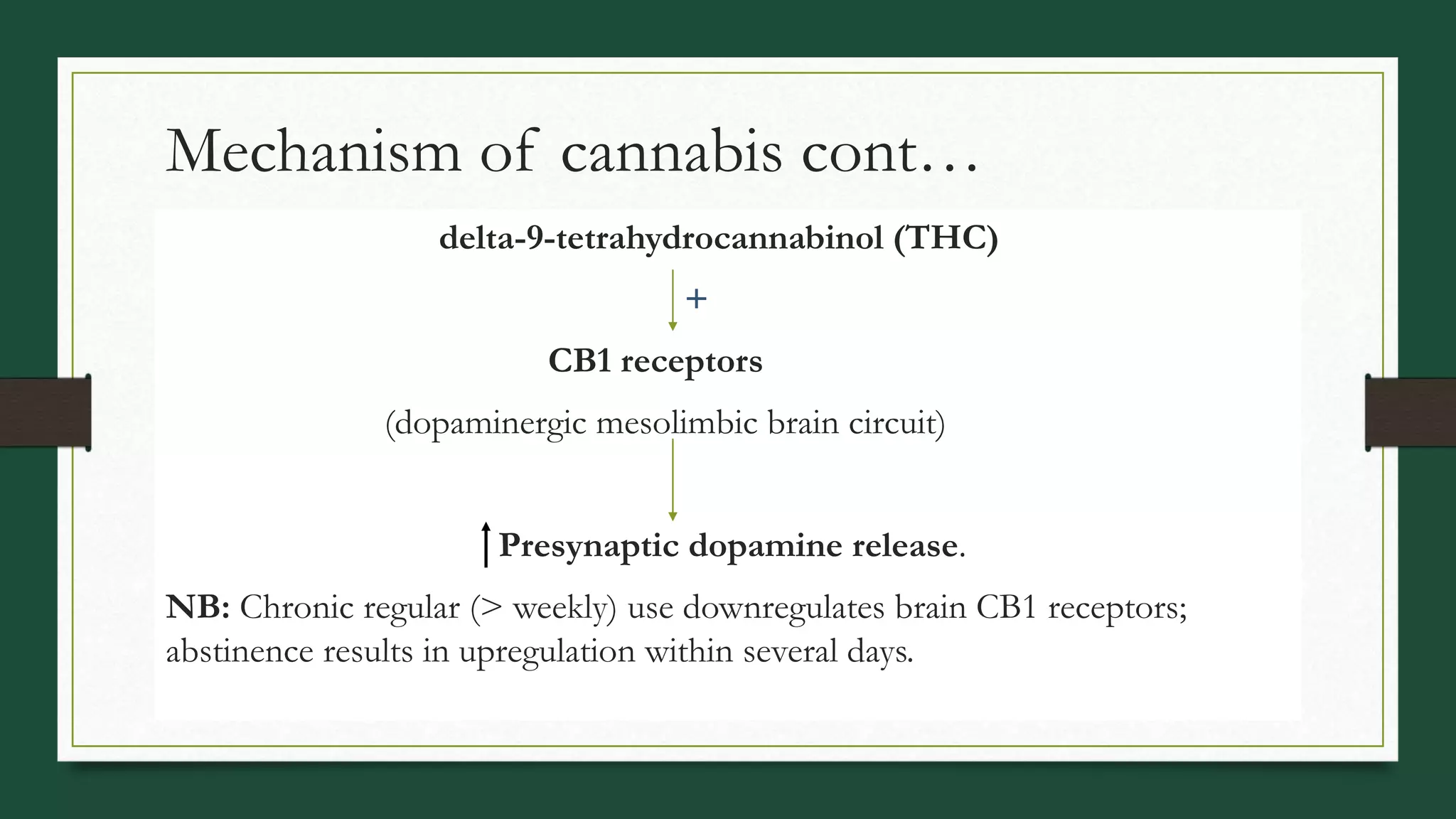
delta-9-tetrahydrocannabinol (THC)
+
CB1 receptors
(dopaminergic mesolimbic brain circuit)
Presynaptic dopamine release.
NB: Chronic regular (> weekly) use downregulates brain CB1 receptors;
abstinence results in upregulation within several days.
Routes of administration
• Smoking
• Inhalation
• Oral intake
• Intravenously – extremely rare
Rapidly absorbed
Metabolism and Excretion
• THC metabolism is primarily by hepatic P450 isozymes 3A4 and 2C9
• Excretion is largely through feces (65-80%) and urine (20- 35%). Tests on
these samples may be positive for several weeks after last intake.
Diagnosis of Cannabis- related disorders
DSM-V ICD 10
Cannabis use disorder Dependence syndrome
Cannabis intoxication Acute intoxication
Cannabis withdrawal Harmful use
Other cannabis- induced disorders Withdrawal state +/- delirium
Unspecified cannabis-related disorder Psychotic disorder
Amnesic syndrome
Residual and late- onset psychotic disorder
Cannabis Use Disorder (CUD)
Cannabis intoxication
• Refers to behavioral and psychological changes that occur with recent use of cannabis.
• Impaired motor coordination, euphoria, anxiety, sensation of slowed time, impaired
judgment and social withdrawal are some of the symptoms of cannabis intoxication.
• Physical signs include; conjunctival injection, dry mouth, tachycardia, postural HTN and
increased appetite.
Management:
• Usually self-limiting; treatment is symptomatic.
• Acute behavioral disturbance – benzodiazepines
• Perceptual disturbances– may use antipsychotics.
Cannabis withdrawal
• Characterized by; irritability, anger or aggression, nervousness/anxiety, sleep
disturbances, decreased appetite, restlessness, and depressed mood.
• Abdominal pains, tremors, fever and chills or headaches, may also be present.
Management:
• Supportive and symptomatic
• Can be managed with a regime of benzodiazepines e.g., diazepam
Other cannabis-induced disorders
• Cannabis- induced psychotic disorder
• Cannabis-induced anxiety
• Cannabis-induced sleep disorder
NB: These are diagnosed (instead of cannabis intoxication or withdrawal) if
symptoms are so severe as to warrant independent clinical attention.
References
• https://www.who.int/substance_abuse/facts/cannabis/en/
• https://www.uptodate.com/contents/cannabis-use-and-disorder-in-adults-pathogenesis-
pharmacology-and-routes-of-administration
• https://www.unodc.org/wdr2016/en/cannabis.html
• 1.The PONES. Correction: The Global Epidemiology and Contribution of Cannabis Use and
Dependence to the Global Burden of Disease: Results from the GBD 2010 Study. PLOS ONE.
2016;11(10):e0165221.
• Opondo P.R. An introduction to the practice of psychiatry in Botswana. Botswana: House of
Gendero; 2014. p. 90-91.
• Association A. Diagnostic and statistical manual of mental disorders: DSM-V. American
Psychiatric Pub. 2013..

Cannabis use disorders

  • 1.
    Cannabis and otherrelated disorders Yolanda N. Khumalo MBBS IV (University of Botswana) 29/08/19
  • 2.
    Objectives: • Appreciate theprevalence of cannabis use globally. • Define cannabis and recognize the different types available. • Describe the mechanism of action of cannabis. • Diagnose cannabis and related disorders.
  • 3.
    Introduction • Cannabis (marijuana)is the most commonly used illicit drug globally. • About 147 million people i.e. 2.5% of the world population use cannabis compared to cocaine (0.2%), opiates (0.2%). • The highest prevalence rates are among Western Central Africa, North America and Oceania. • Males tend to have higher cannabis dependence prevalence rates compared to females. • Certain countries have fully legalized cannabis for recreational use e.g., Uruguay and Canada. • Locally, cannabis account for a significant proportion of psychiatric admissions, especially among the youth.
  • 4.
    About Cannabis Definitions ofcommonly used street terms: Blunt – cannabis with tobacco Joint- cannabis cigarette Commonly used street names • Weed • Mary Jane • Aunt Mary • Grass • Ganja • Pot Synonyms: Dagga Marijuana Bhang
  • 5.
    About Cannabis cont… •The term ‘cannabis’ refers to a genus of flowering plants in the family: Cannabaceae. • Cannabis plant contains more than 421 chemicals of which 61 are cannabinoids. • The most psychoactive cannabinoid is called: delta-9-tetrahydrocannabinol (THC). • THC found in the flowering heads (“buds”), less in leaves and stems. Types: 1. C. sativa 2. C. indica 3. C. ruderallis - negligible amounts of psychoactive compounds • C. sativa and C. indica are cultivated for recreational and medicinal use. • C. ruderallis cultivated for seeds and fiber (hemp), not considered illegal. Significant amount of psychoactive phytocannabinoids
  • 6.
    Mechanism of Actionof Cannabis • Delta-9-tetrahydrocannabinol (THC), binds to and is a partial agonist at (2) cannabinoid receptors:  Cannabinoid 1 (CB1) receptor  Cannabinoid 2 (CB2) receptor • CB1 receptors distributed throughout brain and other body structures e.g., liver, adipose tissue and vascular endothelium. • CB2 receptors are present on immune cells throughout body (incl. microglia, spleen).
  • 7.
    Mechanism of cannabiscont… delta-9-tetrahydrocannabinol (THC) + CB1 receptors (dopaminergic mesolimbic brain circuit) Presynaptic dopamine release. NB: Chronic regular (> weekly) use downregulates brain CB1 receptors; abstinence results in upregulation within several days.
  • 8.
    Routes of administration •Smoking • Inhalation • Oral intake • Intravenously – extremely rare Rapidly absorbed
  • 9.
    Metabolism and Excretion •THC metabolism is primarily by hepatic P450 isozymes 3A4 and 2C9 • Excretion is largely through feces (65-80%) and urine (20- 35%). Tests on these samples may be positive for several weeks after last intake.
  • 10.
    Diagnosis of Cannabis-related disorders DSM-V ICD 10 Cannabis use disorder Dependence syndrome Cannabis intoxication Acute intoxication Cannabis withdrawal Harmful use Other cannabis- induced disorders Withdrawal state +/- delirium Unspecified cannabis-related disorder Psychotic disorder Amnesic syndrome Residual and late- onset psychotic disorder
  • 11.
  • 12.
    Cannabis intoxication • Refersto behavioral and psychological changes that occur with recent use of cannabis. • Impaired motor coordination, euphoria, anxiety, sensation of slowed time, impaired judgment and social withdrawal are some of the symptoms of cannabis intoxication. • Physical signs include; conjunctival injection, dry mouth, tachycardia, postural HTN and increased appetite. Management: • Usually self-limiting; treatment is symptomatic. • Acute behavioral disturbance – benzodiazepines • Perceptual disturbances– may use antipsychotics.
  • 13.
    Cannabis withdrawal • Characterizedby; irritability, anger or aggression, nervousness/anxiety, sleep disturbances, decreased appetite, restlessness, and depressed mood. • Abdominal pains, tremors, fever and chills or headaches, may also be present. Management: • Supportive and symptomatic • Can be managed with a regime of benzodiazepines e.g., diazepam
  • 14.
    Other cannabis-induced disorders •Cannabis- induced psychotic disorder • Cannabis-induced anxiety • Cannabis-induced sleep disorder NB: These are diagnosed (instead of cannabis intoxication or withdrawal) if symptoms are so severe as to warrant independent clinical attention.
  • 15.
    References • https://www.who.int/substance_abuse/facts/cannabis/en/ • https://www.uptodate.com/contents/cannabis-use-and-disorder-in-adults-pathogenesis- pharmacology-and-routes-of-administration •https://www.unodc.org/wdr2016/en/cannabis.html • 1.The PONES. Correction: The Global Epidemiology and Contribution of Cannabis Use and Dependence to the Global Burden of Disease: Results from the GBD 2010 Study. PLOS ONE. 2016;11(10):e0165221. • Opondo P.R. An introduction to the practice of psychiatry in Botswana. Botswana: House of Gendero; 2014. p. 90-91. • Association A. Diagnostic and statistical manual of mental disorders: DSM-V. American Psychiatric Pub. 2013..