Cannabinoid and Harm
Reduction among cannabis users
Sebastien Beguerie
Founder of AlphaCAT
Founder @ the Union Francophone pour les Cannabinoides en Médecines
(UFCM)
Co-founder & coordinator @ the International Medical Cannabis Patient
Coalition (IMCPC).
Board Member as Patient Representative @ the International Association
for Cannabis as Medicine (IACM)
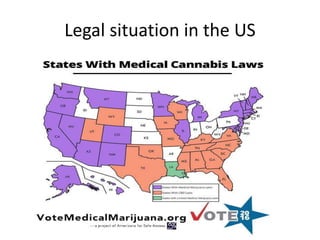
Legal situation in the US
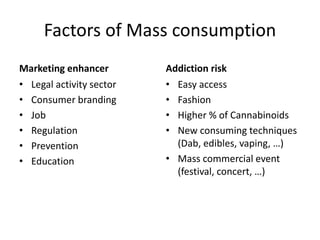
Factors of Mass consumption
Marketing enhancer
• Legal activity sector
• Consumer branding
• Job
• Regulation
• Prevention
• Education
Addiction risk
• Easy access
• Fashion
• Higher % of Cannabinoids
• New consuming techniques
(Dab, edibles, vaping, …)
• Mass commercial event
(festival, concert, …)
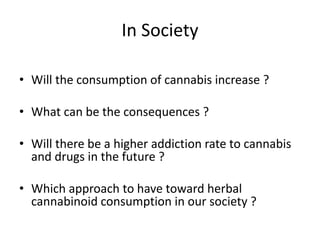
In Society
• Will the consumption of cannabis increase ?
• What can be the consequences ?
• Will there be a higher addiction rate to cannabis
and drugs in the future ?
• Which approach to have toward herbal
cannabinoid consumption in our society ?
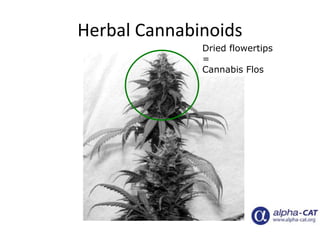
Herbal Cannabinoids
Dried flowertips
=
Cannabis Flos
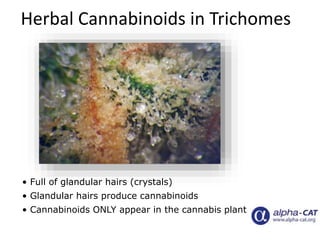
• Full of glandular hairs (crystals)
• Glandular hairs produce cannabinoids
• Cannabinoids ONLY appear in the cannabis plant
Herbal Cannabinoids in Trichomes
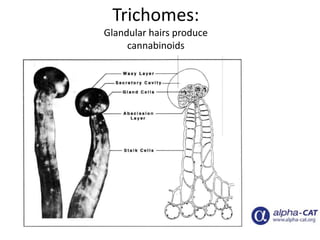
Trichomes:
Glandular hairs produce
cannabinoids
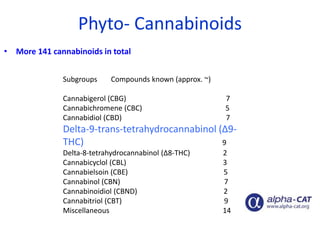
Subgroups Compounds known (approx. ~)
Cannabigerol (CBG) 7
Cannabichromene (CBC) 5
Cannabidiol (CBD) 7
Delta-9-trans-tetrahydrocannabinol (Δ9-
THC) 9
Delta-8-tetrahydrocannabinol (Δ8-THC) 2
Cannabicyclol (CBL) 3
Cannabielsoin (CBE) 5
Cannabinol (CBN) 7
Cannabinoidiol (CBND) 2
Cannabitriol (CBT) 9
Miscellaneous 14
Phyto- Cannabinoids
• More 141 cannabinoids in total
Overstanding
Naturally ,
Human bonds to Herbal Cannabinoids !
Early observations on Cannabis user in
California
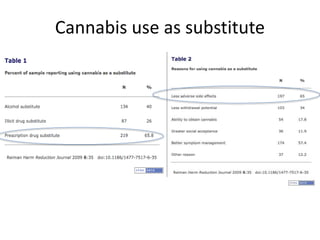
Cannabis as a substitute for alcohol and other drugs.
• In December 2009, Publish in Harm Reduction Journal
by Amanda Reiman
• Anonymous survey
• Data collected at the Berkeley Patient's Group a
medical cannabis dispensary in Berkeley, CA. (N = 350)
Population Sample
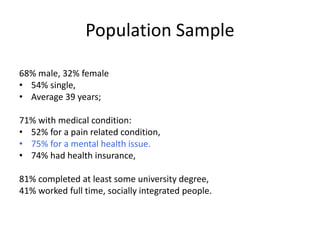
68% male, 32% female
• 54% single,
• Average 39 years;
71% with medical condition:
• 52% for a pain related condition,
• 75% for a mental health issue.
• 74% had health insurance,
81% completed at least some university degree,
41% worked full time, socially integrated people.
Cannabis use as substitute
Remaining Question ?
• What cannabis strain did they consume ?
• Which cannabinoids were in action ?
• What were the cannabinoids percentage ?
Opoids addiction
Cannabidiol inhibits the reward-facilitating effect of morphine: involvement of 5-HT1A receptors
in the dorsal raphe nucleus.
2013 in Journal of addiction and biology publish
by Katsidoni et al. :
Tested on rats using intracranial self-stimulation (ICSS) paradigm.
Rats prepared with a stimulating electrode into the medial forebrain bundle
(MFB)
• CBD a non-psychotomimetic constituent of Cannabis sativa
• Induces central effects in rodents.
• Shown to attenuates cue-induced reinstatement of heroin seeking.
CBD interferes with brain reward mechanisms responsible for the expression
of the acute reinforcing properties of opioids
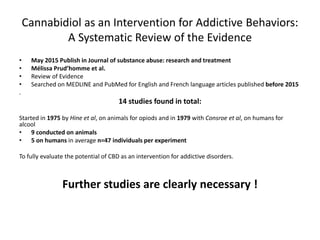
Cannabidiol as an Intervention for Addictive Behaviors:
A Systematic Review of the Evidence
• May 2015 Publish in Journal of substance abuse: research and treatment
• Mélissa Prud’homme et al.
• Review of Evidence
• Searched on MEDLINE and PubMed for English and French language articles published before 2015
.
14 studies found in total:
Started in 1975 by Hine et al, on animals for opiods and in 1979 with Consroe et al, on humans for
alcool
• 9 conducted on animals
• 5 on humans in average n=47 individuals per experiment
To fully evaluate the potential of CBD as an intervention for addictive disorders.
Further studies are clearly necessary !
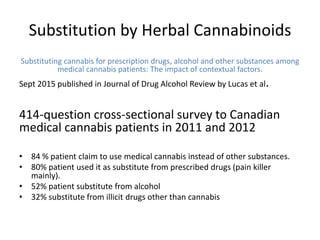
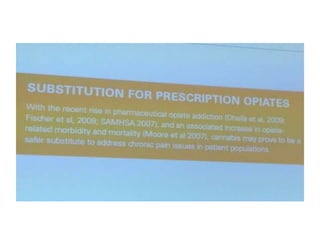
Substitution by Herbal Cannabinoids
Substituting cannabis for prescription drugs, alcohol and other substances among
medical cannabis patients: The impact of contextual factors.
Sept 2015 published in Journal of Drug Alcohol Review by Lucas et al.
414-question cross-sectional survey to Canadian
medical cannabis patients in 2011 and 2012
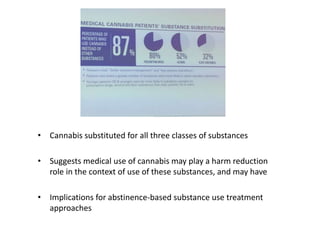
• 84 % patient claim to use medical cannabis instead of other substances.
• 80% patient used it as substitute from prescribed drugs (pain killer
mainly).
• 52% patient substitute from alcohol
• 32% substitute from illicit drugs other than cannabis
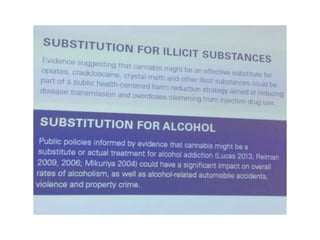
• Cannabis substituted for all three classes of substances
• Suggests medical use of cannabis may play a harm reduction
role in the context of use of these substances, and may have
• Implications for abstinence-based substance use treatment
approaches
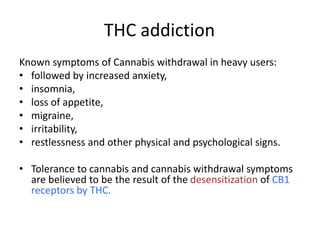
THC addiction
Known symptoms of Cannabis withdrawal in heavy users:
• followed by increased anxiety,
• insomnia,
• loss of appetite,
• migraine,
• irritability,
• restlessness and other physical and psychological signs.
• Tolerance to cannabis and cannabis withdrawal symptoms
are believed to be the result of the desensitization of CB1
receptors by THC.
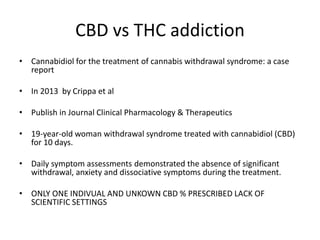
CBD vs THC addiction
• Cannabidiol for the treatment of cannabis withdrawal syndrome: a case
report
• In 2013 by Crippa et al
• Publish in Journal Clinical Pharmacology & Therapeutics
• 19-year-old woman withdrawal syndrome treated with cannabidiol (CBD)
for 10 days.
• Daily symptom assessments demonstrated the absence of significant
withdrawal, anxiety and dissociative symptoms during the treatment.
• ONLY ONE INDIVUAL AND UNKOWN CBD % PRESCRIBED LACK OF
SCIENTIFIC SETTINGS
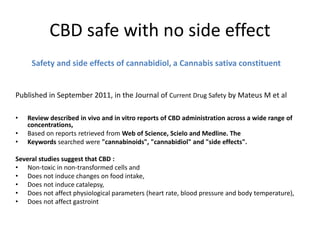
CBD safe with no side effect
Safety and side effects of cannabidiol, a Cannabis sativa constituent
Published in September 2011, in the Journal of Current Drug Safety by Mateus M et al
• Review described in vivo and in vitro reports of CBD administration across a wide range of
concentrations,
• Based on reports retrieved from Web of Science, Scielo and Medline. The
• Keywords searched were "cannabinoids", "cannabidiol" and "side effects".
Several studies suggest that CBD :
• Non-toxic in non-transformed cells and
• Does not induce changes on food intake,
• Does not induce catalepsy,
• Does not affect physiological parameters (heart rate, blood pressure and body temperature),
• Does not affect gastroint
Cannabinoid administration methods
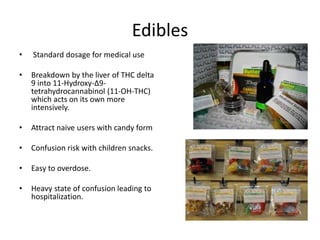
Edibles
• Standard dosage for medical use
• Breakdown by the liver of THC delta
9 into 11-Hydroxy-Δ9-
tetrahydrocannabinol (11-OH-THC)
which acts on its own more
intensively.
• Attract naive users with candy form
• Confusion risk with children snacks.
• Easy to overdose.
• Heavy state of confusion leading to
hospitalization.
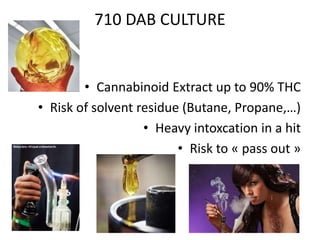
710 DAB CULTURE
• Cannabinoid Extract up to 90% THC
• Risk of solvent residue (Butane, Propane,…)
• Heavy intoxcation in a hit
• Risk to « pass out »
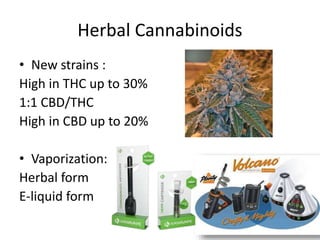
Herbal Cannabinoids
• New strains :
High in THC up to 30%
1:1 CBD/THC
High in CBD up to 20%
• Vaporization:
Herbal form
E-liquid form
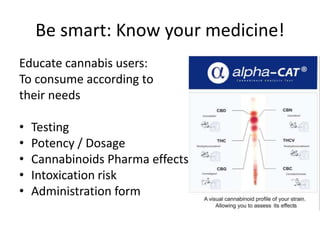
Be smart: Know your medicine!
Educate cannabis users:
To consume according to
their needs
• Testing
• Potency / Dosage
• Cannabinoids Pharma effects
• Intoxication risk
• Administration form
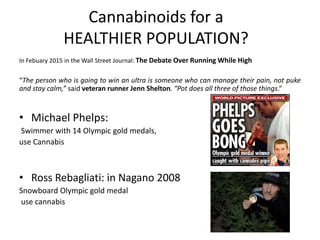
Cannabinoids for a
HEALTHIER POPULATION?
In Febuary 2015 in the Wall Street Journal: The Debate Over Running While High
“The person who is going to win an ultra is someone who can manage their pain, not puke
and stay calm,” said veteran runner Jenn Shelton. “Pot does all three of those things.”
• Michael Phelps:
Swimmer with 14 Olympic gold medals,
use Cannabis
• Ross Rebagliati: in Nagano 2008
Snowboard Olympic gold medal
use cannabis
Cannabis for a smarter society
Cannabinoid and Harm Reduction among cannabis users

Cannabinoid and Harm Reduction among cannabis users

  • 1.
    Cannabinoid and Harm Reductionamong cannabis users Sebastien Beguerie Founder of AlphaCAT Founder @ the Union Francophone pour les Cannabinoides en Médecines (UFCM) Co-founder & coordinator @ the International Medical Cannabis Patient Coalition (IMCPC). Board Member as Patient Representative @ the International Association for Cannabis as Medicine (IACM)
  • 2.
  • 3.
    Factors of Massconsumption Marketing enhancer • Legal activity sector • Consumer branding • Job • Regulation • Prevention • Education Addiction risk • Easy access • Fashion • Higher % of Cannabinoids • New consuming techniques (Dab, edibles, vaping, …) • Mass commercial event (festival, concert, …)
  • 4.
    In Society • Willthe consumption of cannabis increase ? • What can be the consequences ? • Will there be a higher addiction rate to cannabis and drugs in the future ? • Which approach to have toward herbal cannabinoid consumption in our society ?
  • 5.
  • 6.
    • Full ofglandular hairs (crystals) • Glandular hairs produce cannabinoids • Cannabinoids ONLY appear in the cannabis plant Herbal Cannabinoids in Trichomes
  • 7.
  • 8.
    Subgroups Compounds known(approx. ~) Cannabigerol (CBG) 7 Cannabichromene (CBC) 5 Cannabidiol (CBD) 7 Delta-9-trans-tetrahydrocannabinol (Δ9- THC) 9 Delta-8-tetrahydrocannabinol (Δ8-THC) 2 Cannabicyclol (CBL) 3 Cannabielsoin (CBE) 5 Cannabinol (CBN) 7 Cannabinoidiol (CBND) 2 Cannabitriol (CBT) 9 Miscellaneous 14 Phyto- Cannabinoids • More 141 cannabinoids in total
  • 10.
    Overstanding Naturally , Human bondsto Herbal Cannabinoids !
  • 12.
    Early observations onCannabis user in California Cannabis as a substitute for alcohol and other drugs. • In December 2009, Publish in Harm Reduction Journal by Amanda Reiman • Anonymous survey • Data collected at the Berkeley Patient's Group a medical cannabis dispensary in Berkeley, CA. (N = 350)
  • 13.
    Population Sample 68% male,32% female • 54% single, • Average 39 years; 71% with medical condition: • 52% for a pain related condition, • 75% for a mental health issue. • 74% had health insurance, 81% completed at least some university degree, 41% worked full time, socially integrated people.
  • 14.
    Cannabis use assubstitute
  • 15.
    Remaining Question ? •What cannabis strain did they consume ? • Which cannabinoids were in action ? • What were the cannabinoids percentage ?
  • 16.
    Opoids addiction Cannabidiol inhibitsthe reward-facilitating effect of morphine: involvement of 5-HT1A receptors in the dorsal raphe nucleus. 2013 in Journal of addiction and biology publish by Katsidoni et al. : Tested on rats using intracranial self-stimulation (ICSS) paradigm. Rats prepared with a stimulating electrode into the medial forebrain bundle (MFB) • CBD a non-psychotomimetic constituent of Cannabis sativa • Induces central effects in rodents. • Shown to attenuates cue-induced reinstatement of heroin seeking. CBD interferes with brain reward mechanisms responsible for the expression of the acute reinforcing properties of opioids
  • 17.
    Cannabidiol as anIntervention for Addictive Behaviors: A Systematic Review of the Evidence • May 2015 Publish in Journal of substance abuse: research and treatment • Mélissa Prud’homme et al. • Review of Evidence • Searched on MEDLINE and PubMed for English and French language articles published before 2015 . 14 studies found in total: Started in 1975 by Hine et al, on animals for opiods and in 1979 with Consroe et al, on humans for alcool • 9 conducted on animals • 5 on humans in average n=47 individuals per experiment To fully evaluate the potential of CBD as an intervention for addictive disorders. Further studies are clearly necessary !
  • 18.
    Substitution by HerbalCannabinoids Substituting cannabis for prescription drugs, alcohol and other substances among medical cannabis patients: The impact of contextual factors. Sept 2015 published in Journal of Drug Alcohol Review by Lucas et al. 414-question cross-sectional survey to Canadian medical cannabis patients in 2011 and 2012 • 84 % patient claim to use medical cannabis instead of other substances. • 80% patient used it as substitute from prescribed drugs (pain killer mainly). • 52% patient substitute from alcohol • 32% substitute from illicit drugs other than cannabis
  • 19.
    • Cannabis substitutedfor all three classes of substances • Suggests medical use of cannabis may play a harm reduction role in the context of use of these substances, and may have • Implications for abstinence-based substance use treatment approaches
  • 21.
    THC addiction Known symptomsof Cannabis withdrawal in heavy users: • followed by increased anxiety, • insomnia, • loss of appetite, • migraine, • irritability, • restlessness and other physical and psychological signs. • Tolerance to cannabis and cannabis withdrawal symptoms are believed to be the result of the desensitization of CB1 receptors by THC.
  • 22.
    CBD vs THCaddiction • Cannabidiol for the treatment of cannabis withdrawal syndrome: a case report • In 2013 by Crippa et al • Publish in Journal Clinical Pharmacology & Therapeutics • 19-year-old woman withdrawal syndrome treated with cannabidiol (CBD) for 10 days. • Daily symptom assessments demonstrated the absence of significant withdrawal, anxiety and dissociative symptoms during the treatment. • ONLY ONE INDIVUAL AND UNKOWN CBD % PRESCRIBED LACK OF SCIENTIFIC SETTINGS
  • 23.
    CBD safe withno side effect Safety and side effects of cannabidiol, a Cannabis sativa constituent Published in September 2011, in the Journal of Current Drug Safety by Mateus M et al • Review described in vivo and in vitro reports of CBD administration across a wide range of concentrations, • Based on reports retrieved from Web of Science, Scielo and Medline. The • Keywords searched were "cannabinoids", "cannabidiol" and "side effects". Several studies suggest that CBD : • Non-toxic in non-transformed cells and • Does not induce changes on food intake, • Does not induce catalepsy, • Does not affect physiological parameters (heart rate, blood pressure and body temperature), • Does not affect gastroint
  • 25.
  • 26.
    Edibles • Standard dosagefor medical use • Breakdown by the liver of THC delta 9 into 11-Hydroxy-Δ9- tetrahydrocannabinol (11-OH-THC) which acts on its own more intensively. • Attract naive users with candy form • Confusion risk with children snacks. • Easy to overdose. • Heavy state of confusion leading to hospitalization.
  • 27.
    710 DAB CULTURE •Cannabinoid Extract up to 90% THC • Risk of solvent residue (Butane, Propane,…) • Heavy intoxcation in a hit • Risk to « pass out »
  • 28.
    Herbal Cannabinoids • Newstrains : High in THC up to 30% 1:1 CBD/THC High in CBD up to 20% • Vaporization: Herbal form E-liquid form
  • 29.
    Be smart: Knowyour medicine! Educate cannabis users: To consume according to their needs • Testing • Potency / Dosage • Cannabinoids Pharma effects • Intoxication risk • Administration form
  • 30.
    Cannabinoids for a HEALTHIERPOPULATION? In Febuary 2015 in the Wall Street Journal: The Debate Over Running While High “The person who is going to win an ultra is someone who can manage their pain, not puke and stay calm,” said veteran runner Jenn Shelton. “Pot does all three of those things.” • Michael Phelps: Swimmer with 14 Olympic gold medals, use Cannabis • Ross Rebagliati: in Nagano 2008 Snowboard Olympic gold medal use cannabis
  • 31.
    Cannabis for asmarter society