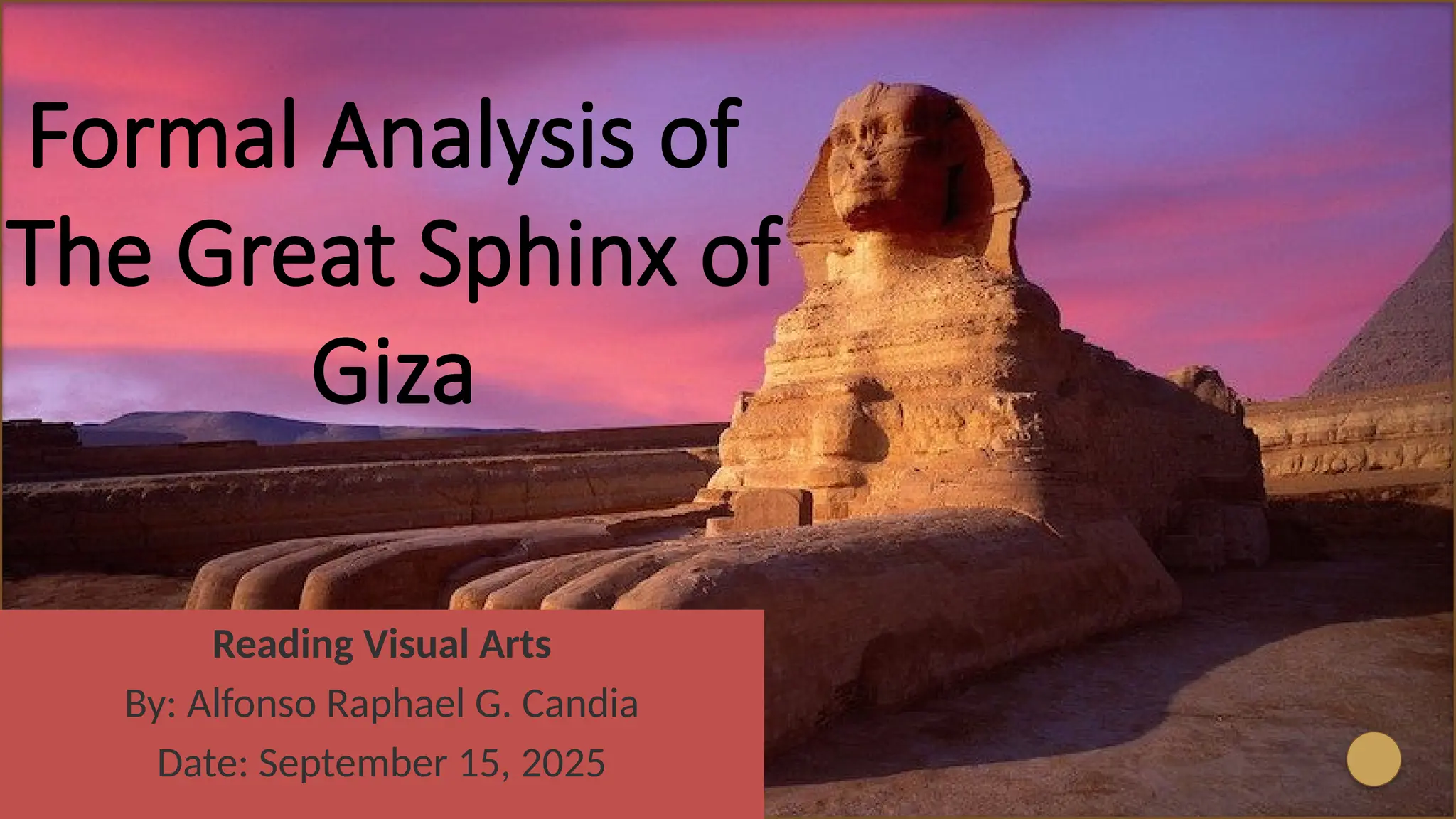
Formal Analysis of
TheGreat Sphinx of
Giza
Reading Visual Arts
By: Alfonso Raphael G. Candia
Date: September 15, 2025
2.
Introduction
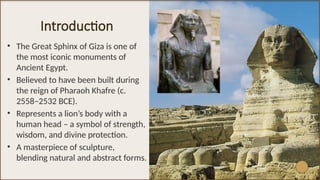
• The GreatSphinx of Giza is one of
the most iconic monuments of
Ancient Egypt.
• Believed to have been built during
the reign of Pharaoh Khafre (c.
2558–2532 BCE).
• Represents a lion’s body with a
human head – a symbol of strength,
wisdom, and divine protection.
• A masterpiece of sculpture,
blending natural and abstract forms.
3.
Visual Description
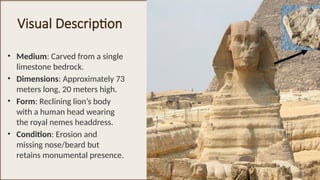
• Medium:Carved from a single
limestone bedrock.
• Dimensions: Approximately 73
meters long, 20 meters high.
• Form: Reclining lion’s body
with a human head wearing
the royal nemes headdress.
• Condition: Erosion and
missing nose/beard but
retains monumental presence.
4.
Elements of Art
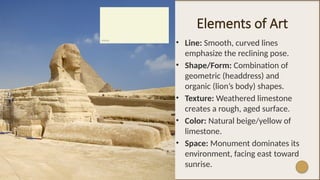
•Line: Smooth, curved lines
emphasize the reclining pose.
• Shape/Form: Combination of
geometric (headdress) and
organic (lion’s body) shapes.
• Texture: Weathered limestone
creates a rough, aged surface.
• Color: Natural beige/yellow of
limestone.
• Space: Monument dominates its
environment, facing east toward
sunrise.
5.
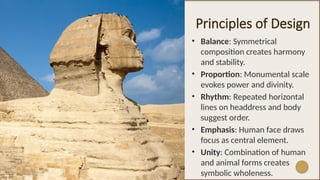
Principles of Design
•Balance: Symmetrical
composition creates harmony
and stability.
• Proportion: Monumental scale
evokes power and divinity.
• Rhythm: Repeated horizontal
lines on headdress and body
suggest order.
• Emphasis: Human face draws
focus as central element.
• Unity: Combination of human
and animal forms creates
symbolic wholeness.
6.
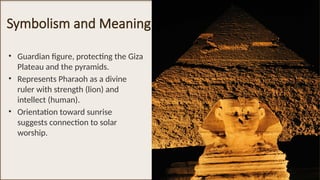
Symbolism and Meaning
•Guardian figure, protecting the Giza
Plateau and the pyramids.
• Represents Pharaoh as a divine
ruler with strength (lion) and
intellect (human).
• Orientation toward sunrise
suggests connection to solar
worship.
7.
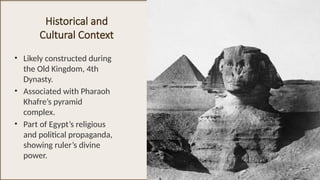
Historical and
Cultural Context
•Likely constructed during
the Old Kingdom, 4th
Dynasty.
• Associated with Pharaoh
Khafre’s pyramid
complex.
• Part of Egypt’s religious
and political propaganda,
showing ruler’s divine
power.
8.
Conclusion
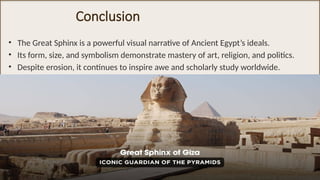
• The GreatSphinx is a powerful visual narrative of Ancient Egypt’s ideals.
• Its form, size, and symbolism demonstrate mastery of art, religion, and politics.
• Despite erosion, it continues to inspire awe and scholarly study worldwide.
9.
References
• Arnold, D.(2003). The Encyclopedia of Ancient Egyptian Architecture.
Princeton University Press.
• Lehner, M. (1997). The Complete Pyramids. Thames & Hudson.
• Shaw, I., & Nicholson, P. (2008). The British Museum Dictionary of Ancient
Egypt. AUC Press.
• Tyldesley, J. (2012). Egypt: How a Lost Civilization Was Rediscovered. UC
Press.
• Wilkinson, R. H. (2000). The Complete Temples of Ancient Egypt. Thames
& Hudson.
Editor's Notes
#1 “Good day everyone! Today I’ll be presenting a Formal Analysis of the Great Sphinx of Giza as part of our subject Reading Visual Arts. We’ll be exploring the Sphinx’s visual characteristics, its design principles, symbolism, and meaning to better understand why it remains one of the world’s most iconic monuments.”
#2 “The Great Sphinx of Giza is one of the most recognizable monuments of Ancient Egypt. Located on the Giza Plateau, it is a limestone statue with the body of a lion and the head of a human. Scholars generally agree that it was built during the reign of Pharaoh Khafre, around 2500 BCE.
#3 “When we look at the Sphinx, we immediately notice its colossal size — about 73 meters long and 20 meters high. The figure lies in a reclining position, facing east. Its head wears a nemes headdress, symbolizing pharaonic power, though the nose and ceremonial beard are missing due to erosion and damage over centuries.
The body is stretched out in a lion-like pose, symbolizing strength and guardianship, while the paws extend forward, framing a small temple area.”
#4 “Let’s look at the basic visual elements.
Line: The horizontal lines of the body create a sense of stability.
Shape & Form: The Sphinx combines organic forms (the lion’s body) and geometric order (the symmetry of the human face).
Texture: The weathered limestone surface shows erosion patterns, adding a sense of age and endurance.
Space: Its monumental scale dominates the surrounding plateau, making it the central focal point.”
#5 “The Sphinx demonstrates several design principles:
Balance: The figure is bilaterally symmetrical, giving a sense of harmony.
Proportion: The head is slightly smaller compared to the body — scholars debate whether this was intentional or due to re-carving.
Emphasis: The face draws the most attention, as it symbolizes the identity of the Pharaoh.
Unity: The lion’s body and human head merge to create a cohesive figure of divine kingship.”
#6 “Symbolically, the Sphinx represents the Pharaoh as a powerful guardian of Egypt, combining human intelligence with the lion’s strength. Facing the rising sun, it may have been linked to solar worship and protection of the necropolis. Its sheer size and placement reinforce the idea of eternal vigilance.”
#7 “Historically, the Sphinx was built during Egypt’s Old Kingdom, a time of great architectural and artistic achievement. Over centuries, it has been buried by sand, excavated, and restored multiple times, becoming a symbol of Egyptian identity. Today, it continues to attract millions of visitors and serves as a reminder of ancient innovation and cultural power.”
#8 “In conclusion, the Great Sphinx of Giza is more than just a colossal statue — it’s a masterpiece of design, symbolism, and cultural significance. Through formal analysis, we appreciate not just its visual beauty but also its deeper role as a guardian, a religious symbol, and a lasting legacy of Egypt’s civilization.”