LEARNING COMPETENCY
Explain themeaning of disaster.
LEARNING OBJECTIVES
• Identify the meaning of disaster and disaster risk
• Understand the nature of disaster
• Understand the different examples of natural and
human-made disaster
5.
DISASTER!
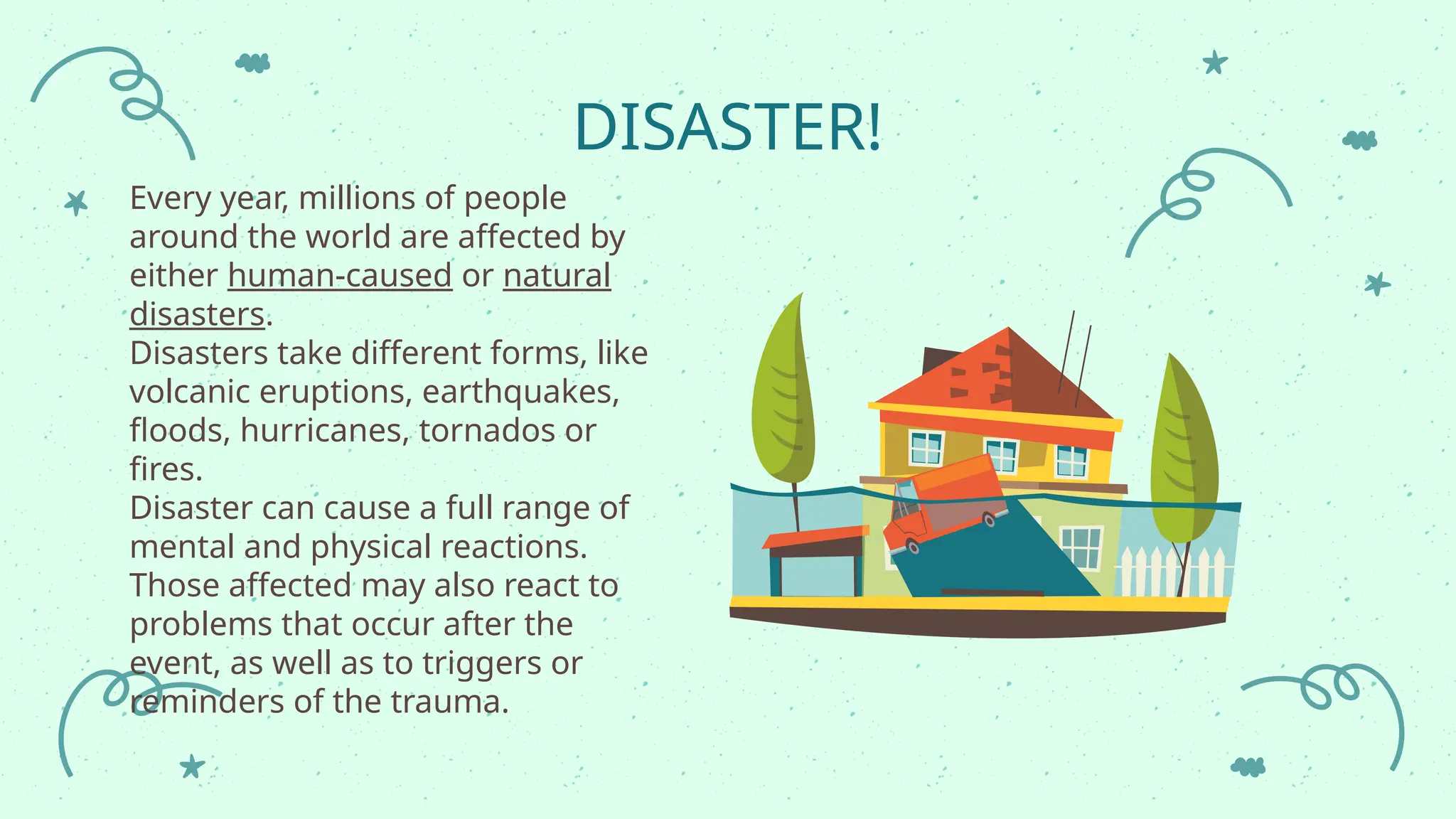
Every year, millionsof people
around the world are affected by
either human-caused or natural
disasters.
Disasters take different forms, like
volcanic eruptions, earthquakes,
floods, hurricanes, tornados or
fires.
Disaster can cause a full range of
mental and physical reactions.
Those affected may also react to
problems that occur after the
event, as well as to triggers or
reminders of the trauma.
6.
DISASTER!
DISASTER is definedas a
sudden calamitous event.
Bringing great damage, loss,
destruction
and devastation to life and
property. (Asian Disaster
Preparedness Center- ADPC,
2012).
Its origin can be natural, such as
earthquakes, floods and
hurricanes or of human origin
such as explosions, nuclear
accidents and terrorist acts.
7.
DISASTER!
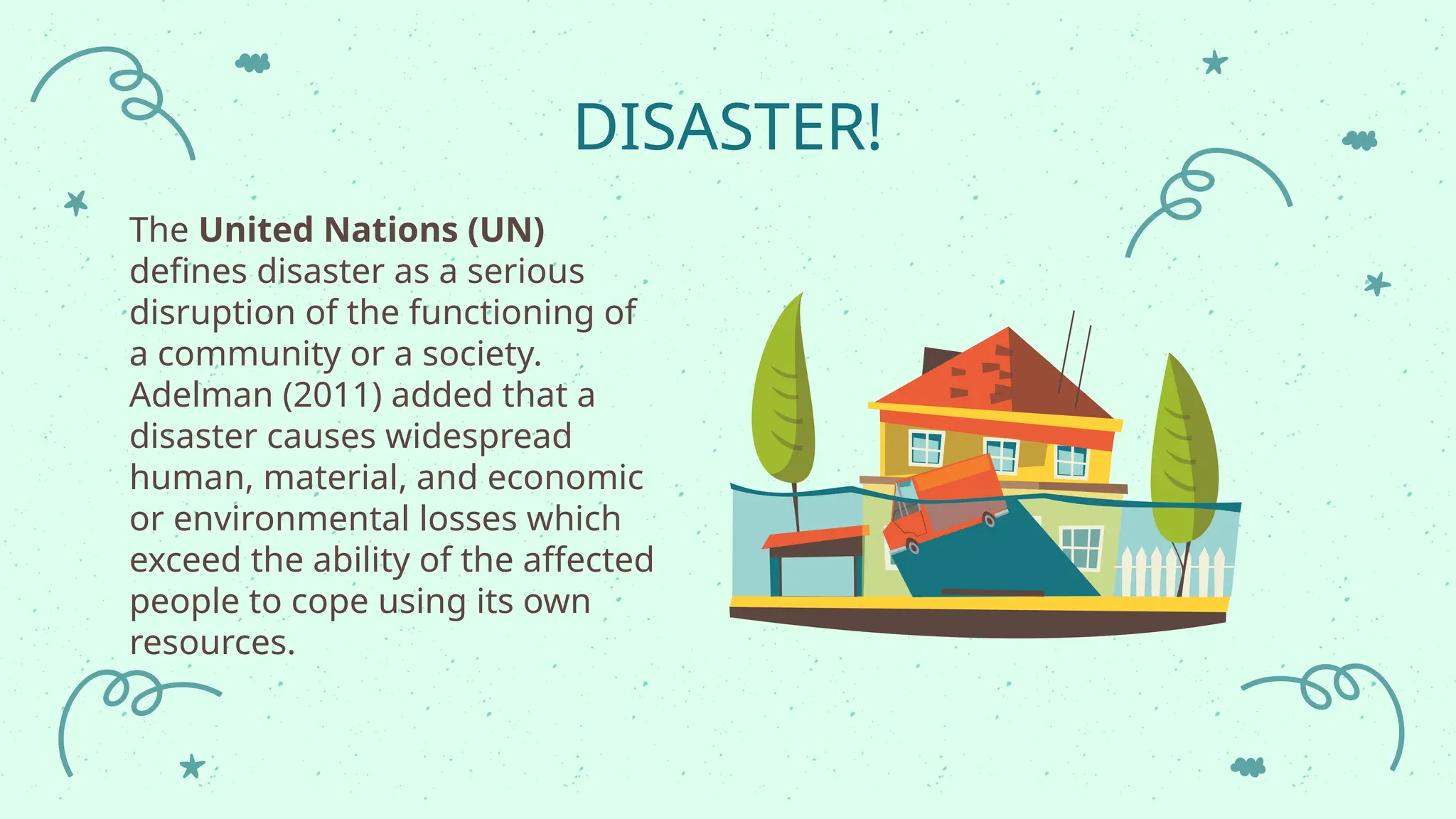
The United Nations(UN)
defines disaster as a serious
disruption of the functioning of
a community or a society.
Adelman (2011) added that a
disaster causes widespread
human, material, and economic
or environmental losses which
exceed the ability of the affected
people to cope using its own
resources.
You can entera subtitle here if you need
it
DISASTER RISK is defined as the
probability that the community
structure or geographic area
is to be damaged or disrupted
by the impact of a particular
hazard, on account of its nature,
construction and proximity to
the hazardous area. (ADPC,
2012)
10.
You can entera subtitle here if you need
it
DISASTER RISK FORMULA
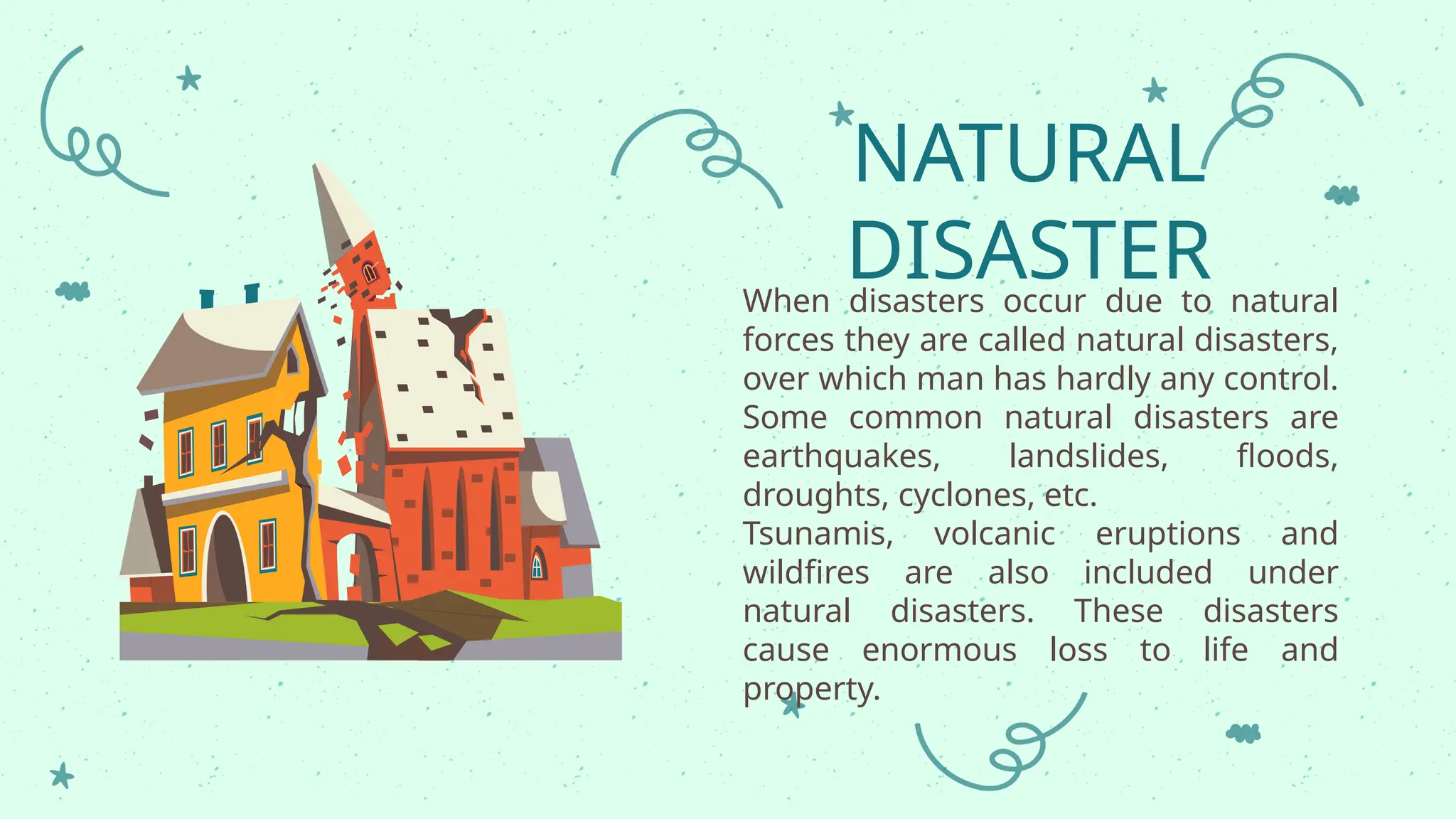
When disasters occurdue to natural
forces they are called natural disasters,
over which man has hardly any control.
Some common natural disasters are
earthquakes, landslides, floods,
droughts, cyclones, etc.
Tsunamis, volcanic eruptions and
wildfires are also included under
natural disasters. These disasters
cause enormous loss to life and
property.
NATURAL
DISASTER
13.
HUMAN-
MADE
DISASTER
When the disastersare due to
carelessness of humans or
mishandling of dangerous
equipment’s they are called man-
made disasters.
Common examples of these
disasters are train accidents, aero
plane crashes, collapse of
buildings, bridges, mines, tunnels,
etc.
NATURAL TYPES OFDISASTER
● Agricultural diseases and pest
● Storm surge
● Drought and water shortage
● Earthquakes
● Hurricanes and tropical storm
● Landslide and debris flow
● Thunderstorm and lightning
● Tornadoes
● Tsunamis
● Sinkholes
● Emergency disease (pandemic influenza/ H1N1, Spanish flu, COVID
19)
● Extreme heat
● Floods and flash floods
● La Nina
16.
HUMAN-MADE AND TECHNOLOGICAL
TYPESOF DISASTER
● Hazardous material
● Power services disruption and blackout
● Nuclear power plant and nuclear blast
● Radiological emergencies
● Chemical threat and biological weapons
● Cyber attacks
● Explosion
● Civil unrest/ war
● Foreseeable crisis