DISCRETE
MATHEMATICS
EMMA R. MAGBAYAO
(Professor)
COURSE CODE: MS101
CREDIT UNIT : 3 units
UNIVERSITY VISION STATEMENT
A dynamic center for the development of
competent and competitive human resource as
foundation for growth and advancement of the
City of Valenzuela.
UNIVERSITY MISSION STATEMENT
To provide the citizens of Valenzuela
an efficient and effective institution
of higher learning that will make
them skillful, productive, competent,
civic-minded, and God-loving toward
a peaceful, healthy, and progressive
city.
COLLEGE VISION STATEMENT
Aims to become the premier institution
of higher learning, providing the city
with competent and committed
engineers and IT professionals that will
help the development of the city of
Valenzuela and the nation.
COLLEGE MISSION STATEMENT
To develop the students of the city of
Valenzuela into top-caliber engineers and
IT professionals who are proficient,
committed, and environmentally aware,
with good leadership skills that will
comply with the needs of the city and the
nation.
The students will be graded according to the following:
• Attendance 10%
• Class Standing 20%
• Quizzes 30%
• Major Examinations 40%
Total 100%
Passing Remark 75%
Students will be assessed at other times during the term
by the following:
Examinations
Quizzes
Machine Problems
House Rules
Attendance
Absentees
Latecomers
Mobile phones
Classroom behavior
Course Syllabus
Topics:
•Logic and proofs
•Sets
•Functions
•Integers and modular arithmetic
•Sequences and summations
•Counting
•Probability
•Relations
•Graphs
• Computers use discrete structures to
represent and manipulate data.
• Computer Science is not Programming
• Computer Science is not Software Engineering
• Edsger Dijkstra: “Computer Science is no more
about computers than Astronomy is about
telescopes.”
Computer Science is about problem-solving.
WHY DISCRETE MATHEMATICS?
•Discrete Mathematics
– study of mathematical structures and
objects that are fundamentally discrete
rather than continuous.
•Examples of objects with discrete values
are
–integers, graphs, or statements in logic.
•Discrete mathematics and computer science.
 Concepts from discrete mathematics are
useful for describing objects and problems
in computer algorithms and programming
languages.
 These have applications in cryptography,
automated theorem proving, and software
development.
 Mathematics is at the heart of problem-solving
 Defining a problem requires mathematical rigor
 Use and analysis of models, data structures, and
algorithms requires a solid foundation of
mathematics
 To justify why a particular way of solving a
problem is correct or efficient (i.e., better than
another way) requires analysis with a well-defined
mathematical model.
•WHY DISCRETE MATHEMATICS?
• Your boss is not going to ask you to solve
- an MST (Minimal Spanning Tree) or
- a TSP (Travelling Salesperson Problem)
• Rarely will you encounter a problem in an
abstract setting
• However, he/she may ask you to build a
rotation of the company’s delivery trucks to
minimize fuel usage
• It is up to you to determine
- a proper model for representing the problem
and
PROBLEM SOLVING REQUIRES MATHEMATICAL
RIGOR
A limo company has hired you/your company to write
a computer program to automate the following tasks
for a large event.
TASK1: IN THE FIRST SCENARIO, BUSINESSES
REQUEST
- limos and drivers
- for a fixed period of time, specifying a start
data/time and end date/time and
- a flat charge rate
• The program must generate a schedule that
accommodates the maximum number of
SCENARIO I
• TASK 2: IN THE SECOND SCENARIO
- the limo service allows customers to bid on a
ride
- so that the highest bidder gets a limo when
there aren’t
enough limos available
• The program should make a schedule that
- is feasible (no limo is assigned to two or more
customers at the same time)
- While maximizing the total profit
SCENARIO II
• TASK 3: HERE EACH CUSTOMER
- is allowed to specify a set of various times
and
- bid an amount for the entire event.
- The limo service must choose to accept
the entire set of times or reject it
• The program must again maximize the
profit.
SCENARIO III
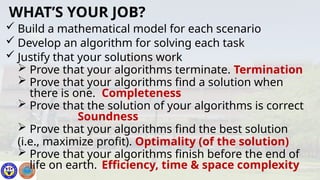
 Build a mathematical model for each scenario
 Develop an algorithm for solving each task
 Justify that your solutions work
 Prove that your algorithms terminate. Termination
 Prove that your algorithms find a solution when
there is one. Completeness
 Prove that the solution of your algorithms is correct
Soundness
 Prove that your algorithms find the best solution
(i.e., maximize profit). Optimality (of the solution)
 Prove that your algorithms finish before the end of
life on earth. Efficiency, time & space complexity
WHAT’S YOUR JOB?
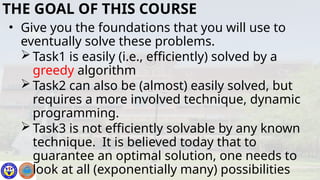
• Give you the foundations that you will use to
eventually solve these problems.
 Task1 is easily (i.e., efficiently) solved by a
greedy algorithm
 Task2 can also be (almost) easily solved, but
requires a more involved technique, dynamic
programming.
 Task3 is not efficiently solvable by any known
technique. It is believed today that to
guarantee an optimal solution, one needs to
look at all (exponentially many) possibilities
THE GOAL OF THIS COURSE
•Digital computers are based on
discrete “atoms” (bits).
•Therefore, both a computer’s
- structure (circuits) and
- operations (execution of algorithms)
can be described by discrete math.
WHY CARE ABOUT DISCRETE
MATH?
Useful tools for discrete mathematics:
•Logic
•Set Theory
•Functions
•Sequences
MATHEMATICAL
APPETIZERS
Crucial for mathematical reasoning
Used for designing electronic circuitry
Logic is a system based on propositions.
A proposition is a statement that is either true
or false (not both).
We say that the truth value of a proposition is
either true (T) or false (F).
Corresponds to 1 and 0 in digital circuits
•LOGIC
Logic
•defines a formal language for representing
knowledge and for making logical inferences
•It helps us to understand how to construct a
valid argument
Logic defines:
•Syntax of statements
•The meaning of statements
•The rules of logical inference (manipulation)
Propositional logic
• The simplest logic
– A proposition is a statement that is either
true or false.
• Examples:
– Pitt is located in the Oakland section of
Pittsburgh. (T)
– 5+2=8. • (F)
– It is raining today. • (either T or F)
Propositional logic
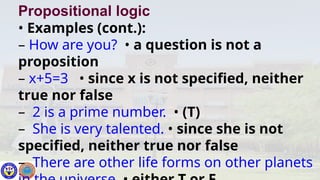
• Examples (cont.):
– How are you? • a question is not a
proposition
– x+5=3 • since x is not specified, neither
true nor false
– 2 is a prime number. • (T)
– She is very talented. • since she is not
specified, neither true nor false
– There are other life forms on other planets
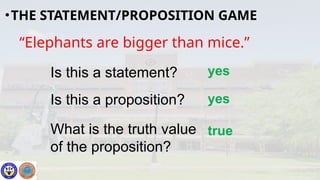
“Elephants are bigger than mice.”
•THE STATEMENT/PROPOSITION GAME
Is this a statement? yes
Is this a proposition? yes
What is the truth value
of the proposition?
true
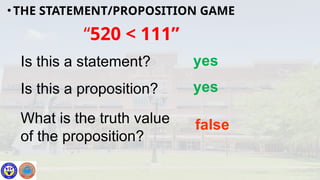
“520 < 111”
• THE STATEMENT/PROPOSITION GAME
Is this a statement? yes
Is this a proposition? yes
What is the truth value
of the proposition?
false
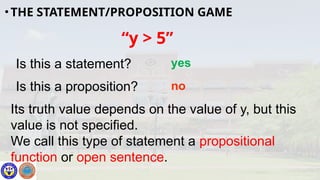
“y > 5”
• THE STATEMENT/PROPOSITION GAME
Is this a statement? yes
Is this a proposition? no
Its truth value depends on the value of y, but this
value is not specified.
We call this type of statement a propositional
function or open sentence.
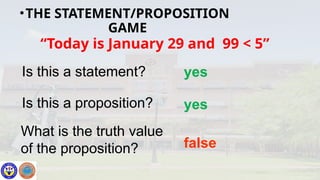
“Today is January 29 and 99 < 5”
•THE STATEMENT/PROPOSITION
GAME
Is this a statement? yes
Is this a proposition? yes
What is the truth value
of the proposition? false
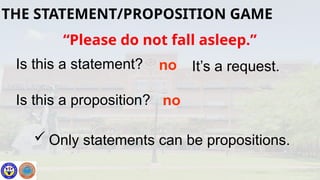
“Please do not fall asleep.”
Is this a statement? no
Is this a proposition? no
 Only statements can be propositions.
It’s a request.
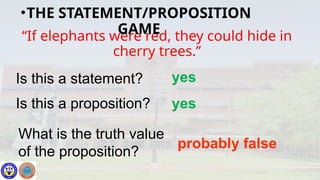
•THE STATEMENT/PROPOSITION GAME
“If elephants were red, they could hide in
cherry trees.”
Is this a statement? yes
Is this a proposition? yes
What is the truth value
of the proposition?
probably false
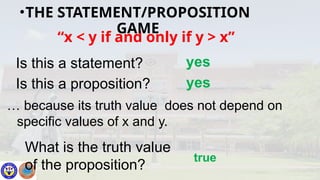
•THE STATEMENT/PROPOSITION
GAME
“x < y if and only if y > x”
Is this a statement? yes
Is this a proposition? yes
What is the truth value
of the proposition?
true
… because its truth value does not depend on
specific values of x and y.
•THE STATEMENT/PROPOSITION
GAME
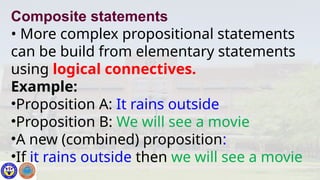
Composite statements
• More complex propositional statements
can be build from elementary statements
using logical connectives.
Example:
•Proposition A: It rains outside
•Proposition B: We will see a movie
•A new (combined) proposition:
•If it rains outside then we will see a movie
As we have seen in the previous examples,
one or more propositions can be combined
to form a single compound
proposition/composite statements.
We formalize this by denoting propositions
with letters such as p, q, r, s, and
introducing several logical operators.
•COMBINING PROPOSITIONS
The following logical operators:
• Negation (NOT)
• Conjunction (AND)
• Disjunction (OR)
• Exclusive or (XOR)
• Implication (if – then)
• Biconditional (if and only if)
LOGICAL OPERATORS
(CONNECTIVES)
Truth tables can be
used to show how
these operators
can combine
propositions to
compound
propositions.
Negation
Definition: Let p be a proposition. The statement "It is not
the case that p." is another proposition, called the negation
of p. The negation of p is denoted by ¬ p and read as "not
p."
Example:
•Pitt is located in the Oakland section of Pittsburgh.
 It is not the case that Pitt is located in the Oakland
section of Pittsburgh.
Other examples:
– 5+2 8.
– 10 is not a prime number.
– It is not the case that buses stop running at 9:00pm.
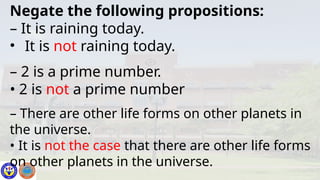
Negate the following propositions:
– It is raining today.
• It is not raining today.
– 2 is a prime number.
• 2 is not a prime number
– There are other life forms on other planets in
the universe.
• It is not the case that there are other life forms
on other planets in the universe.
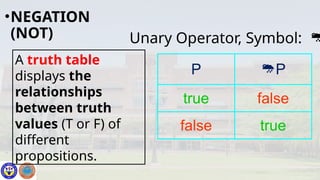
Unary Operator, Symbol: 
•NEGATION
(NOT)
P P
true false
false true
A truth table
displays the
relationships
between truth
values (T or F) of
different
propositions.
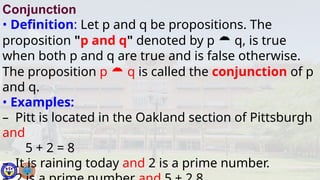
Conjunction
• Definition: Let p and q be propositions. The
proposition "p and q" denoted by p  q, is true
when both p and q are true and is false otherwise.
The proposition p  q is called the conjunction of p
and q.
• Examples:
– Pitt is located in the Oakland section of Pittsburgh
and
5 + 2 = 8
– It is raining today and 2 is a prime number.
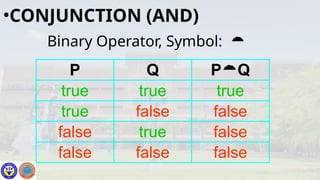
Binary Operator, Symbol: 
•CONJUNCTION (AND)
P Q PQ
true true true
true false false
false true false
false false false
Disjunction
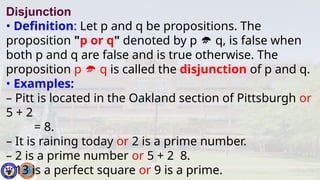
• Definition: Let p and q be propositions. The
proposition "p or q" denoted by p  q, is false when
both p and q are false and is true otherwise. The
proposition p  q is called the disjunction of p and q.
• Examples:
– Pitt is located in the Oakland section of Pittsburgh or
5 + 2
= 8.
– It is raining today or 2 is a prime number.
– 2 is a prime number or 5 + 2 8.
– 13 is a perfect square or 9 is a prime.
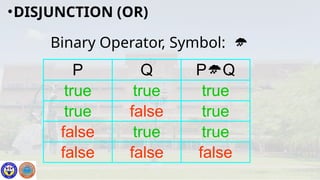
Binary Operator, Symbol: 
•DISJUNCTION (OR)
P Q PQ
true true true
true false true
false true true
false false false
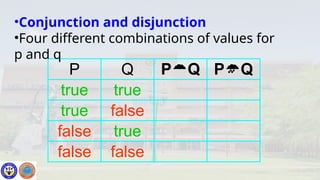
P Q PQ PQ
true true
true false
false true
false false
•Conjunction and disjunction
•Four different combinations of values for
p and q
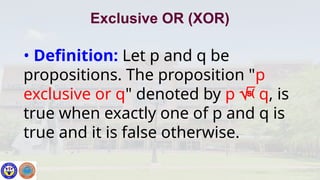
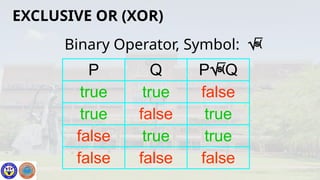
• Definition: Let p and q be
propositions. The proposition "p
exclusive or q" denoted by p  q, is
true when exactly one of p and q is
true and it is false otherwise.
Exclusive OR (XOR)
Binary Operator, Symbol: 
P Q PQ
true true false
true false true
false true true
false false false
EXCLUSIVE OR (XOR)
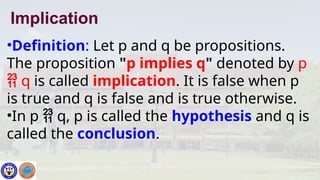
•Definition: Let p and q be propositions.
The proposition "p implies q" denoted by p
 q is called implication. It is false when p
is true and q is false and is true otherwise.
•In p  q, p is called the hypothesis and q is
called the conclusion.
Implication
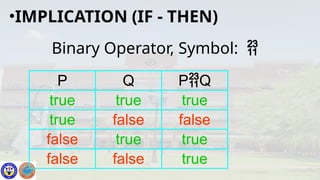
Binary Operator, Symbol: 
•IMPLICATION (IF - THEN)
P Q PQ
true true true
true false false
false true true
false false true
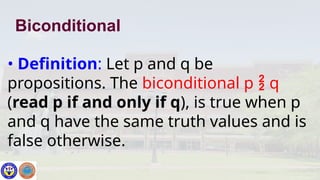
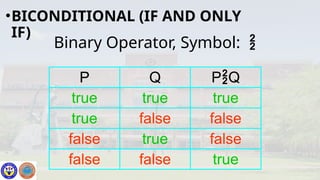
• Definition: Let p and q be
propositions. The biconditional p  q
(read p if and only if q), is true when p
and q have the same truth values and is
false otherwise.
Biconditional
Binary Operator, Symbol: 
•BICONDITIONAL (IF AND ONLY
IF)
P Q PQ
true true true
true false false
false true false
false false true
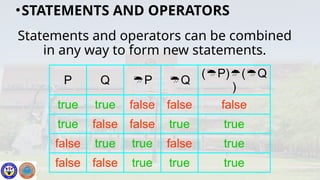
Statements and operators can be combined
in any way to form new statements.
•STATEMENTS AND OPERATORS
P Q P Q
(P)(Q
)
true true false false false
true false false true true
false true true false true
false false true true true
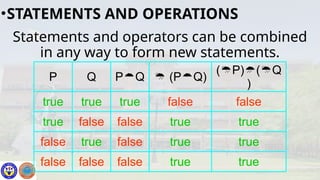
Statements and operators can be combined
in any way to form new statements.
•STATEMENTS AND OPERATIONS
P Q PQ  (PQ)
(P)(Q
)
true true true false false
true false false true true
false true false true true
false false false true true
Thank you for listening!
GOD bless you all!

Stud copy Discrete Math Week1&222222.pptx

  • 1.
  • 2.
    UNIVERSITY VISION STATEMENT Adynamic center for the development of competent and competitive human resource as foundation for growth and advancement of the City of Valenzuela.
  • 3.
    UNIVERSITY MISSION STATEMENT Toprovide the citizens of Valenzuela an efficient and effective institution of higher learning that will make them skillful, productive, competent, civic-minded, and God-loving toward a peaceful, healthy, and progressive city.
  • 4.
    COLLEGE VISION STATEMENT Aimsto become the premier institution of higher learning, providing the city with competent and committed engineers and IT professionals that will help the development of the city of Valenzuela and the nation.
  • 5.
    COLLEGE MISSION STATEMENT Todevelop the students of the city of Valenzuela into top-caliber engineers and IT professionals who are proficient, committed, and environmentally aware, with good leadership skills that will comply with the needs of the city and the nation.
  • 6.
    The students willbe graded according to the following: • Attendance 10% • Class Standing 20% • Quizzes 30% • Major Examinations 40% Total 100% Passing Remark 75% Students will be assessed at other times during the term by the following: Examinations Quizzes Machine Problems
  • 7.
  • 8.
    Course Syllabus Topics: •Logic andproofs •Sets •Functions •Integers and modular arithmetic •Sequences and summations •Counting •Probability •Relations •Graphs
  • 9.
    • Computers usediscrete structures to represent and manipulate data. • Computer Science is not Programming • Computer Science is not Software Engineering • Edsger Dijkstra: “Computer Science is no more about computers than Astronomy is about telescopes.” Computer Science is about problem-solving. WHY DISCRETE MATHEMATICS?
  • 10.
    •Discrete Mathematics – studyof mathematical structures and objects that are fundamentally discrete rather than continuous. •Examples of objects with discrete values are –integers, graphs, or statements in logic.
  • 11.
    •Discrete mathematics andcomputer science.  Concepts from discrete mathematics are useful for describing objects and problems in computer algorithms and programming languages.  These have applications in cryptography, automated theorem proving, and software development.
  • 12.
     Mathematics isat the heart of problem-solving  Defining a problem requires mathematical rigor  Use and analysis of models, data structures, and algorithms requires a solid foundation of mathematics  To justify why a particular way of solving a problem is correct or efficient (i.e., better than another way) requires analysis with a well-defined mathematical model. •WHY DISCRETE MATHEMATICS?
  • 13.
    • Your bossis not going to ask you to solve - an MST (Minimal Spanning Tree) or - a TSP (Travelling Salesperson Problem) • Rarely will you encounter a problem in an abstract setting • However, he/she may ask you to build a rotation of the company’s delivery trucks to minimize fuel usage • It is up to you to determine - a proper model for representing the problem and PROBLEM SOLVING REQUIRES MATHEMATICAL RIGOR
  • 14.
    A limo companyhas hired you/your company to write a computer program to automate the following tasks for a large event. TASK1: IN THE FIRST SCENARIO, BUSINESSES REQUEST - limos and drivers - for a fixed period of time, specifying a start data/time and end date/time and - a flat charge rate • The program must generate a schedule that accommodates the maximum number of SCENARIO I
  • 15.
    • TASK 2:IN THE SECOND SCENARIO - the limo service allows customers to bid on a ride - so that the highest bidder gets a limo when there aren’t enough limos available • The program should make a schedule that - is feasible (no limo is assigned to two or more customers at the same time) - While maximizing the total profit SCENARIO II
  • 16.
    • TASK 3:HERE EACH CUSTOMER - is allowed to specify a set of various times and - bid an amount for the entire event. - The limo service must choose to accept the entire set of times or reject it • The program must again maximize the profit. SCENARIO III
  • 17.
     Build amathematical model for each scenario  Develop an algorithm for solving each task  Justify that your solutions work  Prove that your algorithms terminate. Termination  Prove that your algorithms find a solution when there is one. Completeness  Prove that the solution of your algorithms is correct Soundness  Prove that your algorithms find the best solution (i.e., maximize profit). Optimality (of the solution)  Prove that your algorithms finish before the end of life on earth. Efficiency, time & space complexity WHAT’S YOUR JOB?
  • 18.
    • Give youthe foundations that you will use to eventually solve these problems.  Task1 is easily (i.e., efficiently) solved by a greedy algorithm  Task2 can also be (almost) easily solved, but requires a more involved technique, dynamic programming.  Task3 is not efficiently solvable by any known technique. It is believed today that to guarantee an optimal solution, one needs to look at all (exponentially many) possibilities THE GOAL OF THIS COURSE
  • 19.
    •Digital computers arebased on discrete “atoms” (bits). •Therefore, both a computer’s - structure (circuits) and - operations (execution of algorithms) can be described by discrete math. WHY CARE ABOUT DISCRETE MATH?
  • 20.
    Useful tools fordiscrete mathematics: •Logic •Set Theory •Functions •Sequences MATHEMATICAL APPETIZERS
  • 21.
    Crucial for mathematicalreasoning Used for designing electronic circuitry Logic is a system based on propositions. A proposition is a statement that is either true or false (not both). We say that the truth value of a proposition is either true (T) or false (F). Corresponds to 1 and 0 in digital circuits •LOGIC
  • 22.
    Logic •defines a formallanguage for representing knowledge and for making logical inferences •It helps us to understand how to construct a valid argument Logic defines: •Syntax of statements •The meaning of statements •The rules of logical inference (manipulation)
  • 23.
    Propositional logic • Thesimplest logic – A proposition is a statement that is either true or false. • Examples: – Pitt is located in the Oakland section of Pittsburgh. (T) – 5+2=8. • (F) – It is raining today. • (either T or F)
  • 24.
    Propositional logic • Examples(cont.): – How are you? • a question is not a proposition – x+5=3 • since x is not specified, neither true nor false – 2 is a prime number. • (T) – She is very talented. • since she is not specified, neither true nor false – There are other life forms on other planets
  • 25.
    “Elephants are biggerthan mice.” •THE STATEMENT/PROPOSITION GAME Is this a statement? yes Is this a proposition? yes What is the truth value of the proposition? true
  • 26.
    “520 < 111” •THE STATEMENT/PROPOSITION GAME Is this a statement? yes Is this a proposition? yes What is the truth value of the proposition? false
  • 27.
    “y > 5” •THE STATEMENT/PROPOSITION GAME Is this a statement? yes Is this a proposition? no Its truth value depends on the value of y, but this value is not specified. We call this type of statement a propositional function or open sentence.
  • 28.
    “Today is January29 and 99 < 5” •THE STATEMENT/PROPOSITION GAME Is this a statement? yes Is this a proposition? yes What is the truth value of the proposition? false
  • 29.
    “Please do notfall asleep.” Is this a statement? no Is this a proposition? no  Only statements can be propositions. It’s a request. •THE STATEMENT/PROPOSITION GAME
  • 30.
    “If elephants werered, they could hide in cherry trees.” Is this a statement? yes Is this a proposition? yes What is the truth value of the proposition? probably false •THE STATEMENT/PROPOSITION GAME
  • 31.
    “x < yif and only if y > x” Is this a statement? yes Is this a proposition? yes What is the truth value of the proposition? true … because its truth value does not depend on specific values of x and y. •THE STATEMENT/PROPOSITION GAME
  • 32.
    Composite statements • Morecomplex propositional statements can be build from elementary statements using logical connectives. Example: •Proposition A: It rains outside •Proposition B: We will see a movie •A new (combined) proposition: •If it rains outside then we will see a movie
  • 33.
    As we haveseen in the previous examples, one or more propositions can be combined to form a single compound proposition/composite statements. We formalize this by denoting propositions with letters such as p, q, r, s, and introducing several logical operators. •COMBINING PROPOSITIONS
  • 34.
    The following logicaloperators: • Negation (NOT) • Conjunction (AND) • Disjunction (OR) • Exclusive or (XOR) • Implication (if – then) • Biconditional (if and only if) LOGICAL OPERATORS (CONNECTIVES) Truth tables can be used to show how these operators can combine propositions to compound propositions.
  • 35.
    Negation Definition: Let pbe a proposition. The statement "It is not the case that p." is another proposition, called the negation of p. The negation of p is denoted by ¬ p and read as "not p." Example: •Pitt is located in the Oakland section of Pittsburgh.  It is not the case that Pitt is located in the Oakland section of Pittsburgh. Other examples: – 5+2 8. – 10 is not a prime number. – It is not the case that buses stop running at 9:00pm.
  • 36.
    Negate the followingpropositions: – It is raining today. • It is not raining today. – 2 is a prime number. • 2 is not a prime number – There are other life forms on other planets in the universe. • It is not the case that there are other life forms on other planets in the universe.
  • 37.
    Unary Operator, Symbol: •NEGATION (NOT) P P true false false true A truth table displays the relationships between truth values (T or F) of different propositions.
  • 38.
    Conjunction • Definition: Letp and q be propositions. The proposition "p and q" denoted by p  q, is true when both p and q are true and is false otherwise. The proposition p  q is called the conjunction of p and q. • Examples: – Pitt is located in the Oakland section of Pittsburgh and 5 + 2 = 8 – It is raining today and 2 is a prime number.
  • 39.
    Binary Operator, Symbol: •CONJUNCTION (AND) P Q PQ true true true true false false false true false false false false
  • 40.
    Disjunction • Definition: Letp and q be propositions. The proposition "p or q" denoted by p  q, is false when both p and q are false and is true otherwise. The proposition p  q is called the disjunction of p and q. • Examples: – Pitt is located in the Oakland section of Pittsburgh or 5 + 2 = 8. – It is raining today or 2 is a prime number. – 2 is a prime number or 5 + 2 8. – 13 is a perfect square or 9 is a prime.
  • 41.
    Binary Operator, Symbol: •DISJUNCTION (OR) P Q PQ true true true true false true false true true false false false
  • 42.
    P Q PQPQ true true true false false true false false •Conjunction and disjunction •Four different combinations of values for p and q
  • 43.
    • Definition: Letp and q be propositions. The proposition "p exclusive or q" denoted by p  q, is true when exactly one of p and q is true and it is false otherwise. Exclusive OR (XOR)
  • 44.
    Binary Operator, Symbol: P Q PQ true true false true false true false true true false false false EXCLUSIVE OR (XOR)
  • 45.
    •Definition: Let pand q be propositions. The proposition "p implies q" denoted by p  q is called implication. It is false when p is true and q is false and is true otherwise. •In p  q, p is called the hypothesis and q is called the conclusion. Implication
  • 46.
    Binary Operator, Symbol: •IMPLICATION (IF - THEN) P Q PQ true true true true false false false true true false false true
  • 47.
    • Definition: Letp and q be propositions. The biconditional p  q (read p if and only if q), is true when p and q have the same truth values and is false otherwise. Biconditional
  • 48.
    Binary Operator, Symbol: •BICONDITIONAL (IF AND ONLY IF) P Q PQ true true true true false false false true false false false true
  • 49.
    Statements and operatorscan be combined in any way to form new statements. •STATEMENTS AND OPERATORS P Q P Q (P)(Q ) true true false false false true false false true true false true true false true false false true true true
  • 50.
    Statements and operatorscan be combined in any way to form new statements. •STATEMENTS AND OPERATIONS P Q PQ  (PQ) (P)(Q ) true true true false false true false false true true false true false true true false false false true true
  • 51.
    Thank you forlistening! GOD bless you all!

Editor's Notes

  • #7 Absenteesim, late comings, class participation, cellphone usage..