DIABETES
MELLITUS
Presenters:
1. Akanksha Jha-09
2. Anshumita P. Mahanta-18
3. Ameera Ahmad-13
4. Aman-12
5. Amritash Amrit-14
6. Bikramjit Banerjee-43
• Introduction and Pathogenesis
• Classification and Complications
• Problem Statement
• Epidemiological Determinants
• Diagnostic Methods
• Control and Prevention
• National Programmes
CONTENTS
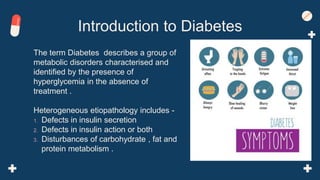
The term Diabetes describes a group of
metabolic disorders characterised and
identified by the presence of
hyperglycemia in the absence of
treatment .
Heterogeneous etiopathology includes -
1. Defects in insulin secretion
2. Defects in insulin action or both
3. Disturbances of carbohydrate , fat and
protein metabolism .
Introduction to Diabetes
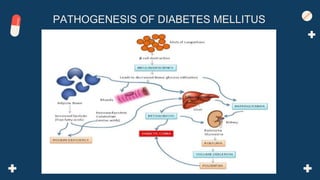
PATHOGENESIS OF DIABETES MELLITUS
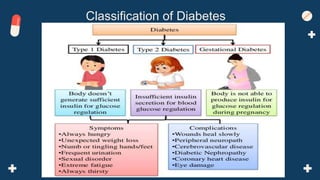
Classification of Diabetes
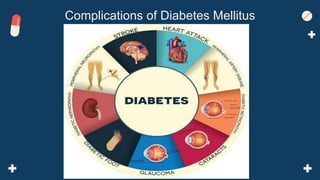
Complications of Diabetes Mellitus
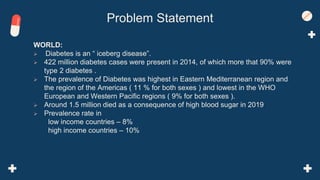
WORLD:
 Diabetes is an “ iceberg disease”.
 422 million diabetes cases were present in 2014, of which more that 90% were
type 2 diabetes .
 The prevalence of Diabetes was highest in Eastern Mediterranean region and
the region of the Americas ( 11 % for both sexes ) and lowest in the WHO
European and Western Pacific regions ( 9% for both sexes ).
 Around 1.5 million died as a consequence of high blood sugar in 2019
 Prevalence rate in
low income countries – 8%
high income countries – 10%
Problem Statement
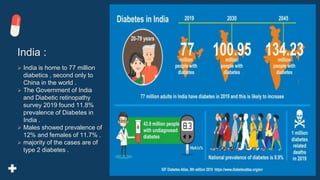
India :
 India is home to 77 million
diabetics , second only to
China in the world .
 The Government of India
and Diabetic retinopathy
survey 2019 found 11.8%
prevalence of Diabetes in
India .
 Males showed prevalence of
12% and females of 11.7% .
 majority of the cases are of
type 2 diabetes .
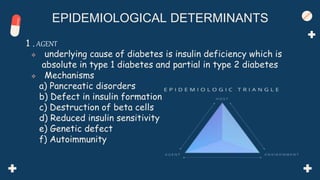
1 . AGENT
 underlying cause of diabetes is insulin deficiency which is
absolute in type 1 diabetes and partial in type 2 diabetes
 Mechanisms
a) Pancreatic disorders
b) Defect in insulin formation
c) Destruction of beta cells
d) Reduced insulin sensitivity
e) Genetic defect
f) Autoimmunity
EPIDEMIOLOGICAL DETERMINANTS
2. Host factors
 Age : Prevalence rises with age
 Sex : In some countries male to female ratio is equal
 Genetic factors : In identical twins, concordance of type 2
diabetes was 90% and type diabetes was about 50%
 Genetic markers : Type 1 – HLA-DR3, HLA-DR4, HLA-
B8,HLA-B15
Type 2 – not HLA associated
 Immune mechanisms : some evidence of both cell mediated
and of humoral activity against islet cells
 Obesity : Risk factor for type 2 diabetes
 Maternal diabetes : Offsprings of diabetic pregnancies are
often large and heavy at birth, tend to develop obesity in
childhood and are at a high risk of developing type 2
diabetes
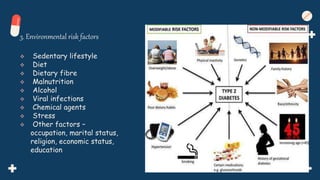
3. Environmental risk factors
 Sedentary lifestyle
 Diet
 Dietary fibre
 Malnutrition
 Alcohol
 Viral infections
 Chemical agents
 Stress
 Other factors –
occupation, marital status,
religion, economic status,
education
T 0
Screening for Diabetes
URINE EXAMINATION -
1. Urine test for glucose
2 hr after meal
2. Often absent in milder
form of diabetes
3. This test yields too
many false negative
results
4. Not considered
appropriate for
surveys
BLOOD SUGAR TESTING –
1. Standard oral glucose
tolerance test remains the
cornerstone of diagnosis of
diabetes .
2. Glucose measurements of
fasting , postprandial or
random blood sample are
used .
3. 2 hour value after 75gm
oral glucose is used .
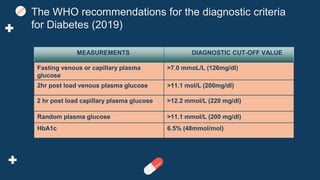
The WHO recommendations for the diagnostic criteria
for Diabetes (2019)
MEASUREMENTS DIAGNOSTIC CUT-OFF VALUE
Fasting venous or capillary plasma
glucose
>7.0 mmoL/L (126mg/dl)
2hr post load venous plasma glucose >11.1 mol/L (200mg/dl)
2 hr post load capillary plasma glucose >12.2 mmol/L (220 mg/dl)
Random plasma glucose >11.1 mmol/L (200 mg/dl)
HbA1c 6.5% (48mmol/mol)
1 . Primary Prevention
Prevention and Care
A . Primordial prevention -
i. Prevention of the
emergence of risk factors
.
ii. Preventive measures
comprise - maintenance of
normal body weight ,
adoption of healthy
nutritional habits , physical
exercise .
B . High Risk Strategy -
i. Correction of sedentary
lifestyle , overnutrition and
obesity
ii. Reduce the risk by avoiding
diabetogenic drugs like oral
contraceptives
iii. Reduce factors that promote
atherosclerosis like smoking ,
high blood pressure , elevated
cholesterol and high
triglyceride levels .
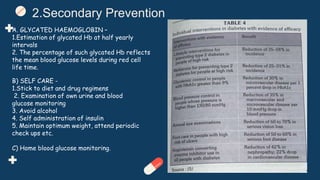
2.Secondary Prevention
A. GLYCATED HAEMOGLOBIN –
1.Estimation of glycated Hb at half yearly
intervals
2. The percentage of such glycated Hb reflects
the mean blood glucose levels during red cell
life time.
B) SELF CARE -
1.Stick to diet and drug regimens
2. Examination of own urine and blood
glucose monitoring
3. Avoid alcohol
4. Self administration of insulin
5. Maintain optimum weight, attend periodic
check ups etc.
C) Home blood glucose monitoring.
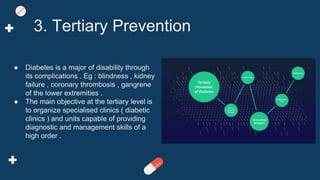
● Diabetes is a major of disability through
its complications . Eg : blindness , kidney
failure , coronary thrombosis , gangrene
of the lower extremities .
● The main objective at the tertiary level is
to organize specialised clinics ( diabetic
clinics ) and units capable of providing
diagnostic and management skills of a
high order .
3. Tertiary Prevention
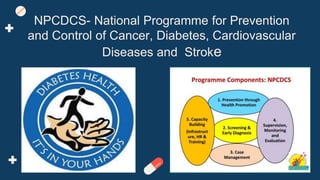
NPCDCS- National Programme for Prevention
and Control of Cancer, Diabetes, Cardiovascular
Diseases and Stroke
T
H
A
N
K
Y
O
U

Diabetes psm presentation.pptx

  • 1.
    DIABETES MELLITUS Presenters: 1. Akanksha Jha-09 2.Anshumita P. Mahanta-18 3. Ameera Ahmad-13 4. Aman-12 5. Amritash Amrit-14 6. Bikramjit Banerjee-43
  • 2.
    • Introduction andPathogenesis • Classification and Complications • Problem Statement • Epidemiological Determinants • Diagnostic Methods • Control and Prevention • National Programmes CONTENTS
  • 3.
    The term Diabetesdescribes a group of metabolic disorders characterised and identified by the presence of hyperglycemia in the absence of treatment . Heterogeneous etiopathology includes - 1. Defects in insulin secretion 2. Defects in insulin action or both 3. Disturbances of carbohydrate , fat and protein metabolism . Introduction to Diabetes
  • 4.
  • 5.
  • 6.
  • 7.
    WORLD:  Diabetes isan “ iceberg disease”.  422 million diabetes cases were present in 2014, of which more that 90% were type 2 diabetes .  The prevalence of Diabetes was highest in Eastern Mediterranean region and the region of the Americas ( 11 % for both sexes ) and lowest in the WHO European and Western Pacific regions ( 9% for both sexes ).  Around 1.5 million died as a consequence of high blood sugar in 2019  Prevalence rate in low income countries – 8% high income countries – 10% Problem Statement
  • 8.
    India :  Indiais home to 77 million diabetics , second only to China in the world .  The Government of India and Diabetic retinopathy survey 2019 found 11.8% prevalence of Diabetes in India .  Males showed prevalence of 12% and females of 11.7% .  majority of the cases are of type 2 diabetes .
  • 9.
    1 . AGENT underlying cause of diabetes is insulin deficiency which is absolute in type 1 diabetes and partial in type 2 diabetes  Mechanisms a) Pancreatic disorders b) Defect in insulin formation c) Destruction of beta cells d) Reduced insulin sensitivity e) Genetic defect f) Autoimmunity EPIDEMIOLOGICAL DETERMINANTS
  • 10.
    2. Host factors Age : Prevalence rises with age  Sex : In some countries male to female ratio is equal  Genetic factors : In identical twins, concordance of type 2 diabetes was 90% and type diabetes was about 50%  Genetic markers : Type 1 – HLA-DR3, HLA-DR4, HLA- B8,HLA-B15 Type 2 – not HLA associated  Immune mechanisms : some evidence of both cell mediated and of humoral activity against islet cells  Obesity : Risk factor for type 2 diabetes  Maternal diabetes : Offsprings of diabetic pregnancies are often large and heavy at birth, tend to develop obesity in childhood and are at a high risk of developing type 2 diabetes
  • 11.
    3. Environmental riskfactors  Sedentary lifestyle  Diet  Dietary fibre  Malnutrition  Alcohol  Viral infections  Chemical agents  Stress  Other factors – occupation, marital status, religion, economic status, education
  • 12.
    T 0 Screening forDiabetes URINE EXAMINATION - 1. Urine test for glucose 2 hr after meal 2. Often absent in milder form of diabetes 3. This test yields too many false negative results 4. Not considered appropriate for surveys BLOOD SUGAR TESTING – 1. Standard oral glucose tolerance test remains the cornerstone of diagnosis of diabetes . 2. Glucose measurements of fasting , postprandial or random blood sample are used . 3. 2 hour value after 75gm oral glucose is used .
  • 13.
    The WHO recommendationsfor the diagnostic criteria for Diabetes (2019) MEASUREMENTS DIAGNOSTIC CUT-OFF VALUE Fasting venous or capillary plasma glucose >7.0 mmoL/L (126mg/dl) 2hr post load venous plasma glucose >11.1 mol/L (200mg/dl) 2 hr post load capillary plasma glucose >12.2 mmol/L (220 mg/dl) Random plasma glucose >11.1 mmol/L (200 mg/dl) HbA1c 6.5% (48mmol/mol)
  • 14.
    1 . PrimaryPrevention Prevention and Care A . Primordial prevention - i. Prevention of the emergence of risk factors . ii. Preventive measures comprise - maintenance of normal body weight , adoption of healthy nutritional habits , physical exercise . B . High Risk Strategy - i. Correction of sedentary lifestyle , overnutrition and obesity ii. Reduce the risk by avoiding diabetogenic drugs like oral contraceptives iii. Reduce factors that promote atherosclerosis like smoking , high blood pressure , elevated cholesterol and high triglyceride levels .
  • 15.
    2.Secondary Prevention A. GLYCATEDHAEMOGLOBIN – 1.Estimation of glycated Hb at half yearly intervals 2. The percentage of such glycated Hb reflects the mean blood glucose levels during red cell life time. B) SELF CARE - 1.Stick to diet and drug regimens 2. Examination of own urine and blood glucose monitoring 3. Avoid alcohol 4. Self administration of insulin 5. Maintain optimum weight, attend periodic check ups etc. C) Home blood glucose monitoring.
  • 16.
    ● Diabetes isa major of disability through its complications . Eg : blindness , kidney failure , coronary thrombosis , gangrene of the lower extremities . ● The main objective at the tertiary level is to organize specialised clinics ( diabetic clinics ) and units capable of providing diagnostic and management skills of a high order . 3. Tertiary Prevention
  • 17.
    NPCDCS- National Programmefor Prevention and Control of Cancer, Diabetes, Cardiovascular Diseases and Stroke
  • 19.