Paracetamol Tablets
© Clearsky Pharmacy
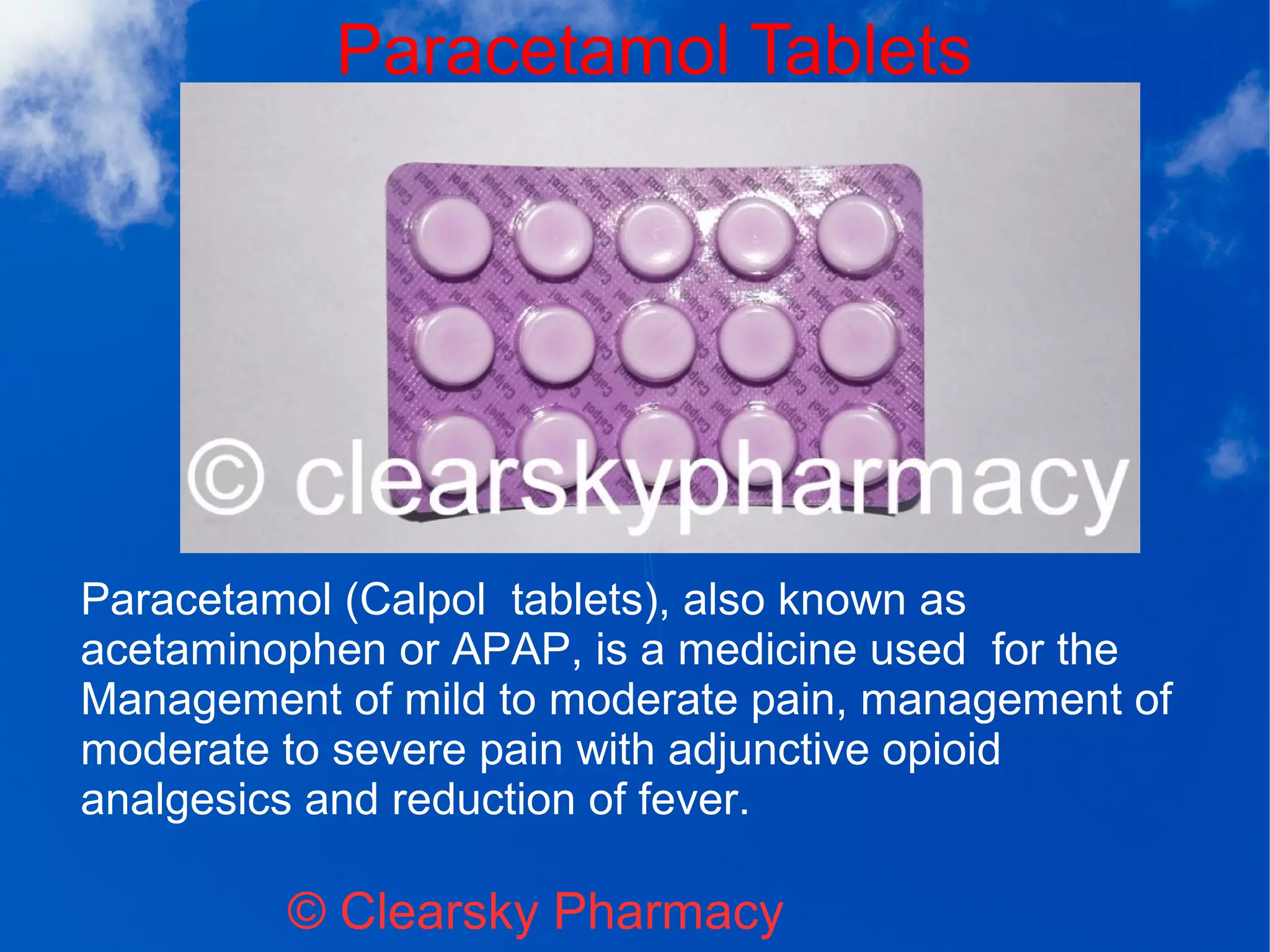
Paracetamol (Calpol tablets), also known as
acetaminophen or APAP, is a medicine used for the
Management of mild to moderate pain, management of
moderate to severe pain with adjunctive opioid
analgesics and reduction of fever.
Calpol Tablets
© Clearsky Pharmacy
Calpol Tablets, (Paracetamol /
Acetaminophen or APAP) are
manufactured by GlaxoSmithKline
Pharmaceuticals Limited, India.
(Website: www.gsk-india.com)
Paracetamol Tablets – Brand Names
© Clearsky Pharmacy
Paracetamol tablets (Acetaminophen)
are available as Calpol, Tylenol,
Crocin, Dolo, Carepar, Parasafe,
Paracip, Febrinil, Winopar, Febrex,
Doliprane, Starmol, Algina, Genmole,
and Ultragin.
Active Ingredient
© Clearsky Pharmacy
The active ingredient contained in Calpol
tablets is Paracetamol (also known as
acetaminophen or APAP) . Each Calpol
tablet contains 500 mg or 650 mg of
Paracetamol respectively.
Chemical Structure
© Clearsky Pharmacy
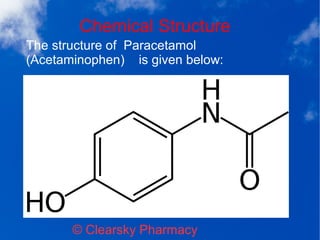
The structure of Paracetamol
(Acetaminophen) is given below:
Uses of Calpol Tablets
© Clearsky Pharmacy
Calpol tablets temporarily relieves minor
aches and pains due to: the common cold,
headache, backache, minor pain of arthritis,
toothache, muscular aches and
premenstrual and menstrual cramps. It also
temporarily reduces fever.
Calpol Dosage
© Clearsky Pharmacy
➢Adults including the elderly and children over
16 years: One to two tablets of 500 mg every
4-6 hours as required, to a maximum of 8
tablets daily in divided doses.
➢Children 10 to 15 years: One tablet of 500
mg every 4-6 hours as necessary to a
maximum of 4 doses in 24 hours.
The dosage of Calpol tablets (Paracetamol or
Acetaminophen) is given below:
Storage Instructions
© Clearsky Pharmacy
Calpol (Paracetamol tablets ) have to
be stored at controlled room temperature
i.e. from 20°C to 25°C (68°F to 77°F)
with excursions permitted between 15°
to 30°C (59° to 86°F).
Keep this as well as all other medicines
away from children and pets.
Warnings
© Clearsky Pharmacy
Administration of Paracetamol in doses higher than
recommended (by all routes of administration and from
all Acetaminophen (Paracetamol) -containing products
including combination products) may result in hepatic
injury,including the risk of liver failure and death.
Use caution when administering acetaminophen in
patients with the following conditions: hepatic
impairment or active hepatic disease, in cases of
alcoholism, chronic malnutrition, severe hypovolemia,
or severe renal impairment (creatinine clearance 30
mL/min or less).
Stop using Paracetamol immediately at the first
appearance of skin rash and if symptoms associated
with allergy or hypersensitivity occur. Do not use in
patients with Acetaminophen allergy.
Warnings
© Clearsky Pharmacy
Patients should contact their health care
provider if symptoms persist (if the pain lasts
for more than 10 days, if there is redness or
fever lasts more than 3 days).
Paracetamol provides symptomatic relief only,
additional therapy to treat the cause of the
pain or fever should be instituted when
necessary.
Keep out of reach of children.
Do not take Calopol tablets if allergic to
Paracetamol (Acetaminophen or APAP).
Calpol Tablets
© Clearsky Pharmacy
Contraindications
Calpol is contraindicated in patients with a
hypersensitivity to Paracetamol (Acetaminophen
or APAP) or any other component of this
medication.
Calpol Side Effects
© Clearsky Pharmacy
➢Side effects of Calpol (Paracetamol tablets) are rare but
hypersensitivity including skin rash may occur.
➢There have been reports of blood dyscrasias including
thrombocytopenia, neutropenia, pancytopenia, leukopenia
and agranulocytosis but these were not necessarily causality
related to Paracetamol.
➢Very rare cases of serious skin reactions have been
reported.
Calpol Overdose
© Clearsky Pharmacy
Liver damage is possible in adults who have
taken 10g or more of Paracetamol. Ingestion of
5g or more of Paracetamol may lead to liver
damage if the patient has risk factors.
The risk factors include: The patient is on long
term treatment with carbamazepine,
phenobarbital, phenytoin, primidone, rifampicin,
St John's Wort or other drugs than induce liver
enzymes or regularly consumes alcohol
(ethanol) in excess of recommended amounts or
is likely to be glutathione depleted e.g. eating
disorders, cystic fibrosis, HIV, starvation,
cachexia.
Calpol Overdose
© Clearsky Pharmacy
Symptoms of Paracetamol overdosage in the first
24 hours are pallor, nausea, vomiting, anorexia
and abdominal pain.
Liver damage may become apparent 12 to 48
hours after ingestion. Abnormalities of glucose
metabolism and metabolic acidosis may occur. In
severe poisioning, hepatic failure may progress to
encephalopathy, haemorrhage, hypoglycaemia,
cerebral oedema, and death. Acute renal failure
with acute tubular necrosis, strongly suggested
by loin pain, haematuria and proteinuria, may
develop even in the absence of severe liver
damage. Cardiac arrhythmias and pancreatitis
have also been reported in connection with
Paracetamol overdose.
Paracetamol Overdose Treatment
© Clearsky Pharmacy
Immediate treatment is essential in the
management of Paracetamol overdose. Despite a
lack of significant early symptoms, patients must
be referred to hospital urgently for immediate
medical attention.
Symptoms may be limited to nausea or vomiting
and may not reflect the severity of overdose or
the risk of organ damage. Management should be
in accordance with established treatment
guidelines.
Treatment with activated charcoal must be
considered if the overdose has been taken within
1 hour. Plasma paracetamol concentration should
be measured at 4 hours or later after ingestion,
since earlier concentrations are unreliable.
Paracetamol Overdose Treatment
© Clearsky Pharmacy
Treatment with N-acetylcysteine could be used
up to 24 hours after ingestion of Calpol tablets,
however, the maximum protective effect is
obtained up to 8 hours post-ingestion.
The effectiveness of the antidote declines sharply
after this period.
In case required the patient should be given
intravenous N-acetylcysteine, in line with the
established dosage schedule.
Management of patients who have serious
hepatic dysfunction beyond 24 hours from
ingestion should be discussed with a liver unit.
Paracetamol During Pregnancy
© Clearsky Pharmacy
Paracetamol also known as Acetaminophen
or APAP (Calpol tablets) has been classified
by the US FDA as Pregnancy Category C.
Epidemiological data on oral
Acetaminophen use in pregnant women
show no increased risk of major congenital
malformations.
However Calpol tablets should be given to a
pregnant woman only if clearly needed.
Calpol Tablets
For more details on
Calpol Tablets click here
© Clearsky Pharmacy
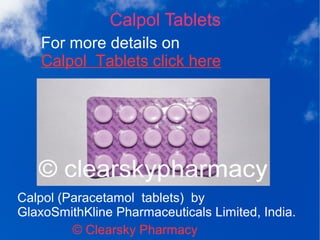
Calpol (Paracetamol tablets) by
GlaxoSmithKline Pharmaceuticals Limited, India.

Calpol (Paracetamol tablets)

  • 1.
    Paracetamol Tablets © ClearskyPharmacy Paracetamol (Calpol tablets), also known as acetaminophen or APAP, is a medicine used for the Management of mild to moderate pain, management of moderate to severe pain with adjunctive opioid analgesics and reduction of fever.
  • 2.
    Calpol Tablets © ClearskyPharmacy Calpol Tablets, (Paracetamol / Acetaminophen or APAP) are manufactured by GlaxoSmithKline Pharmaceuticals Limited, India. (Website: www.gsk-india.com)
  • 3.
    Paracetamol Tablets –Brand Names © Clearsky Pharmacy Paracetamol tablets (Acetaminophen) are available as Calpol, Tylenol, Crocin, Dolo, Carepar, Parasafe, Paracip, Febrinil, Winopar, Febrex, Doliprane, Starmol, Algina, Genmole, and Ultragin.
  • 4.
    Active Ingredient © ClearskyPharmacy The active ingredient contained in Calpol tablets is Paracetamol (also known as acetaminophen or APAP) . Each Calpol tablet contains 500 mg or 650 mg of Paracetamol respectively.
  • 5.
    Chemical Structure © ClearskyPharmacy The structure of Paracetamol (Acetaminophen) is given below:
  • 6.
    Uses of CalpolTablets © Clearsky Pharmacy Calpol tablets temporarily relieves minor aches and pains due to: the common cold, headache, backache, minor pain of arthritis, toothache, muscular aches and premenstrual and menstrual cramps. It also temporarily reduces fever.
  • 7.
    Calpol Dosage © ClearskyPharmacy ➢Adults including the elderly and children over 16 years: One to two tablets of 500 mg every 4-6 hours as required, to a maximum of 8 tablets daily in divided doses. ➢Children 10 to 15 years: One tablet of 500 mg every 4-6 hours as necessary to a maximum of 4 doses in 24 hours. The dosage of Calpol tablets (Paracetamol or Acetaminophen) is given below:
  • 8.
    Storage Instructions © ClearskyPharmacy Calpol (Paracetamol tablets ) have to be stored at controlled room temperature i.e. from 20°C to 25°C (68°F to 77°F) with excursions permitted between 15° to 30°C (59° to 86°F). Keep this as well as all other medicines away from children and pets.
  • 9.
    Warnings © Clearsky Pharmacy Administrationof Paracetamol in doses higher than recommended (by all routes of administration and from all Acetaminophen (Paracetamol) -containing products including combination products) may result in hepatic injury,including the risk of liver failure and death. Use caution when administering acetaminophen in patients with the following conditions: hepatic impairment or active hepatic disease, in cases of alcoholism, chronic malnutrition, severe hypovolemia, or severe renal impairment (creatinine clearance 30 mL/min or less). Stop using Paracetamol immediately at the first appearance of skin rash and if symptoms associated with allergy or hypersensitivity occur. Do not use in patients with Acetaminophen allergy.
  • 10.
    Warnings © Clearsky Pharmacy Patientsshould contact their health care provider if symptoms persist (if the pain lasts for more than 10 days, if there is redness or fever lasts more than 3 days). Paracetamol provides symptomatic relief only, additional therapy to treat the cause of the pain or fever should be instituted when necessary. Keep out of reach of children. Do not take Calopol tablets if allergic to Paracetamol (Acetaminophen or APAP).
  • 11.
    Calpol Tablets © ClearskyPharmacy Contraindications Calpol is contraindicated in patients with a hypersensitivity to Paracetamol (Acetaminophen or APAP) or any other component of this medication.
  • 12.
    Calpol Side Effects ©Clearsky Pharmacy ➢Side effects of Calpol (Paracetamol tablets) are rare but hypersensitivity including skin rash may occur. ➢There have been reports of blood dyscrasias including thrombocytopenia, neutropenia, pancytopenia, leukopenia and agranulocytosis but these were not necessarily causality related to Paracetamol. ➢Very rare cases of serious skin reactions have been reported.
  • 13.
    Calpol Overdose © ClearskyPharmacy Liver damage is possible in adults who have taken 10g or more of Paracetamol. Ingestion of 5g or more of Paracetamol may lead to liver damage if the patient has risk factors. The risk factors include: The patient is on long term treatment with carbamazepine, phenobarbital, phenytoin, primidone, rifampicin, St John's Wort or other drugs than induce liver enzymes or regularly consumes alcohol (ethanol) in excess of recommended amounts or is likely to be glutathione depleted e.g. eating disorders, cystic fibrosis, HIV, starvation, cachexia.
  • 14.
    Calpol Overdose © ClearskyPharmacy Symptoms of Paracetamol overdosage in the first 24 hours are pallor, nausea, vomiting, anorexia and abdominal pain. Liver damage may become apparent 12 to 48 hours after ingestion. Abnormalities of glucose metabolism and metabolic acidosis may occur. In severe poisioning, hepatic failure may progress to encephalopathy, haemorrhage, hypoglycaemia, cerebral oedema, and death. Acute renal failure with acute tubular necrosis, strongly suggested by loin pain, haematuria and proteinuria, may develop even in the absence of severe liver damage. Cardiac arrhythmias and pancreatitis have also been reported in connection with Paracetamol overdose.
  • 15.
    Paracetamol Overdose Treatment ©Clearsky Pharmacy Immediate treatment is essential in the management of Paracetamol overdose. Despite a lack of significant early symptoms, patients must be referred to hospital urgently for immediate medical attention. Symptoms may be limited to nausea or vomiting and may not reflect the severity of overdose or the risk of organ damage. Management should be in accordance with established treatment guidelines. Treatment with activated charcoal must be considered if the overdose has been taken within 1 hour. Plasma paracetamol concentration should be measured at 4 hours or later after ingestion, since earlier concentrations are unreliable.
  • 16.
    Paracetamol Overdose Treatment ©Clearsky Pharmacy Treatment with N-acetylcysteine could be used up to 24 hours after ingestion of Calpol tablets, however, the maximum protective effect is obtained up to 8 hours post-ingestion. The effectiveness of the antidote declines sharply after this period. In case required the patient should be given intravenous N-acetylcysteine, in line with the established dosage schedule. Management of patients who have serious hepatic dysfunction beyond 24 hours from ingestion should be discussed with a liver unit.
  • 17.
    Paracetamol During Pregnancy ©Clearsky Pharmacy Paracetamol also known as Acetaminophen or APAP (Calpol tablets) has been classified by the US FDA as Pregnancy Category C. Epidemiological data on oral Acetaminophen use in pregnant women show no increased risk of major congenital malformations. However Calpol tablets should be given to a pregnant woman only if clearly needed.
  • 18.
    Calpol Tablets For moredetails on Calpol Tablets click here © Clearsky Pharmacy Calpol (Paracetamol tablets) by GlaxoSmithKline Pharmaceuticals Limited, India.