PARACETAMOL ( ACETAMINIOPHAN )
POISONING
8/27/2018 1
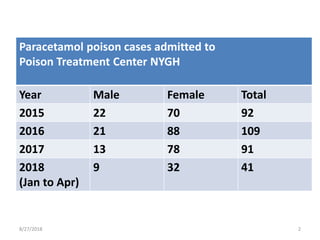
Paracetamol poison cases admitted to
Poison Treatment Center NYGH
Year Male Female Total
2015 22 70 92
2016 21 88 109
2017 13 78 91
2018
(Jan to Apr)
9 32 41
8/27/2018 2
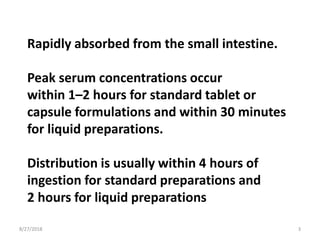
Rapidly absorbed from the small intestine.
Peak serum concentrations occur
within 1–2 hours for standard tablet or
capsule formulations and within 30 minutes
for liquid preparations.
Distribution is usually within 4 hours of
ingestion for standard preparations and
2 hours for liquid preparations
8/27/2018 3
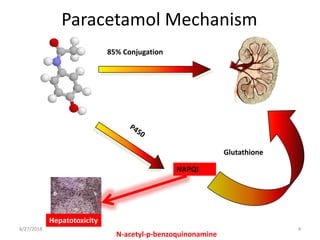
85% Conjugation
NAPQI
Glutathione
Paracetamol Mechanism
N-acetyl-p-benzoquinonamine
Hepatotoxicity
8/27/2018 4
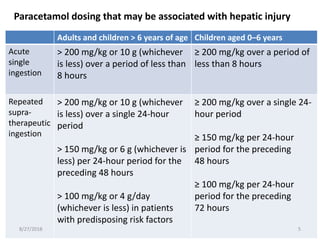
Adults and children > 6 years of age Children aged 0–6 years
Acute
single
ingestion
> 200 mg/kg or 10 g (whichever
is less) over a period of less than
8 hours
≥ 200 mg/kg over a period of
less than 8 hours
Repeated
supra-
therapeutic
ingestion
> 200 mg/kg or 10 g (whichever
is less) over a single 24-hour
period
> 150 mg/kg or 6 g (whichever is
less) per 24-hour period for the
preceding 48 hours
> 100 mg/kg or 4 g/day
(whichever is less) in patients
with predisposing risk factors
≥ 200 mg/kg over a single 24-
hour period
≥ 150 mg/kg per 24-hour
period for the preceding
48 hours
≥ 100 mg/kg per 24-hour
period for the preceding
72 hours
Paracetamol dosing that may be associated with hepatic injury
8/27/2018 5
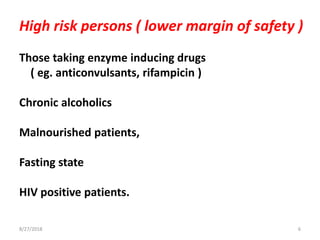
High risk persons ( lower margin of safety )
Those taking enzyme inducing drugs
( eg. anticonvulsants, rifampicin )
Chronic alcoholics
Malnourished patients,
Fasting state
HIV positive patients.
8/27/2018 6
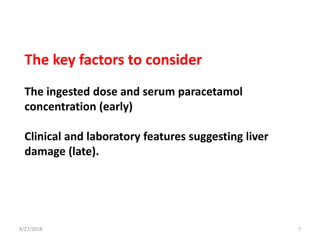
The key factors to consider
The ingested dose and serum paracetamol
concentration (early)
Clinical and laboratory features suggesting liver
damage (late).
8/27/2018 7
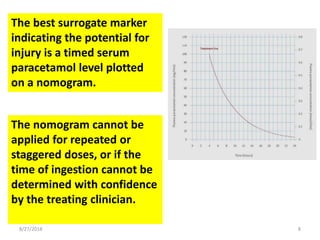
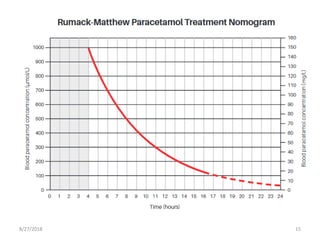
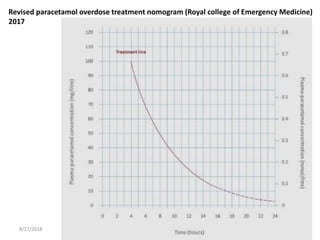
The best surrogate marker
indicating the potential for
injury is a timed serum
paracetamol level plotted
on a nomogram.
8/27/2018 8
The nomogram cannot be
applied for repeated or
staggered doses, or if the
time of ingestion cannot be
determined with confidence
by the treating clinician.
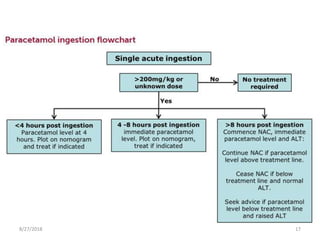
The most important risk factor for liver
damage and death after acute paracetamol
ingestion is the extent of delay beyond 8 hours
until treatment with NAC commences.
8/27/2018 9
First phase
Begins within hours of overdose, and consists of nausea,
vomiting, a pale appearance, and sweating.
Usually no symptoms other than nausea and vomiting.
8/27/2018 10
Second phase
Occurs between 24 h and 72 h
Right upper quadrant tenderness may begin to
develop after this time with raised ALT/AST
Acute renal failure occurs occasionally.
Clinical Features
8/27/2018 11
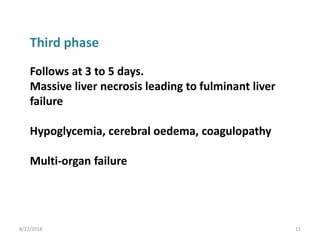
Third phase
Follows at 3 to 5 days.
Massive liver necrosis leading to fulminant liver
failure
Hypoglycemia, cerebral oedema, coagulopathy
Multi-organ failure
8/27/2018 12
The severity of paracetamol toxicity varies
depending on the dose and whether
appropriate treatment is received.
Despite a lack of significant symptoms,
patients should be referred to hospital.
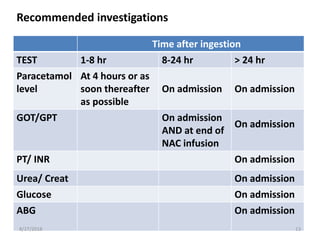
Time after ingestion
TEST 1-8 hr 8-24 hr > 24 hr
Paracetamol
level
At 4 hours or as
soon thereafter
as possible
On admission On admission
GOT/GPT On admission
AND at end of
NAC infusion
On admission
PT/ INR On admission
Urea/ Creat On admission
Glucose On admission
ABG On admission
Recommended investigations
8/27/2018 13
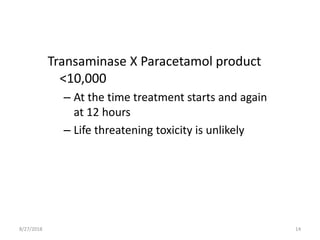
Transaminase X Paracetamol product
<10,000
– At the time treatment starts and again
at 12 hours
– Life threatening toxicity is unlikely
8/27/2018 14
8/27/2018 15
8/27/2018 16
Revised paracetamol overdose treatment nomogram (Royal college of Emergency Medicine)
2017
8/27/2018 17
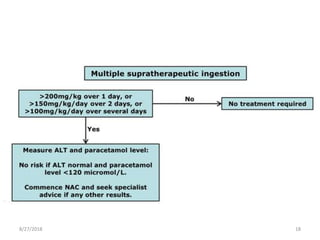
8/27/2018 18
8/27/2018 19
NAC 20%
200mg/ml
30ml= 6 Grams
NAC 20%
200mg/ml
5ml= 1 Gram
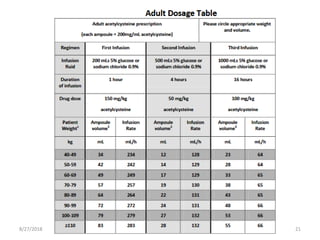
Three-stage N-acetylcysteine infusion
Initial
infusion
150 mg/kg of NAC diluted in 200 mL of 5%
glucose and infused over 60 minutes
Second
infusion
Followed by a continuous infusion of
50 mg/kg of NAC in 500 mL of 5% glucose
over the next 4 hours
Third
infusion
followed by a continuous infusion of
100 mg/kg of NAC in 1000 mL of 5%
glucose over the next 16 hours
8/27/2018 20
8/27/2018 21
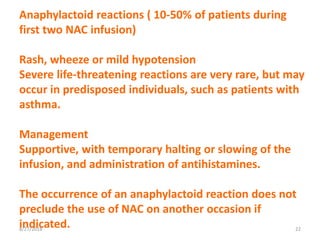
Anaphylactoid reactions ( 10-50% of patients during
first two NAC infusion)
Rash, wheeze or mild hypotension
Severe life-threatening reactions are very rare, but may
occur in predisposed individuals, such as patients with
asthma.
Management
Supportive, with temporary halting or slowing of the
infusion, and administration of antihistamines.
The occurrence of an anaphylactoid reaction does not
preclude the use of NAC on another occasion if
indicated.8/27/2018 22
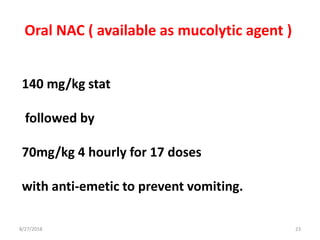
140 mg/kg stat
followed by
70mg/kg 4 hourly for 17 doses
with anti-emetic to prevent vomiting.
8/27/2018 23
Oral NAC ( available as mucolytic agent )
The 2006 Cochrane review of several case series concluded there was no clear
difference in efficacy (in terms of hepatoxicity and mortality rates) between
intravenous and oral routes.
Oral NAC has been used for 30 years in the USA with similar efficacy and safety
Oral and Intravenous Acetylcysteine for Treatment of
Acetaminophen Toxicity:
A Systematic Review and Meta-analysis
(Green JL et. al. West J Emerg Med. 2013 May; 14(3): 218–226)
5164 patients in 16 articles
The overall rate of hepatotoxicity for the oral and IV routes were
12.6% and 13.2%, respectively.
8/27/2018 24
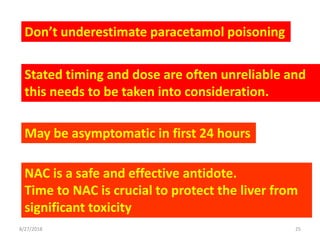
Don’t underestimate paracetamol poisoning
Stated timing and dose are often unreliable and
this needs to be taken into consideration.
NAC is a safe and effective antidote.
Time to NAC is crucial to protect the liver from
significant toxicity
May be asymptomatic in first 24 hours
8/27/2018 25
8/27/2018 26

Prof dr myo lwin nyein

  • 1.
    PARACETAMOL ( ACETAMINIOPHAN) POISONING 8/27/2018 1
  • 2.
    Paracetamol poison casesadmitted to Poison Treatment Center NYGH Year Male Female Total 2015 22 70 92 2016 21 88 109 2017 13 78 91 2018 (Jan to Apr) 9 32 41 8/27/2018 2
  • 3.
    Rapidly absorbed fromthe small intestine. Peak serum concentrations occur within 1–2 hours for standard tablet or capsule formulations and within 30 minutes for liquid preparations. Distribution is usually within 4 hours of ingestion for standard preparations and 2 hours for liquid preparations 8/27/2018 3
  • 4.
  • 5.
    Adults and children> 6 years of age Children aged 0–6 years Acute single ingestion > 200 mg/kg or 10 g (whichever is less) over a period of less than 8 hours ≥ 200 mg/kg over a period of less than 8 hours Repeated supra- therapeutic ingestion > 200 mg/kg or 10 g (whichever is less) over a single 24-hour period > 150 mg/kg or 6 g (whichever is less) per 24-hour period for the preceding 48 hours > 100 mg/kg or 4 g/day (whichever is less) in patients with predisposing risk factors ≥ 200 mg/kg over a single 24- hour period ≥ 150 mg/kg per 24-hour period for the preceding 48 hours ≥ 100 mg/kg per 24-hour period for the preceding 72 hours Paracetamol dosing that may be associated with hepatic injury 8/27/2018 5
  • 6.
    High risk persons( lower margin of safety ) Those taking enzyme inducing drugs ( eg. anticonvulsants, rifampicin ) Chronic alcoholics Malnourished patients, Fasting state HIV positive patients. 8/27/2018 6
  • 7.
    The key factorsto consider The ingested dose and serum paracetamol concentration (early) Clinical and laboratory features suggesting liver damage (late). 8/27/2018 7
  • 8.
    The best surrogatemarker indicating the potential for injury is a timed serum paracetamol level plotted on a nomogram. 8/27/2018 8 The nomogram cannot be applied for repeated or staggered doses, or if the time of ingestion cannot be determined with confidence by the treating clinician.
  • 9.
    The most importantrisk factor for liver damage and death after acute paracetamol ingestion is the extent of delay beyond 8 hours until treatment with NAC commences. 8/27/2018 9
  • 10.
    First phase Begins withinhours of overdose, and consists of nausea, vomiting, a pale appearance, and sweating. Usually no symptoms other than nausea and vomiting. 8/27/2018 10 Second phase Occurs between 24 h and 72 h Right upper quadrant tenderness may begin to develop after this time with raised ALT/AST Acute renal failure occurs occasionally. Clinical Features
  • 11.
    8/27/2018 11 Third phase Followsat 3 to 5 days. Massive liver necrosis leading to fulminant liver failure Hypoglycemia, cerebral oedema, coagulopathy Multi-organ failure
  • 12.
    8/27/2018 12 The severityof paracetamol toxicity varies depending on the dose and whether appropriate treatment is received. Despite a lack of significant symptoms, patients should be referred to hospital.
  • 13.
    Time after ingestion TEST1-8 hr 8-24 hr > 24 hr Paracetamol level At 4 hours or as soon thereafter as possible On admission On admission GOT/GPT On admission AND at end of NAC infusion On admission PT/ INR On admission Urea/ Creat On admission Glucose On admission ABG On admission Recommended investigations 8/27/2018 13
  • 14.
    Transaminase X Paracetamolproduct <10,000 – At the time treatment starts and again at 12 hours – Life threatening toxicity is unlikely 8/27/2018 14
  • 15.
  • 16.
    8/27/2018 16 Revised paracetamoloverdose treatment nomogram (Royal college of Emergency Medicine) 2017
  • 17.
  • 18.
  • 19.
    8/27/2018 19 NAC 20% 200mg/ml 30ml=6 Grams NAC 20% 200mg/ml 5ml= 1 Gram
  • 20.
    Three-stage N-acetylcysteine infusion Initial infusion 150mg/kg of NAC diluted in 200 mL of 5% glucose and infused over 60 minutes Second infusion Followed by a continuous infusion of 50 mg/kg of NAC in 500 mL of 5% glucose over the next 4 hours Third infusion followed by a continuous infusion of 100 mg/kg of NAC in 1000 mL of 5% glucose over the next 16 hours 8/27/2018 20
  • 21.
  • 22.
    Anaphylactoid reactions (10-50% of patients during first two NAC infusion) Rash, wheeze or mild hypotension Severe life-threatening reactions are very rare, but may occur in predisposed individuals, such as patients with asthma. Management Supportive, with temporary halting or slowing of the infusion, and administration of antihistamines. The occurrence of an anaphylactoid reaction does not preclude the use of NAC on another occasion if indicated.8/27/2018 22
  • 23.
    140 mg/kg stat followedby 70mg/kg 4 hourly for 17 doses with anti-emetic to prevent vomiting. 8/27/2018 23 Oral NAC ( available as mucolytic agent )
  • 24.
    The 2006 Cochranereview of several case series concluded there was no clear difference in efficacy (in terms of hepatoxicity and mortality rates) between intravenous and oral routes. Oral NAC has been used for 30 years in the USA with similar efficacy and safety Oral and Intravenous Acetylcysteine for Treatment of Acetaminophen Toxicity: A Systematic Review and Meta-analysis (Green JL et. al. West J Emerg Med. 2013 May; 14(3): 218–226) 5164 patients in 16 articles The overall rate of hepatotoxicity for the oral and IV routes were 12.6% and 13.2%, respectively. 8/27/2018 24
  • 25.
    Don’t underestimate paracetamolpoisoning Stated timing and dose are often unreliable and this needs to be taken into consideration. NAC is a safe and effective antidote. Time to NAC is crucial to protect the liver from significant toxicity May be asymptomatic in first 24 hours 8/27/2018 25
  • 26.